Disclosure: airfryerkitchensupply.com is reader-supported. When you buy through links on our site, we may earn an affiliate commission at no extra cost to you.
Where to buy
Shopping for the best 12 volt fillet knife? Start here. Every knife below is a 12 volt electric fillet knife verified during our research and sold on Amazon under the name shown — use this box to check price on Amazon for each pick. A note on what ’12 volt’ means in this category today: the classic corded knives that plugged into a boat’s 12 volt socket have largely been replaced by cordless knives running on 12 volt rechargeable battery packs, and that is what the current market — and this roundup — reflects.
- WORKPRO 12V Cordless Electric Fillet Knife (8″ & 10″ Blades) — check price on Amazon
- FLISSA 12V Cordless Electric Fillet Knife (8″ & 10″) — check price on Amazon
- EARTHCRAFT 12V Cordless Electric Fillet Knife (6″, 8″ & 10″ Blades) — check price on Amazon
- KOMASTY 12V Cordless Electric Fillet Knife (8″/9″/10″ Blades) — check price on Amazon
- KITLUCK 12V Cordless Electric Fillet Knife with LED Light — check price on Amazon
- TaskStar 12V Cordless Electric Fillet Knife Kit (4 Blades + Tools) — check price on Amazon
The best 12 volt fillet knife is the one still gliding through the last fish of the day as cleanly as the first. Electric fillet knives earn their place at the cleaning station with reciprocating blades that do the sawing for you: instead of working a manual blade back and forth through rib bones and skin, you steer, and the knife works. After a cooler full of walleye, perch, crappie or redfish, that difference is measured in time, in yield, and in how your hands feel at the end of it.
The honest state of this niche is that it has changed its power source. A generation ago, a ’12 volt fillet knife’ meant a corded knife clipped to the boat battery or plugged into a lighter socket, and a few heritage corded models — Rapala’s long-running electric fillet range is the famous example — are still sold for dockside use on mains power. Today’s mainstream, though, is the 12 volt cordless platform: a rechargeable battery pack of the same voltage class as the old socket, giving you the same freedom from the wall with no cord to drag through the fish slime. Every pick in this roundup is one of these modern 12 volt cordless knives, verified as currently sold, with the blades, batteries and cases itemised from their listings.
There is a safety dimension to say out loud before the picks: a reciprocating blade and wet, slimy hands demand respect and design. Every kit here includes a non-slip grip and a safety lock, and those two features matter more than any specification on the box. Pair them with a cut-resistant glove on your holding hand and the electric knife is a controlled tool; without them, no blade length or battery count would make it a wise purchase.
What separates the good ones is not raw speed but control and completeness: a grip that stays secure in wet hands, a safety lock that prevents an accident in the tackle bag, blades in the lengths your fish actually need — shorter and flexible for panfish, longer and stiffer for big fillets — and two batteries, so the second pack is charged when the first fades halfway through the cooler.
In this guide
Quick Picks
WORKPRO 12V Cordless Electric Fillet Knife (8″ & 10″ Blades) — Best Overall
The complete, balanced kit: 8 and 10 inch blades cover panfish through large fillets, two rechargeable batteries and a quick charger keep it working, and the non-slip grip and safety lock are designed for wet hands. WORKPRO’s tool-making pedigree shows in the details. Check on Amazon
FLISSA 12V Cordless Electric Fillet Knife (8″ & 10″) — Best Value
The same essential formula as the premium kits — 8 and 10 inch stainless blades, two lithium-ion batteries, a portable carry case — at a value tier. For anglers who fillet a few trips a month, it covers the whole job for less. Check on Amazon
EARTHCRAFT 12V Cordless Electric Fillet Knife (6″, 8″ & 10″ Blades) — Best Blade Range
Three blades with intent: a 6 inch stiff for small fish and detail work, an 8 inch flex that rides rib cages beautifully, and a 10 inch stiff for big fillets — in carbon stainless steel, with two batteries and an ergonomic non-slip grip. Check on Amazon
KOMASTY 12V Cordless Electric Fillet Knife (8″/9″/10″ Blades) — Best for Large Fish
A big-fish blade set — 8, 9 and 10 inch blades, no short panfish blade at all — with two rechargeable batteries, a safety lock and a carry case. If your cooler holds salmon, catfish, redfish or walleye at the top of the range, this kit is aimed at you. Check on Amazon
KITLUCK 12V Cordless Electric Fillet Knife with LED Light — Best for Low Light
Three stiff blades in 6, 8 and 10 inches, two battery packs — and an LED light built into the knife. Night cleaning stations, dim docks and early launches are its home ground, and the light turns out to be more useful than it sounds. Check on Amazon
TaskStar 12V Cordless Electric Fillet Knife Kit (4 Blades + Tools) — Best Complete Kit
Four stainless steel blades plus the tools kits usually forget — a fish scaler and fin shears — with a safety lock and non-slip grip. The most complete cleaning-station-in-a-box here, for anglers who scale and trim as well as fillet. Check on Amazon
How These Picks Were Chosen
We filtered for electric fillet knives whose listings specify a 12 volt platform, then confirmed each model through the site’s Creators API product verification on Amazon — every ASIN and API title is recorded in the sources file that accompanies this article. Corded-only mains knives were left out of the picks because they cannot do the boat-and-bank work this keyword is about, however good they are at a dock with an outlet.
Within the shortlist we weighed blade selection (the range of lengths and flex in the box), battery provision (two packs is the professional pattern), grip and safety design for wet hands, and the completeness of the kit — a carry case is not a luxury when the tool lives in a boat. We favoured kits that let an angler fillet everything from panfish to saltwater species without buying accessories on day one.
The 6 Best 12 Volt Fillet Knife Picks — Full Reviews

WORKPRO 12V Cordless Electric Fillet Knife (8″ & 10″ Blades) — Best Overall
The WORKPRO kit is what a 12 volt fillet knife outfit looks like when a tool company designs it. The two blade sizes — 8 inch for everyday fish, 10 inch for the big end of the cooler — cover the realistic range without forcing you to buy the second blade separately, and the pair of rechargeable batteries with a quick charger follows the cordless-tool pattern anglers already know from their drills: one pack working, one pack ready, no mid-cooler funeral for the last fish.
The handling details are the ones that matter at a wet cleaning board. A non-slip grip is not a marketing phrase here; it is the difference between steering the blade and chasing it. The safety lock prevents the knife waking up in a bag or drawer, which anyone who has heard a reciprocating blade buzzing inside a tackle box will appreciate in their bones. And the carry case keeps blades, batteries and charger as one kit that lives in the boat, ready, instead of as parts scattered across three cupboards.
Strengths
- Complete kit: two blade sizes, two batteries, charger, case
- Non-slip grip and safety lock for wet-hand work
- From an established tool brand with a support network
Trade-offs
- No short 6-7 inch panfish blade in the box
- Cordless platform means batteries to manage and charge
- Heavier than a manual knife for backpack-style fishing
| Power | 12V cordless, 2 rechargeable batteries (per API listing title) |
| Blades | 8″ and 10″ (per API listing title) |
| Kit | Quick charger and carry case included (per API listing title) |
If you fillet regularly and want one kit that simply handles it, this is the pick. It asks nothing of you but charged batteries and a cutting board, and it will still be the right answer when the day’s catch runs from crappie to catfish.
Best for: regular anglers wanting one complete, quality 12V fillet kit / Not suited for: ultralight bank anglers who fillet one fish a month
Check on Amazon — check the current price on Amazon before you buy, because listings, bundles and included accessories change over time.
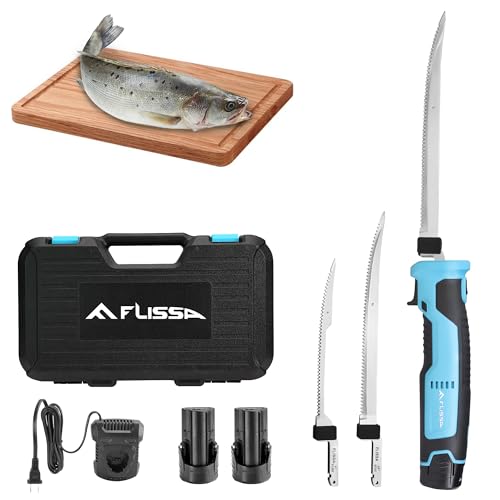
FLISSA 12V Cordless Electric Fillet Knife (8″ & 10″) — Best Value
The FLISSA kit demonstrates how far the value end of this category has come. Stainless steel blades in the two most useful sizes, two lithium-ion battery packs described as long lasting, a non-slip handle and a carry case: that is the full working pattern of the category, at a price tier that makes the electric upgrade easy to justify even for anglers who only fill a cooler a handful of times a season.
Where the savings live is in the refinements — the case is simpler, the fit and finish a step below the tool-brand kits, and the brand’s support network is thinner. None of that changes a fillet. For the occasional-to-regular angler, the FLISSA is the rational buy: the money saved against the premium kits buys a lot of bait, and the fish cannot tell which badge was on the knife.
Strengths
- Full two-battery, two-blade kit at a value tier
- Stainless steel blades in the two key sizes
- Carry case included for boat storage
Trade-offs
- Fit, finish and support trail the tool brands
- No smaller panfish blade included
- Battery longevity claims are the maker’s own
| Power | 12V cordless, 2 lithium-ion batteries (per API listing title) |
| Blades | 8″ and 10″ stainless steel (per API listing title) |
| Kit | Portable carry case (per API listing title) |
Value picks earn their badge by covering the whole job, not most of it, and the FLISSA covers it. Buy it, charge both packs before the trip, and spend the difference on the water.
Best for: occasional-to-regular anglers wanting the full kit for less / Not suited for: daily guides who will wear out value-tier gear
Check on Amazon — check the current price on Amazon before you buy, because listings, bundles and included accessories change over time.

EARTHCRAFT 12V Cordless Electric Fillet Knife (6″, 8″ & 10″ Blades) — Best Blade Range
Most kits give you two blades and call it range. The EARTHCRAFT gives you three, and — this is the part that shows someone thought about fish — it varies the flex as well as the length. The 8 inch flex blade is the connoisseur’s choice for the classic filleting stroke, bending just enough to follow the rib cage and lift the fillet cleanly off the frame. The stiff 6 and 10 inch blades bookend it: the short one for panfish and precision, the long one for powering through the big end of the size range.
Carbon stainless steel is the blade material traditionalists prefer for an edge that takes a keen finish, and the two-battery provision matches the rest of the serious kits here. If your catch genuinely spans species and sizes — a mixed cooler is your normal day — this is the kit built for your cleaning board, because blade choice is the variable that decides yield, and this box offers the most of it.
Strengths
- Three blades with varied flex — the widest range here
- Flex blade option for clean rib-cage work
- Two batteries and ergonomic non-slip grip
Trade-offs
- More blades to clean, store and keep track of
- Carbon stainless wants drying after use to stay pristine
- Lesser-known brand
| Power | 12V cordless, 2 batteries (per API listing title) |
| Blades | 6″ stiff, 8″ flex, 10″ stiff, carbon stainless steel (per API listing title) |
| Grip | Ergonomic non-slip (per API listing title) |
Yield is money and meals: a fillet left on the frame is both wasted. The angler who cleans mixed species will feel the EARTHCRAFT’s blade range in the cooler at the end of the day, which is the most honest metric this category has.
Best for: anglers cleaning mixed species who value blade choice / Not suited for: single-species anglers who only ever need one blade
Check on Amazon — check the current price on Amazon before you buy, because listings, bundles and included accessories change over time.
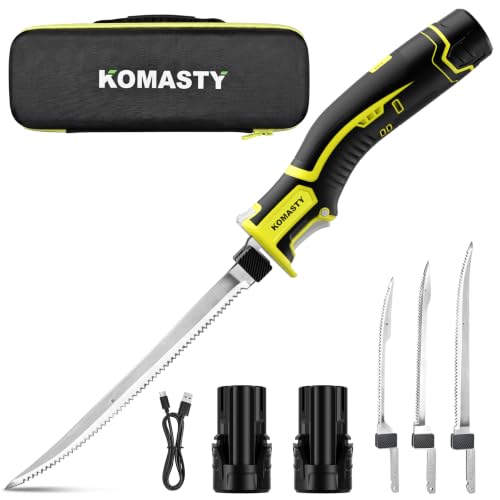
KOMASTY 12V Cordless Electric Fillet Knife (8″/9″/10″ Blades) — Best for Large Fish
The KOMASTY’s blade selection tells you its intentions before you read another word: 8, 9 and 10 inches is a large-fish set. Long blades matter on big fillets because the stroke stays smooth — a blade that spans the fillet lets the reciprocating action do long, even work instead of sawing at the limit of a short blade’s travel. For salmon, big catfish, redfish, striper and the larger walleye, that length is not vanity; it is yield and clean skinning.
The rest of the kit follows the serious pattern: two rechargeable batteries so a long cleaning session does not end on a fading pack, a safety lock for transport, a non-slip grip for the moment a big fish’s slime gets everywhere, and a carry case to keep it one grabbable unit. Panfish specialists should look elsewhere in this roundup — there is deliberately no little blade here — but for the big-fish angler, that focus is the point.
Strengths
- Three long blades sized for large fillets
- Two batteries for long cleaning sessions
- Safety lock and non-slip grip included
Trade-offs
- No short blade for panfish and detail work
- Long blades are clumsy on small fish
- Lesser-known brand support
| Power | 12V cordless, 2 rechargeable batteries (per API listing title) |
| Blades | 8″, 9″ and 10″ (per API listing title) |
| Kit | Charger cable and carry case (per API listing title) |
Match the blade to the fish and electric filleting feels effortless; mismatch it and you fight every stroke. If your typical fish needs two hands to lift, the KOMASTY is the kit that was specced for your board.
Best for: salmon, catfish, redfish and other large-fish anglers / Not suited for: panfish and small-species specialists
Check on Amazon — check the current price on Amazon before you buy, because listings, bundles and included accessories change over time.

KITLUCK 12V Cordless Electric Fillet Knife with LED Light — Best for Low Light
Every angler knows the scene: the best fishing ended at dusk, and the cleaning happens under a dock light that is somehow always behind you, so the fish is lit and the cutting line is in shadow. The KITLUCK’s built-in LED light is aimed at exactly that moment. It sounds like a gimmick until the first night you fillet by it and realise you can see the rib line, the blood line and the blade’s path the way you can at noon.
The rest of the kit is complete and conventional in the best way: three stiff blades spanning 6 to 10 inches, two rechargeable battery packs and a charger. Stiff blades across the range suit anglers who prefer a blade that tracks straight through skinning and steaking work. As a second knife for the night shift — or a primary knife for the evening angler — it occupies a niche none of the other picks contest.
Strengths
- Built-in LED light for night and dock cleaning
- Three stiff blades from 6 to 10 inches
- Two battery packs included
Trade-offs
- All-stiff blade set — no flex option for rib work
- The light is one more thing drawing on the battery
- Lesser-known brand
| Power | 12V cordless, 2 battery packs (per API listing title) |
| Blades | 6″, 8″ and 10″ stiff (per API listing title) |
| Feature | Built-in LED light (per API listing title) |
Judge it by the hour you clean fish, not the hour you catch them. If your filleting happens after dark — and for working anglers it very often does — the KITLUCK earns its place on the board.
Best for: evening and night anglers, dim cleaning stations / Not suited for: anglers who only ever fillet in full daylight
Check on Amazon — check the current price on Amazon before you buy, because listings, bundles and included accessories change over time.

TaskStar 12V Cordless Electric Fillet Knife Kit (4 Blades + Tools) — Best Complete Kit
Filleting is only part of processing a fish, and the TaskStar kit is the only one here that admits it. Alongside four stainless steel blades it includes a fish scaler and fin shears — the tools for the species you scale before cooking whole, the fins you trim before the pan, the jobs that otherwise send you hunting through a drawer mid-session. As a one-box cleaning station, nothing else in the roundup is as complete.
The knife itself follows the category’s safety pattern — non-slip grip, safety lock — on a 12 volt rechargeable platform. Four blades is the widest count here, giving length options for everything from panfish to the big end. For a new boat being equipped from scratch, or a gift for an angler setting up their first proper cleaning station, the TaskStar’s completeness is a genuinely practical advantage rather than a longer bullet list.
Strengths
- Four blades plus scaler and fin shears — the fullest kit
- Safety lock and non-slip grip
- One box equips a complete cleaning station
Trade-offs
- More pieces to wash and keep together
- Lesser-known brand; long-term support unproven
- Occasional anglers may never use the extras
| Power | 12V rechargeable (per API listing title) |
| Blades | 4 stainless steel blades (per API listing title) |
| Extras | Fish scaler and fin shears included (per API listing title) |
Completeness is a real virtue at a cleaning station, where the missing tool is always the one the fish in front of you needs. The TaskStar is the kit for the angler who processes fish properly, all the way, and wants the box to prove it.
Best for: anglers who scale, trim and fillet — and new cleaning stations / Not suited for: minimalists who fillet skin-on species only
Check on Amazon — check the current price on Amazon before you buy, because listings, bundles and included accessories change over time.
Comparison Table
| Pick | Badge | Key spec | Best for |
|---|---|---|---|
| WORKPRO 12V Cordless Electric Fillet Knife (8″ & 10″ Blades) | Best Overall | 12V cordless, 8″ & 10″ blades, 2 batteries, charger and carry case | regular anglers wanting one complete, quality 12V fillet kit |
| FLISSA 12V Cordless Electric Fillet Knife (8″ & 10″) | Best Value | 12V cordless, stainless 8″ & 10″ blades, 2 lithium-ion batteries, case | occasional-to-regular anglers wanting the full kit for less |
| EARTHCRAFT 12V Cordless Electric Fillet Knife (6″, 8″ & 10″ Blades) | Best Blade Range | 12V cordless, 6″ stiff / 8″ flex / 10″ stiff carbon stainless blades, 2 batteries | anglers cleaning mixed species who value blade choice |
| KOMASTY 12V Cordless Electric Fillet Knife (8″/9″/10″ Blades) | Best for Large Fish | 12V cordless, 8″/9″/10″ blades, 2 batteries, carry case | salmon, catfish, redfish and other large-fish anglers |
| KITLUCK 12V Cordless Electric Fillet Knife with LED Light | Best for Low Light | 12V cordless, 6″/8″/10″ stiff blades, LED light, 2 battery packs | evening and night anglers, dim cleaning stations |
| TaskStar 12V Cordless Electric Fillet Knife Kit (4 Blades + Tools) | Best Complete Kit | 12V rechargeable, 4 stainless blades, scaler and fin shears included | anglers who scale, trim and fillet — and new cleaning stations |
How do you choose the right blade length and flex?
Blade choice is where electric filleting is won. The working rule is to match blade length to the depth of the fish: the blade should span the fillet so the stroke stays long and even. Panfish and small trout are 6-7 inch work; the great middle of freshwater and inshore species — walleye, bass, crappie at size, sea trout — lives on 8-9 inch blades; salmon, catfish, redfish and striper want 9-10 inches. A kit with two or three sizes, like most of these picks, covers a mixed cooler without compromise.
Flex is the subtler half. A flex blade bends to follow the rib cage during the classic fillet stroke, lifting meat cleanly and improving yield on round fish. A stiff blade tracks straighter for skinning, steaking and work where the blade must not wander. Anglers who do one kind of work should weight their kit accordingly — the EARTHCRAFT’s mixed set is the hedge for everyone else.
How many batteries do you need?
Two. That is the whole answer, and every serious kit in this roundup provides them. A single pack will fillet a modest catch happily, but the day the cooler is full, the fish are big and the pack fades at fish nine of fourteen, you will learn why the two-battery pattern exists. Rotation is the discipline: charge both packs before the trip, swap at the first sign of fading rather than nursing a dying pack through the last fish, and recharge the same evening so the kit is always ready to grab.
Battery care follows the usual lithium rules: store packs partly charged rather than brim-full or flat, keep them dry, and never leave them cooking in a hot vehicle all summer. Treat the packs well and they will outlast several seasons of cleaning stations.
How do you fillet with an electric knife, cleanly and safely?
The technique differs from manual filleting in one essential way: let the blade work. The reciprocating action replaces your sawing arm, so your job is pressure and steering — light, steady pressure, long strokes, and the patience to let the teeth do the cutting. Forcing an electric blade tears flesh and dulls edges; floating it along the bone produces the glassy fillets the tool exists for.
- Glove the holding hand — a fillet glove is cheap insurance with any sharp blade, electric or not.
- Use the safety lock whenever the knife leaves your hand, and unclip the battery before changing blades.
- Cut away from the body, on a stable board, with the fish flat and the tail pinned by the glove, not by hope.
- Rinse and dry blades after use; saltwater demands it the same day, every time.
Corded, cordless or manual: which fillet knife is right for you?
The heritage corded electric knives still make sense at a fixed cleaning station with power — unlimited runtime, no batteries to manage — and the classic names there have decades of dockside service behind them. The 12 volt cordless platform wins everywhere else: on the boat, at the bank, at a campsite table, with no cord crossing the work or hunting for a socket. Manual knives remain the lightest and cheapest answer for the occasional single fish, and the skill is worth having regardless. Most committed anglers end up owning both a manual knife for the small jobs and a 12 volt electric for the cooler days — which is a fair summary of how this category actually gets used.
How do you keep an electric fillet knife sharp and working?
Electric blades dull like any blade — through rib bones, against boards, and fastest of all through neglect. The reciprocating design hides dullness longer than a manual knife because the motor keeps moving, but the signs arrive: torn flesh instead of clean cuts, more pressure needed, fillets that look worked rather than sliced. Replacement blades are the normal cure and are inexpensive beside the kit; buy them for your model before the season, not during it. Some anglers touch up serrated electric blades with a small file or rod, with modest success — treat sharpening as life extension, and replacement as the real fix.
The motor unit wants almost nothing: keep it dry, wipe it down, store it out of the damp, and never hose it like a deck. Batteries are the consumable with a lifespan; rotate both packs rather than favouring one, and they will age together gracefully instead of leaving you with one strong pack and one ghost.
Which fish suit electric filleting best?
Electric knives shine brightest on volume and on the mid-to-large species: a limit of walleye, a box of sea trout, a day of crappie, catfish for a fish fry, salmon at the dock. The rhythm of the tool — set up once, work steadily — rewards a pile of fish, and the powered stroke handles rib bones and skin that would tire a wrist across a dozen fish. Panfish at the smallest sizes are the honest exception: a practised hand with a slim manual blade can be quicker on a single small fish, and the electric knife only pulls ahead when the count rises.
Tough customers exist in every fishery — thick-scaled, heavy-boned species will slow any blade, and the technique there is patience: shorter strokes, let the teeth work, and do not confuse resistance with a need for force. The knife that survives those fish is the one whose owner slowed down.
What should a first-time buyer know before the first fish?
Expect a learning curve measured in two or three fish, not two or three trips. The first fillets will be humbler than your manual work; by the fifth fish the electric rhythm — light pressure, long strokes, let it cut — clicks, and by the tenth you will be faster than you ever were by hand. Sacrifice a practice fish if you can: a cheap whole fish from the market teaches the same lessons as a hard-won walleye, at a fraction of the emotional cost.
Also know that the kit is a system: charged packs, the right blade fitted, glove on, board stable. The anglers who love these knives set the station up the same way every time, and the anglers who curse them usually skipped a step — most often the glove, the charged spare, or the patience. Buy the complete kit, build the small routine, and the tool will repay you every single cooler.
How does an electric fillet knife change the economics of a fishing day?
Consider what a cooler of fish used to cost at the end of the day: an hour or more of manual filleting, by tired hands, with yield drifting as fatigue set in — the last fish always surrendered more meat to the frame than the first. The electric knife flattens that curve. The tenth fillet is as clean as the first, the session takes a fraction of the time, and the yield across a season of cooler days adds up to meals that manual fatigue used to leave on the bone. Charter crews and fish-camp operators adopted these tools for exactly that arithmetic long before casual anglers did.
There is a second, quieter economy: fish that gets processed promptly and well is fish that gets eaten and appreciated. The angler who dreads the cleaning board keeps fewer fish, releases fish that could have fed people, or lets a cooler sit while enthusiasm fades. A tool that makes processing fast and almost pleasurable changes what a day on the water is worth — which is why, once an angler owns one of these knives, the manual blade becomes the backup rather than the other way round.
How to Fillet a Fish with a 12 Volt Electric Knife
The electric knife changes the effort, not the anatomy. Work through the classic sequence and let the blade do the labour.
- Set the station first: stable board, fillet glove on the holding hand, a tray for fillets, water for rinsing, and the knife with a charged battery and the blade your fish’s size calls for.
- Lay the fish flat and make the first cut just behind the gill plate, down to the backbone — guiding the blade, letting the reciprocation do the cutting rather than sawing with your arm.
- Turn the blade and run it along the backbone toward the tail in long, light strokes, letting the blade ride the bone. Flex blades follow the rib cage here; that is their moment.
- Lift the fillet free, lay it skin-down, and skin it by holding the tail end and running the blade between flesh and skin at a shallow angle, in one smooth pass.
- Trim the rib section and the blood line to your taste, rinse the fillet, and check with a fingertip for pin bones on species that carry them.
- Repeat on the second side. Between fish, a quick rinse keeps the board honest; at the end, remove the battery before washing the blade, wash and dry blades thoroughly, and recharge both packs that evening.
Speed comes with fish ten, not fish one. Every experienced electric-knife hand will tell you the same thing: slow down, lighten the pressure, and the fillets get cleaner as the pile grows.
Common Buying Mistakes
Forcing the blade. Pressure is the manual-knife habit that ruins electric filleting. The motor saws; you steer. Force tears flesh, dulls the edge and tires the battery — three penalties for one bad habit, and the hardest of the three to unlearn is the habit itself, so practise light hands on the first fish, deliberately.
Using one blade for every fish. A 10 inch blade on a bluegill and a 6 inch on a salmon are the same mistake in opposite directions. Match blade to fish, or yield suffers — and yield, remember, is not an abstraction; it is the difference between the fillet on the plate and the fillet left on the frame.
Skipping the glove and the lock. Wet hands, sharp reciprocating blades and fish slime are a poor committee. Glove the holding hand, lock the knife when it is down, every time. Cleaning stations are where fishing injuries actually happen — far more often than on the water — and nearly all of them are hurried, ungloved, end-of-day injuries, which is precisely the state you will be in with a full cooler.
Letting blades sit dirty. Fish residue and saltwater corrode edges overnight, and a blade put away wet in a closed case is being stored in its own worst environment. Wash and dry blades the same day, store them dry, and they will serve for seasons instead of months.
Buying a single-battery kit for cooler days. The cheapest kits save money exactly where it hurts. Two packs is the working standard for a reason: the spare is not a luxury item, it is the difference between finishing the cooler and finishing the day with three fish still waiting and a knife that sounds like it is chewing rather than cutting.
Judging by motor speed alone. A screaming-fast knife you cannot steer is worse than a calmer one you can. Control, grip and blade choice decide fillets — not the RPM on the box. The same goes for headline blade counts: four blades you never fit are worth less than two you use daily, which is why the reviews above match each kit to the angler it actually serves.
Final Recommendation
For most anglers the WORKPRO kit is the answer: complete, well-mannered and from a maker that builds tools for a living. The FLISSA covers the same ground for less; the EARTHCRAFT’s three-blade, mixed-flex set serves the mixed-cooler angler best; the KOMASTY is specced for big fish; the KITLUCK owns the night shift with its LED light; and the TaskStar equips a whole cleaning station in one box.
One last buying note: purchase the kit as a kit, from a listing that itemises its blades, batteries and case, rather than assembling a bare knife and accessories across separate orders. The complete-kit pattern is not marketing — it is how the tool is actually used, at a wet board, with everything in one case in the boat. Every pick above was chosen in that complete form, and the small premium over a bare knife is repaid the first time the spare battery comes out of the case at fish eleven.
Whichever you choose, charge both packs, match the blade to the fish, and let the knife do the work. The best 12 volt fillet knife is the one that turns a full cooler from an hour of honest labour into twenty relaxed minutes of craft — and every pick above was chosen to do exactly that.
Start with the WORKPRO 12V Cordless Electric Fillet Knife (8″ & 10″ Blades) if its badge matches your situation — check price on Amazon.
Start with the FLISSA 12V Cordless Electric Fillet Knife (8″ & 10″) if its badge matches your situation — check price on Amazon.
Start with the EARTHCRAFT 12V Cordless Electric Fillet Knife (6″, 8″ & 10″ Blades) if its badge matches your situation — check price on Amazon.
Frequently Asked Questions
What does 12 volt mean on a fillet knife today?
It describes the knife’s battery platform and voltage class. The older meaning — a corded knife plugged into a boat’s 12 volt socket — has largely given way to cordless knives powered by 12 volt rechargeable battery packs, which deliver the same freedom from mains power without a cord. Every pick in this roundup is a 12 volt cordless model, verified as currently sold.
Can an electric fillet knife handle big saltwater fish?
Yes, with the right blade fitted and a little patience in hand. Long 9-10 inch blades — as in the KOMASTY and WORKPRO kits — span big fillets and keep strokes smooth through thick fish. Tough skin and heavy rib bones on the largest species will still slow any electric knife; work patiently, let the blade cut, and expect the biggest fish to take a little longer rather than a lot of force.
How long does a 12V fillet knife battery last?
Long enough for a normal day’s catch on one pack for most anglers, which is why the serious kits include two. Runtime varies with fish size and how hard the knife works — big, bony fish draw more from the pack than panfish do, and cold weather shortens any battery’s day. The working pattern is to swap packs at the first fade rather than nursing a dying one, and to recharge both the same evening, so the kit is always ready to grab. Anglers who process fish daily, such as guides, simply treat packs as consumables and keep a third in rotation.
Are electric fillet knives hard to clean?
No — the blades detach and wash like any knife blade, and should be washed and dried carefully the same day, especially after saltwater use. The handle and motor unit are wiped, never submerged. Remove the battery before blade changes and washing, and use the safety lock whenever the knife is set down.
Electric or manual fillet knife — which gives better fillets?
A skilled, practised hand with a sharp manual knife produces beautiful fillets, one fish at a time, and always will. The electric knife matches that quality across a whole cooler, with far less effort and far more consistency at fish twelve than at fish two. For occasional single fish, manual is fine; for volume, electric wins, and most committed anglers own both.
What blade sizes should a beginner buy?
Start with a two-blade kit in 8 and 10 inches, or a three-blade set if your catch varies widely. The 8 inch will handle most of what most anglers catch; the 10 covers the big days. Add a short panfish blade later if your fishing demands it — the EARTHCRAFT and KITLUCK kits include one from the start. And buy a practice fish or two from the market before your first real cooler: the lessons are identical and the tuition is much cheaper.


