Disclosure: airfryerkitchensupply.com is reader-supported. When you buy through links on our site, we may earn an affiliate commission at no extra cost to you.
Where to buy
The models named in this guide to bedside lamp pros and cons were checked against the Amazon catalogue on 2026-11-21. Where a model is linked, use the link to check price on Amazon and confirm the exact size, colour and configuration before ordering, because listings group several variants under one page. Where a model is covered without a link, treat it as a design reference rather than a linked recommendation.
What are the real bedside lamp pros and cons?
A bedside lamp seems too small a purchase to deserve a full bedside lamp pros and cons analysis — until you have lived with one that glares in your eyes, needs two hands and a phone torch to switch off, or leaves your phone dead by morning because the nightstand has one outlet and the lamp took it. This guide weighs the format honestly, using six verified lamps from Fenmzee, Yarra-Decor, Govee, Lynnoland, Dicoool and Kakanuo that cover touch dimming, USB charging, smart colour and classic shaded designs.
The bedside lamp’s job is more specific than ‘provide light’. It must light a book without lighting the whole room, be operable by touch in the dark without looking, sit stably on a crowded nightstand, and increasingly act as the charging hub for the phone, watch and earbuds that also live there. Each of those jobs creates both a pro and a con, and the balance shifts depending on whether you read in bed, share the bed, or use your phone as your alarm, book and night light combined.
Every lamp named here was verified on 2026-11-21. We print no fixed prices and no fixed star scores, because both move constantly; use the links to check price on Amazon, and use the framework below to decide which trade-offs suit your side of the bed.
What are the biggest advantages — the pros in bedside lamp pros and cons?
Pro: local light that does not wake the whole room
The defining advantage of a bedside lamp over a ceiling light is containment. A shaded, correctly sized lamp throws a pool of light over your book and your side of the bed while your partner’s side stays dim, and warm-toned light at low brightness supports the wind-down your brain expects before sleep far better than a bright overhead fitting. For anyone who reads, journals or simply needs to find glasses and water at night, that contained pool of light is the difference between a bedroom that works and one that argues.
Containment is also a safety feature. A lamp you can switch on from bed removes the walk across a dark room to a wall switch — a small thing at thirty, a genuine fall-prevention measure at seventy, and a kindness in any home with children, pets or furniture arranged for daytime logic rather than midnight navigation.
Pro: touch and dimming controls you can use half-asleep
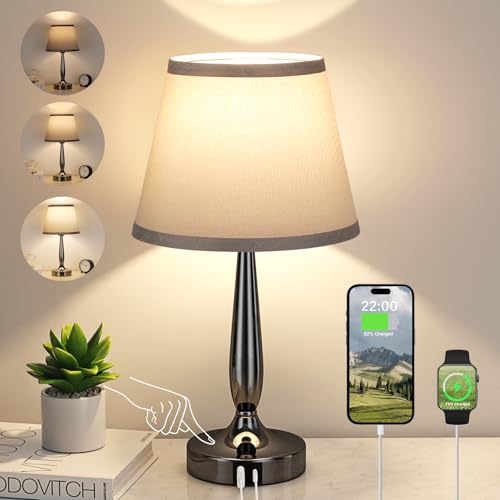
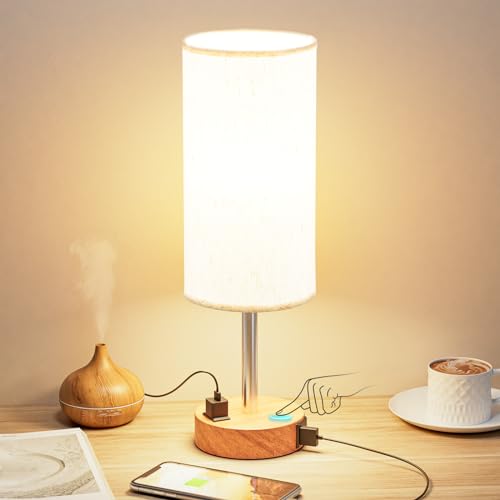
Modern bedside lamps have quietly solved their oldest problem: the fiddly switch. Touch bases, like those on the Yarra-Decor and Kakanuo models verified for this guide, turn on, dim and switch off with a tap anywhere on the base — operable with the back of a hand, in the dark, without sitting up. Three-step dimming covers reading brightness down to a night-light glow in the same lamp, replacing two separate devices.
That usability compounds nightly. A control you never have to think about gets used correctly every time; a lamp with a small rotary knob or an inline cord switch hiding behind the nightstand gets left on, left off, or knocked over. When comparing lamps, treat the control scheme as a primary feature, not a footnote — you will use it twice a day for years.
Pro: built-in USB charging reclaims the nightstand outlet
Nightstands have an outlet problem: lamp, phone charger, alarm clock and sometimes a watch charger all want the same two sockets. Lamps with integrated USB ports — the Fenmzee pick in this guide adds both USB and a pass-through AC outlet — collapse that tangle into one footprint. Your phone charges where you can reach it, the cable run is inches rather than across the floor, and the wall outlet stays partly free.
There is a tidiness dividend beyond convenience. Fewer wall warts and shorter cables mean the nightstand surface stays usable for a book, a glass of water and glasses — the things that were there before charging culture arrived. For guest rooms, a charging lamp is also a small act of hospitality: visitors get light and power without asking where a spare charger lives.
Pro: a fast, reversible way to finish a bedroom’s look
Like the sheet set in its own guide, a bedside lamp is a high-visibility, low-commitment design move. The shade’s shape and the base’s material set the nightstand’s whole tone — fabric shades and wood-grain bases read warm and traditional; compact modern forms read minimal; a smart lamp’s glow can tint a plain room in seconds. Swapping a lamp changes the room without tools, wiring or permanence.
Matched pairs amplify the effect, making two nightstands read as one designed composition. Several verified picks here are sold or styled for pairing, and buying the pair at once guarantees the same shade colour and finish — lamps bought months apart from ‘the same’ listing can differ subtly in fabric tone.
Pro: smart lamps add scheduling, colour and voice control
The Govee RGBIC smart lamp in this guide represents the format’s newest pro: light that behaves like a system. App and voice control, scheduled dimming that mimics sunset, gentle brightening as a wake aid, and colour scenes for reading versus relaxing all live in one small footprint. For shift workers and anyone with an irregular schedule, a lamp that follows a programme rather than a wall switch is a real quality-of-life upgrade.
Smart features also serve accessibility. A lamp that responds to voice or a phone already in hand helps anyone for whom reaching, gripping or precise tapping is difficult — a benefit that rarely appears in marketing but matters enormously in the homes where it applies.
Pro: low running cost and long service life with LED
Contemporary bedside lamps are overwhelmingly LED, whether the bulb is included and replaceable or the light source is integrated. LED running costs are a small fraction of the incandescent lamps these designs replaced, the light sources last for years of nightly use, and the lamps run cool — a meaningful safety and comfort point for a device sitting inches from bedding, books and curtains.
Cool running also protects shades. Fabric shades yellow and scorch over years above hot bulbs; above an LED they stay true far longer, which preserves exactly the design pro described above. When a lamp in this guide includes its bulb, that is one less compatibility puzzle at setup — check the model notes for which picks include one.
What are the biggest disadvantages — the cons in bedside lamp pros and cons?
Con: shade glare and wrong height ruin reading light
The most common bedside lamp failure is geometry. If the bottom of the shade sits above your eye line when you are propped up in bed, you see the bulb directly and read through glare; if the lamp is too short, the light pool lands on your lap instead of the page. Lamp height must be matched to mattress height plus your seated eye level — a measurement almost nobody takes, which is why so many lamps disappoint despite being well made.
Glare is worse with bare or lightly shaded designs and with cool-white light sources. If you read in bed nightly, prioritise a proper fabric shade at the right height over decorative minimalism, and treat the lamp-plus-nightstand combined height as the number that matters. The buying guidance later in this guide gives the measuring method.
Con: touch controls can misfire and lack precision
Touch dimming’s simplicity cuts both ways. Most touch lamps offer only three brightness steps, which may jump from too dim to too bright for your book; a cat walking across the nightstand can change the setting; and some touch bases respond to the metal objects set down beside them. In a power cut, touch lamps also occasionally return at full brightness or not at all, depending on design.
None of this is disqualifying — millions of people use touch lamps happily — but if you want fine-grained control, a lamp with a rotary dimmer, an app, or the smart pick in this guide will suit you better. Decide whether you value half-asleep simplicity or precision more, because at this size you rarely get both.
Con: integrated charging can be slow and dates the lamp
A lamp’s USB port is convenient, but it is not a fast charger. Integrated ports typically deliver modest wattage suited to overnight charging, not a rapid top-up before you leave the house, and the port standard is fixed at manufacture — a lamp bought today carries today’s connector and power expectations for the whole of its long life. Your phone will be replaced several times before your lamp is.
The honest framing is that integrated charging is a tidiness feature, not a performance feature. Overnight, modest wattage is genuinely fine and arguably gentler on batteries; for a quick boost, you will still reach for a dedicated charger. Buy the lamp for its light first and treat the ports as a bonus, and the con shrinks to its proper size.
Con: another device crowding a small nightstand
Nightstand surfaces are small and already contested. A lamp with a wide base or a sprawling shade can evict the book, water glass and glasses it exists to serve, and tall lamps on small nightstands are tippy — especially with a charging cable adding a sideways tug. Measure your nightstand’s usable depth and width before falling for a lamp’s product photo, which is invariably shot on a larger surface than yours.
Compact designs like the Dicoool pick in this guide exist for exactly this constraint, but compactness trades against shade size and therefore light spread. There is no free lunch: footprint, stability and light pool form a triangle, and your nightstand’s dimensions decide which corner of it you can afford.
Con: smart lamps add setup, apps and failure modes
Every smart pro in the list above arrives with an invoice. A smart lamp needs Wi-Fi setup, an app account, firmware updates and a phone nearby to reach its best features; it can misbehave when the router reboots, and its colour brilliance is wasted — even annoying — if all you wanted was warm reading light. In a guest room, a lamp your visitors need an app to operate is a lamp they will leave alone.
There is also longevity asymmetry: a dumb lamp’s failure modes are a bulb and a switch, both trivial; a smart lamp’s electronics and app support determine its life, and app ecosystems change. Buy smart for a bedside you personally use nightly and whose features you will actually programme — not as a default upgrade.


Con: light quality varies and listings rarely tell the truth about it
Brightness and colour quality are the least honestly specified parts of the lamp market. Listings emphasise wattage equivalents and adjectives, while the things your eyes care about — actual light output, colour temperature, and how faithfully colours render under it — are often vague or absent. A lamp can be ‘warm’ anywhere across a wide range, and two ‘3000K’ lamps from different makers can still feel different beside each other as a pair.
Defence is behavioural: buy pairs together, favour lamps that state a colour temperature figure over those that offer only adjectives, and keep the box until you have read under the lamp for two evenings. Light is experiential; no specification sheet fully predicts it, which is why the returns window is part of the product.
Which specific models show these bedside lamp pros and cons most clearly?
A pros-and-cons list only helps if you can see it in real products. The six models below were verified, and each one illustrates a different balance of the advantages and disadvantages above. Read the badge first, then the trade-offs — the trade-offs are where the honest differences live.
In this guide
Quick Picks
- Best Overall: Fenmzee Bedside Table Lamp — 3-way dimmable touch, USB A+C, AC outlet, bulb included
- Best Classic Touch Lamp: Yarra-Decor Touch Control Bedside Table Lamp — Touch control, 2 USB ports, 3000K bulb included
- Best Smart: Govee RGBIC Smart Table Lamp 2 — RGBIC colour, app and voice control, touch operation
- Best Pair Value: Touch Lamps for Bedroom Set of 2 Lynnoland — Matched pair of touch bedside lamps
- Best for Small Nightstands: Dicoool Bedside Table Lamp — Compact bedside lamp design
- Best Simple Touch Pick: Kakanuo Touch Table Lamp for Bedroom — Touch table lamp for bedroom use
Fenmzee Bedside Table Lamp — Best Overall
The Fenmzee is the complete nightstand argument in one lamp: touch dimming in three steps, both USB connector styles, a pass-through AC outlet, an included LED bulb and a fabric shade over a wood-grain base, at a compact fourteen-inch scale.
Strengths
- Charging hub: USB A+C plus an AC outlet
- Touch dimming works half-asleep, no switch hunt
- Bulb included — nothing extra to buy
Trade-offs
- Three dimming steps, not continuous control
- Compact shade gives a modest light pool
- Charging is overnight-speed, not fast-charge
| Detail | What to know |
|---|---|
| Height | 14 inches, per verified listing title |
| Controls | 3-way dimmable touch |
| Shade | Fabric lampshade, per verified listing title |
Fenmzee illustrates this guide’s central balance: it concedes precision dimming and smart features, and in exchange removes the two most common bedside annoyances — switch fumbling and outlet shortage — in a single purchase. For a primary bedside, that is the right trade for most people.
Best for: most nightstands — light, dimming and charging in one footprint / Not suited for: buyers who want app or voice control
Check on Amazon — check price on Amazon
Yarra-Decor Touch Control Bedside Table Lamp — Best Classic Touch Lamp
Yarra-Decor’s lamp pairs the classic formula — round beige fabric shade, metal base — with touch control and twin USB ports, and states its included bulb’s colour temperature plainly, which this guide wishes every maker did.
Strengths
- Stated 3000K warm white — no colour guesswork
- Two USB ports for phone plus a second device
- Traditional shade suits most bedroom styles
Trade-offs
- USB only — no AC pass-through
- Touch steps rather than fine dimming
- Single colour-temperature personality
| Detail | What to know |
|---|---|
| Bulb | 3000K warm white LED, included, per verified listing title |
| Ports | 2 USB charging ports |
This is the lamp for buyers who liked everything about the traditional bedside lamp except operating it. It keeps the look, fixes the switch and adds charging — a conservative upgrade path with very little to relearn and nothing to set up.
Best for: readers who want a traditional shaded look with touch ease / Not suited for: anyone needing a pass-through AC outlet
Check on Amazon — check price on Amazon
Govee RGBIC Smart Table Lamp 2 — Best Smart
Govee’s second-generation smart lamp is the format’s ceiling: segmented colour that can glow in multiple tones at once, app scenes, scheduling and voice control in a corded bedside footprint, with touch control on the lamp itself for basic use.
Strengths
- Scenes, schedules and gentle wake/dim routines
- Voice and app control — accessible operation
- Colour range no shaded lamp can match
Trade-offs
- Needs Wi-Fi and the app for full value
- Most expensive tier in this line-up — check price on Amazon
- Over-featured for pure reading use
| Detail | What to know |
|---|---|
| Type | Smart RGBIC table lamp, corded, per verified listing title |
| Control | Touch on lamp plus app/voice ecosystems |
Buy this lamp as a system, not as a lamp. If you will programme a wind-down routine and actually use it nightly, its pros are unavailable anywhere else in this guide; if you will set it to warm white and forget it, you have paid for a cons list — setup, app dependence — with none of the payoff.
Best for: tech-comfortable sleepers who will use scenes and schedules / Not suited for: guest rooms or anyone who dislikes apps
Check on Amazon — check price on Amazon
Touch Lamps for Bedroom Set of 2 Lynnoland — Best Pair Value
Lynnoland’s set of two answers the pairing problem directly: two matched touch lamps bought together, guaranteeing identical shades and finishes on both sides of the bed.
Strengths
- Perfectly matched pair — no dye-lot gamble
- Touch control on both sides of the bed
- One purchase furnishes the whole bed
Trade-offs
- Two of the same lamp — no mixing styles
- Pair pricing only wins if you need both
- Storage of spares/parts is doubled
| Detail | What to know |
|---|---|
| Configuration | Set of 2 touch bedside lamps, per verified listing title |
As a tier play — check price on Amazon — a matched pair usually undercuts two singles while eliminating the subtle shade mismatch that makes separately bought ‘identical’ lamps look off. If your bedroom has two nightstands, start here and only look elsewhere for a specific feature this pair lacks.
Best for: primary bedrooms furnishing both nightstands at once / Not suited for: single-side or mismatched-nightstand setups
Check on Amazon — check price on Amazon
Dicoool Bedside Table Lamp — Best for Small Nightstands
The Dicoool lamp is the compact answer to the crowding con: a small-footprint bedside lamp that leaves room on the nightstand for the book and glass of water it exists alongside.
Strengths
- Small footprint preserves nightstand surface
- Simple, unfussy bedside operation
- Easy to move between rooms as needs change
Trade-offs
- Smaller shade means a smaller light pool
- Less presence as a design statement
- Fewer hub features than larger rivals
| Detail | What to know |
|---|---|
| Type | Compact bedside table lamp, per verified listing title |
Compact lamps are an honesty test for your furniture: if your nightstand is genuinely small, a lamp that fits it properly will make you happier every night than a grander lamp that crowds it. Dicoool is the pick that respects the tape measure.
Best for: small nightstands, dorms and tight guest corners / Not suited for: readers wanting a wide pool of light
Check on Amazon — check price on Amazon
Kakanuo Touch Table Lamp for Bedroom — Best Simple Touch Pick
Kakanuo’s touch lamp strips the formula to its essentials — touch operation in a bedroom-scaled lamp — for buyers who have charging handled elsewhere and simply refuse to hunt for a switch ever again.
Strengths
- Dead-simple touch operation
- No setup, no app, no configuration
- Clean fit for minimalist nightstands
Trade-offs
- No integrated charging hub
- Fewer stated extras than rivals here
- Touch steps only, like most of its class
| Detail | What to know |
|---|---|
| Type | Touch table lamp for bedroom, per verified listing title |
Not every bedside needs to be a hub. If your outlets are plentiful and your charger already lives where you want it, Kakanuo’s restraint is a feature: fewer functions, fewer failure modes, and the one interaction that matters — the tap — done properly.
Best for: buyers who want touch simplicity without hub extras / Not suited for: anyone who needs built-in charging
Check on Amazon — check price on Amazon
Comparison Table
| Pick | Badge | Key spec | Best for |
|---|---|---|---|
| Fenmzee Bedside Table Lamp | Best Overall | 3-way dimmable touch, USB A+C, AC outlet, bulb included | most nightstands — light, dimming and charging in one footprint |
| Yarra-Decor Touch Control Bedside Table Lamp | Best Classic Touch Lamp | Touch control, 2 USB ports, 3000K bulb included | readers who want a traditional shaded look with touch ease |
| Govee RGBIC Smart Table Lamp 2 | Best Smart | RGBIC colour, app and voice control, touch operation | tech-comfortable sleepers who will use scenes and schedules |
| Touch Lamps for Bedroom Set of 2 Lynnoland | Best Pair Value | Matched pair of touch bedside lamps | primary bedrooms furnishing both nightstands at once |
| Dicoool Bedside Table Lamp | Best for Small Nightstands | Compact bedside lamp design | small nightstands, dorms and tight guest corners |
| Kakanuo Touch Table Lamp for Bedroom | Best Simple Touch Pick | Touch table lamp for bedroom use | buyers who want touch simplicity without hub extras |
Use this table as a shortlist, then read the full review of the two or three picks that match your room, your habits and your budget tier before you decide. A pick that looks similar on paper can feel very different once fabric, fill, finish or hardware meets your daily routine.
How do you choose the right bedside lamp height and shade?
Measure from the top of your nightstand to your eye level when sitting up in bed against your pillows. The bottom of the lampshade should sit roughly at that eye level: low enough that you never see the bare bulb, high enough that the light pool covers an open book in your lap. As a rule of thumb, the combined height of nightstand plus lamp should land the shade’s lower edge near your chin-to-eye zone when propped up — and because mattresses and nightstands vary enormously, your measurement beats any generic size chart.
Shade diameter shapes the light pool. A wider shade spreads softer light further across the bed — good for readers and for ambient glow — while a narrow shade concentrates light downward, which suits a lamp used mainly as a night light and charging station. Fabric shades diffuse and warm the light; that diffusion is why shaded lamps dominate this guide’s picks for actual reading.
Finally, check stability with your real nightstand in mind. A lamp’s base should sit fully on the surface with room for the cable to drop behind without pulling, and if your nightstand is narrow, favour a compact base like the Dicoool pick over a sculptural wide one. A lamp that fits its furniture looks designed; one that overhangs looks borrowed.
How should you set up bedside lighting for reading and sleep?
Use the lamp’s lowest comfortable setting for the last half hour before sleep. Bright light late in the evening works against drowsiness, so treat full brightness as a task setting — finding something, reading small print — and the dim settings as your default evening state. If your lamp has three touch steps, most readers find the middle step right for books and the lowest right for winding down and night waking.
Position the lamp slightly behind your shoulder line rather than beside the book. Light arriving over your shoulder falls on the page without reflecting back into your eyes, and the shade blocks your partner’s direct view of the source. If you share the bed with a light sleeper, that small positional courtesy matters more than any feature on the box.
Keep the night path in mind. The route from bed to bathroom should be coverable at the lamp’s lowest setting or with its glow alone; if you regularly need a second light to cross the room, the lamp is either too dim at its floor or badly placed. Test the full routine — read, dim, sleep, wake, walk — for two nights before deciding a lamp has failed you; most placement problems are fixable in minutes.
How do bedside lamps affect sleep quality beyond brightness?
Light’s effect on sleep runs through timing and spectrum as much as brightness. A warm-toned lamp used at low settings in the last hour of the evening sends the day’s ending signal that overhead cool lighting contradicts — one reason the same person can feel sleepy in a lamplit room and wired in a brightly lit one at the same clock hour. Bedside lamps, precisely because they are dimmer and warmer than room lighting, are structurally kinder to sleep onset, provided they are actually used that way: a touch lamp left on its brightest step all evening forfeits the advantage its format offers.
The wake side matters too. A lamp you can bring up gently — lowest step first, eyes adjusting gradually — is a softer start than a ceiling light at full blast, and smart lamps like the Govee pick extend that logic into programmed dawn simulation. None of this requires believing anything exotic: it is simply the observation that the light nearest your bed, in the last and first minutes of your day, deserves more thought than its price suggests.
What about lamps for children, guests and older sleepers?
Different bedsides want different lamps, and the pros and cons rebalance for each. Children’s lamps should be stable, cool-running and simple enough for small hands — touch operation is excellent here, provided the lamp cannot be tipped into bedding and its lowest setting works as a reassurance light that does not fully wake a parent at 3 a.m. Avoid delicate shades and exposed hot surfaces entirely; in a child’s room the lamp is also a toy, whether you planned it or not.
Guest rooms want instant intelligibility: a lamp a stranger can operate in the dark in one second, ideally with charging for the phone they forgot a cable for — the Fenmzee formula in this guide is practically a hospitality specification. Older sleepers want reach, stability and controls that arthritic hands can manage: large touch surfaces beat small knobs, and a lamp positioned to light the path to the door is a safety device as much as a reading light. Match the lamp to the sleeper, not to the catalogue photo.
How long should a bedside lamp last, and what fails first?
A decent LED bedside lamp should serve for many years, and its failure order is predictable. On basic lamps, the switch or touch sensor eventually tires — the part you touch twice a day wears like any control. On charging lamps, the ports age next, loosening or being superseded by new connector standards. On smart lamps, the electronics and app ecosystem set the lifespan, which is the longevity argument threaded through this guide’s cons: the simpler the lamp, the fewer clocks are ticking inside it.
You can extend any lamp’s life with dull habits: dust the shade so heat and grime do not build up, avoid yanking the cord when moving furniture, and keep charging cables short so they do not lever against the ports. When a lamp does begin to fail, judge it by which part failed — a worn touch sensor after six years of twice-daily use is a life fully lived, not a defect, and its replacement can be chosen with everything this guide has taught you about your own habits.
How do you pair a lamp with the right bulb and brightness?
Where a lamp takes a replaceable bulb, the bulb is half the product. Choose warm colour temperature for a bedroom — the 3000K figure stated on the Yarra-Decor pick is the reference point — and enough output for reading without strain, remembering that a fabric shade absorbs a meaningful share of whatever the bulb produces. A lamp that seems dim in the shop may simply be wearing its shade; judge lamp and shade together, in a darkened corner if the shop allows, rather than by the bulb’s box numbers alone.
Dimming compatibility deserves one check: a bulb and a lamp’s dimmer — touch, rotary or inline — must agree with each other, and mismatched pairs flicker or hum. Lamps with included bulbs, several in this guide among them, remove that gamble entirely, which is a genuine if unglamorous pro. When you replace an included bulb years later, match its type and temperature from the old bulb’s markings rather than from memory.
Brightness taste also changes with age — literally. Older eyes need more light for the same page, and a lamp chosen at forty may feel dim at sixty-five even though nothing about it changed. Buying a lamp whose top step is brighter than you currently need is not waste; it is headroom for the reader you will become, used nightly at the lower steps in the meantime.
What are the safety checks for a bedside lamp?
A bedside lamp lives inches from bedding, so its safety list is short and non-negotiable. Stability first: the lamp should resist a knocked nightstand and a tugged cord without toppling, and its base should sit fully on the surface. Heat second: LED sources run cool, which is one reason they dominate this guide, but check that any lamp you own stays merely warm at the shade after an hour — a hot shade near curtains or bedding is a lamp to retire, not to tolerate.
Cords third: route them behind the nightstand, never under a rug or across the walking path to the door, and never let a charging cable and a lamp cord braid themselves into a single trip line. In children’s rooms and homes with older sleepers, that routing is the difference between a lamp as a safety device — light without a dark walk — and a lamp as a hazard with a shade on it.
Finally, respect water’s geography. A glass of water is a bedside constant; a lamp’s electrics are its neighbour. Keep the lamp and its charging ports on the far side of the nightstand from the water where the layout allows, and wipe spills before they reach a base. These are thirty-second habits that protect a device you will use ten thousand times.
How do you troubleshoot common bedside lamp problems?
Flicker is the commonest complaint and it has three usual causes, in order: a bulb that does not agree with the lamp’s dimming method, a loose bulb that needs a quarter turn, and — on smart lamps — a Wi-Fi or firmware hiccup that a power cycle at the wall resolves more honestly than an hour in an app. Work the list in that order and most flicker surrenders to the first two. If a touch lamp changes brightness by itself, look for the mundane culprits before the electronic ones: a pet, a metal object resting against the base, or a cable draped across the touch surface.
A lamp that seems too dim after months of satisfaction is usually wearing its problem: dust film on the shade and bulb cuts output insidiously, and a five-minute clean restores what you thought the lamp had lost. A lamp that has grown too bright for your evenings, by contrast, has usually not changed at all — your routine has, and the honest fix is a lower-output bulb or disciplined use of the lowest touch step rather than a new lamp.
Keep one spare bulb of the correct type with the lamp’s documentation. Bedside lamps fail at bedtime by definition, and a spare in the drawer converts a week of squinting into a two-minute change. That small preparedness is the final, unglamorous pro of the simple lamp designs in this guide: everything they need to keep working fits in the nightstand they serve.
What is the simplest way to decide today?
Use the three-question shortcut. One: do you read in bed most nights — if yes, shade geometry and dimming outrank everything. Two: is your nightstand outlet overwhelmed — if yes, the hub lamps, led by the Fenmzee, solve two problems in one purchase. Three: will you genuinely programme scenes and schedules — if yes, the Govee earns its complexity; if honestly no, a touch lamp will make you happier for longer.
Then measure your nightstand, check the lamp’s footprint against it, and order with the returns window in mind. Light is experiential: two evenings of reading under your chosen lamp will teach you more than any specification, and a lamp returned inside its window for a better-fitting one is a successful purchase process, not a failed one.
One last check before you order?
Run the bedtime rehearsal mentally, in order, with the lamp you are about to buy. You are tired, the room is dark, your book is finished: can you dim or kill the light with one drowsy hand, without looking, without knocking anything over? Your phone is nearly flat: does it charge where it sleeps, without a cable crossing the bed? You wake at 3 a.m.: does the lowest setting get you to the door and back without waking the house? A lamp that passes all three rehearsals will pass a thousand real nights.
If it fails one, the guide above names the design that fixes exactly that failure — touch control, a charging hub, a proper lowest step. Buy the lamp that passes your rehearsal, not the one that photographed best, and the bedside will quietly work for you every night you own it.
Common Buying Mistakes
Buying the lamp before measuring the nightstand
Product photos are shot on oversized surfaces. Measure your nightstand’s usable width and depth and the lamp’s footprint; a lamp that overhangs or crowds out your book and water has failed its only job.
Ignoring shade height relative to your eyes
A shade that ends above your seated eye line exposes the bulb and creates glare no dimmer can fix. Match combined nightstand-plus-lamp height to your propped-up eye level.
Expecting lamp USB ports to fast-charge
Integrated ports are overnight chargers — convenient and tidy, not rapid. Buy the lamp for its light and controls; treat charging speed expectations accordingly.
Putting a smart lamp in the guest room
Guests will not install your app. Guest bedsides want a lamp that works by touch or switch in one second. Keep smart lamps for your own nightly use.
Final Recommendation
For most bedsides, the Fenmzee is the balanced answer: touch dimming, both USB styles, a pass-through outlet and an included bulb in a compact shaded design. Traditionalists should take the Yarra-Decor for its stated warm colour temperature and classic shade; furnishing both sides at once, the Lynnoland pair removes the matching gamble entirely.
Choose by your honest routine. If you read nightly, shade geometry and dimming come first; if your nightstand is a charging battleground, the hub features come first; if you will genuinely programme scenes and schedules, the Govee earns its complexity. The bedside lamp pros and cons balance tips in favour of the lamp whose controls you can operate at your most tired — because that is when you will use it most.
Frequently Asked Questions
Are touch bedside lamps reliable?
Yes, for most households touch lamps are dependable for years of nightly use, and their tap-anywhere operation is a genuine accessibility win. Their limits are coarse brightness steps and occasional sensitivity to pets or metal objects on the nightstand — inconveniences rather than failures.
What colour of light is best beside a bed?
Warm white, around the 3000K figure stated by the Yarra-Decor pick in this guide, suits bedrooms best: it renders pages and skin tones pleasantly and supports an evening wind-down better than cool daylight tones, which feel clinical and alerting at night.
Do I need two matching bedside lamps?
Only if both sides of the bed are used and visible. A matched pair looks composed and guarantees identical light on both sides; a single lamp is fine for a single sleeper. If you do pair, buy both at once to avoid shade-tone differences between production runs.
Is a smart lamp worth it for a bedside?
It is worth it if you will use schedules, scenes or voice control regularly — particularly gentle wake and wind-down routines. If your routine is simply on, read, off, a good touch lamp delivers the same satisfaction with none of the setup or app dependence.
Why does my bedside lamp glare when I read?
Almost always geometry: the shade’s lower edge sits above your eye line in your reading position, exposing the bulb. Lower the lamp, raise your pillows’ support, choose a taller nightstand pairing, or switch to a design whose shade sits lower relative to its base.
Can a bedside lamp charge a phone overnight?
Yes — lamps with integrated USB ports, such as the Fenmzee pick here, comfortably charge a phone overnight. Expect modest speeds suited to an eight-hour charge rather than a quick top-up, and keep a dedicated fast charger elsewhere for daytime boosts.