Disclosure: airfryerkitchensupply.com is reader-supported. When you buy through links on our site, we may earn an affiliate commission at no extra cost to you.
Where to buy
The models named in this guide to bed sheet set pros and cons were checked against the Amazon catalogue on 2026-11-21. Where a model is linked, use the link to check price on Amazon and confirm the exact size, colour and configuration before ordering, because listings group several variants under one page. Where a model is covered without a link, treat it as a design reference rather than a linked recommendation.
What are the real bed sheet set pros and cons?
A bed sheet set looks like the simplest purchase in the bedroom — a fitted sheet, a flat sheet and pillowcases in a matching fabric — yet the bed sheet set pros and cons only become obvious after the third wash, the first hot night and the first time the fitted corner pops off at 2 a.m. This guide works through both sides honestly, using six verified sets from Bedsure and Mellanni that between them cover microfiber, bamboo-derived rayon, cotton sateen and flannel, so every pro and con below is attached to a fabric you can actually buy.
The first thing to understand is that a sheet set is a system, not a single fabric decision. The weave controls how the surface feels against skin, the fibre controls how it handles heat and moisture, the pocket depth controls whether it stays on your mattress, and the care routine controls how it looks after a year. A set can win on one of those axes and lose badly on another, which is exactly why a flat list of advantages is useless without the matching disadvantages beside it.
We verified every set named here on 2026-11-21 and we do not print fixed prices or fixed star scores anywhere in this guide, because both change constantly. Use the links to check price on Amazon for the exact size and colour you need, and use the pros and cons framework to decide which compromises you are genuinely willing to live with every single night.
What are the biggest advantages — the pros in bed sheet set pros and cons?
Pro: one purchase solves the whole bed in matching fabric
The most obvious advantage of a set over buying pieces separately is coordination. The fitted sheet, flat sheet and pillowcases arrive in the same dye lot, the same weave and the same hand feel, so the bed looks finished rather than assembled. That matters more than people expect: mismatched pillowcases against a different-toned flat sheet make even an expensive bed look tired, and hunting individual pieces in the same shade of white or grey across different brands is a surprisingly frustrating exercise.
A set also removes decision fatigue at the exact moment you least want it — when a sheet tears or stains and you need a replacement tonight. You choose a fabric family and a size once, and the pocket depth, elastic style and pillowcase closure are already engineered to work together. For guest rooms, rental properties and first apartments, that completeness is the whole point: one box, one wash, one made bed.
Pro: sets cost less per piece than buying separates
Because manufacturers cut, sew and package sets at volume, the per-piece cost of a set is almost always lower than assembling the same pieces individually. The fitted sheet is the expensive component — it needs elastic, corner engineering and more fabric for deep pockets — and in a set its cost is spread across the flat sheet and cases, which are simple rectangles. That is why complete sets exist at budget tiers where separates in the same fabric would be hard to find at all.
The saving is not only money but replacement logic. When one piece wears out, value sets are cheap enough as a tier — check price on Amazon for current positioning — that many households simply rotate in a fresh full set and demote the old one to spare duty, rather than nursing a single expensive fitted sheet for a decade. Whether that trade suits you depends on the cons further down, particularly around longevity and waste.
Pro: fabric choice lets you tune the bed for temperature
No other bedding purchase gives you this much thermal control for this little effort. Microfiber feels smooth and warm-neutral and dries fast; rayon derived from bamboo feels cool to the touch and moves moisture away from skin, which hot sleepers notice within the first hour; cotton sateen has a slight sheen and a denser, warmer drape; flannel is brushed on both sides and traps a layer of still air that makes a cold room feel survivable. The six sets in this guide span all four behaviours.
That range means the pros and cons of a bed sheet set are partly a matching exercise. A hot sleeper in a bamboo-derived set and a cold sleeper in flannel can both be delighted by ‘sheet sets’ as a category while hating each other’s choice. When a review or a friend calls sheets amazing or terrible, the useful follow-up question is always which fabric, in which season, on which mattress.
Pro: easy care compared with most bedding
Sheets are the hardest-working washable in the house, and sets are designed around that reality. Microfiber and bamboo-derived sets wash cool, dry fast and come out of the dryer largely wrinkle-free; cotton sateen needs a little more attention but still tolerates ordinary machine washing; even flannel, the fussiest of the four, only asks for a gentle cycle and moderate heat. Compare that with duvets, comforters and mattress protectors, which strain domestic machines and take hours to dry.
Fast, forgiving care has a hygiene dividend: because washing a set is easy, people actually do it weekly, which is the interval sleep hygiene guidance generally points to for sheets in direct skin contact. A bedding system that is theoretically superior but so cumbersome to launder that it gets washed monthly is, in practice, the dirtier bed. Sets win on behaviour, not just specifications.
Pro: deep-pocket engineering now fits modern mattresses
Mattresses have grown thicker — pillow tops, toppers and hybrid builds routinely push total height far beyond what old fitted sheets were cut for — and set makers have responded. Deep-pocket sets like the Bedsure option verified for this guide are cut for mattresses up to around twenty-one inches, with elastic that runs the full perimeter rather than just the corners. That full elastic is the difference between a sheet that survives a restless night and one that works itself loose by morning.
Because the pocket depth is stated as part of the set’s specification, you can match it to your measured mattress height before buying, which is nearly impossible when buying a loose fitted sheet with vague ‘fits most mattresses’ language. Measure your mattress including any topper, add a small allowance for the sheet to tuck under, and choose the pocket range that covers it — the how-to-choose guidance later in this guide walks through the measuring method in full.
Pro: a fast, low-risk way to change how a bedroom looks
A sheet set is the cheapest complete visual reset a bedroom can get. Because the flat sheet and pillowcases are the largest visible fabric surfaces on the bed, changing their colour or texture changes the room’s whole palette without touching paint, furniture or curtains. Seasonal rotation — crisp light fabrics in summer, flannel in winter — also gives a bedroom a rhythm that makes the same room feel maintained rather than static.
The risk is low because the commitment is low. If a colour reads differently in your light than on screen, the set becomes the spare set; nothing was installed, drilled or custom-cut. For renters especially, sets are one of the few bedroom upgrades that are fully reversible and fully portable to the next home, which is a genuine structural advantage over fitted furniture or window treatments.
What are the biggest disadvantages — the cons in bed sheet set pros and cons?
Con: the weakest piece decides when the whole set feels finished
A set ages as a unit in the buyer’s mind but not in the laundry. The fitted sheet takes the most mechanical stress — elastic fatigue, corner abrasion and heel wear — and typically fails first, while the flat sheet and pillowcases still look nearly new. At that point the set’s core promise, coordination, works against you: replacing only the fitted sheet usually means a visible mismatch, so many people retire three serviceable pieces because one piece failed.
You can soften this by buying two identical sets and rotating them, which halves the wear rate on each fitted sheet and guarantees a matching replacement, but that doubles the upfront purchase and the storage needed. It is a rational strategy, yet it undercuts the simplicity that made the set attractive in the first place. Budget for rotation honestly rather than discovering the weakest-link problem at midnight with a torn corner.
Con: fabric compromises are locked in across every piece
When you buy separates, you can pair a fitted sheet in one fabric with pillowcases in another — a common trick for people who love a crisp cotton fitted sheet but want a smoother case against facial skin. A set removes that freedom. If the fabric pills, sleeps warmer than expected or feels wrong against your face, it feels wrong everywhere at once, on every piece, every night.
This lock-in is sharpest with microfiber. Its smoothness and price tier are genuine pros, but some sleepers find it traps heat and builds static in dry winter air, and in a set there is no partial escape — the cases share the behaviour. Reading the cons of the specific fabric family, not just the set format, is therefore essential, and the model reviews below call out the fabric behaviour of each verified set individually.
Con: thread-count and marketing language obscure real quality
Sheet marketing leans heavily on numbers that do not mean what buyers think they mean. Thread count can be inflated by counting multi-ply yarns, and beyond a moderate point it adds density and warmth rather than softness. ‘Hotel luxury’, ‘cooling’ and ‘premium’ are unregulated adjectives. Two sets with near-identical listing language can differ enormously in yarn quality, weave consistency and finishing — differences your skin detects in a week but a product page cannot convey.
The practical defence is to weight construction details over adjectives: single-ply long-staple cotton claims, full-perimeter elastic, stated pocket depth, recognised certifications such as OEKO-TEX, and fabric weight where given. The Mellanni cotton sateen set in this guide, for example, states a specific thread count and dimensions for each piece, which is the kind of concrete specification that lets you compare honestly. Where a listing offers only adjectives, treat the set as an unknown and buy it as a spare first.
Con: fit problems multiply across thick or unusual mattresses
Deep-pocket options have improved, but fit remains the most common reason sheet sets disappoint. A pocket that is too shallow pops corners; a pocket that is far too deep leaves loose fabric that bunches under the sleeper and wrinkles into ridges. Split-king and adjustable beds add another layer: each half needs its own fitted sheet, and many standard sets simply are not configured for that, forcing a move to specialty separates after all.
Measure before you buy — mattress depth at the corner, including topper, in inches — and compare it with the set’s stated pocket range rather than its headline size. A queen label describes length and width only; it tells you nothing about depth. The number of sets returned or abandoned over depth alone is the strongest argument that the set format’s convenience ends exactly where measurement begins.
Con: lower-tier sets can pill, thin and fade quickly
The same volume economics that make sets affordable can make budget sets disposable. Short-staple fibres and loose weaves pill where heels and hips work the fabric, colours fade unevenly between the flat sheet that sees sunlight and the fitted sheet that does not, and thin fabric becomes translucent against a patterned mattress protector. A set that needs replacing twice as often is not half the price of a durable set — it is the same price with more laundry and more waste.
Pilling is the early-warning sign to watch in the first month. If a new set pills quickly in the heel zone, it is telling you the fibre length is short, and no wash routine will reverse it. Mid-tier sets from established bedding brands — the tier most of the verified picks in this guide occupy — exist precisely because this failure mode is so common at the bottom of the market.



Con: environmental cost of fast bedding turnover
A set format encourages whole-unit replacement, and synthetic sets in particular carry an environmental ledger worth naming plainly. Microfiber sheds microplastic fibres in washing, blended fabrics are difficult to recycle, and a retired set with three good pieces still tends to leave the house as one bundle of textile waste. None of this makes sets a bad purchase, but it belongs in an honest pros and cons account.
Mitigations are practical rather than preachy: choose natural or recycled fibres where the fabric behaviour suits you, rotate two sets to extend service life, demote worn sets to guest, pet or drop-cloth duty instead of binning them, and wash synthetics in a microfibre-capture bag if you own one. Longevity is the single biggest environmental variable — a set kept in service for years outperforms any fibre choice replaced annually.
Which specific models show these bed sheet set pros and cons most clearly?
A pros-and-cons list only helps if you can see it in real products. The six models below were verified, and each one illustrates a different balance of the advantages and disadvantages above. Read the badge first, then the trade-offs — the trade-offs are where the honest differences live.
In this guide
Quick Picks
- Best Overall: Bedsure Queen Sheet Set 4 Pieces — 4-piece breathable set, deep pocket, embossed design
- Best for Hot Sleepers: Bedsure PureWoven Bamboo Sheets Queen — 100% rayon derived from bamboo, 16-inch deep pocket
- Best for Thick Mattresses: Bedsure Deep Pocket Queen Sheets Set — Fits mattresses up to 21 inches thick, moisture wicking
- Best Budget: Mellanni Iconic 4-Piece Bed Sheet Set Queen — 16-inch deep pocket, brushed finish, easy care
- Best Cotton Feel: Mellanni 400TC Cotton Sateen Sheets Queen — 100% cotton sateen, 15-inch pocket, stated dimensions
- Best for Cold Rooms: Mellanni Cotton Flannel Sheet Set Queen — Double-brushed cotton flannel, pocket up to 16 inches
Bedsure Queen Sheet Set 4 Pieces — Best Overall
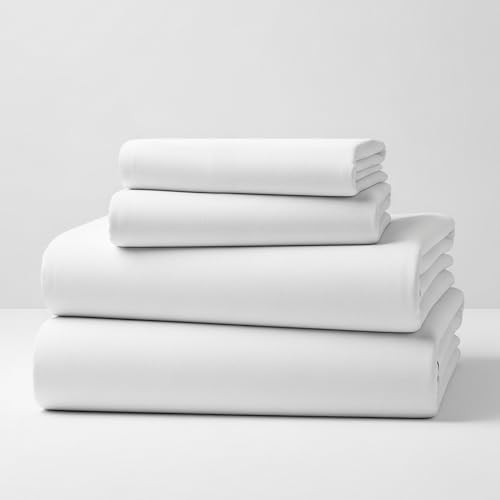
The Bedsure four-piece queen set is the reference point for this guide because it does the ordinary things — fit, wash, feel — without drama. Its embossed microfiber-style finish reads smarter than plain budget fabric and hides light creasing between washes.
Strengths
- Smooth, even hand feel across all four pieces
- Deep pocket fit that suits most modern queen mattresses
- Forgiving care routine; dries quickly
Trade-offs
- Synthetic feel will not suit natural-fibre purists
- Warm-neutral rather than actively cooling on hot nights
- Emboss texture is a look some minimalists dislike
| Detail | What to know |
|---|---|
| Set contents | Fitted sheet, flat sheet and 2 pillowcases |
| Fit note | Deep pocket design — measure mattress depth before ordering |
| Certification | OEKO-TEX referenced in the verified listing title |
In pros-and-cons terms this set is the balanced case: none of its advantages are dramatic and none of its disadvantages are disqualifying. It illustrates why sets dominate the market — for a primary bed that gets washed weekly and slept on nightly, predictable adequacy beats occasional brilliance followed by a fit or care problem.
Best for: everyday sleepers who want one dependable set for year-round use / Not suited for: sleepers who specifically want a natural-fibre feel
Check on Amazon — check price on Amazon
Bedsure PureWoven Bamboo Sheets Queen — Best for Hot Sleepers
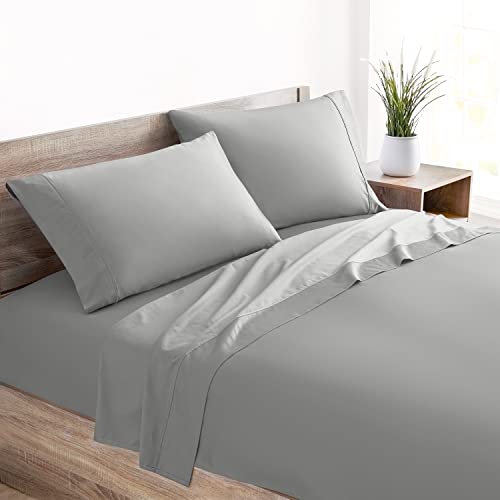
The PureWoven set is the cooling argument for sheet sets made physical. Rayon derived from bamboo feels cool on first contact and moves moisture rather than holding it against the skin, which is the exact failure hot sleepers report with synthetic sets.
Strengths
- Noticeably cool first-touch feel
- Breathable weave suits warm rooms and summer use
- Generous 16-inch pocket covers most toppers
Trade-offs
- Fluid drape can feel slippery to crisp-sheet lovers
- Needs gentler washing than microfiber to stay smooth
- Wrinkles more readily straight from the dryer
| Detail | What to know |
|---|---|
| Fibre | 100% rayon derived from bamboo, per verified listing title |
| 16-inch deep pocket | |
| Certification | OEKO-TEX referenced in the verified listing title |
This set shows the matching principle from the pros section at work: for the right sleeper its headline pro is transformative, and for the wrong sleeper its headline con — that cool, fluid drape — is a nightly irritation. If you run hot, it is the strongest argument in this guide; if you love the tucked, crisp snap of percale, look at the cotton option instead.
Best for: hot sleepers who overheat in microfiber or cotton / Not suited for: anyone who hates any hint of a silky, fluid drape
Check on Amazon — check price on Amazon
Bedsure Deep Pocket Queen Sheets Set — Best for Thick Mattresses
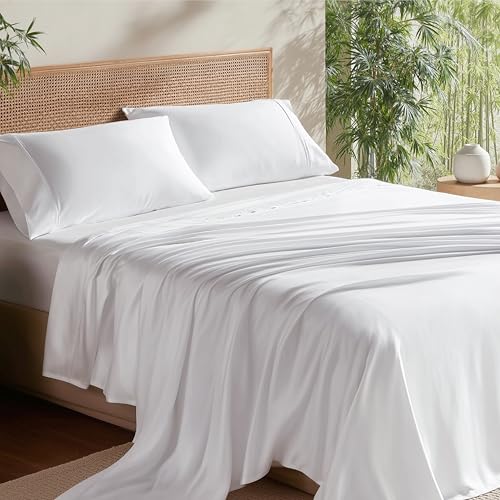
This Bedsure variant exists to solve one specific con from the list above: fit. Cut for mattresses up to twenty-one inches thick, it is the set to reach for when standard pockets have already failed you once.
Strengths
- Exceptional pocket depth for topper stacks
- Moisture-wicking finish helps warm sleepers
- Secure fit reduces corner pop-off
Trade-offs
- Excess fabric bunches on slim mattresses
- Deep pocket takes a moment longer to fit correctly
- Overkill — and extra cost tier — for standard beds
| Detail | What to know |
|---|---|
| Fit | Stated for mattresses up to 21 inches thick |
| Pieces | 4-piece queen set with pillowcases |
Treat this as a specialist tool. On a genuinely deep bed it converts the biggest sheet-set con into a non-issue; on a standard bed it manufactures the opposite problem. Measure first, then decide — the listing’s depth claim is specific enough to make that decision honestly before you spend anything.
Best for: deep pillow-top and topper stacks that defeat standard sheets / Not suited for: thin mattresses, where the extra pocket fabric will bunch
Check on Amazon — check price on Amazon
Mellanni Iconic 4-Piece Bed Sheet Set Queen — Best Budget
The Mellanni Iconic set is the long-running value benchmark in this category, built around a brushed, smooth finish and a sixteen-inch pocket. It is the set most likely to be recommended by a friend, and its pros and cons are the category’s pros and cons in miniature.
Strengths
- Proven, widely used design with predictable fit
- Soft brushed feel straight out of the packet
- Simple care; resists fading and shrinking well
Trade-offs
- Synthetic hand feel divides opinion
- Can sleep warm for very hot sleepers
- Finish is smooth rather than crisp
| Detail | What to know |
|---|---|
| 16-inch deep pocket, per verified listing title | |
| Pieces | 4-piece queen set |
As a budget-tier representative — check price on Amazon for its current positioning — it demonstrates the value pro at full strength and the longevity con at its mildest: expect good service with weekly washing, and rotate two sets if it becomes your primary bedding. For spare beds and rentals, its balance is very hard to beat.
Best for: guest rooms, rentals and first apartments needing a proven value set / Not suited for: sleepers chasing a crisp natural-cotton hand feel
Check on Amazon — check price on Amazon
Mellanni 400TC Cotton Sateen Sheets Queen — Best Cotton Feel
The Mellanni sateen set is the natural-fibre counterweight in this line-up: one hundred percent cotton with a sateen weave, a fifteen-inch fitted pocket and published dimensions for the flat sheet and cases — specification honesty this guide wishes were universal.
Strengths
- Natural cotton breathability and moisture handling
- Smooth sateen surface with a subtle sheen
- Concrete stated dimensions simplify comparison
Trade-offs
- Sateen sleeps slightly warmer than percale
- Wrinkles more than microfiber after washing
- Needs a touch more care to keep its finish
| Detail | What to know |
|---|---|
| Fibre | 100% cotton sateen, per verified listing title |
| 15-inch fitted pocket | |
| Flat sheet | 90 x 102 inches, per verified listing title |
This is the set for buyers whose main con with modern sheet sets is the synthetic feel itself. Cotton’s pros — breathability, a familiar hand, graceful ageing — arrive with cotton’s cons — creasing and slower drying — fully intact. Neither side of that ledger is a surprise, which is precisely its appeal.
Best for: sleepers who want natural fibre and a smooth, slight-sheen finish / Not suited for: anyone who wants the matte grip of percale
Check on Amazon — check price on Amazon
Mellanni Cotton Flannel Sheet Set Queen — Best for Cold Rooms
The flannel set completes the thermal spectrum. Double-brushed cotton traps warm air at the surface, eliminating the cold-sheet shock that makes winter bedtimes miserable in draughty houses.
Strengths
- Warmth on contact without extra blankets
- Brushed surface feels soft even when the room is cold
- Full cotton construction breathes better than synthetic fleece bedding
Trade-offs
- Far too warm outside the cold season
- Brushing can shed lint in early washes
- Heavier to wash and slower to dry
| Detail | What to know |
|---|---|
| Fibre | Cotton flannel, double brushed, per verified listing title |
| Deep pocket up to 16 inches |
Flannel is the clearest seasonal argument in this guide: as a second set for winter it is close to faultless, and as an only set in a warm climate it would be a mistake. That is the bed sheet set pros and cons lesson in one product — the format rewards owning the right fabric for the season over searching for one fabric that does everything.
Best for: cold bedrooms, winter use and anyone who hates climbing into a cold bed / Not suited for: warm sleepers or summer use in uncooled rooms
Check on Amazon — check price on Amazon
Comparison Table
| Pick | Badge | Key spec | Best for |
|---|---|---|---|
| Bedsure Queen Sheet Set 4 Pieces | Best Overall | 4-piece breathable set, deep pocket, embossed design | everyday sleepers who want one dependable set for year-round use |
| Bedsure PureWoven Bamboo Sheets Queen | Best for Hot Sleepers | 100% rayon derived from bamboo, 16-inch deep pocket | hot sleepers who overheat in microfiber or cotton |
| Bedsure Deep Pocket Queen Sheets Set | Best for Thick Mattresses | Fits mattresses up to 21 inches thick, moisture wicking | deep pillow-top and topper stacks that defeat standard sheets |
| Mellanni Iconic 4-Piece Bed Sheet Set Queen | Best Budget | 16-inch deep pocket, brushed finish, easy care | guest rooms, rentals and first apartments needing a proven value set |
| Mellanni 400TC Cotton Sateen Sheets Queen | Best Cotton Feel | 100% cotton sateen, 15-inch pocket, stated dimensions | sleepers who want natural fibre and a smooth, slight-sheen finish |
| Mellanni Cotton Flannel Sheet Set Queen | Best for Cold Rooms | Double-brushed cotton flannel, pocket up to 16 inches | cold bedrooms, winter use and anyone who hates climbing into a cold bed |
Use this table as a shortlist, then read the full review of the two or three picks that match your room, your habits and your budget tier before you decide. A pick that looks similar on paper can feel very different once fabric, fill, finish or hardware meets your daily routine.
How to choose after weighing bed sheet set pros and cons?
Start from your two non-negotiables, not from a fabric’s reputation. For most buyers those are temperature behaviour and fit. Decide whether you sleep hot, cold or neutral — honestly, based on whether you kick covers off or reach for them — and shortlist the fabric family that matches: bamboo-derived rayon or lighter microfiber for hot, cotton sateen for neutral, flannel for cold. Then measure your mattress depth at the corner including any topper and shortlist only sets whose stated pocket range covers that number with a little tuck to spare.
Next, decide your rotation strategy. One set washed and replaced the same day is a laundry deadline every week; two rotating sets halve wear and remove the deadline. If budget forces a choice between one premium set or two mid-tier sets, most households get more real-world value from the two mid-tier sets, because the rotation extends both sets’ lives and guarantees a dry spare when life interrupts laundry day.
Finally, read the care label as a compatibility test with your actual routine. If everything in your house is washed warm and tumble-dried hot, a set that asks for cool gentle cycles will either be ruined or will quietly change your routine — decide which outcome you will really deliver. The best set is the one whose care requirements you will still be meeting in month nine.
How should you wash and rotate a sheet set so the pros last?
Wash sheets weekly in warm — not hot — water with a moderate amount of detergent; excess detergent redeposits on fabric and is a common hidden cause of sheets feeling stiff or sleeping warm. Skip fabric softener on bamboo-derived and moisture-wicking sets, because softener coatings interfere with exactly the moisture behaviour you paid for. Wash a set on its own or with similar light items; zips, hooks and heavy towels abrade sheet fabric and accelerate the pilling discussed in the cons section.
Dry on moderate heat and remove promptly. Over-drying is the quiet killer of elastic: the fitted sheet’s perimeter elastic loses recovery a little with every overheated cycle, and corner pop-off a year later is usually a dryer habit, not a manufacturing defect. Fold or refit immediately to minimise creasing on cotton sateen, and store the whole set inside one of its own pillowcases so the pieces stay together and the spare set is grab-and-go.
Rotate two sets week-about and rest each set off the bed between uses. Resting lets fibres recover and lets any residual moisture fully leave the fabric, which keeps the bed fresher and slows the thinning that ends a set’s life. When a fitted sheet finally does fail, keep the flat sheet and cases in service as spares — the set’s coordination pro is gone, but the fabric still has honest work left in it.
How do sheet sets compare with duvet covers and blankets as a system?
A sheet set does not work alone, and its pros and cons shift with what it is paired with. Under a duvet in a duvet cover, the flat sheet becomes optional for some sleepers — which quietly changes the set’s value calculation, because the piece you may skip is bundled whether you use it or not. Households that sleep directly under the flat sheet with a blanket over it use every piece nightly and extract the set’s full value; duvet households sometimes find separates more rational, buying fitted sheets and pillowcases in the fabric they love and skipping flat sheets entirely. Neither answer is wrong — but knowing which household you are in before you buy prevents paying for a piece that lives in a drawer.
The layering also affects temperature judgements. A bamboo-derived set blamed for sleeping cold may simply have been paired with a lightweight summer duvet in a cool room; a microfiber set blamed for heat may be innocent under a breathable cotton blanket. When you evaluate a set’s performance in its first fortnight, change one layer at a time. Bedding is a system of interacting pieces, and the set is the layer against your skin — judge it for contact comfort, moisture behaviour and fit, and let the layers above it carry the insulation decisions.
What should guest rooms and spare beds do differently?
Guest beds invert the priorities of a primary bed. The guest set is washed less often, slept on by people whose preferences you cannot know, and judged in a single night. That argues for the balanced middle: a smooth, neutral set like the Bedsure four-piece or the Mellanni Iconic in this guide, in a colour that suits the room, with a spare set in the cupboard for turnover between guests. Exotic fabrics are a gamble — flannel delights one guest and roasts the next — while the middle of the fabric road offends nobody.
Durability calculus also flips: a guest set’s enemy is not nightly wear but long storage. Store guest sets washed, fully dry and loosely folded, and air them on the bed for an afternoon before visitors arrive. A set that smells of the cupboard will be remembered longer than the thread count you chose, and the five-minute airing is the cheapest hospitality in this entire guide.
How do you tell a good set in the first month?
The first month reveals a set’s character if you know what to watch. Fit first: a fitted sheet that still grips after ten washes has elastic worth trusting, while one that relaxes early will only get worse. Surface second: check the heel and hip zones against the light for early pilling or thinning — the honest preview of year two. Colour third: compare the pillowcase that lives in daylight with the fitted sheet that does not; uneven fading now means a visibly two-tone set within the year.
Keep the packaging and your order details until that month has passed. A set that fails these early checks is a return, not a regret to be stored. And when a set passes — fits, stays smooth, washes without drama — buy the second identical set immediately for rotation, while the same production run is still available. That is the moment the pros and cons of the format tilt decisively in your favour, and it is worth acting on deliberately.
How do sizes, splits and special formats change the picture?
Everything in this guide assumed a standard one-piece mattress, and the real world is wider than that. Split kings and adjustable bases need two twin-XL fitted sheets rather than one king fitted sheet, and while some brands sell split configurations as sets, many do not — this is the scenario where the set format’s cons genuinely win and separates become the rational purchase. If your bed adjusts, shop by configuration first and fabric second, and accept a smaller field of candidates with good grace.
Oversized and specialty sizes — California king, twin XL in dormitories, RV and sofa-bed formats — shrink the field further. Dormitory twin XL is the classic trap: standard twin sheets are too short, the bed looks made until the first night pulls the fitted corner off, and the student concludes they are bad at beds. They are not; the size was wrong. Measure length as faithfully as depth, especially in any bed you did not buy yourself.
Deep and shallow extremes deserve the same respect. A slim futon or a low platform mattress in a standard deep-pocket set will swim in fabric, bunching into ridges that print through sleep — the mirror image of the shallow pocket popping off a thick mattress. Several makers now state pocket ranges rather than a single depth, and matching your measured depth to the middle of a stated range, rather than its edge, is the quiet expert move this whole guide has been circling.
What does a sheet set really cost over five years?
Sticker comparison misleads in bedding because service life varies so widely. A budget set replaced every year and a mid-tier set rotated in a pair and lasting four years can cost the same across five years — with the mid-tier pair feeling better in every one of those years and sending a fraction of the fabric to landfill. The arithmetic worth doing is cost per year of good service, estimated honestly from the fabric family: synthetics at the bottom tier fade fastest, quality microfiber and bamboo-derived sets hold the middle, and well-made cotton can outlast everything if its care requirements are actually met.
Care costs ride along invisibly. Sets that demand gentle cycles, special detergents or ironing charge you in time and laundry complexity every single week; sets that tolerate your household’s default wash charge nothing. When two sets feel equal in the shop, the one whose care label matches your existing routine is cheaper in every currency that matters — money, minutes and the probability that the routine survives a busy month.
None of this argues for buying the most expensive set available. It argues for buying at the tier where construction quality stops improving quickly — for most households, the established mid-tier occupied by the verified picks in this guide — and then extracting full value through rotation and care. The pros and cons of a bed sheet set are not fixed at purchase; five years of small decisions move them.
What is the simplest way to decide today?
If this guide has left you with analysis rather than a decision, use the three-question shortcut. One: do you sleep hot, cold or neutral — that chooses the fabric family. Two: what is your measured mattress depth — that chooses the pocket. Three: will you rotate two sets — that chooses whether to buy one set or the same set twice. Answer those honestly and the shortlist builds itself from the six verified sets reviewed above, with the Bedsure four-piece as the default when every answer is ‘middle’.
Then stop researching. Sheets are a nightly experience, not a lifetime commitment, and the first-month checks in this guide will tell you more than another evening of comparison pages. Buy the set your three answers point to, wash it before first use, sleep on it for a month, and let your own evidence finish the argument this guide started.
Common Buying Mistakes
Buying by thread count alone
Thread count is the easiest number to inflate and the least reliable predictor of how a sheet feels. Weigh fibre, weave and stated construction details first; use thread count only as a rough density hint within the same fabric family.
Guessing pocket depth from bed size
Queen, king and full describe width and length, never depth. A set that fits your neighbour’s queen may pop off your deeper mattress nightly. Measure the corner depth including topper and match it to the stated pocket range.
Owning exactly one set
A single set creates a weekly same-day laundry deadline and doubles the wear rate. Two mid-tier sets rotated weekly outlast one premium set used continuously, and give you a dry spare for guests and accidents.
Washing sheets with towels and jeans
Heavy, abrasive loads pill sheet fabric and tangle fitted sheets into a damp ball that dries unevenly. Wash sets with light items only, and shake the fitted sheet out before drying.
Final Recommendation
If you want one dependable answer, start with the Bedsure four-piece set as Best Overall and add a second identical set for rotation — that pairing captures the set format’s pros while directly cancelling its weakest-link con. Hot sleepers should pivot to the Bedsure PureWoven bamboo-derived set; cold-room sleepers should add the Mellanni flannel set as a winter second set rather than a replacement.
Whatever you choose, measure your mattress depth first and commit to the fabric family that matches how you actually sleep. The bed sheet set pros and cons balance is not fixed — it tilts in your favour the moment the fabric, the pocket and your laundry routine all agree with each other.
Frequently Asked Questions
Are bed sheet sets better than buying sheets separately?
For most beds, yes: a set guarantees matching colour, weave and pocket engineering in one purchase and costs less per piece. Separates win only when you need a specialty combination — such as different fabrics for the fitted sheet and pillowcases, or a split-king configuration that standard sets do not offer.
What is the biggest disadvantage of a bed sheet set?
The weakest-link problem: the fitted sheet wears out first, and because the set’s value is coordination, its failure pressures you to replace pieces that are still serviceable. Rotating two identical sets is the simplest mitigation.
Which sheet fabric is best for hot sleepers?
Rayon derived from bamboo and lighter breathable weaves generally feel coolest on contact and move moisture well. In this guide the Bedsure PureWoven set is the hot-sleeper pick. Avoid flannel and heavy sateen if you regularly overheat.
How often should a sheet set be washed?
Weekly is the practical standard for sheets in nightly skin contact. Sets make that realistic because they wash and dry quickly; a bedding system that is hard to launder tends to be washed less often, which is worse in practice.
Does a higher thread count mean better sheets?
Not reliably. Thread count can be inflated by multi-ply yarn counting and mainly signals density. Fibre quality, weave, finishing and fit details such as full-perimeter elastic predict real-world satisfaction far better.
How many sheet sets should one bed have?
Two is the practical sweet spot: one on the bed, one washed or in reserve, rotated weekly. A third seasonal set — flannel for winter or a cooling set for summer — makes sense where temperatures swing widely.