Disclosure: airfryerkitchensupply.com is reader-supported. When you buy through links on our site, we may earn an affiliate commission at no extra cost to you.
In this guide
Quick Picks
- Fenmzee Bedside Table Lamp — Best All-Round Touch Lamp
- Yarra-Decor Touch Control Bedside Table Lamp — Best Warm Light Classic
- Govee RGBIC Smart Table Lamp 2 — Best Smart Lamp
- Touch Lamps for Bedroom, Set of 2 (Lynnoland) — Best Matched Pair
- Dicoool Bedside Table Lamp — Best Soft Neutral
- Kakanuo Touch Table Lamp for Bedroom — Best Simple Touch Lamp
Key Takeaways
- Learning how to choose a bedside lamp starts with height: the shade’s bottom should sit near your eye level when you sit up in bed.
- Choose warm light — around 2700–3000K — for bedrooms; cool white belongs in offices, kitchens and other daytime rooms.
- Dimming is not a luxury at the bedside: three levels cover reading, ambience, and quiet night checks in one single lamp.
- Modern bedside lamps double as charging stations; USB A and C ports plus an outlet end the nightstand cable war for good.
- Every lamp shortlisted below was verified against Amazon catalog data for this site; confirm the configuration on the listing.
Knowing how to choose a bedside lamp matters more than the lamp’s modest size suggests, because bedside light does three different jobs in one evening: it is a reading light that must not strain your eyes, an ambience light that helps the room — and you — wind down, and a utility light for the 3 a.m. glass of water that must not wake the household. A lamp chosen only by how it looks in a photograph usually performs one of those jobs and fails the other two. This guide teaches the choosing in the order that prevents regrets: size and height, brightness and dimming, color temperature, controls, and charging.
The bedside lamp market has quietly changed character. The classic lamp — a base, a shade, a switch — now shares the shelf with touch lamps that dim in steps, lamps with USB ports and outlets built into the base, and smart lamps that join the home’s routines. None of those features is mandatory, and all of them are answers to real nightly frictions. The method below helps you decide which frictions are yours, and the verified shortlist at the end shows each answer embodied in a real lamp. None of it requires design training or a lighting plan — only a tape measure, an honest account of your evenings, and the discipline to choose the lamp for the bed you actually sleep in rather than the bedroom in a catalog photograph.
What size and height should a bedside lamp be?
Proportion is the first discipline. The classic rule: when you are sitting up in bed, the bottom of the lampshade should be near your eye level, so the light falls on your book rather than into your eyes, and the bulb stays hidden behind the shade from your resting view. In practice, that means total lamp height is a function of your nightstand height plus your mattress stack — which is why this guide’s shortlist spans 14-inch lamps for standard setups and a 17.6-inch pair for taller beds and bigger nightstands. Measure from the nightstand’s surface to your seated eye level, and buy the lamp whose shade lands there.
Scale the shade and base to the nightstand itself. A lamp should occupy presence without evicting the book, the water glass, and the phone: on a small nightstand, a compact lamp with a slim base — several in the shortlist are built exactly for this — preserves the surface. On a wide nightstand, a lamp that is too small looks lost and lights poorly. And buy for the pair from the start in a primary bedroom: matched lamps at matched heights are the room’s easiest symmetry, whether bought as a set or as two singles of one model in one order.
How bright should bedside light be, and why does dimming matter?
Bedside brightness is a range, not a number, because the jobs conflict: reading wants a clear, focused pool of light; winding down wants a fraction of that; a night check wants a whisper. A single fixed brightness forces one job to fail, which is why dimming is this guide’s strongest recommendation. Three-way touch dimming — low, medium, high at a tap — is the practical standard in the modern lamps shortlisted below: high for reading, medium for the evening room, low for the night. It sounds like a small feature and behaves like three lamps.
Judge brightness by the bulb the lamp ships with or accepts, and prefer lamps that include an LED bulb with stated warmth, like several picks here, because the pairing is pre-solved. If you supply your own bulb, stay in the lamp’s stated wattage class, choose an LED for cool running near bedding and shades, and remember that a fabric shade trims and warms the light that reaches the room — the shade is part of the brightness equation, not packaging around it.
Which color temperature is right for a bedroom?
Color temperature, measured in kelvin, is the difference between a bedroom and a waiting room. Warm light in the 2700–3000K range flatters skin, wood, and bedding, and it supports the evening’s natural wind-down; the Yarra-Decor in this guide publishes its 3000K bulb as its headline, which is the correct instinct. Cool white at 4000K and above has its places — desks, kitchens, workshops — and the bedroom is not one of them: it reads as institutional, sharpens every shadow, and works against sleepiness at exactly the hour you are courting it.
Consistency matters as much as the number. Two bedside lamps at different temperatures look like a mistake even when each is individually fine, and a warm lamp fighting a cool ceiling light produces a room that feels unsettled for reasons guests cannot name. Choose the warm standard for every light source in the bedroom you control, and if a smart lamp tempts you with the full color spectrum, enjoy the colors as scenes — and set the default, the light you actually live by, to warm.
Touch, switch, pull chain or smart: which controls suit you?
Controls decide how a lamp feels at the exact moments you use it: half-asleep, in the dark, one-handed. Touch control — tap the base or stem to change levels — is the modern bedside default for good reason: it can be found by feel, works silently, and combines the switch and the dimmer in one gesture. Its honest cost is the occasional accidental tap from a fumbling hand or a curious pet, which most households adapt to within a week. Traditional switches and pull chains remain the zero-learning option and suit guest rooms, where a lamp should explain itself to a stranger at midnight.
Smart control is the third path: app, voice, and schedules through platforms like Alexa, SmartThings, and Matter, as the Govee in this shortlist offers. It earns its place when the household already runs routines — lights that fade at bedtime and rise at waking are a genuine quality-of-life feature — and it is wasted money in a house that will never open the app. Decide by household, not by lamp: the same person can rightly choose smart for their own room and a dumb touch lamp for the guest room.
Should a bedside lamp charge your devices?
The nightstand is where the household’s devices sleep, and the lamp is the one object guaranteed to be plugged in there — so the market merged them, and the merger is genuinely useful. A lamp with USB ports (ideally both A and C, covering older and current cables) and a pass-through AC outlet, like the Fenmzee and the Lynnoland pair in this guide, turns one wall socket into the whole nightstand’s power supply and retires the power strip from the floor. Fewer cables, one surge point, and a phone that charges where the alarm must be heard.
Apply two checks before valuing the feature. First, your devices: a household of current phones needs USB C; mixed generations need both standards; a watch or earbuds add ports to the count. Second, your habits: if devices already charge happily elsewhere, charging on the lamp is decoration, and a simpler lamp — the Kakanuo’s focused brief — serves better. The feature is worth paying for exactly when the nightstand is the charging station, which, in most modern bedrooms, it already is.
How to layer bedside light with the rest of the bedroom
A bedside lamp is one layer of a bedroom’s lighting, and rooms feel right when the layers agree. The ceiling light is for finding things and cleaning; the bedside lamps are for living — reading, dressing, winding down. If the ceiling fixture is cool or harsh, the practical fix is not always replacing it: use it less, and let warm bedside light carry the evening. Two bedside lamps on their middle setting light a bedroom more pleasantly than most ceiling fixtures, which is why bedrooms in well-lit homes so often run on lamplight alone after dinner.
Add layers deliberately where the room asks: a small warm light near a dressing area, blackout or lined curtains to control morning light (a lighting decision as real as any lamp), and nothing that competes with the bedside pair’s temperature. The discipline is consistency of warmth across every source you control — one cool bulb in a warm room draws the eye like a wrong note, and guests will feel it without naming it.
Bedside lamps for readers, partners and light sleepers
Reading in bed is a negotiation between one person’s book and another person’s sleep, and lamp choice is where it is settled. The reader wants a focused pool: a shade that directs light downward onto the page, a top dimming step bright enough for small print, and a lamp positioned slightly behind the reader’s shoulder line. The partner wants the spill controlled: fabric shades that glow rather than beam, and a low step that lets the room stay dark-adapted. The lamps in this guide’s shortlist, with three-step dimming and fabric shades, are built for exactly this treaty.
Light sleepers should also consider the switch’s sound and the light’s behavior at its lowest step: a silent touch control and a true low level — not a dimmer whose ‘low’ is still a floodlight — are the difference between a partner’s night check and a household wake-up. When furnishing for two, buy the pair to the more sensitive sleeper’s specification; the other will never miss brightness they can add, and cannot subtract glare they did not choose.
How to place and care for a bedside lamp
Placement finishes what choosing started. Set the lamp toward the back third of the nightstand so the front surface stays usable, route its cord down behind the nightstand rather than across it, and if the lamp carries charging ports, let the device cables drop behind the nightstand too — the visible surface should hold the lamp, a book, and a glass, not a cable nest. On a pair, mirror the placement exactly; symmetry is a placement discipline as much as a purchasing one.
Care is minutes per season: dust fabric shades with a lint roller or a vacuum’s soft brush (dust visibly dims and yellows lamplight), wipe bases with a dry cloth, and check that bulbs remain the matched warm temperature when one is replaced — replacing a single bulb with a cooler spare is how pairs quietly unmatch. LED bulbs last for years, so the bulb you choose at setup is a long-term resident; choose its warmth like you mean it.
How to choose bedside lamps for guest rooms, kids and small spaces
Guest rooms invert the main bedroom’s priorities: the lamp must be obvious to a stranger at midnight, so simple controls beat clever ones, and a medium warm glow beats a feature tour. A touch lamp with clear levels is acceptable; a switched lamp is foolproof; a smart lamp that needs an app is a small cruelty. Add charging if you can — guests arrive with dying phones and no cables to spare — and your guest room will be remembered as the one that thought of everything.
Kids’ rooms want stability and cool running: a lamp that cannot tip easily, an LED that stays cool to curious hands, and dimming that doubles as a night-light so one purchase covers two fears. Small spaces and studio living reward the compact end of this guide — a 14-inch lamp with charging built in replaces a lamp, a power strip, and a phone dock on a surface that may be a crate. In every case the method holds: measure the surface, fix the warmth, require the levels, and let the room’s constraints choose the lamp.
What should a bedside lamp cost, and where does the money go?
Bedside lamp money buys, in descending order of nightly value: correct height and shade design, dimming electronics that step smoothly without flicker, a bulb worth living with, charging hardware that is properly built, and finish. The value tier — where most of this guide’s shortlist lives — now includes touch dimming and USB charging as standard, which means the sensible purchase has shifted: pay for the configuration that matches your nightstand’s device census and your bed’s height, and let style arbitrate among equals.
The two false economies are buying a lamp without dimming to save a little — and paying for it nightly — and buying a smart lamp for a household that will never use its smartness. The one true economy is buying the pair once, correctly, in a warm temperature, with the ports your devices need: a decision that then disappears into years of unconsidered, comfortable evenings, which is what bedside light is for.
A worked example: furnishing a primary bedroom’s two nightstands
Take a standard case: a queen bed on a mid-height platform, nightstands of ordinary width, two phones, one watch, a reader on the left and a light sleeper on the right. The eye-level measurement lands in the standard band, so 14-inch-class lamps qualify and the 17.6-inch pair would loom. The device census — two phones, a watch — demands USB on both sides, ideally A and C, and the reader demands a confident top dimming step while the light sleeper demands a true low. Watch the shortlist narrow itself: the Fenmzee’s profile fits both sides as singles, the Lynnoland set would fit a taller stack, and the Govee only enters if the household’s evenings already run on voice routines.
The example’s lesson is that ‘which lamp’ was never one question — it was five small measurements wearing a trench coat. Height, temperature, levels, controls, and ports each eliminated candidates until the answer was obvious, and the same five questions, asked of any bedroom, produce the same clarity. That is the whole promise of this guide: not a lamp to copy, but a method that keeps working when the models change.
How to Choose a Bedside Lamp in Seven Steps
- Measure the height: From the nightstand surface to your eye level sitting up in bed. That number chooses the lamp’s height class — around 14 inches for standard stacks, taller for high beds.
- Fix the temperature: Decide warm — 2700–3000K — and hold every bedroom light source to it. Reject cool-white lamps for the bedside regardless of other features.
- Require dimming: Shortlist lamps with at least three light levels, touch or otherwise, so reading, ambience, and night checks are all covered by one lamp.
- Choose the controls: Touch for the main bedroom, simple switches for guest rooms, smart platforms only if your household already lives by routines and voice.
- Count the charging: List what sleeps on the nightstand. Phones, watches, earbuds and a partner’s set decide whether you need USB A, USB C, both, and an AC outlet.
- Match the pair and the palette: For a primary bed, buy the pair together — a set or two singles in one order — and match shade and base finishes to the room’s existing metals and woods.
- Verify on the listing: Confirm height, bulb inclusion, port configuration, and dimming type on the listing before ordering; bedside lamps are sold in lookalike variants that differ in precisely the features you just spent seven steps choosing.
Troubleshooting: Problems People Hit and How to Fix Them
Problem: the lamp is too bright for the room at night → You are using its top level for every job. Use the lowest dimming step after lights-out, aim for a warmer bulb if the lamp takes changeable bulbs, and let the shade do its work — a lamp that only has one level is the underlying problem.
Problem: the light glares in my eyes when I read → The shade sits too high or too low relative to your seated eye level. Adjust the stack — a slightly taller or shorter lamp, or books under the base as a test — until the shade’s bottom edge hides the bulb from your resting view.
Problem: touch controls keep triggering accidentally → Learn the lamp’s touch zones — most respond to the base or a specific stem area — and place the lamp so the nightstand’s traffic (books, glasses, phones) does not cross them. Most households adapt within days; pets on nightstands remain a special case best solved by placement.
Problem: the two sides of the bed do not match → Different models, batches, or bulb temperatures. Standardize on one model bought together, with identical bulbs, and the room will compose itself. A set of two exists precisely to delete this problem.
Problem: there are never enough outlets at the nightstand → The lamp is the fix: choose a model with USB A and C plus an AC pass-through, plug the lamp into the wall, and let everything else plug into the lamp. Retire the floor power strip the same evening.
Models That Match These Criteria
Six lamps, each verified against Amazon catalog data for this site, spanning the guide’s decision tree: the all-round touch station, the warm classic, the smart lamp, the matched pair, the soft neutral, and the simple touch lamp. Heights, ports, and bulb details below are from the verified catalog titles; confirm the exact configuration on the listing before ordering, because bedside lamps are frequently sold in near-identical variants that differ in exactly the details this guide has taught you to check.
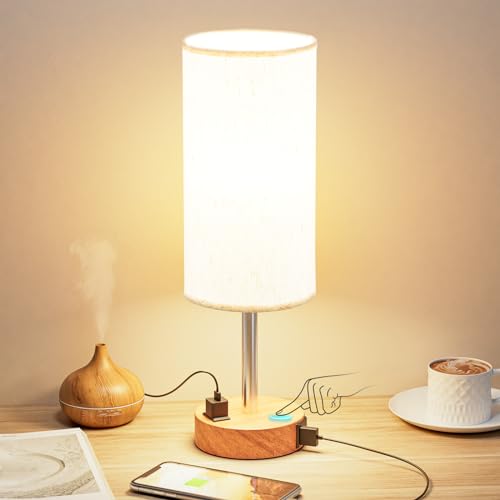
1. Fenmzee Bedside Table Lamp — Best All-Round Touch Lamp
The Fenmzee is the archetype of the modern bedside lamp: a 14-inch touch lamp with 3-way dimming, USB A and C charging, an AC outlet, an included LED bulb, a fabric shade, and a wood-grain metal base. It covers the checklist of this guide — dimming, charging, sensible scale — in one small footprint.
| Spec | Detail |
|---|---|
| Height | 14 inch |
| Dimming | 3-way dimmable touch control |
| Charging | USB A + C ports and an AC outlet |
| Bulb | LED bulb included |
| Shade | Fabric lampshade; wood-grain metal base |
Strengths
- Three light levels cover reading, ambience and night-light duty
- USB A and C plus an outlet retire the power strip hunt
- Compact 14-inch scale suits real nightstands
Trade-offs
- Touch controls can be triggered by a fumbling hand at 3 a.m. until you learn its spots
- Fabric shade wants occasional dusting
- One lamp, one finish story — pairs must be bought as two singles or a set
The Fenmzee demonstrates why the modern bedside lamp is really a small power and light station. The charging cluster — both USB standards plus a pass-through outlet — means the lamp does not consume the nightstand’s only socket; it multiplies it. Add genuine 3-way dimming and the lamp covers the three bedside lighting jobs (read, relax, check the time without waking the room) that this guide’s brightness section separates.
Its 14-inch height is the other lesson: proportioned for a nightstand, not a desk, so the shade sits near seated eye level where bedside light belongs. If you buy one lamp from this shortlist to learn what your household actually uses, buy this profile — then specialize from knowledge.
Best for: Most nightstands, couples standardizing on one model, and first-apartment setups / Not suited for: Anyone wanting app control or color-changing light
Check on Amazon — check price on Amazon before you buy, because countertop oven pricing moves often and the listing is the only place to confirm the current configuration, included accessories, and delivery options.

2. Yarra-Decor Touch Control Bedside Table Lamp — Best Warm Light Classic
The Yarra-Decor pairs touch dimming with two USB charging ports, a 3000K warm white LED bulb included, a round beige fabric shade, and a metal base. Its catalog identity is warmth: 3000K is the color temperature this guide recommends for bedrooms, and the beige shade keeps that warmth flattering rather than yellow.
| Spec | Detail |
|---|---|
| Color temperature | 3000K warm white (bulb included) |
| Dimming | 3 brightness levels, touch control |
| Charging | 2 USB charging ports |
| Shade | Round beige fabric shade; metal base |
Strengths
- Published 3000K warmth — the bedroom-correct temperature
- Two USB ports cover phone and one more device
- Classic shade-and-base silhouette suits traditional rooms
Trade-offs
- No AC outlet pass-through, unlike some rivals here
- Beige shade is a palette commitment toward warm neutrals
- Touch-only control; no mechanical switch backup
This lamp is the guide’s color-temperature lesson made physical. Much bedside misery is not brightness but temperature: a cool, bluish bulb makes a bedroom feel like a clinic and fights the evening’s wind-down, while a stated 3000K warm white supports it. Because the bulb is included and specified, the Yarra-Decor removes the guesswork that buying lamp and bulb separately creates.
Choose it when the room is traditional, the palette warm, and the brief is a lamp that behaves like a lamp — with charging quietly added. It is the least ‘gadget’ option among the touch models here, and for many bedrooms that restraint is exactly right.
Best for: Traditional bedrooms and warm palettes that want correct 3000K light with charging / Not suited for: Buyers who need an AC outlet on the lamp itself
Check on Amazon — check price on Amazon before you buy, because countertop oven pricing moves often and the listing is the only place to confirm the current configuration, included accessories, and delivery options.

3. Govee RGBIC Smart Table Lamp 2 — Best Smart Lamp
The Govee RGBIC Smart Table Lamp 2 is the connected pick: a touch bedside lamp compatible with SmartThings, Matter, and Alexa, with 64 scene modes and RGBIC color capability, in a corded design. It is the lamp for households that run their evenings by voice, routine, and app — and for anyone who wants the bedside light to double as the room’s mood instrument.
| Spec | Detail |
|---|---|
| Smart platforms | SmartThings, Matter and Alexa compatible |
| Scenes | 64 scene modes |
| Light | RGBIC color-changing |
| Design | Corded touch bedside lamp |
Strengths
- Full smart-home integration including Matter for future-proofing
- Scenes and colors turn one lamp into many moods
- Routines can fade light down at night and up in the morning
Trade-offs
- Corded smart features need Wi-Fi and an app to shine
- Color capability is wasted on buyers who only want warm white
- Costs its place at the premium end of this shortlist
Smart lamps earn their premium through routines, not party colors: a lamp that dims itself to a warm glow at bedtime, lights a soft path-brightness if you rise at night (where sensors and routines allow), and wakes the room gently in the morning changes the experience of the whole bedroom. The Govee’s platform list — Matter above all — means those routines can live in whichever smart-home system the household already runs, rather than demanding a new one.
Be honest about the fit: if nobody in the house will open an app or speak to a voice assistant, this lamp’s premium buys features that will sit unused, and the Fenmzee or Yarra-Decor will serve better. If the house is already smart, this is the bedside endpoint that completes it.
Best for: Smart homes, teens’ rooms, and anyone who wants scenes, schedules and voice control / Not suited for: App-averse households and guest rooms where simplicity rules
Check on Amazon — check price on Amazon before you buy, because countertop oven pricing moves often and the listing is the only place to confirm the current configuration, included accessories, and delivery options.

4. Touch Lamps for Bedroom, Set of 2 (Lynnoland) — Best Matched Pair
Sold as a set of two, these 17.6-inch touch lamps bring 3-way dimming, USB C and A ports, an AC outlet, included LED bulbs, blue fabric shades, and silver metal bases. The pair format is the point: matched lamps are what make a primary bedroom look finished, and buying them as a set guarantees the match.
| Spec | Detail |
|---|---|
| Quantity | Set of 2 |
| Height | 17.6 inch |
| Dimming | 3-way dimmable touch |
| Charging | USB C + A ports and AC outlet |
| Shade | Blue fabric shade; silver metal base |
Strengths
- True matched pair — no dye-lot or model drift between sides
- Tallest lamps here, suiting higher beds and bigger nightstands
- Full charging cluster on each side of the bed
Trade-offs
- Blue shades are a definite palette choice — confirm they suit the room
- 17.6 inches can overwhelm small nightstands
- A set is a bigger single decision than one lamp
Symmetry is the cheapest interior design trick in the bedroom, and this set industrializes it. Two identical lamps at identical heights turn a bed into a composed scene; two near-miss singles — same style, different batch, slightly different shade — read as an accident forever. The set removes the risk, and its per-side charging clusters end the nightly negotiation over the one good outlet.
Check the scale before committing: at 17.6 inches these are statement lamps for standard-to-large nightstands and taller mattress stacks. In the terms of this guide’s sizing section, measure your seated eye level and nightstand width first — when the numbers fit, the pair is the most finished-looking purchase in this shortlist.
Best for: Primary bedrooms furnishing both sides at once, and larger nightstands / Not suited for: Small nightstands or rooms where blue clashes with the palette
Check on Amazon — check price on Amazon before you buy, because countertop oven pricing moves often and the listing is the only place to confirm the current configuration, included accessories, and delivery options.

5. Dicoool Bedside Table Lamp — Best Soft Neutral
The Dicoool is a 14-inch touch lamp with 3-way dimming, USB A and C charging, an included LED bulb, a cream fabric shade, and a wood-grain metal base. Against the Fenmzee — its closest relative here — it trades the AC outlet for a softer cream palette, which makes it the pick for light, calm bedrooms.
| Spec | Detail |
|---|---|
| Height | 14 inch |
| Dimming | 3-way dimmable touch |
| Charging | USB A + C ports |
| Bulb | LED bulb included |
| Shade | Cream fabric shade; wood-grain metal base |
Strengths
- Cream and wood-grain palette suits Scandinavian and neutral rooms
- USB A and C cover current phones and tablets
- Compact 14-inch footprint for smaller nightstands
Trade-offs
- No AC outlet pass-through
- Cream shade shows dust sooner than darker shades
- Touch-only operation, like most of this class
Small differences decide bedside happiness, and this lamp is the case study: same sensible class as the Fenmzee, minus the outlet, plus a palette that disappears into calm rooms. If your nightstand devices are all USB — phone, watch, earbuds — the missing outlet costs nothing, and the cream shade’s glow is the gentlest in this shortlist after lights-out.
Choose the Dicoool when the bedroom’s design language is light wood, white bedding, and quiet — the lamp will look less like equipment and more like part of the room. It is also a kind single for a guest room, where its simplicity needs no explaining.
Best for: Neutral, light-wood and Scandinavian-style bedrooms; guest rooms / Not suited for: Anyone who needs the lamp to provide an AC outlet
Check on Amazon — check price on Amazon before you buy, because countertop oven pricing moves often and the listing is the only place to confirm the current configuration, included accessories, and delivery options.
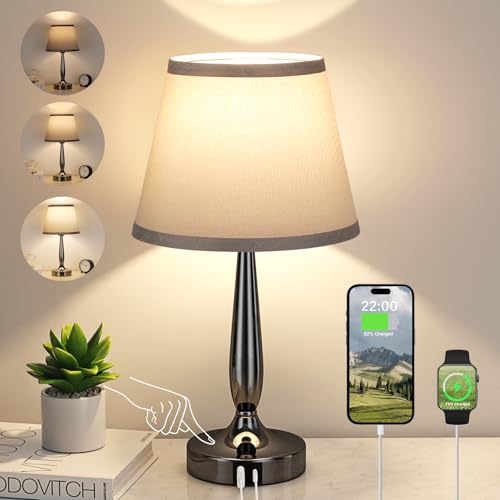
6. Kakanuo Touch Table Lamp for Bedroom — Best Simple Touch Lamp
The Kakanuo keeps the brief minimal: a small bedside lamp with a USB C port, 3-way dimmable touch control, and an included LED bulb, suited to nightstands, living rooms, and offices. It is the uncomplicated pick — the lamp for the second bedroom, the desk corner, the household that wants light and one modern charging port and nothing else.
| Spec | Detail |
|---|---|
| Dimming | 3-way dimmable touch control |
| Charging | USB C port |
| Bulb | LED bulb included |
| Design | Small bedside lamp |
Strengths
- Simple, focused feature set — nothing to configure
- USB C matches current-generation devices
- Small footprint suits tight nightstands and desks
Trade-offs
- Single USB port — multi-device households should look above
- No outlet or second port for a partner’s gear
- Minimalist design will not anchor a room’s style
Not every nightstand needs a power station. The Kakanuo serves the rooms where the brief is honestly small: a lamp that dims in three steps, charges a modern phone by USB C, and otherwise stays out of the way. Its discipline is its charm — and its price tier reflects the focus, making it the sensible second lamp, teen-desk lamp, or travel-household spare.
Within this guide it marks the floor of the modern feature set: touch dimming plus USB C is what ‘basic’ means now, and anything with less — a lamp with only a rotary switch and no charging — must justify itself on pure style. If your needs match its brief, buying more lamp is buying decoration, which is fine, but should be a knowing choice.
Best for: Second bedrooms, desks, teens and anyone wanting simple touch light with USB C / Not suited for: Couples needing multi-port charging on each side
Check on Amazon — check price on Amazon before you buy, because countertop oven pricing moves often and the listing is the only place to confirm the current configuration, included accessories, and delivery options.
Comparison Table
| Model | Badge | Key spec | Best for |
|---|---|---|---|
| Fenmzee Bedside Table Lamp | Best All-Round Touch Lamp | 14-inch touch lamp, USB A+C, outlet | Most nightstands, couples standardizing on one model, and first-apartment setups |
| Yarra-Decor Touch Control Bedside Table Lamp | Best Warm Light Classic | 3000K warm, 2 USB ports | Traditional bedrooms and warm palettes that want correct 3000K light with charging |
| Govee RGBIC Smart Table Lamp 2 | Best Smart Lamp | Matter/Alexa smart, 64 scenes | Smart homes, teens’ rooms, and anyone who wants scenes, schedules and voice control |
| Touch Lamps for Bedroom, Set of 2 (Lynnoland) | Best Matched Pair | Set of 2, 17.6-inch, full charging | Primary bedrooms furnishing both sides at once, and larger nightstands |
| Dicoool Bedside Table Lamp | Best Soft Neutral | 14-inch, cream shade, USB A+C | Neutral, light-wood and Scandinavian-style bedrooms; guest rooms |
| Kakanuo Touch Table Lamp for Bedroom | Best Simple Touch Lamp | USB C, 3-way touch dimming | Second bedrooms, desks, teens and anyone wanting simple touch light with USB C |
Common Buying Mistakes
Buying by photograph without measuring height
A lamp that looks right online glares or hides in person when its shade misses your eye level. The tape measure, applied to your own bed, is the entire cure.
Choosing cool white for a bedroom
However crisp it looks in the store, cool light fights the room’s purpose. Hold the 2700–3000K line for every bedside source.
Skipping dimming to save a little
A one-level bedside lamp fails two of its three jobs every night. Dimming is the highest-value feature in this category, ahead of style and smart features alike.
Mismatching the pair
Two near-identical lamps bought months apart differ in shade dye, finish, or bulb warmth, and the eye reads it as carelessness. Buy pairs together, always.
Forgetting the nightstand’s other tenants
A lamp that evicts the water glass, the book, and the phone has failed its surface. Match the base footprint to the nightstand, not just the height to the bed.
Final Recommendation
For most bedrooms, start with the all-round profile the Fenmzee represents — right height, three light levels, full charging — and specialize only where your household’s habits demand it: the Yarra-Decor for a traditional warm room, the Govee for a smart home, the Lynnoland pair for a primary bed furnished in one move, the Dicoool for a calm neutral palette, the Kakanuo for simple second-room duty. That is the method in one sentence: measure, warm the light, require dimming, then let features follow habits.
Before ordering, confirm the listing’s height, bulb, and port details for the exact lamp you chose, and check price on Amazon there. Then place it, sit up in bed, and check the shade against your eye line on the first evening — the ten-second test that tells you the choosing worked. A bedside lamp chosen this way stops being furniture you notice and becomes light you simply live by, which is the quiet ambition of every good bedroom.
Three verified examples worth opening first while you apply the criteria above: Fenmzee Bedside Table Lamp (Best All-Round Touch Lamp) — Check on Amazon; Yarra-Decor Touch Control Bedside Table Lamp (Best Warm Light Classic) — Check on Amazon; Govee RGBIC Smart Table Lamp 2 (Best Smart Lamp) — Check on Amazon. Confirm the exact size and configuration on the listing, and check price on Amazon there.
Related guides on this site that pair naturally with this one: Bedside Lamp Buying Guide How To Choose A Bed Frame How To Choose A Bed Sheet Set How To Choose A Nightstand How To Choose A Cooling Pillow
Frequently Asked Questions
How tall should a bedside lamp be?
Tall enough that the bottom of the shade sits near your eye level when you sit up in bed. With typical nightstands and mattresses, that lands many lamps in the 14–18 inch range — this guide’s shortlist spans 14 to 17.6 inches for exactly that reason. Measure your own stack rather than copying a number.
What color temperature is best for a bedside lamp?
Warm white, roughly 2700–3000K. It flatters the room, feels calm, and supports winding down. The Yarra-Decor in this guide ships a stated 3000K bulb. Save cooler temperatures for desks and task lighting elsewhere in the house.
Are touch lamps reliable for bedside use?
Yes — touch dimming is the modern bedside standard, combining switch and dimmer in a gesture you can find in the dark. The adaptation is learning the lamp’s touch zones so nightstand traffic does not trigger it. Households that prefer zero learning curve, especially in guest rooms, can still choose simple switched lamps happily.
Do I need USB ports in a bedside lamp?
If your phone and other devices charge on the nightstand — most households’ reality — ports on the lamp are the tidiest solution, especially combined with an AC outlet so the lamp multiplies the socket instead of consuming it. If your devices charge elsewhere, a simpler lamp serves you better and costs less.
Should bedside lamps match?
In a primary bedroom, yes: matched lamps at matched heights are the room’s easiest symmetry and make the bed look composed. Buy them together — as a set or two singles in one order — so finish, shade, and bulb warmth are identical. Deliberate asymmetry is a designer’s game; accidental asymmetry just looks accidental.
Are smart bedside lamps worth it?
Worth it in a smart home, where routines — fading down at night, rising gently in the morning, voice control from bed — genuinely change the experience, and where Matter compatibility keeps the lamp current across platforms. In a non-smart household, the same money buys a better conventional lamp. Decide by household, not by lamp.
Can a bedside lamp be too small or too large for the room?
Yes, in both directions, and the test is proportion rather than taste. Too small: the shade sits below your seated eye line, the bulb glares, and the lamp looks like a toy on a wide nightstand. Too large: the shade crowds the bed, the base evicts everything else from the surface, and the light overwhelms a small room even on its lowest step. The measurements in this guide — eye level for height, nightstand width for footprint — exist to catch both errors before the box is opened.