Disclosure: airfryerkitchensupply.com is reader-supported. When you buy through links on our site, we may earn an affiliate commission at no extra cost to you.
In this guide
Quick Picks
- Zinus 14 Inch Rumi Metal Bed Frame (Queen) — Best Simple Platform
- Zinus Allen Mid Century Wood Platform Bed Frame (Queen) — Best Wood Style
- Zinus Maya Upholstered Bed Frame (Queen) — Best Upholstered Comfort
- ZINUS Vivek Deluxe Wood Platform Bed Frame (Queen) — Best Traditional Wood
- Zinus 14 Inch Ellie Bamboo Platform Bed Frame (Queen) — Best Natural Material
- Zinus 14 Inch Elias Metal Platform Bed Frame (Full) — Best for Smaller Rooms
Key Takeaways
- Learning how to choose a bed frame starts with three measurements: mattress size, room dimensions, and the total bed height you want to sit on.
- Decide the support type first — platform slats or a box spring — because it determines which mattresses you can buy later on.
- Match slat spacing to your mattress type; foam mattresses need closer, flatter support than innersprings.
- Buy the frame for the room you have: walking space on both sides beats a bigger bed you edge around every single day.
- Every model shortlisted at the end of this guide was verified against Amazon catalog data for this site; check size and configuration on the listing before ordering, and keep the listing’s stated specifications with your records.
Knowing how to choose a bed frame matters because the frame is the longest-lived decision in the bedroom. Mattresses rotate every several years, bedding changes with the seasons, but a good frame stays — and the wrong frame quietly sabotages everything placed on it: a mattress that sags between wide slats, a bed too tall to sit on comfortably, a queen wedged into a room that needed a full. This guide walks through the decision in the order it should be made: size, support, height, material, and only then style.
The method here is deliberately unglamorous: measure, match specifications, and let aesthetics arbitrate among the finalists that pass. That order protects you, because the frame market is photographed beautifully and specified loosely — listings lead with lifestyle images and bury slat spacing, the one number your mattress warranty cares about. By the end of this guide you will know which numbers to demand, how to check them, and how to recognize the frame that fits your room, your mattress, and your habits.
You will also find a shortlist of verified frames at the end, chosen to demonstrate the criteria in real products — a metal platform, two distinct woods, an upholstered reader’s frame, a bamboo lightener, and an honest full-size for small rooms. Read the method first and the shortlist second; armed with your own measurements, you will see exactly why each one is there and which of them is shaped like your answer.
What size bed frame should you buy?
Start with the mattress you own or are buying, because the frame serves it: twin, twin XL, full, queen, king, and California king are not interchangeable, and a frame that is ‘close’ is a frame that squeaks, shifts, and wears the mattress edges. Queen is the default for couples in average rooms; king needs a room that can hold its width plus two nightstands without surrendering walking space; full is the honest answer for small rooms and single adults who sleep wide.
Then measure the room, not the catalog. A bed needs roughly two feet of walking space on each side and at the foot as a livability minimum — less than that and making the bed becomes a contact sport. Mark the candidate footprint on the floor with painter’s tape and live with the outline for a day: open the door, open drawers, walk the nighttime route to the bathroom. The tape test has saved more bedrooms than any review ever written.
Size quick reference
- Twin / twin XL — children, teens, dorms, narrow guest rooms
- Full — single adults, small rooms, guest rooms that must stay airy
- Queen — the couple default for standard bedrooms
- King / California king — large rooms; Cal king trades width for length for tall sleepers
Platform or box spring: which support system is right?
Modern frames divide into two support philosophies. Platform frames support the mattress directly on slats or a solid deck — no box spring — which lowers cost, lowers total height, and suits today’s foam and hybrid mattresses. Traditional frames expect a box spring or foundation between frame and mattress, which adds height and a measure of give that some innerspring mattresses are designed around. Neither is better; the mattress manufacturer’s specification is the referee, and it should be read before the frame is ordered.
Slat spacing is the specification that decides mattress health on a platform. Foam and latex mattresses need closely spaced slats — gaps small enough that the foam cannot sag between them — or a solid deck. Wide-spaced slats under a foam mattress produce the classic complaint of a bed that feels hammocky within a year, and many mattress warranties quietly require proper support. When a listing does not state slat spacing, treat that silence as information and ask, measure on delivery, or choose a frame that publishes its numbers.
How tall should your bed be?
Total bed height — floor to the top of the mattress — decides how the bed feels to use. The comfortable sitting benchmark for most adults is a finished height around knee level, so your feet rest flat when you sit on the edge. Build the number from parts: frame platform height, plus box spring if any, plus mattress thickness. A 14-inch platform with a 12-inch mattress and no box spring lands in the comfortable zone for most people; the same platform with a slim mattress suits those who prefer a low, modern sit; add tall legs or a foundation and you climb toward traditional heights.
Height is also storage in disguise. Platforms in the 14-inch class open real under-bed volume — bins, seasonal bedding, suitcases — while low-profile frames trade that space for their look. Decide which you value before choosing, because no accessory adds storage under a low frame later. And consider the household’s real users: children climbing in, older relatives visiting, anyone with knee trouble — the right height is the one every body in the house can use without thinking about it.
Which bed frame material suits your room and habits?
Metal platforms are the utility champions: strong, light, inexpensive to ship, quick to assemble, and visually quiet. Their weakness is presence — a plain metal frame mostly disappears, which is a virtue in small rooms and a disappointment if the bed should anchor the room’s design. Wood frames bring that presence, plus warmth and repairability, at the cost of weight and a need for occasional fastener checks as humidity cycles swell and shrink the joints.
Upholstered frames trade some practicality for daily comfort: a padded headboard transforms reading, working, and breakfast in bed, and fabric softens a room’s acoustics and look. The costs are maintenance — vacuuming, the occasional spot clean — and sensitivity to dust and pet hair. Bamboo and light woods occupy a useful middle: real material presence with a lighter visual weight, well suited to small or darker rooms. Choose by the room’s light and your cleaning temperament, not by the showroom photograph.
How do you check a frame before and after it arrives?
Before ordering, confirm four things on the listing or with the seller: the exact size, the slat spacing and support type, the stated weight capacity interpreted conservatively for two sleepers plus mattress, and whether a box spring is required, optional, or incompatible. Save screenshots of those specifications — if the delivered frame disagrees with them, you have your evidence ready.
On delivery day, assemble on a rug or blanket to protect floors, tighten fasteners in stages rather than fully at first pass so the frame squares itself, and then load the mattress and test: sit on every edge, roll across the middle, and listen. Small noises in week one usually mean a fastener wants another quarter-turn, not a defective frame. Recheck fasteners after the first month — new frames settle — and a quiet frame generally stays quiet.
How to choose a bed frame for specific sleepers
Couples should weight two specifications above all: stability and silence. A frame that flexes or chirps with every turn taxes two people’s sleep, so look for center support, closely fitted slats, and designs that advertise a noise-free brief — and then verify with the edge-and-roll test on delivery day. Heavier combined weights also argue for conservative capacity choices: buy headroom, not arithmetic equality, because a frame at its limit flexes, and flex is where noise is born.
For children and teens, prioritize rounded or padded edges, lower heights that make falls trivial, and sizes that survive growth — a twin XL or full often outlasts a twin bought for a seven-year-old. For guest rooms, the winning formula is a neutral, sturdy platform at standard height with storage underneath for the room’s other life as an office or hobby space; guests forgive plain styling and never forgive a sagging, squeaking bed. For tall sleepers, length is the specification: California king and twin XL exist for you, and a footboard is your enemy — choose open-foot designs so feet can extend past the mattress end without meeting furniture.
Adjustable and specialty frames: when are they worth considering?
Adjustable bases — which incline the head and foot of the mattress — suit readers, snorers whose partners plead for elevation, and anyone whose evenings genuinely happen in bed. They demand compatible mattresses (most foam and many hybrids flex; traditional tied-coil innersprings do not), they replace the frame decision entirely, and they cost accordingly. If your interest is occasional — a few degrees for reading — a wedge pillow solves it for a fraction; if it is nightly, the base earns its price. This site’s adjustable bed frame buying guide covers that branch in full.
Storage frames with drawers answer a different problem: rooms without closet surplus. They trade the open under-bed volume of a tall platform for finished, dust-protected drawers — better storage, less of it, at higher cost. Murphy and wall beds serve studios where the bed must vanish daily. Each specialty exists because a real constraint demands it; the general rule of this guide still applies — name your constraint first, and the specialty either clearly answers it or clearly does not.
How much should a bed frame cost, and where does the money go?
Frame pricing buys four things: material, joinery, support engineering, and finish. At the economical end, metal platforms deliver honest support with minimal material — the best value in the category for pure function. Mid-tier money adds real wood, upholstery, quieter hardware, and designs that survive being looked at. Premium money buys joinery that stays silent for a decade, finishes that age gracefully, and capacities with true headroom. What extra money should never buy is decoration on weak support: a gorgeous frame with wide, thin slats is a bad frame wearing a costume.
Budget the system, not the piece. Frame, foundation if needed, and mattress together form one purchase with one job; overspending on the visible frame while starving the mattress — or the reverse — produces a bed that disappoints as a whole. A sensible household split puts the mattress first for comfort, the frame second for support and silence, and treats the savings from platform designs (no box spring to buy) as found money for better bedding.
Headboard or no headboard? Deciding the bed’s backdrop
A headboard does three jobs: it stops pillows escaping into the wall gap, it gives seated sleepers a backrest, and it sets the bedroom’s visual center. If your bed sits against a wall and anyone reads in it, a headboard earns its place; the only questions are material and height. Upholstered headboards maximize comfort and soften sound; wood headboards maximize durability and match furniture; metal reads light and modern. Height should clear your pillows plus a comfortable lean — too low is a pillow-stop only, too tall can overwhelm a small room or clash with windows and art.
Skipping the headboard is a legitimate modern choice: platform frames with clean lines let bedding and wall color carry the design, cost less, and fit under windows where a headboard cannot go. The honest costs are pillows that migrate and a wall that takes the wear of leaning — a washable paint finish or a row of firm European pillows is the usual compensation. Decide by your evenings: readers need headboards, minimalists can skip them, and nobody should buy one by default without asking which life the bed actually lives.
A worked example: choosing a frame for a real room
Consider a common case: a 11-by-13-foot bedroom, a couple, a queen foam mattress already owned, one reader, one light sleeper, and a closet too small for the household’s bedding. The tape test passes a queen with walking space both sides. The mattress specification demands close slats — that single fact deletes half the market and every wide-slat bargain. The reader argues for a headboard; the light sleeper argues for silence and stability; the closet argues for under-bed storage, which argues for a 14-inch-class platform.
Watch the shortlist assemble itself: an upholstered close-slat platform with storage height satisfies all four constraints — in this guide’s verified examples, the Maya’s profile with a taller platform’s storage logic is the shape of the answer, and where one model cannot satisfy everything, the constraints rank the compromise: support and silence are non-negotiable, headboard comfort next, storage last because bins can live elsewhere. That ranking exercise — constraints first, ranked honestly, style as tiebreaker — is the entire method of this guide compressed into one paragraph, and it works for every room, budget, and sleeper combination you will ever apply it to.
How to choose a bed frame when you rent or move often
Renters and frequent movers should add three filters to the standard method. First, assembly and disassembly: a frame that bolts together in twenty minutes and comes apart without damage will survive five moves; a frame with one-time fittings or glued joints may not survive two. Metal platforms and simple slatted wood frames dominate this category for a reason. Second, floor protection: metal feet and hard casters mark rental floors, so choose frames with capped or padded feet, or budget for furniture pads from day one — deposits have been lost over less. Third, weight and piece size: a frame whose longest piece fits your stairwell, your car, and your next apartment’s stairwell is a frame you keep; measure the route at both ends of the move.
Renters should also think about the headboard question differently: wall-mounted headboards and leaning panels risk the wall, while frame-attached headboards travel with the bed and leave no trace. And because rental bedrooms vary wildly in size, a frame in a standard size with a neutral profile — the Rumi’s formula — adapts to the next room instead of demanding the next room adapt to it. Mobility is a specification; price it into the decision like any other.
How to care for a bed frame so it stays silent and solid
Frames ask for very little: a fastener check twice a year, timed to the season changes when wood moves most; a vacuum under and around the base when you rotate the mattress; and prompt attention to new noises, because a squeak addressed in week one is a quarter-turn, while a squeak ignored for a year is a worn joint. Keep spare fasteners from assembly day in a labeled bag taped under the frame — future you, mid-move, will be grateful.
Material care is simple and specific. Wood wants dusting and protection from standing moisture; a coaster’s discipline on the headboard shelf, if it has one. Metal wants a check for chips in painted finishes in humid rooms — a dab of matching paint stops rust before it starts. Upholstery wants vacuuming with the mattress rotation and immediate blotting of spills, never rubbing. None of this exceeds ten minutes a season, and it is the entire difference between a frame that serves five years and one that serves fifteen.
What are the signs of a well-made frame in a listing?
Listings cannot be sat on, so learn to read construction from specifications and photographs. Positive signs: slat counts and spacing stated numerically; a center rail with supporting legs named for queen and king sizes; fastener types described rather than hidden; weight capacity given as a number; and photographs that show the support system from above with the mattress removed — a seller proud of the platform shows the platform. Detail photos of joints, corners, and hardware count for more than a dozen styled room shots.
Warning signs are equally legible: support described only with adjectives; no slat information anywhere; capacity absent; and a gallery that never shows the frame undressed. None of these prove a bad frame, but each removes a way of verifying a good one, and in a category where the mattress’s warranty rides on support, unverifiable is a rational reason to move to the next candidate. The verified shortlist later in this guide was chosen partly on this legibility — every model’s size, material, and support type could be confirmed from its catalog data before it earned a place.
How to Choose a Bed Frame in Eight Steps
- Measure the room: Record wall-to-wall dimensions, door swing, and window positions. Tape the candidate bed footprint on the floor and live with it for a day.
- Fix the mattress size: Decide twin, full, queen, or king from the room measurements and who sleeps in the bed — not from habit or aspiration.
- Read the mattress specification: Check your mattress maker’s support requirements: platform or foundation, and maximum slat spacing if it is a platform.
- Set the height budget: Choose frame height, foundation, and mattress thickness so the finished bed top lands near knee height for the main sleeper.
- Decide the storage question: If under-bed storage matters, shortlist frames in the taller platform class; if looks matter more, accept low-profile trade-offs knowingly.
- Choose material by room: Metal for utility and small rooms, wood for presence, upholstery for sitting-up comfort, light woods and bamboo for darker rooms.
- Verify the specifications: Confirm size, slat spacing, capacity, and box-spring policy on the listing before ordering; screenshot them.
- Assemble and settle-test: Assemble carefully, test edges and center for noise and flex, and re-tighten fasteners after the first month of use.
Troubleshooting: Problems People Hit and How to Fix Them
Problem: the bed squeaks at night → Tighten every fastener a quarter-turn, check that slats sit fully in their supports, and confirm the frame stands level — an unlevel floor under one leg is a common hidden cause. Felt pads between slat and rail silence metal-on-wood contact.
Problem: the mattress feels like it sags in the middle → Measure the slat gaps. Foam mattresses on wide-spaced slats sag between them; add a bunkie board or a plywood deck cut to size, or replace the frame with a close-slat platform that meets the mattress specification.
Problem: the bed is too tall to sit on comfortably → Remove the box spring if the frame allows platform use, or swap to a lower-profile frame. Do not solve height with a step stool as a permanent fixture — the frame stack is adjustable at purchase, not after.
Problem: the bed is too low and feels like a futon → Add a foundation or taller legs where the design permits, or choose a thicker mattress at replacement time. Low frames pair with thick mattresses by design; the pairing, not the frame alone, sets the height.
Problem: the frame wobbles after assembly → Disassemble to the wobbling joint, check for a cross-threaded or missing fastener, and reassemble tightening in stages. Persistent wobble on a level floor with correct hardware is a defect — use the listing specifications you saved to support a claim.
Models That Match These Criteria
These six frames were verified against Amazon catalog data for this site and chosen to demonstrate the guide’s criteria — platform support, honest heights, distinct materials — across queen and full sizes. Confirm the exact size on the listing; most are offered in several sizes and the size in the title is the one reviewed. Read them as worked examples rather than a ranking: the best frame here is the one whose size, support, height, and material match the measurements you took in the sections above, and for many readers that will be obvious by the time they reach the table.
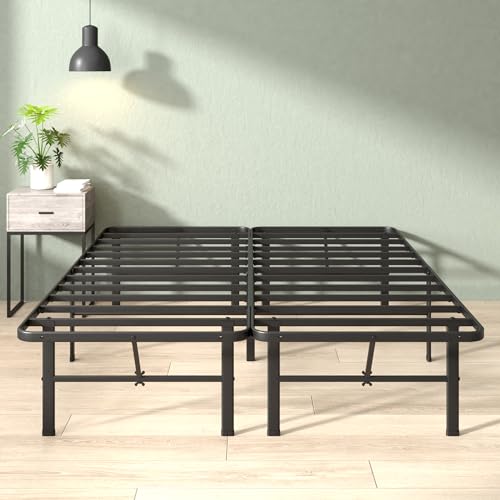
1. Zinus 14 Inch Rumi Metal Bed Frame (Queen) — Best Simple Platform
The Rumi is the straightforward metal platform: a 14-inch SmartBase-style foundation that needs no box spring, assembles quickly, and leaves generous storage space underneath. It suits the measuring advice in this guide perfectly — a standard queen footprint, honest height, and slat support that works with foam and hybrid mattresses alike.
| Spec | Detail |
|---|---|
| Size | Queen |
| Height | 14 inch |
| Type | Metal platform, no box spring needed |
| Assembly | Quick assembly |
Strengths
- No box spring cost or height to plan around
- 14-inch height creates real under-bed storage
- Quick assembly suits first apartments and guest rooms
Trade-offs
- Minimalist metal look will not satisfy traditional styling
- Very tall mattress pairings can make the bed high overall
- Headboard is not the design focus of this frame
Choose the Rumi when your checklist says: standard size, platform support, storage underneath, done. It demonstrates why frame height is a system decision — 14 inches of frame plus a typical mattress lands most sleepers at a comfortable sitting height, while the open base turns dead space into storage. It is the reference example for the ‘measure first, decorate second’ method this guide teaches.
Best for: First apartments, guest rooms and anyone who wants storage plus simplicity / Not suited for: Buyers shopping for a statement headboard or traditional wood styling
Check on Amazon — check price on Amazon before you buy, because countertop oven pricing moves often and the listing is the only place to confirm the current configuration, included accessories, and delivery options.

2. Zinus Allen Mid Century Wood Platform Bed Frame (Queen) — Best Wood Style
The Allen shows what the wood-platform route offers: a solid wood foundation with wood slat support, no box spring needed, and a mid-century profile that makes the frame part of the room’s design rather than hidden under bedding. Its low profile is the key measurement to check against your preferred sitting height.
| Spec | Detail |
|---|---|
| Size | Queen |
| Material | Solid wood foundation |
| Support | Wood slat support, no box spring needed |
| Style | Mid-century, low profile |
Strengths
- Real wood presence that anchors a bedroom’s style
- Slat support suits foam and hybrid mattresses
- Low profile pairs well with thicker modern mattresses
Trade-offs
- Low profile plus a thin mattress can sit too low for some sleepers
- Wood frames ask for occasional bolt checks as seasons change
- Heavier to move than metal platforms
The Allen is the pick for buyers whose frame decision is led by the room: warm wood, clean lines, a headboard presence that photographs like furniture. Its lesson within this guide is the height equation — a low-profile frame plus a thick mattress equals a standard bed height, while the same frame with a slim mattress can feel like a futon. Run the numbers in the measuring section and the Allen rewards you with the best-looking sleep setup in this list.
Best for: Style-led bedrooms and mid-century or Scandinavian schemes / Not suited for: Anyone who needs tall under-bed storage
Check on Amazon — check price on Amazon before you buy, because countertop oven pricing moves often and the listing is the only place to confirm the current configuration, included accessories, and delivery options.

3. Zinus Maya Upholstered Bed Frame (Queen) — Best Upholstered Comfort
The Maya brings upholstery to the platform category: an asymmetric upholstered headboard, durable wooden slats, and a noise-free design brief. It is the frame for readers — literally: a padded headboard changes evening reading and morning coffee in bed from a wall-lean to a proper backrest.
| Spec | Detail |
|---|---|
| Size | Queen |
| Headboard | Upholstered, asymmetric design |
| Support | Durable wooden slats |
| Design | Noise-free sleep brief |
Strengths
- Padded headboard comfort for reading and sitting up
- Wooden slat support under the upholstery
- Quiet design suits light sleepers and partners
Trade-offs
- Fabric headboards need occasional vacuuming and care
- Asymmetric styling is a taste commitment
- Upholstery adds bulk when moving rooms
Upholstered frames answer a comfort question metal and wood cannot: what does the bed lean like? The Maya’s padded headboard and quiet construction make it the couples’ and readers’ pick, and its wooden slats keep mattress supportorthodox underneath the softness. Within this guide it is the worked example of choosing by how you use the bed beyond sleeping — because for many households the bed is also the reading chair, the laptop desk, and the Sunday-morning café.
Best for: Readers, couples, and anyone who sits up in bed daily / Not suited for: Homes with heavy dust or pet-hair challenges on fabric
Check on Amazon — check price on Amazon before you buy, because countertop oven pricing moves often and the listing is the only place to confirm the current configuration, included accessories, and delivery options.

4. ZINUS Vivek Deluxe Wood Platform Bed Frame (Queen) — Best Traditional Wood
The Vivek Deluxe is the traditionalist’s platform: a wood frame with a proper headboard, wood slat support, and no box spring requirement. Where the Allen leans modern, the Vivek leans classic — the frame for bedrooms built around wood furniture that predates trends.
| Spec | Detail |
|---|---|
| Size | Queen |
| Material | Wood platform with headboard |
| Support | Wood slat support, no box spring needed |
| Assembly | Easy assembly |
Strengths
- Classic wood presence with a full headboard
- Slat support without a box spring simplifies the stack
- Easy assembly for a substantial-looking frame
Trade-offs
- Traditional styling will not suit ultra-modern rooms
- Wood tones must be matched to existing furniture honestly
- Like all wood frames, periodic fastener checks keep it silent
The Vivek demonstrates the safest long-term style bet in bedroom furniture: real wood in a classic profile ages by patina rather than by fashion cycle. Its slat platform keeps the mattress decision simple, and the headboard gives pillows a proper stop — a small nightly comfort buyers underestimate until they have lived without one. Choose it when the bedroom’s other furniture is wood and staying.
Best for: Traditional bedrooms and long-term, buy-once shoppers / Not suited for: Ultra-modern or industrial styling schemes
Check on Amazon — check price on Amazon before you buy, because countertop oven pricing moves often and the listing is the only place to confirm the current configuration, included accessories, and delivery options.

5. Zinus 14 Inch Ellie Bamboo Platform Bed Frame (Queen) — Best Natural Material
The Ellie uses bamboo in a 14-inch platform with wood slat support and a minimalist design — a lighter visual footprint than dark woods, with the same under-bed storage advantage as the metal Rumi. Bamboo’s sustainability story is the bonus; its clean look is the point.
| Spec | Detail |
|---|---|
| Size | Queen |
| Material | Bamboo |
| Height | 14 inch |
| Support | Wood slat support, no box spring needed |
Strengths
- Bamboo brings a light, natural finish to the platform format
- 14-inch height keeps under-bed storage in play
- Minimalist design suits small, calm bedrooms
Trade-offs
- Light finishes show scuffs more honestly than dark wood
- Minimalist headboard presence is subtle by design
- Bamboo is a specific palette — check it against your flooring
The Ellie is the answer for bedrooms that feel heavy: small rooms, dark floors, north light. A light bamboo frame lifts the visual weight of the bed — the largest object in any bedroom — while the 14-inch platform keeps storage practical. It also illustrates this guide’s material lesson: choose frame material by the room’s light and existing palette first, and by abstract preference second.
Best for: Small or dark bedrooms that need a lighter visual footprint / Not suited for: Buyers wanting a bold, high-contrast headboard statement
Check on Amazon — check price on Amazon before you buy, because countertop oven pricing moves often and the listing is the only place to confirm the current configuration, included accessories, and delivery options.

6. Zinus 14 Inch Elias Metal Platform Bed Frame (Full) — Best for Smaller Rooms
The Elias is the full-size entry: a 14-inch metal platform with steel support and no box spring needed. It represents the sizing decision many households actually face — a full bed in a room that cannot honestly host a queen — and it makes that decision well, with storage height and simple assembly.
| Spec | Detail |
|---|---|
| Size | Full |
| Height | 14 inch |
| Material | Steel platform |
| Support | No box spring needed |
Strengths
- Full size fits rooms a queen would crowd
- Steel support with a simple, sturdy brief
- 14-inch height preserves storage in small rooms
Trade-offs
- Full size is snug for two adults long-term
- Metal styling is functional rather than decorative
- Measure doorways — even full frames travel in pieces, but plan the route
The Elias earns its place as the honest small-room answer. This guide’s sizing section argues that a bed should leave walking space on both sides and room for the door to swing — and in many apartments and older houses, that arithmetic lands on full, not queen. Choosing the Elias is choosing the room that works over the size that sounds standard, and its storage height means the smaller footprint gives nothing back.
Best for: Small bedrooms, teens’ rooms and guest rooms where a queen crowds the space / Not suited for: Couples who know they sleep wide
Check on Amazon — check price on Amazon before you buy, because countertop oven pricing moves often and the listing is the only place to confirm the current configuration, included accessories, and delivery options.
Comparison Table
| Model | Badge | Key spec | Best for |
|---|---|---|---|
| Zinus 14 Inch Rumi Metal Bed Frame (Queen) | Best Simple Platform | 14-inch metal platform, queen | First apartments, guest rooms and anyone who wants storage plus simplicity |
| Zinus Allen Mid Century Wood Platform Bed Frame (Queen) | Best Wood Style | Solid wood platform, low profile | Style-led bedrooms and mid-century or Scandinavian schemes |
| Zinus Maya Upholstered Bed Frame (Queen) | Best Upholstered Comfort | Upholstered headboard, wooden slats | Readers, couples, and anyone who sits up in bed daily |
| ZINUS Vivek Deluxe Wood Platform Bed Frame (Queen) | Best Traditional Wood | Wood platform with headboard | Traditional bedrooms and long-term, buy-once shoppers |
| Zinus 14 Inch Ellie Bamboo Platform Bed Frame (Queen) | Best Natural Material | Bamboo platform, 14 inch | Small or dark bedrooms that need a lighter visual footprint |
| Zinus 14 Inch Elias Metal Platform Bed Frame (Full) | Best for Smaller Rooms | Full size, 14-inch steel platform | Small bedrooms, teens’ rooms and guest rooms where a queen crowds the space |
Common Buying Mistakes
Choosing size by habit instead of by room
‘We have always had a queen’ is not a measurement. Rooms decide sizes; the tape test on the floor settles arguments that opinions cannot.
Ignoring slat spacing until the mattress sags
The frame’s cheapest specification to check is the one mattress warranties care about most. Verify spacing before purchase, not after the foam dips.
Buying a frame and mattress in isolation
Height, support type, and warranty requirements bind the two together. Decide them as one system with one combined height and support plan.
Forgetting the delivery route
King frames and upholstered headboards meet narrow stairwells and tight landings. Measure the route — doors, turns, stairs — before the delivery day does it for you.
Skipping the one-month re-tighten
New frames settle as joints seat and wood acclimates. Five minutes with the hex key at week four prevents the squeaks people blame on the frame forever.
Final Recommendation
If you take one method from this guide, take the order of operations: room first, mattress specification second, height third, material fourth, style last. Followed honestly, it produces a shortlist where every candidate works — and then taste can safely decide. Among the verified examples here, the Zinus Rumi is the default platform for most rooms, the Allen and Vivek split the wood vote between modern and traditional, the Maya serves readers and couples, the Ellie lightens dark rooms, and the Elias makes the honest full-size case for small spaces.
Before ordering any frame, re-check the listing for the exact size, slat specification, and configuration, and check price on Amazon there. Then run the tape test one last time. A bed frame chosen this way disappears into your life the way good furniture should — silent, solid, and forgotten about for years, which is the highest compliment a frame can earn. And when the mattress eventually changes, as mattresses do, you will find the decision easier the second time: a frame chosen by measurement and specification accepts its next mattress the way it accepted the first, because the method never depended on a particular mattress — only on the room, the sleeper, and the numbers.
Three verified examples worth opening first while you apply the criteria above: Zinus 14 Inch Rumi Metal Bed Frame (Queen) (Best Simple Platform) — Check on Amazon; Zinus Allen Mid Century Wood Platform Bed Frame (Queen) (Best Wood Style) — Check on Amazon; Zinus Maya Upholstered Bed Frame (Queen) (Best Upholstered Comfort) — Check on Amazon. Confirm the exact size and configuration on the listing, and check price on Amazon there.
Related guides on this site that pair naturally with this one: Bed Frame Buying Guide Adjustable Bed Frame Buying Guide How To Choose A Bed Sheet Set How To Choose A Bedside Lamp How To Choose A Cooling Pillow How To Choose A Nightstand
Frequently Asked Questions
Do I need a box spring with a platform bed frame?
No — that is the platform’s defining feature. Its slats or deck support the mattress directly. Adding a box spring to a platform usually makes the bed too tall and can void the platform’s clean support. Only add a foundation if the frame and mattress makers both call for one. If you already own a box spring from a previous bed, the honest options are to choose a traditional rail frame designed for it, or to retire it — stacking it on a platform ‘because it is there’ creates a bed that is too tall, less stable, and harder to make, which is a daily tax on a one-time saving.
How far apart should bed frame slats be?
Close enough that the mattress cannot sag between them. Foam and latex mattresses need the closest spacing or a solid deck; innersprings tolerate more. Because mattress warranties often specify support requirements, check your mattress maker’s stated maximum and match the frame to it — and prefer frames that publish their slat spacing.
What is the best bed frame height?
The one that puts the top of the mattress near your knee height, so you sit on the edge with feet flat. For most adults that means planning frame, foundation, and mattress thickness together rather than choosing any one of them alone. Taller platforms add storage; lower profiles add a modern look — decide which trade you want.
Are metal or wood bed frames better?
Neither, categorically. Metal wins on weight, assembly speed, and value; wood wins on presence, warmth, and repairability; upholstery wins on sitting-up comfort. The better frame is the one matched to your room’s light, your mattress’s support needs, and your tolerance for maintenance.
Can a bed frame make a mattress last longer?
Yes — correct support is a mattress’s life insurance. Slats at the right spacing, a level frame, and capacity headroom prevent the premature sagging that kills mattresses early. Conversely, a good mattress on a wrong frame will fail early and may not be covered, which is why this guide treats frame and mattress as one system.
How do I stop a new bed frame from squeaking?
Assemble on a level surface, tighten fasteners in stages, and re-tighten after the first month as joints settle. Check slats are fully seated, add felt pads where metal meets wood, and confirm the floor itself is level under all legs. Most squeaks are assembly stories, not product defects. To find a stubborn one, have a partner move on the bed while you listen at each joint in turn — the squeak will localize to one corner or rail, and that joint, re-seated and re-tightened, is almost always the whole cure.

