Disclosure: airfryerkitchensupply.com is reader-supported. When you buy through links on our site, we may earn an affiliate commission at no extra cost to you.
Where to buy
For anyone comparing the best copper kitchen sinks, this shortlist is the place to start: every model below was verified before its link was attached. Copper kitchen sinks are sold through Amazon, specialist kitchen dealers and the makers’ own stores. Read listings with unusual care in this category: “copper” describes both solid copper sinks and copper-finished steel, and the difference decides everything about ownership. This guide labels the two honestly in every pick, and you should confirm the material on the listing before ordering.
- Sinkology Lange Copper Farmhouse Sink, 32-Inch, Single Bowl — check price on Amazon; confirm whether the listing is solid copper or copper-finished steel before ordering.
- Sinkology Angelico Copper Drop-In Sink, 33-Inch, 3-Hole — check price on Amazon; confirm whether the listing is solid copper or copper-finished steel before ordering.
- Sinkology Lange Copper Farmhouse Sink, 32-Inch, Double Bowl — check price on Amazon; confirm whether the listing is solid copper or copper-finished steel before ordering.
- Sinkology Lange Copper Farmhouse Sink Kit, 32-Inch — check price on Amazon; confirm whether the listing is solid copper or copper-finished steel before ordering.
- Strictly Sinks 32-Inch Undermount Sink, Brushed Copper Finish — check price on Amazon; confirm whether the listing is solid copper or copper-finished steel before ordering.
- Strictly Sinks 32-Inch Undermount Workstation Sink, Brushed Copper Finish — check price on Amazon; confirm whether the listing is solid copper or copper-finished steel before ordering.
The best copper kitchen sinks are bought with the heart, but they should be chosen with the head, because copper is the most characterful and the most demanding material in this entire series. The best copper kitchen sinks — hand-hammered, solid, heavy-gauge — reward their owners with a living finish that deepens for decades, natural resilience that never rusts or chips, and a presence that turns a sink into the kitchen’s heirloom. They ask in return for gentle cleaning and an owner who enjoys change.
This guide ranks six verified options across the honest spectrum: four solid copper Sinkology sinks — the single and double farmhouse, the drop-in, and the complete kit — and two copper-finished steel workhorses from Strictly Sinks for buyers who want the colour without the commitment. Every linked model was verified before linking, and the distinction between solid and finished is stated in every review rather than buried, because an informed copper buyer is a happy copper owner.
In this guide
Quick Picks
- Sinkology Lange Copper Farmhouse Sink, 32-Inch, Single Bowl — Best Overall: The Lange is the copper sink most kitchens are picturing when they search: a hand-hammered, solid copper apron front that becomes the room’s focal point on day one and then spends decades developing a patina that makes it more beautiful, not less. Check price on Amazon.
- Sinkology Angelico Copper Drop-In Sink, 33-Inch, 3-Hole — Best Drop-In: The Angelico brings solid copper to kitchens that cannot undermount: a 33-inch drop-in with an integrated faucet deck, so the copper arrives without a counter replacement, a fabricator or a renovation. Check price on Amazon.
- Sinkology Lange Copper Farmhouse Sink, 32-Inch, Double Bowl — Best Double Bowl: Double-bowl households need not exile themselves from copper. Check price on Amazon.
- Sinkology Lange Copper Farmhouse Sink Kit, 32-Inch — Best Complete Kit: Copper ownership runs on accessories — the grid that protects the bowl, the drains finished to match, the care products that keep the patina beautiful rather than blotchy — and the Lange Kit bundles the correct ones in the box. Check price on Amazon.
- Strictly Sinks 32-Inch Undermount Sink, Brushed Copper Finish — Best Copper-Look Alternative: Honesty first: this is not a solid copper sink. Check price on Amazon.
- Strictly Sinks 32-Inch Undermount Workstation Sink, Brushed Copper Finish — Best Workstation: The workstation version of the copper-finish concept adds the ledge that turns the sink into a prep station, in a deep 10-inch bowl. Check price on Amazon.
How These Picks Were Chosen
Verification came first, as in every guide in this series: each model was confirmed against current catalogue listings before it received a link, and its material — solid copper versus copper-finished steel — was confirmed from the listing rather than assumed from the title. The criteria were copper-specific. For solid copper: gauge and construction (hand-hammered, heavy-gauge sinks age best), format coverage across farmhouse, drop-in, double bowl and kit, and the maker’s care ecosystem, because copper ownership succeeds or fails on care products and guidance. For the finished-steel picks: honesty of labelling, gauge of the underlying steel, and whether the finish route genuinely serves the buyer who chooses it. Colour and patina claims were treated with suspicion throughout — no sink in this guide is promised to stay bright, stay dark or patina evenly, because real copper does none of those things on command. No prices or ratings are printed; check price on Amazon when you buy.
The 6 Best Copper Kitchen Sinks

Sinkology Lange Copper Farmhouse Sink, 32-Inch, Single Bowl — Best Overall
The Lange is the copper sink most kitchens are picturing when they search: a hand-hammered, solid copper apron front that becomes the room’s focal point on day one and then spends decades developing a patina that makes it more beautiful, not less. As the single-bowl farmhouse in Sinkology’s range it pairs the classic format with the living finish that is copper’s whole argument.
| Material | Hand-hammered 17-gauge solid copper |
| Format | 32-inch apron-front (farmhouse) single bowl |
| Cabinet | Fits 36-inch cabinet (per listing) |
| Installation | Undermount apron-front installation |
Strengths
- Solid hand-hammered copper develops a unique living patina
- Apron front makes the copper the kitchen’s focal point
- Deep single bowl suits serious, pan-heavy cooking
Trade-offs
- Living finish changes with use; not for set-and-forget owners
- Requires gentle, non-abrasive cleaning
- Premium material at a premium position in the tier
Solid copper behaves unlike any other sink material, and the Lange shows why owners become evangelists. The surface is naturally antimicrobial in character, it never rusts or chips, and small scratches do not damage it — they join the hammered texture and are gradually absorbed as the patina shifts with use, water and touch. The apron front format suits the material: the copper face is the kitchen’s jewellery, displayed rather than hidden under a counter edge, and the deep single bowl handles farmhouse-scale cooking. The honest commitments are two. Copper asks for gentle cleaning — no abrasives, no harsh acids left sitting — and it asks its owner to love change, because a copper sink is a living finish that will not stay showroom-bright unless waxed and polished on a routine. Buyers who want their sink identical in year ten should choose composite; buyers who want it more characterful should choose this.
Best for: kitchens that want best overall from a copper sink / Not suited for: owners who want a finish that never changes and never asks for care, unless the pick says otherwise
Check on Amazon — check price on Amazon and confirm dimensions, gauge and cabinet requirements on the listing.

Sinkology Angelico Copper Drop-In Sink, 33-Inch, 3-Hole — Best Drop-In
The Angelico brings solid copper to kitchens that cannot undermount: a 33-inch drop-in with an integrated faucet deck, so the copper arrives without a counter replacement, a fabricator or a renovation. For a kitchen refresh built around one dramatic object, it is the most practical route into real copper in this guide.
| Material | Hand-hammered 17-gauge solid copper (antique copper finish) |
| Format | 33-inch drop-in single bowl with faucet deck |
| Faucet holes | 3-hole deck configuration (per listing) |
| Installation | Top-mount drop-in, suits existing counters |
Strengths
- Solid copper without a counter project or undermounting
- Antique finish starts with a mature, forgiving patina
- Integrated deck simplifies faucet planning
Trade-offs
- Rim and deck edges need a cleaning pass
- Faucet position is fixed by the deck
- Copper care rules still apply in full
Drop-in copper solves the material’s biggest practical barrier. Undermount and apron installations tie a copper sink to a counter project; the Angelico’s rim and deck let it replace an existing top-mount sink in an afternoon, faucet mounted on the sink itself. The antique finish is the other intelligent choice: it starts life with the deep, varied tone that bright copper takes months to earn, which makes the living-finish journey gentler for owners who love patina but fear the blotchy teenage phase. The deck’s three holes suit a standard faucet plus accessories, and the single bowl keeps the pan capacity family cooking needs. Compromises are the drop-in format’s own — a rim to clean around, a deck that fixes your faucet position — plus copper’s standing rules on gentle care. As a transformation per hour of installation effort, nothing else in this guide competes.
Best for: kitchens that want best drop-in from a copper sink / Not suited for: owners who want a finish that never changes and never asks for care, unless the pick says otherwise
Check on Amazon — check price on Amazon and confirm dimensions, gauge and cabinet requirements on the listing.

Sinkology Lange Copper Farmhouse Sink, 32-Inch, Double Bowl — Best Double Bowl
Double-bowl households need not exile themselves from copper. The double-bowl Lange keeps the hand-hammered apron front and living finish of the overall pick and divides the bowl for the wash-and-rinse, soak-and-prep routines that two-bowl cooks refuse to surrender — in a material that makes the daily routine feel like an occasion.
| Material | Hand-hammered solid copper, antique patina |
| Format | 32-inch apron-front double bowl |
| Cabinet | Fits 36-inch cabinet (per listing) |
| Installation | Apron-front undermount installation |
Strengths
- Copper farmhouse presence with a true two-bowl workflow
- Hammered texture forgives the marks double bowls collect
- Antique patina suits traditional and farmhouse kitchens
Trade-offs
- Each bowl smaller than the single-bowl model
- Apron install suits planned renovations
- Two bowls of copper care instead of one
The case here is the combination, because each half strengthens the other. The apron front displays the copper; the double bowl organises the work; and copper’s forgiving, self-blending surface is particularly kind to the divider and corners where double bowls usually show wear first. Hand-hammering is not merely decorative in a double bowl — the texture disguises the water spotting and minor marks that two working bowls accumulate. The trade-offs are the format’s constants: each bowl is smaller than the single Lange’s, so the largest roasting pans may need the diagonal or the oven-rack soak in the tub; the apron installation belongs to a planned counter project; and two bowls of living finish mean two bowls of gentle cleaning. Households that hand-wash daily and cook in a traditional or farmhouse kitchen will find this the most satisfying sink in the guide, full stop.
Best for: kitchens that want best double bowl from a copper sink / Not suited for: owners who want a finish that never changes and never asks for care, unless the pick says otherwise
Check on Amazon — check price on Amazon and confirm dimensions, gauge and cabinet requirements on the listing.
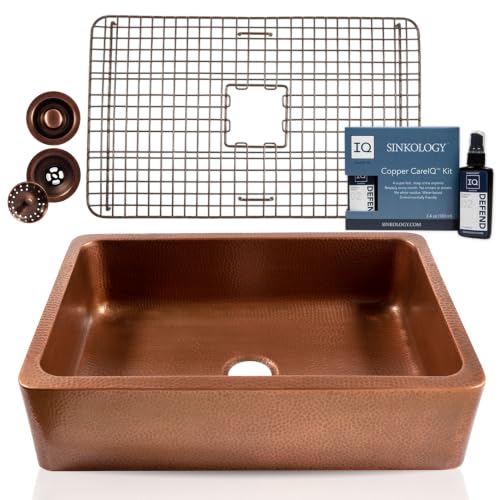
Sinkology Lange Copper Farmhouse Sink Kit, 32-Inch — Best Complete Kit
Copper ownership runs on accessories — the grid that protects the bowl, the drains finished to match, the care products that keep the patina beautiful rather than blotchy — and the Lange Kit bundles the correct ones in the box. For a first-time copper buyer, it removes every ‘which grid fits?’ and ‘what do I clean it with?’ question in a single purchase.
| Material | Hand-hammered solid copper apron front |
| Format | 32-inch single bowl farmhouse kit |
| Kit includes | Bottom grid, drains and care components (per listing) |
| Cabinet | 36-inch cabinet class (confirm on listing) |
Strengths
- Matched grid, drains and care remove copper’s accessory risks
- Establishes the correct care routine from day one
- The proven Lange bowl in its most complete form
Trade-offs
- Premium over the bare sink for components some owners own
- Kit value depends on using the included care system
- Same living-finish commitment as all solid copper
Kits matter more for copper than for any other material in this series, because copper’s accessories are material-specific. A generic grid can react with the surface; a mismatched drain finish looks like a mistake every single day; and the wrong cleaner can strip patina unevenly in one enthusiastic afternoon. The kit’s matched components eliminate all three risks, and the included care system establishes the waxing routine that separates copper sinks that glow from copper sinks that sulk. The bowl itself is the proven Lange single: hand-hammered, apron-fronted, sized for a 36-inch cabinet. The premium over the bare sink is real, and this guide’s judgement is that first-time copper owners recoup it in avoided mistakes within the first season. Experienced copper households who already own the care system should buy the bare Lange and spend the difference elsewhere.
Best for: kitchens that want best complete kit from a copper sink / Not suited for: owners who want a finish that never changes and never asks for care, unless the pick says otherwise
Check on Amazon — check price on Amazon and confirm dimensions, gauge and cabinet requirements on the listing.

Strictly Sinks 32-Inch Undermount Sink, Brushed Copper Finish — Best Copper-Look Alternative
Honesty first: this is not a solid copper sink. It is a well-made 16-gauge stainless steel sink wearing a brushed copper finish — and for households that want copper’s colour with steel’s set-and-forget temperament, that is not a lesser choice but a different and entirely respectable one. No patina, no waxing, no living finish: the colour you install is the colour you keep.
| Material | 16-gauge stainless steel with brushed copper finish |
| Format | 32-inch undermount single bowl |
| Sound | Sound dampening pads fitted |
| Includes | Bottom grid included (per listing) |
Strengths
- Copper colour with stainless steel’s easy temperament
- 16-gauge build with sound dampening and included grid
- No patina management or waxing routine required
Trade-offs
- Finish can wear at contact points; not solid copper
- Colour never develops living patina character
- Purists will always know — decide if that matters to you
The copper-look route deserves a fair hearing because it solves the two reasons people abandon solid copper: maintenance anxiety and finish unpredictability. A finished steel sink cleans like steel, matches a fixed design scheme permanently, and costs meaningfully less than solid copper while delivering the warm metallic tone that makes copper kitchens sing — particularly alongside copper-toned fixtures and hardware that themselves never change. The trade-offs must be stated as plainly as the benefits: a finish is a surface, and surfaces can wear at the drain and the grid contact points in a way solid copper never does, because solid copper has no ‘through’ to wear to. The sink will also never develop patina character; what you see is the whole story, forever. Buyers should choose with eyes open — and for busy households, rental-quality durability and design schemes built on an exact colour match, eyes-open copper-look is frequently the right answer.
Best for: kitchens that want best copper-look alternative from a copper sink / Not suited for: owners who want a finish that never changes and never asks for care, unless the pick says otherwise
Check on Amazon — check price on Amazon and confirm dimensions, gauge and cabinet requirements on the listing.

Strictly Sinks 32-Inch Undermount Workstation Sink, Brushed Copper Finish — Best Workstation
The workstation version of the copper-finish concept adds the ledge that turns the sink into a prep station, in a deep 10-inch bowl. It is the pick for keen cooks who want the copper look at the centre of a working kitchen — chopping over the bowl, draining over the bowl — without committing to solid copper’s care routine.
| Material | 16-gauge stainless steel, brushed copper finish |
| Format | 32-inch undermount workstation, 10-inch deep single bowl |
| Sound | Sound dampening pads fitted |
| Workstation | Integrated ledge for sliding accessories |
Strengths
- Workstation ledge adds real prep function in copper tones
- Deep 10-inch bowl handles prep debris and large pans
- Steel temperament: no patina or waxing routine
Trade-offs
- Copper finish, not solid copper — wear points apply
- Accessory inclusion varies; confirm before ordering
- Undermount install requires suitable counters
Workstation format and copper colour are a natural pairing in modern kitchens, because both are about the sink as the room’s working heart rather than its plumbing. The ledge carries boards and racks at counter height; the deep bowl beneath swallows the prep debris and the largest pans; and the brushed copper tone warms the stainless-steel practicality that the format usually wears. As with its sibling pick, the honesty rules apply: this is a finish on steel, with a finish’s virtues — permanence, easy cleaning, predictable colour — and its limits at wear points. The workstation accessories game also applies: confirm which accessories are included and which are extras before ordering, because ledge systems vary. For cooks who prep seriously and clean simply, this is the most functional copper-toned sink in the guide.
Best for: kitchens that want best workstation from a copper sink / Not suited for: owners who want a finish that never changes and never asks for care, unless the pick says otherwise
Check on Amazon — check price on Amazon and confirm dimensions, gauge and cabinet requirements on the listing.
Comparison Table
| Pick | Badge | Key spec | Best for |
|---|---|---|---|
| Sinkology Lange Copper Farmhouse Sink, 32-Inch, Single Bowl | Best Overall | Hand-hammered 17-gauge solid copper | Best Overall buyers |
| Sinkology Angelico Copper Drop-In Sink, 33-Inch, 3-Hole | Best Drop-In | Hand-hammered 17-gauge solid copper (antique copper finish) | Best Drop-In buyers |
| Sinkology Lange Copper Farmhouse Sink, 32-Inch, Double Bowl | Best Double Bowl | Hand-hammered solid copper, antique patina | Best Double Bowl buyers |
| Sinkology Lange Copper Farmhouse Sink Kit, 32-Inch | Best Complete Kit | Hand-hammered solid copper apron front | Best Complete Kit buyers |
| Strictly Sinks 32-Inch Undermount Sink, Brushed Copper Finish | Best Copper-Look Alternative | 16-gauge stainless steel with brushed copper finish | Best Copper-Look Alternative buyers |
| Strictly Sinks 32-Inch Undermount Workstation Sink, Brushed Copper Finish | Best Workstation | 16-gauge stainless steel, brushed copper finish | Best Workstation buyers |
Read the material column before the badge column. The first four picks are solid copper and a lifestyle; the last two are copper-toned steel and a convenience. Both are legitimate — provided you choose the one you actually meant.
How to Choose a Copper Kitchen Sink
Decide the material question first, because it is really a personality question. Solid copper is a living finish: it darkens, brightens where hands touch, develops patterns from your water and your cooking, and becomes unmistakably yours. Copper-finished steel is a fixed finish: identical in year ten, cleaned like any steel sink, and honest about being a colour rather than a metal. Neither answer is wrong, but they are different purchases wearing similar photographs, and most copper disappointment is simply a buyer who wanted one and received the other.
What gauge and construction should you look for?
In solid copper, gauge is destiny: heavier gauges (lower numbers) resist denting, sound solid rather than tinny, and carry the hammered texture that defines the look. Hand-hammering is functional as well as beautiful — the dimpled surface disperses light, disguises water spots and minor marks, and work-hardens the metal. Welds and seams should be smooth and finished, the apron (on farmhouse models) straight and true, and the drain opening standard-sized so quality strainers and disposals fit without improvisation.
Bright copper or antique patina — which starting finish?
Bright copper is essentially a photograph for a month and a journey afterwards: it will darken unevenly before it settles, and owners who wax regularly can hold it near-bright at the cost of a routine. Antique and pre-patinated finishes start where the journey ends, with deep, varied tones that change more gracefully and forgive the blotchy phase entirely. Most households are happier starting antique; romantics who want to watch the metal age from bright should choose bright with open eyes and a care kit in the cupboard.
Farmhouse, drop-in or undermount — which format fits your project?
Farmhouse apron fronts display the copper and belong to planned renovations with 36-inch cabinets and counters being fitted around the sink. Drop-ins like the Angelico transform an existing kitchen in an afternoon and keep the faucet on the deck. Plain undermounts in copper finish suit modern schemes where the colour should glow from within the counter line rather than announce itself across an apron. Match the format to the project’s reality, not its fantasy.
What size copper sink should you choose?
The 32- and 33-inch class dominates this guide because it dominates real kitchens: wide enough for roasting pans and sheet trays, matched to the 36-inch cabinets that farmhouse and statement sinks usually serve. Smaller copper sinks exist for bars and butler’s pantries, and they make charming secondary sinks, but as a kitchen’s only bowl they frustrate within a month. Depth matters as much as width — the farmhouse picks’ deep bowls hide a day of dishes and soak tall stockpots, which is half the farmhouse format’s practical appeal beneath the romance. Measure the cabinet before anything else, confirm the apron dimensions on farmhouse models against the cabinet’s false-front construction, and remember that copper’s weight wants a properly supported installation, particularly in apron format where the bowl’s face carries forward of the cabinet line.
How much does the care routine really cost in time and products?
Less than its reputation. The daily wipe is seconds and replaces the polishing steel owners do; the waxing rhythm is a few minutes every few months with a single care product; the grid is a one-time purchase. The true cost is attention rather than time — remembering not to leave a lemon half cut-side down overnight, not to park a wet steel-wool pad in the bowl, not to attack a mark with the scourer that lives by muscle memory at every other sink. Households that cook with acidic ingredients constantly should be doubly honest with themselves here, because copper records acid faithfully. Everyone else discovers within a season that the famous copper routine is mostly a set of tiny kindnesses that become automatic.
How is a copper farmhouse sink installed, and what can go wrong?
Apron-front installation is the one part of copper ownership best left to experienced hands or very careful amateurs. The cabinet’s front must be cut or built to receive the apron, the sink supported on a frame within the cabinet rather than hung from the counter, and the counter fitted around the apron with the reveal agreed beforehand. The classic errors are supporting the bowl by its rim alone — copper is heavy, and heavier full of water and dishes — and sealing the apron junctions so rigidly that seasonal movement cracks the sealant line. Water management matters too: an apron front sheds water down the cabinet face by design, so the cabinet front beneath should be a finish that tolerates drips, and the household should learn the quick wipe as part of the washing-up rhythm. None of this is difficult; all of it is specific, which is why this guide keeps steering first-time copper farmhouse buyers toward the kit and toward installers who have fitted aprons before.
Copper in a resale or rental kitchen — does it pay?
In owner-occupied homes being prepared for sale, a copper farmhouse sink is one of the few single items that can reposition an entire kitchen in photographs, because it reads instantly as craft and investment. Buyers remember the copper-sink kitchen. The caveat is taste: copper is a strong flavour, and a minority of buyers will read it as work. In long-term rentals the calculus flips — copper’s durability is superb, but its care rules depend on tenants who did not choose them, and a neglected copper sink can look tired in a way neglected steel does not. The copper-finish picks exist precisely for this middle ground: the photograph and the warmth, with a tenant-proof temperament. Choose by who will actually stand at the sink for the next five years, and the material decision makes itself.
What water type suits copper best, and what if yours is difficult?
Copper has lived with every water type for centuries, but the patina’s pace and pattern follow the water. Soft water lets the finish deepen evenly and slowly, the connoisseur’s scenario. Hard water adds mineral spotting to the story, which the hammered texture disguises and a wipe-dry habit largely prevents; left unwiped, scale can crust in the bowl’s quiet corners and needs gentle, non-abrasive removal. Highly chlorinated water can push patina toward darker, faster change in the first months. None of these is a disqualification — they are the local accent in the sink’s diary — but hard-water households should adopt the wipe habit from day one rather than month six, and every copper household should keep the maker’s care product in the cupboard rather than in a delivery box of good intentions.
How to Care for a Copper Sink (and Keep the Patina Beautiful)
Step 1: Rinse and wipe daily. Copper’s routine is thirty seconds: rinse away food acids and salts after use, and wipe dry when you can. Acids left sitting — lemon, vinegar, tomato, wine — strip patina in bright patches; rinsed promptly, they do no harm at all.
Step 2: Clean gently, always. Warm water, mild soap, a soft cloth. Never abrasive pads, scouring powders or harsh chemical cleaners, which scratch the surface and tear the patina unevenly. The hammered texture hides a multitude of sins provided you do not add new ones with a scourer.
Step 3: Protect the high-wear zones. Use the bottom grid so pans rest on steel rather than copper, and avoid leaving cast iron or steel wool sitting wet in the bowl, where they can mark the surface. Copper is tough, but it records its history — help it record a kind one.
Step 4: Wax on a rhythm. A quality copper wax or the maker’s care product, applied every few months, slows patina change, deepens the colour and makes water bead and rinse cleanly. Owners who want a brighter finish wax more often; owners chasing a deep patina wax rarely or never. Both are correct.
Step 5: Let it live. The final step is philosophical: stop inspecting. A copper sink’s beauty is cumulative and irregular, like a wooden table’s or a leather bag’s. The households that love copper longest are the ones that let the metal keep its diary.
Common Buying Mistakes
Buying “copper” without checking the material. The single most common copper mistake. Confirm solid versus finished on the listing, in the specifications, not the headline — and use this guide’s labelling as your checklist.
Expecting the showroom finish to persist. Solid copper changes. Buyers who need permanence should choose the finished-steel picks or another material entirely, and this guide would rather lose the sale than create a disappointed owner.
Cleaning copper like stainless steel. One afternoon with a scouring powder can undo a year of beautiful patina. Learn the gentle routine before the sink arrives, and retire the abrasives to the oven where they belong.
Skipping the bottom grid. On copper the grid is not an accessory but a protection system for the bowl floor, where pans otherwise grind the finish daily. If your pick does not include one, order the correct size with the sink.
Choosing thin, lightweight copper. Light-gauge copper dents, drums and feels cheap in the hand. In this material more than any other, weight is quality you can verify the moment the box arrives.
Final Recommendation
For the classic copper purchase, choose the Sinkology Lange Copper Farmhouse Sink, 32-Inch, Single Bowl — or its kit form, the Sinkology Lange Copper Farmhouse Sink Kit, 32-Inch, if this is your first copper sink. Renovations without new counters belong on the Sinkology Angelico Copper Drop-In Sink, 33-Inch, 3-Hole, and two-bowl households on the double Lange. Buyers who want the colour with a quieter life should choose between the two Strictly Sinks copper-finish picks without a moment of shame: the workstation for keen cooks, the classic undermount for everyone else.
Continue through the sink cluster: Best Composite Kitchen Sinks · Best Corner Kitchen Sinks · Best Deep Kitchen Sinks · Best Farmhouse Kitchen Sinks · Best Undermount Kitchen Sinks
What Is It Actually Like to Live With a Copper Sink?
Owners’ reports follow a remarkably consistent arc. The first month is the adjustment: the finish changes visibly, bright patches appear where hands and water touch most, and new owners either fall for the process or reach for the wax to slow it down. By six months the surface has settled into its working character — deep, varied, unmistakably handmade — and the sink quietly stops being a renovation item and becomes the kitchen’s signature, the thing guests ask about and the background of every photograph taken in the room. By five years, well-kept copper has a richness that no manufactured finish imitates, because it is not an imitation of age; it is age, recorded honestly.
The daily texture of ownership is quieter than sceptics expect. The hammered surface hides the evidence of a busy day — water spots, crumbs, minor marks dissolve into the texture instead of advertising themselves as they do on mirror steel. The bowl is kind to glassware and china, which meet a softer metal than steel. And the sink pairs with almost any cabinet direction over time: copper warms white kitchens, deepens dark ones, and bridges the traditional-modern divide that dates other statement materials. The owners who regret copper are almost never those who disliked the metal; they are those who were sold a photograph instead of a process, which is why this guide insists on the distinction in every single review.
How Does Copper Pair With Faucets, Counters and Cabinets?
Copper is a generous team player with a few strong and entirely reasonable opinions, most of them about what it refuses to sit beside quietly. Faucets in oil-rubbed bronze, brushed bronze, matte black and antique copper tones sit naturally with it; bright chrome looks like a guest from another wedding. Because solid copper’s tone shifts, exact matching is a fool’s errand — choose a faucet family that harmonises across a range of copper tones, and let the sink lead. Counters in warm whites, creams, butcher block and mid-tone stones flatter copper; cool blue-gray stones can fight it. Natural wood cabinetry is copper’s oldest friend, painted cabinets in deep greens, navies and warm whites its modern one.
One practical pairing deserves emphasis: the drain and disposal flange are visible inside the bowl every day, so their finish matters more than any other accessory decision. Mismatched bright steel inside a copper bowl looks unfinished; matched antique copper or bronze hardware looks designed. The kit pick in this guide exists largely to solve this detail in the box, and buyers of the bare sinks should budget for matched drains with the same seriousness as the faucet.
Which Copper Pick Suits Which Kitchen? A Plain-Language Match
The farmhouse renovator, building the kitchen around warmth and craft, belongs on the single-bowl Lange — or the kit, if copper is new to the household. The traditional two-bowl cook belongs on the double Lange and will defend the divider to anyone who questions it. The refresher, transforming a sound kitchen with one gesture, belongs on the Angelico drop-in, the fastest dramatic change in this entire series of guides. The modernist who loves copper’s colour and hates its diary-keeping belongs on the Strictly Sinks pair — workstation for the prep-driven, classic undermount for the calm — and should choose without apologising to purists, because a sink that suits its owner’s temperament outlasts a sink that suits a magazine. The undecided should visit a kitchen with aged copper before buying anything: five minutes with a five-year-old sink teaches more than five hours of photographs, because copper is the one material whose aged state, not its new state, is the product.
What should you budget beyond the sink itself?
Copper projects carry predictable companions. Matched drains or a disposal flange in a sympathetic finish; a bottom grid sized to the bowl; the maker’s care kit to establish the routine; and, for farmhouse installations, the cabinet modification that apron fronts require, which is carpentry rather than plumbing and should be quoted as such. None of these is a surprise to a reader of this guide, and together they are the difference between a copper installation that looks designed and one that looks assembled. Set the companions in the budget from the start, and the project stays the pleasure it was meant to be.
Frequently Asked Questions
Is a copper sink hard to maintain?
It asks for a different routine rather than a harder one: rinse after acids, clean gently, wax occasionally if you like. Owners who enjoy the ritual find it meditative; owners who want zero involvement should choose composite or finished steel, and this guide says so in every relevant review.
Does copper turn green?
Outdoor copper eventually verdigris, but a kitchen sink’s patina normally matures through warm browns and deep amber tones, because the surface is washed, touched and dried constantly. Green tones appear only where water sits undisturbed for long periods, which a used sink never allows.
Is copper naturally antimicrobial?
Copper surfaces are well documented to be hostile to many bacteria, which is one reason the material has been used for water vessels for millennia. Treat it as a pleasant property of the material rather than a substitute for normal kitchen hygiene, and clean the sink as you would any other.
Can you put a garbage disposal in a copper sink?
Yes, straightforwardly, with the correct flange for the drain opening, and ideally in a finish that suits the copper. Fit a bottom grid as well, because disposal vibration plus loose cutlery is exactly the combination a grid exists to manage.
Will a copper sink dent?
Heavy-gauge copper resists denting very well in normal domestic service, and the hammered texture disguises minor marks as part of the finish. Thin copper is another story, which is why gauge is a headline criterion in this guide and why the picks are all substantial sinks.
Solid copper or copper finish — which holds its value?
Solid copper is the heirloom material: it cannot wear through, it ages into character, and it suits the farmhouse and traditional kitchens where it is most often installed. Finishes hold their appearance rather than their material value. Buy solid for the decades, finished for the scheme.
How do you remove a bright spot or a stain from copper?
Most bright patches — where acid stripped the patina — are not damage but youth: the spot is simply newer copper, and normal use will re-patina it to match its surroundings within weeks. Patience, in almost every case, is the correct first remedy. For a more even reset, a gentle paste of lemon juice and salt or a maker-approved copper cleaner applied to the whole bowl can restart the surface uniformly, after which the waxing routine governs the pace of change. What never helps is localised scrubbing, which engraves the difference you are trying to erase.
Can hot pans damage a copper sink?
Copper tolerates ordinary kitchen heat without any complaint and does not scorch, crack or discolour permanently from a hot pan. The sensible cautions are about the pan’s contents and the cook’s hands, not the sink. Where a grid is fitted, rest hot pans on it as a matter of routine and the bowl floor keeps its finish longest.
How long does a solid copper sink last?
Measured in decades rather than years. Copper does not rust, its surface renews itself through patina rather than wearing away, and heavy-gauge bowls have no finish to fail. Historic copper sinks remain in daily service in farmhouses considerably older than the modern plumbing they are now connected to. The realistic limit on a copper sink’s life is the kitchen around it being remodelled, not the sink wearing out — which is exactly why experienced owners speak of it as the one fixture that moves to the next kitchen with them.


