Disclosure: airfryerkitchensupply.com is reader-supported. When you buy through links on our site, we may earn an affiliate commission at no extra cost to you.
Where to buy
The fastest way to compare the best convertible hand and stand mixers in this guide is on Amazon, where most of the models below are sold by the brands themselves or by authorized kitchen and audio retailers. Prices and stock move around, especially on seasonal colors and bundle configurations, so every pick here is listed with a live price check rather than a fixed number.
Confirm on the listing that the stand, bowl, and hand unit are all included — convertible mixers are sometimes listed as the hand unit alone by third-party sellers, which defeats the entire point of the category.
- Hamilton Beach Classic Stand and Hand Mixer (4 Quart) (Best Overall Convertible) — check price on Amazon
- West Bend Two Sweet 2-in-1 Hand & Stand Mixer (Best Capacity and Speed Range) — check price on Amazon
- bella 3.5 Qt Hand & Stand Mixer (2-in-1) (Best Budget Convertible) — check price on Amazon
- KitchenAid 5 Ultra Power Speed Hand Mixer (KHM512) (Best Hand-Mixer Alternative) — check price on Amazon
- Hamilton Beach 6-Speed Electric Hand Mixer (62682G) (Best Budget Hand-Mixer Alternative) — check price on Amazon
- Kitchen in the box 3.2Qt Small Stand Mixer (Best Mini Stand Alternative) — check price on Amazon
The best convertible hand and stand mixers answer a question most small kitchens eventually ask: why own two mixers when one motor could do both jobs? A convertible docks a full hand mixer into a stand with its own bowl. Docked, it mixes hands-free while you add ingredients or prep the next component; undocked, it becomes a hand mixer you carry to the stove, the sink, or a bowl of your own choosing. For renters, small kitchens, and bakers who cannot decide between the hand and stand guides elsewhere in this cluster, it is a genuinely sensible third answer.
Honesty is required about this category, because it is smaller than shoppers expect. There are only a handful of true convertible models sold today — this guide’s first three picks are the ones worth buying — and the design involves real compromises: the bowls are modest, the stands are light rather than massive, and none of these machines kneads stiff dough like a dedicated stand mixer. What they offer instead is flexibility per dollar and per cubic inch of storage that no single-purpose machine can match.
Because the true convertible field is thin, this guide does something transparent: after the three real convertibles, it includes the three alternatives buyers actually cross-shop — the best pure hand mixer, a budget hand mixer, and the best mini stand mixer — each labeled as an alternative rather than dressed up as a convertible. If your heart is set on the 2-in-1 format, the first three picks are your list. If you are really asking “what mixing setup fits my small kitchen,” all six belong in the decision.
Judge convertibles by the quality of both halves. A great stand with a feeble hand unit fails on mashed-potato day; a strong hand mixer on a wobbly stand fails on cake day. The reviews below grade each model in both modes, including the details that decide daily satisfaction: how the bowl turns, how the hand unit releases, and whether the beaters are worth owning.
In this guide
Quick Picks
If you are short on time, these are the six best convertible hand and stand mixers worth your attention first. Each one carries a badge for the job it does best, and the same badge follows it into the detailed review further down the page.
- Hamilton Beach Classic Stand and Hand Mixer (4 Quart) — Best Overall Convertible. The category’s benchmark: a 4-quart bowl on a shift-and-stir stand, a 6-speed hand unit with QuickBurst, and a bowl-rest feature that shows someone thought hard about real kitchens. Check price on Amazon.
- West Bend Two Sweet 2-in-1 Hand & Stand Mixer — Best Capacity and Speed Range. A 4.4-quart rotating bowl, 11 speeds with turbo boost, and a tilt-head stand — the convertible that specs like it wants to be taken seriously. Check price on Amazon.
- bella 3.5 Qt Hand & Stand Mixer (2-in-1) — Best Budget Convertible. A 3.5-quart 2-in-1 in kitchen-friendly colors at the lowest tier here — the convertible for the casual baker and the tiny budget. Check price on Amazon.
- KitchenAid 5 Ultra Power Speed Hand Mixer (KHM512) — Best Hand-Mixer Alternative. Not a convertible — the hand mixer so good that many shoppers abandon the 2-in-1 idea entirely and pocket the savings. Check price on Amazon.
- Hamilton Beach 6-Speed Electric Hand Mixer (62682G) — Best Budget Hand-Mixer Alternative. The value hand mixer with QuickBurst, a bowl rest, and a snap-on storage case — the other way to spend convertible money wisely. Check price on Amazon.
- Kitchen in the box 3.2Qt Small Stand Mixer — Best Mini Stand Alternative. The other fork in the road: a dedicated mini stand mixer, lighter than most convertibles’ stands and better at docked work — with no hand mode at all. Check price on Amazon.
How These Picks Were Chosen
Every pick was verified against live Amazon catalog data, so model names, bowl sizes, and configurations match current listings. For the three true convertibles we required a detachable hand unit, an included stand and bowl, a rotating or turntable bowl design (fixed bowls mix poorly with a docked hand unit), and attachments beyond bare beaters.
We weighted the hand unit’s quality first — it is the motor and the tool you will use most — then stand stability, bowl rotation, and the release mechanism’s one-handed friendliness. We also considered the failure mode unique to this category: if the stand half disappoints, do you still own a good hand mixer? On the picks below, the answer is yes, which is the correct insurance policy for a compromise format.
Excluded: stand mixers that merely include a hand-mixer-shaped accessory, no-name convertibles whose stands flex visibly under load, and discontinued models still circulating through third-party sellers without support. What remains is the honest state of the category in 2026.
The 6 Best Convertible Hand and Stand Mixers
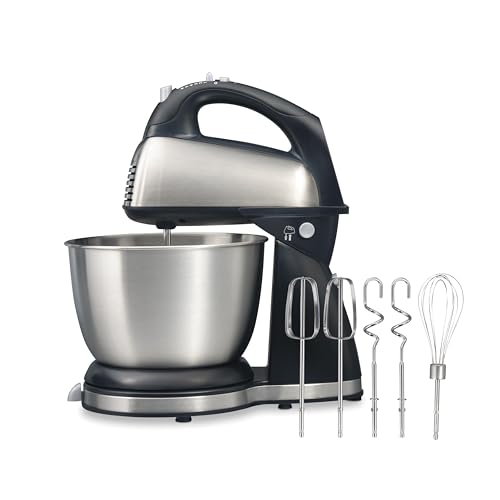
Hamilton Beach Classic Stand and Hand Mixer (4 Quart) — Best Overall Convertible
Hamilton Beach essentially defines the modern convertible category with this machine, and the details explain why. The stand’s base shifts the bowl side to side as it turns, moving the mixture through the beaters instead of letting the beaters carve a fixed channel — the single most important design feature in any convertible, because a docked hand mixer cannot orbit like a planetary stand mixer. The 4-quart stainless bowl is the largest in the true-convertible class, sized for real cake and cookie batches rather than demonstrations.
Strengths
- Shift-and-stir bowl movement mixes evenly while docked
- Largest bowl in the true convertible class at 4 quarts
- Hand unit is a genuinely good mixer on its own, with bowl-rest
Trade-offs
- Hand-mixer power — no stiff dough
- Light stand can shift under thick loads
- No planetary action; scraping still helps
| Bowl capacity | 4 quart stainless |
| Speeds | 6 plus QuickBurst |
| Power | 290 watts peak |
| Included | Beaters, dough hooks, whisk |
The hand unit is a proper 6-speed mixer with a QuickBurst button for a shot of extra power through thick moments, and it carries a small stroke of genius: a bowl-rest lip that lets the hand mixer perch on the edge of any bowl, dripping into it rather than onto the counter. Undocked, it is simply a good hand mixer; docked, the system handles batters, frostings, whipped cream, and soft doughs with the dough hooks included.
Its ceilings are the format’s ceilings: 290 watts of peak power is hand-mixer power, so stiff dough is out and thick cookie dough is a sometimes food. The stand is light, which aids storage and caps stability. Within the convertible brief, though, this is the most complete execution available, at a budget-friendly mid tier — check the current price on Amazon, where it is sold in several colors.
Best for: Small kitchens wanting one machine for both mixing modes / Not suited for: Bread dough or bakers needing planetary performance
Check the current price on Amazon

West Bend Two Sweet 2-in-1 Hand & Stand Mixer — Best Capacity and Speed Range
West Bend’s Two Sweet is the ambitious entry in this category: the biggest bowl here at 4.4 quarts, the widest speed range at 11 settings plus a turbo boost, and a tilt-head stand design that lifts the hand unit clear for bowl access like a miniature stand mixer. The bowl rotates during docked mixing, and the attachment set is complete — dough hooks, beaters, and a whisk are all in the box.
Strengths
- Largest bowl here: 4.4 quarts, rotating
- 11 speeds plus turbo for fine low-speed control
- Complete attachment set included
Trade-offs
- Newer model — support track record still forming
- Peak-watt figure overstates dough ability
- Light stand stability limits, as with all convertibles
| Bowl capacity | 4.4 quart, rotating |
| Speeds | 11 plus Turbo Boost |
| Power | 550 watts peak |
| Included | Dough hooks, beaters, whisk |
In practice, the speed range is its real distinction. Eleven speeds give a genuinely gentle low gear for folding flour — the moment convertibles usually fail with a splatter — and fine gradations through the creaming range. The 550 peak watts headline should be read as hand-mixer-class power with headroom, not stand-mixer torque, and the machine is happiest in the batter-and-soft-dough world where convertibles belong.
As a newer name in this niche, its long-term parts and support story is less proven than Hamilton Beach’s, and the light stand shares the category’s stability limits. For buyers who want the most convertible — most bowl, most speeds, most attachments — at a mid tier, it is the pick. Check the current price on Amazon.
Best for: Buyers wanting the maximum convertible specification / Not suited for: Stiff dough or buyers prioritizing proven long-term support
Check the current price on Amazon

bella 3.5 Qt Hand & Stand Mixer (2-in-1) — Best Budget Convertible
The bella 2-in-1 strips the convertible idea to its essentials and prices it accordingly: a hand mixer that docks into a stand with a 3.5-quart bowl, sized and powered for the everyday work of small households — cake and brownie batters, frostings, whipped toppings, pancake and muffin mixes. The design is modern and compact, the colors suit kitchens that care, and the whole system stores in a fraction of the space a stand mixer demands.
Strengths
- Lowest price tier among true convertibles
- Compact, attractive, and easy to store
- Covers everyday batters and toppings for small households
Trade-offs
- Light-duty hand unit and stand
- No thick dough work
- Smaller bowl and simpler bowl movement
| Bowl capacity | 3.5 quart |
| Design | 2-in-1 hand and stand |
| Included | Stand, bowl, hand unit with beaters |
Expect the budget tier’s physics. The hand unit is a light-duty tool, the stand is light with it, and thick doughs are beyond the brief — this is a batter machine, honestly labeled. What it returns for that honesty is the lowest-cost entry into hands-free mixing that still lets you undock and mash potatoes at the stove.
For a first apartment, a dorm-adjacent kitchen, or a baker whose mixing is monthly and gentle, it is a rational buy — check price on Amazon. Frequent bakers should step up to the Hamilton Beach, whose bowl movement and hand unit justify the difference the first time a thick batter stays mixed instead of channeling.
Best for: Casual bakers and first kitchens on a tight budget / Not suited for: Frequent baking or thick doughs
Check the current price on Amazon

KitchenAid 5 Ultra Power Speed Hand Mixer (KHM512) — Best Hand-Mixer Alternative
This pick is labeled an alternative because honesty is this guide’s policy — and it earns its place by winning the argument for a large share of shoppers. If your docked-mode jobs are mostly batters you could mix by hand with patience, the KHM512 does every undocked job better than any convertible’s hand unit: five speeds with a truly gentle first gear, stainless Turbo Beaters with no center post for easy cleaning, and KitchenAid build quality in a drawer-sized package.
Strengths
- Best-in-class hand mixer quality and beaters
- Zero counter footprint — lives in a drawer
- Gentle first speed prevents flour clouds
Trade-offs
- No stand — no hands-free mixing
- Not a convertible; included as the leading alternative
- Thick dough still beyond it
| Type | Hand mixer (alternative pick) |
| Speeds | 5 |
| Included | 2 stainless Turbo Beater accessories |
What you give up is hands-free mixing — your arm is the stand. What you gain is simplicity, reliability, counter space, and budget left over for ingredients. For cooks whose mixing is mashed potatoes, boxed mixes, whipped cream, and occasional cookie dough in modest batches, that trade is not a compromise at all; it is the correct answer wearing a smaller price tag.
Choose it over a convertible if you bake less than weekly and your recipes are light. Choose a true convertible if hands-free mixing during long whips and batters is the feature you actually daydream about. Check the current price on Amazon.
Best for: Light, infrequent mixers who value storage over hands-free / Not suited for: Anyone who specifically wants docked, hands-free mixing
Check the current price on Amazon

Hamilton Beach 6-Speed Electric Hand Mixer (62682G) — Best Budget Hand-Mixer Alternative
The second alternative on this list is the budget mirror of the first: if the convertible idea appeals mainly because it is inexpensive, this hand mixer is the inexpensive thing itself, done well. Six speeds plus QuickBurst, traditional beaters, a snap-on case that keeps the attachments with the machine, and the same bowl-rest lip that makes its convertible sibling so livable — it is the hand mixer budget guides have recommended for years because it keeps deserving it.
Strengths
- Excellent value with QuickBurst and storage case
- Bowl-rest feature like its convertible sibling
- Remains useful as a second mixer forever
Trade-offs
- No stand or hands-free mode
- Traditional beaters are less refined than premium rivals
- Light-duty for thick dough
| Type | Hand mixer (alternative pick) |
| Speeds | 6 plus QuickBurst |
| Power | 250 watts peak |
| Included | Traditional beaters, snap-on storage case |
Paired with a large bowl of your own, it covers the undocked universe completely and the docked universe not at all. The honest comparison against the bella convertible above is instructive: for similar money, you choose between a better hand mixer with no stand, or a lighter hand mixer with one. Frequency of hands-free need should decide, not habit.
At a firmly budget tier — check price on Amazon — it is also the rational “buy it now, decide later” step: it remains useful forever as a second mixer even if a stand mixer joins the kitchen later.
Best for: Budget buyers whose hands-free need is occasional / Not suited for: Committed hands-free bakers
Check the current price on Amazon
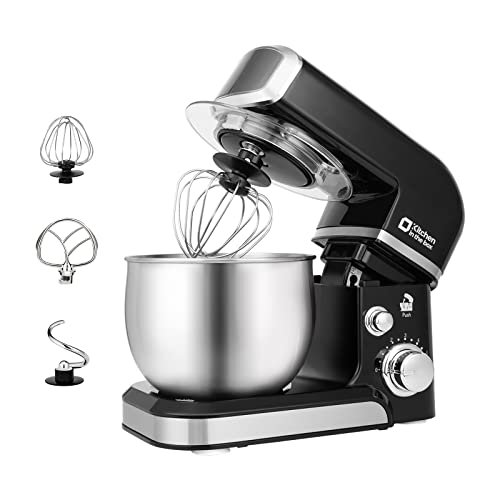
Kitchen in the box 3.2Qt Small Stand Mixer — Best Mini Stand Alternative
The final alternative inverts the convertible bargain. The Kitchen in the box mini stand mixer gives up the hand mode entirely and spends everything on the docked job: a 3.2-quart bowl, six speeds, suction-cup feet that keep the light body planted, and whisk, dough hook, and flat beater included. For bakers who realize their “convertible” desire was really “hands-free mixing in a tiny footprint,” this is the more focused tool.
Strengths
- Focused docked performance with suction-cup stability
- Three attachments included
- Featherweight and compact
Trade-offs
- No hand mode at all
- Light-duty dough ceiling
- Bowl sized for one or two people
| Type | Mini stand mixer (alternative pick) |
| Bowl capacity | 3.2 quart |
| Speeds | 6 |
| Included | Egg whisk, dough hook, flat beater, splash guard |
Its docked mixing is a step steadier than the budget convertibles’, because the machine was designed around one job and one bowl position. Its ceiling is the mini-stand ceiling: light doughs and batters for one or two people, plastic construction, and no stove-side work ever — when the potatoes need mashing, this machine watches from the counter.
At a budget tier — check the current price on Amazon — it completes this guide’s honest map of the decision: convertible for flexibility, hand mixer for storage, mini stand for focused hands-free work. None of the three is the wrong answer; each is the right answer for a different kitchen.
Best for: Hands-free-first bakers in tiny kitchens / Not suited for: Anyone who mixes at the stove or in varied bowls
Check the current price on Amazon
Comparison Table
| Pick | Badge | Key spec | Best for |
|---|---|---|---|
| Hamilton Beach Classic Stand and Hand Mixer (4 Quart) | Best Overall Convertible | 4-qt, 6 speeds + QuickBurst, shift bowl | Small kitchens wanting one machine for both mixing modes |
| West Bend Two Sweet 2-in-1 Hand & Stand Mixer | Best Capacity and Speed Range | 4.4-qt rotating bowl, 11 speeds | Buyers wanting the maximum convertible specification |
| bella 3.5 Qt Hand & Stand Mixer (2-in-1) | Best Budget Convertible | 3.5-qt, budget 2-in-1 | Casual bakers and first kitchens on a tight budget |
| KitchenAid 5 Ultra Power Speed Hand Mixer (KHM512) | Best Hand-Mixer Alternative | 5 speeds, Turbo Beaters, drawer storage | Light, infrequent mixers who value storage over hands-free |
| Hamilton Beach 6-Speed Electric Hand Mixer (62682G) | Best Budget Hand-Mixer Alternative | 6 speeds + QuickBurst, storage case | Budget buyers whose hands-free need is occasional |
| Kitchen in the box 3.2Qt Small Stand Mixer | Best Mini Stand Alternative | 3.2-qt mini stand, suction feet | Hands-free-first bakers in tiny kitchens |
The first three rows are true convertibles; the last three are the alternatives buyers cross-shop, labeled as such. If you remember one thing, make it this: bowl movement (shift or rotation) is what separates a convertible that mixes from one that merely holds a hand mixer upright.
How to Choose a Convertible Hand and Stand Mixer
Start with the bowl, because in a convertible the bowl and stand must compensate for what the design lacks: planetary action. A docked hand mixer’s beaters spin in a fixed position, so the mixture must move instead — through a rotating bowl, a shift-and-stir base like Hamilton Beach’s, or your own spatula doing laps. Rank bowl movement as the first feature; a convertible with a fixed bowl and no movement mechanism will leave an unmixed ring no matter how good its motor is.
Grade the hand unit as if you were buying it alone, because statistically you will use it alone often: speed range with a genuinely slow first gear, beater quality and release, weight in the hand, and a cord that swivels or locks to the side you favor. The stand half then needs only three virtues — stability, a release you can work one-handed while holding a spatula, and a footprint that stores with the bowl nested.
Be clear-eyed about power. Convertible motors are hand-mixer motors, rated in peak watts that flatter them; their honest domain is batters, frostings, whipped cream, mashed potatoes, and soft doughs in modest batches. If your baking life includes weekly cookie dough at full batch or any bread, the convertible is the wrong format — the compact stand and cookie guides in this cluster exist for you. Buy the convertible for flexibility within its domain and it delights; buy it as a discount stand mixer and it disappoints.
Finally, price the decision against the alternatives in this guide. A convertible should cost meaningfully less than a good hand mixer plus a mini stand bought separately — that gap is its reason to exist. When a convertible’s price approaches the two-machine total, the two-machine answer usually wins on capability, and this guide’s alternative picks become the main event.
What Can a Convertible Mixer Actually Do? An Honest Capability Map
Docked mode excels at: cake and muffin batters, boxed mixes of every kind, frostings and buttercreams, whipped cream and egg whites in small-to-standard batches, and soft doughs like enriched or high-hydration pizza dough in small quantities. These share a profile — fluid or soft mixtures, moderate volumes, mixing times of a few minutes — that suits a rotating bowl and hand-mixer torque perfectly.
Undocked mode is the hand mixer’s whole world: mashed potatoes in the pot, whipped cream in your own chilled bowl, egg whites in a copper or glass bowl the stand could never hold, quick batters in the pan they will bake in. This mode is not a consolation prize; for many cooks it is the majority of real mixing, and it is why a convertible’s hand unit quality matters more than its stand’s cleverness.
The red zone is equally clear: stiff cookie dough at full batch, any bread dough beyond the softest small loaves, and marathon whipping sessions that heat a small motor. A convertible asked to live in the red zone will not die dramatically — it will strain, walk, overheat, and mix unevenly until its owner concludes, wrongly, that all convertibles are junk. They are not junk; they are specialists, and the map above is their specialty.
Convertible vs. Hand Mixer Plus Mini Stand: The Two-Machine Question
The fairest test of a convertible is the alternative it replaces: a decent hand mixer and a mini stand mixer, bought separately. The two-machine answer wins on capability at every point — the stand mixes docked work better, the hand mixer is chosen purely for hand work, and if one fails the other still cooks dinner. It loses on the two currencies small kitchens count: money (two purchases) and storage (two machines, two cords, two sets of attachments).
The convertible wins when those currencies dominate: the renter with one cabinet, the student, the second home, the baker whose mixing is genuinely occasional. It also wins on a subtle point — there is exactly one motor to learn, one set of beaters to store, one machine to bring out. Friction, again, is the real enemy of home baking, and a single mid-weight box on the counter gets used more than two better machines in two different cupboards.
The deciding question is frequency of serious docked work. Weekly bakers should buy the two machines (or one real stand mixer) without guilt. Monthly bakers with light recipes should buy the convertible and spend the savings on ingredients. This guide’s six picks are arranged so that either conclusion has a best buy waiting at the end of it.
Getting the Best from Docked Mode: Technique for Convertible Owners
Convertible technique differs from stand-mixer technique in one habit: you are part of the mixing action. Because the beaters cannot orbit, plan to stop once mid-mix, scrape the bowl’s sides and bottom with a flexible spatula, and rotate the bowl a quarter turn by hand if your model’s rotation is lazy. That ten-second ritual closes most of the evenness gap between a convertible and a planetary machine.
Load the bowl thoughtfully: liquids and fats first, dry ingredients in two additions at the lowest speed, and never fill beyond two-thirds — rotating bowls slosh, and a convertible’s light stand forgives less splashing than a heavyweight’s. For whipped cream and egg whites, docked mode is at its best: start slow, climb gradually, and let the hands-free advantage do what it was bought for while you prep the next step.
And respect the warmth rule that governs all small motors: if the hand unit’s body grows hot during a long or thick mix, rest it. Five patient minutes preserve the machine; five stubborn ones spend its lifespan. Convertible owners who learn these three habits — scrape, load modestly, rest when hot — routinely report machines that serve for years beyond the format’s reputation.
How to Use a Convertible Mixer in Both Modes, Step by Step
A convertible rewards owners who learn both modes deliberately rather than treating the stand as an afterthought. This sequence covers a first week with the machine.
- Assemble and inspect the stand mode first. Dock the hand unit until it clicks, seat the bowl, and run the empty machine at low speed: the bowl should rotate or shift smoothly and the unit should sit without rocking. Any wobble now is a setup issue, not a mixing issue.
- First docked job — a cake or muffin batter. Add ingredients in recipe order, start at the lowest speed, and scrape once halfway, rotating the bowl a quarter turn as you do. Note how the mixture moves: you are learning your machine’s bowl-movement character.
- First undocked job — mashed potatoes or whipped cream in your own bowl or pot. Use the bowl-rest lip between bursts, keep the beaters submerged to avoid splatter, and feel the difference the hand unit’s weight and balance make — this is the mode you will use most.
- Try the dough hooks on a soft dough — a small pizza or enriched dough — docked, at low speed, stopping if the stand shifts or the motor strains. You have now mapped the machine’s ceiling honestly, on a forgiving recipe.
- Practice the release. Undock and redock the hand unit several times until it is one smooth motion; mid-recipe, with wet hands and a waiting batter, is the wrong classroom.
- Wash and nest everything: attachments in the bowl, cord loosely coiled, the whole stack stored where you planned it. The storage ritual is part of the appliance.
By the end of that week you will know which mode your cooking actually lives in — and if the answer surprises you toward one side, this guide’s alternative picks are the honest next step, not an admission of defeat.
Storage, Cords, and Attachments: Living with a Convertible
The convertible’s storage story is its quiet triumph: stand, bowl, and hand unit nest into a single compact stack that fits cabinets a stand mixer cannot enter. Keep the attachments in the bowl, the cord loosely coiled alongside (never wrapped tight around the hand unit’s neck, which fatigues the wires), and the whole system at the front of its cabinet. A convertible buried behind the slow cooker fails the only test that matters — whether it gets used.
Attachment discipline is simple because the sets are small: beaters for batters, dough hooks for soft doughs, a whisk where included for creams and whites. Wash them promptly — dried batter in beater cages is the category’s most annoying chore — and dry before nesting them in the bowl to prevent rattling and musty surprises. Spare beaters are the one accessory worth buying for the Hamilton Beach and West Bend, since a bent beater on a fixed-axis machine wobbles the whole stand.
If the stand half of your kitchen life grows — you begin baking weekly, doughs get serious — the convertible does not become waste. It retires gracefully into the hand-mixer role it always half-was, and a dedicated stand mixer takes over the docked work. Few appliance purchases degrade this gracefully, and it is a real argument for the format as a first serious mixer.
Who Should Not Buy a Convertible Mixer?
Three buyers should walk past this category, and naming them is part of this guide’s job. The first is the bread baker: no convertible kneads respectably, and pretending otherwise wastes money that a compact stand mixer would spend properly. The second is the production baker — holiday dozens, bake-sale volume — whose batches exceed these bowls and whose sessions exceed these motors. The third is the buyer who actually wants a stand mixer and is choosing a convertible only because it is cheaper: the price gap is real, but so is the capability gap, and the regret arrives with the first stiff dough.
For everyone else — the small kitchen, the occasional baker, the undecided — the convertible is not a compromise to apologize for but a format matched to a life. The test is the capability map in this guide: if your mixing lives inside it, a convertible will serve you completely, and the space and money it saves are pure profit.
The History of the Convertible Mixer, Briefly — and Why It Persists
The hand-and-stand convertible is one of the oldest ideas in electric mixing: mid-century manufacturers sold exactly this format to kitchens that had neither the space nor the budget for a full stand mixer, and the design’s survival through the planetary era says something real. Formats persist when they solve a permanent problem, and the permanent problem here is arithmetic — most households mix lightly, store tightly, and spend carefully.
Modern convertibles improve on their ancestors in the details this guide grades: bowl movement mechanisms, quick-burst power, better beaters, and stands that release with one hand. What has not changed is the physics that defines the format’s ceiling, which is why the honest guides of any decade read alike on this category: wonderful within its domain, wrong outside it. The three true convertibles above are the current state of a durable idea.
Convertible Mixers for Small Business and Side Hustles: A Reality Check
Home bakers selling at markets or online sometimes eye convertibles as a low-cost start, so the reality deserves a paragraph. A convertible can launch a side hustle whose products are batters and frostings in modest batches — cupcakes, muffins, snack cakes — and many sellers have started exactly there. The moment the menu turns to volume cookie dough, laminated doughs, or back-to-back production days, the format’s ceilings become business costs in time and consistency, and the upgrade to a planetary stand mixer (the cookie guide’s territory) pays for itself in throughput.
Food-safety and durability planning also change with commercial intent: attachments and bowls must survive constant washing, and a backup mixing method is not a luxury when orders are promised. Treat the convertible as the capable first chapter of that story rather than its whole plot, and it will have been money well spent.
Common Buying Mistakes
Buying a convertible as a cheap stand mixer. It is a flexible hand mixer with a stand, not a planetary machine at a discount. Buy it for the flexibility and it delights; buy it for dough and it disappoints.
Ignoring bowl movement. A fixed bowl under fixed beaters cannot mix evenly. Shift, rotation, or turntable action is the feature that makes docked mode real — check for it before anything else.
Overfilling the bowl. Rotating bowls slosh and light stands forgive poorly. Two-thirds full is the working ceiling, whatever the quart figure says.
Judging by peak watts. Convertible power is hand-mixer power. The honest gauges are the capability map: batters and soft doughs yes, stiff doughs no, at any wattage printed on the box.
Never undocking. Owners who leave the hand unit docked forever own a mediocre stand mixer. The format’s value is the second mode — take it to the stove, the pot, and your favorite bowl.
Forgetting to check what is actually in the box. Convertible listings from third-party sellers sometimes ship the hand unit alone, or the stand without the bowl, at a tempting price that is no bargain at all. The format is a system; buy the system complete, from a listing that names every component, and photograph the unboxing carefully if the seller is unfamiliar to you or the price seems unusually good.
Skipping the mid-mix scrape. Fixed-axis beaters need one scrape and a quarter turn to match planetary evenness. Ten seconds, every batch, is the whole technique.
Final Recommendation
The Hamilton Beach Classic is the convertible to buy: its shift-and-stir bowl solves the format’s core problem, its 4-quart bowl is the class’s most useful, and its hand unit stands on its own merits. The West Bend Two Sweet is the maximalist alternative — biggest bowl, widest speed range — and the bella is the honest budget entry for gentle, occasional mixing.
And if this guide’s capability map talked you out of the format, it did its job: the KitchenAid and Hamilton Beach hand mixers and the Kitchen in the box mini stand are the right answers for the storage-first and docked-first kitchens respectively. Flexibility, storage, or focus — choose the virtue your kitchen actually needs, and the machine will feel less like a compromise and more like a fit. That feeling is not a small thing: it is the difference between an appliance that gets reached for weekly, almost without thought, and one that gathers dust while its owner quietly goes back to mixing by hand and wondering why the purchase never quite delivered on the promise that was imagined for it in the first place, back when the box was still sealed and every recipe in the world seemed possible before breakfast had even been cleared away from the table.
Ready to buy? Start with Hamilton Beach Classic Stand and Hand Mixer (4 Quart), West Bend Two Sweet 2-in-1 Hand & Stand Mixer, bella 3.5 Qt Hand & Stand Mixer (2-in-1) — check the current price on Amazon for each and confirm the exact color and configuration on the listing before you order.
Keep exploring the rest of this cluster: Best Compact Small Mixers Best Compact Stand Mixers Best Hand Mixers Best Cookie Mixers Best Mixers For Small Kitchens
Frequently Asked Questions
Are convertible hand and stand mixers worth it?
For small kitchens and light-to-moderate mixing, yes: one machine covers hands-free batter work and stove-side hand mixing for less money and storage than the two separate machines. For frequent bakers, bread makers, or stiff-dough work, a dedicated stand mixer is worth more. The format’s value is flexibility, not power.
Can a convertible mixer knead bread dough?
Only the softest, smallest doughs, gently — enriched or high-hydration dough for a small loaf, using the hooks at low speed. Stiff or standard bread dough exceeds hand-mixer motors and light stands. If bread is a regular part of your baking, buy a compact or full stand mixer instead; this guide’s alternatives section explains the fork in the road.
What is the advantage of a rotating or shifting bowl?
A docked hand mixer’s beaters cannot orbit the bowl, so the mixture must move instead. A rotating bowl or a shift-and-stir base carries unmixed batter through the beaters, preventing the unmixed ring and channeling that fixed bowls suffer. It is the single most important feature in a convertible — more than wattage or speed count.
Convertible mixer or separate hand and stand mixers?
Separate machines mix better at both jobs and survive each other’s failures; a convertible costs less, stores in one stack, and asks you to learn one machine. Weekly, serious bakers should separate; occasional bakers in small kitchens should convert. Your baking frequency, honestly assessed, is the whole decision.
How big a batch can a convertible handle?
Working capacity follows the two-thirds rule: the 4-quart Hamilton Beach handles standard cake and cookie-soft batches for a small household; the 3.5-quart bella suits smaller, lighter work. Full stiff cookie batches and doubles belong to stand mixers — see the cookie mixer guide in this cluster.
Which convertible is best for a small apartment?
The Hamilton Beach Classic, for most people: it stores as one nested stack, its bowl is big enough for real recipes, and its hand unit covers the stove-side jobs apartment cooking is full of. If the budget is the binding constraint, the bella 2-in-1 keeps the same one-stack storage virtue at a lower tier, accepting lighter power and a smaller bowl as the trade. Either way, measure the cabinet or shelf the stack will live in before ordering — the format’s promise is storage, and the promise should be verified like any other.
Do convertible mixers last?
The hand unit is the wear item and the value: cared for — rested when hot, kept out of stiff dough — the name-brand convertibles here serve for years, and the Hamilton Beach design has a long track record in the category. When the stand half eventually feels limiting, the machine retires into pure hand-mixer duty rather than the bin.


