Disclosure: airfryerkitchensupply.com is reader-supported. When you buy through links on our site, we may earn an affiliate commission at no extra cost to you.
Where to buy
The fastest way to compare the best compact stand mixers in this guide is on Amazon, where most of the models below are sold by the brands themselves or by authorized kitchen and audio retailers. Prices and stock move around, especially on seasonal colors and bundle configurations, so every pick here is listed with a live price check rather than a fixed number.
With compact stand mixers, always confirm the exact variant on the listing: several models below share a name across two bowl sizes or bundle configurations, and the height figure that matters is the one with the head tilted open.
- KitchenAid Artisan Mini 3.5-Qt Tilt-Head Stand Mixer (KSM3316) (Best Overall) — check price on Amazon
- KitchenAid Classic Series 4.5-Qt Tilt-Head Stand Mixer (K45SS) (Best Step-Up Compact) — check price on Amazon
- Kitchen in the box 3.2Qt Small Stand Mixer (Best Budget) — check price on Amazon
- Dash Everyday Stand Mixer, 3-Quart (Best for the Smallest Footprint) — check price on Amazon
- Hamilton Beach 4 Qt Electric Stand Mixer (Best Compact for Families) — check price on Amazon
- Delish by Dash Stand Mixer, 3.5-Quart (Best Lightweight for Casual Bakers) — check price on Amazon
The best compact stand mixers exist because the standard stand mixer has a dirty secret: it was sized for a 1990s suburban counter, and it shows. A full-size tilt-head stands tall, eats a square and a half of counter, and weighs enough that nobody moves it willingly. Compact stand mixers cut the footprint, the height, and the bowl down to apartment scale while keeping the one thing that makes a stand mixer worth owning — hands-free planetary mixing with real attachments.
This guide is strictly about stand mixers. Hand mixers and hybrids appear in their own guides in this cluster; here, every pick stands on the counter, holds its own bowl, and mixes unattended. Within that rule there is real variety: a shrunken premium machine with a full attachment hub, featherweight budget minis you can lift with two fingers, and a 4-quart middle option for small families who kept outgrowing 3-quart bowls.
A word on honesty, because this category needs it: compact stand mixers are not small versions of bakery machines. Their dough ceilings are real, their working capacities run about two-thirds of the number printed on the bowl, and the cheapest of them are batter tools, not bread tools. Each review below states plainly what its mixer can and cannot do, so the machine you buy matches the cooking you actually do.
It is also worth naming who should skip this category entirely. If your household bakes for six or more people, if you sell at markets, or if sourdough is a weekly ritual, a compact stand mixer will frustrate you no matter which one you choose — your guide is the full-size and bowl-lift coverage elsewhere in this cluster, and the cookie mixer roundup in particular assumes bigger bowls and stiffer doughs. Compacts reward realistic expectations and punish hopeful ones.
If you bake weekly in a small kitchen, this is one of the highest-impact upgrades you can make — the difference between a mixer that lives on the counter and gets used, and a full-size machine that lives in a box and does not. The six picks below cover the price tiers honestly, from budget minis to a premium compact that will outlive most of the kitchens it serves.
In this guide
Quick Picks
If you are short on time, these are the six best compact stand mixers worth your attention first. Each one carries a badge for the job it does best, and the same badge follows it into the detailed review further down the page.
- KitchenAid Artisan Mini 3.5-Qt Tilt-Head Stand Mixer (KSM3316) — Best Overall. The benchmark compact stand mixer: a true KitchenAid at roughly four-fifths scale, with planetary action, 10 speeds, and the full front-hub attachment ecosystem. Check price on Amazon.
- KitchenAid Classic Series 4.5-Qt Tilt-Head Stand Mixer (K45SS) — Best Step-Up Compact. The original KitchenAid formula at 4.5 quarts and 59 bowl touchpoints — bigger than a true mini, smaller than an Artisan, and built to be repaired rather than replaced. Check price on Amazon.
- Kitchen in the box 3.2Qt Small Stand Mixer — Best Budget. A 3.2-quart, six-speed mini that weighs almost nothing, sticks itself to the counter with suction feet, and covers everyday mixing for one or two people. Check price on Amazon.
- Dash Everyday Stand Mixer, 3-Quart — Best for the Smallest Footprint. Three quarts, six speeds, and the tiniest footprint of any stand mixer here — the compact that fits the counters other compacts cannot. Check price on Amazon.
- Hamilton Beach 4 Qt Electric Stand Mixer — Best Compact for Families. Planetary mixing and a 4-quart bowl in a carry-handle body — the compact that stops forcing small families to halve recipes. Check price on Amazon.
- Delish by Dash Stand Mixer, 3.5-Quart — Best Lightweight for Casual Bakers. A 3.5-quart compact with a bowl that lifts off for washing and serving, dough hooks in the box, and a five-speed range tuned for casual baking. Check price on Amazon.
How These Picks Were Chosen
Every model here was verified against live Amazon catalog data, so capacities, speed counts, and included attachments match current listings. We required a genuinely compact footprint or height compared with standard 5-quart machines, a bowl in the 3 to 4.5-quart class, and attachments included in the box.
We scored the picks on mixing action (planetary single-beater designs score above twin-beater designs for thick work), low-speed control for adding flour, storage practicality — weight, height with the head open, cord handling — and cleanup. We also weighed the ownership horizon: whether parts and attachments exist for the machine in five years, or whether it is a sealed appliance that gets replaced whole.
Two product types were excluded on purpose. Full-size mixers rebranded as “space-saving” without actually shrinking were cut, because a compact guide that smuggles in standard machines helps nobody. And novelty mini mixers that cannot whip egg whites without overheating were cut too — cute is not a mixing action.
The 6 Best Compact Stand Mixers
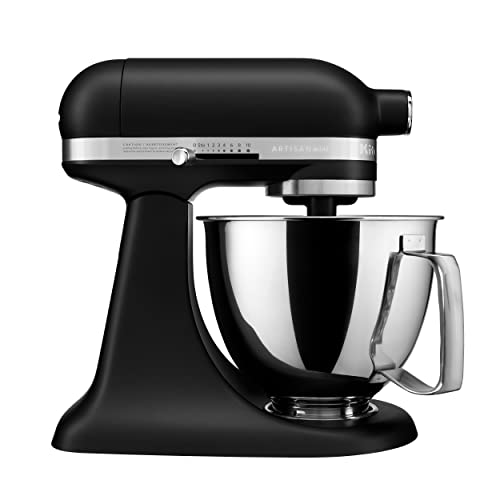
KitchenAid Artisan Mini 3.5-Qt Tilt-Head Stand Mixer (KSM3316) — Best Overall
Start with the fact that defines this machine: KitchenAid shrank the Artisan without changing what it is. The Artisan Mini keeps planetary mixing — the beater orbits the bowl while spinning, sweeping the sides so thoroughly that scraping becomes occasional rather than constant — and it keeps the front attachment hub, which means pasta rollers, grinders, spiralizers, and the ice cream maker all fit. No other compact stand mixer offers anything like that expansion path.
Strengths
- Full KitchenAid attachment-hub compatibility
- Planetary action mixes evenly with minimal scraping
- 10 speeds including a gentle flour-friendly start
Trade-offs
- Premium price tier
- 3.5-quart bowl caps batch size
- Heavier than budget minis — a counter resident, not a cupboard mixer
| Bowl capacity | 3.5 quart |
| Design | Tilt-head, planetary |
| Speeds | 10 |
| Included | Flat beater, dough hook, wire whip |
In daily use, the 3.5-quart bowl is the right size for real small-household cooking: a standard cookie batch, a two-layer cake, a single loaf of enriched dough, mashed potatoes for four. The 10-speed control includes a genuinely gentle start for flour, and the tilt-head keeps the machine low enough to slide under most upper cabinets — measure yours, but this is the compact most likely to live permanently on the counter, which is where a mixer earns its keep.
The costs are money and ceiling. It sits in the premium tier — check the current price on Amazon, as colors vary — and 3.5 quarts will not double a stiff dough. Buy it as the last compact mixer you intend to purchase, sized for one-to-four-person cooking, and it is exactly that.
Best for: Serious small-kitchen bakers who want one machine for years / Not suited for: Big-batch bakers or buyers on a tight budget
Check the current price on Amazon

KitchenAid Classic Series 4.5-Qt Tilt-Head Stand Mixer (K45SS) — Best Step-Up Compact
The K45SS is the mixer for buyers who measured the minis and found them a touch too small. Its 4.5-quart bowl swallows standard recipes whole — full cookie batches, family mashed potatoes, a proper cake — while the body remains noticeably more manageable than the 5-quart Artisan class. KitchenAid quotes 59 touchpoints around the bowl for its planetary action, and in practice it means batter comes together fast with very little unmixed flour hiding at the bottom.
Strengths
- 4.5-quart bowl handles full standard recipes
- Metal construction with a long repair ecosystem
- Full attachment-hub compatibility
Trade-offs
- Largest footprint in this guide
- Mid-to-premium price tier
- Heavy — plan on a permanent counter spot
| Bowl capacity | 4.5 quart |
| Design | Tilt-head, planetary, 59 touchpoints |
| Speeds | 10 |
| Included | Flat beater, dough hook, wire whip |
Construction is the quiet headline: durable metal build, a 10-speed all-metal transmission feel, and the same attachment hub as every KitchenAid. This is a machine with a decades-long service culture behind it — parts exist, repair videos exist, and owners keep these for a very long time. For a compact stand mixer, that longevity is a category of value the budget minis cannot match.
The trade is footprint and price tier: it is the largest machine in this guide and sits mid-to-premium in cost, so check price on Amazon and measure your cabinet gap with the head open before committing. If it fits, it is arguably the most sensible buy here for a small family.
Best for: Small families wanting full-recipe capacity in a compact-leaning frame / Not suited for: The tightest counters or cabinet-storage plans
Check the current price on Amazon
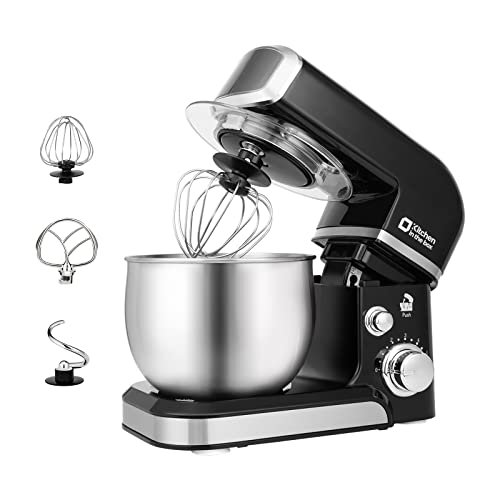
Kitchen in the box 3.2Qt Small Stand Mixer — Best Budget
This is the compact stand mixer for the smallest budgets and the smallest households, and it succeeds by knowing exactly what it is. The 3.2-quart bowl, six speeds, and three included attachments — egg whisk, dough hook, flat beater — cover batters, frostings, whipped cream, and soft doughs, while suction-cup feet keep the light body planted on smooth counters.
Strengths
- Extremely light and easy to store
- Suction feet keep it steady while mixing
- Three attachments plus splash guard included
Trade-offs
- Plastic build and light-duty motor
- Stiff dough is beyond it
- Bowl too small for family batches
| Bowl capacity | 3.2 quart |
| Speeds | 6 |
| Included | Egg whisk, dough hook, flat beater, splash guard |
Storage is its superpower. It is light enough to lift into a cabinet one-handed, small enough to fit where a toaster oven would not, and simple enough that there is nothing to learn: one dial, no menus, no drama. For a first apartment or a couple who bake occasionally, that simplicity is the feature.
The limits are structural, and this review will not dress them up: plastic construction, a motor that strains on stiff dough, and a bowl sized for one or two. Treat the dough hook as a soft-dough tool and this mixer delivers honest service at a budget tier — check price on Amazon, where it frequently anchors the low end of the whole category.
Best for: Singles, couples, and first apartments on a budget / Not suited for: Bread bakers or families
Check the current price on Amazon

Dash Everyday Stand Mixer, 3-Quart — Best for the Smallest Footprint
When the counter is truly tiny — a studio, an RV galley, a dorm-adjacent kitchenette — the Dash Everyday is the stand mixer that still fits. Its 3-quart stainless bowl and compact tilt-head body occupy less space than most toaster ovens, and the retro styling in a wide color range means it can live out in the open without making the kitchen look like a workshop.
Strengths
- Smallest footprint in this guide
- Very light and simple to operate
- Attractive retro design in many colors
Trade-offs
- Light-duty only — no stiff dough
- 3-quart bowl is a hard capacity ceiling
- No expansion attachments
| Bowl capacity | 3 quart |
| Design | Tilt-head |
| Speeds | 6 |
| Included | Beaters and dough hooks |
Performance is straightforward light-duty mixing done competently: boxed and scratch cake batters, brownies, whipped cream, frosting, mashed potatoes for two. The six speeds are sensibly spaced and the controls could not be simpler, which suits a machine bought for convenience rather than conquest.
Buy it with clear eyes: thick cookie dough in a full bowl strains it, bread dough is out of the question, and there is no attachment ecosystem to grow into. Within its brief — the best compact stand mixer for the smallest counters and the lightest workloads — it has very few real competitors, and it sits in the budget tier.
Best for: Studios, RVs, and the tiniest counters / Not suited for: Dough work or batches beyond two or three people
Check the current price on Amazon

Hamilton Beach 4 Qt Electric Stand Mixer — Best Compact for Families
Hamilton Beach aimed this mixer at the gap between the minis and the full-size machines, and the aim is good. Four quarts is the smallest bowl that takes standard recipes whole, and the planetary mixing action — a genuine differentiator at this tier — means the beater sweeps the bowl instead of leaving a ring of unmixed flour for you to fold in by hand.
Strengths
- 4-quart bowl fits standard recipes whole
- Planetary action at a mid-range tier
- Carry handle and splash guard included
Trade-offs
- Plastic-heavy construction
- Not a heavy-dough machine
- Bigger than the true minis
| Bowl capacity | 4 quart |
| Power | 300 watts |
| Speeds | 7 |
| Included | Whisk, flat beater, dough hook, splash guard |
Seven speeds, a splash guard, and the standard whisk, beater, and dough hook trio are all included, and the built-in handle sounds like a gimmick until the first time you carry the mixer to a shelf with one hand while holding a toddler, a cat, or a bag of flour with the other. Small design choices like that are why this model keeps its owners.
It is a 300-watt-class machine with a plastic-heavy build, so its dough ceiling resembles the other mid-tier compacts: soft and medium doughs in single batches, yes; a big stiff loaf, no. At its mid-range tier it is the most practical family buy in this guide — check the current price on Amazon.
Best for: Small families who outgrew 3-quart minis / Not suited for: Heavy dough or buyers wanting all-metal build
Check the current price on Amazon
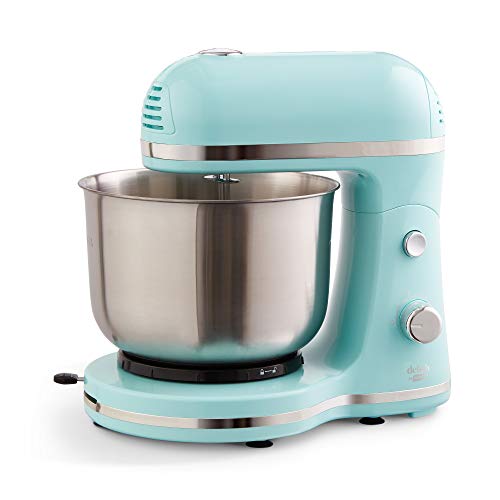
Delish by Dash Stand Mixer, 3.5-Quart — Best Lightweight for Casual Bakers
The Delish by Dash refines the original Dash formula in the two places owners actually complained about: the bowl grows to 3.5 quarts and removes entirely for serving and washing, and dough hooks join the beaters in the box. It remains a genuinely light machine — the kind you move without a second thought — which is precisely the point for casual bakers.
Strengths
- Removable bowl washes and serves easily
- Featherweight and compact
- Dough hooks included
Trade-offs
- Only 5 speeds
- Light-duty motor
- No attachment hub or ecosystem
| Bowl capacity | 3.5 quart |
| Speeds | 5 |
| Included | Beaters, dough hooks, removable bowl |
Five speeds sounds sparse next to ten-speed rivals, but the spacing suits the work this mixer will do: gentle folding, everyday batters, whipped cream, frosting, and soft doughs for one to three people. Cleanup is the fastest here because everything is small, light, and unfussy.
The ceiling is the same as its smaller sibling’s: light duty, honestly labeled. Stiff dough and double batches belong to other machines. If your baking is weekend-casual and your storage is tight, this is one of the most likeable compact stand mixers in the budget-to-mid tier.
Best for: Casual bakers prioritizing light weight and easy cleanup / Not suited for: Frequent or heavy baking
Check the current price on Amazon
Comparison Table
| Pick | Badge | Key spec | Best for |
|---|---|---|---|
| KitchenAid Artisan Mini 3.5-Qt Tilt-Head Stand Mixer (KSM3316) | Best Overall | 3.5-qt, planetary, attachment hub | Serious small-kitchen bakers who want one machine for years |
| KitchenAid Classic Series 4.5-Qt Tilt-Head Stand Mixer (K45SS) | Best Step-Up Compact | 4.5-qt, metal build, 59 touchpoints | Small families wanting full-recipe capacity in a compact-leaning frame |
| Kitchen in the box 3.2Qt Small Stand Mixer | Best Budget | 3.2-qt, 6 speeds, suction feet | Singles, couples, and first apartments on a budget |
| Dash Everyday Stand Mixer, 3-Quart | Best for the Smallest Footprint | 3-qt, ultra-compact footprint | Studios, RVs, and the tiniest counters |
| Hamilton Beach 4 Qt Electric Stand Mixer | Best Compact for Families | 4-qt, planetary, 300W | Small families who outgrew 3-quart minis |
| Delish by Dash Stand Mixer, 3.5-Quart | Best Lightweight for Casual Bakers | 3.5-qt removable bowl, 5 speeds | Casual bakers prioritizing light weight and easy cleanup |
The real dividing lines in this table are mixing action and bowl size. Planetary models (both KitchenAids and the Hamilton Beach) handle thick batters and soft doughs with less help from you; the twin-beater minis are lighter, cheaper, and happiest with batters and creams.
How to Choose the Right Compact Stand Mixer Size
Bowl size is the decision everything else hangs on, so translate quarts into your actual cooking. Three quarts serves one or two people: single cake mixes, small cookie batches, whipped cream, potatoes for two or three. Three and a half quarts — the Artisan Mini and Delish by Dash — is the small-household sweet spot, covering standard single batches for two to four. Four to four and a half quarts is where standard recipes stop needing to be halved, which is why the Hamilton Beach and the K45SS exist.
Remember the two-thirds rule: a bowl’s working capacity is roughly two-thirds of its stated volume, because ingredients need room to move, fold, and — in the case of whipped cream and egg whites — expand dramatically. If your signature recipe already fills a bowl to the brim on paper, it will overflow in practice; size up.
Height is the second measurement and the one buyers forget. A tilt-head compact needs clearance not just to stand but to open — the head swings up and back, and the bowl must lift off its base. Measure from counter to cabinet underside, then check the manufacturer’s open-head height for the model you want. If you are short by an inch, plan for the mixer to live on an open stretch of counter or on a sliding appliance mat that pulls it out from under the cabinets for use.
Weight decides where the mixer sleeps, and where it sleeps decides whether it gets used. Models in the featherweight class genuinely get put away and brought out without friction. The heavier compacts — the KitchenAids especially — should be bought as permanent counter residents. Be honest with yourself about which owner you are; a premium mixer in a closet loses to a budget mixer on the counter every single week.
Are Compact Stand Mixers Powerful Enough for Bread and Cookie Dough?
Cookie dough first, because it is the more common test: yes, with conditions. A standard single batch of cookie dough — the kind with cold butter and a full load of flour and mix-ins — is comfortably within the planetary compacts’ ability and manageable for the better twin-beater minis if the butter is properly softened. The failure mode to avoid is doubling the batch in a 3-quart bowl: the dough climbs, the motor strains, and the mix stays uneven. Compact mixers reward bakers who make one honest batch at a time.
Bread dough divides the field. Soft, wetter doughs — focaccia, brioche, pizza dough for two — knead well in the KitchenAid Mini and acceptably in the Hamilton Beach, especially with the mix-rest-mix technique described in the how-to section below. Stiff, dry doughs — bagels, firm sourdough, big sandwich loaves — exceed every compact stand mixer’s design brief. The motors are smaller, the frames lighter, and the physics unsympathetic: the machine will walk, strain, or overheat before the dough develops.
Ignore wattage when judging this. Dough performance comes from gearing and low-speed torque, and the listings rarely disclose either honestly. The practical signals are a proper C-shaped or spiral dough hook, planetary action, and a frame heavy or grippy enough to stay planted — which is exactly why the reviews above name each model’s dough ceiling instead of quoting its watts.
How Much Should You Spend on a Compact Stand Mixer?
The category sorts into three honest tiers. The budget tier — the Kitchen in the box and Dash models — buys light-duty mixing, plastic construction, and a replace-rather-than-repair lifespan; for occasional bakers that math is perfectly sound. The mid tier, represented by the Hamilton Beach, buys planetary action and a bigger bowl in a still-light frame. The premium tier is KitchenAid territory: metal construction, the attachment ecosystem, and a service culture that keeps machines running for decades.
The right tier is the one matched to your frequency. Bake monthly and the budget tier returns its cost in a handful of uses. Bake weekly and the premium tier’s durability and attachments repay the difference many times over — a machine that lasts fifteen years is cheaper per year than three budget machines that last four each. What never makes sense is the mismatch: a serious baker on a toy, or a twice-a-year baker paying premium prices for capacity that sits idle.
One budgeting note: factor in the attachments you will actually buy. If pasta or grinding is on your roadmap, the KitchenAid premium buys you a platform, and third-party attachments widen it further. If your list stops at beater, whisk, and hook, every pick here includes them — spend the difference on ingredients instead.
Compact Stand Mixer Care: Making a Small Machine Last
Small mixers die from three causes: dough abuse, heat, and water where it should not be. The dough rules are covered above. Heat management is simpler than people think — if the head grows hot to the touch during a long mix, stop and let the machine rest for fifteen minutes; small motors shed heat slowly, and patience is cheaper than a replacement. Never run a compact mixer empty at high speed for fun; it wears the gears for nothing.
Cleaning has one rule that matters: the body never goes under the tap. Wipe it with a damp cloth, and wash only the bowl and attachments. Coated beaters prefer hand-washing — dishwasher detergent is abrasive enough to dull and eventually flake coatings — while stainless bowls and wire whisks are generally dishwasher-safe; check your model’s manual, because the budget brands vary. Dry attachments before storing them in the bowl, with a cloth between them to prevent rattling and chipped edges.
Storage details extend life too. Coil cords loosely, keep the head latch engaged so it does not flop during moves, and if your mixer lives in a cabinet, put it at the front — a compact mixer buried behind other appliances is a compact mixer you will stop using, which is the most common failure mode of all.
How to Use a Compact Stand Mixer for Your First Three Jobs
The fastest way to learn a compact stand mixer is to run it through the three jobs that teach its range: whipped cream for control, cake batter for technique, and a soft dough for limits.
- Job one — whipped cream. Chill the bowl if it is stainless. Add cold cream, start on the lowest speed for thirty seconds, then climb gradually. Stop the moment soft peaks hold; compact bowls whip fast, and the gap between perfect and butter is about twenty seconds at full speed.
- Job two — cake batter. Cream butter and sugar on medium until pale, add eggs one at a time, then add flour in three additions on the lowest speed, mixing only until each addition disappears. Scrape the bowl once, halfway through the flour. This slow-start discipline is what separates compact-mixer success from flour clouds and strained motors.
- Job three — a soft dough. Use the dough hook, mix on low until the dough forms a rough ball, then stop. Rest the dough in the bowl for twenty minutes — hydration does the hard work — then mix two more minutes until smooth. You have just kneaded dough while keeping a small motor completely out of the strain zone.
- After every job: wash the bowl and attachment immediately, dry them, and store the attachment in the bowl. Compact parts are quick to clean and even quicker to lose in a crowded drawer.
Run those three jobs in your first week, while returns are still painless. You will know exactly what your mixer is — and if its ceiling sits below your ambitions, you will know that too, in time to exchange it for the step-up model.
Tilt-Head vs. Bowl-Lift in the Compact Class
Every mixer in this guide is a tilt-head, and that is a deliberate feature of the compact class rather than an accident of pricing. A bowl-lift mechanism needs a column, a lift arm, and the frame strength to hold a loaded bowl suspended — all of which add height, weight, and cost that fight the purpose of a compact machine. Tilt-heads put the motor in a hinged head that swings up for bowl access, keeping the whole unit lower, lighter, and simpler.
Tilt-heads do ask one thing of you: vertical clearance. The head’s swing arc is the measurement that decides whether the mixer can live under your cabinets or must sit on open counter. Bowl-lift owners never think about this; compact buyers must. The second tilt-head habit is checking the latch — the head must be locked down before mixing, because an unlatched head on a thick batter will nod and clunk in a way that sounds alarming and mixes poorly.
If your baking grows toward big, stiff dough batches, the honest path is not a bigger compact — it is a different class of machine entirely: a full-size bowl-lift, covered in the cookie mixer guide in this cluster, where the lift mechanism and frame exist precisely to absorb that punishment. Compacts and bowl-lifts are complements, not rivals.
What Owners of Compact Stand Mixers Say After a Year
Patterns repeat in long-term owner feedback for this category, and they are worth hearing before you buy. The happiest owners are the ones who sized the bowl to their real recipes and bake at least a couple of times a month; their reviews read like love letters to a machine that is simply always there, ready, and quick to clean. The unhappiest owners almost always made one of two mistakes: they bought a light-duty mini for weekly bread, or they bought a premium compact and then discovered they bake twice a year.
A second pattern concerns storage. Owners who planned a parking spot — measured, cleared, near an outlet — use their mixers several times more often than owners who improvise. This sounds trivial and is not: in small kitchens, friction is the enemy of cooking, and a compact stand mixer’s entire job is to remove friction. The models above were chosen partly on this axis — carry handles, suction feet, removable bowls, and low profiles are all friction-reducers.
Finally, owners consistently report that the second bowl is the accessory they wish they had bought sooner, ahead of every novelty attachment. Back-to-back recipes — frosting while the cake layers cool, a second batter while the first rests — are where a spare bowl turns a compact mixer from adequate to genuinely efficient. If your budget allows one extra, make it that.
Noise, Vibration, and Neighbors: The Apartment Reality Check
Compact mixers live disproportionately in apartments, so their noise behavior matters more than it does for a machine in a detached house. The good news is that compact motors are smaller and generally quieter than full-size ones; the bad news is that lightweight bodies transmit more vibration into the counter, and a hollow apartment counter can amplify that into a drum. The fixes are cheap and effective: an appliance mat or folded towel under the base, suction feet kept clean so they grip, and mixing on the counter section nearest a wall, where the structure is stiffest.
Vibration also shows up as walking — the mixer migrating across the counter during thick mixes. Walking is information: it means the load is at or beyond what the machine’s weight and grip can manage. Rather than holding the mixer down with one hand (which defeats the purpose of a stand mixer), take it as a signal to split the batch or switch to the mix-rest technique. A compact mixer that stays planted through your standard recipes is correctly matched to your cooking; one that travels is telling you it is not.
Timing helps too. Whipping egg whites at midnight in a thin-walled apartment is legal but unkind; the compact mixer’s speed is your ally here, since most everyday jobs finish in under five minutes. Plan the loud two minutes for reasonable hours and nobody — including the person sleeping in the next room — will ever object to your baking habit.
Second Bowls, Flex Beaters, and the Accessories Actually Worth Buying
Of everything sold for compact stand mixers, three accessories earn their storage space. The first is a second bowl, for the back-to-back recipes described earlier — it is the single highest-value addition for anyone who bakes more than one thing in a session. The second is a flex-edge beater for planetary models: its silicone edge wipes the bowl as it orbits, cutting scraping stops to nearly zero and genuinely improving mix evenness in small bowls where unmixed pockets hide. The third is a pouring shield or splash guard if your model did not include one, because compact bowls sit close to the head and flour escapes them eagerly.
Everything else should have to argue its way into your kitchen. Hub attachments make sense only on the KitchenAid models and only when they replace another appliance you would otherwise store. Decorative covers are harmless but solve a problem most owners do not have. Extra whisk and beater duplicates duplicate what a quick wash already provides. In a small kitchen, every accessory is also a storage decision — buy the three that change how the mixer performs, and let the rest go.
Common Buying Mistakes
Judging by the bowl number alone. Working capacity is about two-thirds of the stated size. A recipe that “just fits” a 3-quart bowl on paper will climb the beaters in practice.
Forgetting open-head clearance. The parked height fits; the tilted height does not. Measure the swing before the mixer arrives, not after.
Doubling recipes in a mini. Compact mixers are single-batch machines. Two smaller batches mix better, strain nothing, and take less total time than one overloaded failure.
Treating wattage as power. Gearing and planetary action decide dough performance. The reviews in this guide state each model’s real ceiling; trust that over the number on the box.
Buying premium for monthly baking. Frequency should set the tier. Occasional bakers get full value from the budget picks; the premium tier pays off only under weekly use.
Washing the body. Water inside a mixer body is a slow death. Damp cloth on the body, sink for the bowl and attachments, every time.
Judging a mixer by its first boxed mix. Every mixer on this page handles a boxed cake mix beautifully; that test tells you nothing. Judge by your thickest regular recipe — your cookie dough, your frosting, your mashed potatoes at full batch — because that is the job that separates the planetary machines from the light-duty minis, and it is the job the mixer must still be doing in year three.
Final Recommendation
The KitchenAid Artisan Mini is the compact stand mixer we recommend first: it is the only pick that shrinks nothing but the size, and its attachment hub turns a small appliance into a platform. The K45SS is the step-up for small families who need 4.5 quarts and metal construction, while the Hamilton Beach 4 Qt delivers planetary mixing and family capacity at a mid-range tier.
On a budget, the Kitchen in the box 3.2Qt covers everyday mixing for one or two people with zero fuss, and the Dash Everyday remains the answer for counters where nothing else fits. Match the machine to your batch sizes and your baking frequency — in this category, the honest fit beats the impressive spec sheet every single time, for every kind of baker, in every size of kitchen, without any exception at all.
Ready to buy? Start with KitchenAid Artisan Mini 3.5-Qt Tilt-Head Stand Mixer (KSM3316), KitchenAid Classic Series 4.5-Qt Tilt-Head Stand Mixer (K45SS), Kitchen in the box 3.2Qt Small Stand Mixer — check the current price on Amazon for each and confirm the exact color and configuration on the listing before you order.
Keep exploring the rest of this cluster: Best Compact Small Mixers Best Convertible Hand And Stand Mixers Best Cookie Mixers Best Mixers For Small Kitchens Best Stand Mixers Under $200
Frequently Asked Questions
What is the smallest stand mixer worth buying?
The Dash Everyday at 3 quarts is the smallest stand mixer we recommend — below that, products become novelty-grade. It handles light everyday mixing in the tiniest footprints, but if your recipes are standard-size, the 3.5-quart class is the practical minimum.
Can a compact stand mixer replace a full-size one?
For one-to-four-person households baking single batches, yes — the Artisan Mini and K45SS cover the same recipe range as full-size machines. What you give up is double batches, stiff dough capacity, and production volume. Households that bake for crowds or sell their baking still need a full-size or bowl-lift machine.
Do compact KitchenAid mixers use the same attachments?
Yes. The Artisan Mini and the Classic K45SS share the standard KitchenAid front attachment hub, so pasta, grinding, and other hub attachments fit. Bowl-mounted accessories are size-specific, so confirm the accessory is rated for the 3.5 or 4.5-quart bowl before buying.
How long should a compact stand mixer last?
Premium metal-bodied models are built for a decade-plus of home use and can be serviced. Budget minis are realistically multi-year appliances under light use. In both cases, respecting the dough ceiling and letting a hot motor rest are the two habits that most extend lifespan.
Is planetary mixing worth paying for in a compact mixer?
If you make thick batters, frostings, or soft doughs regularly, yes — planetary action mixes more evenly, needs less scraping, and works far better with a dough hook. If your mixing is mostly thin batters and whipped cream, twin-beater minis do the same job for less money and weight.
Can I make pizza dough in a compact stand mixer?
Yes — pizza dough is one of the friendlier doughs for compacts because most recipes are moderately hydrated and made in small batches. Use the dough hook on low speed, mix until the dough clears the bowl, and use the rest method if the motor warms. A double batch for a crowd is where you should split the work into two rounds.
What speed should I use for cake batter in a small mixer?
Cream butter and sugar in the middle of the range, add eggs at low-medium, and bring flour in at the very lowest speed in three additions. Compact bowls are shallow, so high speeds throw batter and flour; the low gears are where good cake texture is made, and overmixing at any speed toughens the crumb.
Where should a compact stand mixer live: counter or cabinet?
Buy for the spot it will actually occupy. Featherweight models suit cabinet storage and stay easy to fetch; heavier compacts belong on the counter. The worst outcome is a heavy mixer in a deep cabinet — it will be used less and less until it is simply furniture you store.

