Disclosure: airfryerkitchensupply.com is reader-supported. When you buy through links on our site, we may earn an affiliate commission at no extra cost to you.
Where to buy
The fastest way to compare the best compact small mixers in this guide is on Amazon, where most of the models below are sold by the brands themselves or by authorized kitchen and audio retailers. Prices and stock move around, especially on seasonal colors and bundle configurations, so every pick here is listed with a live price check rather than a fixed number.
Compact mixers are one category where the listing photos genuinely matter: check the stated footprint and the height with the head tilted back, because a mixer that fits under your cabinets while parked may not fit while you are adding ingredients.
- KitchenAid Artisan Mini 3.5-Qt Tilt-Head Stand Mixer (KSM3316) (Best Overall) — check price on Amazon
- Kitchen in the box 3.2Qt Small Stand Mixer (Best Budget) — check price on Amazon
- Dash Everyday Stand Mixer, 3-Quart (Best for Tiny Counters) — check price on Amazon
- Hamilton Beach 4 Qt Electric Stand Mixer (Best Compact for Bigger Batches) — check price on Amazon
- Delish by Dash Stand Mixer, 3.5-Quart (Best Lightweight with Removable Bowl) — check price on Amazon
- KitchenAid 5 Ultra Power Speed Hand Mixer (KHM512) (Best Drawer-Friendly Alternative) — check price on Amazon
The best compact small mixers solve a specific problem: most stand mixers are designed for big suburban counters, and they punish anyone working in an apartment, a galley kitchen, a dorm-adjacent rental, or an RV. A compact mixer trades raw bowl capacity for a footprint you can actually live with, and the six models below are the ones that make that trade honestly — real motors, real attachments, and bowls sized for one-to-four-person cooking rather than wedding-cake production.
One honest warning before the picks: “compact” is doing heavy lifting in this category. Some small mixers are simply shrunken versions of full-size machines with the same planetary mixing action and metal gearing. Others are lightweight plastic units that handle cake batter and whipped cream beautifully but strain audibly on stiff cookie dough. Both kinds have a place, and this guide labels them clearly so you know which one you are buying.
There is also a lifestyle truth in this category: the smaller the kitchen, the more an appliance has to earn its place every single week. A compact mixer that comes out for Sunday pancakes, Tuesday frosting, and Thursday mashed potatoes justifies its square foot of counter in a way a big machine used monthly never will. That is why this guide weighs storage, weight, and cleanup as heavily as mixing performance — in a small kitchen, the best compact small mixers are the ones that remove friction from cooking, not the ones with the longest spec sheet.
We also included one hand mixer. That is deliberate. For genuinely tiny kitchens, the most compact “small mixer” is sometimes the one that lives in a drawer, and the KitchenAid hand mixer on this list outperforms several mini stand mixers on this page for everyday tasks like mashed potatoes, boxed mixes, and whipped toppings.
In this guide
Quick Picks
If you are short on time, these are the six best compact small mixers worth your attention first. Each one carries a badge for the job it does best, and the same badge follows it into the detailed review further down the page.
- KitchenAid Artisan Mini 3.5-Qt Tilt-Head Stand Mixer (KSM3316) — Best Overall. A genuine KitchenAid shrunk by roughly a fifth: same planetary action, same attachment hub, 3.5-quart bowl, and a footprint that finally fits small counters. Check price on Amazon.
- Kitchen in the box 3.2Qt Small Stand Mixer — Best Budget. A featherweight 3.2-quart mini with six speeds, three attachments, and suction-cup feet — the cheapest honest way into stand mixing for one or two people. Check price on Amazon.
- Dash Everyday Stand Mixer, 3-Quart — Best for Tiny Counters. The smallest footprint on this list: a 3-quart tilt-head that tucks into corners and comes in a stack of colors for kitchens where the mixer is also decor. Check price on Amazon.
- Hamilton Beach 4 Qt Electric Stand Mixer — Best Compact for Bigger Batches. A 4-quart bowl and planetary action in a carry-handle body — the compact pick when 3-quart bowls keep proving too small. Check price on Amazon.
- Delish by Dash Stand Mixer, 3.5-Quart — Best Lightweight with Removable Bowl. A 3.5-quart compact with a removable bowl and dough hooks included — easy to carry, easy to wash, aimed squarely at casual bakers. Check price on Amazon.
- KitchenAid 5 Ultra Power Speed Hand Mixer (KHM512) — Best Drawer-Friendly Alternative. When even a mini stand mixer is too much counter, this five-speed hand mixer lives in a drawer and still handles most everyday mixing jobs. Check price on Amazon.
How These Picks Were Chosen
Every pick below was verified against Amazon’s own catalog data, so the model names, capacities, and configurations in the spec boxes match live listings rather than recycled press releases. We prioritized mixers with a footprint meaningfully smaller than a standard 5-quart tilt-head, a bowl between roughly 3 and 4.5 quarts, and attachments that are actually included in the box rather than sold separately.
We also deliberately excluded two kinds of products. The first is the novelty mini — toy-grade mixers sold as gifts that cannot beat egg whites without overheating. The second is the full-size mixer wearing a compact costume: several 5-quart tilt-heads are marketed as “space-saving” while keeping a full-size footprint, and calling them compact helps nobody. Every stand mixer in this guide is genuinely smaller than the standard machines it competes with, in footprint, in height, or in both.
We weighted four things: honest motor behavior on thick batters, how the mixer stores (weight, height, cord management), the quality of the included beaters and dough hook, and how easy the bowl and attachments are to clean. Where a small mixer is only suitable for light work, the review says so in plain language instead of hiding behind wattage numbers, which are a poor predictor of mixing performance in this class anyway.
The 6 Best Compact Small Mixers
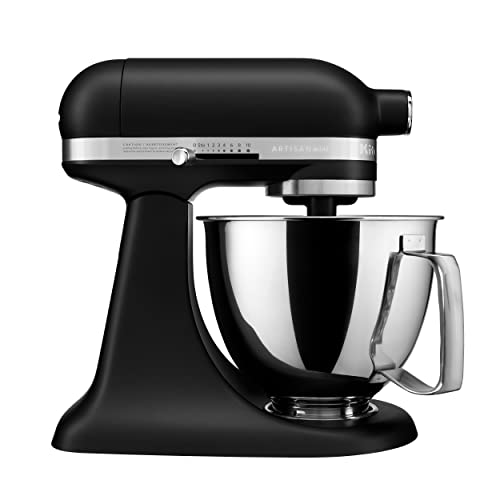
KitchenAid Artisan Mini 3.5-Qt Tilt-Head Stand Mixer (KSM3316) — Best Overall
The Artisan Mini is the compact mixer to buy if you want no compromises beyond size. KitchenAid kept the planetary mixing action, the all-metal drive feel, and — critically — the front attachment hub, so every standard KitchenAid attachment from the pasta roller to the meat grinder fits this machine exactly as it fits a full-size Artisan. For a small household that still cooks seriously, that ecosystem access is the difference between a mini mixer and a toy.
Strengths
- Full KitchenAid attachment-hub compatibility in a compact body
- Planetary mixing action reaches around the whole bowl
- 10 speeds with a gentle start for dry ingredients
Trade-offs
- Premium price tier compared with other minis
- 3.5-quart bowl is too small for double dough batches
- Heavier than the plastic-bodied budget minis
| Bowl capacity | 3.5 quart |
| Design | Tilt-head |
| Speeds | 10 |
| Included | Flat beater, dough hook, wire whip |
The 3.5-quart bowl handles a single batch of cookies, a loaf of enriched dough, mashed potatoes for four, or a two-layer cake without drama. The 10-speed range starts gently enough to fold flour without a countertop snowstorm, and the tilt-head design keeps the parked height low enough for standard cabinet clearance in most kitchens.
The trade-offs are price and capacity ceiling. This is a premium-tier purchase — check the current price on Amazon, because it sits well above the budget minis below — and double batches of stiff dough will push it. If you regularly bake for a crowd, a full-size bowl-lift is the better tool. For one-to-four-person kitchens, though, this is the compact mixer that behaves like a real one.
Best for: Small kitchens that still want the full KitchenAid ecosystem / Not suited for: Bakers who routinely double recipes or knead large stiff dough batches
Check the current price on Amazon
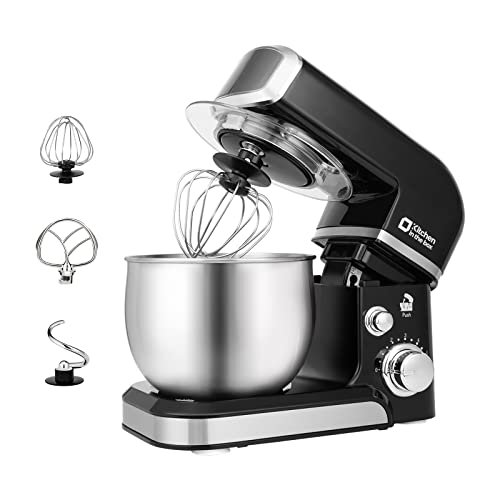
Kitchen in the box 3.2Qt Small Stand Mixer — Best Budget
Kitchen in the box built this mixer for a specific person: someone cooking for one or two, in a small space, who wants hands-free mixing without spending real money. The whole unit is light enough to lift with one hand and move to a cabinet, the bowl is a sensible 3.2 quarts, and the suction feet genuinely help keep it planted during thicker mixes.
Strengths
- Very light and easy to store in a cabinet
- Suction-cup feet keep it steady on smooth counters
- Three attachments and a splash guard included
Trade-offs
- Not built for stiff, low-hydration dough
- Plastic construction feels less durable than metal-bodied rivals
- Small bowl limits batch size to one or two people
| Bowl capacity | 3.2 quart |
| Speeds | 6 |
| Included | Egg whisk, dough hook, flat beater, splash guard |
Performance is honest light-duty work. Cake batters, pancake batter, whipped cream, egg whites, frosting, and soft doughs all come out well. The included egg whisk, dough hook, and flat beater cover the basics, and the splash guard with its pouring window is a thoughtful touch at this price tier.
Where it shows its budget roots is stiff dough. A heavy, low-hydration bread dough will make the head work hard and can walk the unit despite the suction cups. Treat the dough hook as a soft-dough tool — pizza dough in small batches, enriched doughs, cookie dough — and this little mixer punches above its tier. It is sold as a budget-tier appliance, so check price on Amazon and expect plastic-bodied construction rather than metal gearing.
Best for: Singles and couples mixing batters, frosting, and soft doughs / Not suited for: Serious bread bakers or anyone mixing for a family
Check the current price on Amazon

Dash Everyday Stand Mixer, 3-Quart — Best for Tiny Counters
The Dash Everyday is the mixer people buy when the counter is measured in inches. Its 3-quart stainless bowl and compact tilt-head body take up less room than a toaster oven, it weighs very little, and the retro styling means many owners simply leave it out — which, for a small appliance, is the highest compliment there is.
Strengths
- Smallest footprint of any stand mixer here
- Light enough to move with one hand
- Simple, durable 6-speed control with no learning curve
Trade-offs
- Light-duty motor strains on thick dough
- 3-quart bowl caps batch size hard
- Fewer attachments and no expansion hub
| Bowl capacity | 3 quart |
| Design | Tilt-head |
| Speeds | 6 |
| Included | Beaters and dough hooks |
Six speeds cover the everyday range: folding, mixing, whipping. The fully rotating bowl offset and beaters handle boxed cake mixes, brownie batter, whipped cream, and mashed potatoes for two without complaint. Cleanup is quick because everything is small, light, and mostly dishwasher-friendly.
Be clear about the ceiling, though. This is a light-duty machine. Thick cookie dough in a full bowl makes it strain, and it is not a bread machine in any sense. Buy it for what it is — the best compact small mixer for genuinely tiny counters and light everyday mixing — and it delivers exactly that, at a budget-friendly tier.
Best for: Studio apartments, dorms, and RVs with light mixing needs / Not suited for: Bread dough or frequent thick cookie dough
Check the current price on Amazon

Hamilton Beach 4 Qt Electric Stand Mixer — Best Compact for Bigger Batches
Hamilton Beach’s 4-quart stand mixer is the answer to the most common mini-mixer complaint: the bowl is just too small. Four quarts handles a full standard cookie batch, a two-layer cake, or potatoes for a family side dish, yet the body stays compact enough for apartment counters and the built-in handle makes it genuinely easy to carry to a pantry shelf.
Strengths
- 4-quart bowl fits full standard batches
- Planetary action reduces bowl scraping
- Carry handle and splash guard included
Trade-offs
- Plastic construction feels less premium
- Not suited to large stiff dough loads
- Slightly larger footprint than the 3-quart minis
| Bowl capacity | 4 quart |
| Power | 300 watts |
| Speeds | 7 |
| Included | Whisk, flat beater, dough hook, splash guard |
The planetary mixing action is the real headline at this tier — the beater orbits the bowl so you scrape less and mix more evenly than with twin-beater budget designs. Seven speeds, a splash guard, and the standard trio of whisk, flat beater, and dough hook are all in the box.
It is a 300-watt-class machine, so the same dough honesty applies: soft and medium doughs yes, a big stiff sourdough no. The plastic-heavy build also feels a step below the KitchenAid Mini. But as a compact mixer that does not force you to halve recipes, it occupies a sweet spot nothing else on this list quite matches, at a mid-range tier below the premium pick.
Best for: Small families who found 3-quart minis too limiting / Not suited for: Heavy bread production or buyers wanting metal construction
Check the current price on Amazon
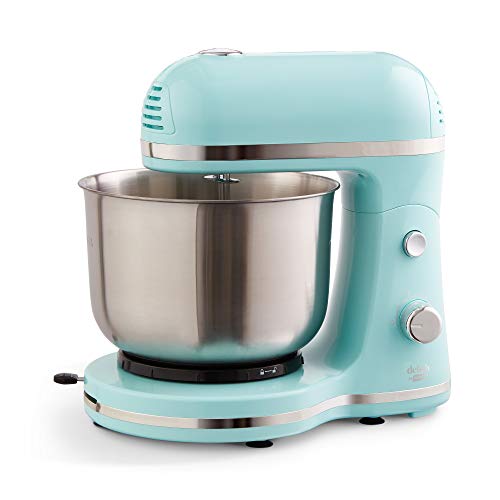
Delish by Dash Stand Mixer, 3.5-Quart — Best Lightweight with Removable Bowl
The Delish by Dash takes the original Dash formula and adds the two things owners asked for: a slightly larger 3.5-quart bowl that lifts off for serving and washing, and included dough hooks for light dough work. It stays firmly in the lightweight class, so it is a mixer you move without thinking about it.
Strengths
- Removable 3.5-quart bowl is easy to wash and serve from
- Very light and compact for small kitchens
- Dough hooks included for light dough work
Trade-offs
- Only 5 speeds
- Light-duty motor — no stiff dough
- No attachment ecosystem
| Bowl capacity | 3.5 quart |
| Speeds | 5 |
| Included | Beaters, dough hooks, removable bowl |
Five speeds is fewer than rivals offer, but the range is sensibly spaced for batters, frostings, whipped cream, and soft doughs — the jobs this mixer will actually do in a small kitchen. The compact head and cheerful color options keep it in the leave-it-out category rather than the hide-it-away one.
Like the smaller Dash, this is a light-duty appliance and the review would be dishonest if it pretended otherwise. Stiff dough and double batches are out of its league. Within its lane — casual baking for one to three people, minimal storage space, minimal fuss — it is one of the most likeable compact small mixers sold today, in the budget-to-mid tier.
Best for: Casual bakers who value easy cleanup and light weight / Not suited for: Frequent bread bakers or large households
Check the current price on Amazon

KitchenAid 5 Ultra Power Speed Hand Mixer (KHM512) — Best Drawer-Friendly Alternative
Every compact-mixer guide should ask an awkward question: do you need a stand mixer at all? If your mixing is mashed potatoes, boxed cake mix, whipped cream, pancake batter, and the occasional cookie dough, a good hand mixer does all of it, stores in a drawer, and costs a fraction of even a budget stand mixer. The KHM512 is the one to get.
Strengths
- Stores in a drawer — zero counter footprint
- Slow first speed prevents flour clouds
- Center-post-free beaters clean easily
Trade-offs
- Your arm does the holding — no hands-free mixing
- Not suitable for kneading bread dough
- Smaller effective capacity than a stand mixer bowl
| Type | Hand mixer |
| Speeds | 5 |
| Included | 2 stainless Turbo Beater accessories |
Five speeds with a genuinely slow first gear matter more than raw power here — you can start flour without wearing it. The stainless Turbo Beater accessories have no center post, so batter does not climb and clog them the way it does on cheap beaters, and they rinse clean in seconds. The swivel cord and light body make it comfortable for left- or right-handed use.
The limits are the obvious ones: your arm is the stand, so long kneading is out, and thick dough will bog it down if you push. But measured purely as a compact small mixer for everyday cooking, it earns its place on this list — and for the tiniest kitchens, it may honestly be the best pick here.
Best for: The smallest kitchens and mostly-light mixing workloads / Not suited for: Hands-free mixing or regular dough work
Check the current price on Amazon
Comparison Table
| Pick | Badge | Key spec | Best for |
|---|---|---|---|
| KitchenAid Artisan Mini 3.5-Qt Tilt-Head Stand Mixer (KSM3316) | Best Overall | 3.5-qt bowl, 10 speeds, attachment hub | Small kitchens that still want the full KitchenAid ecosystem |
| Kitchen in the box 3.2Qt Small Stand Mixer | Best Budget | 3.2-qt bowl, 6 speeds, suction feet | Singles and couples mixing batters, frosting, and soft doughs |
| Dash Everyday Stand Mixer, 3-Quart | Best for Tiny Counters | 3-qt bowl, 6 speeds, ultra-compact body | Studio apartments, dorms, and RVs with light mixing needs |
| Hamilton Beach 4 Qt Electric Stand Mixer | Best Compact for Bigger Batches | 4-qt bowl, planetary action, 300W | Small families who found 3-quart minis too limiting |
| Delish by Dash Stand Mixer, 3.5-Quart | Best Lightweight with Removable Bowl | 3.5-qt removable bowl, 5 speeds | Casual bakers who value easy cleanup and light weight |
| KitchenAid 5 Ultra Power Speed Hand Mixer (KHM512) | Best Drawer-Friendly Alternative | 5 speeds, drawer storage, Turbo Beaters | The smallest kitchens and mostly-light mixing workloads |
Read the bowl sizes carefully: the jump from 3 to 4 quarts is the difference between halving recipes and making them whole, while the jump from budget minis to the KitchenAid Mini is about construction and attachment support rather than capacity.
How to Choose a Compact Small Mixer That Actually Fits Your Kitchen
Start with two measurements, not with brands. First, measure the height from your counter to the underside of your upper cabinets — typically around 18 inches, but older kitchens can be tighter — and remember that a tilt-head mixer needs extra clearance when the head is open for bowl removal. Second, measure the depth and width of the spot where the mixer will live, including the space the cord needs. A mixer that fits on paper but blocks a cabinet door will end up in a closet, and a mixer in a closet does not get used.
Next, be honest about your heaviest regular job. If it is cake batter and whipped cream, any pick on this list works. If it is weekly cookie dough, prioritize planetary action and a dough hook with a motor that does not strain — the KitchenAid Mini and the Hamilton Beach are the safer buys. If it is bread, even occasionally, understand that compact mixers knead small, soft doughs only; plan to finish stiff doughs by hand or step up to a bowl-lift machine.
Bowl capacity deserves skepticism. A “3.5-quart” bowl does not comfortably mix 3.5 quarts of batter — working capacity is closer to two-thirds of the stated size once you leave room for ingredients to move and rise. As a rule of thumb, a 3-quart bowl suits one-to-two-person cooking, 3.5 quarts suits small families making single batches, and 4 quarts is the smallest size that handles standard recipes without splitting them.
Finally, consider where the mixer sleeps. Lightweight minis like the Dash and Kitchen in the box models are designed to be lifted into cabinets, which is a real advantage if counter space is your scarcest resource. Heavier compact machines like the Artisan Mini earn a permanent counter spot — better for frequent bakers, worse for minimalists. Neither answer is wrong; the mistake is buying the heavy machine for a kitchen where it will live in a box.
Is a Compact Mixer Powerful Enough for Dough?
This is the question that decides most compact-mixer purchases, and the honest answer is: it depends entirely on the dough. Soft, high-hydration doughs — focaccia, enriched brioche in small batches, pizza dough for two — are within reach of the better compact mixers, especially the KitchenAid Mini with its proper dough hook and planetary action. Stiff, low-hydration doughs like bagels or a firm sourdough are a different story: they demand torque that small motors and light frames cannot deliver without straining, walking across the counter, or overheating.
Wattage is a misleading guide here. Small mixers advertise watts prominently, but mixing performance depends on gearing and torque at low speed, not the watt figure. A well-geared compact mixer will knead a small soft dough calmly, while a higher-watt twin-beater budget model can whine and stall on the same job. The reviews above flag each model’s real dough ceiling rather than repeating its wattage as if it settled the question.
A practical technique extends any compact mixer’s dough ability: mix the dough only until it comes together, rest it for twenty minutes (the flour hydrates and the gluten relaxes on its own), then mix briefly again. This autolyse-style rest does half the kneading for free and keeps a small motor out of the strain zone. If bread becomes a serious hobby, treat the compact mixer as your batter-and-cookie machine and knead bread by hand or save for a bowl-lift — no compact model is the right long-term bread tool.
Compact Stand Mixer vs. Hand Mixer: Which Small Mixer Should You Buy?
The stand-versus-hand decision is really about hands and time. A stand mixer frees both hands to add ingredients, scrape the bowl, and prep the next component, and it handles long whipping — meringues, marshmallow, big frosting batches — without tiring your arm. A hand mixer answers back with storage: it vanishes into a drawer, costs far less, and for the five-minute jobs that make up most home mixing, it is simply faster to grab, use, and wash.
Frequency settles it for most people. Bake weekly or more, and a compact stand mixer earns its footprint. Bake monthly, mostly from boxes and simple recipes, and the KitchenAid hand mixer on this list will do everything you ask of it while leaving your counter clear. Many small kitchens end up with the hand mixer first and add the mini stand mixer later, which is a perfectly sensible order of operations.
There is also a middle path worth knowing: convertible hand-and-stand models, covered in their own guide in this cluster, dock a hand mixer into a stand. They compromise on bowl size and power but suit renters who genuinely cannot decide. For most buyers, though, a purpose-built compact stand mixer or a good hand mixer beats the hybrid.
What Can a Compact Mixer Actually Make? A Realistic Menu
It helps to translate bowl sizes into food. A 3-quart compact mixer comfortably makes: one standard cake mix or scratch equivalent, a single batch of roughly two dozen cookies, whipped cream from a pint of cream, mashed potatoes for four, pancake or waffle batter for a small household, and frosting for one cake. That covers the overwhelming majority of everyday home mixing, which is why compact mixers satisfy most owners despite their size.
A 3.5 to 4-quart model stretches that to a two-layer celebration cake, a fuller cookie batch, and potatoes for six. Where compact mixers genuinely run out of road is production work: double cookie batches, sandwich loaves in quantity, big holiday baking days, and stiff doughs. None of that makes them bad tools — a compact car is not a bad car because it cannot tow a boat — but it does mean frequent big-batch bakers should read this guide as a second-mixer guide rather than a primary-mixer one.
One more category where small mixers shine is small-batch experimentation. Halved recipes, test batches of a new frosting, a single serving of whipped coffee topping — jobs where dragging out a big machine and washing a big bowl feels absurd. Owners of full-size mixers often keep a hand mixer for exactly this reason, which is why the KHM512 earned its slot here.
Tilt-Head or Bowl-Lift, Planetary or Twin-Beater: Compact Mixer Designs Explained
Compact mixers come in two mechanical families, and the difference matters more than any spec on the box. Planetary mixers — the KitchenAid Mini and the Hamilton Beach on this list — use a single beater that orbits around the bowl while spinning, sweeping nearly the whole bowl surface. That action mixes faster, incorporates ingredients more evenly, and works far better with dough hooks, because the hook can actually gather and push a dough mass rather than slicing through it.
Twin-beater designs — the Dash models and most budget minis — spin two beaters in a fixed position while the bowl rotates or sits offset. For batters and whipped cream this works perfectly well and keeps costs and weight down. The weakness shows up with thick mixtures: the beaters can carve a channel through stiff dough instead of folding it, and the bowl-scraping burden falls on you. Neither design is a scam; they are simply aimed at different workloads, and the reviews above tell you which family each pick belongs to.
Head design is the second fork. Every compact mixer here is a tilt-head, and that is no accident: bowl-lift mechanisms need a taller, heavier frame to house the lift, which fights the entire point of a compact machine. Tilt-heads are lighter and simpler, with one caveat — you need vertical clearance to open the head, which is why measuring your cabinet gap appears so often in this guide. If your cabinets are unusually low, a hand mixer or a model you store in a cabinet and use on an open stretch of counter may serve you better than any countertop resident.
How Long Do Compact Mixers Last, and How Do You Keep Them Alive?
A compact mixer’s lifespan is decided less by its brand than by whether its owner respects its dough ceiling. Budget minis that spend their lives on batters, frostings, and whipped cream routinely serve for years; the same model killed in six months almost always died kneading stiff dough weekly. Heat is the tell: if the head feels hot or the motor smell turns sharp and electrical, stop, let the machine rest, and finish the job by hand.
Care is simple. Wipe the body with a damp cloth rather than rinsing it, wash attachments promptly so acidic batters do not sit on finishes, and avoid the dishwasher for coated beaters unless the manual explicitly allows it — harsh detergents dull and eventually flake beater coatings. Store the cord loosely coiled; tight wrapping around the neck fatigues the wires where they enter the body.
The premium end of this list plays by different rules. The KitchenAid Mini shares its service ecosystem with full-size models: parts, attachments, and repair knowledge are widely available, which is a real component of its value. Budget minis are effectively sealed appliances — when they die, they are replaced. Neither model is unreasonable at its tier, but it is worth knowing which ownership style you are buying into before you choose.
How to Set Up and Use a Compact Mixer in a Small Kitchen
A compact mixer rewards a little setup thought. Five minutes spent on placement and first-use checks will decide whether it becomes a daily tool or a cabinet ornament.
- Pick the parking spot first. Place the mixer where it will live, tilt the head fully open, and confirm it clears the cabinets. If it does not, plan a slide-out spot — many owners park compact mixers on a small appliance mat so they glide forward for use and back for storage.
- Wash the bowl and attachments before first use. Warm soapy water removes factory residue; dry the bowl fully so the first batter does not pick up water spots or off-flavors.
- Lock the bowl and head before starting. On tilt-head models, confirm the bowl is seated and twisted into its base and the head is latched down. A compact mixer that walks usually turns out to be an unlatched one.
- Start every mix on the lowest speed. Add dry ingredients in two or three additions, letting each incorporate before raising the speed. This single habit prevents both flour clouds and motor strain.
- Scrape once, halfway. Stop, lift the head, and scrape the bowl sides and bottom with a flexible spatula. Compact bowls are small enough that one scrape gets you an even mix without overworking the batter.
- For dough, use the rest trick. Mix until the dough just comes together, rest it 20 minutes in the bowl, then mix two more minutes. Small motors stay cool and the dough gets properly developed.
- Clean immediately. Rinse beaters and bowl before batter dries on them; compact attachments are small enough that a dried-on cleanup takes longer than the mixing did.
Store the attachments in the bowl with a folded towel between them to stop rattling and chipping, and coil the cord loosely rather than wrapping it tight around the neck — compact mixers live long lives when their cords and latches are treated gently.
Which Attachments Are Worth It for a Compact Mixer?
Attachments are where compact mixers divide into two philosophies. The KitchenAid Mini plugs into the same front-hub ecosystem as full-size models: pasta rollers and cutters, a meat grinder, a grain mill, an ice cream maker, spiralizers, and more. For a small kitchen, that matters in an unexpected way — one compact base that replaces three other appliances can be a net space saving, even though each attachment needs a home. If you already own KitchenAid attachments, the Mini is close to an automatic choice.
Budget compact mixers take the opposite approach: what is in the box is what you get. That is usually a flat beater, a whisk, and a dough hook, which honestly covers ninety percent of home mixing. The accessories worth adding regardless of model are humble ones: a second bowl if you bake recipes with separate wet and dry mixes, a flexible-edge beater that scrapes the bowl as it orbits (available for planetary models), and a splash guard if your mixer did not include one — compact bowls sit close to the head, so flour escapes them more easily than it does from deep full-size bowls.
What you can skip: novelty attachments marketed for minis that duplicate tools you already own, and any attachment whose job your mixer’s motor is too light to do well. An attachment is only worth buying if the base machine has the torque to run it; on the light-duty picks here, that means staying with the included tools and letting knives, graters, and food processors do their own jobs.
Common Buying Mistakes
Buying by wattage. In compact mixers, gearing and planetary action matter more than the watt number on the box. A lower-watt planetary mixer will out-mix a higher-watt twin-beater on thick batters every time.
Assuming the bowl size is the batch size. Working capacity is roughly two-thirds of the stated bowl volume. A 3-quart bowl that overflows with your standard cookie recipe will make you hate the mixer, not the recipe — size up to 4 quarts if you bake standard batches.
Never measuring cabinet clearance. The number one reason compact mixers get returned is height with the head open. Measure before you buy, including the tilt arc.
Kneading stiff dough in a light mixer. Bagel dough and firm sourdough can strain or stall small motors. Compact mixers are batter, frosting, and soft-dough tools; respect the ceiling and they last for years.
Skipping the slow start. Dumping flour into a bowl and hitting speed six creates a flour cloud and a strained motor. Two additions, low speed first — it takes twenty extra seconds.
Storing the mixer where it is annoying to use. A compact mixer buried behind the slow cooker in a deep cabinet might as well not exist. If cabinet storage is your plan, choose one of the genuinely light models and keep it at the front; if you know you will not fetch it, be honest and buy the hand mixer instead.
Ignoring the return window on first dough. Test your heaviest regular recipe within the first week, while returns are painless. A compact mixer that strains on your standard cookie dough is telling you something important about the match between machine and workload — believe it early, not after the window closes.
Final Recommendation
For most small kitchens, the KitchenAid Artisan Mini is the compact small mixer to buy: it is the only mini here with a full attachment ecosystem and true planetary performance, and it will still feel like a serious tool in five years. If the budget is the binding constraint, the Kitchen in the box 3.2Qt covers everyday mixing for one or two people at a fraction of the commitment, and the Hamilton Beach 4 Qt is the right call when small bowls keep forcing you to halve recipes.
And do not overlook the drawer option. If your mixing is light and your counter is precious, the KitchenAid KHM512 hand mixer may serve you better than any stand mixer on this page. The best compact mixer is the one that fits your kitchen and your actual recipes — measure both honestly and the choice makes itself, every single time.
Ready to buy? Start with KitchenAid Artisan Mini 3.5-Qt Tilt-Head Stand Mixer (KSM3316), Kitchen in the box 3.2Qt Small Stand Mixer, Dash Everyday Stand Mixer, 3-Quart — check the current price on Amazon for each and confirm the exact color and configuration on the listing before you order.
Keep exploring the rest of this cluster: Best Compact Stand Mixers Best Convertible Hand And Stand Mixers Best Cookie Mixers Best Small Mixers Best Stand Mixers For Small Kitchens
Related guides
Frequently Asked Questions
What size bowl is best for a compact mixer?
For one or two people, 3 to 3.5 quarts is the sweet spot: enough for a standard cake or cookie batch without wasted space. Small families should look at 4 quarts, the smallest size that reliably handles full standard recipes. Remember that working capacity is about two-thirds of the stated bowl size.
Can a compact stand mixer knead bread dough?
Small, soft doughs yes — pizza dough for two, focaccia, and enriched doughs in single batches. Stiff, low-hydration doughs like bagels or firm sourdough exceed what compact motors and light frames can handle safely. Use the mix-rest-mix technique to reduce strain, and finish stiff doughs by hand.
Is the KitchenAid Artisan Mini worth it over budget minis?
If you bake weekly and want attachment compatibility — pasta, grinding, ice cream — yes: it is built like a full-size KitchenAid, just smaller. If your mixing is occasional and light, the budget minis do the same everyday jobs for much less, and the price gap buys a lot of ingredients.
How much counter space does a compact mixer need?
Plan on roughly a square foot of footprint plus clearance to tilt the head open under your cabinets. Lightweight models under about five pounds can live in a cabinet instead; heavier compact mixers like the Artisan Mini are better treated as permanent counter residents.
Compact stand mixer or hand mixer — which is better for a small apartment?
A hand mixer wins on storage and price and handles most everyday jobs. A compact stand mixer wins on hands-free work, long whipping, and dough hooks. If you bake weekly, choose the stand mixer; if you mix a few times a month, the hand mixer is the smarter compact buy.
Are compact mixers loud?
They are not silent, but size is not the main driver of noise — gear design is. Metal-geared planetary models tend to produce a lower, steadier hum, while light twin-beater minis can sound higher-pitched under load, especially on hard counters that act like sounding boards. A folded towel or appliance mat under the base noticeably cuts the racket, and mixing during reasonable hours keeps apartment neighbors friendly.
Do compact mixers work with standard attachments?
Only some. The KitchenAid Artisan Mini accepts the brand’s standard front-hub attachments, which is a major reason for its premium tier. Most budget compact mixers work only with their included beaters and hooks, so check what is in the box before assuming you can expand later.


