Disclosure: airfryerkitchensupply.com is reader-supported. When you buy through links on our site, we may earn an affiliate commission at no extra cost to you.
Where to buy
If you are comparing the best compact portable sound mixers for live events, start with the verified shortlist below — and settle the powered-versus-unpowered question before reading any further.
Portable sound mixers are sold by music retailers, live-sound dealers, and Amazon’s instrument storefronts. The class splits in two — unpowered mixers that feed powered speakers, and powered mixers with built-in amplification for passive speakers — and buying the wrong half is the classic mistake, so confirm which your speakers need before ordering anything. Every linked pick below was verified against Amazon listing data feed so the listing matches the mixer reviewed. Check the current price on Amazon for the exact model, and budget cables in the same order.
Dealer tip: live-sound retailers will often confirm speaker compatibility by phone in two minutes — a call worth making before a powered mixer and passive cabinets meet for the first time at your expense.
- Mackie ProFX10v3+ 10-Channel Mixer — Check on Amazon
- Yamaha MG10XU 10-Input Stereo Mixer — Check on Amazon
- Soundcraft Notepad-12FX Small-Format Mixer — Check on Amazon
- Behringer EUROPOWER PMP550M Powered Mixer — Check on Amazon
- Rockville RPM45 4-Channel Powered Mixer — Check on Amazon
- Pyle PMXU63BT 6-Channel Audio Mixer with Bluetooth — Check on Amazon
The best compact portable sound mixers are the ones that make a small event sound inevitable: a duo at a winery, a ceremony in a garden, a school assembly, a church hall, a DJ’s spoken-word segments — set up in twenty minutes, sounding like you meant it. The six verified picks below span the portable spectrum honestly: Mackie’s ProFX10v3+ and Yamaha’s MG10XU as the unpowered benchmarks, Behringer’s PMP550M and Rockville’s RPM45 as powered mixers that drive passive speakers directly, Pyle’s PMXU63BT as the budget Bluetooth all-rounder, and Soundcraft’s Notepad-12FX as the compact quality pick with Lexicon effects.
Portable is a discipline, not a size. It means the mixer travels in a case, sets up without a manual, survives a volunteer’s hands, and pairs with speakers you can carry. Every pick here was judged against that discipline first and its spec sheet second — because at a real event, the mixer you understand at a glance beats the mixer with two more channels you do not.
Scope note, to close the batch cleanly: this article covers mixers for live portable sound — the event rig. Desktop streaming boards live in the micromix article, app-controlled stage boxes in the digital article, and the broad middle in the compact audio article. Portable sound’s distinguishing demand is the room: strangers, speeches, music, and a hard stop on setup time, all in spaces that were never designed for audio. The picks below were chosen by people who respect that demand.
In this guide
Quick Picks
Six portable sound mixers in two families: unpowered boards for powered speakers, and powered mixers for passive speakers. Find your family first, then your pick — the badges and reviews are organized to make that order natural.
If your speakers plug into the wall, read the unpowered reviews twice and the powered ones once, for literacy; if they do not, reverse the instruction.
Mackie ProFX10v3+ 10-Channel Mixer — Best Overall Portable — Check on Amazon
The portable benchmark updated: Mackie’s Onyx-grade preamp heritage in the small format, the GigFX+ effects engine for voices, Bluetooth for break music, and USB for recording the event. For duos, DJs, and small venues, this is the board that ends the research.
Yamaha MG10XU 10-Input Stereo Mixer — Best for Clarity and Simplicity — Check on Amazon
Yamaha’s MG10XU is the clarity pick: D-PRE preamps, one-knob compressors that tame voices without engineering knowledge, SPX effects, and a USB interface. For speech-first events — ceremonies, schools, worship — it is the board engineers recommend to non-engineers.
Soundcraft Notepad-12FX Small-Format Mixer — Best Sound Quality Portable — Check on Amazon
The connoisseur’s portable: Soundcraft preamps, Lexicon reverbs that flatter like studio units, and USB I/O in a board that still fits the gig bag. For small acts whose sound is their signature, the Notepad-12FX is the quality argument won.
Behringer EUROPOWER PMP550M Powered Mixer — Best Powered Mixer — Check on Amazon
The powered answer for passive speakers: 500 watts of amplification, five channels, Klark Teknik effects, and FBQ feedback detection that shows you which frequency is ringing. For schools, churches, and bands with passive PA cabinets, this is the one-box solution.
Rockville RPM45 4-Channel Powered Mixer — Best Budget Powered — Check on Amazon
The budget powered option aimed squarely at churches and schools: four channels, a built-in amplifier for passive speakers, USB playback for music, echo and delay for voices, and phantom power for condenser mics — the announcement-and-music brief at the lowest tier here.
Pyle PMXU63BT 6-Channel Audio Mixer with Bluetooth — Best Budget Unpowered — Check on Amazon
The feature-per-dollar outlier: six channels, Bluetooth streaming, USB and MP3 playback, DSP effects, 3-band EQ, and phantom power in a budget board for powered speakers. For DJs, karaoke hosts, and starter event rigs, it covers more of the checklist than anything near its tier.
How These Picks Were Chosen
Picks were verified feed, with channel counts, power claims, and feature sets matched to each manufacturer’s line. The powered/unpowered border was policed strictly — it is the first question a portable buyer must answer — and DJ-only controllers without microphone mixing were excluded.
Ranking weighted event reality: legibility under pressure, the features each venue type actually uses (feedback detection for halls, Bluetooth for entertainers, compression for speech), build for transport, and brand support. Each pick leads one portable brief — the feature-forward gig board, the speech board, the quality board, two powered solutions at two tiers, and the budget all-rounder — because portable sound is a family of briefs, not a single contest.
One further filter deserves record: every pick had to be operable, at its core functions, by a competent newcomer in one sitting. Portable sound’s defining user is not the touring engineer but the teacher, the deacon, the duo partner, the DJ — people for whom the mixer is a means. Boards whose basic operation hides behind menus or apps were therefore steered to the digital article, where their users self-select, and this list kept the surfaces that confess their functions at a glance.
The 6 Best Compact Portable Sound Mixers
Each review states who the mixer suits, three strengths, three trade-offs, the specifications verified from its listing, and a bold verdict. Prices are not printed — check the current price on Amazon for your shortlist, and confirm powered versus unpowered before anything else.
As you read, keep your own next event in mind — its room, its speakers, its operator — because portable mixers are matched to events, not to abstract merit, and the right pick is the one whose strengths describe your Saturday.

Mackie ProFX10v3+ 10-Channel Mixer — Best Overall Portable
The ProFX10v3+ suits working small-format performers: duos and trios, wedding and event DJs who speak, worship and school presenters, and streamers who also play live. Four mic preamps cover the classic portable lineup — two voices, an instrument mic, a spare — while stereo channels take keyboards and playback, Bluetooth handles the phone full of requests, and the GigFX+ engine supplies the reverbs and delays that make a voice sound finished in a bare room.
Strengths
- GigFX+ effects polish voices without outboard gear
- Bluetooth playback plus USB recording in one board
- Mackie build and preamps — gig-proven lineage
Trade-offs
- Unpowered — needs powered speakers or an amp
- Effects are shared across channels, not per-channel inserts
- More features means a real first-evening learning curve
| Channels | 10 |
| Effects | GigFX+ engine |
| Extras | Bluetooth, USB recording (per Amazon listing title) |
Portability here is thoughtful rather than minimal: the board is sized for a gig bag, the layout is legible in poor light, and the recording path means the same mixer that runs the wedding can capture the speeches. Mackie’s ProFX line has been the small-gig standard long enough that sound volunteers at venues you will play have already met its ancestors — an underrated form of support.
The honest comparison is with the Yamaha below: Mackie leans feature-forward (effects breadth, Bluetooth, recording), Yamaha leans clarity-forward (preamp reputation, compression on channels, simplicity). Performers who sing should weigh GigFX+ heavily; presenters who speak should weigh the MG10XU’s channel compression. Both are correct answers to slightly different events.
Buy the case. A portable mixer’s life is measured in load-ins, and the ProFX10v3+ rewards the owner who treats transport as part of the instrument — padded bag, cables coiled in the same pocket, power supply labeled. It will return the care in years.
Best for: Duos, event DJs, and small venues wanting effects, Bluetooth, and recording / Not suited for: Passive-speaker rigs without an amplifier
Check the current price on Amazon

Yamaha MG10XU 10-Input Stereo Mixer — Best for Clarity and Simplicity
The MG10XU suits presenters, worship teams, schools, and acoustic acts whose priority is intelligible voices in real rooms. The one-knob compressor is its signature kindness: turn it until the loud talker and the quiet talker occupy the same comfortable level, a transformation that normally requires an engineer’s ear. D-PRE preamps keep the source clean, SPX effects add a breath of space, and the layout is Yamaha-tidy — the board a volunteer can be taught in one rehearsal.
Strengths
- D-PRE preamps — clean, respected gain
- 1-knob compressors make voices broadcast-even
- USB interface for recording and playback
Trade-offs
- Unpowered — pairs with powered speakers
- Four mic preamps cap the lineup size
- Effects selection is curated rather than deep
| Inputs | 10 |
| Preamps | D-PRE |
| Effects | SPX effects (per model line) |
| Interface | USB |
In halls and sanctuaries — the reflective rooms where portable sound goes to die — the MG10XU’s combination of clean gain and easy compression produces the thing audiences actually judge: they can understand every word without strain. That is a higher compliment than any spec, and it is why this board appears in so many institutional cupboards, usually bought once and used for a decade.
Musicians chasing lush effects or many monitor options will find its ceiling sooner than the Mackie’s; its design center is the spoken and acoustic event. Judge it by that center and it is close to flawless; judge it as a rock band’s board and the smaller sibling article on digital mixers is your next stop.
The MG family’s manuals deserve mention: Yamaha writes the clearest setup guidance in the class, which matters when the operator is a teacher with twenty minutes. A portable mixer is a system that includes its documentation, and Yamaha ships a good one.
Best for: Speech-first events, worship, schools, and acoustic acts / Not suited for: Bands needing deep effects or many monitors
Check the current price on Amazon

Soundcraft Notepad-12FX Small-Format Mixer — Best Sound Quality Portable
The Notepad-12FX suits singer-songwriters, acoustic ensembles, and small studios that also perform — buyers who hear the difference between adequate and voiced. Four mic preamps with Soundcraft’s console heritage, Lexicon effects with genuine pedigree, and USB for recording the night or playing tracks make it the most sonically ambitious unpowered board in this guide, at a size that travels without complaint.
Strengths
- Lexicon effects — the finest built-in reverbs here
- Soundcraft preamp quality and EQ voicing
- USB I/O for recording and playback flexibility
Trade-offs
- Dense, small-print layout demands familiarity
- Unpowered — powered speakers required
- Premium tier among the unpowered picks
| Inputs | 12 |
| Effects | Lexicon effects |
| Interface | USB I/O (per Amazon listing title) |
The Notepad’s party trick is making small rooms sound designed. Its reverbs sit behind a voice rather than washing over it, its EQ corrects without thinning, and its preamps stay composed when a singer leans in. Acts that record their gigs through its USB consistently report the same surprise: the board’s mix sounds like a record of the night rather than a memo of it.
The cost is ergonomic density — small knobs, close spacing, legends that reward owners who learn them at home. As in the compact article’s treatment of its smaller sibling, the verdict splits by user: the prepared performer calls it precise; the occasional volunteer calls it fiddly. Both are describing the same board honestly.
For the hybrid studio-stage life, this is the portable pick with the longest reach: rehearsal recording, demo capture, and live work from one surface. Buyers whose music lives in both rooms should start their shortlist here and make the others argue their way past it.
Best for: Quality-first small acts and hybrid studio-stage users / Not suited for: Volunteers needing a spacious, glanceable layout
Check the current price on Amazon

Behringer EUROPOWER PMP550M Powered Mixer — Best Powered Mixer
The PMP550M suits rigs built around passive speakers — the installed base of school halls, churches, community theaters, and bands with classic PA cabinets. Instead of a mixer plus a separate amplifier, the powered mixer is both: plug microphones in, plug speakers out, and the system is complete. The FBQ feedback detection earns special respect in these rooms: when a frequency begins to ring, the system identifies it on the graphic EQ, turning the most frightening live-sound moment into a single slider adjustment.
Strengths
- Built-in 500W amplification for passive speakers
- FBQ feedback detection — a lifeline in live rooms
- Klark Teknik effects included
Trade-offs
- Five channels is a modest lineup ceiling
- Powered format is heavier than unpowered boards
- Speaker matching (impedance, wattage) needs care
| Type | Powered mixer |
| Power | 500 W (per Amazon listing title) |
| Channels | 5 |
| Extras | Klark Teknik multi-FX, FBQ feedback detection, wireless option |
Feedback deserves its paragraph, because it is the sound that defines amateur events in the audience’s memory. FBQ does not prevent feedback — microphone placement and gain discipline do that — but it converts diagnosis from panic to procedure, which for a volunteer operator is the difference between a recovered moment and a ruined one. In the rooms this mixer serves, that feature alone justifies its badge.
Speaker math is the buyer’s homework: confirm your cabinets’ impedance and power handling against the amplifier’s ratings, and keep total load within the manual’s guidance. Done once, correctly, the PMP550M becomes the simplest rig in this guide to operate — one box, one power cable, speakers on stands — which is precisely the virtue its venues need.
It is also the natural upgrade path for institutions replacing an aging powered head: same speaker infrastructure, modern effects and feedback tools, no re-cabling of the hall. Continuity of infrastructure is a real budget virtue, and Behringer’s Europower line has served it for years.
Best for: Schools, churches, and bands running passive speakers / Not suited for: Powered-speaker rigs or lineups beyond five channels
Check the current price on Amazon
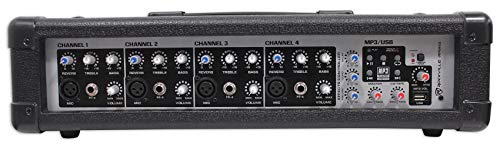
Rockville RPM45 4-Channel Powered Mixer — Best Budget Powered
The RPM45 suits small institutions and starter rigs: a chapel with two microphones and music playback, a school gym’s assembly system, a community group’s portable PA. Its feature list reads the brief back accurately — USB playback so the music lives on a stick, echo and delay to keep voices pleasant in hard rooms, XLR and TRS inputs for whatever microphones the cupboard holds, and fan-cooled amplification sized for small passive speakers.
Strengths
- Powered format at the guide’s lowest tier
- USB playback and voice effects built in
- Phantom power for condenser microphones
Trade-offs
- Four channels — the smallest lineup here
- Budget build and support versus the majors
- Power figures are peak-flavored; size speakers conservatively
| Channels | 4 |
| Amplifier | Built-in, fan-cooled (per Amazon listing title) |
| Extras | USB playback, echo and delay, 15V phantom power |
Judged as an institutional appliance rather than a musician’s instrument, the RPM45 makes sense: it answers the phone-call brief — “we need to be heard in the hall, and play music at the fair” — in one box at a price a committee approves without a second meeting. Setup is correspondingly simple, and simplicity is the feature its venues are actually purchasing.
The discipline is speaker matching and expectation setting. Treat headline power numbers as ceilings, choose efficient passive speakers, and keep the rig’s job description — speech, playback, light music — pinned to the cupboard door. Inside that job, the RPM45 serves; asked to run a rock band, it will file its complaint through the speakers.
For buyers choosing between this and the Behringer powered pick: the PMP550M buys channels, feedback detection, and a deeper brand bench; the RPM45 buys the lowest complete price. Institutions with a tech volunteer should lean Behringer; institutions with a budget line and a simple brief can take the Rockville and spend the difference on better microphones, where the audience will hear it.
Best for: Small churches, schools, and starter passive-speaker rigs / Not suited for: Bands or events needing more than four channels
Check the current price on Amazon

Pyle PMXU63BT 6-Channel Audio Mixer with Bluetooth — Best Budget Unpowered
The PMXU63BT suits DJs who speak, karaoke hosts, mobile entertainers, and starter event setups feeding powered speakers. Its connectivity is the pitch: Bluetooth for the phone, USB for the computer or a stick of MP3s, and enough channels for microphones plus playback sources simultaneously. The 16-bit DSP effects give voices the echo and space that karaoke and event work expect, and 48V phantom power keeps condenser microphones welcome.
Strengths
- Bluetooth, USB, and MP3 playback — every source covered
- DSP effects and 3-band EQ at a budget tier
- Phantom power and six channels for growing rigs
Trade-offs
- Budget build and knob feel versus Mackie/Yamaha/Soundcraft
- Pyle’s support bench is thinner than the majors
- Feature breadth trades against refinement in each feature
| Channels | 6 |
| EQ | 3-band |
| Effects | 16-bit DSP FX (per Amazon listing title) |
| Extras | Bluetooth, USB computer input, MP3 player, 48V phantom power |
The honest way to read the Pyle is as a connectivity appliance: it exists to make any source audible through powered speakers with a voice over the top, anywhere, cheaply. Mobile entertainers whose show is exactly that — music from three possible sources, a microphone, a happy room — will find its priorities perfectly aligned with their work, and its compromises mostly invisible in that context.
Where it yields is refinement under scrutiny: preamp noise at high gain, control feel, and the long-tail support that the majors provide. Podcasters recording quiet speech and engineers mixing critical music should step up to the Mackie or Yamaha. Event operators at working volumes will rarely hear the difference the price gap buys, and that sentence is the Pyle’s whole defense — a good one, in its lane.
It also serves as the class’s sensible spare: a backup board that covers Bluetooth and USB emergencies for a main rig, at a price that makes redundancy rational. Working DJs who carry one describe it the way drummers describe a spare snare — hopefully unnecessary, occasionally priceless.
Best for: DJs, karaoke hosts, and starter event rigs on powered speakers / Not suited for: Quiet recording or critical listening work
Check the current price on Amazon
Comparison Table
| Pick | Badge | Key spec | Best for |
|---|---|---|---|
| Mackie ProFX10v3+ 10-Channel Mixer | Best Overall Portable | 10 channels, GigFX+ effects, Bluetooth, USB recording | Duos, event DJs, and small venues wanting effects, Bluetooth, and recording |
| Yamaha MG10XU 10-Input Stereo Mixer | Best for Clarity and Simplicity | 10 inputs, D-PRE preamps, 1-knob compressors, SPX effects, USB | Speech-first events, worship, schools, and acoustic acts |
| Soundcraft Notepad-12FX Small-Format Mixer | Best Sound Quality Portable | 12 inputs, Lexicon effects, USB I/O, Soundcraft preamps | Quality-first small acts and hybrid studio-stage users |
| Behringer EUROPOWER PMP550M Powered Mixer | Best Powered Mixer | 500W powered, 5 channels, Klark Teknik FX, FBQ feedback detection | Schools, churches, and bands running passive speakers |
| Rockville RPM45 4-Channel Powered Mixer | Best Budget Powered | 4 channels, powered amp, USB playback, echo/delay, phantom power | Small churches, schools, and starter passive-speaker rigs |
| Pyle PMXU63BT 6-Channel Audio Mixer with Bluetooth | Best Budget Unpowered | 6 channels, Bluetooth, USB/MP3 playback, DSP effects, 48V phantom | DJs, karaoke hosts, and starter event rigs on powered speakers |
The table’s most important column is the one implied by the badges: powered or not. Two of these mixers contain amplifiers and drive passive speakers; four require powered speakers or an amp. Every other comparison is secondary to getting that one right.
Channel counts here, as throughout this batch, flatter to deceive: the honest figure is microphone preamps, and the reviews state them. A twelve-input board with four preamps is a four-microphone system with generous playback — which for most portable events is not a limitation but a precise description of the job.
How to Choose the Best Compact Portable Sound Mixers for Your Events?
Answer the speaker question first, in writing: are your speakers powered (they plug into the wall) or passive (they only take speaker cable)? Powered speakers pair with unpowered mixers — the Mackie, Yamaha, Soundcraft, and Pyle here. Passive speakers pair with powered mixers — the Behringer and Rockville — or with an unpowered mixer plus a separate amplifier. This single fact halves the list correctly, and no other specification should be read until it is settled.
Count microphones second, as throughout this batch: portable events run on two to four preamps for most duos, ceremonies, and assemblies, and every pick here except the four-channel Rockville provides at least that with headroom for playback. Then match the signature feature to your venue’s signature problem: feedback-prone halls want FBQ or disciplined EQ, speech-first events want compression, entertainers want Bluetooth and playback, and quality-first acts want the best preamps and effects in the budget.
Finally, plan the carry. Mixer, speakers, stands, cables, and a power strip should move in two trips from a car, maximum, or the rig is not portable in the only sense that matters at load-out time, in the rain, at midnight.
Powered vs Unpowered Mixers: The Portable PA Decision Explained
A powered mixer combines the mixer and the amplifier in one box: fewer pieces, faster setup, and a system matched by its maker — at the cost of committing to its power and channel count, and of carrying amplifier weight in the mixer case. An unpowered mixer plus powered speakers distributes the amplification into the speaker cabinets: each piece is lighter, the system scales by swapping speakers, and a failure in one half leaves the other half rentable-around.
Installed and institutional rigs with existing passive speakers are the powered mixer’s homeland — the Behringer and Rockville picks exist for those cupboards. New rigs bought today usually start with powered speakers and an unpowered mixer, because powered speakers have become the market’s center of gravity. Neither architecture sounds inherently better; they are logistics decisions wearing audio clothing, and they should be made on logistics: what you own, what you carry, who sets it up.
Setting Up Portable Sound Without Feedback: A Field Guide
Feedback is a geometry problem before it is an equipment problem. Keep speakers in front of the microphones, never behind them; keep microphones close to their sources so gains can stay low; and aim speakers at the audience, not at walls and ceilings that return sound to the stage. With that geometry, most rooms behave. Then ring out the system: raise the main level slowly with a microphone live, find the first frequency that wants to ring, and cut it a little on the EQ — or let a tool like the PMP550M’s FBQ identify it for you.
Two habits finish the job. Soundcheck at performance volume, because feedback thresholds live there and not at rehearsal murmur. And teach every speaker the same sentence: the microphone works at a hand’s distance, always. Portable events are won by these unglamorous disciplines far more than by any mixer’s badge, which is why this guide’s picks favor tools that support the disciplines — compression for uneven talkers, feedback detection for brave rooms, legible layouts for tired operators.
How Loud Is Loud Enough? Sizing Portable Sound for a Room
Portable sound fails quietly more often than loudly: a system straining at its ceiling sounds harsh long before it sounds silent. Size for the room and the crowd, remembering that bodies absorb sound — the garden party of eighty needs meaningfully more system than the empty garden suggested at soundcheck. Speech is forgiving: clarity at conversational-plus levels serves ceremonies and assemblies, and every pick here delivers it for small-to-medium rooms with appropriate speakers. Music with drums is not forgiving, and no compact mixer article should pretend otherwise; that brief belongs to larger systems.
The practical test is headroom at the loudest planned moment, with the main level marked below the system’s strain point. If the tape mark creeps toward maximum at every event, the rig is undersized and the honest fix is speakers first, mixer power second. If the mark sits comfortably mid-range, the system is correctly sized and further spending belongs to microphones and convenience, in that order.
How to Set Up a Portable Sound Mixer for a Small Event
Step 1 — Place speakers first: on stands, at ear height, in front of the performance area, angled at the audience. Step 2 — Connect the system powered off: microphones and sources into the mixer, mixer into powered speakers — or speaker cables from a powered mixer to passive cabinets, checking impedance guidance. Step 3 — Zero the board, then gain each microphone with its user speaking at real distance and volume. Step 4 — Set the monitor or room balance from the audience’s seats, not from behind the speakers.
Step 5 — Add effects sparingly: a touch of reverb or echo on voices, none on playback music until it asks for it. Step 6 — Ring out per the guide above and mark the main level with tape. Step 7 — Tape the cables on walkways — portable events are remembered for trips as much as for sound. Step 8 — Photograph the board and coil cables in order at teardown, so the next event starts from this one’s wisdom instead of from zero.
Step 9 — Run the failure drill in miniature. Know, before the audience arrives, which cable you will swap first and where the spare lives. Step 10 — Leave the venue’s settings behind. Photograph the board, note the room’s quirks in the case notebook — the ringing frequency, the good outlet, the wobbly floor spot — and the next event in this room starts ahead of where this one did.
Common Buying Mistakes
Buying a powered mixer for powered speakers (or the reverse). The class’s defining error; answer the speaker question first. Speakers behind the microphones. Feedback geometry, guaranteed. Gain by guesswork. Quiet talkers vanish and loud ones clip; use the meters and the compression. No soundcheck at volume. Rooms change their minds when they fill; check loud, early. Untaped cable runs. A safety failure wearing an audio costume. Forgetting the break music. Bluetooth or USB playback planned in advance is professionalism; silence while you scroll a phone is not.
One speaker for a wide room. Two smaller speakers placed wide beat one loud speaker blasting the front row and starving the back. Testing with recorded music only. Music forgives; the human voice at a podium does not. Soundcheck with the actual speakers of the day, at their actual distance from the microphone.
The Portable PA Kit Around the Mixer: Speakers, Stands, and Cables
The mixer is the brain of a portable rig, but the audience hears the whole body. Speakers deserve the largest share of any portable budget — the mixer shapes the signal, the speakers are the signal, as far as a room is concerned. Stands that place those speakers at ear height over a seated audience do more for intelligibility than any EQ. Cables should be balanced where the format allows, long enough to place speakers properly rather than conveniently, and present in duplicate for the runs that matter.
The supporting cast finishes the professional picture: a power strip with surge protection and enough reach to keep the rig on one circuit, gaffer tape for cable paths, a small toolkit, spare batteries for wireless anything, and a headlamp for load-out. Portable sound is a logistics performance with an audio soundtrack; the kits that respect both halves are the ones that get hired, invited, and thanked again.
Portable Mixers for Weddings and Ceremonies: A Specialized Brief
Weddings judge portable sound by two moments: the vows, which must be understood at the back row of a garden, and the speeches, which must survive emotion, laughter, and a best man holding the microphone at his waist. The equipment implications are specific — a quality wireless or well-placed wired microphone for the officiant, compression for speakers whose volume swings with their feelings (the Yamaha’s one-knob design was practically invented for this), and playback that starts on cue without a laptop negotiation, which is where Bluetooth and USB picks earn their badges.
The professional habits matter as much: a rehearsal walk of the space, a soundcheck with the actual officiant, spare batteries staged, and a mixer operator whose only job during the ceremony is the ceremony. The picks in this guide all serve the brief at their tiers; the difference between a good wedding rig and a legendary one is almost entirely in those habits, which is the most encouraging sentence in this article for buyers on any budget.
Troubleshooting Portable Sound at the Event: A Calm Checklist
Problem: no sound at all. Work the chain in order — power at the mixer, power at the speakers (or the powered mixer’s speaker cables seated), main level up, one channel gained with a known source. Most total silences are one mute, one cable, or one unpowered box. Problem: one microphone dead. Swap its cable before its channel, and its channel before the microphone; the cable is guilty most often. Problem: hum under everything. Put the whole rig on one power strip so grounds agree, and keep audio cables away from power bricks and dimmers.
Problem: voices are muffled. Check that speakers aim at ears, not ceilings, and that no high-frequency cut was left on the channel from a previous event — photographing your board settings, as this guide keeps urging, turns this diagnosis into a glance. Problem: Bluetooth will not pair. Forget the mixer on the phone and re-pair close and unhurried, or fall back to the cable you packed because you read a guide that told you to pack one. Event troubleshooting rewards order and spares; panic is the only unforgivable fault.
Renting vs Buying a Portable Sound Mixer
The arithmetic is simple and the answer is personal. An event a year argues for rental or borrowing, with the caveat that rented gear arrives with someone else’s settings and no rehearsal. Monthly use argues for ownership at exactly the tiers in this guide, because ownership buys familiarity — the operator’s knowledge of one board is worth more than a rental’s extra channels. Weekly use argues for ownership one tier up, with a spare cable kit and eventually a backup board, because at that rhythm the mixer is infrastructure.
Institutions should also count the hidden rental cost: staff time to collect, learn, and return, multiplied by every event, forever. Against that ledger, even the premium picks here pay for themselves with a speed that surprises committees — usually within the first year of regular use, and with better sound at every event along the way.
Microphones for Portable Sound: The Other Half of the System
A portable mixer can only amplify what a microphone honestly captures, and the pairing rules are forgiving but real. Dynamic handheld microphones are the portable standard for voices: they reject room noise, survive drops, and need no phantom power. Condenser microphones capture detail for quiet acoustic work and podium speech, at the price of hearing the whole room — choose them for controlled spaces and careful hands. Whatever the type, one microphone per simultaneous speaker, held or mounted at a consistent distance, beats any processing in this guide.
Budget order matters: after the mixer, the next dollars belong to the microphones, then to the stands that hold speakers at ear height, then to cables. Buyers who follow that order discover that even the budget picks in this article sound startlingly professional — because the system’s weakest links were addressed in the order the audience hears them.
Final Recommendation
Powered-speaker rigs should start with the Mackie ProFX10v3+ for features or the Yamaha MG10XU for speech clarity, with the Soundcraft Notepad-12FX as the quality upgrade and the Pyle PMXU63BT as the budget all-rounder. Passive-speaker rigs should take the Behringer PMP550M for its feedback tools, or the Rockville RPM45 where the brief is simple and the budget strict. Answer the speaker question, count your microphones, check the current price on Amazon, and buy the case in the same order.
Whichever family your speakers dictate, remember that portable sound is a promise made to people who cannot see your equipment list: they will judge the day by whether they heard every word without effort. Choose the mixer that makes that promise easiest to keep in your rooms, with your operators, and the badge on the box will take care of itself.
- Mackie ProFX10v3+ 10-Channel Mixer (Best Overall Portable) — Check on Amazon
- Yamaha MG10XU 10-Input Stereo Mixer (Best for Clarity and Simplicity) — Check on Amazon
- Soundcraft Notepad-12FX Small-Format Mixer (Best Sound Quality Portable) — Check on Amazon
- Behringer EUROPOWER PMP550M Powered Mixer (Best Powered Mixer) — Check on Amazon
- Rockville RPM45 4-Channel Powered Mixer (Best Budget Powered) — Check on Amazon
- Pyle PMXU63BT 6-Channel Audio Mixer with Bluetooth (Best Budget Unpowered) — Check on Amazon
Keep exploring the mixer range on this site: Best Compact Audio Mixers Best Compact Digital Mixers Best Powered Mixers Best Portable Pa Systems Best Compact Mixers Under $100 Dollars
Frequently Asked Questions
What is the difference between a powered and an unpowered mixer?
A powered mixer contains an amplifier and drives passive speakers directly. An unpowered mixer outputs line-level signal and needs powered speakers or a separate amplifier. Match the mixer to the speakers you own — this is the first decision in portable sound.
How many channels do I need for a small event?
Most duos, ceremonies, and assemblies use two to four microphones plus a playback source. The picks here span four to twelve inputs; count your microphones, add playback, and keep one channel spare for the guest or the extra instrument.
Can these mixers connect to a phone for music?
Yes — the Mackie ProFX10v3+ and Pyle PMXU63BT offer Bluetooth, and several others take phones through USB or a stereo line input with the right cable. Playback planning is part of portable professionalism; choose the path your events will actually use.
How do I stop feedback at an outdoor or hall event?
Place speakers in front of microphones, keep mics close to their sources, soundcheck at full volume, and cut the first ringing frequency on the EQ. The Behringer PMP550M’s FBQ system identifies ringing frequencies automatically, which is a genuine help for volunteer operators.
Can I record an event with a portable mixer?
Several picks can: the Mackie records over USB, the Soundcraft offers USB I/O, and the Yamaha MG10XU works as a USB interface. For multitrack recording of a full band, the digital mixer article in this batch covers the stage-box and recorder options.
What speakers should I pair with these mixers?
With unpowered picks, choose powered speakers sized for your room — a pair of quality powered cabinets covers most small events. With powered mixers, choose passive speakers whose impedance and power handling match the amplifier’s ratings in its manual, and size conservatively.
Is Bluetooth reliable enough for event playback?
For break music and cues at small events, yes, with the phone kept near the mixer and notifications silenced. For critical cues — a ceremony processional — a wired connection or USB playback removes the wireless variable, and professionals treat that distinction seriously.
Which portable mixer is best for a church?
For passive-speaker sanctuaries, the Behringer PMP550M with its feedback detection; for powered speakers, the Yamaha MG10XU, whose compression keeps every reader and speaker intelligible. Both are volunteer-friendly, which is the real church specification.


