Disclosure: airfryerkitchensupply.com is reader-supported. When you buy through links on our site, we may earn an affiliate commission at no extra cost to you.
Where to buy
If you are comparing the best compact mixers for a small kitchen, start with the verified shortlist below — every pick here was matched to its manufacturer’s model line before it earned a link.
Compact kitchen mixers are sold everywhere kitchen electrics are sold, which makes exact-model buying more important, not less: the hand mixers below share shelf space with near-identical siblings in different wattages and accessory bundles. Every linked pick was verified against Amazon listing data feed, so the listing title matches the model reviewed — beater types, speeds, and included storage cases included. Check the current price on Amazon for the configuration you want, and confirm the color variant carries the same accessories before ordering.
- KitchenAid 5 Ultra Power Speed Hand Mixer KHM512 — Check on Amazon
- Breville Handy Mixer BHM800SIL — Check on Amazon
- Hamilton Beach 6-Speed Electric Hand Mixer 62682G — Check on Amazon
- Cuisinart Power Advantage 5-Speed Hand Mixer HM-50 — Check on Amazon
- Kitchen in the box Stand Mixer (3.2 Qt) — Check on Amazon
- Hamilton Beach 4 Qt Electric Stand Mixer — Check on Amazon
The best compact mixers answer a kitchen reality: most of us do not have the counter for a full-size stand mixer, the storage for a food processor army, or the batch sizes that justify either. Compact mixing means hand mixers that live in a drawer and genuinely handle cake batter, cookie dough, and whipped cream — plus a few small stand mixers that trade capacity for a footprint a real apartment can spare. The six verified picks below cover that territory honestly: KitchenAid and Cuisinart hand mixers, two Hamilton Beach workhorses in hand and stand form, Breville’s premium hand mixer, and a 3.2-quart mini stand mixer from Kitchen in the box.
A scope note, because “mixer” is an overloaded word: this article covers compact kitchen mixers. Readers hunting compact audio mixers will find them in the sibling articles in this batch — compact audio, micromix, digital, and portable sound each have their own guide — because a hand mixer and a mixing console share a noun and nothing else, and this page serves the kitchen.
One more promise about how this guide treats size: compact is not a euphemism for weak. Every pick below was chosen because it performs its intended jobs completely — the cakes rise, the cream whips, the small doughs knead — within batch sizes this article states plainly. Where a job exceeds the format, the guide says so and points to the format that owns it, because a compact mixer bought with clear eyes is a decade-long pleasure and the same mixer bought with fantasies is a return label.
In this guide
Quick Picks
Six compact kitchen mixers: five hand mixers spanning budget to premium, and two small-footprint stand options for bakers who want hands-free without the counter commitment. Badges match the full reviews exactly.
KitchenAid 5 Ultra Power Speed Hand Mixer KHM512 — Best Overall — Check on Amazon
The compact hand mixer benchmark: five speeds that start genuinely slowly, Turbo Beaters designed to pull batter rather than fling it, a swivel cord that locks left or right, and beaters that go in the dishwasher. The default drawer mixer for most kitchens.
Breville Handy Mixer BHM800SIL — Best Premium Hand Mixer — Check on Amazon
Breville’s Handy Mixer is the hand mixer for people who read spec sheets: nine speeds plus boost, a soft-start that respects your flour, and a build that feels like a small appliance from a design studio. The premium pick, priced like one, worth it to frequent bakers.
Hamilton Beach 6-Speed Electric Hand Mixer 62682G — Best Budget — Check on Amazon
The budget champion with two genuinely useful ideas: a QuickBurst button for a shot of extra power, and a bowl-rest notch that parks the mixer on the bowl’s rim instead of the counter. Six speeds, a snap-on case for the beaters, and a price tier that makes it the easiest recommendation in the article.
Cuisinart Power Advantage 5-Speed Hand Mixer HM-50 — Best Simple Classic — Check on Amazon
Cuisinart’s long-running classic: five speeds, extra-long beaters that reach deep bowls, a generous swivel cord, and a design that has outlasted trends. For bakers who want a known quantity from a kitchen brand with a service desk, the HM-50 is the steady choice.
Kitchen in the box Stand Mixer (3.2 Qt) — Best Mini Stand Mixer — Check on Amazon
The stand-mixer experience at hand-mixer scale: a 3.2-quart bowl, six speeds, and the full trio of whisk, dough hook, and flat beater in a lightweight body one hand can move. For small households that knead small doughs and hate holding a mixer, this is the compact answer.
Hamilton Beach 4 Qt Electric Stand Mixer — Best Compact Stand Value — Check on Amazon
A real stand mixer shrunk with intent: planetary mixing action, a 4-quart bowl, seven speeds, splash guard, and a carry handle for kitchens where the mixer lives in a cupboard between uses. The value stand pick for serious small-batch bakers.
How These Picks Were Chosen
Picks were verified feed, matching speeds, wattage, accessories, and bowl sizes to each manufacturer’s model line. The searches returned the wider mixer world — stand mixers of full size, audio mixers, cocktail mixes — and this article deliberately kept only compact kitchen machines, because the search’s intent, read with its sibling keywords in this batch, is a small kitchen appliance that mixes food.
Ranking weighted the compact virtues in order: size and storage honesty, mixing quality at realistic home batch sizes, control at low speed (where compact mixers most often fail their bakers), cleanup, and only then maximum power. Every pick is the best execution of one compact brief — drawer hand mixer, premium hand mixer, budget hand mixer, deep-bowl classic, mini stand, compact stand — rather than six attempts at the same one.
One deliberate omission deserves a sentence: full-size stand mixers appeared throughout the verification searches and were excluded even when beloved, because a guide to compact mixers that pads itself with standard machines has answered a question nobody asked. Readers whose batch math points upward will find those machines in this site’s stand mixer guides, recommended with the same rigor.
The 6 Best Compact Mixers for Small Kitchens
Each review states who the mixer suits, three strengths, three trade-offs, the specifications verified from its listing, and a bold verdict. Prices are not printed, as small-appliance pricing is promotion-driven — check the current price on Amazon for the models you shortlist.

KitchenAid 5 Ultra Power Speed Hand Mixer KHM512 — Best Overall
The KHM512 suits the everyday baker: cakes, brownies, muffins, mashed potatoes, whipped cream, and light cookie doughs in standard home batches. KitchenAid’s low first speed is the detail owners praise most — flour incorporates instead of erupting — and the Turbo Beater design, with no center post, mixes efficiently and releases batter cleanly. The lockable swivel cord sounds like a footnote until you have mixed left-handed against a wall outlet; then it is the feature.
Strengths
- Genuinely slow first speed — no flour clouds
- Turbo Beaters mix efficiently and clean easily
- Compact, light, and drawer-friendly
Trade-offs
- Five speeds is modest next to 9-speed rivals
- Not the tool for stiff, full-batch bread dough
- Hand mixers always demand your hand — no hands-free batches
| Speeds | 5 |
| Accessories | Turbo Beater accessories (per Amazon listing title) |
| Cord | Lockable swivel cord |
| Cleanup | Dishwasher-safe beaters |
In daily use the KHM512 disappears into the routine: out of the drawer, beaters clicked in with the easy-release button, mixing done, beaters in the dishwasher, gone. That frictionlessness is the compact category’s entire promise, and KitchenAid executes it with the fit and finish its name implies. Power is honest for the class — it will slow in a double batch of stiff cookie dough, which is the signal to split the batch, not a defect.
Against its 9-speed sibling (also verified in this site’s research), the 5-speed trades granularity for simplicity and price tier. Most home mixing uses three speeds in practice — slow to combine, medium to cream, fast to whip — and the KHM512 covers all three with room. Buyers who whip egg whites weekly and chase fine control can justify the upgrade; everyone else is buying numbers.
Longevity reports for this model line are strong, and parts — replacement beaters above all — are trivially available, which matters for an appliance whose accessories visit the dishwasher hundreds of times. It is the compact mixer least likely to be replaced for any reason other than a growing baker outgrowing the hand-mixer format itself.
Best for: Everyday home bakers wanting the reliable drawer standard / Not suited for: Heavy bread dough or double batches of stiff cookie dough
Check the current price on Amazon

Breville Handy Mixer BHM800SIL — Best Premium Hand Mixer
The Handy Mixer suits frequent bakers who use a hand mixer several times a week and feel the limits of basic models: the speed granularity for emulsions and egg whites, the boost for the last seconds of a whip, the quiet confidence of a motor that does not strain audibly at medium doughs. Breville’s design language — soft-touch surfaces, considered controls, a storage solution that keeps beaters with the body — targets exactly the owner who keeps a mixer on the counter rather than in a drawer.
Strengths
- 9 speeds plus boost — the finest control in this list
- Soft, controlled starts protect dry ingredients
- Premium build and thoughtful storage
Trade-offs
- Premium tier pricing for a hand mixer
- Heavier in the hand than the budget picks over long mixes
- Power still bounded by the hand-mixer format for stiff dough
| Speeds | 9, plus boost (per Amazon listing title) |
| Type | Hand mixer, premium |
| Finish | Silver (per Amazon listing title) |
The experience difference is cumulative rather than dramatic: each individual mix is a little calmer, a little more controlled, a little quieter than on a basic machine, and across hundreds of mixes that is the difference between an appliance you tolerate and one you reach for. Egg whites in particular reward the speed range — the climb from foam to peaks can be ridden precisely instead of lurched through.
Value honesty: a casual baker will not recover the premium, because the KHM512 makes the same cakes. The Handy Mixer is for the baker who notices mixer behavior the way a driver notices steering — if that sentence describes you, the price is not an obstacle but a description of your standards, and this is your pick.
It also makes the strongest gift in the list, for the practical reason that its quality is legible the moment it is lifted from the box. Wedding-registry logic aside, households that bake for others — bake sales, birthdays, holidays — will feel the upgrade exactly when volume and frequency peak.
Best for: Frequent bakers who feel and value fine speed control / Not suited for: Occasional bakers, for whom the KitchenAid suffices
Check the current price on Amazon

Hamilton Beach 6-Speed Electric Hand Mixer 62682G — Best Budget
The 62682G suits first kitchens, occasional bakers, and anyone whose mixing is cakes, boxed mixes, potatoes, and whipped toppings. The bowl-rest feature deserves its fame: mid-recipe, the mixer rests stably on the bowl edge, dripping into the bowl rather than across the counter — a small mercy every baker recognizes instantly. The snap-on storage case keeps beaters attached to the machine, ending the drawer archaeology that plagues hand mixers.
Strengths
- Bowl-rest design keeps counters clean mid-recipe
- QuickBurst adds power on demand
- Snap-on case stores beaters with the mixer
Trade-offs
- Traditional beaters are less efficient than turbo designs
- Budget build — lighter feel, more vibration at speed
- Stiff dough remains beyond the format’s honest limits
| Speeds | 6, plus QuickBurst |
| Motor | 250 watt peak power (per Amazon listing title) |
| Extras | Bowl rest, snap-on storage case |
Hamilton Beach’s budget engineering is respectful of the buyer: the features added are the ones that solve daily annoyances, not the ones that photograph well. Six speeds cover the real range, the motor’s peak rating handles standard batters without drama, and the whole package stores as one object. For a first apartment or a cabin kitchen, it is difficult to argue for spending more.
The honest ceiling is refinement. Next to the KitchenAid it is louder and rougher at the top speeds, and next to the Breville it is a different species of object. But cakes do not know which mixer creamed the butter, and the 62682G creams butter perfectly well — the budget pick’s eternal and correct defense.
It is also the rational second mixer: the one that travels to the holiday rental, lives at the lake house, or serves as backup when the primary is mid-recipe. At its tier, redundancy is affordable, and bakers who host big baking days genuinely use two hand mixers at once.
Best for: First kitchens and occasional bakers on a budget / Not suited for: Daily bakers who will feel the refinement gap
Check the current price on Amazon
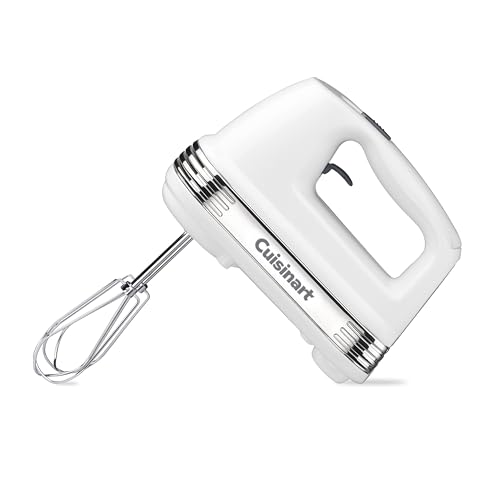
Cuisinart Power Advantage 5-Speed Hand Mixer HM-50 — Best Simple Classic
The HM-50 suits traditional home bakers whose mixing happens in deep bowls and stockpots as often as in mixing bowls — mashed potatoes in the pot, whipped cream in a tall container. The extra-long beaters are its signature: they reach the bottom of deep vessels that strand shorter-beater rivals, and the 60-inch swivel cord gives the freedom to work at the stove or the far counter without an extension cord negotiation.
Strengths
- Extra-long beaters reach deep pots and bowls
- Long swivel cord for flexible work positions
- A proven, long-production design from a major kitchen brand
Trade-offs
- 5 speeds without the fine low-end of newer rivals
- Traditional styling and feature set — no storage case
- Mid-tier pricing against strong budget competition
| Speeds | 5 |
| Motor | 220 W (per Amazon listing title) |
| Beaters | Extra-long, dishwasher-safe |
| Cord | 60-inch swivel cord |
There is a particular comfort in a model that has been in production for years: the reviews are written, the quirks are known, the replacement beaters are stocked. The HM-50’s quirks are mild — it is a straightforward machine with a strong motor for its class — and its virtues are the daily ones of reach and cord freedom.
Compared head-to-head with the KitchenAid KHM512, the choice is philosophical: KitchenAid’s beater design and slow start versus Cuisinart’s reach and cord. Bakers who mash and mix in pots should take the Cuisinart without a second thought; bowl-focused bakers will prefer the KitchenAid. Both answers are correct, which is why both are in this guide.
Cuisinart’s broader ecosystem matters to some kitchens — matching small appliances, a known warranty path — and the HM-50 slots into that ownership pattern seamlessly. Brand coherence is not a performance spec, but it is a real reason satisfied owners replace like with like, and this model has earned that loyalty over a long production run.
Best for: Bakers who mix in deep pots and value reach and cord length / Not suited for: Buyers wanting the newest beater designs or a storage case
Check the current price on Amazon
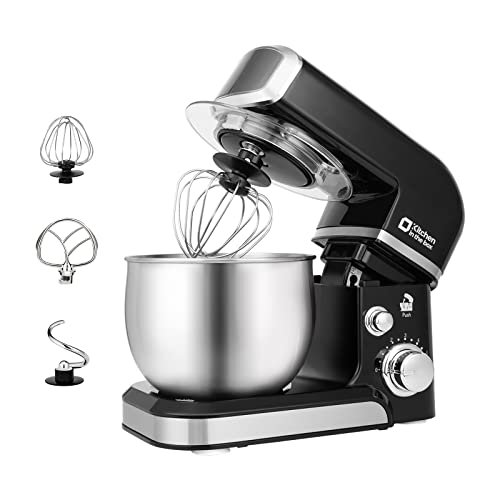
Kitchen in the box Stand Mixer (3.2 Qt) — Best Mini Stand Mixer
This mini stand mixer suits one- and two-person households, dorm-adjacent kitchens, and bakers whose batches are single loaves, small cookie runs, and whipped toppings. The stand format’s gift is freedom: both hands stay free to add ingredients, scrape, and steady the bowl’s contents, and the dough hook opens small bread and pizza doughs that hand mixers handle poorly. At 3.2 quarts it is honest about its scale — this is a daily-use mixer for small households, exactly as its listing says.
Strengths
- Hands-free stand mixing in a tiny footprint
- Full attachment trio: whisk, dough hook, flat beater
- Lightweight and genuinely portable between counters
Trade-offs
- 3.2 quarts caps batch size firmly
- Light body can walk on counters under dough load — steady it
- Brand support is thinner than the majors in this list
| Bowl | 3.2 qt |
| Speeds | 6 |
| Attachments | Egg whisk, dough hook, flat beater (per Amazon listing title) |
| Design | Portable, lightweight |
The use pattern it enables is the weekday bake: a small pizza dough started in the morning, a single batch of muffins, cream whipped while dinner finishes. Full-size stand mixers discourage exactly these small jobs with their bulk; this one invites them by being liftable with one hand and rinsable in a small sink. Suction or a steadying hand handles the dough-load wobble that any light stand mixer exhibits.
Buyers must respect the ceiling cheerfully. Double batches do not fit; stiff, large doughs strain it; holiday production belongs to bigger machines. Within its brief — daily, small, hands-free — it is the most enabling product in this article, and its owners tend to use it more often than owners of grander machines use theirs.
It is also the friendliest entry to stand mixing for new bakers: the full attachment set teaches what each tool does at a scale where mistakes are cheap and cleanup is quick. As a first mixer that is also a stand mixer, it has no real rival in this list.
Best for: Small households wanting hands-free mixing for daily small batches / Not suited for: Double batches, big doughs, or holiday production
Check the current price on Amazon

Hamilton Beach 4 Qt Electric Stand Mixer — Best Compact Stand Value
Hamilton Beach’s 4-quart stand mixer suits bakers who have outgrown hand mixing — wrist fatigue, frequent doughs, regular double-duty — but whose kitchens cannot house a full-size stand mixer. Planetary action, where the beater orbits the bowl, is the headline: it delivers the full bowl coverage that distinguishes real stand mixers from bowl-spinners, so batters need less scraping and doughs develop evenly. The carry handle and modest weight acknowledge the cupboard-to-counter commute most compact mixers actually live.
Strengths
- True planetary mixing for full bowl coverage
- Splash guard and full attachment set included
- Carry handle — designed to be stored and moved
Trade-offs
- 4 quarts is compact — family-size batches need splitting
- 300W class power: respect dough limits
- Takes more storage than any hand mixer here
| Bowl | 4 qt |
| Speeds | 7 |
| Motor | 300 W (per Amazon listing title) |
| Action | Planetary mixing |
| Extras | Splash guard, whisk, flat beater, dough hook, mixing guide |
The step up from hand mixing is bigger than the step from this to a full-size stand mixer: hands-free operation, planetary coverage, and a dough hook that actually kneads change what a home baker attempts. Pizza Fridays, weekly sandwich loaves in single batches, and layered cakes all move from projects to routines. The included mixing guide is a thoughtful touch for first-time stand owners learning speed selection.
The compromises are capacity and ultimate power, stated plainly by the specs themselves. A 4-quart bowl splits what a 5.5-quart takes whole, and stiff doughs should be kept to sensible single batches. Buyers who accept those terms get the stand-mixer life at a compact footprint and a value tier — the trade this entire article exists to map.
Between this and the Kitchen in the box mini, the fork is seriousness: the Hamilton Beach is heavier, stronger, and more durable in feel — a machine bought for years of weekly baking — while the mini is lighter, smaller, and aimed at daily small jobs. Kitchens bake their way to the correct answer by batch size alone.
Best for: Regular bakers wanting real stand mixing in a compact footprint / Not suited for: Large families or high-volume holiday baking
Check the current price on Amazon
Comparison Table
| Pick | Badge | Key spec | Best for |
|---|---|---|---|
| KitchenAid 5 Ultra Power Speed Hand Mixer KHM512 | Best Overall | 5 speeds, Turbo Beater accessories, lockable swivel cord | Everyday home bakers wanting the reliable drawer standard |
| Breville Handy Mixer BHM800SIL | Best Premium Hand Mixer | 9 speeds plus boost, premium hand mixer | Frequent bakers who feel and value fine speed control |
| Hamilton Beach 6-Speed Electric Hand Mixer 62682G | Best Budget | 6 speeds + QuickBurst, 250W peak-power motor, storage case | First kitchens and occasional bakers on a budget |
| Cuisinart Power Advantage 5-Speed Hand Mixer HM-50 | Best Simple Classic | 5 speeds, 220W motor, extra-long beaters, 60-inch swivel cord | Bakers who mix in deep pots and value reach and cord length |
| Kitchen in the box Stand Mixer (3.2 Qt) | Best Mini Stand Mixer | 3.2 qt bowl, 6 speeds, whisk/hook/beater included, lightweight | Small households wanting hands-free mixing for daily small batches |
| Hamilton Beach 4 Qt Electric Stand Mixer | Best Compact Stand Value | 4 qt, 7 speeds, planetary action, 300W, carry handle | Regular bakers wanting real stand mixing in a compact footprint |
The table divides along the article’s real fault line: hand versus stand. Hand mixers win storage and price; stands win freedom and dough. Everything else — speeds, wattage, accessories — is refinement within whichever side of that line your kitchen lives on.
Speed counts in the table deserve a skeptical eye: they are not comparable across brands as performance figures, because each maker’s speeds sit at different actual rates. Treat the number as a granularity hint — how finely you can adjust — and let the reviews’ discussion of low-speed behavior carry the real comparison.
How to Choose the Best Compact Mixers for a Small Kitchen?
Start with storage, because a compact mixer that does not fit your kitchen will not be used in it. Measure the drawer or cupboard honestly: hand mixers need a drawer deep enough for the body plus beaters, or a case system like the Hamilton Beach’s; mini stands need a cupboard shelf with their height in clearance; the 4-quart stand needs a genuine home, ideally a counter corner or a low cupboard it can be lifted from daily. The best compact mixer is the one whose storage story works on a tired Tuesday.
Then match power to your real batches. Wattage figures in this class are peak ratings and poor predictors; beater design and gearing matter more. Cakes, batters, and whipped work — every pick here excels. Cookie dough in single batches — all cope, the stands cope best. Bread dough — the stands, in small batches, are the honest answer, and hand mixers should be excused from the task beyond the softest doughs.
Finally, count the speeds you will use. Three cover most baking; more speeds buy finesse for egg whites, emulsions, and the Breville-style precision baker. Do not pay for nine speeds to make boxed cake mix — and do not buy five to chase meringue perfection weekly.
Hand Mixer vs Mini Stand Mixer: Which Compact Format Is Right?
The hand mixer’s virtues are storage, price, and versatility of vessel — it mixes in any bowl, pot, or jug you own, which is why the Cuisinart’s long beaters matter. Its cost is your presence: a hand and attention for the whole mix, and real limits on stiff dough. The mini stand reverses the ledger: it frees your hands, kneads small doughs properly, and standardizes results, at the price of a fixed bowl size and a storage footprint.
The deciding question is your signature bake. If it is cakes and toppings in varied vessels, hand. If it is a weekly small loaf or pizza dough, stand. If it is both and the budget allows, the classic compact-kitchen answer is a good hand mixer first — it covers more of the map — with a mini stand added when the dough habit proves itself.
Getting the Most from a Compact Mixer: Technique That Beats Wattage
Compact mixers reward technique disproportionately. Bring ingredients to room temperature — cold butter defeats small motors and patience alike. Add flour in thirds at the lowest speed and let each addition disappear before the next. Scrape the bowl’s sides and bottom once mid-mix; compact beaters leave a margin that one scrape erases. For egg whites, a scrupulously clean, grease-free bowl matters more than two extra speeds.
Know the overload signals and respect them: a motor note that drops and strains, a body growing warm, dough climbing the beaters toward the vents. Split the batch, rest the machine a minute, finish in halves — the results are identical and the mixer lives to bake again. Compact does not mean fragile; it means sized, and sized tools used within their size outlast oversized tools used carelessly.
What Can a Compact Mixer Not Do? The Honest Limits List
Full-size double batches of anything dense. A 5.5-quart stand mixer’s everyday work — two loaves, a double cookie batch, a party-size cake — exceeds compact bowls and motors, and no technique in this guide changes that arithmetic. Large, stiff doughs at volume. Pizza night for six is a full-size machine’s or a bakery’s job; compact stands serve the household’s own loaf and pie. Continuous production. A bake sale’s dozen batches in a row will heat and tire a compact motor that handles three batches without complaint.
None of these limits indicts the category — they define its borders, and borders are what let the picks inside them be recommended without asterisks. The baker whose life includes those jobs regularly should buy the full-size machine and enjoy it without guilt; the baker whose life does not should decline to store and pay for capacity that exists only in December.
How to Use a Compact Mixer for Cakes, Dough, and Whipped Cream
Cakes and batters. Cream butter and sugar at medium speed until visibly lighter — compact mixers need a little longer than big stands, so judge by color, not the clock. Add eggs one at a time, then alternate dry and wet additions at the lowest speed, finishing by hand with a spatula for the last few strokes to avoid overmixing. Whipped cream. Chill the bowl and beaters for ten minutes; start medium, climb to high as the cream thickens, and stop at soft peaks unless the recipe demands more — compact mixers go from perfect to overwhipped in seconds at the end.
Small doughs (stand picks). Combine at the lowest speed until a shaggy mass forms, rest ten minutes — the flour hydrates and the motor’s later work halves — then knead with the hook at low speed until smooth and elastic, keeping total dough weight within the bowl’s honest capacity. Cleanup as technique. Eject beaters directly into warm soapy water or the dishwasher, wipe the body before batter dries on it, and store beaters with the machine. A compact mixer’s advantage is speed of the whole task, and cleanup is part of the task.
Storage as the final step. Return the mixer to its measured home with its beaters attached or cased, cord loosely looped rather than tightly wound around the body — tight winding fatigues cords at the strain relief, the quiet killer of hand mixers. A mixer stored kindly is a mixer that starts next time, which is the entire point of the compact format.
Common Buying Mistakes
Judging by wattage alone. Peak wattage is marketing; beater design and gearing decide real mixing. Full-batch bread dough in a hand mixer. The format’s hard limit — use the stands, small batches, or your hands. High speed for flour. The cloud is optional; start low, always. Ignoring storage until delivery. Measure the drawer before the box arrives. Skipping the mid-mix scrape. One scrape is the difference between marbled and mixed. Storing beaters separately. They will be lost by the third bake; keep them with the machine or in its case.
Compact Mixer Care: Making a Small Appliance Last a Decade
Hand and mini-stand mixers die of three causes: dough overload, batter in the vents, and lost or bent beaters. The countermeasures are habits, not products. Respect batch size — the manual’s dough guidance is a ceiling, not a challenge. Keep the body’s vents clear of flour dust with a dry brush after baking days, and never immerse a motor body. Wash beaters promptly; dried batter pried off bends the wires that make them efficient, and a bent beater vibrates its way into early retirement.
Storage completes the picture. A hand mixer rattling loose in a drawer accumulates the dents and cord damage that shorten its life; a case, a pouch, or even a dedicated corner of the drawer pays for itself. Stand minis want their attachments kept with the bowl, not scattered. None of this is burdensome — it is the five-percent effort that separates the ten-year appliance from the two-year one, in a category where the machines themselves are honestly built to allow the decade.
The Compact Mixer Baking Kit: Bowls, Scrapers, and Small Tools That Matter
A compact mixer performs at its best inside a small supporting kit. One medium stainless bowl with a handle and a pour spout covers most batters and whips beautifully; one flexible silicone scraper, sized to the bowl, makes the mid-mix scrape a two-second act; a kitchen scale replaces cup-measuring with weights, which improves consistency more than any mixer upgrade; and a simple bench scraper turns small dough work from sticky to serene.
Two situational additions earn their drawer space. A splatter shield or a deep, narrow bowl tames whipped cream and thin batters in compact vessels. And a second set of beaters — cheap, model-specific — means a baking day never pauses for washing between the cake and the frosting. The kit’s whole philosophy matches the mixers in this guide: small, sufficient, and chosen on purpose.
Compact Mixers for Small Households: Batch Math That Keeps Baking Fun
Small households bake differently: a full cake is an event, but a half-batch of muffins is a Tuesday. Compact mixers fit that rhythm when the baker thinks in scaled batches. Most cake and cookie recipes halve cleanly by weight — another argument for the kitchen scale — and a halved batch sits squarely in every pick’s comfort zone, including the hand mixers’ dough limits. Freezing completes the system: cookie dough scooped and frozen, cake layers wrapped and frozen, whipped toppings made fresh in the ninety seconds a compact mixer needs.
The mini stands extend the same logic upward. A 3.2- or 4-quart bowl is a full batch for a small household, not a compromise batch — the distinction matters, because it means the machine is correctly sized rather than undersized, with all the longevity that correct sizing bought the commercial machines in this batch’s first article. Size the mixer to the household, and compact stops being a limitation and becomes the correct engineering.
Troubleshooting Compact Mixer Results: Lumpy Batter, Flat Whites, Tough Dough
Problem: lumpy batter. Ingredients were cold or flour went in all at once. Room-temperature ingredients and third-by-third flour additions fix it; one mid-mix scrape prevents it. Problem: egg whites will not peak. A trace of grease in the bowl or a speck of yolk is the usual culprit — rewash the bowl with hot soapy water, dry it fully, and start with clean beaters. Problem: whipped cream turns grainy. It went seconds too far; stop at soft peaks for serving, and rescue an overwhipped batch by folding in a splash of fresh cream by hand.
Problem: dough climbs the beaters or hook. The batch is too dry or too large for the tool; add liquid a spoon at a time, or split the batch. Problem: the mixer strains and slows. That is information, not failure — the load exceeds the format. Rest the motor a minute and finish in halves. Compact mixers communicate honestly through sound and speed; bakers who listen get both better results and longer-lived machines.
A Compact Mixer for Every Baker: Matching the Pick to the Person
Advice columns love a single winner; kitchens contain multitudes. The new apartment baker needs the Hamilton Beach budget hand mixer and a drawer. The pot-and-pan cook who mashes where things boil needs the Cuisinart’s reach. The methodical baker who weighs, folds, and whips whites weekly needs the Breville’s control or the KitchenAid’s calm. The small household with a pizza ritual needs a stand — the mini for daily lightness, the Hamilton Beach 4-quart for the fuller commitment.
Reading the six reviews as personality matches rather than a ladder is the fastest route to the right purchase, and it explains this guide’s structure: badges name people and patterns, not ranks. The mixer you will love is the one whose strengths describe your baking and whose trade-offs describe somebody else’s. Choose that one, and the question of whether a different model scored better somewhere becomes what it should be — trivia.
Final Recommendation
Most small kitchens should buy the KitchenAid KHM512 and bake happily for years. Budget buyers lose surprisingly little with the Hamilton Beach 62682G; deep-pot bakers should take the Cuisinart HM-50; precision bakers who will feel the difference should take the Breville. Hands-free small-batch bakers have two good answers — the Kitchen in the box mini for daily small jobs, the Hamilton Beach 4-quart stand for the fuller stand-mixer life. Measure your storage, check the current price on Amazon, and buy for the batches you actually make.
- KitchenAid 5 Ultra Power Speed Hand Mixer KHM512 (Best Overall) — Check on Amazon
- Breville Handy Mixer BHM800SIL (Best Premium Hand Mixer) — Check on Amazon
- Hamilton Beach 6-Speed Electric Hand Mixer 62682G (Best Budget) — Check on Amazon
- Cuisinart Power Advantage 5-Speed Hand Mixer HM-50 (Best Simple Classic) — Check on Amazon
- Kitchen in the box Stand Mixer (3.2 Qt) (Best Mini Stand Mixer) — Check on Amazon
- Hamilton Beach 4 Qt Electric Stand Mixer (Best Compact Stand Value) — Check on Amazon
Keep exploring the mixer range on this site: Best Compact Mixers Under $100 Dollars Best Stand Mixers Best Hand Mixers Best Mixers For Bread Dough Best Kitchenaid Mixers
Frequently Asked Questions
Can a compact hand mixer handle cookie dough?
Yes, in single batches of standard consistency. Cream the butter and sugar first, add flour gradually at low speed, and finish stiff doughs with a spatula or by hand for the last additions. Double batches and very stiff doughs belong in a stand mixer.
Can compact mixers knead bread dough?
The stand picks can, in small batches — a single loaf or pizza dough — using the dough hook at low speed. Hand mixers are not dough tools beyond the softest, smallest doughs; forcing them shortens their life and underdevelops the dough.
How many speeds do I actually need?
Three cover most baking: low for combining, medium for creaming, high for whipping. More speeds add finesse for egg whites and emulsions. The picks here span five to nine speeds, and the guide’s reviews explain who benefits from the upper range.
Are mini stand mixers worth it over a hand mixer?
If you bake small batches frequently and value hands-free operation — especially for dough — yes. If you bake occasionally in varied bowls and pots, a hand mixer covers more ground for less money and storage. Many kitchens end up owning both, in that order.
What size bowl is right for a compact stand mixer?
The 3.2- to 4-quart range in this guide suits one- and two-person households and single standard batches. If you regularly double recipes or bake for a family, step up to a full-size stand mixer rather than splitting every batch.
How do I stop flour from flying everywhere?
Start at the lowest speed, add flour in portions, use a deep bowl, and consider a towel or shield over the bowl for the first seconds. Mixers with genuinely slow first speeds — a praised trait of the KitchenAid pick — make the biggest difference.
Can I mash potatoes with a hand mixer?
Yes — it is a classic hand-mixer job, producing fluffy results quickly. Use the pot you cooked in (the Cuisinart’s long beaters shine here), add butter and warm liquid first, and stop as soon as they are smooth; overmixing turns potatoes gluey.
How long should a compact mixer last?
With batches kept to size and beaters cared for, the major-brand picks here commonly serve many years of regular home baking. The failure modes are usually lost accessories and overload abuse, both preventable with the habits in this guide.


