Disclosure: airfryerkitchensupply.com is reader-supported. When you buy through links on our site, we may earn an affiliate commission at no extra cost to you.
Where to buy
If you are comparing the best commercial mixers for kitchen production, start with the verified shortlist below — every machine here is a genuine commercial model, not a home mixer in a bigger bowl.
Commercial planetary mixers are sold through Amazon’s commercial kitchen listings, restaurant-supply storefronts, and manufacturer-authorized dealers. For a purchase this size, buy from a listing that names the exact model, states the voltage, and ships freight or heavy-parcel with liftgate options where needed. Every pick below that carries an Amazon link was verified against Amazon listing data feed, so the model name on the listing matches the model reviewed here. Check the current price on Amazon before budgeting, because commercial mixer pricing moves with freight costs and seasonal supply promotions.
- Hobart HL200-1STD Legacy Planetary Mixer (20 Qt) — Check on Amazon
- Globe SP20 20-Quart Countertop Planetary Mixer — Check on Amazon
- KitchenAid Commercial Series KSM8990 (8 Qt) — Check on Amazon
- Globe SP08 8-Quart Countertop Planetary Mixer — Check on Amazon
- VEVOR 20Qt Commercial Food Mixer (1100W) — Check on Amazon
- Centerline by Hobart HMM20-1STD (20 Qt) — Check on Amazon
Choosing the best commercial mixers for kitchen production work is a different exercise from choosing a home stand mixer with a bigger bowl. A commercial planetary mixer is judged on gear-driven reliability, bowl capacity measured against real batch weights, a safety guard that satisfies your health inspector, and a service network that can get you a part before a weekend rush, not on color options. The six machines below span the range a working kitchen actually buys: a flagship 20-quart Hobart, two value-leaning 20-quart alternatives, a true commercial 8-quart countertop unit from KitchenAid, and two Globe countertop models that bridge cafe and bakery volumes.
One honest note before the picks: genuine commercial mixers start where home mixers stop. If your daily mixing is a single batch of cookie dough, several machines here are more mixer than you need, and the guide sections below explain how to size down without buying a machine that burns out in a year. If you run a bakery, pizzeria, school kitchen, or commissary, capacity and duty cycle are the whole conversation, and that is how these picks are ranked.
Finally, a word about where these machines come from. Commercial mixers are one of the categories where the used market is genuinely strong — Hobart and Globe units circulate between kitchens for decades — but a first purchase for a new operation is usually better made new, with warranty, correct voltage, and a dealer relationship established from day one. The picks below are therefore all current listings, verified as complete machines rather than parts, and the buying-guide sections that follow the reviews will help you pressure-test any quote, new or used, against the same criteria.
In this guide
Quick Picks
Six commercial planetary mixers, each verified, each assigned the job it genuinely does best. Badges are used identically here and in the full reviews so you can scan fast and read deep only where it matters.
Hobart HL200-1STD Legacy Planetary Mixer (20 Qt) — Best Overall — Check on Amazon
The benchmark 20-quart bench mixer. Hobart’s Legacy line is the machine other commercial mixers are compared against: gear-driven transmission, a deep dealer and service network, and parts availability measured in decades. If a kitchen can only own one serious mixer, this is the default answer.
Globe SP20 20-Quart Countertop Planetary Mixer — Best Hobart Alternative — Check on Amazon
Globe’s 20-quart countertop planetary is the value-engineered rival to the Hobart: NSF listed, gear-driven, and sold through the same restaurant-supply channels, typically at a friendlier point in the commercial tier. A serious second quote for any 20-quart shortlist.
KitchenAid Commercial Series KSM8990 (8 Qt) — Best Countertop Commercial — Check on Amazon
The only home-brand machine here that is genuinely commercial: NSF certified, bowl-lift, 8-quart capacity, and built on a commercial duty cycle. The right answer for cafes, food trucks, and small bakeries that need certification without a 20-quart footprint.
Globe SP08 8-Quart Countertop Planetary Mixer — Best Small Commercial Planetary — Check on Amazon
A true planetary machine shrunk to cafe scale: 3 speeds, stainless bowl, 115 V plug, NSF listing. For delis, bakeries’ second stations, and test kitchens that want commercial mechanics in an 8-quart body, the SP08 is the specialist pick.
VEVOR 20Qt Commercial Food Mixer (1100W) — Best Budget Commercial — Check on Amazon
The budget disruptor: a full 20-quart bowl, 1100 W motor, lever-operated lift, timer, and a security shield at a fraction of legacy-brand money. For startups and budget-bound bakeries it is the capacity-per-dollar champion — with ownership caveats stated plainly in the review.
Centerline by Hobart HMM20-1STD (20 Qt) — Best Mid-Tier 20-Quart — Check on Amazon
Hobart’s Centerline badge is its value line: a 20-quart bench planetary with 3 fixed speeds and a 1/2 HP motor on ordinary 120 V power, aimed at schools, churches, and mid-volume kitchens that want the Hobart ecosystem without Legacy-line pricing.
How These Picks Were Chosen
These picks were chosen from commercial planetary mixers verified feed for this site: each listing’s model name, bowl size, and certification claims were matched against the manufacturer’s model naming before a link was attached. Machines that appeared in search results as bowls, whips, or other accessories were excluded — a surprising share of “commercial mixer” results are parts, not mixers.
The ranking criteria, in order: duty cycle and drivetrain (gear-driven planetary machines first), honest capacity (bowl quarts translated into realistic flour and batter loads), certification (NSF listing where a health department will ask), serviceability (dealer and parts network), and only then price tier. Every pick is a machine a kitchen can insure, inspect, and repair — the three tests that separate commercial equipment from big home equipment.
Two further filters shaped the final six. First, format honesty: machines marketed with commercial language but built on home-mixer platforms were excluded unless they carried a genuine commercial certification, which is why the KitchenAid entry here is specifically the NSF-certified Commercial Series rather than a larger home model. Second, size coverage: the list deliberately spans 8 to 20 quarts so that the recommendation can follow your batch size instead of forcing every reader toward the biggest machine in the room.
The 6 Best Commercial Mixers for a Working Kitchen
Each review states who the machine suits, three strengths, three trade-offs, the verified specifications from its listing, and a bold verdict. Prices are not printed because commercial pricing shifts with freight and promotions — use the Amazon links to check the current price for any pick that carries one.
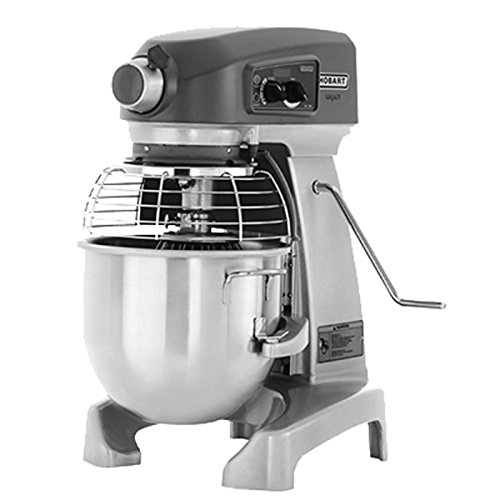
Hobart HL200-1STD Legacy Planetary Mixer (20 Qt) — Best Overall
The HL200 suits bakeries, pizzerias, and institutional kitchens mixing dough, batter, and whipped products all day. It is a tabletop unit, which matters: at 20 quarts it still needs a sturdy stand or reinforced counter, but it avoids committing floor space the way a 30- or 40-quart floor model does. Kitchens upgrading from a worn 10-quart or an overworked home-style mixer will feel the difference in the first dough batch.
Strengths
- Gear-driven transmission built for continuous commercial duty
- The deepest parts and service network in the category
- Standard accessory kit covers beater, whip, and dough work from day one
Trade-offs
- Premium-tier investment compared with import 20-quart models
- Heavy — plan the stand and the delivery path before ordering
- More capacity than a small cafe will ever use
| Type | Planetary, tabletop |
| Bowl capacity | 20 qt |
| Kit | Standard accessory kit (per Amazon listing title) |
In daily production the HL200’s value is boring reliability. Planetary action reaches around the bowl so batters need less scraping, the speed changes are mechanical and positive rather than electronic guesses, and the machine tolerates the stop-start rhythm of a real prep list. Dough capacity is where cheap mixers lie and Hobart does not: respect the flour-capacity guidance in the manual and the gearbox will outlast the building lease.
Ownership costs are the honest counterweight. Hobart parts are priced like Hobart parts, and out-of-warranty service calls are not cheap. Even so, total cost per year of service usually favors the Hobart over replacing a budget mixer twice. Buy it when mixing is revenue, not a hobby.
Budget the installation, not just the machine. A 20-quart bench mixer needs a stand that will not flex, a delivery path that fits its crate, and enough vertical clearance for the bowl lift and a full bowl of dough. Kitchens that plan those three things on day one report the HL200 as the least troublesome capital purchase they own; kitchens that improvise the stand spend the first month annoyed at a machine that is blameless.
Best for: Bakeries and production kitchens that mix daily and cannot afford downtime / Not suited for: Low-volume cafes mixing a few small batches a week
Check the current price on Amazon
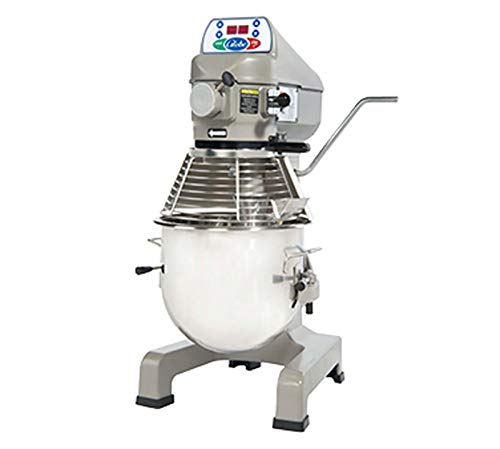
Globe SP20 20-Quart Countertop Planetary Mixer — Best Hobart Alternative
The SP20 fits the same kitchens as the HL200 — bakeries, pizzerias, school and hospital prep — with a purchasing department that wants competitive bids. It is a countertop-format 20-quart machine, so the same stand and space planning applies. Globe has a long history in foodservice equipment, and the SP line is its core planetary range rather than a side project.
Strengths
- NSF listing satisfies commercial inspection requirements
- Gear-driven design at a more accessible commercial price point
- Full attachment ecosystem sized for the 20-quart class
Trade-offs
- Dealer network is thinner than Hobart’s in some regions
- Resale value trails the Hobart name
- Accessory pricing varies more between dealers
| Type | Planetary, countertop |
| Bowl capacity | 20 qt |
| Certification | NSF (per Amazon listing title) |
Performance in the bowl is genuinely close to the class leaders for standard work: pizza dough in sensible batch sizes, cake batters, mashed potatoes, and whipped cream all come out as expected from a gear-driven 20-quart. Where the Globe asks more of the owner is homework — confirm your local service options before purchase, because a mixer this size is not a ship-it-back product.
For a kitchen opening on a budget that still needs a real 20-quart, the SP20 is the pick that respects both constraints. Pair it with the correct stand, keep the gearbox maintenance on schedule, and it will carry a production list for years.
Ask your Hobart and Globe dealers the same three questions — installed price with stand, first-year service terms, and parts lead time for a gearbox wear item — and let the answers, not the brochure, break the tie. In territories with a strong Globe dealer, the SP20 can be the smarter lifetime buy even for buyers who walk in intending to purchase the Hobart name.
Best for: Cost-conscious production kitchens that still need true 20-quart capacity / Not suited for: Buyers who want the largest possible service network
Check the current price on Amazon

KitchenAid Commercial Series KSM8990 (8 Qt) — Best Countertop Commercial
The KSM8990 suits operations whose batches are real but modest: a cafe doing daily scones and whipped toppings, a food truck with tight counter space, a bakery supplementing a floor mixer with a certified countertop unit. Its 8-quart bowl handles roughly double a typical home mixer’s working batch while staying liftable and movable by one person.
Strengths
- NSF certified — passes health inspection where home mixers cannot be used commercially
- Bowl-lift design stays stable under dough loads
- Far smaller footprint and weight than 20-quart machines
Trade-offs
- 8 quarts is a hard ceiling — growing menus outgrow it
- Commercial KitchenAid pricing sits well above the home line
- Not a dough machine for high-volume pizza production
| Type | Bowl-lift stand mixer, commercial series |
| Bowl capacity | 8 qt |
| Certification | NSF certified (per Amazon listing title) |
The bowl-lift mechanism is the detail that matters most in use. Under dough load a tilt-head can flex and walk; the KSM8990’s lift keeps the bowl locked and the head rigid, which is exactly the behavior you want when the machine runs for hours of prep. Speed control is straightforward, attachments are the familiar KitchenAid pattern, and staff trained on home units need almost no retraining.
Choose it when certification and counter space are the constraints, and size your batches to the bowl honestly. Choose a 20-quart instead when dough volume is the business. Within its class, nothing else combines this brand’s attachment ecosystem with a commercial listing.
The KSM8990 also earns its keep as the second mixer in bigger kitchens: the machine that whips, emulsifies, and handles overflow while the 20-quart is committed to dough. Buying it as a station mixer rather than a starter mixer is the framing under which it almost never disappoints, because its capacity ceiling stops being a surprise and becomes the point.
Best for: Cafes, food trucks, and small bakeries needing an NSF-certified countertop mixer / Not suited for: High-volume dough production
Check the current price on Amazon

Globe SP08 8-Quart Countertop Planetary Mixer — Best Small Commercial Planetary
The SP08 is what the KSM8990 is not: a ground-up commercial planetary mixer in a small body, from a foodservice-equipment maker. Three fixed speeds cover dough, batter, and whipping, and the 115 V supply means it plugs into ordinary kitchen circuits. It suits a prep station dedicated to sauces, fillings, and small dough batches inside a larger kitchen, or a small operation whose whole menu fits in 8 quarts.
Strengths
- True gear-driven planetary action in an 8-quart footprint
- Simple 3-speed control staff cannot misconfigure
- NSF listed and built for washdown-adjacent commercial life
Trade-offs
- Commercial pricing for a small bowl — you pay for the mechanics, not capacity
- No attachment hub versatility of consumer-style machines
- Overkill for occasional home-bakery use
| Type | Planetary, countertop |
| Bowl capacity | 8 qt |
| Speeds | 3 |
| Power | 115 V (per Amazon listing title) |
| Certification | NSF |
In use, the SP08 feels like its bigger siblings scaled down: positive speed engagement, a guard arrangement designed for inspectors, and a bowl and tools in stainless that tolerate commercial dish pits. It will not flex under a stiff dough the way light-duty stand mixers do, because the drivetrain was never designed down to a price.
This is a niche pick and proud of it. If your health department requires listed equipment and your batches are small, it is one of very few correct answers. If nobody inspects your kitchen, the KitchenAid above gives you more versatility for the tier.
Treat the SP08’s purchase paperwork like a capital asset file: keep the serial, the dealer invoice, and the manual together. Small commercial planetaries get resold between cafes more than any other class here, and a documented machine holds its value. If you buy used instead, budget immediately for a new bowl seal inspection and a gearbox oil check before the first service.
Best for: Small commercial stations needing a listed, gear-driven 8-quart planetary / Not suited for: Home bakers or anyone paying for capacity they will not use
Check the current price on Amazon

VEVOR 20Qt Commercial Food Mixer (1100W) — Best Budget Commercial
The VEVOR 20-quart suits new bakeries, pizzerias, and restaurants whose capital budget cannot stretch to Hobart or Globe but whose menu genuinely needs 20-quart batches. The lever-operated bowl lift and included safety shield address the two features inspectors and insurers ask about first, and the timer function helps standardize mixes across staff.
Strengths
- 20-quart capacity at an entry commercial price point
- Safety shield and bowl lift included, not upsold
- Timer supports consistent, repeatable batch timing
Trade-offs
- Long-term parts and service support is the open question with value brands
- Fit, finish, and noise trail the legacy makers
- Resale value is minimal — buy it to use it up
| Type | Planetary food mixer, lever-operated lift |
| Bowl capacity | 20 qt |
| Motor | 1100 W (per Amazon listing title) |
| Speeds | 3 adjustable |
| Extras | Timing function, security shield |
Expect honest performance on batters, doughs within sensible flour limits, and general prep, with more noise and vibration than a Hobart at the same work. The dual-rotating kneading action is marketed heavily; in practice it behaves like a competent planetary with a rotating tool. Keep loads conservative, especially stiff dough, and the machine rewards you.
The buying logic is simple arithmetic: if the price difference funds other opening equipment and you accept a shorter expected service life, the VEVOR is rational. If mixing is your single point of failure, save longer for the Globe or Hobart. Either way, verify the listing’s voltage and plug before ordering.
The ownership discipline that makes the VEVOR work is a simple one: keep a written load limit for your own menu — the heaviest dough weight you will allow per batch — taped to the machine, and train every operator to it. Value-tier gearboxes forgive a lot except repeated overload. Kitchens that run it inside its envelope get the bargain they hoped for; kitchens that treat it like a Hobart do not.
Best for: Startups and budget bakeries needing real 20-quart capacity now / Not suited for: Operations that cannot tolerate any downtime risk
Check the current price on Amazon
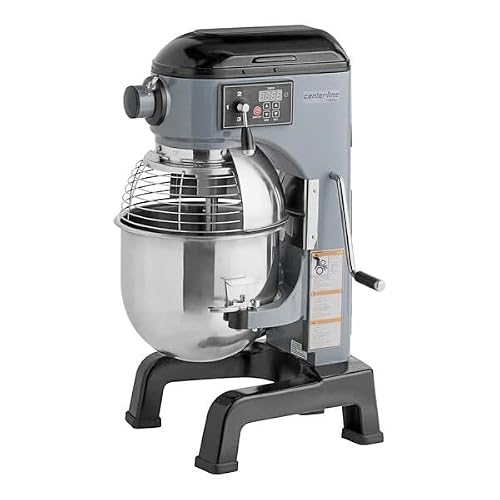
Centerline by Hobart HMM20-1STD (20 Qt) — Best Mid-Tier 20-Quart
The HMM20 fits institutional and mid-volume kitchens: school cafeterias, church and community kitchens, delis with a baking program, and restaurants adding house-made bread. The 120 V requirement is a genuine advantage — many older buildings cannot easily add the circuits heavier mixers want, and a bench-format 20-quart that runs on standard power removes an electrician from the project.
Strengths
- Hobart engineering and dealer ecosystem at the value badge
- Runs on 120 V — no electrical upgrade for most kitchens
- 3 fixed speeds keep operation foolproof for rotating staff
Trade-offs
- 1/2 HP is modest for constant stiff-dough production
- Value line trims some Legacy durability features
- Still a heavy bench unit needing a proper stand
| Type | Planetary, bench |
| Bowl capacity | 20 qt |
| Speeds | 3 fixed |
| Motor | 1/2 HP |
| Power | 120 V (per Amazon listing title) |
Daily behavior is calm and predictable: three speeds that map cleanly to dough, batter, and whip work, a standard accessory package, and controls a new hire can learn in one shift. Flour capacity discipline matters more here than on the HL200 — batch to the manual, not to the bowl rim, and the drivetrain stays happy.
For institutions, the Centerline is often the sweet spot of the whole category: credible brand, credible capacity, standard power, and a price a committee can approve. High-volume artisan dough programs should still step up to the Legacy or Globe.
For committee purchases — schools, churches, caterers with boards — the HMM20 has a paperwork advantage worth naming: a single recognizable brand, a standard accessory kit, and ordinary 120 V power make it the easiest 20-quart to specify, bid, and approve without an electrician’s quote attached. That administrative simplicity is a real feature in institutional buying, and it is a large part of why the Centerline badge exists.
Best for: Schools, institutions, and mid-volume kitchens on standard 120 V power / Not suited for: Nonstop stiff-dough production
Check the current price on Amazon
Comparison Table
| Pick | Badge | Key spec | Best for |
|---|---|---|---|
| Hobart HL200-1STD Legacy Planetary Mixer (20 Qt) | Best Overall | 20 qt tabletop planetary, standard accessory kit | Bakeries and production kitchens that mix daily and cannot afford downtime |
| Globe SP20 20-Quart Countertop Planetary Mixer | Best Hobart Alternative | 20 qt countertop planetary, NSF listed | Cost-conscious production kitchens that still need true 20-quart capacity |
| KitchenAid Commercial Series KSM8990 (8 Qt) | Best Countertop Commercial | 8 qt bowl-lift, NSF certified commercial series | Cafes, food trucks, and small bakeries needing an NSF-certified countertop mixer |
| Globe SP08 8-Quart Countertop Planetary Mixer | Best Small Commercial Planetary | 8 qt, 3-speed, 115 V, NSF | Small commercial stations needing a listed, gear-driven 8-quart planetary |
| VEVOR 20Qt Commercial Food Mixer (1100W) | Best Budget Commercial | 20 qt, 1100 W, 3 speeds, timer, safety shield | Startups and budget bakeries needing real 20-quart capacity now |
| Centerline by Hobart HMM20-1STD (20 Qt) | Best Mid-Tier 20-Quart | 20 qt bench, 3 fixed speeds, 1/2 HP, 120 V | Schools, institutions, and mid-volume kitchens on standard 120 V power |
Read the table as a capacity map first: 8-quart machines serve cafes and stations, 20-quart machines serve production. The badge column tells you the job each machine was picked for; the full reviews explain the ownership trade-offs behind each row.
One pattern in the table deserves emphasis: the two 8-quart machines are not smaller versions of the same idea. The KitchenAid is a commercial-certified stand mixer built for versatility and easy relocation, while the Globe SP08 is a true planetary built for a fixed station and a gearbox-first life. Readers choosing between them are really choosing a philosophy — flexible and movable, or fixed and mechanical — and both philosophies are correct for the kitchens they were designed to serve.
How to Choose the Best Commercial Mixers for Kitchen Production?
Start with your heaviest regular batch, not your average one. Bowl quarts are a volume measure, but mixers fail on weight and stiffness: a 20-quart bowl of stiff pizza dough is a different load from 20 quarts of whipped cream. Manufacturers publish flour-capacity guidance for dough; treat it as a ceiling, and size the machine so your biggest dough batch sits comfortably under it. Kitchens that mix dough daily should buy one size up from their arithmetic answer.
Next, the drivetrain. Gear-driven planetary mixers are the commercial standard because gears tolerate shock loads and do not slip or burn like belts under a stiff batch. Belt and electronic-drive machines exist at the edges of the category, but for a purchase meant to last a decade, gears plus a local service agent is the conservative, correct default.
Finally, certification and installation. If your kitchen is inspected, the mixer needs a recognized commercial listing such as NSF, full stop — a home mixer used commercially can fail an inspection and void insurance after an incident. Confirm voltage and phase before ordering, measure the stand and the doorway, and price the accessories you will actually use: a second bowl is the cheapest production upgrade in this entire category.
What Size Commercial Mixer Does a Bakery or Pizzeria Need?
As a working rule: cafes and small bakeries producing a handful of batches a day live happily at 8–10 quarts, especially with a second bowl. Bakeries and pizzerias whose dough is the product should start at 20 quarts, which handles family-scale pizza dough batches and full cake-batter runs without splitting mixes. Beyond 20 quarts you enter floor-model territory — 30, 40, and 60 quarts — where the machine becomes a fixed installation with its own electrical and floor-space planning.
Splitting batches is the hidden cost of undersizing. Every split doubles mixing time, doubles bowl washing, and introduces inconsistency between batch one and batch two. Oversizing has a cost too — a 20-quart struggles to whip a small quantity of cream properly — which is why many mature kitchens pair a 20-quart production machine with an 8-quart station mixer like the two smaller picks in this guide.
Commercial Mixer Attachments and Bowls: What Is Worth Buying?
The standard trio — flat beater, wire whip, and dough hook — covers most menus. Add a second bowl before any exotic tool: it lets one batch proof or rest while the next mixes, which is worth more throughput than any attachment. Pastry chefs may add a scraper beater to cut bowl-scraping stops. Meat grinder and slicer hubs exist on some lines, but dedicated tools usually outperform hub attachments in commercial volumes; buy hub attachments for occasional tasks only.
Whatever you add, match the accessory to the exact model and size. A 20-quart whip does not fit a 10-quart head, and “equivalent” bowls vary in the lug pattern that locks them to the lift. Order by model number, and keep the original bowl’s part number in your maintenance file.
How to Set Up and Break In a Commercial Planetary Mixer
Step 1 — Place and level it. Put bench models on a stand rated for the machine’s full loaded weight, level the stand, and leave clearance above the bowl lift’s full travel. Floor models get anchored or leveled per the manual. Step 2 — Wash before first food. Bowls and tools ship with protective oils; wash, rinse, and sanitize them, and wipe the machine exterior. Step 3 — Learn the guard. The safety guard or shield must be in place for the machine to run on most models; never defeat the interlock — inspectors check, and the guard exists because planetary mixers do not stop for fingers.
Step 4 — Break in with batter, not dough. Run your first sessions on batters and soft mixes at middle speed, listening for the gearbox’s normal voice so you will recognize an abnormal one later. Step 5 — Respect speed discipline. Start every batch at the lowest speed until dry ingredients are incorporated, then shift. Shifting under full stiff load is the classic gearbox killer; many manuals require stopping or slowing to change gears. Step 6 — Log maintenance. Note the purchase date, serial number, and the manual’s lubrication and inspection intervals in your kitchen maintenance log, and calendar them. A commercial mixer maintained on schedule is a 15-year asset; the same machine ignored is a 5-year expense.
Step 7 — Establish your batch book. For each menu item, record the ingredient weight, the speed sequence, and the mixing time that produced the result you want, and keep that sheet with the machine. Commercial mixers reward standardization: the same dough mixed by three different staff members should come out identical, and the batch book is how that happens. Note the flour weight limit you have set for your machine at the top of the book, in marker, where nobody can miss it.
Step 8 — Schedule the first service visit before you need it. Register the machine with the dealer, confirm who your local technician is, and put their number in the batch book. The worst day to discover your service options is the Friday a gearbox starts grinding. A short introductory call when nothing is broken costs nothing and converts a future emergency into a routine appointment.
Common Buying Mistakes
Buying bowl size instead of batch weight. Quarts describe volume; dough is sold by weight and stiffness. Check flour capacity, not just bowl size. Using a home mixer commercially. Beyond durability, it risks failed inspections and insurance problems. Ignoring electrical requirements. Voltage, phase, and circuit capacity must match your building; confirm before the freight truck is booked. Shifting gears under load. The fastest route to a gearbox rebuild. Skipping the second bowl. Owners consistently rate it the best-value accessory after purchase. Defeating the safety guard. Never — for safety, legal, and insurance reasons at once.
Judging by horsepower alone. Drivetrain type and flour capacity predict dough performance; a headline horsepower figure does not. Forgetting the doorway. Measure the crate path — door, hallway, elevator — before freight is booked, not while the driver waits. One bowl, full menu. A single bowl serializes your whole prep list; the second bowl is a production tool, not a spare. No batch book. Without recorded weights, speeds, and times, quality depends on who is working, and your best baker becomes a single point of failure.
How Much Do Commercial Mixers Cost to Own Over Five Years?
The sticker is the smallest honest number in a commercial mixer purchase. Year-one costs add the stand, a second bowl, freight, and any electrical work. Years two through five add preventive maintenance — gearbox inspection and lubrication per the manual — plus wear items: a whip’s wires fatigue, bowl lugs wear, and a beater that has kissed the bowl a hundred times gets replaced. Legacy brands charge more per part but stock them for decades; value brands charge less per machine but ask you to plan on replacement rather than repair at the long end.
Labor is the silent line item. A mixer that splits batches costs staff minutes every single day; over five years, an undersized mixer can burn more wages than the price gap to the correct size. Run the arithmetic the other way as well: an oversized mixer wastes product on small batches that will not whip or emulsify properly in a big bowl. The five-year winner is almost always the correctly sized machine from a brand your local technician already services.
Energy, by contrast, is a rounding error. Even a hard-worked 20-quart draws modest power in short prep bursts. Spend your analysis time on capacity, service, and labor — the three numbers that actually move.
Commercial Mixer Safety and Sanitation: What Inspectors Look For
Inspectors look at three things: listing, guarding, and cleanability. The listing — NSF or an equivalent commercial certification — establishes that the machine was designed for foodservice. Guarding means the bowl guard or shield is present, undamaged, and not wired open; an interlock that has been defeated is one of the fastest ways to turn a routine inspection into a corrective order, and it voids the safety logic your insurer assumes.
Cleanability is where planetary mixers earn or lose trust. Flour and batter migrate into the hub, the lift rails, and the guard hinges. Build a closing routine: tools and bowls through the dish pit, the head and hub wiped with the machine unplugged, the guard washed rather than wiped, and the stand’s underside checked weekly. Stainless bowls tolerate commercial chemicals; painted exteriors want milder cleaners to protect the finish that protects the metal beneath.
Train the human side too. No loose sleeves or jewelry near a running planetary, hair restrained, and a hard rule that hands never enter a bowl until the machine is stopped and, for cleaning, unplugged. The mixers in this guide are powerful enough to injure without malice; the routine is what keeps that power boring.
Planetary vs Spiral vs Countertop Stand: Which Commercial Format Fits?
Planetary mixers — every pick in this guide — move the tool around a stationary bowl, which makes them the generalists: one machine beats, whips, and kneads across a whole menu. Spiral mixers rotate the bowl against a fixed spiral hook and are dough specialists; a pizzeria doing nothing but dough at volume should compare a spiral before buying a second planetary. Countertop stand mixers in commercial dress, like the KSM8990, trade the planetary gearbox’s brute durability for a smaller footprint and easier relocation.
The deciding question is menu breadth. Broad menu, one machine: planetary. Dough-only, high volume: spiral, possibly beside a small planetary for everything else. Small menu, small space, certification required: commercial countertop. Most kitchens reading this guide land on the planetary answer, which is why this category, and this article, is built around it.
Reading a Commercial Mixer Spec Sheet Without Getting Fooled
Four numbers on a commercial mixer listing actually predict your experience. Bowl quarts tell you volume; the flour-capacity figure in the manual tells you dough truth — always find it before buying for bread or pizza. Horsepower tells you less than the drivetrain type: a gear-driven half-horse institutional machine will outwork a higher-rated light-duty design on stiff dough, because gears deliver torque without slipping. Voltage and phase tell you whether the machine plugs into your building or into an electrician’s invoice.
Everything else is secondary until those four check out. Speed counts matter mainly at the low end — a true slow first speed for incorporating flour without a dust cloud — and at the whip end for creams and meringues. Timer controls help consistency across staff. Guards, bowls, and tools in stainless predict sanitation life. Read listings in that order and the marketing language loses its power to mislead.
When to Repair, When to Replace a Commercial Mixer
Repair when the frame, motor, and gearbox housing are sound and the failure is a wear item — switches, seals, belts on belt models, worn tools, tired bowl lugs. These are the repairs legacy-brand parts networks exist for, and a repaired Hobart or Globe returns to full production life. Replace when the gearbox itself is damaged on a value-brand machine with thin parts support, when the bowl lift mechanism is bent, or when the repair quote approaches the replacement cost of an equivalent new unit — at that point the new machine’s warranty and efficiency win the arithmetic.
The middle case is the motor. A motor rewind or replacement on a legacy machine is often economical because everything around the motor was built to outlast it. On a budget machine, a motor failure is usually the honest end of the purchase — which is not an argument against budget machines, only an argument for buying them with that lifecycle already priced into the decision.
Whichever way a failure resolves, log it. A kitchen that records failures, repairs, and downtime per machine makes its next purchase with data instead of folklore, and that record is worth real money at replacement time.
Final Recommendation
For most production kitchens, the Hobart HL200 is the buy-once answer at 20 quarts, with the Globe SP20 as the value alternative and the Centerline HMM20 as the institutional middle path on standard power. Startups watching capital should look honestly at the VEVOR 20-quart and its trade-offs. Smaller operations should not buy capacity they cannot fill: the KitchenAid KSM8990 and Globe SP08 bring genuine commercial certification to a countertop. Whichever you choose, check the current price on Amazon, confirm the electrical spec twice, and order the second bowl in the same cart.
- Hobart HL200-1STD Legacy Planetary Mixer (20 Qt) (Best Overall) — Check on Amazon
- Globe SP20 20-Quart Countertop Planetary Mixer (Best Hobart Alternative) — Check on Amazon
- KitchenAid Commercial Series KSM8990 (8 Qt) (Best Countertop Commercial) — Check on Amazon
- Globe SP08 8-Quart Countertop Planetary Mixer (Best Small Commercial Planetary) — Check on Amazon
- VEVOR 20Qt Commercial Food Mixer (1100W) (Best Budget Commercial) — Check on Amazon
- Centerline by Hobart HMM20-1STD (20 Qt) (Best Mid-Tier 20-Quart) — Check on Amazon
Keep exploring the mixer range on this site: Best Commercial Mixers Best Stand Mixers Best Mixers For Bread Dough Best Commercial Shake Mixers Best Kitchenaid Mixers
Related guides
Frequently Asked Questions
What makes a mixer “commercial” rather than a large home mixer?
Certification, drivetrain, and duty cycle. A commercial mixer carries a recognized listing such as NSF, uses a gear-driven planetary drivetrain rated for continuous work, and is supported by a foodservice parts and service network. A large home mixer may share bowl size but none of those three foundations.
How long should a commercial planetary mixer last?
With scheduled maintenance and loads kept within the manual’s flour-capacity guidance, legacy-brand 20-quart machines commonly serve well beyond a decade in daily production. Value-brand machines should be budgeted with a shorter expected life, which is part of their price logic.
Can a 20-quart mixer handle small batches?
Poorly at the extremes. A few cups of cream will not whip properly in a 20-quart bowl because the whip cannot reach the product. Kitchens with both needs pair a production mixer with an 8-quart station machine, as this guide’s picks allow.
Do commercial mixers need special electrical work?
Some do. Many 20-quart bench models run on standard 120 V, including the Centerline in this guide, but larger and older machines may need 208–240 V or three-phase power. Verify the listing’s voltage against your panel before ordering.
Is a safety guard required on a commercial mixer?
In inspected kitchens, effectively yes. Guards and shields with interlocks are part of how modern commercial mixers meet safety standards, and inspectors and insurers both look for them. Never operate with a guard removed or an interlock defeated.
What is the first accessory to buy with a commercial mixer?
A second bowl in the correct size for your model. It removes the wash-and-wait gap between batches and pays for itself in labor faster than any specialty attachment.
Should a new bakery buy one 20-quart or two smaller mixers?
One 20-quart, in most cases. Dough consistency, batch economics, and a single maintenance file favor the production machine, and a second bowl restores most of the flexibility two small mixers promise. Add the small station mixer later, when the menu proves it needs one.
Are refurbished commercial mixers a good buy?
They can be, from a dealer who replaces wear items and warranties the gearbox. Hobart and Globe machines are rebuilt routinely because parts exist. A private-sale machine with no service history is a gamble priced like a bargain; have a technician inspect before money moves.


