Disclosure: airfryerkitchensupply.com is reader-supported. When you buy through links on our site, we may earn an affiliate commission at no extra cost to you.
The best chopsticks for beginners are not simply smaller chopsticks. Learning to eat with chopsticks is a motor-skill problem — one stick stays still, one stick moves, and the hand must discover both jobs at once — so beginner tools succeed by teaching that division of labour, through finger guides, hinges, connectors and forgiving shapes, and then by getting out of the way as skill arrives. This guide covers the whole staircase: training designs for toddlers and children, a trainer that fits adult beginners too, and the short, light real pairs to graduate to when the helpers come off.
That verification matters in a category full of adorable photography, because what teaches is not the animal on top — it is the guide geometry underneath: where the fingers are placed, how the sticks are joined, and whether the tool still works when the novelty wears off at the second meal. The reviews judge each pick on that teaching quality first and its cuteness a distant second.
Set expectations honestly before choosing. A toddler’s trainer and an adult’s first pair are different tools answering different hands, and this guide badges them separately rather than pretending one product serves a three-year-old and a thirty-year-old equally. Adult beginners, in particular, should know that the Patelai trainer below was designed for kids and adults alike — and that many adults skip trainers entirely and start on the short bamboo pair, using the technique section of this guide as their teacher. Both routes are respectable; the staircase metaphor only insists that you start on a step, not on the landing.
Finally, a reassurance the whole category rests on: chopstick skill is ordinary. Billions of children acquire it without instruction manuals, and adults acquire it in a handful of meals when the tool and the first foods are chosen kindly. The picks and the practice method below are arranged to make those first meals successful ones, because success — food reaching the mouth — is the only teacher that has ever really worked.
Who is this guide for, in one paragraph: the parent whose toddler covets the noodle-shop sticks, the parent whose seven-year-old has asked outright, the adult whose new in-laws cook with chopsticks weekly, the traveller with a trip booked, and the cook whose own kitchen has gone Asian three nights a week while their hands remain unconvinced. Each of you enters the staircase at a different step, and each step is badged below with your name on it — find it, start there, and let the steps above wait their turn.
Where to buy
All six picks are sold through Amazon, where you can check the current price on Amazon and confirm the training mechanism, pair count and intended age or hand in the listing title before the first lesson begins.
- Patelai Training Chopsticks with Finger Guide (2 Pairs, Metal, Blue and Pink) — Best Overall — Kids and Adults: Check the current price on Amazon
- PandaEar Animal Toddler Training Chopsticks (3 Pairs, Frog, Bear and Panda) — Best for Toddlers: Check the current price on Amazon
- KIDSFANTASY Kids Training Chopsticks (2 Pairs) — Best for Young Children: Check the current price on Amazon
- Plum Garden Kids Chopsticks (4 Pairs, Animal Toddler Training) — Best for Families: Check the current price on Amazon
- Antner Natural Bamboo Chopsticks (5 Pairs, 8.8 Inches) — Best First Real Pair: Check the current price on Amazon
- GLAMFIELDS Japanese Natural Wooden Chopsticks (5 Pairs, 8.8 Inches) — Best Step-Up Pair: Check the current price on Amazon
In this guide
Quick Picks
The beginner staircase: a finger-guide trainer for all ages, three children’s training designs by age and family size, and two short real pairs to graduate to.
- Patelai Training Chopsticks with Finger Guide (2 Pairs, Metal, Blue and Pink) — Best Overall — Kids and Adults: Reusable metal trainers with a finger guide that fits right or left hands — the only pick here explicitly designed for adult beginners as well as children. Check the current price on Amazon
- PandaEar Animal Toddler Training Chopsticks (3 Pairs, Frog, Bear and Panda) — Best for Toddlers: Silicone finger-guide trainers with animal helpers for ages two to eight — three pairs so the lesson survives the dishwasher’s rotation and the floor. Check the current price on Amazon
- KIDSFANTASY Kids Training Chopsticks (2 Pairs) — Best for Young Children: Training chopsticks for toddlers and young beginners focused on grip, coordination and non-slip control — the classic first trainer format. Check the current price on Amazon
- Plum Garden Kids Chopsticks (4 Pairs, Animal Toddler Training) — Best for Families: Four pairs of animal training chopsticks with non-slip silicone finger guides — the family-pack step for households with several small learners. Check the current price on Amazon
- Antner Natural Bamboo Chopsticks (5 Pairs, 8.8 Inches) — Best First Real Pair: Shorter, lighter, classic Japanese-style bamboo — the real pair beginners graduate to, and the pair many adults should simply start with. Check the current price on Amazon
- GLAMFIELDS Japanese Natural Wooden Chopsticks (5 Pairs, 8.8 Inches) — Best Step-Up Pair: Lightweight hand-carved-style wooden chopsticks at the same forgiving 8.8 inches — the step from bamboo basics to a pair with craft in it. Check the current price on Amazon
How These Picks Were Chosen
Selection started from the learning mechanics. A beginner tool had to do at least one real teaching job: place the fingers correctly with guides or loops, join the sticks so they cannot cross or drop apart, shorten and lighten the lever the hand must control, or texture the tips so early success comes easier. Products that were merely small, colourful versions of expert chopsticks were excluded — a beginner given an expert’s tool in a brighter colour has been given a decoration, not a teacher.
Verification followed the programme’s rule: brand-and-model search, the returned title matched against the intended product, links only on exact matches. In this category that discipline also confirmed the details that matter — the Patelai’s explicit kids-and-adults beginner design and ambidextrous trainer, the PandaEar’s silicone finger guide and age framing, the pair counts that decide whether a family buys once or twice.
The picks were then sequenced as a staircase rather than ranked as rivals. Training tools come first, ordered by the age and hand they serve; the two real pairs close the list as graduation targets, chosen for the properties that forgive new skill — shorter length for control, lighter weight for endurance, natural grip from bamboo and wood. A household should be able to enter at its learner’s step and see the next step waiting.
Food was the final filter. Each pick was considered against the foods beginners actually learn on — noodles, rice, dumplings, vegetables, the occasional triumphant peanut — and against the practice method in this guide’s how-to section, so the tool, the food and the lesson agree with each other.
A final honesty note on scope: this guide teaches eating, not cooking. The long sticks used at the stove are a separate tool with a separate guide in this series, and a beginner who masters the table first will find the stove’s version of the skill — same grip, longer lever, hotter stakes — a short and confident second course rather than a discouraging first one.
What are the 6 best chopsticks for beginners?

Patelai Training Chopsticks with Finger Guide (2 Pairs, Metal, Blue and Pink) — Best Overall — Kids and Adults
Most training chopsticks assume a child. The Patelai assumes a learner. Its verified title names kids, adults and beginners in one breath, and the design backs the claim: reusable metal sticks joined to a finger-guide trainer that positions the hand correctly and works for right- or left-handed users. The guide teaches the category’s core secret — that the fingers have assigned seats — by simply not letting them sit anywhere else, so the learner’s first successful pickups arrive in the first meal instead of the fifth.
Metal construction gives the trainer a grown-up dignity that adult beginners quietly appreciate: these do not look like a toy borrowed from a child’s drawer, they wash like real utensils, and the two pairs in blue and pink let a couple learn together — the single most effective adult learning strategy known, because shared embarrassment converts rapidly into shared skill. The sticks’ weight gives the hand honest feedback, and once the guide comes off, the learner discovers the motion has already been memorised by the fingers.
Choose the Patelai as the household’s default answer to who is learning? — child, teenager, partner, grandparent. It is the staircase’s most versatile step, and its ambidextrous honesty alone earns the top badge in a category that usually forgets left-handed learners exist.
Strengths
- Finger guide teaches correct hand position from the first meal
- Designed for kids and adults; trainer works right- or left-handed
- Reusable metal — durable, washable and not a toy in appearance
Trade-offs
- Two pairs — larger learning households may want a second set
- Metal feel is less forgiving than bamboo for absolute first-timers
- Guide must eventually come off — graduation pair not included
| Specification | Detail |
|---|---|
| Type | Training chopsticks with finger guide |
| Material | Metal, reusable |
| Quantity | 2 pairs (blue, pink) |
| Hand | Right or left handed trainer |
Best for: adult beginners and mixed-age households learning together / Not suited for: toddlers, who need the connected toddler designs below
Check the current price on Amazon

PandaEar Animal Toddler Training Chopsticks (3 Pairs, Frog, Bear and Panda) — Best for Toddlers
For the youngest learners, the PandaEar set understands the assignment completely. The sticks are joined and guided by a silicone finger guide that holds a small hand in a workable grip, the animal helpers — frog, bear and panda — give the lesson a face to root for, and the design is framed for the two-to-eight age band where chopsticks are learned as play before they are learned as skill. Three pairs in the box is the detail parents will bless: one in use, one in the wash, one already under the sofa, and the lesson never waits for logistics.
The teaching is genuine beneath the charm. A toddler cannot yet manage two independent sticks, so the trainer removes independence as a variable and lets the child practise the pincer motion itself — open, close, lift, mouth — which is the actual motor pattern the skill is built from. Success arrives early and often, and early success is what turns a utensil into a habit rather than a battle at the table.
Expect the PandaEar to be outgrown, and count that as its purpose fulfilled. When the child starts defeating the guide’s help — reaching for parents’ sticks, succeeding — the staircase continues to the KIDSFANTASY and Plum Garden trainers and then to a short real pair. Buy the toddler step for the toddler years and it will have been cheap at twice the price.
Strengths
- Silicone finger guide holds small hands in a working grip
- Animal helpers make practice a game for ages two to eight
- Three pairs — the lesson survives washing and losing
Trade-offs
- Will be outgrown — a stage tool, not a permanent set
- Connected design teaches the pincer before true two-stick independence
- Bright animal styling suits its age band, not older children
| Specification | Detail |
|---|---|
| Type | Toddler training chopsticks |
| Guide | Silicone finger guide with animal helpers |
| Quantity | 3 pairs |
| Ages | 2–8 (verified title) |
Best for: toddlers and preschoolers starting the chopstick habit as play / Not suited for: older children and adults, who need the Patelai or real pairs
Check the current price on Amazon

KIDSFANTASY Kids Training Chopsticks (2 Pairs) — Best for Young Children
The KIDSFANTASY trainers are the category’s classic form: connected training chopsticks for young children, built around the two things early learning actually needs — a grip that cannot wander and tips that do not surrender the food at the last inch. The verified title’s emphasis on hand-eye coordination is not marketing garnish; it is the developmental truth of the tool, which is why chopstick practice is recommended far beyond the dinner table in the cultures that grow up with it.
Two pairs suits the commonest household shape — one child learning with a spare, or two siblings racing each other to competence, a race being the finest teaching method ever discovered for this skill. The non-slip grip framing matters at the exact moment beginners fail most, the lift, and the trainer’s joined design keeps the sticks’ relationship correct while the child’s hand learns its own.
Place this pick between the toddler step and independence: older than the PandaEar’s play-first band in spirit, simpler than the Patelai’s finger-guide precision. For a child of four to seven starting in earnest, it is the natural first trainer — and its longevity in the market reflects how many families have started exactly here.
Strengths
- Classic connected trainer — grip cannot wander while learning
- Non-slip design targets the lift, where beginners fail most
- Two pairs suit one learner with a spare, or two siblings
Trade-offs
- Children’s sizing — not an adult beginner’s tool
- Connected format is a stage on the way to independent sticks
- Styling and sizing will be outgrown with the stage
| Specification | Detail |
|---|---|
| Type | Kids training chopsticks |
| Focus | Grip, coordination, non-slip (verified title) |
| Quantity | 2 pairs |
| Users | Toddlers and young beginners |
Best for: young children beginning in earnest, roughly preschool to early school / Not suited for: adult beginners — see the Patelai trainer above
Check the current price on Amazon

Plum Garden Kids Chopsticks (4 Pairs, Animal Toddler Training) — Best for Families
Families do not learn one child at a time, and the Plum Garden set is packed for that reality: four pairs of animal training chopsticks with non-slip silicone finger guides, enough for siblings to learn simultaneously, cousins to join at the family table, and the dishwasher to hold its usual hostage without cancelling the lesson. The finger-guide design mirrors the PandaEar’s teaching logic — hold the hand correctly, join the sticks, let the pincer pattern form — scaled to a household rather than a child.
The four-pair count changes the economics of the stage. Training chopsticks are lost, chewed, adopted as wands and left at grandparents’ houses; a family pack absorbs that entropy and keeps every learner equipped, which matters because the child whose trainer is missing at the noodle meal is the child who asks for a fork and quietly exits the skill. Uniform tools also end the fairness negotiations that derail family practice before it starts.
Choose Plum Garden when the learner count is plural. Single-child households are served as well by the PandaEar’s three pairs; the Plum Garden’s extra pair and family framing earn their badge exactly where the headcount — and the chaos — is larger.
Strengths
- Four pairs — siblings, cousins and spares in one purchase
- Silicone finger guides teach a correct grip from the start
- Animal designs keep early practice playful for toddlers
Trade-offs
- Toddler-focused design will be outgrown as a set
- Four identical-stage tools — no graduation pair included
- Connected trainers teach the pincer before full independence
| Specification | Detail |
|---|---|
| Type | Animal toddler training chopsticks |
| Guide | Non-slip silicone finger guide |
| Quantity | 4 pairs |
| Users | Toddlers and young beginners, family pack |
Best for: families with several young learners at once / Not suited for: single adult beginners — the Patelai serves them better
Check the current price on Amazon
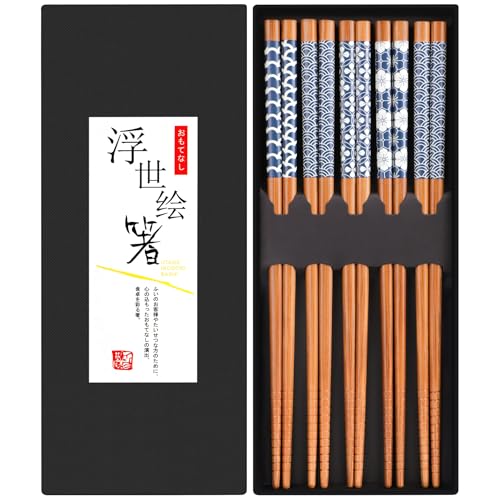
Antner Natural Bamboo Chopsticks (5 Pairs, 8.8 Inches) — Best First Real Pair
Every staircase needs its first real step, and the Antner bamboo set is this guide’s: genuine, unconnected chopsticks whose beginner virtues are physical rather than mechanical. At eight-point-eight inches they are shorter than the dining standard, which shortens the lever a new hand must control and brings the food measurably closer to the fingers’ authority. Bamboo is the lightest common material, so the hand tires slowly and practises longer, and its natural micro-texture grips food with a forgiveness that slippery steel and lacquer deny the unskilled.
Many adult beginners should start here and skip trainers altogether — particularly those learning for travel, for a partner’s family table, or for the pleasure of the skill itself. Paired with this guide’s technique section and a bowl of forgiving food, a motivated adult is functionally competent within a few meals on a pair like this, and the five-pair gift set means the household’s other members can join the project (or replace the pair that will inevitably be practised with at the desk).
Bamboo’s terms are the familiar ones: it is a natural material with a natural lifespan, happiest hand-washed though its verified title claims dishwasher safety, and happiest retired when it eventually tires. As a first real pair — inexpensive, kind, and honest — it has no rival in this guide.
Strengths
- Shorter 8.8-inch length — easier control for new hands
- Bamboo is light and naturally grippy, forgiving early technique
- Five pairs: practice spares and household joiners included
Trade-offs
- No training aids — the technique section is your teacher
- Bamboo is a natural material with a finite lifespan
- Shorter length is less suited to shared dishes at crowded tables
| Specification | Detail |
|---|---|
| Type | Real chopsticks, beginner-friendly format |
| Material | Natural bamboo |
| Length | 8.8 inches |
| Quantity | 5 pairs |
Best for: graduating learners and adults starting directly on real chopsticks / Not suited for: young children who still need a connected trainer
Check the current price on Amazon

GLAMFIELDS Japanese Natural Wooden Chopsticks (5 Pairs, 8.8 Inches) — Best Step-Up Pair
The GLAMFIELDS wooden set is where the beginner’s drawer starts to become a collection. The format repeats the Antner’s winning geometry — five pairs, eight-point-eight inches, lightweight classic Japanese style — in natural wood with a hand-carved character that bamboo’s uniformity does not attempt. For the learner whose pincer is reliable and whose interest has survived the first month, this is the pair that rewards the skill: a little more presence in the hand, a little more beauty on the table, and the same forgiving short length while technique consolidates.
Wood’s eating qualities explain its centuries of tenure: warmer than bamboo to the touch, quiet on bowls, and grippy in the dry, natural way that makes learners trust their lift. The gift-set presentation suits the step-up moment — this is the set bought to mark progress, for oneself or for the household’s newly competent teenager, and it carries that small ceremony well.
Its care terms are wood’s eternal ones — hand-washing is the kind regime, and this set makes no dishwasher claim in its verified title, which is why it sits in the beginners’ guide as a step-up rather than in the dishwasher guide at all. Treat it as the craft pair and it will serve for years; graduate from it, eventually, to whatever length and material your mastered hand prefers.
Strengths
- Hand-carved character in natural wood — the rewarding step-up
- Same forgiving 8.8-inch lightweight format as the first real pair
- Gift-set presentation suits marking a learner’s progress
Trade-offs
- No dishwasher claim in its verified title — hand-wash care
- Wood needs the gentle regime: no soaking, no pan duty
- A step-up, not a starter — beginners begin with the picks above
| Specification | Detail |
|---|---|
| Type | Real chopsticks, step-up |
| Material | Natural wood |
| Length | 8.8 inches |
| Quantity | 5 pairs, gift set |
Best for: learners consolidating skill who want a pair with craft / Not suited for: households wanting dishwasher-proof everything
Check the current price on Amazon
Comparison Table
| Pick | Badge | Key spec | Best for |
|---|---|---|---|
| Patelai Training Chopsticks with Finger Guide (2 Pairs, Metal, Blue and Pink) | Best Overall — Kids and Adults | Metal trainer, finger guide, ambidextrous, 2 pairs | adult beginners and mixed-age households learning together |
| PandaEar Animal Toddler Training Chopsticks (3 Pairs, Frog, Bear and Panda) | Best for Toddlers | Toddler trainer, silicone guide, 3 pairs | toddlers and preschoolers starting the chopstick habit as play |
| KIDSFANTASY Kids Training Chopsticks (2 Pairs) | Best for Young Children | Kids trainer, non-slip grip, 2 pairs | young children beginning in earnest, roughly preschool to early school |
| Plum Garden Kids Chopsticks (4 Pairs, Animal Toddler Training) | Best for Families | Family trainer pack, silicone guide, 4 pairs | families with several young learners at once |
| Antner Natural Bamboo Chopsticks (5 Pairs, 8.8 Inches) | Best First Real Pair | Bamboo real pair, 8.8in, 5 pairs | graduating learners and adults starting directly on real chopsticks |
| GLAMFIELDS Japanese Natural Wooden Chopsticks (5 Pairs, 8.8 Inches) | Best Step-Up Pair | Wooden real pair, 8.8in, 5 pairs | learners consolidating skill who want a pair with craft |
How does learning progress on each of these picks?
Progress on the Patelai trainer
The guide’s gift is sequence: correct grip first, success immediately after, and a hand that memorises its seats without lectures. Learners typically remove the guide for part of a meal within the first week and discover, pleasantly, that their fingers keep the formation unassisted.
Progress on the PandaEar
Toddlers progress by appetite: the animal that delivers food to the mouth becomes a favourite character, and the pincer strengthens inside the play. Parents report the tell-tale milestone — the child reaching for an adult’s sticks — as the sign the next step is ready.
Progress on the KIDSFANTASY
School-age children turn the trainer into a sport: races, challenges, and the first successful pea announced like a trophy. The connected design quietly retires itself as the child’s confidence outgrows its help, which is the graduation the format intends.
Progress on the Plum Garden
In families, progress is social: the youngest copies the eldest, the table normalises practice, and the four-pair supply means nobody’s learning waits on the dishwasher. The set’s success is measured in family meals where the trainers are simply the children’s cutlery.
Progress on the Antner bamboo
Graduates describe a specific pleasure: the first meal where the hand disappears from attention and the food is simply eaten. The short bamboo’s forgiveness carries the learner across the last gap — from performing the grip to owning it.
Progress on the GLAMFIELDS wood
The step-up pair marks the shift from learning to choosing: the user now has preferences — weight, finish, feel — which is the surest evidence the beginner phase has ended. A learner with opinions about chopsticks is no longer a beginner.
The patience principle
Across every pick, progress tracks encouragement and meal frequency, never pressure or talent. The households that succeed keep practice short, foods kind and forks unashamedly available — and find, within weeks, that the forks stay in the drawer by preference rather than by rule.
A note for grandparents and gift buyers
A training set is one of the rare gifts that is also an activity: the giver gets to teach, the learner gets an audience that applauds, and the meal becomes the occasion. Choose the step that matches the child’s age from the badges above, add the giver’s presence at the first practice, and the present outperforms toys that cost ten times more — because what is actually being given is a skill for life, wrapped in an animal.
What success actually looks like
It does not look like a performance. It looks like a meal where nobody — including the learner — mentions chopsticks at all: the food is eaten, the conversation is about the day, and the sticks have become transparent equipment. Every pick and every step in this guide is aimed at that unremarkable meal, which is why the guide measures progress in forgotten forks rather than in feats with peas.
How do you hold chopsticks correctly?
The method every trainer in this guide is secretly teaching has three moves. Rest the lower stick in the web between thumb and index finger, supported by the ring finger — this stick does not move, ever; it is furniture. Lay the upper stick across the middle finger’s side, held by the thumb and index like a pencil — this stick does all the work. Open and close by moving only the upper stick, keeping the tips meeting neatly. If the tips cross or scissor, the grip has crept too far down the sticks; reset higher and begin again.
Two diagnostics fix most beginner struggles. If food rotates as you lift, the sticks are not parallel — the lower stick has joined the dance and must be re-parked. If your hand aches in minutes, you are gripping at the very ends or squeezing continuously; hold the sticks in their rear third and let the hand rest between bites. Skill arrives when the hand stops supervising — usually sooner than the learner fears.
What foods should beginners practise on first?
Choose foods that forgive. Begin with large, textured, non-slippery pieces — steamed broccoli, dumplings with matte skins, chunky vegetables, thick noodles — in a bowl, whose walls corral escapes and whose rim rests the sticks. Progress to rice in a small bowl, where the accepted technique is a gentle scoop-and-lift rather than single-grain heroics. Save the final examinations — glossy peas, single noodles in broth, sashimi — for the week your hand stops asking permission.
- Start: dumplings, chunky vegetables, thick noodles in a bowl
- Then: rice in a small bowl, tofu cubes, scrambled egg pieces
- Later: glossy peas, slippery noodles, beans and small round foods
- Always: a bowl over a plate while learning — walls are allies
How long does it take to learn chopsticks?
Children absorb the pincer pattern in days of play with a trainer and refine it over months of meals. Adults with a finger-guide trainer or a forgiving short pair typically eat a full meal without rescue within three to five attempts, and feel genuinely fluent — no conscious grip management — within a few weeks of regular use. The variable is never talent; it is meal frequency and the kindness of the first foods. Practise at home, where the audience is supportive and the fork is honourably available, and the skill will be ready before the occasion that demands it.
Should adult beginners use training chopsticks or start on real ones?
Both routes work, and the honest answer depends on the learner’s patience. The Patelai trainer guarantees correct finger placement and early success, which protects motivation — the resource adult learners actually run out of. The short bamboo route is purist and entirely viable for the motivated, especially with the technique section above as a coach. What adults should not do is start on long, slippery, expert-format sticks and conclude they lack the gene: the tool was the problem, and this guide exists to remove it.
How do left-handed beginners fare?
Better than they expect — chopsticks are among the most ambidextrous tools in the kitchen, and the Patelai trainer in this guide explicitly works for right or left hands. Left-handed learners should simply mirror every instruction: the still stick and the moving stick swap hands as a pair, and the mechanics are unchanged. Children’s trainers should be checked for handedness in their guides, since some moulded grips assume the right hand; the connected designs here are symmetric in practice.
How do you teach a reluctant learner?
Reluctance is information: the tool hurt, the food embarrassed, or the audience judged. Fix the variable, not the learner. Return to a trainer without commentary, serve the most forgiving and beloved food the learner knows — the favourite dumpling has taught more chopstick skill than any lecture — and shorten the session to a few triumphant minutes inside an ordinary meal. For children, let them teach a stuffed animal; for adults, let them practise on snacks while cooking, where nobody performs. Skill grows in safety and starves in scrutiny, at every age.
And keep the long view in the room: nobody’s life is diminished by a fork. The goal is a door opened, not a test passed, and learners who feel that from their teachers walk through the door at their own pace — usually faster than the anxious schedule their teachers secretly held.
What should beginners know about chopstick etiquette?
A little, kindly, and without anxiety. Rest the sticks on the bowl’s rim or a rest, never speared upright in rice; do not point with them, drum with them, or pass food stick-to-stick; and do not spear food that can possibly be gripped — spearing is the white flag, reserved for genuine defeat. These courtesies matter most at family and formal tables in chopstick cultures, where they are read as care rather than as rules. A beginner who handles the basics with goodwill will be forgiven every technical slip, everywhere, always — etiquette’s spirit is consideration, and consideration is visible long before technique is perfect.
How to practise chopsticks: a one-week starter plan
Skill follows a plan better than it follows hope. This week of short, kind practice — ten minutes at real meals, not drills at a desk — takes most beginners from trainer to competence.
- Day one: set the grip with your trainer or short pair and lift large, forgiving pieces — dumplings, broccoli — from a bowl. Success only; stop while it is still fun.
- Day two: repeat at a real meal, adding thick noodles. Notice the lower stick staying still; re-park it whenever it wanders.
- Day three: introduce rice in a small bowl, using the gentle scoop-lift, and one smaller item — tofu cubes — for precision.
- Day four: if you have been using a trainer, try five minutes with the guide loosened or on the short real pair, returning to the trainer whenever frustration rises.
- Day five: eat a full ordinary meal with chopsticks, fork honourably available but untouched unless a food defeats you twice.
- Day six: attempt one examination food — glossy peas or slippery noodles — and laugh at the result either way; laughter is the sign the hand has relaxed.
- Day seven: graduate formally. Move to your real pair at the family table, keep the trainer for the next learner, and notice that the skill now belongs to your fingers, not your attention.
After the week, skill consolidates on its own schedule — fluency is just competence plus repetitions. Keep the forgiving short pair as your home pair for the first month, and let restaurant meals, with their longer sticks and watching friends, be the graduation ceremony rather than the classroom.
If a child is your learner, let the plan bend around their appetite for the game: some finish the week in three days, some take three weeks, and both graduations are equally real. The plan’s only non-negotiable is its kindness — every session ends on a success, however small, because the hand remembers the last thing it did.
Common Buying Mistakes
- Starting on long, slippery expert chopsticks. Length multiplies every error and smooth lacquer forgives none of them. Begin short, light and textured — the staircase exists because it works.
- Gripping at the very tips or the very ends. Hold the rear third. Tip-grippers scissor; end-grippers ache. The trainers’ guides exist to place this automatically — trust their geometry.
- Moving both sticks. One stick is furniture, one stick dances. Every beginner breakthrough in history is this sentence arriving in the fingers.
- Practising on peas and broth noodles first. Examination foods on day one teach only discouragement. Begin with dumplings and chunky vegetables, where success is available immediately.
- Forcing a child past the fun. A trainer abandoned under pressure teaches avoidance. Short, playful, successful sessions build the habit; the skill follows the habit, never the reverse.
- Buying expert-length sticks to grow into. Children do not grow into 10.5-inch cooking-length sticks at the table, and adults do not learn faster on harder tools. Buy the step you are standing on; the next step is inexpensive when you reach it.
- Skipping the bowl stage and learning over a flat plate. A plate offers escaping food nowhere to stop and the learner no wall to gather against. Bowls are the beginner’s home ground for a reason — rice, noodles and practice itself all behave better inside one.
Final Recommendation
Enter the staircase at your learner’s step: toddlers on the PandaEar’s guided animals, young children on the KIDSFANTASY or the family-sized Plum Garden, older children and adults on the Patelai’s finger-guide trainer — the most versatile teacher here. Graduate to the short Antner bamboo as the first real pair, and mark the consolidation with the GLAMFIELDS wood. Follow the week plan, start on forgiving foods, and the skill that looked like a party trick becomes what it is for half the world: just how dinner works.
Keep the fork in the drawer unashamedly and the trainer in service as long as it helps; there are no judges in your kitchen. What there is, within a surprisingly few meals, is a hand that knows something new — and a table where one more of the world’s great food cultures is fully, deliciously open to you.
- Patelai Training Chopsticks — Best Overall, Kids and Adults: Check the current price on Amazon
- PandaEar Toddler Training — Best for Toddlers: Check the current price on Amazon
- Antner Bamboo — Best First Real Pair: Check the current price on Amazon
Keep researching within this range: Best Chopsticks Dishwasher Safe Best Chopsticks For Cooking Best Chopsticks For Kids Best Bamboo Chopsticks Best Wooden Chopsticks
Frequently Asked Questions
At what age can a child start learning chopsticks?
With a connected toddler trainer, many children start between two and three as play, once they can sit at the table and show interest. The PandaEar’s verified framing covers ages two to eight. Follow the child’s enthusiasm — interest is the curriculum at that age.
Can adults really learn chopsticks, or is it a childhood skill?
Adults learn it in days-to-weeks, routinely — for travel, for family, for work. The Patelai trainer in this guide is explicitly designed for adult beginners too, and the short bamboo route suits motivated adults who prefer to start on real sticks.
Why do my chopsticks cross at the tips?
The lower stick is moving or the grip sits too low. Re-park the lower stick in the thumb’s web, hold both sticks in their rear third, and move only the upper stick. Trainers prevent crossing mechanically while the habit forms.
Are shorter chopsticks really easier?
Yes — a shorter stick is a shorter lever, so small hand movements produce smaller, more controllable tip movements. That is why both real pairs in this guide are 8.8 inches rather than the dining standard, and why children graduate to longer sticks only as control matures.
Should beginners practise with a fork available?
Absolutely. A rescue fork protects the meal and the learner’s morale; skill built under no pressure consolidates faster. Most learners stop reaching for it within the first week or two — by preference, which is the only graduation that counts.
What is the fastest way to get better?
Frequency on forgiving foods: a few minutes at every meal beats a weekly drill. Use the week plan in this guide, keep the grip honest with the technique section, and let dumplings do the teaching.
Do training chopsticks delay real skill?
No — they sequence it. Connected trainers teach the pincer motion and grip position first, which are the skill’s foundations; independence is layered on after, and learners who start with trainers typically reach for real sticks eagerly once the pattern feels easy. The delay theory confuses support with dependence.
How do I stop my hand from cramping?
Cramp is a grip report: you are holding too low, too tight, or without rest. Move the grip to the rear third, let the lower stick truly rest on the ring finger instead of being squeezed, and put the sticks down between bites — even experts rest their hands; beginners simply need permission to copy that too.


