Disclosure: airfryerkitchensupply.com is reader-supported. When you buy through links on our site, we may earn an affiliate commission at no extra cost to you.
Where to buy
For anyone comparing the best charcoal bbq smokers, this shortlist is the place to start: every model below earned its place on the criteria set out in this guide, and every linked model was verified before its link was attached.
Charcoal BBQ smokers are stocked by Amazon, outdoor retailers and home centres, often under both ‘grill’ and ‘smoker’ listings for the same hardware.
- Weber Smokey Mountain Cooker 18-inch — check price on Amazon; choose the listing sold or shipped by Amazon or the brand’s own store, and confirm the exact model name before you order.
- Oklahoma Joe’s Bronco Pro 21.5-inch Charcoal Drum Smoker — check price on Amazon; choose the listing sold or shipped by Amazon or the brand’s own store, and confirm the exact model name before you order.
- Oklahoma Joe’s Bandera Smoker and Grill — check price on Amazon; choose the listing sold or shipped by Amazon or the brand’s own store, and confirm the exact model name before you order.
- Masterbuilt Gravity Series 800 — check price on Amazon; choose the listing sold or shipped by Amazon or the brand’s own store, and confirm the exact model name before you order.
- Char-Griller Smokin’ Pro Charcoal Grill and Offset Smoker — check price on Amazon; choose the listing sold or shipped by Amazon or the brand’s own store, and confirm the exact model name before you order.
- Weber Smokey Mountain Cooker 22-inch — check price on Amazon; choose the listing sold or shipped by Amazon or the brand’s own store, and confirm the exact model name before you order.
BBQ is barbecue with its sleeves rolled up: weeknight chicken thighs given an hour of smoke, ribs on a Saturday, a shoulder when the family gathers. The best charcoal bbq smokers for that life are not competition pits — they are versatile charcoal cookers that smoke low, grill hot, and ask a fair amount of effort for the flavour they return. If you are shopping for the best charcoal bbq smokers, this guide ranks them by that everyday standard.
The six picks span the useful spectrum: two bullets for dependable low-and-slow, a drum for fast, hot, hanging barbecue, two offsets for the live-fire faithful, and a vertical offset cabinet for cooks whose BBQ includes sausage and jerky. Every linked model was verified against the site’the Amazon catalogue, matching the Amazon title to the exact product before any link was attached.
Note what this guide optimises for, because it differs from a brisket-only ranking: versatility per dollar and per hour. A cooker that grills brilliantly on Tuesday and smokes credibly on Saturday outranks, for most households, a specialist that does one thing supremely and sits idle otherwise. Prices are not printed — they move too often — so use the check-price links and the tier described in each review.
In this guide
Quick Picks
Everyday BBQ picks: bullets for reliability, a drum for speed, offsets for ceremony, and a cabinet for the sausage makers.
- Best Overall — Weber Smokey Mountain Cooker 18-inch: The everyday BBQ bullet: two grates, a water pan and a charcoal ring that turn out ribs, chicken and shoulders with metronome reliability, sized for how families actually eat.
- Best Drum Smoker — Oklahoma Joe’s Bronco Pro 21.5-inch Charcoal Drum Smoker: A heavy drum that hangs ribs and whole chickens over the coals for hot, fast, direct-heat BBQ — and grills on the same grate when the hanging is done.
- Best Vertical Offset — Oklahoma Joe’s Bandera Smoker and Grill: The cult classic vertical offset: a tall cabinet of shelves beside a charcoal firebox, built for mixed loads — ribs on one shelf, sausage hanging above, a shoulder below.
- Best Grill-Smoker Combo — Masterbuilt Gravity Series 800: The charcoal combo that grills, griddles and smokes under digital control: 800 square inches, a griddle insert for smash burgers and breakfast, and a hopper fire that holds temperature by itself.
- Best Budget Combo — Char-Griller Smokin’ Pro Charcoal Grill and Offset Smoker: The budget do-everything barrel: direct charcoal grilling in the main chamber, offset smoking from the side firebox, dual dampers and a warming rack across a generous total area.
- Best for Gatherings — Weber Smokey Mountain Cooker 22-inch: The gathering bullet: two wide grates that take a pair of briskets or four shoulders, the water pan’s famous stability, and charcoal economy no offset can match at this capacity.
How These Picks Were Chosen
Candidates were scored on the BBQ week as households actually live it: a hot grill session, a mid-length smoke, and occasionally a long cook. Models needed credible performance in at least two of the three, genuine charcoal flavour in all of them, and build quality proportionate to their tier. Pure grills with a token smoke setting and novelty smokers with no temperature control were both excluded.
Verification followed the programme’s standard: each linked pick’s ASIN comes from the Amazon catalogue for this site, with the Amazon title matched to the model named in the review. Models the API could not confirm were written unlinked or dropped, and any model with a known safety recall was excluded outright.
The final six deliberately avoid duplicating one design. BBQ is a family of techniques — low-and-slow, hot-and-fast hanging, live-fire offset, cabinet smoking — and a guide that shows the family teaches more than a guide that ranks six near-identical barrels.
The 6 Best Charcoal BBQ Smokers, Reviewed in Detail
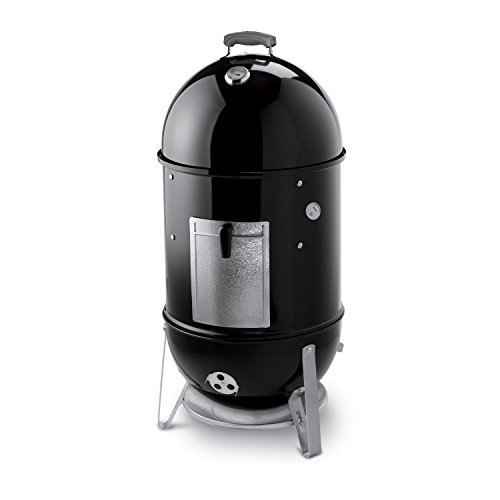
Weber Smokey Mountain Cooker 18-inch — Best Overall
Most BBQ is not a brisket. It is ribs for six, a pair of chickens, a shoulder for pulled pork on Sunday — and the 18-inch Smokey Mountain is sized precisely for that menu. Its two grates stack the food over a water pan that steadies the charcoal fire, and once the vents are set it holds its band with the calm that made the bullet design famous.
For BBQ duty specifically, the bullet’s virtues compound: the humid chamber keeps chicken skin-friendly and forgiving, ribs cook evenly without rotation, and a shoulder can ride unattended through a family afternoon. It sips charcoal compared with offsets, lights quickly, and stores in a corner of the patio rather than dominating it.
Strengths
- Outstanding reliability for ribs, chicken and shoulders
- Frugal charcoal use and quick start-up suit frequent cooking
- Porcelain-enameled build and deep parts support
Trade-offs
- Full packer briskets need draping tricks to fit
- No genuine searing role — pair it with a kettle or gas grill for steaks
- Lower grate access means lifting the loaded upper grate
| Specification | Detail |
|---|---|
| Format | Vertical bullet smoker |
| Cooking grates | Two, stacked |
| Body | Porcelain-enameled steel |
| Heat source | Charcoal bed with water pan |
| Best loads | Ribs, chicken, shoulders |
The case for the 18 as Best Overall is a frequency argument: it is the smoker in this guide most likely to be lit every week, because it asks the least and delivers the most consistent plate of BBQ. Skill grows with repetitions, and this cooker manufactures repetitions.
Add a rib rack to stand racks upright and a hinge kit for the lid if you fall in love with it; the accessory ecosystem is bottomless. Outgrowing it usually means adding a second cooker, not replacing it.
Best for: Families whose BBQ is ribs, chicken and pulled pork most weekends / Not suited for: Brisket-first cooks or households needing banquet capacity
Check on Amazon — check price on Amazon and confirm the current configuration, since bundles and included accessories change between listings.
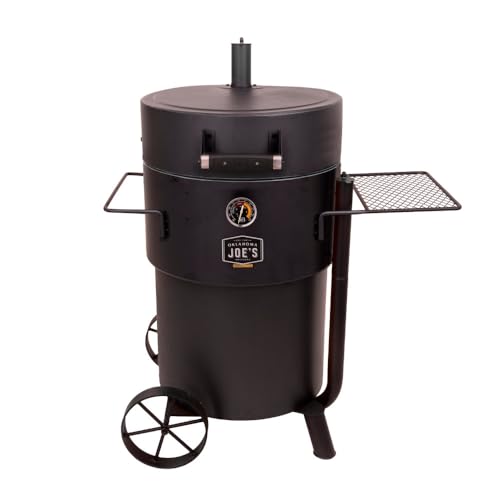
Oklahoma Joe’s Bronco Pro 21.5-inch Charcoal Drum Smoker — Best Drum Smoker
Drum smokers cook the way BBQ was cooked before the offset era: meat suspended or laid over a charcoal fire in a sealed barrel, juices dripping onto coals and returning as vapour and flavour. The Bronco Pro is the heavy-duty end of that tradition — a 21.5-inch drum with 366 square inches of grate, hooks for hanging ribs and birds, and a sealed, gasketed construction that gives drum cooking its signature temperature obedience.
Hanging changes the BBQ maths. Ribs hang vertically and cook evenly end to end; whole chickens hang and baste themselves; and because the heat is direct-but-distant, cooks run faster than in an offset at the same tenderness. The intake and exhaust system, with a proper sealing lid, lets the drum hold a band or run hot with equal composure.
Strengths
- Hanging cooking delivers fast, even ribs and poultry with unique flavour
- Heavy sealed drum holds temperature with unusual obedience
- Converts to a charcoal grill on the same grate
Trade-offs
- Capacity is one-dimensional: great for ribs and birds, awkward for many flat cuts at once
- Direct-heat style is a distinct flavour some households love and others find intense
- Heavy for its size; plan its patio spot rather than moving it casually
| Specification | Detail |
|---|---|
| Format | Charcoal drum smoker and grill |
| Cooking area | 366 sq. in. (Amazon title) |
| Diameter | 21.5 in. |
| Features | Hanging hooks, sealed lid, grate grilling |
| Best loads | Ribs, whole chicken, turkey |
The drum is BBQ’s best-kept open secret: competition teams win on drums because the flavour is bold, the cooks are quick and the fire is simple. For a household, the Bronco Pro offers that competition style in a manufactured, heavy-gauge form with none of the DIY barrel’s rough edges.
Learn it on ribs — hang them, watch the drum hold its line, and taste why the style has devotees. Then hang a turkey at the holidays and accept the compliments as your due.
Best for: Rib and poultry lovers who want bold, direct-heat BBQ and faster cooks / Not suited for: Cooks who mainly need wide flat grate space for briskets and many racks laid flat
Check on Amazon — check price on Amazon and confirm the current configuration, since bundles and included accessories change between listings.
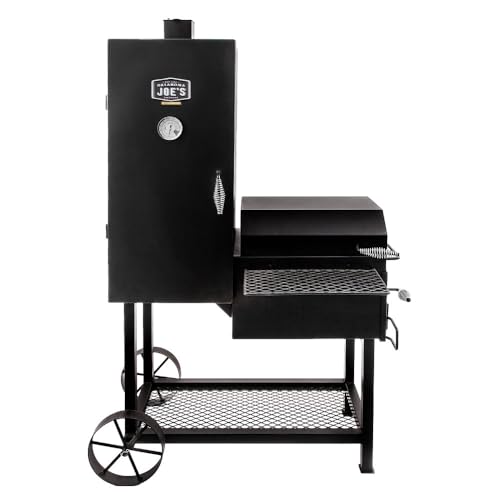
Oklahoma Joe’s Bandera Smoker and Grill — Best Vertical Offset
The Bandera’s layout answers a question horizontal offsets cannot: what if the cook is five different foods at once? Its vertical cabinet stacks multiple shelves beside an offset firebox, so ribs, chicken halves, sausage links and a shoulder all ride the same charcoal-and-wood fire at slightly different heights — and therefore slightly different temperatures — in one cook.
It has been a favourite of the sausage-and-ribs crowd for years precisely because the cabinet shape suits hanging and shelving at once. The firebox burns charcoal with wood chunks or short splits, the cabinet’s draw is strong, and the whole cooker occupies the footprint of a horizontal offset’s firebox end alone.
Strengths
- Shelves plus hanging space suit mixed, varied BBQ loads
- Small footprint for its capacity
- Offset firebox keeps fire-tending outside the cooking chamber
Trade-offs
- Vertical gradient requires shelf rotation on long cooks
- Cabinet doors on production models benefit from gasket attention
- Less brisket-friendly than a horizontal barrel of similar cost
| Specification | Detail |
|---|---|
| Format | Vertical offset smoker and grill |
| Firebox | Offset, charcoal and wood |
| Layout | Multiple shelves in a tall cabinet |
| Best loads | Ribs, sausage, chicken, mixed loads |
| Positioning | Mid-range tier |
Think of the Bandera as BBQ’s multitasker. A game-day cook — wings up top where it runs hotter, ribs in the middle, beans below catching drippings — is its native programme, and no other pick in this guide runs that programme as naturally.
It rewards the cook who thinks in shelves and rotations. If your BBQ is one big cut at a time, a horizontal offset serves you better; if your table groans with variety, the Bandera is the shape of your habit.
Best for: Mixed-load cooks serving varied BBQ spreads from one fire / Not suited for: Single-brisket specialists who want a long horizontal grate
Check on Amazon — check price on Amazon and confirm the current configuration, since bundles and included accessories change between listings.

Masterbuilt Gravity Series 800 — Best Grill-Smoker Combo
The Gravity 800 is the BBQ combo for households that refuse to own three cookers. Its gravity-fed charcoal hopper and fan hold a smoking temperature for a shoulder, run hot for steaks, and — with the included griddle insert — turn out diner-style breakfasts and smash burgers. The maker lists 800 square inches, and the app-connected digital control means the smoking side genuinely runs itself.
Wood chunks in the hopper or ash pan keep the smoke honest, and the charcoal fire gives a depth pellet combos cannot match. As a BBQ proposition it is about range: this is the only pick here that can smoke ribs at lunch and griddle onions for burgers at dinner without a second appliance.
Strengths
- True grill, griddle and smoker range in one cooker
- Digital control holds smoking temperatures unattended
- Charcoal fire delivers deeper flavour than pellet combos
Trade-offs
- Electronics and fan add maintenance a plain charcoal cooker avoids
- Requires mains power at the cooking position
- Griddle and grates need seasoning care to stay rust-free
| Specification | Detail |
|---|---|
| Format | Gravity-fed digital charcoal grill and smoker |
| Cooking area | 800 sq. in. (Amazon title) |
| Model | MB20040221 |
| Extras | Griddle insert included (Amazon title) |
| Control | Digital with app connectivity |
Judge the 800 as a household appliance rather than a pit: it replaces a grill, adds a griddle and smokes credibly, under a thermostat. For many families that arithmetic beats a specialist smoker plus a separate grill on cost, space and actual weekly use.
Its smoke is charcoal-led and clean; offset devotees will call it gentler, and they are right, and for Tuesday chicken gentler-and-ready beats perfect-and-idle. Keep the ash pan emptied and the charcoal dry and it will be the most-used cooker on the patio.
Best for: Households wanting one charcoal cooker that grills, griddles and smokes / Not suited for: Off-grid cooking or live-fire purists
Check on Amazon — check price on Amazon and confirm the current configuration, since bundles and included accessories change between listings.

Char-Griller Smokin’ Pro Charcoal Grill and Offset Smoker — Best Budget Combo
No cooker in this guide has introduced more people to charcoal BBQ than the barrel-plus-firebox combo, and the Smokin’ Pro is its benchmark. Grill steaks over the main barrel’s coals tonight; load the side firebox tomorrow and the same barrel becomes an offset smoker for ribs and shoulders. The headline 1,130 square inches counts the whole system including the warming rack, so treat smoking capacity as the barrel itself — still ample for family BBQ.
Dual damper control is the feature that makes the smoking mode real rather than decorative: intake at the firebox, exhaust at the stack, and a fire that answers to both. The steel is light and the seams are honest-budget, which the trade-offs below state plainly; the enormous owner community has documented every gasket and baffle improvement a new owner could want.
Strengths
- Grill and offset smoker in one low-cost footprint
- Dual dampers provide genuine fire control
- Vast community knowledge base for setup and mods
Trade-offs
- Light steel swings with weather and burns more fuel
- Smoking area is the barrel, not the headline total
- Cast-iron grates need seasoning discipline
| Specification | Detail |
|---|---|
| Format | Barrel grill with offset side firebox |
| Total area | 1,130 sq. in. (Amazon title, incl. warming rack) |
| Model | CG30044223 |
| Controls | Dual damper control |
| Positioning | Budget tier |
The Smokin’ Pro is BBQ’s apprenticeship: inexpensive enough to start on, capable enough to keep for years as the household grill even after a heavier smoker arrives. Seal it, shelter it, and learn fire management on it; the skills transfer to every cooker in this guide.
Its honest ceiling is long cooks in cold wind. Schedule winter BBQ for calm days, keep a charcoal reserve, and it will feed a family far beyond its price’s promise.
Best for: Beginners and budget households wanting grilling plus real offset smoking / Not suited for: Frequent winter brisket in exposed, windy locations
Check on Amazon — check price on Amazon and confirm the current configuration, since bundles and included accessories change between listings.

Weber Smokey Mountain Cooker 22-inch — Best for Gatherings
When the BBQ is for twenty people, the 22-inch Smokey Mountain is the calmest way to cook it. Four pork shoulders across two grates, or two briskets, ride a single charcoal ring for the length of the cook, and the water pan keeps the chamber steady while the host does host things instead of fire things.
That combination — capacity plus calm — is why big bullets anchor so many family gatherings and amateur competition teams alike. It is not the cooker for a live-fire performance; it is the cooker for feeding everyone superbly and still being at the table.
Strengths
- Gathering capacity with bullet stability
- One charcoal load carries long cooks economically
- Built and supported for decade-scale service
Trade-offs
- Larger charcoal ring is wasteful for a single small cook
- Lower-grate access requires lifting loaded grates
- No grilling or searing role
| Specification | Detail |
|---|---|
| Format | Vertical bullet smoker |
| Cooking grates | Two, stacked |
| Body | Porcelain-enameled steel |
| Heat source | Charcoal bed with water pan |
| Best loads | Multiple shoulders, briskets, rib programmes |
Households deciding between the two bullets should count covers at their biggest regular gathering, not their average Tuesday. If the big cook happens monthly, the 22 earns its charcoal; if it happens twice a year, the 18 plus a borrowed kettle is the thriftier answer.
Either way the bullet method — minion fire, water pan, vents set early — is BBQ’s most repeatable technique, and the 22 is its full-size expression.
Best for: Hosts who regularly smoke for a crowd / Not suited for: Small households that rarely cook more than one cut
Check on Amazon — check price on Amazon and confirm the current configuration, since bundles and included accessories change between listings.
Comparison Table
| Pick | Badge | Key spec | Best for |
|---|---|---|---|
| Weber Smokey Mountain Cooker 18-inch | Best Overall | 18-inch bullet, dual grates, water pan | Families whose BBQ is ribs, chicken and pulled pork most weekends |
| Oklahoma Joe’s Bronco Pro 21.5-inch Charcoal Drum Smoker | Best Drum Smoker | 21.5-inch drum, 366 sq. in., hanging hooks and grates | Rib and poultry lovers who want bold, direct-heat BBQ and faster cooks |
| Oklahoma Joe’s Bandera Smoker and Grill | Best Vertical Offset | Vertical cabinet with offset firebox, shelves and hanging space | Mixed-load cooks serving varied BBQ spreads from one fire |
| Masterbuilt Gravity Series 800 | Best Grill-Smoker Combo | Gravity-fed charcoal, 800 sq. in., griddle insert included | Households wanting one charcoal cooker that grills, griddles and smokes |
| Char-Griller Smokin’ Pro Charcoal Grill and Offset Smoker | Best Budget Combo | Barrel grill plus side firebox, 1,130 sq. in. total, dual dampers | Beginners and budget households wanting grilling plus real offset smoking |
| Weber Smokey Mountain Cooker 22-inch | Best for Gatherings | 22-inch bullet, dual grates, water pan | Hosts who regularly smoke for a crowd |
Read the table by badge first and by key spec second: the badge tells you the job each cooker was chosen to do, and the key spec tells you the physical fact that decides whether it can do that job in your space, with your fuel and your typical load.
How to Choose a Charcoal BBQ Smoker for Your Kind of BBQ
Define your BBQ before you define your smoker. List the last ten cooks you actually made or genuinely plan: if ribs, chicken and burgers dominate, a bullet, drum or combo serves you better than a brisket pit; if a monthly packer is the point, start at the offsets. Most disappointment in this category is a menu mismatch, not a product failure.
Next, decide your labour budget in hours, honestly. Offsets charge attention every half hour; bullets charge a check every few hours; gravity-fed cookers charge a hopper fill and an ash emptying. All three currencies buy good BBQ. Pick the one you will pay gladly, because a cooker whose labour you resent becomes garden furniture.
Finally, weigh construction against climate and storage. A cooker that lives outdoors in a wet, cold region needs enamel, covers and steel that shrug off weather; a garaged cooker in a mild climate can be lighter. Match the machine to the life it will actually live.
- Write down your real menu before shopping — it picks the format
- Price the labour each design charges and choose one you will gladly pay
- Consider hanging and shelf space if your BBQ is varied, not single-cut
- Check grate material: cast iron sears, porcelain enamel forgives, chrome needs care
- Leave budget for a dual-probe thermometer and a cover — both are necessities, not accessories
Hot and Fast vs Low and Slow: The Two BBQ Tempos
Low-and-slow — the smoking band, hours of patience — renders tough cuts tender and builds bark; it is the tempo of brisket, shoulders and traditional ribs. Hot-and-fast, the drum smoker’s native tempo, cooks ribs and poultry at higher heat with direct-fire flavour, finishing in half the time with a different, bolder character. Neither is a shortcut or a cheat; they are two dialects of BBQ, and many households eventually speak both.
Your schedule should arbitrate. A family that BBQs on weeknights needs the hot-and-fast dialect in its life; a family whose BBQ is a Saturday ceremony can live in low-and-slow alone. The picks in this guide were chosen so both dialects are represented by cookers that speak them natively, not by one cooker pretending to do everything.
How to Smoke Ribs on a Charcoal BBQ Smoker
Ribs are BBQ’s weekly bread. This method adapts to every cooker in the guide; the format notes tell you what changes.
- Remove the membrane from the bone side — slide a knife under it, grip with a paper towel, pull
- Season all over and rest the ribs while the cooker comes up to temperature; cold meat takes smoke better
- Set the cooker in its smoking band with clean, thin smoke running before the ribs go on
- Cook bone-side toward the heat: down on bullets and offsets, hanging in a drum
- Leave the ribs undisturbed for the first two hours while bark and colour develop
- Spritz lightly only after the bark has set, if the surface looks dry
- Wrap when the bark is firm and the colour is deep mahogany — or skip the wrap for firmer bark
- Test doneness by bend and bone: the rack bends deeply, cracks the bark, and the meat has drawn back from the bone ends
- Rest ten minutes, slice between the bones, and serve without sauce theatrics
In a drum, ribs hang and typically finish noticeably faster; start checking early. In an offset, place thicker racks nearer the firebox and rotate once. On a bullet, the top grate runs a touch hotter — put the thicker rack up top. The bend test outranks every clock in every format.
Sauce, if your household insists, goes on in the last fifteen minutes as a glaze, never as a cooking medium. Good ribs carry the meal; sauce is an accent the cook adds, not a rescue the cook needs.
Common Buying Mistakes
- Peeling the lid constantly to check colour — ribs cook by schedule and test, not by viewing
- Wrapping before the bark sets, steaming the crust you spent two hours building
- Judging ribs by internal temperature alone instead of bend and draw-back
- Burning sugar-heavy rubs over direct drum heat without adjusting distance
- Serving ribs straight from the cooker with no rest, losing juices to the board
- Buying a brisket pit for a rib menu — format mismatch is the costliest error in this category
A subtler mistake is smoking everything at one temperature because the cooker is set there. Poultry wants more heat for its skin, ribs want the classic band, shoulders forgive almost anything. Learn each food’s preference and adjust the fire, not the food.
Charcoal Choices That Change Your BBQ
Briquettes burn evenly, predictably and long — the metronome fuel, ideal for bullets and long cooks where consistency outranks romance. Lump charcoal burns hotter, cleaner-tasting to many palates and less uniformly, with pieces ranging from shards to logs in the same bag; it suits grilling, drums and gravity hoppers that meter fuel mechanically. Most experienced BBQ cooks keep both: briquettes for the smoking base, lump for the grill and for topping up heat.
Charcoal quality is visible: good lump sounds like glass when poured and contains few rocks, wires or unburned wood; good briquettes are dense, uniform and low in filler odour at lighting. Store all charcoal dry — a damp bag is the hidden cause of half the ‘my smoker won’t hold temperature’ complaints in the hobby.
Setting Up a Two-Zone Fire for Grill-Smoker Versatility
Combo cookers earn their keep with the two-zone fire: charcoal banked to one side for searing, the other side clear for indirect finishing. Chicken pieces sear over the coals, then move to the cool side under the lid to finish in gentle smoke; steaks reverse-sear by travelling the opposite direction. The side firebox of an offset combo extends the idea — a small fire beside the chamber gives delicate smoke while the main barrel grills.
Mastering zones matters more than mastering any single recipe, because it converts one cooker into a kitchen: direct heat, indirect heat and smoke, simultaneously available. Practice with chicken thighs, BBQ’s most forgiving test piece, until moving food between zones becomes reflex.
The BBQ Cook’s Pantry: Rubs, Sauces and Wood Pairings
BBQ rewards a small, mastered pantry over a shelf of experiments. A house rub — salt, coarse pepper, paprika, garlic, a little brown sugar for pork — covers most of the BBQ year and lets the cook learn what smoke and meat do without a new variable every weekend. Sauce, where the household wants it, belongs at the end as a glaze or at the table as a choice; meat that needs sauce to be edible is a fire problem, not a sauce opportunity. Keep the pantry small and the standards high, and every cook becomes comparable to the last, which is how improvement actually happens.
Wood pairing follows the same discipline. Oak for beef and as the all-round base, hickory for pork in moderation, apple and cherry for poultry and fish, mesquite only when its boldness is the point. In drums, where smoke is concentrated by the direct fire, milder woods flatter more often than strong ones; in bullets, where the water pan softens everything, a firmer hand with hickory is forgiven. Write the pairing in the cook log next to the result, and within a season the pantry stops being a guess and becomes a style — your household’s BBQ accent, recognisable at the first bite.
Weeknight BBQ: Shrinking the Craft to Fit a Tuesday
The cooks in this guide are usually described at weekend scale, but BBQ’s techniques shrink gracefully. Chicken thighs on a bullet at a higher heat, with the water pan foiled, are an hour’s work and taste like a holiday. Ribs in a drum, hung and hot, fit an evening. Even a small shoulder, started at lunch on a gravity-fed cooker that minds itself, lands at dinner without the cook’s afternoon. The weeknight versions are not lesser BBQ; they are the repetitions that make the weekend versions masterful.
The enabling habits are mundane: charcoal stored dry and ready, a chimney that lives beside the cooker, rub already mixed, a thermometer that is charged. Weeknight BBQ fails on friction, not on skill — every missing item is a reason to order pizza instead. Remove the friction once, deliberately, and the charcoal gets lit on Tuesdays, which is when a household’s BBQ identity is truly formed.
Cleaning and Care That Keep Charcoal BBQ Tasting Clean
Old grease is the silent flavour in too many backyard cooks: rancid drippings reheated cook after cook, ash paste corroding the firebox floor, grates carrying last month’s chicken into this week’s ribs. The care rhythm that prevents it is short enough to be a habit — brush grates hot after every cook, empty ash cold the next day, wipe the chamber’s worst grease monthly, and run one hot, empty burn each season to reset the interior. Ten minutes of rhythm against a background flavour no rub can cover is the best trade in BBQ.
Care is also inspection. The end of a cook is when a cooker confesses: a gasket thinning, a damper loosening, a rust spot starting on a leg. Caught at confession, each is a small part and a small hour; ignored for a season, each becomes the reason a good cooker gets replaced. The owners in every BBQ community whose equipment is oldest are not lucky — they are the ones who looked while they cleaned.
BBQ for a Crowd Without a Second Cooker
The gathering is where BBQ formats are truly audited, and the audit is mostly logistics: what cooks simultaneously, what holds, and what the cook can serve without leaving the table for the whole party. Bullets pass by stacking — shoulders below, ribs above, everything holding in its own juices while the host is present. Drums pass by speed — batch after batch of ribs and chicken, each finished as the next is wanted, the fire’s rhythm matching the party’s. Cabinets pass by variety — shelves of different foods finishing in a planned sequence. Offsets pass by spectacle and by the firebox grill, which becomes the appetiser station while the chamber holds the main event.
The crowd technique that matters most is holding, and it is format-agnostic: cooked meat, wrapped and rested in a dry cooler, waits an hour or more at serving quality, which converts the party from a race into a schedule. Cook to finish early, hold with confidence, and use the party itself for the fast work — wings, sausages, corn — that entertains as it cooks. A household that masters holding discovers its existing cooker was crowd-capable all along; the bottleneck was never the grate. It was the plan, and plans are free.
Leftovers, finally, are a crowd strategy rather than an accident: shoulders and briskets scale better than ribs, freeze better than chicken, and reappear as sandwiches and chilli that extend the party across the week. The BBQ cook who plans the second meal at the first one’s fire is practising the oldest economy in the craft — nothing wasted, everything honoured, the fire’s work fully eaten.
Storing and Transporting a Charcoal BBQ Smoker
BBQ cookers live harder lives than their owners admit: hauled to tailgates, stored under eaves, lent to brothers-in-law. A few habits protect the investment. Transport any smoker cold, empty and secured — ash out, grates seated, lid latched or strapped — because a cooker that shifts in a truck bed arrives with bent dampers and a season of mysterious temperature behaviour. At home, store it covered on a surface that drains; a smoker standing in a puddle rusts from the legs up while its owner admires the top. Wheels, where fitted, want a chock on any slope, and handles want a glove’s respect after a cook, not during the move that follows it.
Lending deserves one rule, offered from long collective experience: lend the cooker with its method attached. Five minutes — how the vents behave, where the hot spot lives, what the fire likes — converts a loan from a risk into a recruitment, and the borrower returns as the newest member of the BBQ congregation rather than as an apology. Equipment shared well builds the community that makes the craft richer; equipment shared carelessly builds only resentment and rust.
And if this guide leaves one impression, let it be that BBQ is a practice measured in cooks, not in equipment. The six cookers here span bullets, drums, cabinets, offsets and automated charcoal, yet the plates they produce converge as their owners’ logs grow longer and their fires grow calmer. Choose the format that fits your menu and your hours, season it honestly, feed it dry charcoal and clean wood, and then cook — weekly, logged, and with the patience the craft has always asked. The BBQ will follow, as it has followed that formula on every continent where meat meets smoke.
Keep the first cook simple, the log honest and the fire clean, and every cooker in this guide will teach you the rest at its own pace — that is the whole secret, and it was never really a secret at all, just a discipline disguised as one, passed from cook to cook wherever charcoal smoke rises over a backyard and somebody is learning, bite by bite, why this way of cooking has outlived every fashion that tried to replace it.
Bring a notebook to the first month of cooks and the smoker will repay it for years.
Fire, patience, salt, smoke and time — five ingredients, endlessly recombined, are the whole of BBQ, and every cooker in this guide is simply a different way of holding them together long enough for the magic to happen at your table.
Final Recommendation
Start where your menu starts. For most families that is the Smokey Mountain 18-inch: it will make more good BBQ, more often, than anything else here. Rib-and-poultry devotees should seriously consider the Bronco Pro’s drum style, mixed-load cooks the Bandera, and households replacing a grill the Gravity 800.
The Smokin’ Pro remains the budget apprenticeship of choice, and the Smokey Mountain 22-inch the gathering machine. What unites all six is real charcoal and honest construction for their tier — the rest is matching the fire to your life, which this guide has tried to make a straightforward decision.
Start your shortlist here: Weber Smokey Mountain Cooker 18-inch, Oklahoma Joe’s Bronco Pro 21.5-inch Charcoal Drum Smoker, Oklahoma Joe’s Bandera Smoker and Grill — check price on Amazon for each and confirm the exact configuration before ordering.
Keep exploring the same cluster on this site: Best Charcoal And Wood Smokers Best Charcoal Barbecue Smokers Best Charcoal Grills Smokers Best Charcoal Smokers Under $200 Best Drum Smokers
Frequently Asked Questions
What is the easiest charcoal BBQ smoker for a beginner?
A bullet smoker such as the Smokey Mountain 18-inch. Its water pan forgives vent mistakes, its fire lasts for hours untouched, and its core technique — light, set, wait — can be learned in two cooks.
Are drum smokers good for beginners?
Drums are simple to run but cook hot and fast by BBQ standards, which compresses the learning timeline: ribs finish quickly and reward attention. A patient beginner does well on a drum; a beginner who wants long, slow cooks should start with a bullet.
Can one cooker really grill and smoke well?
Yes, within limits. Gravity-fed combos and barrel-plus-firebox combos grill excellently and smoke credibly. Dedicated smokers smoke better and grill poorly or not at all. The honest question is which activity your household does weekly.
How do I keep charcoal BBQ from tasting like lighter fluid?
Never use fluid. Light charcoal in a chimney starter with newspaper or a fire-starter cube, and let the coals ash over fully before cooking. The fluid taste complaint disappears permanently.
Why are my ribs tough even after hours of cooking?
They are underdone, not overdone — rib collagen converts slowly and the bend test, not the clock, decides. Give them more time in the band and test by bend and bone draw-back rather than by hours.
Do I need to add water to a bullet smoker’s pan?
For low-and-slow BBQ, yes: the water is a heat sink that steadies temperature and humidifies the chamber. For hotter poultry cooks some owners run the pan empty or foiled for easier cleanup and crisper skin.


