Disclosure: airfryerkitchensupply.com is reader-supported. When you buy through links on our site, we may earn an affiliate commission at no extra cost to you.
Where to buy
For anyone comparing the best charcoal bbq grills under 500, this shortlist is the place to start. The under-$500 tier is where charcoal grills get serious, and it is sold through Amazon, barbecue specialists and home centres alike. Buy against the exact model names in this guide, confirm trim and accessories on the listing — several picks are sold in multiple configurations — and verify the live price at checkout against your under-$500 frame, because this guide prints no prices and prices move.
- Weber Master-Touch Charcoal Grill, 22-Inch — check price on Amazon; confirm trim and included accessories on the listing before ordering.
- Char-Griller AKORN Kamado Charcoal Grill and Smoker, 20-Inch — check price on Amazon; confirm trim and included accessories on the listing before ordering.
- Weber Performer Charcoal Grill, 22-Inch — check price on Amazon; confirm trim and included accessories on the listing before ordering.
- Char-Griller Barrel Pro Charcoal Grill, 785 Sq In — check price on Amazon; confirm trim and included accessories on the listing before ordering.
- Royal Gourmet CC1830V Barrel Charcoal Grill, 30-Inch — check price on Amazon; confirm trim and included accessories on the listing before ordering.
- Kamado Joe Joe Jr, 13.5-Inch Portable Ceramic Grill — check price on Amazon; confirm trim and included accessories on the listing before ordering.
The best charcoal bbq grills under 500 occupy the most interesting ground in charcoal cooking: enough budget for real formats — a perfected kettle, a kamado, full-size barrels, a ceramic portable — but not so much that the choice makes itself. The best charcoal bbq grills under 500 are therefore chosen by cooking style, and this guide is organised to make that choice honestly, including the unfashionable truth that the best single answer for most households still costs noticeably less than the full budget and spends the difference on the system around the grill.
What the tier buys over the under-$200 level is format range and workflow: insulation, enclosed ash systems, work surfaces, capacity. What it does not buy is immunity from charcoal’s fundamentals — fire management, ash discipline and vent patience decide results at $500 exactly as they do at $150, which is why every pick here was judged on those fundamentals first and features second. Every linked model was verified before linking.
In this guide
Quick Picks
- Weber Master-Touch Charcoal Grill, 22-Inch — Best Overall Under $500: With up to $500 to spend, the smartest single purchase remains a kettle — the best one. Check price on Amazon.
- Char-Griller AKORN Kamado Charcoal Grill and Smoker, 20-Inch — Best Kamado Under $500: The under-$500 frame is exactly where the AKORN makes its famous argument: kamado cooking — the heat range, the fuel efficiency, the steady low-and-slow — without ceramic money. Check price on Amazon.
- Weber Performer Charcoal Grill, 22-Inch — Best for Convenience: The Performer spends the under-$500 budget on the thing frequent grillers actually run out of: workspace. Check price on Amazon.
- Char-Griller Barrel Pro Charcoal Grill, 785 Sq In — Best Large Barrel: When the cooking is measured in trays rather than portions, the Barrel Pro is the under-$500 answer: a full-size barrel chamber that swallows burgers for a party, long racks of ribs laid flat, or a mixed grill for a family gathering, with the direct, smoky character that only a barrel of burning charcoal produces.. Check price on Amazon.
- Royal Gourmet CC1830V Barrel Charcoal Grill, 30-Inch — Best Value Barrel: The CC1830V is the value barrel: a 30-inch chamber with practical shelves and a working layout, priced to leave most of the under-$500 budget unspent for the cooks who would rather invest in fuel, tools and meat. Check price on Amazon.
- Kamado Joe Joe Jr, 13.5-Inch Portable Ceramic Grill — Best Portable Ceramic: The Joe Jr is the connoisseur’s portable: a real ceramic kamado, small enough to travel, that sears a pair of steaks at fierce heat and then holds a low, steady smoke for a small shoulder better than full-size steel grills costing the same. Check price on Amazon.
How These Picks Were Chosen
Verification first, as throughout this series: each model was confirmed against current catalogue listings before receiving a link, and tier position was checked as a positioning matter, with readers instructed to re-confirm live prices at checkout. The judging order was fixed. Fire control and cooking-system honesty first — dampers, sealing, and whether the format performs its claimed role. Ownership second: materials, parts support, covers and the realistic service life of each construction type. Workflow third: ash handling, grate design, workspace and the small frictions that decide whether a grill gets used weekly or monthly. Capacity was judged against household reality rather than headline figures. Excluded from the tier: ceramic kamados and offsets whose normal position sits above the frame, however good they are; novelty multi-fuel combos with unverifiable specifications; and any model whose under-$500 status depended on a temporary promotion rather than its normal tier.
The 6 Best Charcoal BBQ Grills Under 500 Dollars
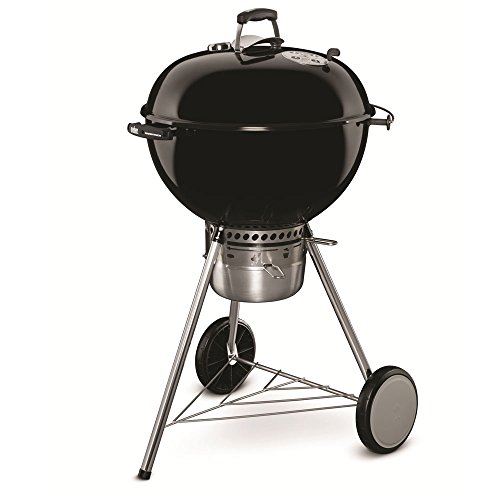
Weber Master-Touch Charcoal Grill, 22-Inch — Best Overall Under $500
With up to $500 to spend, the smartest single purchase remains a kettle — the best one. The Master-Touch adds the hinged insert grate, enclosed ash catcher and lid holder that fix the plain kettle’s few frictions, and it leaves room in the budget for a cover, a chimney, a probe thermometer and a season of charcoal. As a complete charcoal system bought in one decision, nothing in this guide beats it.
| Cooking surface | 22-inch hinged Gourmet BBQ System grate |
| Ash management | One-Touch cleaning with enclosed high-capacity ash catcher |
| Lid features | Tuck-Away lid holder, built-in thermometer |
| Extras | Warming rack, tool hooks, all-weather wheels |
Strengths
- Most complete kettle system, with budget left for tools and fuel
- Hinged insert grate expands the menu to griddle, wok and pizza
- Enclosed ash management suits long roasting and smoking sessions
Trade-offs
- Still a kettle: no insulation for extreme-weather marathon cooks
- No work table; pair it with a side table or cart
- Insert accessories are extra purchases, not included
Judged purely as a grill, the Master-Touch is the kettle perfected: the Gourmet BBQ System grate accepts a griddle, wok or pizza stone at its centre; the hinged sides feed a snake or a banked fire without disturbing food; the enclosed catcher keeps ash out of the fire’s air supply on long cooks. Judged as a budget decision, it is even stronger, because the under-$500 frame rewards buyers who resist spending the whole sum on hardware. The cooks who get the most from this tier own a complete system — grill, tools, cover, fuel — rather than a bare premium cooker and a drawer of improvised utensils. Longevity seals the case: enamel, parts support everywhere, and a design with no electronics to fail. Buy it if you want one grill that answers every normal request for a decade.
Best for: buyers who want best overall under $500 within an under-$500 budget / Not suited for: cooks whose needs point to a different format in this guide
Check on Amazon — check price on Amazon to confirm the live figure fits your under-$500 budget.

Char-Griller AKORN Kamado Charcoal Grill and Smoker, 20-Inch — Best Kamado Under $500
The under-$500 frame is exactly where the AKORN makes its famous argument: kamado cooking — the heat range, the fuel efficiency, the steady low-and-slow — without ceramic money. Its triple-wall insulated steel body holds smoking temperatures for hours on a small load of lump and still climbs to a fierce sear, and it does so at a weight and price a ceramic cooker cannot approach in this tier.
| Cooking surface | 20-inch cast iron grates in an insulated steel kamado body |
| Temperature range | Low smoking through high-heat searing via dual dampers |
| Construction | Triple-wall insulated steel, cart with folding shelves |
| Extras | Removable ash pan, warming rack, lid temperature gauge |
Strengths
- Full kamado heat range and fuel economy inside the budget
- Cast iron grates sear superbly and reward seasoning
- Light, mobile and far less fragile than ceramic
Trade-offs
- Steel body and seals age faster than a ceramic kamado
- Fit and finish trail premium brands
- Smaller grate than barrel picks for crowd cooking
The AKORN’s party trick is efficiency. Because so little heat escapes, cooks use noticeably less charcoal per session, and the grill recovers temperature quickly after the lid opens — a small mercy that matters across a long afternoon of tending. Cast iron grates are the second advantage: they store heat and lay down crust in a way plated steel cannot, and they suit the kamado’s high-heat work particularly well. The compromises are durability and finish: steel and seals age faster than ceramic, the latch and gaskets want occasional attention, and the cart is built to a price. None of this prevents the AKORN from being the best route in this guide to discovering whether kamado cooking is your thing — and for many owners it turns out to be the destination rather than the stepping stone, because the food never gives them a reason to spend more.
Best for: buyers who want best kamado under $500 within an under-$500 budget / Not suited for: cooks whose needs point to a different format in this guide
Check on Amazon — check price on Amazon to confirm the live figure fits your under-$500 budget.

Weber Performer Charcoal Grill, 22-Inch — Best for Convenience
The Performer spends the under-$500 budget on the thing frequent grillers actually run out of: workspace. Its kettle bowl is the proven 22-inch unit with enclosed ash management, but it sits in a cart with a proper table for trays, tools and resting meat, plus storage below for fuel and the chimney. If you grill three times a week, this is the pick whose value you feel every single session.
| Cooking surface | 22-inch hinged plated steel grate |
| Frame | Cart with large work table and lower storage |
| Ash management | One-Touch cleaning with enclosed ash catcher |
| Extras | Lid holder, built-in lid thermometer |
Strengths
- Work table transforms prep, cooking and resting workflow
- Proven kettle bowl with enclosed ash management
- Storage keeps fuel and tools at the grill
Trade-offs
- Largest footprint of the kettle picks
- Premium paid for furniture, not cooking capability
- Table surface needs regular cleaning discipline
Workflow is a cooking feature. With staging space at the grill, raw and cooked food stay separated, sauces and thermometers live within reach, and the frantic plate-juggling that causes dropped sausages and overcooked steaks quietly disappears. The bowl itself needs no defence: two-zone fires, lid-down roasting and snake-method smoking all work exactly as they do on the Master-Touch, with the same parts support behind them. The costs are footprint and price position — this is furniture-sized, and buyers who grill monthly will not recoup the table’s value. For the frequent cook with the patio space, though, the Performer is the under-$500 pick most likely to increase how often the grill gets lit, and a grill that gets lit is the only kind worth buying.
Best for: buyers who want best for convenience within an under-$500 budget / Not suited for: cooks whose needs point to a different format in this guide
Check on Amazon — check price on Amazon to confirm the live figure fits your under-$500 budget.

Char-Griller Barrel Pro Charcoal Grill, 785 Sq In — Best Large Barrel
When the cooking is measured in trays rather than portions, the Barrel Pro is the under-$500 answer: a full-size barrel chamber that swallows burgers for a party, long racks of ribs laid flat, or a mixed grill for a family gathering, with the direct, smoky character that only a barrel of burning charcoal produces.
| Cooking area | Large barrel chamber (785 sq in class per listing) |
| Format | Full-size barrel grill for batch cooking |
| Grates | Heavy cooking grates suited to large loads |
| Extras | Side shelf and storage, chimney stack, wheels |
Strengths
- Capacity for parties and batch cooking inside the budget
- Wide grate suits production-line mixed grilling
- Barrel character and smoke flavour gas cannot match
Trade-offs
- Oversized for small everyday cooks
- Heat distribution needs learning and food rotation
- Steel finish needs ongoing rust prevention
Barrels earn their fans honestly. The wide grate runs a genuine production line — sear zone at one end, holding zone at the other — and the chamber height gives whole chickens and beer-can birds room that a kettle makes awkward. For hosts, that geometry is worth more than any feature list. The discipline barrels demand is fire management across a wide space: expect a hotter centre and cooler edges until you learn your individual grill, and expect to rotate food as a matter of routine. Construction at this level is working steel rather than heirloom steel; keep it covered, keep the ash out, and touch up the firebox paint as it burns off, and it will serve seasons of gatherings. Buy it when headcount is your defining problem, and pair it eventually with a kettle for small weeknight cooks, when lighting the big barrel for two burgers feels like launching a ship.
Best for: buyers who want best large barrel within an under-$500 budget / Not suited for: cooks whose needs point to a different format in this guide
Check on Amazon — check price on Amazon to confirm the live figure fits your under-$500 budget.

Royal Gourmet CC1830V Barrel Charcoal Grill, 30-Inch — Best Value Barrel
The CC1830V is the value barrel: a 30-inch chamber with practical shelves and a working layout, priced to leave most of the under-$500 budget unspent for the cooks who would rather invest in fuel, tools and meat. It grills wide and sociably, and its adjustable charcoal arrangements on many trims give more heat control than bargain barrels usually offer.
| Cooking area | 30-inch barrel chamber (627 sq in class per listing) |
| Format | Barrel grill with front and side shelves |
| Grates | Porcelain-coated cooking grates |
| Extras | Adjustable charcoal pan on many trims, cool-touch handles, wheels |
Strengths
- Large barrel capacity at a value position in the tier
- Practical shelves and stable, usable layout
- Leaves budget room for tools, cover and fuel
Trade-offs
- Light steel needs cover and paint upkeep
- Manual heat control; no insulation for cold weather
- Assembly is a two-person, take-your-time job
Value barrels live or die on whether the basics are right, and here they are: the chamber is honestly sized, the grates are sensibly coated, the shelves land where hands want them, and the whole unit assembles into a stable, usable cooker. Heat management is manual — this is charcoal in its direct form — and the steel is light enough that wind and winter will test your vent discipline. Longevity follows the usual light-steel contract: covered, cleaned and touched up, it serves well for years; neglected, it will not. Within an under-$500 plan it plays a specific, intelligent role: the big-occasion grill bought alongside, or instead of, nothing else at all — the cooker that handles the summer party while the budget’s remainder funds the accessories that make every cook better.
Best for: buyers who want best value barrel within an under-$500 budget / Not suited for: cooks whose needs point to a different format in this guide
Check on Amazon — check price on Amazon to confirm the live figure fits your under-$500 budget.

Kamado Joe Joe Jr, 13.5-Inch Portable Ceramic Grill — Best Portable Ceramic
The Joe Jr is the connoisseur’s portable: a real ceramic kamado, small enough to travel, that sears a pair of steaks at fierce heat and then holds a low, steady smoke for a small shoulder better than full-size steel grills costing the same. For one or two people — at home on a small terrace or at a campsite — it is not a compromise; it is the best-cooking small grill in this guide.
| Cooking surface | 13.5-inch ceramic kamado with cast iron grate |
| Construction | High-fire ceramic body in a cast iron stand |
| Format | Portable kamado for camping, tailgating and small households |
| Extras | Heat deflector included for indirect cooking, ash tool |
Strengths
- True ceramic kamado performance in a portable size
- Sears fiercely and smokes steadily on little fuel
- Heat deflector enables real indirect cooking on the road
Trade-offs
- Capacity is two people, no more
- Heavy for its size and ceramic needs careful transport
- Premium price per inch of grate
Ceramic at this size is a delight because the physics scale down gracefully: the little dome heat-soaks quickly, sips lump charcoal, and holds its temperature with the authority of its big brothers. The included heat deflector makes genuine indirect cooking possible in a portable format, which almost nothing else that travels can claim. The limits are obvious and absolute — capacity for two, real weight despite the size, and ceramic’s need for careful handling in transit. It is also, frankly, an enthusiast’s object: nobody needs a ceramic portable, which is precisely why those who buy one tend to adore it. As an under-$500 purchase it suits the small household that cooks seriously, the camper who refuses to eat badly outdoors, and the kamado owner who wants the same craft in miniature for weeknights.
Best for: buyers who want best portable ceramic within an under-$500 budget / Not suited for: cooks whose needs point to a different format in this guide
Check on Amazon — check price on Amazon to confirm the live figure fits your under-$500 budget.
Comparison Table
| Pick | Badge | Key spec | Best for |
|---|---|---|---|
| Weber Master-Touch Charcoal Grill, 22-Inch | Best Overall Under $500 | 22-inch hinged Gourmet BBQ System grate | Best Overall Under $500 buyers |
| Char-Griller AKORN Kamado Charcoal Grill and Smoker, 20-Inch | Best Kamado Under $500 | 20-inch cast iron grates in an insulated steel kamado body | Best Kamado Under $500 buyers |
| Weber Performer Charcoal Grill, 22-Inch | Best for Convenience | 22-inch hinged plated steel grate | Best for Convenience buyers |
| Char-Griller Barrel Pro Charcoal Grill, 785 Sq In | Best Large Barrel | Large barrel chamber (785 sq in class per listing) | Best Large Barrel buyers |
| Royal Gourmet CC1830V Barrel Charcoal Grill, 30-Inch | Best Value Barrel | 30-inch barrel chamber (627 sq in class per listing) | Best Value Barrel buyers |
| Kamado Joe Joe Jr, 13.5-Inch Portable Ceramic Grill | Best Portable Ceramic | 13.5-inch ceramic kamado with cast iron grate | Best Portable Ceramic buyers |
Notice what the table really shows: three philosophies. Spend on the system (Master-Touch, Performer), spend on the format (AKORN, Joe Jr), or spend on capacity (the two barrels). The right philosophy is the one that matches your cooking diary, which the next section works through.
How to Choose a Charcoal Grill With an Under-$500 Budget
Begin with the discipline this tier demands: decide the format before the model. Kettle, kamado, barrel and portable-ceramic are different answers to different lives, and $500 spent across the wrong format is worse than $200 spent on the right one. Use your last twenty cooks as the evidence. Mostly mixed family grilling points to the kettles. A smoking habit, or the desire for one, points to the kamado. Regular crowds point to the barrels. Serious cooking for two, at home or away, points to the Joe Jr.
Should you spend the whole budget on the grill?
Usually, no. The complete-system principle from our under-$200 guide applies with even more force here: a Master-Touch with a cover, chimney, probe thermometer and a season of quality charcoal will out-cook and out-last a bare premium cooker at the top of the frame with none of those things. Reserve a sensible portion of the $500 for the system, and let the grill be the best one the remainder buys well.
Kamado in steel or save for ceramic?
The AKORN delivers the kamado method now, inside the budget, with lighter weight and no fragility. Full ceramic delivers greater longevity, steadier extreme-weather performance and a heavier accessory ecosystem, at a position above this tier. The honest answer depends on horizon: cooks who expect to upgrade within a few years should buy the AKORN and enjoy it; cooks buying a twenty-year cooker should save past this tier rather than compromise inside it — and this guide would rather tell you that than sell you the wrong grill.
How much capacity is enough?
Count your biggest regular cook, not your biggest imaginable one. A 22-inch kettle handles six eaters with two-zone technique; the barrels handle a party; the Joe Jr handles two beautifully and four not at all. Oversizing is the tier’s most common error, because capacity costs fuel and heat-up time on every small cook for the sake of one large one.
What about warranty and support at this tier?
Support separates the serious makers from the catalogue brands, and at under $500 it deserves a line in the budget decision. The established names in this guide publish parts lists, honour warranties through real channels and keep designs stable enough that a grate bought in year eight fits the grill bought in year one. That stability is worth money, because the alternative — a discontinued no-name model with a failed damper — converts a mid-tier purchase into a replacement purchase. Before ordering, spend two minutes on the manufacturer’s site confirming that your model’s grates, dampers and ash parts are listed as available spares. If they are not, treat the grill as a shorter-lived purchase and judge its price accordingly. The picks in this guide passed that check at verification; it is one of the reasons they are the picks.
Gas, pellet or charcoal at this budget — a fair word for the alternatives
Honesty requires acknowledging the competition. At under $500, gas buys push-button convenience and easy weeknight speed, and gives up smoke flavour and maximum searing heat. Pellets buy set-and-forget smoking with mild flavour and an appetite for electricity and proprietary fuel. Charcoal buys the fullest flavour, the fiercest heat and the widest technique range, and charges you twenty minutes and some attention for it. Households that grill on weeknights against the clock often land on gas and are right to; households that cook for the pleasure of cooking land here, in this guide, and are equally right. Choose by your evenings, not by anyone’s ideology — including ours.
How does this tier handle winter and bad-weather cooking?
Weather is where mid-tier construction earns its money quietly. Wind strips heat from thin, leaky grills and makes a mockery of vent settings; the sealed lids, enclosed ash systems and sheer mass of this tier’s picks hold a working temperature in conditions that would shut a bargain grill down. Cold lengthens every timeline — allow a third more fuel and a longer preheat in winter, and prefer briquettes for their steady burn when the air is bitter. Kamados, steel or ceramic, are the winter champions because insulation defeats ambient temperature almost entirely; a January smoke on an AKORN or a Joe Jr is a pleasure rather than an endurance test. Kettles manage well with a windbreak and patience. Barrels suffer most and should be sited thoughtfully, out of the prevailing wind, with their stacks working as designed. Whatever the format, keep the charcoal indoors and bone dry: damp fuel in cold weather is the single most common cause of the fires that “just won’t light” in winter, and it is a storage failure, not a grill failure.
What should you check in the first week of ownership?
Unbox like an inspector. Confirm every part against the manual before assembly, because a missing damper screw discovered mid-build on a Saturday is a small tragedy. Check enamel and ceramic for transit chips, test that lids seat evenly all the way round, and run the first empty burn before food is involved — it cures factory coatings, reveals assembly errors and teaches you the damper responses in safety. Register the warranty while the receipt is still findable, photograph the model plate and the serial label with your phone, save the manual somewhere you will actually look for it, and order the fitted cover immediately if you did not bundle it with the grill itself. These unglamorous steps, taken in week one, are why some owners report a decade of trouble-free cooking while others review their grill angrily in month three.
Two grills or one? How experienced owners actually spend $500
Ask owners a few seasons in — the ones whose grills still look loved rather than abandoned at the fence line — and a pattern emerges that no product page will ever tell you: many of the happiest under-$500 setups are pairs. A kettle for everyday cooking plus a small smoker, or a barrel for parties plus a portable for weeknights, covers more real life than any single cooker at the same total spend. The logic is the logic of this whole guide — formats are specialists wearing generalist clothing, and two honest specialists beat one compromised all-rounder whenever the cooking diary genuinely splits in two directions. The pairs that work share a trait: each grill is a complete, quality example of its format, not two half-budget compromises. A plain kettle plus a value offset, both from this series of guides, is the classic sub-$500 pairing for the household that grills weekly and smokes monthly. A kettle plus a portable covers the home-and-away household. If your diary does not split, buy the single best format and ignore this section with a clear conscience — but if it does, spend the tier across two grills and enjoy being right twice.
How to Run an Under-$500 Charcoal Grill Like You Mean It
Step 1: Season and learn the grill empty. Run one hot, empty burn to cure coatings and learn how the dampers respond. Note where the hot spots are; every grill has them, and knowing yours is free performance.
Step 2: Standardise your fire. Pick one fuel and one chimney measure for your standard cook, and change one variable at a time as you learn. Consistency is how a new grill becomes a known instrument within a month.
Step 3: Cook two-zone by default. Bank the coals, sear over them, finish in the cool zone, rest on the warm side. This single layout handles ninety percent of charcoal cooking and rescues the other ten percent.
Step 4: Use the format’s strength weekly. Kamado owners should smoke something monthly to justify the insulation; barrel owners should batch-cook and freeze; kettle owners should roast whole birds, the format’s party trick. A grill used to its strength stays loved.
Step 5: Maintain on a rhythm. Ash out when cold, grate brushed hot, cover on between cooks, seals and fasteners checked each season. At this tier the hardware rewards rhythm with a decade of service.
Common Buying Mistakes
Spending the whole $500 on hardware. A bare premium grill with no cover, chimney or thermometer is a worse purchase than a complete mid-tier system. Budget the system, not the object.
Buying capacity for imaginary parties. The once-a-year crowd can be fed in batches from a kettle. The weekly family cannot be fed efficiently from a barrel built for thirty.
Treating steel kamados as ceramic. The AKORN is excellent and it is steel: it needs a cover and seal care that ceramic does not. Buy it with its real maintenance contract in mind.
Ignoring total footprint. Cart grills and barrels are furniture. Measure the patio, the storage and the path between them before the grill arrives, not after.
Chasing a promotion across tiers. A discounted grill from the wrong format is not a bargain. Let your cooking diary, not a price drop, choose the format — and check price on Amazon for the model you actually decided on.
Final Recommendation
For most households, buy the Weber Master-Touch Charcoal Grill, 22-Inch and the system around it. Kamado-curious cooks should take the Char-Griller AKORN Kamado Charcoal Grill and Smoker, 20-Inch, frequent grillers with space the Weber Performer Charcoal Grill, 22-Inch, and hosts the barrel that fits their crowd — the Char-Griller Barrel Pro for capacity, the Royal Gourmet CC1830V for value. Serious cooks for two should seriously consider the Kamado Joe Joe Jr.
Set this tier against its neighbours: Best Charcoal Barbecue Grills · Best Charcoal Bbq Grills · Best Charcoal Bbq Grills Under $200 · Best Kamado Grills · Best Barrel Charcoal Grills
What Does the Under-$500 Tier Cook That Cheaper Grills Struggle With?
Three categories justify the step up, and they are worth naming precisely. The first is duration: insulated and well-sealed cookers hold a smoking temperature through a long afternoon without the constant tending a thin grill demands, which turns ribs and shoulders from a project into a plan. The second is weather: wind and cold punish exposed, thin-walled fires, and the mass and sealing in this tier buy back winter evenings that cheaper grills surrender. The third is simultaneity — the mixed cook. A cart kettle with a table, a barrel with zones, a kamado with two levels: each lets you sear, roast and hold at once, which is the difference between everything arriving hot together and the cook eating last and cold.
Equally important is what the tier does not unlock. It does not unlock different flavour — charcoal is charcoal — and it does not unlock skill. A cook who has not learned two-zone fire management will struggle on a $500 grill exactly as on a $150 one, only with more expensive frustration. That is why this guide keeps recommending the system over the object: the tier rewards technique with consistency, and consistency, repeated weekly, is what great home barbecue actually is.
How Should You Plan the Total Cost of Ownership?
Run the five-year numbers before choosing, because the formats diverge after purchase. Kettles are the cheapest ownership in grilling: modest fuel use, inexpensive grates, no seals or electronics, and parts priced like hardware-store items. Steel kamados add gasket and latch care and reward a cover, but repay with the lowest fuel consumption per cook of any format here. Barrels burn the most charcoal per session — big chambers are thirsty — and need paint and rust attention as a budgeted routine. The ceramic portable uses little fuel and asks only for careful handling and the occasional gasket.
Accessories follow the same pattern: budget for the deflector, the insert or the gasket kit your format wants in year one, rather than discovering the omission mid-cook. None of these costs is large, and all of them are predictable — which is the real definition of a good tier. Under $500, bought with open eyes, there are no expensive surprises left in charcoal cooking; there is only the food, which is rather the point.
Which Pick Suits Which Cook? A Plain-Language Match
The methodical home cook, who grills twice a week and roasts on Sundays, belongs on the Master-Touch and will never think about grills again. The tinkerer, who reads about brisket at midnight and wants one cooker that does everything, belongs on the AKORN. The host, whose garden fills monthly, belongs on a barrel — the Barrel Pro if the crowds are real, the Royal Gourmet if they are occasional. The entertainer-cook, who preps like a professional and hates juggling trays, belongs on the Performer. And the perfectionist pair, cooking serious food for two at home and away, belongs on the Joe Jr, the smallest grill here and in some ways the finest. If none of those descriptions fits, the Master-Touch is the default for a reason: it is the pick whose strengths are the most universal and whose weaknesses matter to the fewest people.
How Do You Get the Most From the Grill You Chose?
The first month decides the next decade, because habits form fast around a new grill. Keep a simple log for the first ten cooks — fuel amount, vent settings, weather, result — and the grill’s personality becomes predictable data instead of folklore. Learn its hot spot by toasting bread slices across the grate once; that thirty-second experiment improves every cook afterwards. Establish the cleaning rhythm while the grill is new and the motivation is high: ash out, grate brushed, cover on, in that order, every time, until it is automatic.
Then cook the format’s signature dishes early, while enthusiasm is funded. Kettle owners should roast a whole chicken in week one and smoke ribs by week four. Kamado owners should run one long low cook and one fierce sear in the first fortnight to feel the range they bought. Barrel owners should host once, modestly, and learn the chamber’s zones with forgiving food. Portable-ceramic owners should take the little kamado somewhere — a beach, a site, a friend’s garden — because a portable that stays home is a small grill, while a portable that travels becomes a tradition. The under-$500 tier is full of excellent hardware; the cooks who love theirs are simply the ones who used them hard in the first month and never stopped.
Frequently Asked Questions
Is it worth spending up to $500 on a charcoal grill?
Yes, if the money buys format or workflow you will use weekly: kamado insulation, a work-table cart, or genuine crowd capacity. It is not worth it for badges and gadgets. The tier’s best value is a complete system — grill, tools, cover, fuel — rather than the single most expensive cooker.
Steel kamado or ceramic kamado — what is the real difference?
Ceramic holds heat longer, shrugs off weather and decades, and costs more everywhere it appears. Insulated steel delivers the same cooking method with lighter weight and lower cost, and asks for cover discipline and seal maintenance in exchange. Food from the two is far closer than the price gap suggests.
Can one grill under $500 both grill and smoke well?
Yes — the kettles smoke respectably by the snake method and the AKORN smokes genuinely well, while both grill excellently. What no single grill at any price does is match a dedicated offset for traditional high-volume smoking; that remains a second-cooker purchase.
How long should an under-$500 charcoal grill last?
Enamelled kettles: a decade or more with ash discipline. Steel kamados and barrels: many seasons with covers and touch-ups. Ceramic: effectively indefinite with careful handling. At this tier, lifespan is bought as much by the owner’s routine as by the purchase.
What is the best first upgrade after buying in this tier?
A probe thermometer with a grate clip, if you do not own one — it converts guesswork into repeatability on every format in this guide. After that, format-specific: a heat deflector for kamado smoking, gasket tape for barrels, a griddle insert for kettle owners who cook breakfast outdoors.
Why does this guide not print the prices?
Because grill prices move with seasons, promotions and stock, and a printed figure would mislead within weeks. The picks are positioned by their normal tier; check price on Amazon at the moment of purchase to confirm the live figure fits your under-$500 budget.
Should I buy an extended warranty or protection plan?
For charcoal grills, generally no. There are no electronics to fail expensively, the wear parts are cheap and user-replaceable, and the manufacturers in this guide support their products with real parts channels. The money a protection plan costs is better spent on the cover and the spare grate that actually extend the grill’s life. The exception is a ceramic kamado bought above this tier, where a cracked dome is a genuinely expensive event and the manufacturer’s own warranty terms deserve a careful read before purchase.
When is the best time of year to buy a charcoal grill?
Grills are seasonal products, and the honest answer is that the strongest value usually appears at the ends of the season — late summer clearances and early spring promotions — while peak season rewards buyers with stock rather than savings. Because this guide prints no prices and positions picks by their normal tier, the practical advice is simple: decide the model from your cooking diary first, then check price on Amazon across a few weeks if your purchase is not urgent, and buy the moment the live figure fits the budget you set. A grill bought in time for the season you will actually cook in is worth more than a marginally cheaper one that arrives after it.


