Disclosure: airfryerkitchensupply.com is reader-supported. When you buy through links on our site, we may earn an affiliate commission at no extra cost to you.
Where to buy
For anyone comparing the best charcoal and wood smokers, this shortlist is the place to start: every model below earned its place on the criteria set out in this guide, and every linked model was verified before its link was attached.
Charcoal-and-wood smokers are sold through Amazon, big-box outdoor stores and specialist barbecue dealers, and the same model often appears in several configurations. Buy the configuration named in each review below, confirm whether a cover, extra grate or hanging kit is actually included, and factor freight into any offset purchase, because a heavy steel pit costs real money to move.
- Weber Smokey Mountain Cooker 22-inch — check price on Amazon; choose the listing sold or shipped by Amazon or the brand’s own store, and confirm the exact model name before you order.
- Oklahoma Joe’s Highland Offset Smoker — check price on Amazon; choose the listing sold or shipped by Amazon or the brand’s own store, and confirm the exact model name before you order.
- Masterbuilt Gravity Series 600 — check price on Amazon; choose the listing sold or shipped by Amazon or the brand’s own store, and confirm the exact model name before you order.
- Dyna-Glo Wide Body Vertical Offset Charcoal Smoker DGO1890BDC-D — check price on Amazon; choose the listing sold or shipped by Amazon or the brand’s own store, and confirm the exact model name before you order.
- Weber Smokey Mountain Cooker 18-inch — check price on Amazon; choose the listing sold or shipped by Amazon or the brand’s own store, and confirm the exact model name before you order.
- Cuisinart 18-inch Vertical Charcoal Smoker COS-118 — check price on Amazon; choose the listing sold or shipped by Amazon or the brand’s own store, and confirm the exact model name before you order.
The best charcoal and wood smokers share one defining trait: the fire you build is the flavour. If you are shopping for the best charcoal and wood smokers, you are not really buying a cabinet or a barrel — you are buying a fire-management system, a particular way of turning lump charcoal and hardwood splits into steady heat and clean smoke over six, ten or fourteen hours. Every pick in this guide burns charcoal, wood, or both, and every pick was chosen because its fire system teaches you something true about that craft rather than hiding it from you.
That honesty matters because this category splits into four genuinely different schools. Bullet smokers like the Weber Smokey Mountain burn a charcoal bed under a water pan and reward patience with remarkable stability. Offset smokers run a live wood fire in a side firebox and reward attention with the deepest smoke flavour in home barbecue — and punish neglect just as honestly. Drum smokers split the difference, burning charcoal in a sealed barrel with tight airflow control. Gravity-fed charcoal smokers automate the charcoal side while still letting wood chunks ride along in the hopper and ash pan. None of these is objectively best; each is best for a different cook.
What this guide will not do is pretend a cheap thin-steel offset cooks like a heavy one, or that a bullet smoker produces the same bark as a live-fire offset. Where a design has a real ceiling, the review says so. Prices are not printed here because they move constantly; use the check-price links, judge each model against the tier described in its review, and spend first on steel thickness, grate space and airflow control — the three things you cannot upgrade later.
In this guide
Quick Picks
Six charcoal-and-wood smokers, six different fires. Start with the bullet if you want stability, the offset if you want the craft, and the gravity-fed model if you want charcoal flavour without the overnight alarm clock.
- Best Overall — Weber Smokey Mountain Cooker 22-inch: The bullet by which all others are judged: a charcoal bed, a water pan and two big grates that hold a steady smoking temperature for the length of a brisket cook with almost no intervention once the vents are set.
- Best for Live Wood Fire — Oklahoma Joe’s Highland Offset Smoker: The accessible entry into true offset cooking: a horizontal barrel, a side firebox sized for splits, and 900 square inches of grate that teach real fire management at a home-cook scale.
- Best Automated Charcoal — Masterbuilt Gravity Series 600: Charcoal flavour with a thermostat: a gravity-fed hopper feeds a fan-controlled fire, wood chunks can ride in the hopper or ash pan, and the controller holds your set temperature like an oven.
- Best Vertical Capacity — Dyna-Glo Wide Body Vertical Offset Charcoal Smoker DGO1890BDC-D: A tall, wide cabinet fed by an offset charcoal box: shelf after shelf of hanging and flat space for sausage, ribs and whole birds, at a scale horizontal barrels cannot match for footprint.
- Best for Small Households — Weber Smokey Mountain Cooker 18-inch: The same water-pan bullet design in the size most couples and small families actually need: a brisket flat or a pair of shoulders, on noticeably less charcoal per cook.
- Best Budget Bullet — Cuisinart 18-inch Vertical Charcoal Smoker COS-118: The entry ticket to vertical charcoal smoking: an 18-inch two-grate bullet with water bowl and dual vents that teaches the fundamentals for the price of a few bags of charcoal a month.
How These Picks Were Chosen
Picks were chosen first on fire architecture: each of the four schools — bullet, offset, drum-adjacent vertical offset, and gravity-fed charcoal — is represented by the strongest widely available example we could verify, so the comparison teaches the category rather than repeating one design six times. Every linked model was cross-checked against the site’the Amazon catalogue: the Amazon title had to match the exact model named in the review before any Amazon link was attached.
Within each school, the deciding criteria were steel quality and sealing, usable grate area measured against the foods this audience actually cooks, airflow control fine enough to hold a narrow band for hours, and a parts ecosystem — replacement grates, gaskets, covers and dampers — that keeps the cooker alive for a decade. Models with known safety recalls were excluded outright, and thin novelty smokers that cannot hold temperature in a light wind never made the shortlist.
A note on wood: every pick here burns charcoal as its heat backbone and wood as flavour, except the offsets, which can run wood splits as the primary fuel once a coal bed is established. That distinction — charcoal-led versus wood-led fire — is the single most useful idea in this guide, and the buying-guide sections below return to it from several angles.
The 6 Best Charcoal and Wood Smokers, Reviewed in Detail

Weber Smokey Mountain Cooker 22-inch — Best Overall
The 22-inch Smokey Mountain is the charcoal smoker most home cooks should buy first, and the one many never need to replace. Its design is almost aggressively simple: a charcoal ring at the base, a large water pan above it acting as heat sink and humidity source, and two cooking grates stacked in a porcelain-enameled bullet body. There is nothing to plug in, nothing to update and nothing to break that a replacement part cannot fix in minutes.
What that simplicity buys is stability. Once the charcoal is lit with a minion-style arrangement — unlit coals in the ring, a small number of lit coals on top — the cooker settles into its band and stays there, the water pan absorbing the spikes that make cheaper smokers yo-yo. Two full packer briskets, four pork shoulders or a serious rack load fit across the two grates, which is why this size, not the smaller ones, anchors the guide.
Strengths
- Exceptional temperature stability from the water-pan heat sink
- Two large grates handle briskets and multiple shoulders at once
- Porcelain-enameled body and deep spare-parts support promise a very long service life
Trade-offs
- Accessing the lower grate means lifting the upper grate and food off mid-cook
- The stock door seals loosely until it is adjusted or gasketed
- No electronics: overnight cooks rely on fuel load and vent craft, not an app
| Specification | Detail |
|---|---|
| Format | Vertical bullet smoker |
| Cooking grates | Two, stacked |
| Body | Porcelain-enameled steel |
| Heat source | Charcoal bed with water pan |
| Fuel access | Side door for charcoal and water |
Run it on lump charcoal with three or four hardwood chunks buried in the ring and you get the classic bullet profile: gentle, even smoke, mahogany bark, and meat that cooks in a humid environment that forgives small timing errors. It is the easiest charcoal smoker in this guide to learn on precisely because the water pan narrows the consequences of a vent adjustment made too late or too large.
Its ceiling is equally clear. This is a charcoal-led fire; you will not get the assertive, live-fire bark of an offset burning post-oak splits, and searing requires a separate grill or a grate moved down over the coals. Buy it as a smoking instrument, not a do-everything cooker, and it is close to perfect at its job.
Best for: Most home cooks who want stable, charcoal-led smoking for brisket, shoulders and ribs with minimal fuss / Not suited for: Cooks chasing live wood-fire flavour above all else, or anyone who wants push-button overnight automation
Check on Amazon — check price on Amazon and confirm the current configuration, since bundles and included accessories change between listings.

Oklahoma Joe’s Highland Offset Smoker — Best for Live Wood Fire
If the flavour you are chasing is the one from a wood-fired pit — deep bark, clean blue smoke, that unmistakable post-oak or hickory signature — the Highland is where that education starts without a fabricator’s price or a two-year waiting list. It is a traditional offset: fire in the side box, heat and smoke drawn across the cooking chamber by the stack, food never sitting over direct flame.
The 900 square inches of cooking area the maker lists is honest working space: a brisket and two racks, or three shoulders with room for the air to move, which matters more in an offset than raw area because crowded meat steams instead of barking. The firebox takes small splits over a coal bed, and the whole cooker is sized so a home cook can run it on a Saturday without a woodpile the size of a shed.
Strengths
- True offset airflow delivers genuine live-fire smoke flavour
- Firebox sized for small wood splits over a charcoal bed
- Generous grate area with room for smoke to circulate around the food
Trade-offs
- Demands active fire tending roughly every half hour to forty-five minutes
- Factory sealing is imperfect; most owners add gasket and latch mods
- Temperature varies across the chamber — hotter near the firebox — and must be managed, not ignored
| Specification | Detail |
|---|---|
| Format | Horizontal offset smoker |
| Cooking area | 900 sq. in. (Amazon title) |
| Firebox | Side firebox for charcoal and wood splits |
| Fuel | Charcoal bed plus hardwood splits |
| Extras | Functions as a charcoal grill over the firebox grate |
Judge an offset by its fire, not its silhouette. The Highland’s firebox door and intake give you the two controls that matter — air in, and the stack damper for draw — and with a coal bed established first, small splits added one at a time keep the smoke thin and blue rather than white and bitter. That discipline is the entire craft, and this cooker teaches it faithfully.
Set expectations correctly: this is a moderate-gauge production offset, not a quarter-inch custom pit. It loses heat faster, swings more in wind and rewards the owner who parks it out of the breeze and plans a slightly larger fire. Within those honest limits it produces brisket that no bullet or pellet cooker quite replicates, which is why it earns its place here.
Best for: Aspiring pitmasters who want to learn live wood-fire cooking on a real offset / Not suited for: Anyone who wants to light a fire and walk away for six hours
Check on Amazon — check price on Amazon and confirm the current configuration, since bundles and included accessories change between listings.

Masterbuilt Gravity Series 600 — Best Automated Charcoal
The Gravity Series 600 answers the question offset owners ask at 3 a.m.: can charcoal flavour survive automation? Its hopper holds a tall column of charcoal that feeds down onto a small fire by gravity; a digital controller spins a fan to hold the set temperature, and the fire simply consumes the column over many hours. Mix wood chunks through the hopper or drop them into the ash pan, where falling embers kiss them into smoke.
The result is a genuinely charcoal-led flavour profile — noticeably deeper than pellet smoke to most palates — with a workload closer to an electric smoker. The 600’s cooking area suits a family brisket, a pair of chickens or several racks of ribs, and because the same firebox can run hot, it doubles as a charcoal grill for weeknight cooking in a way a dedicated bullet never will.
Strengths
- Set-and-hold temperature control on a real charcoal fire
- Wood chunks in the hopper or ash pan layer genuine wood smoke over the charcoal base
- Doubles as a hot charcoal grill, widening its weekly usefulness
Trade-offs
- Electronics, fan and controller are failure points a pure charcoal cooker does not have
- Needs mains power at the cooker, which limits placement
- Hopper fires demand dry charcoal storage; damp fuel undermines the whole system
| Specification | Detail |
|---|---|
| Format | Gravity-fed digital charcoal grill and smoker |
| Cooking area | 600 sq. in. (Amazon title) |
| Fuel system | GravityFed charcoal hopper |
| Control | Digital controller with WiFi technology |
| Model | MB20041023 |
The honest comparison is against pellet grills, and it favours charcoal: the Gravity fire burns lump or briquettes at real combustion temperatures with wood chunks contributing actual split-wood aromatics, while the controller removes the one chore — vent management — that stops many cooks smoking more often. A cooker that gets used every weekend beats a purist pit that comes out twice a year.
Keep the hopper lid and ash door seals clean, because the whole system depends on controlled airflow; ash paste and grease are the enemies of its precision. Treated as an appliance and maintained like one, it is the most practical route in this guide to frequent, flavourful charcoal smoking.
Best for: Busy cooks who want real charcoal-and-wood flavour with oven-like temperature holding / Not suited for: Off-grid cooks, purists who want to tend a live fire, or anyone without power at the cooking spot
Check on Amazon — check price on Amazon and confirm the current configuration, since bundles and included accessories change between listings.
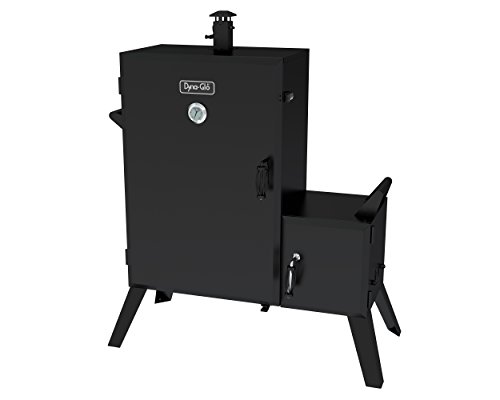
Dyna-Glo Wide Body Vertical Offset Charcoal Smoker DGO1890BDC-D — Best Vertical Capacity
Vertical smokers use gravity and rising heat the way nature intended, and the Dyna-Glo Wide Body is the value end of that idea executed at useful scale. The offset firebox sits low and to the side, feeding heat and smoke into a tall cabinet with multiple shelves; the wide body, rather than the narrow columns of cheaper verticals, means briskets and full racks lie flat instead of being cut or curled.
This is the shape competition sausage makers and jerky producers favour, because product can hang from the top while pans and racks fill the shelves below, all in the footprint of a small filing cabinet. Charcoal is the working fuel, with wood chunks layered through the burn for flavour, and the offset box keeps the fire serviceable without opening the cabinet and dumping your heat.
Strengths
- Tall wide cabinet fits full racks and hanging product in a small footprint
- Offset firebox lets you tend charcoal and wood without opening the cooking chamber
- Multiple shelves suit mixed loads — sausage, jerky, ribs and birds together
Trade-offs
- Vertical heat gradient is real: top shelves run hotter and loads benefit from rotation
- Light-gauge construction needs shelter from wind to hold a narrow band
- Assembly and door sealing deserve care and, ideally, a gasket upgrade from day one
| Specification | Detail |
|---|---|
| Format | Vertical offset charcoal smoker |
| Model | DGO1890BDC-D |
| Firebox | Offset, charcoal with wood chunks |
| Layout | Multiple shelves in a wide-body cabinet |
| Best loads | Sausage, jerky, ribs, poultry |
The vertical offset is the thinking cook’s budget format: it separates fire from food like a true offset, stacks capacity like a cabinet, and costs like a starter cooker because the steel is folded, not rolled plate. Its weakness is thermal — thin walls shed heat — so site it in a sheltered corner, consider a welding-blanket wrap in cold weather, and let the fire run slightly larger rather than starving it into dirty smoke.
For cooks whose smoking is as much about charcuterie, fish and jerky as about brisket, this cabinet shape is simply the right tool, and the Wide Body is its most accessible verified example.
Best for: Sausage, jerky and mixed-load cooks who need tall cabinet capacity on a budget / Not suited for: Cooks who mainly smoke one large brisket at a time and want horizontal offset bark
Check on Amazon — check price on Amazon and confirm the current configuration, since bundles and included accessories change between listings.
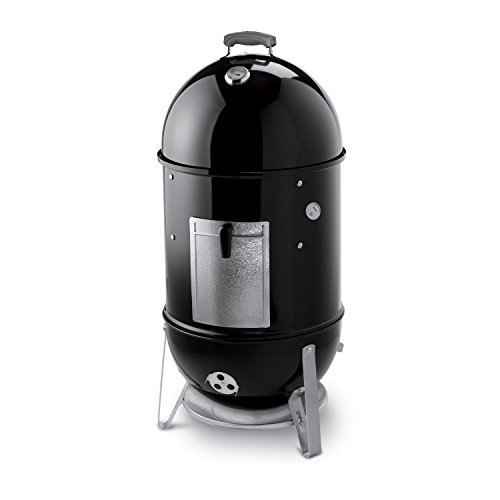
Weber Smokey Mountain Cooker 18-inch — Best for Small Households
Everything true of the 22-inch bullet is true here, scaled to the household that smokes a shoulder and two racks rather than a banquet. The 18-inch Smokey Mountain keeps the two-grate layout, the water pan and the porcelain-enameled body, but burns a smaller charcoal load to do it — which, across a season of weekend cooks, is a real saving in fuel and in the patience needed to bring the cooker up to temperature.
Its limits are geometric, not qualitative. A full packer brisket must be draped over a rib rack or a wood chunk until it shrinks enough to lie flat, and four racks of ribs need a rack stand to stand upright. Cooks who mostly smoke for two to six people will never feel those limits; cooks feeding a crowd monthly should step up to the 22.
Strengths
- Same stability and build quality as the 22-inch in a thriftier size
- Smaller charcoal loads mean cheaper, quicker cooks for small households
- Deep accessory and parts ecosystem shared with the whole Smokey Mountain line
Trade-offs
- Full packer briskets need draping or trimming tricks to fit
- Rib capacity depends on stands and vertical arrangement
- Same loose-fitting stock door as its bigger sibling
| Specification | Detail |
|---|---|
| Format | Vertical bullet smoker |
| Cooking grates | Two, stacked |
| Body | Porcelain-enameled steel |
| Heat source | Charcoal bed with water pan |
| Best loads | Shoulders, chickens, ribs, brisket flats |
There is a strong argument that the 18 is the rational default and the 22 the specialist: most home smoking is a single shoulder, a couple of chickens or a few racks, and the smaller bullet does all of it while sipping charcoal. Its resale market is also the strongest in the category, so a cook who outgrows it rarely loses much moving up.
Pair it with a rib rack and a second thermometer probe and it covers the realistic menu of a small household completely. It earns the small-household badge not by being a compromise, but by being the right size of an excellent thing.
Best for: Couples and small families who smoke one or two cuts at a time / Not suited for: Regular crowd-feeders who need two full briskets lying flat at once
Check on Amazon — check price on Amazon and confirm the current configuration, since bundles and included accessories change between listings.

Cuisinart 18-inch Vertical Charcoal Smoker COS-118 — Best Budget Bullet
The Cuisinart COS-118 exists to answer a fair question: is bullet smoking for me? It reproduces the essential architecture — charcoal base, water bowl, two chrome-plated grates, dual vents for intake control and an integrated lid thermometer — in a lightweight 18-inch package aimed at beginners, campers and tailgaters as much as patio cooks.
Judged as a teaching tool, it succeeds. The vents respond predictably, the water bowl stabilises the small fire, and a learner can produce genuinely good pulled pork and chicken while discovering whether they enjoy the ritual of charcoal. Judged as a lifetime cooker, it is thinner, lighter and less precisely fitted than the Weber bullets, and it will ask more attention from its operator in wind or cold.
Strengths
- Lowest-cost route into true vertical charcoal smoking with a water bowl
- Light enough for camping and tailgate duty the heavy bullets resent
- Dual vents and integrated thermometer cover the real controls a beginner must learn
Trade-offs
- Thinner steel and looser fit mean wider temperature swings in poor weather
- Chrome-plated grates need gentler care than porcelain-enameled or stainless alternatives
- Capacity suits learning cooks, not crowd cooking
| Specification | Detail |
|---|---|
| Format | Vertical charcoal smoker |
| Model | COS-118 |
| Grates | Chrome-plated cooking grates |
| Features | Integrated thermometer, water bowl, dual vents |
| Positioning | Budget tier |
The right way to buy this smoker is with open eyes: it is a first smoker, a travel smoker or a second smoker for the lake house, and at those jobs its lightness and price are virtues. Seal the joints with a gasket kit if you keep it long-term, shield it from wind, and it will smoke far above its station.
What it should not be is a false economy for a cook who already knows they love charcoal smoking; that cook will buy the Weber within a year and own both. For everyone still deciding, the COS-118 is the honest, inexpensive way to find out.
Best for: Beginners, campers and tailgaters who want to learn bullet smoking cheaply / Not suited for: Committed cooks in cold, windy climates who need set-and-forget stability
Check on Amazon — check price on Amazon and confirm the current configuration, since bundles and included accessories change between listings.
Comparison Table
| Pick | Badge | Key spec | Best for |
|---|---|---|---|
| Weber Smokey Mountain Cooker 22-inch | Best Overall | 22-inch bullet, dual cooking grates, porcelain-enameled steel | Most home cooks who want stable, charcoal-led smoking for brisket, shoulders and ribs with minimal fuss |
| Oklahoma Joe’s Highland Offset Smoker | Best for Live Wood Fire | Offset smoker, 900 sq. in. cooking area, side firebox | Aspiring pitmasters who want to learn live wood-fire cooking on a real offset |
| Masterbuilt Gravity Series 600 | Best Automated Charcoal | Gravity-fed charcoal hopper, digital fan control, 600 sq. in. | Busy cooks who want real charcoal-and-wood flavour with oven-like temperature holding |
| Dyna-Glo Wide Body Vertical Offset Charcoal Smoker DGO1890BDC-D | Best Vertical Capacity | Wide-body vertical cabinet, offset charcoal firebox | Sausage, jerky and mixed-load cooks who need tall cabinet capacity on a budget |
| Weber Smokey Mountain Cooker 18-inch | Best for Small Households | 18-inch bullet, dual grates, porcelain-enameled steel | Couples and small families who smoke one or two cuts at a time |
| Cuisinart 18-inch Vertical Charcoal Smoker COS-118 | Best Budget Bullet | 18-inch vertical, water bowl, dual vents, integrated thermometer | Beginners, campers and tailgaters who want to learn bullet smoking cheaply |
Read the table by badge first and by key spec second: the badge tells you the job each cooker was chosen to do, and the key spec tells you the physical fact that decides whether it can do that job in your space, with your fuel and your typical load.
How to Choose a Charcoal and Wood Smoker That Fits How You Cook
Start with the fire, not the food. Ask how you want to spend a cooking day: tending splits every forty minutes in exchange for the deepest flavour (offset), checking vents twice in ten hours (bullet), hanging sausage in a tall cabinet (vertical offset), or letting a controller fan a charcoal hopper while you do something else (gravity-fed). Your honest answer picks the format; only then should you compare models inside it.
Second, match grate geometry to your real menu. Brisket-led cooks need one long, uninterrupted grate; rib and sausage cooks benefit from multiple shelves and hanging room; mixed grill-and-smoke households should weight the gravity-fed and firebox-grate options that sear as well as smoke. Measure your biggest regular cook, not your biggest imaginable one.
Third, interrogate the steel and the seals. Heavier steel and tight doors are not machismo; they are temperature stability, fuel economy and clean smoke on a windy day. A cooker that leaks at every seam forces a bigger, dirtier fire to compensate. Whatever the format, budget for a gasket kit and a decent dual-probe thermometer in the same purchase.
- Decide charcoal-led or wood-led flavour first — it determines format
- Size the grate to your regular cook, not your annual party
- Prioritise steel thickness, door fit and damper precision over gadgets
- Plan fuel storage: dry charcoal and seasoned splits are part of the purchase
- Confirm parts availability — grates, gaskets and dampers wear out
Charcoal-Led vs Wood-Led Fires: Which Smoke Flavour Do You Actually Want?
Charcoal-led fires — bullets, drums and gravity-fed cookers — burn charcoal for heat and use wood chunks or chips for a measured dose of smoke. The flavour is rounded and even, the bark is firm and mahogany, and the margin for error is wide, which is why charcoal-led smokers dominate home barbecue. If your household prefers smoke as a seasoning rather than the main event, stay charcoal-led.
Wood-led fires — offsets once the coal bed is established — burn splits for both heat and smoke. The flavour ceiling is higher and unmistakably different: sharper, cleaner, with bark that shatters rather than chews. The cost is labour and learning curve; a wood-led fire punished with neglect produces bitter, undercooked meat faster than any other format.
The practical middle path many experienced cooks take is a charcoal-led cooker for weekly use and access to wood-led cooking for occasions — or a gravity-fed smoker, which layers wood chunks through a charcoal fire and lands closer to the middle than either extreme. Taste, honestly assessed, should make this decision; there is no prestige in owning a fire you resent tending.
How to Run a Charcoal and Wood Smoker Fire, Step by Step
Good charcoal-and-wood cooking is a repeatable sequence, not a talent. This is the shared routine behind every pick in this guide, with the format-specific notes flagged as you go.
- Choose dry fuel: lump charcoal or quality briquettes, plus hardwood chunks or splits seasoned until they sound hollow when knocked together
- Build the fire for your format: a minion arrangement in a bullet, a coal bed then splits in an offset, a full hopper in a gravity-fed cooker
- Light a small starting fire — a chimney of lit coals over the unlit bed — rather than lighting everything at once
- Wait for clean smoke: let the fire run until the thick white smoke thins to a faint blue wisp before any food goes on
- Set the vents for your target band and make one adjustment at a time, waiting fifteen minutes between changes
- Put the food on cold from the fridge, fat positioned toward the heat source, with space between pieces for smoke to move
- Track two temperatures: the cooker at grate level and the meat’s internal temperature with a probe
- Feed the fire in small additions — a split, a handful of coals — before it fades, never after it collapses
- Rest the meat wrapped and held warm for at least thirty minutes; brisket rewards a longer rest
Two habits separate consistent cooks from lucky ones. First, keep a simple log: fuel, weather, vent settings, times and results. Fires are systems, and a log turns anecdotes into adjustments. Second, change one variable per cook. The cook who swaps charcoal brand, wood species and vent strategy simultaneously learns nothing except that something changed.
For overnight cooks on non-automated smokers, build the largest stable fuel load the format allows, confirm the temperature has held for a full hour before sleeping, and set a remote thermometer alarm band. A bullet with a full ring or a gravity hopper earns sleep; an offset, honestly, does not — schedule offset briskets to start early in the morning instead.
Common Buying Mistakes
- Buying an offset for the look, then resenting the fire-tending it honestly requires
- Burning green or resinous wood — pine and unseasoned splits make bitter smoke no technique can fix
- Chasing temperature with constant vent changes instead of small adjustments and patience
- Judging doneness by colour or time instead of internal temperature and probe tenderness
- Crowding the grate so tightly that smoke cannot circulate and bark never sets
- Skipping the rest, then blaming the smoker for dry slices that simply needed their juices to redistribute
The most expensive mistake is undersizing the steel to save money once, then fighting the cooker for years. A cheap cooker that swings wildly teaches bad habits and wastes meat worth more than the saving. Buy the best-sealed, heaviest cooker your tier allows, in the format you will actually enjoy running.
Seasoning and First Fires: What New Owners Should Do First
Every new charcoal-and-wood smoker arrives with machining oils and factory residue that should never meet food. Wipe the interior down, then run a hot, empty burn — a full fire at grilling temperature for an hour or more — to burn off volatiles and cure any paint or coating. Many cooks follow with a light coat of cooking oil on the interior during that burn to start the seasoning layer that will protect the steel and, over time, become part of the cooker’s character.
Treat the first real cook as calibration, not performance. A pork shoulder is the ideal student: forgiving, inexpensive and delicious across a wide band of outcomes. Run it with your thermometer probes placed deliberately, note where the lid gauge disagrees with grate level, and learn your cooker’s hot spots with a simple biscuit test — plain biscuits spread across the grate reveal the heat map in fifteen minutes. That knowledge, bought cheaply, improves every cook that follows.
Wood Selection for Charcoal and Wood Smokers
Wood is seasoning, and species choice should follow the meat. Oak is the neutral backbone — assertive enough for brisket, polite enough for poultry — which is why it anchors so many regional styles. Hickory is stronger and bacon-like, ideal for pork in moderation and overpowering in excess. Fruitwoods — apple and cherry — are mild and sweet, flattering poultry, fish and ham, while mesquite is the loudest voice in the room: magnificent on beef in small doses, acrid when it dominates a long cook.
Form matters as much as species. Chunks buried in a charcoal bed smoulder steadily and suit bullets and drums; splits are the offset’s native fuel and need a coal bed beneath them; chips burn fast and belong in short, hot cooks or smoker boxes. Whatever the form, the wood must be dry and bark-heavy pieces should be used sparingly, since bark carries the most bitter compounds. When in doubt, use less wood and cleaner fire — you can always taste restraint, but you cannot remove bitterness.
Reading Smoke: The Skill Every Charcoal and Wood Cooker Rewards
Smoke tells the truth about a fire before any thermometer does. Thick white smoke billowing from the stack means wood is pyrolysing faster than it can burn — moisture and volatiles boiling off, bitter compounds looking for meat to land on. Thin, blue-tinged smoke, barely visible against the sky, means combustion is nearly complete and what remains is the clean aromatic fraction barbecue is built on. Every cooker in this guide, from bullet to offset, is run by that colour: food waits until the smoke runs thin, and fires are fed to keep it there.
Learning to read smoke changes a cook’s whole relationship with the fire. Adjustments stop being about chasing numbers and become about feeding combustion what it needs — a smaller split, a little more air, a pause while the coal bed re-establishes. The thermometer confirms what the smoke already said. Cooks who master that sequence on any charcoal-and-wood smoker find their results converge across equipment, which is the hobby’s open secret: the fire is the recipe, and the cooker is only its instrument.
Resting, Holding and Serving: Where Good Cooks Become Great Ones
The fire gets the glory, but the rest decides the texture. A brisket sliced hot loses its juices to the board; the same brisket held wrapped in a dry cooler for an hour or two — still hot, gently relaxing — slices into meat that glistens. Shoulders shred cleaner after a rest, ribs set their bark, and poultry’s juices redistribute instead of flooding the platter. Plan the rest into the schedule from the start: light the fire an hour earlier than the arithmetic suggests and let the meat, not the guests, wait.
Holding is also the social technology of charcoal cooking. A bullet full of shoulders finished at four o’clock holds happily until six; an offset’s last hour can be stretched by banking the fire. The cook who masters holding serves everyone at once, at the table, unhurried — which, more than any smoke ring, is what the people eating will remember about the meal.
Final Recommendation
If you buy one smoker from this guide, make it the Weber Smokey Mountain 22-inch: it is the most forgiving, longest-lived route to excellent charcoal smoking, and its two grates cover the full home menu. Choose the Oklahoma Joe’s Highland instead if your heart is set on live wood fire and your Saturdays can hold the tending it requires — its flavour ceiling is the highest here.
Choose the Masterbuilt Gravity Series 600 if automation decides whether you smoke at all, the Dyna-Glo Wide Body if your cooking leans to sausage, jerky and tall mixed loads, the Smokey Mountain 18-inch if your household is small, and the Cuisinart COS-118 if you are buying an education before an heirloom. Every one of them burns real charcoal and real wood — which is to say, every one of them can make barbecue worth remembering.
Start your shortlist here: Weber Smokey Mountain Cooker 22-inch, Oklahoma Joe’s Highland Offset Smoker, Masterbuilt Gravity Series 600 — check price on Amazon for each and confirm the exact configuration before ordering.
Keep exploring the same cluster on this site: Best Charcoal Smokers Best Offset Smokers Best Wood Smokers Best Charcoal Smokers Under $200 Best Charcoal Smokers To Cook Turkey
Frequently Asked Questions
What is the difference between a charcoal smoker and a wood smoker?
In home equipment the line is about which fuel leads. Charcoal smokers burn charcoal for heat and add wood for flavour; wood-led offsets burn wood splits for both once a coal bed exists. Most cookers in this guide can work along that spectrum, but each is designed around one end of it.
Which wood should a beginner start with?
Oak chunks. Oak is forgiving, widely available and balanced enough for beef, pork and poultry, so a beginner can learn fire management without the wood itself becoming a variable that ruins cooks.
How long does a charcoal load last in a bullet smoker?
A full ring in a large bullet, lit minion-style and run in the smoking band, commonly carries an overnight cook; smaller bullets and windy, cold conditions shorten that. The gravity-fed design extends the same principle with a hopper you can top up without disturbing the fire.
Can I grill on a charcoal smoker?
Some designs can: gravity-fed smokers run hot by design, and offset fireboxes usually carry a grill grate. Dedicated bullets are smoking instruments; searing on them means improvising a grate over the coal bed, which works but is not their strength.
Why does my smoke taste bitter?
Almost always a dirty fire: wood smouldering without enough air, green wood, or food put on during the thick white start-up smoke. Wait for thin, blue-tinged smoke, keep the exhaust open, and feed small, dry splits to a lively coal bed.
Do I need a water pan?
In a bullet smoker the water pan is a heat sink that stabilises temperature and adds humidity, and most owners keep it filled for low cooks. Some cooks run it empty or filled with sand for higher-heat poultry; treat it as a tuning tool rather than a rule.


