Disclosure: airfryerkitchensupply.com is reader-supported. When you buy through links on our site, we may earn an affiliate commission at no extra cost to you.
Where to buy
The fastest way to buy any of the best camping fire grills in this guide is through Amazon, where stock, delivery options and current pricing are shown on each product page. We never print static prices in our guides because campsite-gear pricing moves with seasons and promotions, so use the links below to check price on Amazon before you commit.
- Stansport Tripod Cooker with 17-Inch Grill (15997-77) — check price on Amazon
- Sunnydaze Over the Fire Camping Grill Grate — Campfire Tripod, 22-Inch — check price on Amazon
- Joyfair Campfire Tripod Grill Grate, 17-Inch Stainless Steel — check price on Amazon
- Coleman Tripod Campfire Grill & Lantern Hanger — check price on Amazon
- Lodge Sportsman’s Pro Cast Iron Grill — check price on Amazon
- Kuvik Titanium Camping Grill — check price on Amazon
The best camping fire grills are not appliances — they are steel, chain and geometry, designed to put food at the right height over a fire you built yourself. The best camping fire grills come in three families: tripods that suspend an adjustable grate over the fire ring, folding grates that stand in or over the coals, and cast-iron grills that bring their own firebox when no ring exists. Each cooks with a flavor no gas grill in this series can imitate, and each demands the fire skills gas was invented to avoid.
This guide verifies six fire grills against Amazon’s catalog data and reviews them by the jobs they do: family fire-ring cooking, height-adjustable tripod work, heavy cast-iron searing, and ultralight fire cooking for campers who carry their kitchen. Spec boxes quote only what the verified listings state — grate sizes, materials, included parts — because fire gear listings are full of romance and short on numbers.
The standing warning for this entire category: a fire grill is only usable where fire is legal. Campground rules, fire bans and burn conditions decide whether these grills cook dinner or ride home unused, and every review below assumes you have checked. Where fire is banned, the gas guides in this series are your dinner plan.
Key Takeaways
- Fire grills cook on coals, not flames — the forty-minute burn-down is the recipe’s first step.
- Tripods give height control; cast iron gives searing; folding grates give portability.
- Legality is daily: check fire rules every trip, and drown every fire cold before bed.
- Material is destiny: stainless and titanium forgive damp storage, steel and iron demand drying.
In this guide
Quick Picks
- Stansport Tripod Cooker with 17-Inch Grill (15997-77) — Best Overall Fire Grill. The classic campfire tripod: a 17-inch grill suspended by chain over the fire, from the brand that has equipped scout troops and family camps for generations. Check on Amazon
- Sunnydaze Over the Fire Camping Grill Grate — Campfire Tripod, 22-Inch — Best for Big Groups. A 22-inch diameter grate on an adjustable tripod — the largest fire cooking surface in this guide, built for reunion-size campsites. Check on Amazon
- Joyfair Campfire Tripod Grill Grate, 17-Inch Stainless Steel — Best Stainless Tripod. The 17-inch tripod format in stainless steel — the corrosion-resistant upgrade for campers whose gear lives in damp garages and coastal air. Check on Amazon
- Coleman Tripod Campfire Grill & Lantern Hanger — Best Value Tripod. Coleman’s steel tripod with an adjustable 17-inch grate and a lantern hanger — the budget-tier way into tripod cooking, with a second job after dinner. Check on Amazon
- Lodge Sportsman’s Pro Cast Iron Grill — Best Cast Iron Fire Grill. A 9 x 16.75-inch cast-iron charcoal grill with a removable grate and dual air vents — its own firebox, hibachi-style, for sites with no fire ring. Check on Amazon
- Kuvik Titanium Camping Grill — Best Ultralight Fire Grill. A flat-packing titanium grill for cooking over small fires and coals — the fire grill for campers who arrive on foot. Check on Amazon
How These Picks Were Chosen
We chose these six to cover the three fire-grill families with verified products: three tripod systems at different sizes and tiers, a premium cast-iron hibachi-style grill that carries its own fire, and two folding titanium/stainless grates for light packing. Every linked product passed Amazon listing data verification — brand-and-model search, title match, ASIN from the response — on 2026-11-21 for the newly added tripod models and from the verified cache for the rest.
Fire grills invite exaggeration, so our criteria were physical: grate diameter or area from the listing, material, how height adjustment works, and how the unit packs. We excluded any fire grill we could not verify and any design that requires a permanent installation, since a camping grill must travel.
We also considered the fire itself. A grill that needs a bonfire is a different tool from one that cooks over a modest coal bed, and the reviews note which fire each pick wants — because building the wrong fire under the right grill still ruins dinner.
We excluded two categories deliberately: permanent backyard fire-pit installations, which are not camping gear however they are marketed, and novelty mini grills too small to cook a meal, which survive on charm rather than function. Every pick here can anchor a real dinner — that was the bar, and several picturesque products did not clear it.
The 6 Best Camping Fire Grills, Reviewed One by One
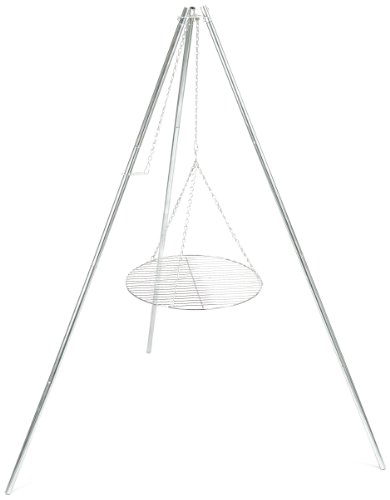
Stansport Tripod Cooker with 17-Inch Grill (15997-77) — Best Overall Fire Grill
The Stansport Tripod Cooker is the reference design for fire grilling: three steel legs, a chain, and a 17-inch grill that hangs over the fire at whatever height the cook sets. Its verified listing confirms the 17-inch grill and the tripod cooker format that also suspends Dutch ovens and coffee pots — one frame that anchors an entire fire-based camp kitchen.
Strengths
- 17-inch grate fits family-size rounds of food
- Chain height adjustment is precise, simple and repairable
- Suspends Dutch ovens and pots as well as the grill grate
Trade-offs
- Needs a proper fire ring or safe fire site
- Steel construction needs drying to prevent rust
- Heat control is a skill, not a knob
| Grate (per listing) | 17-inch grill |
| Format | Tripod cooker with chain suspension |
| Also suits | Dutch oven and pot suspension |
What makes the Stansport the overall pick is not novelty — it is that the design has no weak point. The legs plant outside the fire’s heat, the chain adjusts in small increments that translate directly to temperature, and the grate is big enough for a family’s burgers yet light enough to pack in a car without planning around it. Generations of camp cooks learned fire control on exactly this geometry, which means advice, parts and replacement chains are everywhere.
Its demands are the category’s demands: a legal fire, patience to build a coal bed, and a cook willing to manage height instead of a dial. Meet those terms and it produces the meal every other grill in this series is imitating — food cooked over wood, under the sky, at exactly the height you chose.
Scout troops favor this tripod for a reason beyond price: it teaches. A young cook learns coal judgment, height control and fire patience on a tool with no shortcuts to hide behind, and the same frame then boils the wash water and hangs the lantern. As an educational instrument disguised as a grill, it has no rival in this guide.
Best for: family fire-ring camping and scout-style camp kitchens / Not suited for: fire-restricted sites or cooks who want push-button heat
Check the current price on Amazon
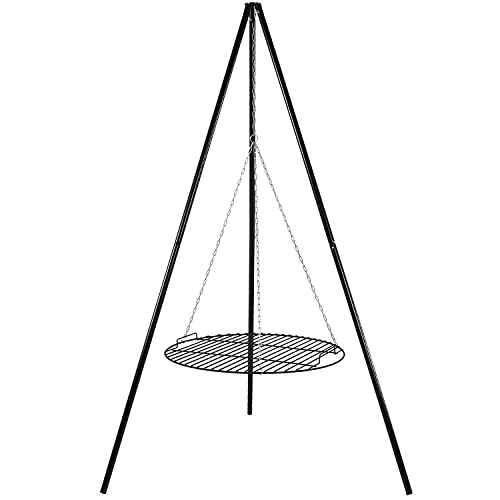
Sunnydaze Over the Fire Camping Grill Grate — Campfire Tripod, 22-Inch — Best for Big Groups
When the fire ring is big and the group is bigger, grate area is the whole game. The Sunnydaze tripod answers with a 22-inch diameter cooking grate per its verified listing — half again the area of the 17-inch class — on an adjustable, durable steel tripod the listing describes as portable across backyard, camping and hiking use.
Strengths
- 22-inch grate cooks for a crowd in one round
- Adjustable height for coal-bed management
- Steel build suits repeated seasons of fire use
Trade-offs
- Largest fire grill here — car camping only
- Needs a fire built to match its grate size
- More steel to clean and dry after trips
| Grate (per listing) | 22-inch diameter |
| Construction (per listing) | Durable steel, adjustable |
| Format | Over-fire tripod grill grate |
Area changes fire cooking qualitatively, not just quantitatively. On a 22-inch grate you can run a hot center over the coals and a warm perimeter at the edge — a two-zone fire kitchen — instead of cooking everything at one height over one heat. For group camps where the fire is the evening’s center anyway, that turns dinner from a queue into a spread.
The trade is logistics: this tripod wants a wagon or SUV, a fire ring that suits its span, and a cook who builds a fire sized to the grate. Small households will be happier with the 17-inch class. For the annual big camp, nothing else over a fire in this guide keeps up.
The 22-inch grate has a second career at home: over a backyard fire pit it becomes the neighborhood’s burger station, sized for the whole street’s worth of patties in two rounds. Campers who entertain around a home pit will use this tripod more weekends than they camp.
Best for: large groups cooking over a central campfire / Not suited for: small households or walk-in sites
Check the current price on Amazon

Joyfair Campfire Tripod Grill Grate, 17-Inch Stainless Steel — Best Stainless Tripod
Joyfair’s tripod takes the classic formula — 17-inch grate, adjustable height stand, over-fire cooking — and builds it in stainless steel per its verified listing. That material choice is the whole pitch: where painted or plain steel tripods rust at the welds after a wet season, stainless shrugs off the damp storage conditions that camping gear actually endures.
Strengths
- Stainless construction resists the rust that kills steel tripods
- 17-inch grate is the proven family size
- Adjustable height stand for coal management
Trade-offs
- Stainless costs more than plain steel equivalents
- Same fire-rule and skill demands as every tripod
- Heavier than titanium folding grates for light packing
| Grate (per listing) | 17-inch diameter |
| Material (per listing) | Stainless steel |
| Format | Adjustable-height over-fire tripod |
Fire gear lives a hard material life: heat cycles, ash, rain on pack-up morning, and storage in garages that are never as dry as you think. Stainless steel is the pragmatic answer, and on a tripod — a design with no moving parts to improve — material is most of the product. The Joyfair cooks exactly like the classic tripods, because it is one; it simply plans to look and work the same after five damp winters.
If your gear storage is dry and your budget is tight, plain steel serves fine and the Stansport above is the value play. If your tripods keep dying of rust, this is the correction.
Stainless also cleans differently: where plain steel tripods get wire-brushed and oiled like cast iron, the Joyfair’s grate tolerates a proper wash and an air-dry without the rust clock ticking. For campers who like their gear clean rather than seasoned, that maintenance style is the deciding factor.
Best for: coastal and damp-climate campers who keep gear for years / Not suited for: ultralight packers
Check the current price on Amazon

Coleman Tripod Campfire Grill & Lantern Hanger — Best Value Tripod
Coleman’s tripod covers the same ground as the Stansport — an adjustable 17-inch grate over the fire — at the value end of the category, and adds the detail that makes campers fond of it: a lantern hanger, so the frame keeps working after the cooking ends, holding light over the campsite table while the fire settles.
Strengths
- Value-tier entry into tripod cooking
- Lantern hanger gives the frame an evening second job
- Compact storage for a full-size tripod, per its listing
Trade-offs
- Steel legs need drying to stay ahead of rust
- Basic chain-and-hook hardware versus premium rivals
- Fire rules and coal skills apply as always
| Grate (per listing) | Adjustable 17-inch grill grate |
| Frame | Steel legs, lantern hanger |
| Fuel | Campfire wood or charcoal |
As a cooking tool this is the classic tripod pattern executed plainly, and plainly is fine — the physics of a hanging grate do not improve with decoration. What you give up against the Stansport is a measure of heft and finish; what you gain is Coleman’s distribution and a price tier that lets a family try fire cooking without committing to premium gear.
The lantern hanger sounds like a gimmick until the first evening it holds the light exactly over the card game while the cook finishes at the fire. Small dual-purpose thinking is what camp gear is for.
Families discover the Coleman tripod’s training-wheels quality: its straightforward chain and grate make a forgiving first fire grill for a teenager learning to cook outdoors, at a tier where a bent leg is a lesson rather than a loss. First tools should be like that.
Best for: families trying tripod cooking for the first time / Not suited for: campers wanting stainless or premium hardware
Check the current price on Amazon

Lodge Sportsman’s Pro Cast Iron Grill — Best Cast Iron Fire Grill
The Sportsman’s Pro solves the fire grill’s biggest dependency: it does not need a fire ring. This is a cast-iron charcoal grill in the hibachi tradition — its verified listing confirms a 9 x 16.75-inch body, a removable grate and dual air vents — that contains its own fire, sits on its own legs, and sears with the thermal violence only cast iron over charcoal achieves.
Strengths
- Self-contained fire — no fire ring required
- Cast iron holds searing heat like nothing else here
- Dual vents give real fire control in a compact grill
Trade-offs
- Cast iron is heavy — car camping only
- Needs seasoning care and dry storage
- Cooking area suits two to four, in batches for more
| Size (per listing) | 9 x 16.75 inches |
| Material | Cast iron |
| Controls (per listing) | Dual air vents, removable grate |
This is the connoisseur’s pick in the guide. A bed of charcoal in a cast-iron box, with vents that actually govern it, produces steakhouse searing at a picnic table — the crust that makes people who own big kamado grills nod slowly. The removable grate and vent control make it a working grill rather than a novelty hibachi, and Lodge’s cast iron, maintained, is effectively immortal.
Maintenance is the contract: keep it dry, keep it seasoned, and never leave it wet in a trunk. It is also genuinely heavy for its size. Campers who accept both terms get the finest small-fire cooking in this guide; campers who will not should take a tripod and a fire ring instead.
The Sportsman’s Pro has a winter second life its size enables: it is small enough to use in a fireplace hearth or on a patio as a two-person hibachi, cooking with a quality of sear that justifies hauling it out of the camping box in January. Cast iron this good refuses to be seasonal.
Best for: sear-obsessed car campers and hibachi fans / Not suited for: light packers or low-maintenance campers
Check the current price on Amazon

Kuvik Titanium Camping Grill — Best Ultralight Fire Grill
The Kuvik reduces fire grilling to its essence: a titanium grill surface, per its verified listing ultralight and compact with a carrying case included, that sets over a small fire or a bed of coals wherever dispersed camping allows one. No legs to plant, no chain to hang — just a corrosion-proof cooking surface that rides in a pack panel.
Strengths
- Ultralight titanium — carry it miles without noticing
- Corrosion-proof and food-safe per its listing
- Packs flat in its carry case
Trade-offs
- Small surface for solo and duo cooking
- Needs a suitable fire or coal bed arranged under it
- No height mechanism — you manage heat with coals and placement
| Material | Titanium, per listing |
| Design (per listing) | Ultralight, compact, carry case included |
| Fuel | Campfire or charcoal |
At walk-in sites the tripod class is a non-starter, and the Kuvik is what fire grilling becomes: a surface, a small fire, and a cook who understands coals. It grills a steak, sausages, fish or vegetables for one or two with real fire flavor, then wipes clean and vanishes into the pack. Titanium’s heat behavior takes one cook to learn — it is thinner and faster than steel — after which it is predictable.
This is a specialist’s tool and proud of it. Car campers should buy grate area and stands; campers who walk should buy grams and simplicity. The Kuvik is the lightest honest answer in this guide.
Ultralight campers pair the Kuvik with a small alcohol or twig stove as a windfall system: stove for boiling and bad weather, titanium grate for the evenings a legal fire offers itself. The combination weighs less than most single appliances and cooks a wider menu than either alone.
Best for: backpackers and dispersed-site campers / Not suited for: groups or car campers wanting capacity
Check the current price on Amazon
Comparison Table
| Pick | Badge | Key spec | Best for |
|---|---|---|---|
| Stansport Tripod Cooker with 17-Inch Grill (15997-77) | Best Overall Fire Grill | 17-inch grate, chain-adjustable tripod | family fire-ring camping and scout-style camp kitchens |
| Sunnydaze Over the Fire Camping Grill Grate — Campfire Tripod, 22-Inch | Best for Big Groups | 22-inch grate, adjustable steel tripod | large groups cooking over a central campfire |
| Joyfair Campfire Tripod Grill Grate, 17-Inch Stainless Steel | Best Stainless Tripod | 17-inch stainless grate, adjustable tripod | coastal and damp-climate campers who keep gear for years |
| Coleman Tripod Campfire Grill & Lantern Hanger | Best Value Tripod | 17-inch adjustable grate, lantern hanger | families trying tripod cooking for the first time |
| Lodge Sportsman’s Pro Cast Iron Grill | Best Cast Iron Fire Grill | Cast iron, 9 x 16.75 in, dual vents | sear-obsessed car campers and hibachi fans |
| Kuvik Titanium Camping Grill | Best Ultralight Fire Grill | Ultralight titanium, flat pack | backpackers and dispersed-site campers |
How to Choose a Camping Fire Grill: Tripod, Grate or Cast Iron?
Choose by the fire you will actually have. Campsites with established fire rings suit tripods — the ring contains the fire, the tripod works above it, and the site stays legal and tidy. Sites without rings, where a contained charcoal fire is permitted, suit the cast-iron Sportsman’s Pro, which brings its own firebox. Dispersed and walk-in camping suits folding grates that cook over small, carefully managed fires.
Then size the grate to the group with the same honesty as any grill: 17 inches is the family standard, 22 inches is group territory, and the compact surfaces are for one to four. Oversizing a fire grill has a hidden cost — a big grate wants a big fire, and a big fire wants more wood, more time and more water to kill it dead at bedtime.
Finally, pick your material by your storage. Stainless and titanium forgive damp garages; plain steel asks for drying discipline; cast iron asks for seasoning and dry storage and repays it with the best searing in the category.
Fire Grill Safety and Legality: Read This Before You Buy
A fire grill is a fire, with everything that implies. Use it only where open fires are currently permitted, inside established rings where they exist, and never during a fire ban — bans override your dinner plans, and rangers’ fines are the least of the reasons. Keep the fire small enough to cook over; a grill fire is a coal bed, not a bonfire, and smaller fires are both safer and better for cooking.
Clear the area around the fire of dry material, keep water and a shovel at hand, and never leave a cooking fire unattended — including the ‘dead’ one at bedtime. Drown, stir, and feel for heat with the back of your hand before you sleep or leave; if it is too hot to touch, it is too hot to leave. Ash and coals from grilling go cold, sealed, and out with the trash or into the site’s ash disposal, never scattered in the woods.
Food safety rides along: a fire grill’s grate should be heated and brushed before cooking, and raw and cooked foods need separate plates exactly as they do at home. The romance of fire cooking does not exempt anyone from the basics.
Coal Craft: The Skill Every Fire Grill Rewards
Fire grills cook on coals, not flames. Flames soot food and cook unevenly; a mature coal bed radiates steady, even heat. Build the fire forty minutes before dinner, let it burn down, and cook when the coals glow with a light ash coat. Add small wood pieces to the side to generate tomorrow’s coals while today’s cook — a rolling fire is the experienced camp cook’s signature.
Height is your thermostat. On a tripod, an inch or two of chain changes temperature more than any vent; on a folding grate, moving food between the coal center and the grate’s edge does the same job. Learn your grill’s heights with forgiving food — sausages, vegetables — before you commit the expensive steaks to your first fire.
Choosing Wood for Grill Fires: What Burns Best Over Dinner
Not all firewood cooks alike. Hardwoods — oak, hickory, maple, fruitwoods — burn down to dense, long-lived coals with clean smoke, and they are the fire griller’s fuel wherever they are available. Softwoods like pine burn fast, spark enthusiastically and can resin-flavor food; they are fine for getting a fire established and poor for cooking over. The practical camp compromise is to build with what the site provides, then cook over the coal bed, by which stage most wood sins have burned away.
Charcoal is the fire griller’s cheat code and there is no shame in it: a bag of briquettes or lump in the fire ring gives a predictable coal bed on a schedule, blends happily with wood coals, and rescues dinners when the available wood is damp. Many experienced fire cooks run a hybrid fire — wood for the evening’s pleasure, charcoal for the cooking window — and their food is better for the honesty.
Fire Grill Cooking for Groups: Running a Ring Like a Kitchen
A group fire cook is a producer as much as a chef. The fire must be started earlier than solo cooks start theirs — a big coal bed takes time — and the menu should be sequenced so the grill is never empty and never crowded: vegetables and breads that hold well go first, proteins in waves, and the cook eats last by design rather than by accident. A second small grate or a cast-iron plate at the fire’s edge doubles as the holding station.
Assign the fire a tender who is not the cook. One person manages coals, height and wood; the other manages food. Every chaotic group fire meal we have witnessed had one person doing both jobs; every smooth one had the pair. It is the cheapest upgrade in fire cooking, and it costs one volunteer.
Fire Cooking Times and Temperatures: A Practical Field Guide
Fire grills have no dials, so their cooks run on proxies: hand height, coal color and time. The hand test is the classic instrument — hold your palm at grate level and count: two seconds before you must pull away is searing heat for steaks; four to five seconds is medium, for chicken and chops; seven seconds is gentle, for fish, vegetables and holding. Coal color corroborates: bright orange with ash edges is hot, dull red under grey ash is the long, steady middle where most fire cooking lives.
Times then behave much as they do on any grill, with one adjustment: fire heat falls as coals age, so long cooks are planned around coal renewal — fresh coals added at the bed’s edge and raked under at intervals. Thick items go on when the bed is young and strong, or cook by height on a tripod where falling heat is answered by lowering the grate. None of this requires instruments; it requires two or three attentive cooks to become fluent, which is why we advise learning on forgiving food and keeping notes the first season.
Fire Grill Cooking Techniques: Direct, Indirect and Ember Work
Direct cooking over a mature coal bed is the fire grill’s home technique: steaks, chops, burgers, peppers and corn, turned once, rested properly. Indirect cooking is the advanced course — coals banked to one side or ringed at the edges, food in the gentler middle, lidless but patient — and it is how whole chickens, thick roasts and delicate fish survive a fire grill. Tripods cheat elegantly here: raise the grate and the whole fire becomes indirect, which is the strongest technical argument for the format.
Ember work is the oldest technique of all: food cooked in or on the coals themselves — potatoes and onions buried in embers, flatbreads slapped on a hot stone or the grate’s edge, coffee boiled in a pot nested in the bed. A fire grill camper who masters the three levels — over, beside and in the coals — owns a complete kitchen with one grate and one fire, which is the entire romance and the entire practicality of this category in a single sentence.
Storing and Transporting Fire Grills Without the Mess
Fire gear’s reputation for mess is earned by campers who pack it wrong. The correct sequence is fixed: brush the grate while the fire still offers heat, let everything cool completely — overnight if the trip allows — knock ash off over the fire ring or into a bag, and only then bag or wrap the grill for the vehicle. Ash that travels loose will find upholstery, tents and lungs, in that order of regret.
At home, fire grills store best hung or shelved dry, with cast iron oiled and steel brushed. A dedicated tote for the whole fire kit — grill, brush, gloves, fire starters, a small shovel — turns packing from an archaeology dig into a grab. Fire campers who systemize the dirty side keep cooking over fire for decades; those who wing it tend to become gas campers within three seasons, and they usually blame the flavor instead of the logistics.
The Fire Grill Kit: Everything Around the Grill Itself
A fire grill never travels alone, and the kit around it decides whether fire cooking feels like a craft or a struggle. The core is small: a stiff brush sized to the grate, heat-resistant gloves that actually fit, long tongs, a small shovel or sturdy stick reserved for coal work, and fire starters that light damp mornings without drama — commercial cubes or a homemade equivalent, never a splash of fuel on the fire, which is how fire campers become cautionary tales. Add a headlamp, because fire cooking finishes in the dark by design.
The second layer is food-side: a cast-iron skillet that rides the grate for eggs, sauces and delicate items; a lidded pot or Dutch oven if your tripod takes one; foil for ember vegetables and for wrapping the grate in transit. The third layer is the conscience of the kit: a collapsible water container dedicated to drowning the fire, and a sealed metal tin or bag for cold ash where pack-out is required. None of this is expensive, and all of it together weighs less than the firewood for one evening.
Store the kit as a kit — one tote, one home, checked once each spring. The campers who cook over fire for decades are not the ones with the finest tripods; they are the ones whose brush, gloves and drowning water are always in the same box, so that choosing the fire grill for a trip is a single grab instead of a scavenger hunt. Systems, again, beat gear.
Your First Fire Grill Cook: A Forgiving Menu to Learn On
Choose the first cook for what it teaches, not what it impresses. Sausages are the ideal students’ food: they tolerate heat surprises, they announce doneness clearly, and they forgive the height experiments that are the whole point of a first session. Corn in the husk is the second teacher — nearly impossible to ruin over coals, and it teaches coal placement because the husks show you exactly where the heat ran strong. Round the menu out with peppers and onions in a cast-iron pan or on the grate’s edge, and a pot of something warm that asks nothing of the fire but patience.
Deliberately leave the steaks for the second cook. By then your hands will know your tripod’s chain or your grate’s coal map, your timing will have a trip’s worth of evidence behind it, and the expensive food will meet a cook instead of a student. Fire grilling’s learning curve is short but real, and respecting its first evening is the difference between a hobby and a disappointment with good equipment.
How to Cook Over a Campfire With a Tripod or Fire Grill
Fire cooking is a sequence with a long first step: the fire itself. Start earlier than feels necessary, cook on coals rather than flames, and manage height like a thermostat. The steps below work for tripods and folding grates alike.
- Confirm fires are permitted at your site today — conditions change daily — and use the established fire ring if one exists. Clear any stray dry material from around the ring.
- Build a compact fire with dry wood and let it burn down for thirty to forty minutes, adding wood at the edge to keep generating coals. You are farming a coal bed, not raising a bonfire.
- Set the tripod legs firmly on level ground outside the ring’s hottest zone, or position the folding grate where it will sit stable over the coals. Test stability before any food is involved.
- Hang or place the grate and let it heat over the coals for several minutes, then brush it clean and oil it lightly with a high-heat oil on a folded cloth held in tongs.
- Set your starting height: higher for gentle cooking and thick items, lower for searing. Mark the chain link or note the position — repeatability is how fire cooking becomes a skill instead of a lottery.
- Cook, adjusting height instead of moving food whenever flare-ups threaten. Fat dripping into coals will flare; raising the grate calms it without losing your sear the way moving to a cold corner does.
- Rest cooked food on a clean warm plate near — not over — the fire. Keep raw and cooked utensils separate, exactly as in a kitchen.
- After eating, let the fire burn down, then drown it thoroughly, stir the ash, and check for heat by hand before bed. Pack the grill only when cool; ash goes out cold and sealed.
Master this sequence and a fire grill stops being rustic improvisation and becomes the most controllable cooking at the campsite — a thermostat you set with a chain, powered by the oldest fuel there is.
Common Buying Mistakes
Cooking over flames instead of coals
Flames soot food, scorch exteriors and leave centers raw. The forty-minute burn-down to a coal bed is not waiting — it is the cooking preparation itself.
Ignoring the day’s fire rules
Permission is not permanent. Wind, drought and bans change daily, and a fire grill used illegally risks fines, fires and the site’s future access. Check every trip, every day.
Building a bonfire to grill a burger
Oversized fires take forever to become coals, waste wood and endanger the site. A compact fire sized to the grate cooks better and dies safer.
Leaving the fire ‘basically out’
Coals hold heat for hours under ash. Drown, stir and hand-check, every time — the fire is out when it is cold, not when it stops glowing.
Storing steel grills wet
Ash plus moisture is a corrosion paste. Brush, dry and store fire grills dry, or buy stainless or titanium and still store them dry — the habit matters more than the metal.
Skipping the grate preheat and brush
A cold, dirty grate welds food down and flavors tonight’s steak with last trip’s fish. Heat it, brush it, oil it — thirty seconds of ritual, every cook.
Final Recommendation
For most fire-ring campers, the Stansport Tripod Cooker is the fire grill to buy: the proven 17-inch format, chain control, and Dutch-oven versatility in one frame. Groups should take the Sunnydaze 22-inch; damp-climate campers, the stainless Joyfair; first-timers on a budget, the Coleman tripod. Sear purists belong on the Lodge Sportsman’s Pro, and walk-in campers on the Kuvik.
Whichever you choose, buy the fire skills with it — coal patience, height control and a drowned-dead fire at bedtime. The grill is the easy part; the craft is the product.
- Stansport Tripod Cooker with 17-Inch Grill (15997-77) (Best Overall Fire Grill) — check price on Amazon
- Sunnydaze Over the Fire Camping Grill Grate — Campfire Tripod, 22-Inch (Best for Big Groups) — check price on Amazon
- Joyfair Campfire Tripod Grill Grate, 17-Inch Stainless Steel (Best Stainless Tripod) — check price on Amazon
- Coleman Tripod Campfire Grill & Lantern Hanger (Best Value Tripod) — check price on Amazon
- Lodge Sportsman’s Pro Cast Iron Grill (Best Cast Iron Fire Grill) — check price on Amazon
- Kuvik Titanium Camping Grill (Best Ultralight Fire Grill) — check price on Amazon
Best Camping Grills For Fires Best Camping Grills Best Camping Grills Portable
Related guides
Frequently Asked Questions
Are camping fire grills legal at campgrounds?
Where open fires are permitted and fire rings are provided, yes — tripod and grate grills are designed exactly for those rings. During fire bans or at sites without rings, rules vary and often prohibit them. Always confirm the current rules for your specific site and day before building a fire.
What is the best size grate for family camping?
A 17-inch round grate is the family standard: it fits a round of burgers or a mixed grill for four to five people over a normal fire ring. Groups of six or more should look at 22-inch tripods or plan to cook in two rounds.
Tripod or folding grate — which is better?
Tripods offer height adjustment, which is temperature control, and suit established fire rings and longer cooks. Folding grates pack smaller and suit dispersed camping and small fires. Choose by where you camp: rings favor tripods, trails favor folding grates.
Can I cook a Dutch oven on a tripod grill?
Yes — tripod cookers like the Stansport in this guide are designed to suspend Dutch ovens and pots from the same chain that holds the grate. It is one of the format’s oldest uses and turns one frame into a complete fire kitchen.
How do I control temperature on a fire grill?
With coal quantity and height. A mature, even coal bed gives the base heat; raising the grate cools the cooking, lowering it intensifies the sear. Small adjustments of an inch or two are meaningful. There is no dial — the skill is the control, and it comes quickly with practice.
How do I clean a fire grill at the campsite?
Heat and brush the grate before cooking, not after — the fire does the work. After the trip, brush off ash, wash if needed, dry thoroughly and store dry. Never leave ash caked on steel in a damp space; it holds moisture against the metal and starts rust.
Can I use a fire grill on a backyard fire pit?
Yes — tripods and grates sized to your pit turn a decorative fire into a working kitchen, and many owners use their camping fire grills at home more than on the road. Observe the same rules: legal fires, coal-bed cooking, and a fully drowned finish, plus whatever local ordinances apply to residential burning.
Best Camping Grills Under $100 Best Camping Grills Coleman Best Camping Gas Grills


