Disclosure: airfryerkitchensupply.com is reader-supported. When you buy through links on our site, we may earn an affiliate commission at no extra cost to you.
Where to Buy
Shopping for the best blenders for baby puree starts with verified equipment only: every pick below was cross-checked by brand and model against Amazon’s catalog data for this site, and a link appears only where the returned title matched the exact product. Use the links to check price on Amazon before ordering — this page never prints static prices, because baby gear pricing changes too often for printed numbers to stay honest.
- BEABA Babycook Neo Baby Food Maker, 42 oz — check price on Amazon
- NutriBullet Baby Complete Food-Making System, 32 oz — check price on Amazon
- Braun MultiQuick 5 Hand Blender, 350W — check price on Amazon
- Cuisinart Smart Stick CSB-179 Variable Speed Hand Blender — check price on Amazon
- BEABA Babycook Duo 4-in-1 Baby Food Maker — check price on Amazon
- Bear Baby Food Maker, Steamer & Blender, 18.5 oz — check price on Amazon
The best blenders for baby puree are judged on one thing above all: texture. A puree has to be completely smooth for a baby’s first foods, reliably soft-lumpy a few months later, and everything in between on demand — and it has to reach those textures in small quantities, often just a few spoonfuls of a single vegetable. That is a different job from making a smoothie, and it is why this guide mixes two kinds of equipment: dedicated baby food makers that steam and blend in one bowl, and immersion blenders that puree directly in the cooking pot.
Every machine here was verified by brand and model connected to this site, and each ASIN comes from a verified API response whose title matched the intended product. The specifications in the reviews — bowl sizes, motor wattages, shaft lengths, included accessories — are taken from those listings. We do not print prices or ratings; check price on Amazon through each review’s link instead.
Why include stick blenders in a baby puree guide at all? Because for many families they are the honest best tool: you steam or boil vegetables in a pot you already own, then puree them right there, in whatever quantity the pot holds, with one small wand to wash. Parents who already own a steam-blender may still add one for big soup-pot batches. The guide compares both philosophies directly, so you can choose with your eyes open. As always on this site, feeding decisions belong to you and your pediatrician; this page covers the equipment for making purees well.
One more framing note: puree making is a short, intense season. The equipment that serves it best is equipment that stays useful afterward — a stick blender moves on to soups and sauces for the family, and a good baby food maker reheats toddler portions long after the smooth stage ends. We have weighted that afterlife into the badges below.
In this guide
Quick Picks
In a hurry? The six picks split into steam-and-blend machines for the full workflow and immersion blenders for pureeing in the pot. Badges match the detailed reviews, and each badge names the texture job that machine does best — start from the badge that describes your kitchen, not from the top of the list, because in this category the workflow fit matters more than any ranking we could impose.
- BEABA Babycook Neo Baby Food Maker, 42 oz — Best Overall for Silky Purees. Steam and blend in one 42 oz bowl with one-handed operation — the smoothest route from raw vegetable to first puree, and a texture range that grows to solids. — Check price on Amazon
- NutriBullet Baby Complete Food-Making System, 32 oz — Best for Smooth First Purees in Batches. A 32 oz bullet-style system that produces very even, smooth purees from pre-cooked ingredients, with storage accessories for portioning the batch. — Check price on Amazon
- Braun MultiQuick 5 Hand Blender, 350W — Best Immersion Blender for Pureeing in the Pot. A 350W dual-speed stick blender with stainless blades, a beaker and a whisk — puree vegetables right in the pot, then use it for family cooking for years. — Check price on Amazon
- Cuisinart Smart Stick CSB-179 Variable Speed Hand Blender — Best Variable-Speed Immersion Blender. A 300W stick blender with true variable speed, an 8-inch shaft, and a chopper, whisk and measuring cup included — the texture-control pick for pot purees. — Check price on Amazon
- BEABA Babycook Duo 4-in-1 Baby Food Maker — Best for Two Textures at Once. Two 27 oz bowls that work independently — make a smooth puree in one and a chunky version in the other, in the same 20-minute session. — Check price on Amazon
- Bear Baby Food Maker, Steamer & Blender, 18.5 oz — Best for Small Fresh Batches. An 18.5 oz one-step steam-blender with dual-layer baskets — fresh puree in small quantities, with two ingredients steamed at once. — Check price on Amazon
How These Picks Were Chosen
Verification came first, as on every guide on this site. Each candidate was searched by brand and model; a product was eligible only when the returned listing title matched the intended machine exactly, and its ASIN was taken from that API response. Products we could not verify were excluded outright.
The puree-specific criteria followed. Smoothness: can the machine produce a genuinely lump-free first puree from fibrous vegetables like sweet potato and green beans? Small-batch behavior: does it work at the few-tablespoons scale, or does the food hide under the blades? Texture control: pulse functions, variable speeds and staged settings that let you stop at each developmental texture. And workflow: does it steam as well as blend, or does it assume a pot — and is that assumption fine for your kitchen?
We also weighed cleanup with unusual seriousness, because puree making happens daily and puree dries like cement. Dishwasher-safe bowls, detachable shafts and minimal crevices all counted. The result is a list of six that splits honestly: three steam-blenders for the closed workflow, two immersion blenders for the pot-based workflow, and one compact machine for small fresh batches.
A note on what is not here: full-size countertop blenders make superb purees in large quantities, and if you already own one it will serve the batch-cooking stage well. We did not rank them for this search because their jars handle small puree quantities poorly and they cannot steam — the two facts that define this particular job. They are covered in our general baby food guide linked at the end.
The 6 Best Blenders for Baby Puree, Reviewed in Detail
Each review covers who the machine suits, its strengths, its honest trade-offs, and the verified specifications from its listing. Use the link in each review to check the current price on Amazon.

1. BEABA Babycook Neo Baby Food Maker, 42 oz — Best Overall for Silky Purees
For a dedicated puree machine, the Babycook Neo is the most complete package we verified. It steams ingredients in its basket and blends them in the same 42 oz bowl, which matters for texture: food goes from steamer to blades without cooling, transferring or losing the cooking liquid that helps a puree reach silkiness. The listing confirms it is designed to grow from purees to solids, so the same bowl serves the smooth stage and the chunkier months after.
One-handed operation is a genuine puree-stage feature, not a gimmick — the other hand is usually holding the baby whose lunch is being made. Cleanup is dishwasher-safe, and the bowl size suits a few days of portions per session.
The Neo sits at the premium end of this guide, and the case for it is frequency: used daily, its convenience compounds. Used weekly, the simpler picks below deliver nearly the same puree for less commitment.
Strengths
- Steam-to-blend in one bowl keeps food hot and hydrated for smoother purees
- Texture range grows from first purees to solids in the same machine
- One-handed operation; dishwasher-safe cleanup
Trade-offs
- Premium tier positioning
- 42 oz bowl is mid-sized — not a mega-batch machine
- Dedicated appliance that will eventually be outgrown
| Bowl | 42 oz |
| Functions | Steam, blend |
| Operation | One-handed |
| Cleaning | Dishwasher-safe |
Texture quality in a steam-blender is mostly about what happens before blending: even steaming, complete softness, and enough retained moisture. The Neo’s closed process handles all three by design, which is why its purees come out consistent session after session. Parents report fewer ‘why is this batch grainy’ mysteries with one-bowl machines, and the physics supports them.
Choose the Neo if puree making will be a near-daily habit and you want the least friction per session. If your style is one big weekly pot, the immersion blenders further down may genuinely suit you better — that is a workflow preference, not a quality gap.
Best for: daily puree makers who want the smoothest one-bowl workflow / Not suited for: occasional users, or big-pot batch cooks
Check the current price on Amazon

2. NutriBullet Baby Complete Food-Making System, 32 oz — Best for Smooth First Purees in Batches
Bullet-style blades are exceptionally good at one thing: turning soft, cooked food into a uniformly smooth puree. The NutriBullet Baby system leans into that strength — steam or boil your ingredients in a pot, blend them in the 32 oz system, and portion the result into the included storage. For the first-food stage, when smoothness is the whole brief, that blending action is hard to fault.
The system’s batch logic suits parents who cook a pot of one vegetable at a time and freeze portions. The storage accessories close the loop from blending to freezer without improvised containers.
The limits are the mirror image of its strengths: no steaming in the unit, no reheating, and a blending jar that wants a reasonable volume to work well — tiny two-spoon test batches are not its natural territory. It is a batch puree specialist, and within that role it is excellent.
Strengths
- Very smooth, even puree texture from bullet-style blending
- Batch-and-store workflow with portioning accessories included
- Compact system compared with countertop blenders
Trade-offs
- No built-in steaming or reheating
- Needs a reasonable batch volume to blend well
- More pieces to wash after a session
| Capacity | 32 oz |
| Format | Blending system with storage accessories |
| Steaming | Not built in — cook first |
There is a texture nuance worth knowing: bullet blenders achieve smoothness through speed and a small working volume, which also incorporates air. For baby purees that is harmless and even pleasant — a lighter, whipped consistency many babies take to readily. For parents who prefer denser purees, a few seconds of settling before portioning solves it.
Pair this system with a simple steamer basket for your existing pots and you have a complete, if two-appliance, puree kitchen at a mid-tier total. That combination is the strongest budget-conscious route to genuinely smooth first foods in this guide.
Best for: batch cooks who want the smoothest first purees and tidy storage / Not suited for: parents wanting steaming inside the same appliance
Check the current price on Amazon
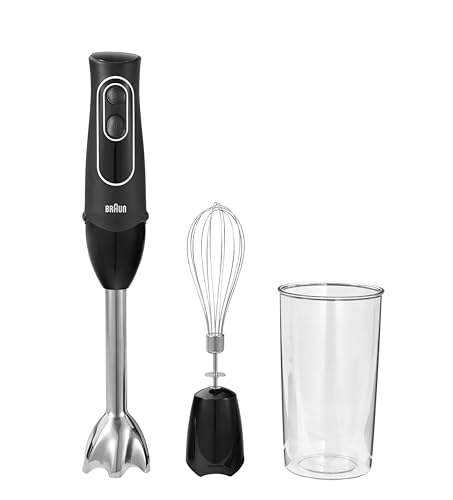
3. Braun MultiQuick 5 Hand Blender, 350W — Best Immersion Blender for Pureeing in the Pot
The immersion route to baby puree is beautifully simple: cook vegetables in a pot, lower in the Braun MultiQuick 5, and puree in place. No transferring hot food, no jar size limits, and quantities scale from a single portion to a soup pot. The verified listing confirms a 350W motor, dual speeds, stainless steel blades and an ergonomic, slip-proof handle, with a beaker and whisk in the box.
Dual speed is enough for puree work: the lower speed starts the process without splashing, the higher speed finishes to smoothness. The included beaker doubles as a small-batch vessel for single portions — exactly the scale at which countertop jars fail.
After the puree months, this tool simply becomes the household’s stick blender for soups, sauces and mashing — the longest afterlife of any pick in this guide. That longevity is a large part of its value case.
Strengths
- Purees directly in the pot — any quantity, no transfers
- Beaker included for small single-portion batches
- Whisk attachment and a long family-cooking afterlife
Trade-offs
- No steaming — cooking happens in your pots
- Handheld blending needs a steady hand and a deep enough pot to avoid splashes
- Texture control is manual: your timing decides smoothness
| Motor | 350W |
| Speeds | Dual speed |
| Blades | Stainless steel |
| Included | Beaker, whisk attachment |
Technique is the price of admission with immersion blending, and it is quickly learned: keep the blade head submerged, tilt the pot slightly, move the wand slowly through the mixture, and let the vortex do the work. Thirty to sixty seconds of that produces a puree as smooth as most babies’ first foods need to be, especially if the vegetables were cooked completely soft.
The honest comparison with the BEABA picks is steps versus flexibility. The Braun asks you to cook separately and blend actively; in exchange it handles any volume, costs less as a tier, and never becomes obsolete. Households that cook family food anyway often find the pot-based workflow is no burden at all.
Best for: parents who cook in pots anyway and want one tool for purees and beyond / Not suited for: parents wanting a closed steam-and-blend appliance
Check the current price on Amazon
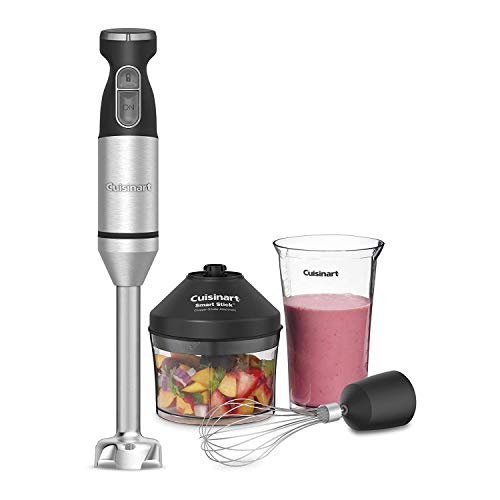
4. Cuisinart Smart Stick CSB-179 Variable Speed Hand Blender — Best Variable-Speed Immersion Blender
If the Braun is the simple two-speed tool, the Cuisinart Smart Stick CSB-179 is the control version: a 300W motor with variable speed control, so you can start a puree at a crawl — no splashing, no suction lock on the pot base — and finish at full speed for smoothness. The verified listing notes an 8-inch blending shaft, which reaches comfortably into deeper pots, and a quiet-running motor.
The accessory set is unusually complete for baby food duty: a chopper for small quantities of cooked food and early finger-food prep, a whisk, and a measuring cup that doubles as a small blending vessel. Together they cover the puree months and a good stretch of toddler cooking.
Variable speed is the deciding feature. Puree texture is a dial here rather than a hope — start slow for chunky, finish fast for smooth — which makes this the immersion pick for parents following a careful texture progression.
Strengths
- Variable speed gives precise control from chunky to smooth
- 8-inch shaft suits deeper pots; quiet motor per the listing
- Chopper, whisk and measuring cup included
Trade-offs
- 300W is adequate for cooked vegetables, not a heavy-duty crushing motor
- Handheld process still needs technique to avoid splashes
- More accessories to store than a basic stick blender
| Motor | 300W |
| Controls | Variable speed |
| Shaft | 8 in blending shaft |
| Included | Chopper, whisk, measuring cup |
The chopper attachment deserves specific mention for the puree stage’s second half. When babies move to minced and finely chopped textures, a small chopper produces them more evenly than a knife and faster than a fork — and it handles the herbs, cooked chicken and soft vegetables of family cooking afterward.
Between the two immersion picks, choose the Braun for simplicity and the stronger motor, and the Cuisinart for control and accessories. Both puree in the pot; they simply suit different hands.
Best for: parents who want dial-level control over puree texture in the pot / Not suited for: anyone wanting an appliance that steams as well as blends
Check the current price on Amazon

5. BEABA Babycook Duo 4-in-1 Baby Food Maker — Best for Two Textures at Once
The Babycook Duo’s twin-bowl design has a puree-specific superpower: it can produce two textures of the same food at once. One bowl blends a carrot puree completely smooth for the younger baby; the other stops at soft lumps for the older sibling — or for the same baby’s next stage, frozen ahead. No other pick in this guide parallel-processes texture like that.
The verified figures: two 27 oz bowls, 9.1 cups combined, up to 54 servings in 20 minutes, with the full 4-in-1 function set — steam, blend, defrost, reheat — and one-handed operation, in BPA-free construction.
It is the biggest and most premium machine here, and for a single baby with modest needs it is honestly more than required. For twins, siblings, or a parent deliberately cooking two stages ahead, it is uniquely capable.
Strengths
- Two independent bowls — two textures or flavors simultaneously
- Up to 54 servings in 20 minutes; full defrost and reheat loop
- One-handed operation; BPA-free per the verified listing
Trade-offs
- Largest footprint and premium tier pricing
- Overkill for one baby with small batches
- More parts to wash after a full session
| Bowls | 2 × 27 oz (9.1 cups combined) |
| Functions | Steam, blend, defrost, reheat |
| Batch | Up to 54 servings |
The two-texture trick also solves a subtle weaning problem: babies often accept a new flavor more readily in a familiar texture, and accept a new texture more readily in a familiar flavor. The Duo lets you vary one dimension at a time, in one session, which makes systematic exploration of foods genuinely practical.
If you are choosing between the Duo and the Neo, decide by parallelism. One baby, one texture at a time: the Neo. Two textures, two babies, or batch-freezing two stages ahead: the Duo earns its counter space.
Best for: twins, siblings, and parents cooking two texture stages ahead / Not suited for: single-baby households with modest batches and small kitchens
Check the current price on Amazon

6. Bear Baby Food Maker, Steamer & Blender, 18.5 oz — Best for Small Fresh Batches
Not every puree session is a batch. The Bear Baby Food Maker is built for the opposite rhythm: small, fresh quantities, made often. Its 18.5 oz capacity matches a day or two of food, and its dual-layer steam baskets let two ingredients steam simultaneously — sweet potato below, apple above — before blending in the same compact unit.
The verified listing describes one-step operation and BPA-free construction, with warming and sterilizing functions for small items that help the little machine earn its place in a crowded feeding corner.
Small-batch blending has a texture advantage worth naming: in a right-sized bowl, a few spoonfuls of puree actually reach the blades and blend evenly, where the same quantity would smear around the walls of a big jar. For test batches of new foods, that makes the Bear the most practical tool here.
Strengths
- Right-sized bowl blends small quantities evenly
- Dual-layer baskets steam two ingredients at once
- One-step operation; compact footprint; BPA-free per listing
Trade-offs
- 18.5 oz ceiling rules out batch cooking
- Less established brand than BEABA or Braun
- No reheat program set like the 4-in-1 machines
| Capacity | 18.5 oz |
| Baskets | Dual-layer steam baskets |
| Functions | Steam, blend; warming/sterilizing for small items |
The Bear suits a philosophy as much as a kitchen size: fresh over frozen, little and often. Parents who cook a small amount while the family’s dinner steams will find its rhythm natural, and babies get food at its freshest.
It also works as the household’s second machine — for travel, grandparents, or the new-food test batches alongside a bigger system. Its limits are clear and honestly priced into its tier.
Best for: fresh, small-batch cooking and testing new foods in tiny quantities / Not suited for: freezer-stash batch cooking or twins
Check the current price on Amazon
Comparison Table
| Pick | Badge | Key Spec | Best For |
|---|---|---|---|
| BEABA Babycook Neo Baby Food Maker, 42 oz | Best Overall for Silky Purees | 42 oz bowl, steam + blend | daily puree makers who want the smoothest one-bowl workflow |
| NutriBullet Baby Complete Food-Making System, 32 oz | Best for Smooth First Purees in Batches | 32 oz system + storage | batch cooks who want the smoothest first purees and tidy storage |
| Braun MultiQuick 5 Hand Blender, 350W | Best Immersion Blender for Pureeing in the Pot | 350W, dual speed, beaker + whisk | parents who cook in pots anyway and want one tool for purees and beyond |
| Cuisinart Smart Stick CSB-179 Variable Speed Hand Blender | Best Variable-Speed Immersion Blender | 300W, variable speed, 8 in shaft | parents who want dial-level control over puree texture in the pot |
| BEABA Babycook Duo 4-in-1 Baby Food Maker | Best for Two Textures at Once | 2 × 27 oz bowls, 54 servings | twins, siblings, and parents cooking two texture stages ahead |
| Bear Baby Food Maker, Steamer & Blender, 18.5 oz | Best for Small Fresh Batches | 18.5 oz, dual-layer baskets | fresh, small-batch cooking and testing new foods in tiny quantities |
The split in this table is philosophical: steam-blenders (BEABA Neo, Duo, Bear) own the whole process in one bowl, while the immersion blenders (Braun, Cuisinart) own the pot you already have, at any scale, forever. The NutriBullet Baby sits between them as a batch-blending system. Choose by where your cooking already happens — countertop appliance or stovetop pot — and the right column will be obvious. If you are genuinely undecided, consider which failure would annoy you more: a dedicated appliance gathering dust after the puree months (argues for the stick blender), or a daily routine with one transfer and one extra pot to wash (argues for the steam-blender). That small thought experiment resolves most ties in this category more honestly than any specification can.
What Makes a Puree Smooth — and Why Do Some Come Out Grainy?
Smoothness is decided before the blender ever switches on. Fibrous vegetables — sweet potato, carrot, green beans, peas — contain structures that only fully yield when cooked completely soft. Steam or boil until a piece collapses under a fork with no resistance, and almost any decent blender in this guide will produce a smooth puree. Stop five minutes early, and no motor at any price fully rescues the texture; you will get fine grains that no amount of extra blending removes.
Moisture is the second variable. A puree needs enough liquid to circulate past the blades; too dry, and the mixture rides above the blades in a lump while the motor spins beneath it. Add the cooking liquid — which carries flavor and nutrients that leached during steaming — a spoonful at a time until the puree moves like thick paint. Too wet is easily fixed by blending in more of the cooked vegetable; too dry is the far more common failure.
The third variable is volume. Every blender has a minimum working quantity: below it, food smears on the walls and never reaches the blades. This is the small-batch problem that makes big countertop jars frustrating for purees, and it is why this guide favors right-sized bowls and immersion blenders, which work at almost any depth in a pot or beaker.
- Cook until completely soft — fork-collapsing, no resistance
- Add cooking liquid gradually until the puree circulates like thick paint
- Respect the minimum volume: right-sized bowls or an immersion wand
- Blend longer than feels necessary for the first-food stage
- Sieve only as a rescue — good cooking makes it unnecessary
Steam-Blender vs Immersion Blender: Which Is Better for Purees?
A steam-blender is a closed system: raw ingredients go in, puree comes out, portions reheat in the same bowl. It minimizes decisions, transfers and washing, and it is the better choice for parents who want baby food to be a self-contained routine — especially in the early months when sessions are frequent and time is fragmented. Its limits are batch size and its single-purpose nature.
An immersion blender is an open system: your pots, your stove, your quantities. It purees a tablespoon-scale test batch in its beaker or a family-size pot of soup with equal indifference, costs less as a category, and remains a front-line kitchen tool for a decade after the puree stage ends. Its costs are technique — you must cook separately and blend actively — and the absence of reheating and defrosting functions.
Many households rationally own both: the steam-blender for the daily baby routine, the stick blender for everything else, including the big weekend pot of family soup that becomes next week’s puree base. If the budget forces one choice, decide by where your cooking already lives: appliance people should buy the steam-blender; stovetop people should buy the stick.
How Do You Move a Baby from Smooth Purees to Lumpy Textures?
The equipment answer is control. Machines with pulse cycles, variable speeds or dual bowls let you produce the same food at two consistencies, which is the practical way to advance texture: serve mostly the familiar smoothness with a spoonful of the lumpier version alongside, and shift the ratio as your baby manages. The Duo in this guide automates that pairing; the Cuisinart’s variable speed dials it in manually; a fork and a bowl handle it with no machinery at all.
The progression itself — smooth, then thicker, then mashed with soft lumps, then minced and finger foods — follows your baby’s development and your pediatrician’s guidance, not a chart on a website. What the equipment owes you is range: a machine locked to one consistency will be outgrown mid-journey, which is why single-texture gadgets scored poorly in our selection.
One technique note: when you want lumps, blend the base smooth first, then stir in a small amount of the same food mashed rather than blended. That gives soft, even, manageable lumps without stray hard pieces — a better texture than simply under-blending the whole batch, which produces an inconsistent mix of soup and chunks.
How Should You Store Purees, and for How Long?
Portion puree promptly after blending into the small servings you will actually use, label each with contents and date, refrigerate the next day or two’s worth, and freeze the rest — following current food-safety guidance for exact storage periods. Small portions thaw faster, waste less, and let you combine flavors at serving time rather than at cooking time.
Reheat until steaming throughout, stir thoroughly to even out hot spots, test the temperature yourself, and serve from a clean bowl so the stored portion stays uncontaminated. Discard anything the baby has eaten from, and never reheat the same portion twice. These habits, more than any appliance feature, are what make homemade puree a safe routine.
For freezing, trays and small cups in the 2–4 oz range match how appetites grow; several picks in this guide include starter sets in exactly those sizes. Freeze portions flat and stack them like files — a well-organized freezer drawer of labeled purees is the visible sign that your system is working.
Which Puree Ingredients Are Hardest to Blend, and How Do You Handle Them?
Green beans and peas carry fibrous skins and strings that survive casual cooking; steam them thoroughly and blend them with a generous share of liquid, and for the very first foods, blend them with a smoother partner like pear or sweet potato to carry the texture. Sweet potato itself is dense and can turn gluey if overworked in some machines — blend it just to smoothness and stop, rather than running extended cycles.
Meats, once your pediatrician gives the go-ahead for them, are the hardest puree of all: cooked meat fibers resist blades and dry out quickly. The reliable method is to blend meat with plenty of its cooking liquid or with a vegetable puree base, in small additions, until it reaches a fine, moist consistency — and an immersion blender in the pot or a steam-blender’s bowl both handle this better than a large countertop jar, where the small quantity gets lost.
Fruits split into two camps. Soft fruits — banana, ripe pear, avocado — barely need a machine at all and mash beautifully with a fork, which is worth remembering before washing a blender for one banana. Firmer fruits need cooking first: apple and unripe pear steam into excellent purees, and the steam-blenders in this guide exist for exactly that transformation.
The general rule underneath all of this: a blender can only refine what cooking has softened. When a batch disappoints, adjust the cooking first — longer steaming, smaller pieces, more liquid — before blaming or replacing the machine. Nine times out of ten, the fix is in the pot, not the appliance.
How to Make a Perfectly Smooth First Puree, Step by Step
This method works with any pick in this guide — steam-blender, system or immersion wand — using sweet potato as the example. The principles transfer to every vegetable and fruit.
- Prep evenly. Wash, peel and cut the vegetable into small, even cubes. Even pieces cook at the same rate, which is the foundation of an even puree.
- Cook until collapsing. Steam (in your machine’s basket, or over a pot) until a fork slides through with zero resistance and the piece falls apart. When in doubt, cook five minutes longer — overcooked is smooth; undercooked is grainy.
- Reserve the cooking liquid. Keep the steaming or boiling water. It carries flavor and dissolved nutrients, and it is your thinning liquid for the blend.
- Blend in stages. Start the blend, let the mixture begin moving, then add cooking liquid a spoonful at a time until the puree circulates steadily and looks glossy.
- Check against the spoon test. Lift a spoonful: a first puree should ribbon off the spoon in a continuous, lump-free stream and hold soft peaks in the bowl.
- Rescue if needed. Still grainy? Blend longer with a touch more liquid. Still lumpy after that? The batch was undercooked — note it for next time, and pass this batch through a sieve rather than serving the lumps.
- Portion, label, store. Spoon into small cups or trays while fresh, label with contents and date, refrigerate the immediate portions and freeze the rest promptly.
- Serve safely. Reheat until steaming, stir well, test the temperature yourself, and serve from a clean bowl — discarding whatever the meal leaves behind in the serving bowl.
Once the method is automatic, puree making becomes a background task: vegetables steam while dinner cooks, the blend takes two minutes, and the freezer fills almost incidentally. That ease is the real product every machine in this guide is selling — the texture knowledge above is what lets you judge whether yours is delivering it.
Keep a small notebook or phone note for the first month: what you made, how long you steamed it, how much liquid you added, and how the texture came out. Three lines per session turns guesswork into a recipe file, and by the second month you will be producing consistent purees in any machine — including a borrowed one at a grandparent’s house — because the knowledge, not the appliance, was the point all along.
Common Buying Mistakes
Puree problems are almost never equipment problems. These are the errors behind nearly every disappointing batch, and they share a pattern: each one happens upstream of the blender — in the chopping, the cooking, the portioning or the labeling — which is why buying a more expensive machine never fixes them. Fix the process and the blender you already shortlisted will suddenly seem twice as good, because in practical terms it will be.
- Undercooking the vegetables. Grainy puree is a cooking failure, not a blending failure. Cook until pieces collapse under a fork, every time.
- Adding too little liquid. A dry mixture cannot circulate past the blades. Add cooking liquid gradually until the puree moves like thick paint.
- Blending tiny amounts in a huge jar. Below a blender’s minimum volume, food hides from the blades. Use a right-sized bowl, a beaker, or an immersion wand.
- Under-blending the first foods. Early purees should be completely smooth. Give the blend a full cycle; check with the spoon test before portioning.
- Skipping labels and dates. Frozen purees are indistinguishable within days. Label every portion at freezing time.
- Advancing texture by under-blending. Random chunks in soup is not a texture stage. Blend smooth, then stir in deliberately mashed food for even, soft lumps.
Final Recommendation
If you buy one machine from this page, make it the BEABA Babycook Neo for the smoothest closed workflow, or the Braun MultiQuick 5 if your cooking already lives in pots and you want a tool with a decade of afterlife. The NutriBullet Baby system is the batch puree specialist, the Cuisinart Smart Stick is the texture-control immersion pick, the BEABA Duo serves two textures at once, and the Bear handles small fresh batches in small kitchens. Check price on Amazon for the one that matches your kitchen’s habits.
Keep reading on this site: Best Blenders For Baby Food compares complete food-making systems and storage, Best Blenders For Baby covers the wider baby blender field, and for the adults’ side of the same kitchen, Best Blenders For Athletes handles high-power blending while Best Blenders Can Handle Hot is the guide to machines for soups and hot blends. If cleanup decides your purchases, Best Blenders Easy To Clean ranks every format by washing effort.
Frequently Asked Questions
What blender makes the smoothest baby puree?
Any pick in this guide can, provided the ingredients are cooked completely soft and enough liquid is added — technique decides more than machinery. For the most consistent results with the least effort, a steam-blender like the BEABA Neo controls the whole process, while bullet-style systems like the NutriBullet Baby produce very even purees from pre-cooked batches.
Can I use an immersion blender for baby puree?
Yes — it is one of the best tools for the job. Puree directly in the cooking pot at any quantity, keep the blade head submerged to avoid splashing, and move the wand slowly until the texture is uniform. The Braun MultiQuick 5 and Cuisinart Smart Stick in this guide are both verified picks for exactly this use.
How much puree should I make at once?
Match the batch to your storage and your baby’s pace. Steam-blenders here range from the Bear’s 18.5 oz fresh batches to the Duo’s 54 servings; immersion blenders scale to whatever your pot holds. Frozen portions should be sized to a meal — small cups you can thaw individually beat one large block.
Why is my puree grainy even with a good blender?
Almost always undercooking. Fibrous vegetables must be steamed or boiled until they collapse under a fork before blending; no blade fully breaks down half-cooked fibers. Add enough cooking liquid for the mixture to circulate, blend a full cycle, and the graininess disappears.
Do I need a special blender for baby puree, or will my normal one work?
A normal countertop blender works for large, pre-cooked batches but handles small puree quantities poorly and cannot steam or reheat. A stick blender works at any quantity in the pot. A dedicated steam-blender adds the closed cook-blend-reheat loop. Choose based on your batch sizes and how often you will cook.
When can I stop blending food completely smooth?
Texture progression follows your baby’s development and your pediatrician’s guidance — generally moving from smooth to thicker, mashed and lumpy foods over the weaning months. Equipment with pulse or variable speed, or the Duo’s twin bowls, makes each stage easy to produce deliberately rather than accidentally. A practical sign you are ready to thicken up: your baby is handling the current texture easily, showing interest in family food, and mealtimes feel almost boring — at that point a slightly thicker, then slightly lumpier version of a familiar favorite is the gentle next step, and your blender’s pulse button or speed dial is the tool that makes the change gradual rather than abrupt.
What is the cheapest way to make good baby purees?
An immersion blender and the pots you already own. It is the lowest-cost route in this guide by a wide margin, it works at any quantity, and the tool remains useful for family cooking indefinitely. Add a simple steamer basket for your pot and you have a complete puree kitchen. Dedicated steam-blenders buy convenience and a closed workflow, not better purees — so if budget leads your decision, buy the stick blender with confidence and spend the difference on good produce.


