Disclosure: airfryerkitchensupply.com is reader-supported. When you buy through links on our site, we may earn an affiliate commission at no extra cost to you.
Where to Buy
Shopping for the best blenders for athletes starts here: every pick below was cross-checked against Amazon’s own catalog data for this site before a link was added, and only listings whose titles matched the exact model are linked. Use the links under each pick to check price on Amazon on the day you buy — blender pricing moves with promotions, and we do not print static prices for that reason.
- Vitamix 5200 Professional-Grade Blender, 64 oz — check price on Amazon
- Ninja Professional Plus Blender BN701, 1400W Peak — check price on Amazon
- Blendtec Classic 575 with WildSide+ Jar — check price on Amazon
- nutribullet Pro+ Personal Blender, 1200W — check price on Amazon
- Ninja Nutri-Blender Pro BN401 with Auto-iQ — check price on Amazon
- KitchenAid K400 Variable Speed Blender with Tamper — check price on Amazon
The best blenders for athletes are not the same machines that top a generic smoothie list, because training changes what a blender has to do every single day. An athlete’s blender crushes frozen fruit and ice for post-workout shakes, grinds nuts and oats into calorie-dense recovery drinks, handles a scoop or two of protein powder without leaving dry pockets, and often has to do all of that twice a day, seven days a week, without the motor fading by month three. Durability and jar capacity matter more than a long preset list, and cleanup speed matters more than almost anything, because a blender that takes ten minutes to wash is a blender that quietly stops being used.
This guide splits the field the way athletes actually buy. There are full-size countertop machines for households blending big batches, personal blenders that turn the blending cup into the drinking cup for a fast exit to the gym, and one mid-range option for people who want real power without paying flagship money. Every model named here was verified against the manufacturer’s catalog data; only confirmed models carry a purchase link, and the specs quoted are the specs from those verified listings — nothing is guessed, and no prices or ratings are printed because both change too often to stay honest on the page.
One honest warning up front: the cheapest personal blenders sold for gym use often struggle with the exact job athletes give them — frozen berries, ice and thick Greek-yogurt-style blends. If your shake is mostly liquid and fresh fruit, almost anything works. If it is frozen and dense, motor power and blade design decide whether you get a shake or a half-blended slurry with a burning smell. The picks below are ordered with that reality in mind.
It is also worth being clear about what this guide is not. It is not a ranking of the most powerful blenders money can buy, and it does not reward features athletes never touch. A touchscreen with twenty programs adds nothing to a post-workout shake; a jar that survives a thousand frozen blends and washes in a minute adds everything. Where two machines were close, we favored the one with the simpler routine, the easier cleanup and the clearer replacement-parts path, because training equipment — and a training blender is training equipment — earns its keep through repetition, not novelty. If your needs are narrower than the full list, jump straight to the badge that matches them: big-batch households, frozen-bowl specialists, solo shake drinkers and mid-range buyers each have a dedicated pick waiting below.
In this guide
Quick Picks
Short on time? These are the six machines we would shortlist for training diets, from a flagship countertop blender down to a grab-and-go personal model. Badges match the detailed reviews further down the page.
- Vitamix 5200 Professional-Grade Blender, 64 oz — Best Overall. The long-running flagship formula: a tall 64 oz container, variable speed dial and stainless blades that pull frozen mixtures down into a vortex instead of leaving chunks riding on top. — Check price on Amazon
- Ninja Professional Plus Blender BN701, 1400W Peak — Best for Big Batches. A 1400 peak-watt motor and a big 72 oz pitcher with three Auto-iQ presets — the batch-prep pick for households and shared training kitchens. — Check price on Amazon
- Blendtec Classic 575 with WildSide+ Jar — Best for Frozen Fruit and Ice. Five speeds, four preprogrammed cycles and the wide WildSide+ jar that pulls mixtures into the blade path — a frozen-drink specialist with a self-cleaning cycle. — Check price on Amazon
- nutribullet Pro+ Personal Blender, 1200W — Best Personal Blender. A 1200W personal blender with a pulse button and 32 oz and 24 oz to-go cups — blend, swap the blade for a travel lid, and leave. — Check price on Amazon
- Ninja Nutri-Blender Pro BN401 with Auto-iQ — Best for the Gym Bag Routine. 1100 peak watts, two Auto-iQ programs and a pair of 24 oz cups — set it running while you lace your shoes and drink from the same cup. — Check price on Amazon
- KitchenAid K400 Variable Speed Blender with Tamper — Best Mid-Range Countertop. A 5-speed dial, three preset recipe programs and Intelli-Speed motor control that holds speed under load — the considered middle ground between bullets and flagships. — Check price on Amazon
How These Picks Were Chosen
We chose these picks by starting from what athletes actually blend: frozen fruit, ice, nut butters, oats, leafy greens, protein powders and high-calorie recovery mixtures. Models were included only if the verified listing confirmed the motor, jar size and configuration we describe — each product was searched by brand and model connected to this site, and the ASIN was taken from the listing response only when the returned title matched the intended machine exactly.
From there we weighed four things. First, crushing power on frozen ingredients, because that is the failure point for most blenders in athletic use. Second, capacity — a 64 to 72 oz pitcher suits batch prep and households, while 24 to 32 oz personal cups suit single shakes. Third, cleanup: dishwasher-safe jars and self-cleaning cycles get used daily; fiddly blade assemblies do not. Fourth, control — variable speed and pulse matter when the same machine has to make a thin hydration drink in the morning and a thick spoonable bowl at night.
We deliberately left out models we could not verify, novelty mini-blenders with motors too weak for frozen fruit, and any machine whose listing did not clearly match a real current product. Where a category has a genuine gap, we say so in the review rather than filling the slot with an unverified name.
A note on how to read the badges: they are assignments, not ranks. Best Overall is the machine we would buy with no other information; the other badges name the best tool for a specific job — batch volume, frozen drinks, a solo grab-and-go routine, or a mid-range budget. An athlete who only ever makes one shake a day is genuinely better served by the personal picks than by the flagship, and we would rather tell you that than push everyone to the top of the range.
The 6 Best Blenders for Athletes, Reviewed in Detail
Each review explains who the machine suits, where it is strong, where it honestly falls short, and the verified specifications from its listing. Prices are never printed — use the link in each review to check price on Amazon before you decide.

1. Vitamix 5200 Professional-Grade Blender, 64 oz — Best Overall
For an athlete who blends daily and wants one machine to last for years, the Vitamix 5200 is the benchmark everything else gets compared to. Its tall, narrow 64 oz container creates a strong vortex that keeps thick mixtures — frozen mango, nut butter, oats, protein powder — circulating through the stainless steel blades instead of stalling at the top. The variable speed dial plus a high-speed switch gives you genuine control: start slow to incorporate powders without a dust cloud, then ramp up to fully liquefy.
It also covers the jobs around training food. The same machine that makes a post-workout shake will puree soups for meal prep, grind oats into flour for high-calorie baking, and handle nut butters better than most rivals. The self-cleaning routine — warm water, a drop of soap, thirty seconds on high — is the reason owners actually keep using it daily.
Strengths
- Variable speed dial gives precise control from powder incorporation to full liquefaction
- Tall 64 oz container builds a strong vortex for thick, frozen athletic blends
- Self-cleaning cycle makes daily use realistic, and the build quality suits years of heavy use
Trade-offs
- Premium tier machine — the most expensive style of pick in this guide
- Tall profile may not fit under low kitchen cabinets with the jar on the base
- No preset programs; you control everything manually, which some people find old-fashioned
| Container | 64 oz |
| Controls | Variable speed dial + high-speed switch |
| Blades | Stainless steel |
| Cleaning | Self-cleaning cycle |
The detail athletes notice most is texture consistency across a week of shakes. Cheaper blenders produce a shake that is smooth on Monday and gritty on Thursday because the blade cavitates — it spins in an air pocket while the mixture sits above it. The 5200’s container geometry works against that: ingredients fold back down continuously, so frozen fruit and ice get processed evenly without constant tamper work or stopping to shake the jar. For anyone adding calorie-dense ingredients like peanut butter or tahini, that circulation is the difference between a drinkable shake and a layered one.
Ownership is the other half of the case. This is a buy-once machine for serious training blocks: the controls are mechanical and simple, there is no touchscreen to fail, and the jar, lid and base are built for commercial-style workloads. If your training diet runs on two blended meals a day, the cost per use drops fast — but only if you genuinely blend that often, which is the honest condition on this recommendation.
Best for: athletes who blend daily and want one durable flagship for shakes, soups and meal prep / Not suited for: occasional users, or anyone who needs a compact personal cup system
Check the current price on Amazon

2. Ninja Professional Plus Blender BN701, 1400W Peak — Best for Big Batches
The Ninja BN701 is built around volume. Its 72 oz pitcher is the largest in this guide, and the 1400 peak-watt motor with Total Crushing blades is designed to turn a full pitcher of ice and frozen fruit into a uniform frozen drink without pre-thawing. For athletes who batch-prep — making a morning’s worth of shakes for two people, or a big recovery blend after a group session — that capacity removes the second blending cycle entirely.
Three Auto-iQ presets (smoothies, frozen drinks and ice cream) run timed pulse-and-blend patterns so you can load, press and walk away to get changed out of training kit. The parts are dishwasher safe, which again is what keeps a big pitcher in daily rotation instead of gathering dust.
Strengths
- 72 oz pitcher handles family-size and batch-prep volumes in one cycle
- 1400 peak-watt motor with Total Crushing blades powers through full loads of ice
- Auto-iQ presets give repeatable results without watching the blender
Trade-offs
- Stacked blade assembly is sharp and needs care when washing by hand
- Large footprint and a tall pitcher demand counter and cabinet space
- Texture on very thick, low-liquid blends is good rather than Vitamix-smooth
| Motor | 1400 peak watts |
| Pitcher | 72 oz |
| Programs | 3 Auto-iQ presets |
| Cleaning | Dishwasher-safe parts |
Where the BN701 earns its badge is workload per session. A pitcher that swallows a whole bag of frozen berries, two bananas, milk, oats and powder in one go changes the routine from blending-as-chore to blending-as-batch-cooking. Athletes cutting or bulking in phases also appreciate that the same pitcher handles lighter drinks without the machine feeling oversized — the presets scale reasonably well down to half loads.
The honest limitation is finesse. The stacked-blade design is a crusher first: it excels at ice and frozen drinks, and it makes very good smoothies, but for silky nut milks or ultra-fine green smoothies with fibrous kale stems, a high-end vortex jar still finishes smoother. Most athletes will never notice; green-smoothie perfectionists might.
Best for: households, couples and batch preppers who blend large volumes at once / Not suited for: single users with small kitchens, or anyone chasing the absolute smoothest texture
Check the current price on Amazon

3. Blendtec Classic 575 with WildSide+ Jar — Best for Frozen Fruit and Ice
Blendtec takes the opposite design route to Vitamix: a wide, five-sided WildSide+ jar that throws the mixture back into the blades with each turn, paired with a blunt, thick blade that is safer to handle and built to pulverize ice. The Classic 575 offers five manual speeds and four preprogrammed cycles, so a frozen-fruit smoothie bowl or a crushed-ice recovery drink is a one-button job.
For athletes, the appeal is frozen performance plus speed of routine. The jar’s shape means less stopping to push ingredients down, and the self-cleaning cycle keeps the post-training cleanup to under a minute. The wide jar is also easier to scrape out — useful when a thick, calorie-dense blend is effectively a meal and you do not want a quarter of it left behind.
Strengths
- WildSide+ jar design keeps frozen mixtures circulating without a tamper
- Four preprogrammed cycles plus five speeds cover drinks from thin to spoonable
- Blunt blade profile is safer to clean around than razor-edged assemblies
Trade-offs
- Wide jar is less precise for very small single servings
- Loud at full power, like most high-performance machines
- Premium tier pricing, in the same bracket as other flagship blenders
| Jar | WildSide+ (90 oz total capacity marked on jar) |
| Speeds | 5 speeds + pulse |
| Programs | 4 preprogrammed cycles |
| Cleaning | Self-cleaning cycle |
The Classic 575 suits athletes whose blends lean frozen: smoothie bowls thick enough to hold toppings, frozen coffee-style recovery drinks, and ice-heavy shakes after hot sessions. The preprogrammed cycles are timed well for those jobs, ramping speed in a pattern that first cracks the ice, then refines. Manual control is there when you need it, but most owners live on the presets.
Counter space is the practical check: the wide jar and base want a permanent home on the counter, and the machine is tall enough that under-cabinet clearance deserves a tape measure before ordering. Athletes in small apartments may be better served by the personal picks below, even though the blending quality here is a clear step up.
Best for: frozen smoothie bowls, ice-heavy drinks and athletes who value one-button cycles / Not suited for: tiny kitchens, or single-serve users who rarely blend more than one cup
Check the current price on Amazon

4. nutribullet Pro+ Personal Blender, 1200W — Best Personal Blender
Most personal blenders are underpowered toys; the nutribullet Pro+ is the exception that suits training life. Its 1200W motor is serious output for the format, and the pulse button matters more than it sounds — pulsing first cracks frozen fruit and settles powder before the full blend, which prevents the dry pocket problem that ruins protein shakes in small cups.
The workflow is the real product here. You blend in the same 32 oz or 24 oz cup you drink from, twist off the blade base, fit the travel lid and go. For a 6 a.m. session before work, removing the washing-up step entirely is what keeps the habit alive. Cups and parts are dishwasher safe for the evening reset.
Strengths
- 1200W motor is genuinely strong for a personal blender — frozen fruit is fair game
- Blend-in-cup design with travel lids removes transfer and washing steps
- Pulse function helps incorporate protein powder without dry clumps
Trade-offs
- Single-serve format only; no good for family batches
- Cups are plastic, unlike the glass or Tritan pitchers some rivals use
- Not the tool for hot soups or large meal-prep purees
| Motor | 1200W |
| Cups | 32 oz and 24 oz to-go cups with travel lids |
| Controls | Blend + pulse button |
| Cleaning | Dishwasher-safe parts |
For solo athletes, the Pro+ hits the sweet spot of power per dollar and power per inch of counter. It handles the standard training shake — frozen berries, banana, milk or water, oats, a scoop of powder — without the motor strain that kills budget bullets within a season. The 32 oz cup is big enough for a genuinely filling recovery drink, which smaller 18 oz bullets cannot claim.
Keep expectations aligned with the format: run times should stay short, very thick mixtures need enough liquid to circulate, and nut butters go in by the spoonful rather than the jar. Used the way it is designed — one or two shakes a day, rinsed immediately — it is one of the most practical tools in this guide.
Best for: solo athletes who want a fast blend-and-go shake routine / Not suited for: families, batch preppers, or anyone blending hot liquids
Check the current price on Amazon
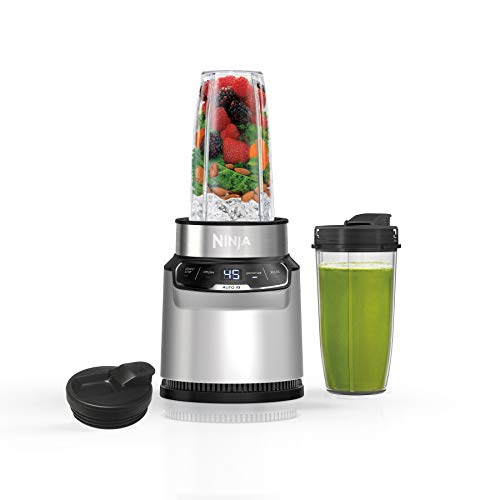
5. Ninja Nutri-Blender Pro BN401 with Auto-iQ — Best for the Gym Bag Routine
The BN401 is Ninja’s answer to the same brief as the nutribullet Pro+: a personal blender for people whose shake is part of leaving the house. Its 1100 peak-watt motor and two Auto-iQ programs handle the timing for you — one program for smoothies, one that also suits salsas and dips — so the blend finishes consistently while you do something else.
Two 24 oz cups in the box is a small detail with a big effect on routine: one cup can be in the dishwasher while the other is in your bag. The cups, lids and blade assembly are dishwasher safe, and the whole unit stores in a fraction of the space a countertop blender needs.
Strengths
- Auto-iQ programs deliver consistent shakes without guesswork
- Two 24 oz cups support a wash-one-use-one rotation
- Compact base fits small kitchens, dorms and office corners
Trade-offs
- 24 oz ceiling rules out large or shared blends
- Preset-driven control gives less manual finesse than a speed dial
- Like all personal blenders, thick low-liquid blends need care
| Motor | 1100 peak watts |
| Cups | 2 × 24 oz to-go cups |
| Programs | 2 Auto-iQ programs |
| Cleaning | Dishwasher-safe parts |
Choose between this and the nutribullet Pro+ on workflow, not headline power — both are strong. The Ninja’s edge is automation: Auto-iQ’s pulse patterns are tuned for frozen fruit, and repeatability is excellent, which matters when you make the same shake 200 mornings in a row. The nutribullet’s edge is its larger 32 oz cup and manual pulse. Athletes who want the machine to decide will prefer the BN401.
It also moonlights better than most personal blenders. The second program handles salsas, dips and sauce bases for meal prep, so the base earns its counter space beyond shakes. Just respect the cup size: overfilling past the max line is the most common cause of leaks and poor blends in this format.
Best for: athletes who value set-and-forget programs and a two-cup rotation / Not suited for: anyone who needs pitcher capacity or fine manual speed control
Check the current price on Amazon

6. KitchenAid K400 Variable Speed Blender with Tamper — Best Mid-Range Countertop
The K400 is the pick for athletes who want a real countertop blender but not a flagship bill. Its five-speed variable dial is backed by Intelli-Speed motor control, which senses the load and holds the chosen speed as frozen ingredients break down — the practical benefit is fewer stalls and less of the speed sag that leaves grit in a green smoothie.
Three preset recipe programs (Ice Crush, Icy Drinks and Smoothie) cover the training staples, and the included tamper helps with thick mixtures like smoothie bowls and nut-based blends. It sits in the mid tier on price positioning while feeling a class above basic blenders in weight, finish and control.
Strengths
- Intelli-Speed control maintains blade speed under heavy frozen loads
- Presets for ice crush, icy drinks and smoothies match athlete staples
- Tamper included for thick bowls and dense mixtures
Trade-offs
- Smaller working capacity than the 64–72 oz flagships in this guide
- Not as powerful on paper as the biggest Ninja or Vitamix models
- Fewer program options than preset-heavy rivals
| Controls | 5-speed variable dial |
| Programs | Ice Crush, Icy Drinks, Smoothie |
| Motor control | Intelli-Speed |
| Included | Tamper |
The K400’s personality is control rather than brute force. The dial lets you start slow to fold in powders and greens, then climb gradually — a technique that produces smoother results with less splashing and fewer air pockets than an on/off blast. For athletes who also cook, that same control makes it a better sauce and soup blender than preset-only machines.
It is also the most kitchen-friendly design here for people who care how the counter looks: the Contour Silver finish and die-cast style base read as a permanent appliance, not gym equipment. Performance on standard frozen shakes is thoroughly convincing; only the thickest, driest mixtures remind you it is a mid-range motor.
Best for: athletes who want countertop quality and manual control at a mid-tier position / Not suited for: batch preppers needing 72 oz, or buyers wanting maximum raw power
Check the current price on Amazon
Comparison Table
| Pick | Badge | Key Spec | Best For |
|---|---|---|---|
| Vitamix 5200 Professional-Grade Blender, 64 oz | Best Overall | 64 oz container, variable speed | athletes who blend daily and want one durable flagship for shakes, soups and meal prep |
| Ninja Professional Plus Blender BN701, 1400W Peak | Best for Big Batches | 1400 peak W, 72 oz pitcher | households, couples and batch preppers who blend large volumes at once |
| Blendtec Classic 575 with WildSide+ Jar | Best for Frozen Fruit and Ice | WildSide+ jar, 4 program cycles | frozen smoothie bowls, ice-heavy drinks and athletes who value one-button cycles |
| nutribullet Pro+ Personal Blender, 1200W | Best Personal Blender | 1200W, 32 oz + 24 oz cups | solo athletes who want a fast blend-and-go shake routine |
| Ninja Nutri-Blender Pro BN401 with Auto-iQ | Best for the Gym Bag Routine | 1100 peak W, 2 × 24 oz cups | athletes who value set-and-forget programs and a two-cup rotation |
| KitchenAid K400 Variable Speed Blender with Tamper | Best Mid-Range Countertop | 5-speed dial, Intelli-Speed | athletes who want countertop quality and manual control at a mid-tier position |
Read the table as a workflow choice, not a league table. Flagship jars win on texture and batch size; personal blenders win on speed of routine. Most serious athletes end up happiest with one of the top three countertop machines, while the two personal blenders suit solo shake drinkers who value minutes saved every single morning. If you are torn between two rows, decide on the serving you make most often — the daily shake, not the occasional smoothie bowl for guests — because the machine that fits the daily job is the one still in use next season, and consistency with nutrition, like consistency with training, is where the results actually come from.
What Should Athletes Look for in a Blender?
Start with the load, not the logo. An athlete’s typical blend — frozen fruit, ice, dairy or alternatives, oats, nut butter, powder — is one of the hardest jobs in a home kitchen, because it combines hard frozen chunks with thick, sticky ingredients and very little free liquid at the start. Motors are marketed in watts or peak watts, but what matters in practice is whether the blade keeps moving under that load without cavitation. As a rule of thumb from the machines in this guide, full-size blenders in the flagship class and personal blenders around 1100–1200W handle frozen blends confidently; small budget bullets often do not, whatever the box claims.
Jar and cup design is the second factor, and it is underrated. A tall, narrower jar (like the Vitamix 5200) builds a vortex that suits thick mixtures; a wide jar (like the Blendtec) throws ingredients back into the blades and excels at frozen drinks; stacked-blade pitchers (Ninja) crush ice aggressively for big batches. Personal cups trade all of that for speed — the blend happens in the drinking vessel, so the ceiling is one serving, but the routine is unbeatable.
Finally, judge the machine by its Tuesday-morning reality. Dishwasher-safe parts, a self-cleaning cycle, a jar that fits your cabinets, a cord length that reaches your socket — these unglamorous details decide whether the blender is used 300 times a year or thirty. Athletes are buying a habit, not a gadget.
- Frozen-load power: enough motor and blade design to process ice and frozen fruit without stalling
- Capacity matched to your routine: 64–72 oz pitchers for batches, 24–32 oz cups for solo shakes
- Cleanup you will actually do: dishwasher-safe parts or a self-cleaning cycle
- Control: variable speed or proven presets for both thin drinks and thick bowls
- Footprint and height that fit your kitchen with the jar in place
Countertop vs Personal Blender: Which Suits Training Life?
Countertop blenders are the better tool when blending is cooking: big post-training batches for two or more people, meal-prep soups and sauces, nut butters, oat flour and smoothie bowls. They cost more, take more space, and reward you with texture and capacity a personal blender cannot match. If your shake is a meal — 600-plus calories of fruit, oats, dairy and nut butter — a countertop jar handles the volume and thickness properly.
Personal blenders are the better tool when the shake is a routine: one serving, blended in its own cup, drunk on the move. They are cheaper, smaller, faster to clean and easier to keep at work or in a dorm. Their limits are real — no hot liquids in sealed cups, one serving at a time, and thick mixtures need enough liquid — but for the classic protein shake they are honestly all most athletes need.
The deciding question is who else eats from your blender. Solo shake drinker? Go personal, and put the savings toward ingredients. Feeding a partner, kids or a training group, or blending food beyond shakes? Go countertop, sized to your biggest regular batch.
How Much Power Do You Need for Frozen Fruit and Protein Shakes?
For a basic shake — liquid, fresh fruit, a scoop of powder — almost any blender in this guide is more than enough, and technique matters more than wattage: liquid first, then soft ingredients, then frozen items on top, so the blade starts in fluid and pulls the frozen load down gradually. Add powder after a few seconds of blending, through the lid opening or after a pulse, and it incorporates instead of plastering itself to the jar wall.
Frozen-heavy blending is where power separates the field. A full load of ice or frozen berries asks the motor to deliver high torque at low speed first, then sustained speed to refine. That is why the flagship countertop machines and the 1100W-plus personal blenders in this guide exist. If your current blender smells hot, leaves ice shards, or needs three restarts per shake, it is not your technique — it is an underpowered machine for the job, and upgrading will feel dramatic.
One caution about headline numbers: ‘peak watts’ is a momentary maximum, not continuous output, so treat it as a rough class marker rather than a precise ranking. Blade design, jar geometry and motor control (like KitchenAid’s Intelli-Speed) move real-world results as much as the watt figure does.
How Do You Keep a Blender Alive Through Daily Training Use?
Daily athletic use is closer to commercial duty than to normal home use, and blenders die early from a handful of repeatable abuses. The first is sustained overload: running a small personal blender for minutes at a time, or forcing a countertop jar through a mixture with almost no liquid, overheats motors and cooks the seals. Blend in bursts for thick mixtures, give personal blenders a rest between back-to-back shakes, and always include enough liquid for the mixture to circulate.
The second killer is residue. Protein and nut-butter films left to dry attack seals, cloud plastic jars and make the next shake taste like the last one. The fix is boring and total: rinse or self-clean within minutes, wash blade assemblies carefully (Ninja’s stacked blades in particular demand respect), and let jars dry fully before storing them lidded, so seals do not take a permanent set or pick up odors.
Treat wear parts as consumables. Gaskets flatten, blade assemblies dull, and personal-blender cups crack at the threads after enough cycles. Machines from established brands keep those parts available for years, which is a quiet but real advantage of the names in this guide over anonymous budget blenders — when a cup or gasket fails on a no-name machine, the whole blender usually goes in the bin.
Finally, store the machine the way you use it: assembled, on the counter, plugged into the routine. A blender that lives in a cupboard gets used on weekends; a blender that lives next to the coffee maker gets used twice a day. For athletes, that placement decision is worth more than any single specification in this article.
How to Make a Post-Workout Shake That Blends Smooth Every Time
Technique fixes most ‘bad blender’ complaints. This layering and timing method works in every machine in this guide, from the Vitamix 5200 down to the smallest personal cup, and it is built around the three classic failures: powder clumps, ice shards and air pockets.
- Add liquid first. Pour in your milk, water or alternative to cover the blades — roughly a cup for a personal blender, more for a full pitcher. The blade must start in liquid, not in dry powder or frozen chunks.
- Layer soft before frozen. Add fresh fruit, yogurt, nut butter and oats next, then frozen fruit and ice last, on top. Gravity feeds the hard ingredients into an already-moving mixture.
- Start low, then climb. Begin on the lowest speed (or pulse twice on a personal blender) for five to ten seconds to pull everything down, then increase to high. On preset machines, simply run the smoothie program.
- Add protein powder mid-blend. Once a vortex forms, add powder through the lid cap or pause and add it after the first pulse. Powder added to a moving vortex incorporates; powder dumped on top at the start coats the walls.
- Blend 45–60 seconds for frozen shakes. Most under-blended shakes are simply stopped too early. Let the mixture run until the sound evens out and the surface looks glossy and uniform.
- Fix texture, not the recipe. Too thick? Add liquid a splash at a time. Too thin? Add frozen fruit or ice a few pieces at a time. An air pocket (blade spinning, nothing moving) means stop, tamp or shake the cup, and restart low.
- Rinse immediately. A ten-second rinse now, or the self-clean cycle on countertop models, prevents the dried-on protein film that makes blenders unpleasant by Friday.
For meal-replacement shakes, treat the blender as a kitchen tool, not a shaker bottle: oats blended in add body and slow-digesting energy, a spoon of nut butter adds staying power, and a handful of spinach disappears into a fruit base without changing the flavor in any way most people can detect. Build two or three combinations you like, because the best shake is the one you will actually make after a hard session.
Common Buying Mistakes
Most disappointing blender purchases come from mismatched expectations rather than bad machines. These are the errors we see athletes make most often, and every one of them is avoidable in five minutes before you order.
- Buying by wattage alone. Peak-watt numbers are marketing-friendly and inconsistent between brands. Jar design, blade geometry and motor control decide frozen-blend results as much as the watt figure.
- Choosing a personal blender for family batches. A 24 oz cup cannot serve three people, and running it three times back-to-back overheats small motors. Match capacity to your biggest regular job.
- Loading powder and ice first. Dry powder on the blades and frozen chunks at the bottom cause clumps and cavitation. Liquid first, frozen last, powder mid-blend.
- Ignoring cabinet height. Flagship blenders with the jar seated are tall. Measure your counter-to-cabinet gap before ordering, not after delivery.
- Skipping the rinse. Protein shakes dry into concrete. A rinse or self-clean cycle immediately after use is the difference between a pleasant tool and a science project.
- Expecting a bullet to make nut butter. Thick, dry, fatty mixtures need a full-size jar, a tamper and a motor built for sustained load. Use the right tool for that job.
Final Recommendation
If you want one recommendation: the Vitamix 5200 is the best blender for athletes who blend daily and cook with it too, and it earns Best Overall on texture, control and longevity. For households and batch prep, the Ninja BN701 moves the most food per session, while the Blendtec Classic 575 is the frozen-drink specialist. Solo athletes should skip the countertop entirely and take the nutribullet Pro+ or the Ninja BN401 — the fastest routine wins. The KitchenAid K400 is the balanced middle for people who want real countertop quality without flagship pricing. Whichever you choose, check price on Amazon on the day you buy, because blender pricing shifts constantly.
Still deciding between formats? Read our companion guides next: Best Blenders Easy To Clean if cleanup is your sticking point, Best Blenders Food Processor Combo if you want one base that also chops and processes, and Best Blenders Can Handle Hot if soups are part of your meal prep. Training for a family as well as yourself? The batch techniques above pair well with the picks in Best Blenders College for budget-conscious setups, and if your household is also making baby food, see Best Blenders For Baby Food for the dedicated machines.
Frequently Asked Questions
What makes a blender good for athletes specifically?
Daily-use durability, the power and jar design to process frozen fruit and ice without stalling, enough capacity for calorie-dense shakes, and cleanup fast enough that you will use it twice a day. Athletes blend harder loads, more often, than typical smoothie drinkers, so marginal machines fail faster in training kitchens.
Is a personal blender powerful enough for frozen fruit?
The stronger ones are. Personal blenders around 1100–1200W, like the nutribullet Pro+ and Ninja BN401 in this guide, handle frozen berries and banana well with correct layering. Very cheap bullets with small motors struggle, leave ice shards and overheat — power class matters more in this format than any other.
Can I put hot soup in a personal blender cup?
No. Sealed personal cups are not designed for hot liquids — steam pressure can build dangerously. Hot blending belongs in a vented countertop pitcher, and even then you should start on low speed with the lid cap vented. Check your model’s manual for its hot-liquid guidance.
How do I stop protein powder clumping in the shake?
Add it mid-blend, once a vortex has formed, rather than at the start. If your machine has no lid opening, blend the base for a few seconds, stop, add the powder, pulse twice, then finish. Powder that hits a moving liquid surface incorporates; powder sitting on dry jar walls does not.
Vitamix or Blendtec for a serious training diet?
Both are flagship-class and either will serve for years. Choose the Vitamix 5200 for manual variable-speed control and the smoothest thick blends; choose the Blendtec Classic 575 for programmed cycles, a wide easy-scrape jar and frozen drinks. The deciding factors are control style and jar shape, not raw ability.
How long should an athlete-grade blender last?
A flagship countertop blender used daily should last many years — that longevity is the core of its value case. Personal blenders work their motors harder per ounce and are realistically a shorter-life purchase. In both cases, rinsing immediately, avoiding sustained overloads and keeping blades and seals clean extends working life considerably.


