Disclosure: airfryerkitchensupply.com is reader-supported. When you buy through links on our site, we may earn an affiliate commission at no extra cost to you.
Where to buy
Amazon is where the best basic toaster ovens are sold at their sharpest, and every pick below was verified against the maker’s own catalog listing for this site before a link was added — capacities, functions and temperature ranges in the reviews come from those verified listings. Use the links to check price on Amazon, and measure your counter before ordering: a toaster oven needs clearance above and behind for heat, and the exterior dimensions in each listing — not the slice count — decide whether it fits under your cabinets.
- BLACK+DECKER 4-Slice Toaster Oven TO1745SSG — Best Overall: Check the current price on Amazon
- Hamilton Beach Easy Reach 4 Slice Toaster Oven — Best for Easy Access: Check the current price on Amazon
- BLACK+DECKER TO1313SBD Toaster Oven — Best Budget: Check the current price on Amazon
- Proctor Silex 4 Slice Toaster Oven 31260G — Best Simple and Compact: Check the current price on Amazon
- Panasonic FlashXpress Toaster Oven NB-G110P — Best for Toast: Check the current price on Amazon
- Elite Gourmet ETO449X Toaster Oven — Best for Tiny Spaces: Check the current price on Amazon
A basic toaster oven is a deliberate rejection of feature creep. No air fry modes you will use twice, no rotisserie spits, no app. What remains is the original bargain of the category: a small, fast box that toasts bread properly, bakes a tray of cookies or a personal pizza, broils a cheese sandwich, and reheats leftovers better than a microwave — all without heating a full-size oven and the whole kitchen with it. The best basic toaster ovens do those few jobs with controls a guest can understand at a glance: a temperature knob, a function knob, a timer that dings.
The six picks here are all 4-slice class ovens, because that is the honest center of “basic”: big enough for a 9-inch pizza in most cases, small enough for a normal counter. Within that class they differ in the ways that actually matter day to day — how the door opens, how the toast browns, whether the crumb tray slides out from the front, and how much of your money goes to engineering versus extras. One uses infrared elements for near-instant heat; another rolls its door up and out of the way; the cheapest still manages convection. Basic, it turns out, is a spectrum, not a single product.
Set expectations correctly and this category delights. A basic toaster oven will not roast a Thanksgiving turkey or match a full oven’s evenness on a tall cake. It will, however, handle perhaps eighty percent of what a household actually cooks in a week — toast, reheats, frozen snacks, small bakes, broiled toppings — faster and with less energy than the big oven. That is the entire case for the product, and these six make it best.
In this guide
Quick Picks
BLACK+DECKER 4-Slice Toaster Oven TO1745SSG — Best Overall. Four honest functions, Even Toast browning, a slide-out crumb tray and a timer — the complete basic oven, done right. Check the current price on Amazon
Hamilton Beach Easy Reach 4 Slice Toaster Oven — Best for Easy Access. The roll-top door moves up and out of the way, so food goes in and out without reaching over a hot drop-down door — and crumbs stay off the door entirely. Check the current price on Amazon
BLACK+DECKER TO1313SBD Toaster Oven — Best Budget. A compact convection oven that fits a 9-inch pizza, with a stay-on function and removable crumb tray, at the budget end of the shelf. Check the current price on Amazon
Proctor Silex 4 Slice Toaster Oven 31260G — Best Simple and Compact. Bake, broil, toast; 200-450°F; a 30-minute timer with auto shutoff. The appliance equivalent of a firm handshake. Check the current price on Amazon
Panasonic FlashXpress Toaster Oven NB-G110P — Best for Toast. Double infrared heating with no real preheat wait, six auto cook options and precise temperature control — the connoisseur’s basic oven. Check the current price on Amazon
Elite Gourmet ETO449X Toaster Oven — Best for Tiny Spaces. A 9.5-quart, 800W mini oven that fits an 8-inch pizza and the counters nothing else fits. Check the current price on Amazon
How These Picks Were Chosen
We defined “basic” strictly: bake, broil, toast and keep-warm class functions, knob-or-simple controls, no air fry or specialty modes driving the price. Every candidate then had to be a genuine 4-slice-class oven from a maker with a real presence in the category, and every pick was verified against Amazon’s catalog data for this site — model number, functions and temperature range in the listing title had to match the oven described here before it earned a purchase link.
Within the class, we judged the unglamorous details that decide satisfaction in month six: crumb tray access (front slide-out beats tilting the oven), door design (drop-down doors collect crumbs and demand reach; the roll-top avoids both), toast evenness technology, and honest temperature ranges. We deliberately included one infrared outlier, the Panasonic, because its speed changes the daily experience enough to justify its premium for the right buyer — and we labeled it as the premium pick rather than pretending it competes on price.
The 6 Best Basic Toaster Ovens

BLACK+DECKER 4-Slice Toaster Oven TO1745SSG — Best Overall
The TO1745SSG is the basic toaster oven in its most complete form. Four functions — bake, broil, toast and keep warm — cover the whole honest workload of the category; BLACK+DECKER’s Even Toast design addresses the category’s oldest complaint, patchy browning; the crumb tray removes for cleaning instead of demanding you shake the oven over a bin; and a proper timer keeps toast from becoming charcoal when the phone rings. Nothing here is exciting, and that is precisely the recommendation: this is the oven you stop thinking about, which is the highest praise a basic appliance can earn.
Strengths
- Complete basic function set including keep warm, which many rivals omit
- Even Toast design targets the patchy-browning flaw of cheap ovens
- Removable crumb tray makes the weekly clean a ten-second job
Trade-offs
- 4-slice capacity caps you at personal pizzas and small trays
- Knob controls are simple but not precise to the degree
- No convection fan, so baked goods brown a touch less evenly than in the convection budget pick
| Capacity | 4-slice |
| Functions | Bake, broil, toast, keep warm |
| Features | Even Toast technology, removable crumb tray, timer |
In a household this oven becomes infrastructure: morning toast, lunchtime melts, evening reheats of pizza that come back crisp instead of microwaved into leather. The keep-warm function, easy to dismiss on paper, turns out to be the one that gets used at every family meal where people eat in shifts. If you are buying one basic oven for a normal kitchen and want no regrets in any direction, this is the safest pair of hands in the roundup.
Step elsewhere only for a specific reason: the Hamilton Beach if door access bothers you, the Panasonic if toast quality is your religion, the Proctor Silex if your counter is truly tiny. Absent a specific reason, the TO1745SSG is the answer.
Best for: Most households wanting one simple, dependable countertop oven for daily basics / Not suited for: Anyone who needs to fit a large casserole or a whole chicken.
Check the current price on Amazon

Hamilton Beach Easy Reach 4 Slice Toaster Oven — Best for Easy Access
The Easy Reach solves the toaster oven’s most annoying daily interaction: the drop-down door. On a conventional oven the door opens toward you and down, so you reach over a hot door to load food, and crumbs that fall during loading land on the door and get baked onto it. Hamilton Beach’s roll-top door rolls up and back over the oven instead — the opening is completely clear, food slides straight in, and crumbs fall into the oven where the tray catches them, not onto the door. It is a small redesign that improves every single use.
Strengths
- Roll-top door gives unobstructed access and keeps the door crumb-free
- Full 200 to 450°F range with bake, broil and toast functions
- Auto shutoff adds peace of mind for busy or forgetful households
Trade-offs
- The roll-top mechanism needs vertical clearance as the door travels up and back
- No convection or keep-warm extras — the function set is strictly basic
- Two rack positions only, which limits tall-item flexibility
| Capacity | 4-slice |
| Door | Roll-top door for easy access |
| Functions | Bake, broil, toast |
| Temperature | 200 to 450°F adjustable |
| Safety | Auto shutoff |
The Easy Reach also suits cooks for whom the reach itself is the problem — shorter cooks, anyone with limited mobility, and kitchens where the oven sits at the back of a deep counter. Loading a bubbling dish of mac and cheese straight in and out, rather than over a door, is a safety feature as much as a convenience. Hamilton Beach offers this same door in a 6-slice version for bigger households, verified in our research, but the 4-slice here is the basic-class pick.
Choose it if door design has ever annoyed you — which, if you have owned a toaster oven, it has. Choose a conventional model only if your cabinet clearance above the counter is too tight for the door’s upward travel.
Best for: Anyone who hates reaching over a drop-down door, and cooks with limited counter depth / Not suited for: Air fry fans — this is a classic bake/broil/toast oven.
Check the current price on Amazon
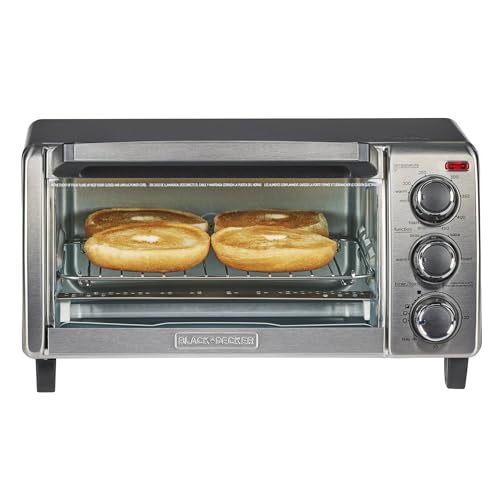
BLACK+DECKER TO1313SBD Toaster Oven — Best Budget
The TO1313SBD is the budget pick that refuses to feel like a compromise where it counts. It is a compact convection oven — the fan helps baked items brown more evenly than in fanless rivals — sized at 15.47 inches and still able to fit a 9-inch pizza, which is the capacity line that separates a toy from a tool. A timer, a stay-on function for longer bakes, and a removable crumb tray complete a spec that embarrasses several pricier ovens in this roundup.
Strengths
- Convection at a budget tier — better browning on bakes and reheats
- Fits a 9-inch pizza despite the compact footprint
- Stay-on function plus timer covers both short toasts and long, low bakes
Trade-offs
- Compact interior means tall items need measuring before you commit
- Basic knob controls and finish — function over form throughout
- Convection fan adds a little noise the fanless picks do not make
| Size | 15.47 inch, silver |
| Capacity | Fits a 9-inch pizza |
| Features | Convection, timer, stay-on function, removable crumb tray |
This is the first-apartment and replace-the-microwave oven: the one bought with a gift card that ends up used three times a day for five years. The convection fan earns its keep most on frozen foods — nuggets, fries, pizza — where moving air is the difference between crisp and soggy, and on reheats, where it revives texture the microwave destroys. For a single person or couple cooking small portions, it can quietly become the main oven of the house.
Buy it when budget leads the decision but you still want real capability. Spend more only if you know you need the Panasonic’s toast quality or the Hamilton Beach’s door — the cooking results here will not embarrass you.
Best for: Budget shoppers and first apartments that still want convection and a 9-inch pizza fit / Not suited for: Precision bakers who want digital temperature control.
Check the current price on Amazon

Proctor Silex 4 Slice Toaster Oven 31260G — Best Simple and Compact
Proctor Silex builds the oven for people who look at appliance control panels the way they look at tax forms. The 31260G offers bake, broil and toast, a temperature dial spanning 200-450°F, and a 30-minute timer that shuts the oven off automatically when it rings down. Four slices fit inside. That is the whole description, and for a large group of buyers — dorm rooms, office kitchens, grandparents, minimalists, anyone furnishing a first kitchen on a budget — it is not a limitation but the entire point.
Strengths
- Maximum simplicity: three functions, two dials, zero learning curve
- Automatic shutoff on the timer — set it and genuinely forget it
- Compact 4-slice footprint suits the smallest counters
Trade-offs
- No keep-warm, no convection, no extras of any kind
- 30-minute timer ceiling rules out long slow bakes
- Interior is strictly small-batch
| Capacity | 4-slice |
| Functions | Bake, broil, toast |
| Temperature | 200-450°F adjustable |
| Timer | 30 minute timer with automatic shutoff |
There is an underappreciated virtue in an appliance with nothing to break down into menus: it gets used by everyone in the house, including the people who refuse to learn new gadgets. In shared spaces — offices, dorms, rental kitchens — that universality is worth more than features. The auto shutoff also makes it the pick we are most comfortable recommending for elderly relatives cooking alone.
Buy it for simplicity’s sake and mean it. If you find yourself wanting convection, keep-warm or a longer timer within the year, the BLACK+DECKER picks above are the upgrade path — but plenty of owners never want more than this.
Best for: Minimalists, dorms and small kitchens that want knobs, heat and nothing else / Not suited for: Anyone cooking for more than two people at once.
Check the current price on Amazon
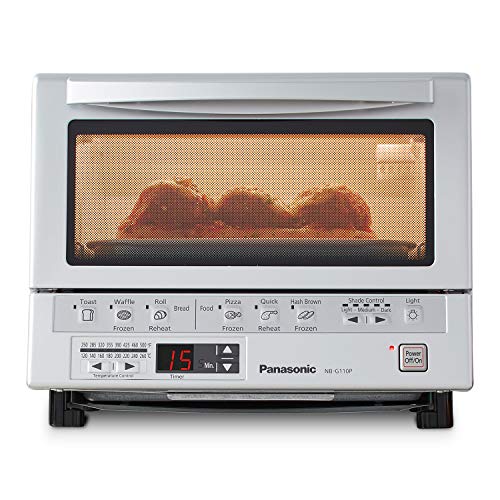
Panasonic FlashXpress Toaster Oven NB-G110P — Best for Toast
The FlashXpress is the basic toaster oven for people who care about the basics at a connoisseur level. Instead of conventional heating elements that need minutes to come up to temperature, Panasonic uses double infrared heating at 1300W — the oven is effectively ready when you are, and toast browns with a speed and evenness that element ovens struggle to match. Six auto cook options and precise temperature control replace the vague knob-guesswork of the class, in a compact silver 4-slice body that has become something of a design classic in the category.
Strengths
- Double infrared heating means virtually no preheat wait
- Toast quality and reheating speed are the best in this roundup
- Precise temperature control and six auto cook options reward exact cooks
Trade-offs
- Premium pricing — it costs what feature-loaded ovens cost, for basic functions done superbly
- Compact interior is tuned for toast and small items, not family trays
- No convection fan; its evenness comes from the infrared elements instead
| Capacity | 4-slice, compact |
| Heating | Double infrared heating, 1300W |
| Controls | 6 auto cook options, precise temperature control |
The FlashXpress reframes what “basic” can mean: not fewer features, but the core jobs executed at a higher level. Frozen waffles, reheated pizza, a single portion of salmon, toast at exactly your shade — the infrared system’s instant response makes the oven feel less like an appliance and more like a tool that keeps up with you. For a one- or two-person household that uses a toaster oven daily and a big oven rarely, the arithmetic of paying more for the thing you use most is sound.
Buy it if toast and reheats are your oven’s real job description and you are willing to pay for them done properly. If your use is occasional, the premium is wasted — the budget picks will toast your bread just fine.
Best for: Toast perfectionists and anyone reheating leftovers fast, without preheating a big oven / Not suited for: Budget buyers — it is the premium-priced basic oven here.
Check the current price on Amazon

Elite Gourmet ETO449X Toaster Oven — Best for Tiny Spaces
The Elite Gourmet ETO449X exists for the counters the other picks cannot fit. At 9.5 quarts with an 800W quartz heating system, it is a true mini oven: four slices, an 8-inch pizza, a temperature range of 200-450°F and a 30-minute timer in a footprint made for dorm rooms, RVs, studio apartments and office nooks. Quartz elements heat fast, suiting the small interior, and the black compact body disappears into tight spaces in a way a full-size oven never could.
Strengths
- The smallest genuine oven in this roundup — fits where others cannot
- Full 200-450°F range despite the mini size
- 800W draw is gentle on dorm and RV electrical circuits
Trade-offs
- 8-inch pizza ceiling — measure your frozen pizzas before buying
- Small cavity means small batches, always
- Basic build and controls, as the size and tier dictate
| Capacity | 9.5 qt / 4-slice |
| Power | 800W quartz |
| Fits | 8-inch pizza |
| Temperature | 200-450°F adjustable |
| Timer | 30-minute timer |
Judge this oven against the alternative in its habitat, which is not a bigger toaster oven — it is a microwave, or no oven at all. Against that competition it is transformative: real toast, crisp reheats, a baked potato, a personal pizza with a browned crust. RV and dorm cooks in particular will find that a mini oven changes what eating-in means. The modest wattage is a feature in these settings, where a 1500W appliance can be the one that trips the breaker.
Buy it when space or power is the binding constraint. If your counter fits a standard 4-slice oven, the other picks give you more capacity for similar money — this one’s genius is specifically for the spaces they cannot go.
Best for: Dorms, RVs, offices and the smallest counters, where every inch is negotiated / Not suited for: Households that regularly cook 9-inch pizzas or larger dishes.
Check the current price on Amazon
Comparison Table
| Pick | Badge | Key spec | Best for |
|---|---|---|---|
| BLACK+DECKER TO1745SSG | Best Overall | 4 functions incl. keep warm, Even Toast | The complete basic oven |
| Hamilton Beach Easy Reach 4 Slice | Best for Easy Access | Roll-top door, 200-450°F, auto shutoff | Easy loading, crumb-free door |
| BLACK+DECKER TO1313SBD | Best Budget | Convection, fits 9-inch pizza | Value with real capability |
| Proctor Silex 31260G | Best Simple and Compact | 3 functions, 30-min timer, auto shutoff | Simplicity seekers, dorms |
| Panasonic FlashXpress | Best for Toast | Double infrared, 1300W, 6 auto cook options | Toast and reheat quality |
| Elite Gourmet ETO449X | Best for Tiny Spaces | 9.5 qt, 800W quartz, fits 8-inch pizza | Dorms, RVs, micro counters |
BLACK+DECKER TO1745SSG: Check the current price on Amazon
Hamilton Beach Easy Reach 4 Slice: Check the current price on Amazon
BLACK+DECKER TO1313SBD: Check the current price on Amazon
Proctor Silex 31260G: Check the current price on Amazon
Panasonic FlashXpress: Check the current price on Amazon
Elite Gourmet ETO449X: Check the current price on Amazon
How to Choose the Best Basic Toaster Ovens
Measure first — twice. The exterior footprint decides whether the oven fits your counter and cabinet clearance; the interior decides whether your actual dishes fit the oven. Bring your most-used small pan and your usual frozen pizza size to the decision: a 4-slice oven that fits a 9-inch pizza covers most singles and couples, but an 8-inch ceiling, like the Elite Gourmet’s, is a real limitation if your freezer says otherwise. Leave heat clearance above and behind whatever you buy; toaster ovens vent real heat, and cabinets directly overhead should be checked against the maker’s guidance in the listing.
Then rank the daily frictions. If you eat toast daily, browning evenness and speed (the Panasonic’s infrared, BLACK+DECKER’s Even Toast) outrank everything. If you bake small batches, convection (the budget BLACK+DECKER) quietly improves results. If loading and cleaning annoy you, door design and crumb tray access (the Hamilton Beach) are worth more than any function list. “Basic” does not mean identical — it means the differences have moved from features to ergonomics, which is where they actually live in daily use.
Toaster Oven vs Full Oven vs Air Fryer: An Honest Division of Labor
The full oven still wins for volume and for tall, delicate bakes: a layer cake, a Dutch oven of stew, a holiday bird. The air fryer wins for maximum crispness on small batches of frozen and breaded foods. The basic toaster oven wins the broad middle — everything too small to justify heating the big oven and too bread-like, cheesy or bake-oriented for the air fryer’s basket: toast, melts, reheated pizza and pasta, small casseroles, cookies by the half-dozen, garlic bread, nachos. Most households that own one find it becomes the default oven for one- and two-person cooking, and the big oven becomes the specialist. Buy the basic oven for that middle, and do not ask it to be either of the other two.
How to Set Up and Use a Basic Toaster Oven Well
Step 1: Give it air. Place the oven with clearance on top and behind per the maker’s guidance, away from paper, towels and plastic. Toaster ovens get properly hot on the outside; treat the space around them like the space around a stove burner.
Step 2: Learn your oven’s hot spots with toast. Run a full rack of bread slices once, early in ownership, and look at the pattern. Every small oven has a personality; knowing yours — a darker back-left corner, say — tells you when to rotate a tray halfway through a bake.
Step 3: Use the middle rack position and small pans. Most basic cooking lives on the middle position. Match pan size to the cavity with room around the edges for air to circulate; an oversized pan that blocks airflow cooks unevenly no matter how good the oven is.
Step 4: Preheat briefly for bakes, skip it for toast. Five minutes brings a small oven to temperature for cookies and casseroles. Toast, melts and reheats can start cold — and the infrared Panasonic barely needs preheating for anything.
Step 5: Empty the crumb tray weekly. Crumbs near the elements are the main cause of smoke, smells and, in the worst case, a small fire. The slide-out trays on these picks make it a ten-second habit; set the habit.
What “Basic” Leaves Out — and When You Will Actually Miss It
Honesty about the omissions helps you buy once. Air fry mode is the big one: a basic oven bakes frozen fries acceptably but will not match a convection air fry oven’s crispness, because it lacks the high-speed fan and the basket geometry. If frozen snacks are a weekly ritual for a family, that is a real reason to step up a category rather than a marketing invention. Interior lights are the second omission — most basic ovens are dark inside, and judging browning means opening the door or trusting the timer. Digital precision is the third: knob ovens wander a little around the set temperature, which matters for delicate baking and not at all for toast, melts and reheats.
What you will not miss: preset menus for foods you cook by eye anyway, rotisserie spits in a 4-slice cavity, and companion apps. The pattern to notice is that everything on the miss list is either a different appliance’s job or a refinement of a job the basic oven already does. Buy basic confidently if your cooking is toast-centric and small-batch; buy up only when a specific omission maps to a specific weekly habit.
Placement, Heat and Small-Kitchen Reality
A toaster oven is a small appliance with a stove’s manners. Its exterior gets hot — hot enough that the space above it matters, and plastic items, paper towels and cookbooks should not live on top of it or wedged beside it. In small kitchens the temptation is to push it into a corner under the lowest cabinet; resist unless the maker’s clearance figures allow it, because trapped heat ages cabinets and the oven alike. The roll-top Hamilton Beach deserves a specific note here: its door travels upward, so measure the door’s path, not just the box, against your cabinet height.
Electrical reality matters too. These ovens draw real power — the Panasonic in this guide is 1300W, and full-size basics commonly draw similar loads. On an older kitchen circuit shared with a kettle or microwave, running two big appliances at once can trip the breaker; the Elite Gourmet’s modest 800W draw is a deliberate feature for dorms and RVs, where circuits are small and patience for breaker panels is smaller. Match the oven to your wiring as honestly as to your counter.
The Reheat Case: Where Basic Ovens Quietly Win
If this category has a killer application, it is the reheated leftover. A microwave returns pizza with a soft, steamed crust and rubbery cheese; a basic toaster oven returns it with the crust re-crisped and the cheese re-melted — closer to the original meal than to a compromise. The same applies to fried foods, roasted vegetables, quiche, and anything whose texture was the point. Five minutes at moderate heat, straight from the fridge on the oven’s tray, is the whole technique. Households that cook once and eat twice — which is to say, most households that cook at all — will find this single use justifies the counter space, and it is the use that converts skeptics who thought the toaster oven was a toast-only appliance.
A Week With a Basic Toaster Oven: What It Actually Cooks
Monday is toast and a reheated slice of quiche. Tuesday is a tray of frozen samosas that come out crisp instead of microwaved soft, because moving hot air — even without an air fry mode — treats pastry kindly. Wednesday is garlic bread under the broiler next to a pasta that never needed the oven at all. Thursday is two salmon fillets and a handful of asparagus on the small tray, a complete dinner for two that would have been absurd to heat a full oven for. Friday is pizza night at personal scale: a 9-inch pizza, or naan pizzas built to individual order, which families with strong opinions quietly prefer. Saturday is cookies, half a batch, baked while the coffee brews. Sunday is the leftover revival — roast vegetables and the remains of a chicken, re-crisped into something that tastes intentional.
That diary is the real specification sheet of this category. Notice what is absent: nothing tall, nothing huge, nothing requiring a water bath or a Dutch oven. Notice also what is present: seven days of use from an appliance that occupies a breadbox’s worth of counter. When people say a basic toaster oven changed how they cook, this week is what they mean — the big oven did not get worse; it just got promoted to special occasions.
Small Pans and Accessories That Unlock a Basic Oven
The oven is only half the system; the other half is pans that fit it. An 8×8-inch pan and a quarter-sheet tray cover the overwhelming majority of toaster oven cooking — brownies, small casseroles, roasted vegetables, reheats — and our companion guide to the Best Bakeware For Toaster Ovens exists precisely because standard pans do not fit. A small oven-safe ramekin set handles individual portions and eggs; a pair of silicone mitts sized for reaching into a small cavity prevents the knuckle burns that full-size mitts invite. None of this is expensive, and all of it multiplies what the basic oven can do far more than a feature upgrade on the oven itself would.
One accessory to skip: the third-party “universal” racks and trays sold by diameter alone. Clearances in a small oven are tight, and a rack that nearly touches the upper elements is a scorching hazard. Buy pans by measured interior dimensions, leave air room around them, and the oven will cook the way its maker intended.
How Long Will a Basic Toaster Oven Last?
Simplicity is a durability strategy. A knob-controlled oven has no touchscreen to fail, no control board waiting to be orphaned by a discontinued part, and heating elements that are among the most proven components in the kitchen. In ordinary home use, a basic oven from the makers in this guide should give years of daily service; the parts that age first are cosmetic — door seals, knob markings, tray finishes — rather than functional. The habits that shorten life are the ones this guide has already flagged: crumbs left to carbonize against the elements, grease baked on in layers, and the oven run jammed against a wall so its own heat cannot escape. Treat it like the small stove it is, and “basic” turns out to be the longest-lived tier in the category — one more argument for buying the simple oven well instead of the complicated oven cheaply.
A closing thought on value, because this category invites a particular mistake: assuming that because basic ovens are inexpensive, they are disposable. The opposite is true. The cheapest complicated appliance is usually the worst purchase in a kitchen, and the well-bought simple one the best — and nowhere is that clearer than here, where a modest oven with a good door, a removable tray and honest browning will out-cook and out-last a feature-stuffed rival at twice the commitment. Buy the basics properly, once, and let the oven disappear into your routine. That disappearance is the product.
It is also worth saying who should skip this category entirely. If your household cooks for five or more every night, a 4-slice oven will spend its life as a reheating station while the big oven does the real work — useful, but not the centerpiece purchase this guide assumes. And if your baking ambitions run to artisan bread and tall celebration cakes, your money belongs in oven quality, not countertop convenience. The basic toaster oven is a specialist in small, frequent, everyday cooking; households whose cooking matches that description will use it daily, and households whose cooking does not should buy accordingly.
One last practical note: keep the box and the manual’s clearance page for the first month. If the oven’s heat pattern, door swing or footprint fights your kitchen, that is a discovery to make while returns are painless — and the right basic oven, in the right spot, is a ten-year decision you should not have to compromise on.
Trust the humble toast test above all, every single time: in the first week, one rack of bread will tell you more about your oven than any review, including this one.
Common Buying Mistakes
Buying by slice count alone. Four-slice ovens vary enormously in interior height and depth. Check pizza diameter and interior dimensions against your real cookware.
Paying for modes you will never use. The premise of this guide: a dozen specialty functions do not toast better. Spend on door design, browning quality and build instead.
Ignoring the crumb tray design. If crumbs require tilting the oven or reaching inside, the tray will not get emptied — and the oven will smoke by month three. Front slide-out trays get used.
Squeezing it under cabinets without clearance. Heat rises. Check the maker’s clearance guidance and your cabinet height before the oven arrives, not after.
Expecting full-oven results on tall bakes. Elements sit close to the food in a small cavity; tall cakes and soufflés can scorch on top. The basic oven is a champion of flat and small, and a specialist tool — use it as one.
Final Recommendation
Buy the BLACK+DECKER TO1745SSG if you want the complete basic oven with no weak spots. Take the Hamilton Beach Easy Reach if loading and cleaning have ever frustrated you, the TO1313SBD if budget leads but you still want convection and a 9-inch pizza, the Proctor Silex if simplicity is the whole requirement, the Panasonic FlashXpress if toast quality justifies a premium, and the Elite Gourmet if your counter or circuit makes the decision for you. Each is basic in the honorable sense: a few jobs, done properly, every day.
Need the pans to go with it? See Best Bakeware For Toaster Ovens. Ready to step beyond basic later? Compare Best Air Fry Toaster Ovens, Best Digital Toaster Ovens and Best Affordable Toaster Ovens, or size up with Best Big Toaster Ovens.
BLACK+DECKER TO1745SSG: Check the current price on Amazon
Hamilton Beach Easy Reach 4 Slice: Check the current price on Amazon
BLACK+DECKER TO1313SBD: Check the current price on Amazon
Frequently Asked Questions
What size pizza fits in a basic 4-slice toaster oven?
Usually a 9-inch pizza, as with the budget BLACK+DECKER pick here — but the mini Elite Gourmet caps at 8 inches, and interiors vary. Always check the pizza diameter in the listing against the pizzas you actually buy; it is the single most useful capacity number in this category.
Is a basic toaster oven cheaper to run than a full oven?
For small jobs, yes, meaningfully: you are heating a few cubic feet instead of a whole oven cavity, and preheats shrink from fifteen minutes to five or none. For a full family dinner the big oven is more efficient per serving. The toaster oven’s economy is the economy of small batches, which is most weeknight cooking for one or two people.
Can I bake cookies and cakes in a basic toaster oven?
Cookies, yes — they are the category’s home turf, baked a small tray at a time. Cakes, with care: use the middle rack, watch the top, since elements sit close, and expect small, flat layers to do best. Tall or delicate bakes still belong in the full oven.
Why does my toaster oven toast unevenly?
Small cavities put food close to the elements, so hot spots show. Ovens designed against it — Even Toast layouts, convection fans, infrared elements like the Panasonic’s — do measurably better. Rotating the bread or tray halfway through is the free fix that works in any oven.
How often should I clean a toaster oven?
Empty the crumb tray weekly, wipe the interior monthly, and clean up cheese or grease spills promptly, before they bake into smoke. Most of these picks have removable trays and nonstick-friendly interiors that make the routine quick; the ovens that get neglected are the ones with awkward tray access, which is why this guide weights it.
Do I need to preheat a toaster oven?
For baking, a short preheat — about five minutes — gives more reliable results. For toast, melts and reheats, starting cold is fine and faster overall. Infrared models like the FlashXpress largely skip the question, since their elements reach temperature almost immediately.
Can a toaster oven replace my regular oven?
For one- and two-person households, largely yes for weeknight cooking — small bakes, reheats, toast and broiling all move over, and many owners find the big oven idle for weeks. Families, batch bakers and holiday cooks still need the full oven’s volume. Think of the toaster oven as replacing the big oven’s small jobs, which are the majority of its jobs in most homes.
Are toaster ovens safe to leave plugged in?
They are designed to be countertop appliances, but the safe habit in this category is respect: keep clearance around the oven, empty the crumb tray so debris cannot smolder, use the timer or auto shutoff rather than stay-on modes when you can, and never run it under low cabinets against the maker’s guidance. Several picks here include auto shutoff precisely to forgive human forgetfulness.
What temperature should I use for reheating in a toaster oven?
Moderate heat is the general answer: around 325-350°F for most leftovers, giving the center time to warm through while the surface re-crisps, rather than blasting the outside at broiler temperatures. Pizza and fried foods reward a few minutes at the higher end of that band; delicate items like fish and quiche do better at the lower end. When in doubt, lower and slightly longer beats hotter and scorched — you can always add a minute, and you cannot subtract one.
Can I put foil in a basic toaster oven?
Yes, with the same respect you would give foil in any oven: keep it off the heating elements, do not let it touch the walls where it can trap heat against them, and never drape it over the crumb tray in a way that blocks airflow. A small foil-lined tray under drippy cheese melts is standard practice and makes cleanup trivial; a fully foil-wrapped cavity is not.