Disclosure: airfryerkitchensupply.com is reader-supported. When you buy through links on our site, we may earn an affiliate commission at no extra cost to you.
Where to buy
Shopping for the best 12 volt deep cycle battery? Every linked pick below was confirmed through the Amazon Creators API on our own site install before this guide was written, so the product name, capacity and battery-management details in each review match the live listing title exactly. Prices move constantly on batteries this size, so no figure is printed here — use the Amazon links to check price on Amazon on the day you buy, and confirm the group size and terminal layout on the listing before ordering.
- LiTime 12V 100Ah LiFePO4 Battery, Group 24, Bluetooth — Best Overall: check price on Amazon
- 12V 200Ah LiFePO4 Battery with 200A BMS (UL1973 / UN38.3) — Best for Large Banks: check price on Amazon
- Renogy 12V 100Ah Deep Cycle AGM Battery — Best AGM: check price on Amazon
- NERMAK 12V 50Ah LiFePO4 Deep Cycle Battery — Best Compact: check price on Amazon
- Feuruetc 12V 50Ah LiFePO4 Solar Battery — Best for Small Solar: check price on Amazon
- HQST 12V 100Ah LiFePO4 Battery, Group 22NF Mini — Best Mini-Format 100Ah: check price on Amazon
Finding the best 12 volt deep cycle battery starts with one honest fact: there is no single winner, because a deep cycle battery is really two different products wearing the same label. Lithium iron phosphate (LiFePO4) models now dominate new RV, marine and solar installs because they deliver nearly all of their rated capacity, weigh roughly half as much as lead-acid and survive thousands of cycles. Sealed AGM lead-acid models still earn their place where the charger is old, the budget is tight, or the battery must also crank an engine. This guide separates the two chemistries cleanly, sizes each pick by real usable energy rather than headline amp-hours, and flags the limits — cold-weather charging, series and parallel rules, charger compatibility — that decide whether a battery lasts a decade or disappoints in a season.
A true deep cycle battery is built to be discharged deeply and recharged hundreds or thousands of times, unlike a starting battery that delivers a short burst and stays near full. That distinction matters more than brand. A cheap starting battery pressed into house-battery duty will fade within a year, while a genuine deep cycle design — thick plates in lead-acid, or a protected lithium pack with a battery management system (BMS) — tolerates daily cycling. The six picks below cover the main honest choices: a Bluetooth lithium all-rounder, a high-capacity lithium bank battery, a dependable AGM, a compact lithium for smaller loads, a solar-leaning lithium, and a mini-format lithium for tight compartments.
In this guide
Quick Picks
Short on time? These are the six picks in one view. Badges are used identically in the detailed reviews further down, so you can jump straight to the model that matches your use.
- LiTime 12V 100Ah LiFePO4 Battery, Group 24, Bluetooth — Best Overall. A Group 24 lithium drop-in with Bluetooth monitoring, a 100A BMS, low-temperature charge protection and 1,280Wh of energy — the easiest single-battery upgrade for most RV and trolling-motor setups. — Check on Amazon
- 12V 200Ah LiFePO4 Battery with 200A BMS (UL1973 / UN38.3) — Best for Large Banks. Double the energy of a 100Ah unit in one box — 2,560Wh with a 200A BMS and low-temperature protection, for off-grid cabins, bigger RVs and solar storage that outgrew a single small battery. — Check on Amazon
- Renogy 12V 100Ah Deep Cycle AGM Battery — Best AGM. The dependable sealed lead-acid option: maintenance-free AGM from an established solar brand, safe for RV, cabin, marine and off-grid use, and compatible with the chargers most owners already own. — Check on Amazon
- NERMAK 12V 50Ah LiFePO4 Deep Cycle Battery — Best Compact. Half-size lithium with a full-size 100A BMS — 50Ah for kayaks, fish finders, small solar and portable power boxes where a 100Ah battery simply does not fit or is not needed. — Check on Amazon
- Feuruetc 12V 50Ah LiFePO4 Solar Battery — Best for Small Solar. A lightweight, maintenance-free 50Ah lithium aimed squarely at small solar systems, off-grid lighting and backup power — the starter battery for a first panel-and-battery build. — Check on Amazon
- HQST 12V 100Ah LiFePO4 Battery, Group 22NF Mini — Best Mini-Format 100Ah. Full 100Ah and 1,280Wh in a smaller Group 22NF mini case with an LED meter and low-temperature protection — for compartments that reject a standard Group 24 box. — Check on Amazon
How These Picks Were Chosen
Each candidate had to pass three gates before it could be recommended. First, identity: the exact product was searched by brand and model through the Creators API attached to this site, and the ASIN used for every Amazon link comes from that API response — if the returned title did not clearly match the intended product, the pick was dropped or written without a link. Second, honesty of specification: only figures stated in the verified listing title — capacity, group size, BMS rating, cycle claims, waterproof rating — are repeated in the spec boxes, and nothing else is invented. Third, fit: the six finalists were chosen to cover distinct jobs (all-round RV use, large banks, AGM compatibility, compact installs, solar storage, mini compartments) rather than six near-identical boxes.
Two standing rules shape the whole guide. No fixed price is printed for any battery, because lithium prices in particular swing week to week; each pick is positioned by tier in words instead. And no star rating or review count appears anywhere, for the same reason — those numbers change daily and would be stale on arrival. Where a chemistry has a genuine weakness, such as lithium charging below freezing, it is stated plainly in the trade-offs rather than softened.
The 6 Best 12 Volt Deep Cycle Battery Options, Reviewed
Reviews are ordered by badge, not by a hidden ranking formula. Read the fit paragraph first — who a battery suits and who it does not — because the wrong chemistry in the right size is still the wrong battery.

LiTime 12V 100Ah LiFePO4 Battery, Group 24, Bluetooth — Best Overall
This is the pick for the typical buyer replacing one lead-acid house battery in a travel trailer, camper van or boat and wanting the full lithium benefit without rewiring anything. It suits owners who value monitoring, because the Bluetooth readout replaces guesswork about state of charge. It is not the pick for engine starting — it is a deep cycle house battery — and not for anyone whose charger cannot be set to a lithium profile.
Strengths
- Bluetooth monitoring shows state of charge directly, ending the voltage-guessing game of lead-acid ownership
- Low-temperature protection blocks charging in freezing conditions, the most common way lithium packs are damaged
- Group 24 footprint drops into the most common existing battery boxes and trays
Trade-offs
- Bluetooth range is short, so the battery must be reachable from inside the living space to be useful
- A single 100Ah unit is not enough for large inverter loads run for hours
- Needs a lithium-compatible charger profile to reach a genuinely full charge
| Specification | Detail (as stated in the verified listing title) |
|---|---|
| Capacity / energy | 100Ah / 1,280Wh |
| Group size | Group 24 |
| BMS | 100A |
| Ingress rating | IP65 |
| Cycle figure in listing title | Up to 15,000 cycles (at the stated depth of discharge) |
The reason this model earns the top badge is balance rather than any single headline number. The 100A BMS supports a 100-amp continuous draw, which covers a modest inverter, a compressor fridge, lights, fans and device charging running together in a typical camper. Low-temperature protection matters more than most buyers realise: charging a lithium pack below freezing plates lithium onto the cells and permanently reduces capacity, and the protection circuit simply refuses the charge until the pack warms. Owners in cold climates should still read the self-heating alternative in the RV-specific guide on this site if winter charging is routine. In parallel and series expansion the listing supports building a larger bank later, so this battery works as a first step rather than a dead end. Weight is the everyday dividend — one person can lift and fit it without help, which anyone who has wrestled a lead-acid battery out of a tight compartment will appreciate immediately.
Best for: Most RV, camper and trolling-motor owners making a first lithium upgrade / Not suited for: Engine starting, or rigs whose charger has no lithium profile
Check the current price on Amazon

12V 200Ah LiFePO4 Battery with 200A BMS (UL1973 / UN38.3) — Best for Large Banks
Choose this when one 100Ah battery demonstrably runs short: a residential fridge through an inverter, a microwave used daily, or a cabin that must bridge a cloudy day. The 200A BMS also suits higher inverter draws. It is oversized — in cost, size and weight — for a weekend tent-trailer setup, and pointless for small electronics-only loads.
Strengths
- 2,560Wh in a single unit means fewer parallel connections, simpler cabling and one BMS to monitor
- 200A BMS supports larger inverters without the nuisance cut-outs of a 100A limit
- Low-temperature protection and the certifications named in the listing suit permanent off-grid installs
Trade-offs
- One large battery is a single point of failure compared with two smaller units
- Heavier and bulkier — confirm the compartment and tray before ordering
- Delivers its value only if your loads actually use the extra capacity
| Specification | Detail (as stated in the verified listing title) |
|---|---|
| Capacity / energy | 200Ah / 2,560Wh |
| BMS | 200A |
| Certifications in listing title | UL1973, UN38.3 |
| Protection | Low-temperature protection |
Bank design is where this battery makes sense. Two 100Ah batteries in parallel work, but they add interconnect cables, double the terminals to maintain, and can drift out of balance if they were not bought and installed together. A single 200Ah unit avoids most of that, and the 200A BMS removes the ceiling that makes a 2,000-watt-class inverter trip a smaller pack under surge. For solar homes and cabins, 2,560Wh is a meaningful overnight budget: lights, a fridge, a router, device charging and a television sit comfortably inside it, with the array refilling the pack the next day. The honest caution is depth of discharge discipline — lithium tolerates deep cycling far better than lead-acid, but routinely draining any battery to empty still shortens its life, so size the bank so a normal day uses well under the full capacity.
Best for: Off-grid cabins, larger RVs and solar storage needing real overnight capacity / Not suited for: Small weekend setups or electronics-only loads
Check the current price on Amazon

Renogy 12V 100Ah Deep Cycle AGM Battery — Best AGM
This pick suits buyers who are not ready for lithium — because their converter or solar controller lacks a lithium profile, because the battery lives somewhere genuinely cold and charges there, or because the upfront budget rules lithium out. It also suits dual-purpose thinking, since AGM tolerates high discharge bursts. It does not suit weight-sensitive installs or anyone planning to cycle deeply every single day for years.
Strengths
- Works with standard lead-acid chargers and older RV converters with no settings hunt
- Sealed and maintenance-free — no watering, no acid checks, flexible mounting orientation
- Low self-discharge figure in the listing suits seasonal and stored equipment
Trade-offs
- Only about half the rated capacity is comfortably usable without shortening life
- Roughly double the weight of an equivalent lithium battery
- Cycle life is a fraction of LiFePO4, so cost per cycle is higher over time
| Specification | Detail (as stated in the verified listing title) |
|---|---|
| Capacity | 100Ah AGM (lead-acid) |
| Self-discharge in listing title | 3% |
| Max discharge current in listing title | 1,100A |
| Intended uses in listing title | RV, camper, cabin, marine, off-grid |
AGM is the chemistry of least resistance, and this Renogy unit is its sensible representative. There is no app, no BMS to configure and no charger argument: connect it where the old battery sat and the system works. The trade is physics. Lead-acid should not be drawn below roughly half charge as a routine, so this 100Ah battery behaves like a 50Ah lithium in daily usable terms, and it weighs far more doing it. Where it still wins is cold and neglect: an AGM in an unheated barn or a boat stored all winter asks for little beyond an occasional top-up charge, and it will crank-support in a pinch in a way a house lithium should not be asked to. Buy it with clear eyes — as a compatibility and budget choice, not as the longest-life option — and it will do its job without drama.
Best for: Owners with lead-acid-only chargers, cold storage, or a firm budget ceiling / Not suited for: Daily deep cycling for years, or weight-critical installs
Check the current price on Amazon

NERMAK 12V 50Ah LiFePO4 Deep Cycle Battery — Best Compact
Pick this for portable and space-limited duty: a kayak trolling motor, a fish-finder and lights rig, a small off-grid lighting system, or a DIY portable power box. The 100A BMS is unusually generous at this size, so short higher draws are handled gracefully. It is not a whole-RV house battery, and twin units in parallel still trail one proper 100Ah unit for big installs.
Strengths
- Compact, light format opens installs a Group 24 or 31 battery cannot enter
- 100A BMS at 50Ah capacity is generous headroom for motor and inverter bursts
- Lithium cycle life applies even at this size — it outlasts small lead-acid many times over
Trade-offs
- 640Wh-class energy runs out quickly under sustained heavy loads
- Small batteries invite undersizing — do a load audit before buying
- Expansion by paralleling small units gets messy beyond two batteries
| Specification | Detail (as stated in the verified listing title) |
|---|---|
| Capacity | 50Ah LiFePO4 |
| BMS | 100A |
| Cycle figure in listing title | 4,000+ cycles |
| Intended uses in listing title | Solar, marine, home storage, off-grid |
Small lithium batteries are where the chemistry change is most dramatic in daily handling. The lead-acid equivalent of this capacity is a heavy sealed brick; this unit can be carried in one hand to the boat, the ice-fishing shelter or the garden shed, and brought indoors for charging without a second thought. That portability changes behaviour: owners actually charge it properly and store it correctly, which is half of battery longevity in practice. Use it where the load list is short and known — electronics, lights, a small motor — and respect the energy budget. A 50Ah lithium delivers close to its full rating, which tempts owners to add loads until a normal day ends at empty; leave headroom and it will serve for years.
Best for: Kayaks, fish finders, small solar and portable power boxes / Not suited for: Whole-RV house duty or sustained heavy inverter loads
Check the current price on Amazon

Feuruetc 12V 50Ah LiFePO4 Solar Battery — Best for Small Solar
This suits the first-time solar builder: one or two panels, a charge controller, lights, a router and device charging at a shed, allotment, gate or small cabin. It also works as tidy backup for a sump or communications load. It does not suit anyone trying to run refrigeration or power tools for hours — step up to 100Ah or 200Ah instead.
Strengths
- Positioned and sized honestly for small solar rather than oversold for big loads
- Maintenance-free lithium removes the watering and equalising chores of flooded lead-acid
- Lightweight handling suits pole, shed and loft-adjacent installs where lifting matters
Trade-offs
- Brand support and documentation are thinner than the biggest lithium names
- 50Ah fills quickly in winter when solar input drops — panel sizing matters
- Confirm the controller has a lithium profile before pairing
| Specification | Detail (as stated in the verified listing title) |
|---|---|
| Capacity | 50Ah LiFePO4 |
| Cycle figure in listing title | 15,000+ cycles (at the stated depth of discharge) |
| Intended uses in listing title | Solar, off-grid, RV, marine, backup power |
Small solar succeeds or fails on matching: panel watts, daily load and battery capacity in balance. This battery fits the most common starter balance — a modest array refills it on a normal day, and its usable capacity covers an evening of lights and electronics with reserve. Lithium helps small systems disproportionately, because a lead-acid battery at this size would offer barely half the usable energy and would sulfate if left part-charged by cloudy weather, while LiFePO4 is content to sit at partial charge. The practical advice is to meter your real loads for a week before expanding; most first systems discover their true load is smaller than feared, and this battery is then exactly right rather than a stepping stone.
Best for: First small solar builds, off-grid lighting and modest backup power / Not suited for: Refrigeration or power-tool loads run for hours
Check the current price on Amazon
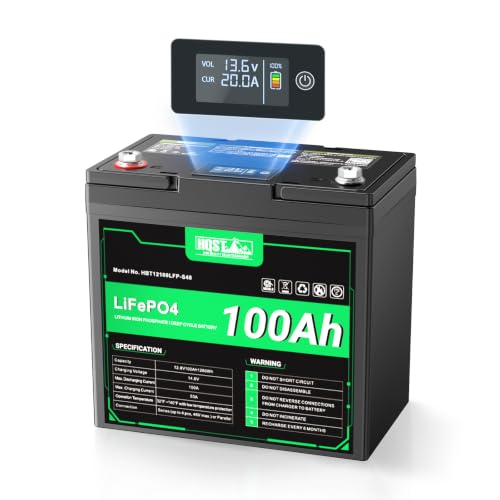
HQST 12V 100Ah LiFePO4 Battery, Group 22NF Mini — Best Mini-Format 100Ah
Choose this when the tape measure, not the budget, is the constraint: compact RV compartments, smaller boats, and trolling-motor installs where a Group 24 will not physically fit but 100Ah of energy is still needed. The built-in LED meter suits owners who do not want an app. It is not the pick if your tray is already Group 31 — take the larger-case options with more expansion room.
Strengths
- Mini case solves genuine fit problems without giving up 100Ah capacity
- LED meter gives an at-a-glance state-of-charge check with no phone involved
- Low-temperature protection and series/parallel support keep future options open
Trade-offs
- Non-standard group size means replacement trays and boxes need checking
- LED meters are approximate compared with a shunt-based monitor
- Smaller case concentrates heat — leave ventilation space in tight installs
| Specification | Detail (as stated in the verified listing title) |
|---|---|
| Capacity / energy | 100Ah / 1,280Wh |
| Group size | Group 22NF Mini |
| Weight in listing title | 25.11 lb |
| Features in listing title | BMS, LED meter, low-temperature protection, series/parallel |
Fit is an underrated specification. A remarkable number of battery upgrades fail at the tape-measure stage: the compartment was moulded for a smaller group size, the cables are short, and the dream battery simply does not go in. This mini-format unit exists for exactly that moment, delivering the standard 100Ah lithium proposition — full usable capacity, low-temperature protection, expansion support — in a case that fits where the standard case cannot. The LED meter is a small but real quality-of-life feature for owners who check the battery in a locker rather than from the sofa. Verify your compartment dimensions against the listing, confirm terminal orientation matches your cables, and this becomes the straightforward answer to a frustrating problem.
Best for: Tight compartments in RVs and boats that still need 100Ah / Not suited for: Group 31 trays with room to spare
Check the current price on Amazon
Comparison Table
The table compresses the reviews into the four facts that separate these batteries: chemistry and size, the badge job each was picked for, its key verified specification, and the buyer it fits. Energy you can actually use — not headline amp-hours — is the column to think in.
| Pick | Badge | Key spec | Best for | Amazon |
|---|---|---|---|---|
| LiTime 12V 100Ah LiFePO4 Battery, Group 24, Bluetooth | Best Overall | 100Ah LiFePO4, Group 24, 100A BMS, Bluetooth | Most RV, camper and trolling-motor owners making a first lithium upgrade | Check price |
| 12V 200Ah LiFePO4 Battery with 200A BMS (UL1973 / UN38.3) | Best for Large Banks | 200Ah LiFePO4, 2,560Wh, 200A BMS | Off-grid cabins, larger RVs and solar storage needing real overnight capacity | Check price |
| Renogy 12V 100Ah Deep Cycle AGM Battery | Best AGM | 100Ah AGM, sealed lead-acid, 3% self-discharge | Owners with lead-acid-only chargers, cold storage, or a firm budget ceiling | Check price |
| NERMAK 12V 50Ah LiFePO4 Deep Cycle Battery | Best Compact | 50Ah LiFePO4, 100A BMS, compact format | Kayaks, fish finders, small solar and portable power boxes | Check price |
| Feuruetc 12V 50Ah LiFePO4 Solar Battery | Best for Small Solar | 50Ah LiFePO4, solar-focused, lightweight | First small solar builds, off-grid lighting and modest backup power | Check price |
| HQST 12V 100Ah LiFePO4 Battery, Group 22NF Mini | Best Mini-Format 100Ah | 100Ah LiFePO4, Group 22NF Mini, LED meter | Tight compartments in RVs and boats that still need 100Ah | Check price |
Short version of the table: most readers should start with the LiTime 12V 100Ah LiFePO4 Battery, Group 24, Bluetooth (check price on Amazon) and only move to the 12V 200Ah LiFePO4 Battery with 200A BMS (UL1973 / UN38.3) (check price on Amazon) when the specific job in its badge matches theirs.
What does deep cycle actually mean, and why does it matter?
A deep cycle battery is engineered to deliver a moderate current for a long time, be discharged deeply, and then be recharged — repeatedly, for years. A starting battery is engineered for the opposite life: a very large current for a few seconds, then immediate recharge, staying near full for its whole service. The internal construction differs accordingly. Deep cycle lead-acid uses thicker plates that resist the corrosion of repeated cycling; lithium deep cycle packs use LiFePO4 cells governed by a BMS that enforces safe voltage, current and temperature limits on every cycle.
The practical consequence is lifespan measured in cycles. Cycle a starting battery deeply and it may survive a few dozen such events. Cycle a genuine deep cycle battery within its design limits and it survives hundreds of cycles in lead-acid form or thousands in lithium form. When you shop, the honest signals of a true deep cycle design are a stated cycle life, a depth-of-discharge figure attached to that claim, and — for lithium — a named BMS rating. A battery listing that talks only about cranking amps is telling you it is a starting battery, whatever the headline says.
Lithium or AGM: which chemistry should you choose?
Choose lithium (LiFePO4) if you cycle the battery regularly, if weight matters, if your charger or solar controller offers a lithium profile, and if the battery will not need charging while frozen. You gain nearly the full rated capacity as usable energy, a service life measured in thousands of cycles, stable voltage under load, and half the carrying weight. The costs are a higher purchase price and stricter rules: a compatible charger profile, and no charging below freezing unless the pack has heating or low-temperature protection that blocks the charge.
Choose AGM if compatibility is the binding constraint — an older RV converter, a simple solar controller, a charger you do not want to replace — or if the battery lives in genuine cold and must accept charge there, or if the upfront budget is firm. Accept the physics in return: plan to use only about half the rated amp-hours day to day, expect a shorter cycle life, and budget the replacement sooner. Neither answer is wrong; the wrong answer is buying lithium for a system that cannot charge it properly, or AGM for a daily-cycling job it will age out of quickly.
How do you size a 12 volt deep cycle battery correctly?
Size from energy, not from the battery you are replacing. List everything the battery must run, with its watts and its hours per day, and add the watt-hours up. A fridge that averages 45 watts over 24 hours is roughly 1,080Wh a day on its own; lights, fans, pumps and device charging commonly add a few hundred more. Divide your daily watt-hours by 12 to get amp-hours, then choose a battery whose usable capacity covers that figure with reserve: for lithium, usable capacity is close to the rating; for AGM, plan on half the rating. That arithmetic is why a single 100Ah lithium satisfies many campers while a 100Ah AGM disappoints the same owners.
Then check the second sizing dimension — power, not energy. The BMS rating on a lithium battery, or the discharge capability of an AGM, must exceed your largest simultaneous draw, including inverter surge. A battery can hold enough energy for the day and still cut out when the microwave and the water pump coincide. Finally, match the physical group size to the compartment and confirm terminal layout before ordering; a battery that does not fit is not a bargain at any capacity.
What does a battery management system (BMS) actually do?
Every lithium pick in this guide contains a BMS — a circuit board that watches each cell group and enforces the pack’s safety limits. It disconnects the battery if voltage goes too high during charging or too low during discharge, if current exceeds the rated limit, if the pack overheats, and — on the protected models listed here — if a charge is attempted below freezing. That enforcement is why a lithium battery can be treated as a drop-in appliance rather than a chemistry experiment, and also why it can appear to ‘die suddenly’: a BMS cut-out is the protection working, and the fix is to remove the cause (charge the battery, warm it, or reduce the load), not to bypass anything.
The BMS current rating is the number to match against your largest load. A 100A BMS at 12 volts supports roughly 1,200 watts of continuous draw before surge behaviour is considered, which is why inverter sizing and BMS sizing must be decided together. Bluetooth models add a window into the BMS — state of charge, voltage, current in or out, and temperature — which turns troubleshooting from guesswork into reading. If you plan a large inverter, choose the battery by its BMS first and its capacity second; the 200Ah pick in this guide carries a 200A BMS for exactly that reason.
Series, parallel, or one bigger battery: how should a bank grow?
Parallel connection (positive to positive, negative to negative) adds capacity at the same 12 volts and is how most house banks grow. Series connection (positive to negative) adds voltage — two 12-volt batteries make a 24-volt bank — and belongs to systems designed for that voltage from the start. Several picks in this guide state series and parallel support in their verified listings; that statement, plus the maker’s stated maximum number of units, is the authority for your bank, not forum folklore.
Three rules keep expanded banks healthy. Build with identical batteries bought at the same time, because age and capacity differences make units work unevenly. Use equal-length interconnect cables so current shares evenly between parallel units. And fuse the bank at the main positive cable, sized for the cable and the load. If the bank will grow beyond two units, honestly consider whether one larger battery — like the 200Ah pick above — is the simpler engineering answer: fewer connections, one BMS, one thing to monitor.
How does temperature change what your battery can do?
Cold is the deep cycle battery’s hardest environment, in opposite ways for the two chemistries. Lead-acid loses capacity as temperature falls — a battery that is generous in summer is noticeably smaller in winter — but it can accept charge in the cold, which is why AGM survives in unheated outbuildings and winter boats. Lithium keeps most of its discharge capacity in the cold but must not be charged below freezing unless the pack heats itself or blocks the charge; the low-temperature protection named in several listings here exists to enforce that rule automatically.
Heat is the quieter enemy of both chemistries: sustained high temperatures accelerate aging, so a battery baking in a sealed, sun-heated compartment will not reach its cycle-life potential wherever it lives. Ventilation space, shade where possible, and not charging a heat-soaked battery at maximum rate are cheap lifespan. If your install is cold-climate and off-grid, plan the charging location — an insulated box inside the living space is a common, effective answer — before you choose between the lithium and AGM picks above.
How long will a deep cycle battery actually last in your setup?
Manufacturers quote cycle life at a stated depth of discharge, and your real lifespan is that number bent by three habits: how deeply you cycle, how promptly you recharge, and what temperature the battery lives at. A lithium battery cycled to 80% depth daily and recharged the same day is living the life its listing describes. The same battery left discharged in a hot compartment for a month between uses is not, whatever the box said. Lead-acid is stricter still: prompt full recharge is the single behaviour that separates a five-year AGM from a two-year one, because every day spent part-charged grows sulfation that no charger fully reverses.
Translate cycles into years with your own calendar. A weekend camper cycling forty times a year will hit calendar aging — the slow chemical decline that happens regardless of use — long before cycle limits, for either chemistry. A full-time RVer cycling daily reaches cycle limits in years you can count, which is where lithium’s thousands of cycles stop being a spec-sheet boast and become the cheaper ownership. Count your cycles per year honestly and the chemistry decision in the earlier section makes itself.
What warranty and support should you expect at each tier?
Battery warranties divide by chemistry and tier in a pattern worth understanding before you buy. Lithium batteries at the mainstream tier commonly carry multi-year warranties because the makers expect thousands of cycles; the meaningful questions are what the warranty counts as failure (a capacity threshold, not just total death), whether it is pro-rated, and who handles the claim — a seller marketplace page or a brand with its own support channel. AGM warranties are shorter, matching the chemistry’s service life, and are most valuable when a dealer network stands behind them, as with the Interstate picks in the AGM guide in this cluster.
Whichever tier you buy, keep the order record, photograph the installed battery with its labels visible, and register the product if the maker offers it. Warranty claims fail on paperwork more often than on chemistry. And read the exclusions once: frozen charging damage, reversed polarity and physical damage are excluded nearly everywhere, which is the industry’s way of repeating this guide’s safety sections back to you.
How to Install and Commission a 12 Volt Deep Cycle Battery Safely
Work methodically and treat even a 12-volt battery with respect — it cannot shock you through intact skin, but a shorted terminal can weld a spanner and start a fire. You need insulated tools, eye protection, and the new battery’s manual.
- Switch everything off. Turn off the inverter, charger and solar controller, and cover solar panels or disconnect them first so no charge source is live during the swap.
- Photograph the old wiring. Cable colours lie in older installs; a photo of every terminal, fuse and shunt connection is your wiring diagram.
- Remove the negative cable first, then the positive. Tape or sleeve each removed terminal so it cannot touch metal. Reverse the order on fitting — positive first, negative last — so a slipped tool cannot short the battery through the chassis.
- Clean and inspect. Wire-brush corroded terminals, replace cracked lugs, and check the in-line fuse near the positive terminal. Most ‘bad new battery’ stories are actually bad connections.
- Seat and secure the battery. Use the tray or strap the compartment provides. A battery that can move will eventually chafe a cable or crack a case.
- Set the charger before the first charge. Select the lithium profile for LiFePO4 or the AGM profile for AGM on every charge source — converter, solar controller, portable charger. This single step decides most of the battery’s future lifespan.
- Charge fully, then verify under load. Run a known load for fifteen minutes and confirm voltage holds steadily (lithium) or behaves as the manual describes (AGM). Note the date and the starting state of charge in a simple log.
For storage, lithium prefers a partial charge in a cool, dry place, checked every few months; AGM prefers storage fully charged with a maintainer or a periodic top-up, because a lead-acid battery left discharged sulfates permanently.
Common Buying Mistakes
- Buying a starting battery for house duty. Cranking-amp headlines are the tell. Deep cycle work needs a deep cycle design, or you will replace it within a year or two.
- Comparing amp-hours across chemistries. 100Ah of AGM and 100Ah of lithium are not the same usable energy. Compare usable watt-hours after depth-of-discharge limits.
- Charging lithium below freezing. Without low-temperature protection or heating, a frozen charge permanently damages the pack. Check the protection spec before winter use.
- Leaving the charger on the wrong profile. A lead-acid profile undercharges lithium and an aggressive equalise mode can trip or damage it. Set every charge source, not just the main one.
- Mixing old and new batteries in a bank. The weakest unit drags the bank down and ages the new battery early. Build banks from identical batteries bought together.
- Ignoring the BMS ceiling. Energy capacity and power capacity are different numbers. Size the BMS or discharge rating for your largest simultaneous load, including surges.
Final Recommendation
For most buyers, the LiTime 12V 100Ah Group 24 Bluetooth battery is the cleanest answer: standard fit, honest protection, monitoring that removes guesswork — check price on Amazon. If your daily energy maths says one battery is not enough, step straight to the 200Ah 200A-BMS unit rather than paralleling mismatched small batteries. If your charger cannot speak lithium, the Renogy AGM remains a respectable, drama-free choice, and the two 50Ah lithium picks plus the mini-format HQST solve the fit problems that stop many upgrades at the compartment door.
Keep exploring the cluster before you buy: Best 12 Volt Deep Cycle Batteries For Rv Use, Best 12 Volt Deep Cycle Agm Rv Battery, Best 12 Volt Deep Cycle Battery Charger, Best 12 Volt Deep Cycle, and Best 12 Volt Dc To Ac Power Inverter cover the RV lens, the AGM lens, the charger that decides lifespan, and the inverter that will draw from your new battery.
Frequently Asked Questions
How long will a 100Ah deep cycle battery run my RV fridge?
Work in watt-hours. A typical compressor RV fridge averages roughly 40–60 watts across a day once cycling is averaged in, which is about 1,000–1,400Wh per day. A 100Ah lithium battery stores 1,280Wh and can deliver most of it, so expect around a day of fridge-only running; a 100Ah AGM should be planned at roughly half its rating, so expect about half that time. Lights, pumps and charging shorten both figures.
Can I replace my lead-acid battery with lithium without changing anything else?
Physically, usually yes — the group sizes match. Electrically, check two things: every charger and controller needs a lithium profile, or the battery will chronically undercharge, and your alternator charging arrangement on a vehicle may need a DC-DC charger so the lithium pack does not overwork the alternator. Those two checks are the whole conversion in most RVs.
What depth of discharge is safe?
For LiFePO4, discharging to around 20% remaining as a routine is well within design intent, and the BMS protects against true over-discharge. For AGM and other lead-acid, plan your daily use around the top half of the charge; deeper routine cycling is the main reason lead-acid house batteries die young.
Can I connect deep cycle batteries in parallel or series?
Yes, within the limits stated in each battery’s listing — several picks above state series/parallel support explicitly. Use identical batteries of the same age, equal-length cables, and a fuse on the bank. Never mix chemistries, capacities or an old battery with a new one in the same bank.
How should I store a deep cycle battery over winter?
Lithium: charge to a partial level, disconnect it fully, store cool and dry, and check it every few months. AGM: store it fully charged on a maintainer, or top it up periodically — a lead-acid battery stored discharged sulfates and loses capacity permanently. Neither chemistry should be left connected to parasitic loads all winter.
Do I need a special charger for a deep cycle battery?
You need the correct profile, which most modern smart chargers provide: a lithium profile for LiFePO4 and an AGM setting for AGM. The charger guide in this cluster — see the internal links above — covers amp sizing and the specific models verified for this site.


