Disclosure: airfryerkitchensupply.com is reader-supported. When you buy through links on our site, we may earn an affiliate commission at no extra cost to you.
Where to buy
Every product in this guide to the best 12 volt crock pot options was verified against the manufacturer listings in Amazon’s catalog data, and the spec boxes repeat only what those listings state — capacity, power options and intended use. Check the current price on Amazon before ordering, and read the honest market note in the introduction first: this is a small and often mislabelled category, and knowing exactly what exists, and what does not, will save you from buying the wrong appliance with total confidence.
- RoadPro RPSL-350 12V Slow Cooker, 1.5 Quart (Best Overall — The True 12 Volt Crock Pot) — Check the current price on Amazon
- Travel Time 12V Cooking Pot with Cover (Best for Faster Cooking) — Check the current price on Amazon
- RoadPro RPSC-197 Portable Electric Lunchbox Stove, 12V (Best Portable Oven) — Check the current price on Amazon
- Aotto Electric Lunch Box, 32 oz, 12V/24V/110V (Best Multi-Voltage Warmer) — Check the current price on Amazon
- DDHTSAL Portable Oven Electric Lunch Box, 1.8QT, 12V/24V/110V (Best Large-Capacity Warmer) — Check the current price on Amazon
- A Second RoadPro Slow Cooker for the Passenger Seat — A Note on Spares (Best Strategy for Full-Time Road Life) — No second distinct slow cooker model could be verified in the catalog at review time — see the honest market note in this review.
The best 12 volt crock pot is a genuinely useful appliance wrapped in a slightly misleading name. What actually exists — and what this guide ranks — is a small family of 12 volt cooking appliances built for trucks, RVs and road life: one true slow cooker that plugs into a vehicle socket and cooks a real meal over a driving day, a 12 volt cooking pot for faster jobs, and a set of portable lunchbox ovens and food warmers that heat meals from the same socket. If your mental picture is a full-size countertop Crock-Pot simply shrunk to cigarette-lighter size, adjust it now, gently but completely: the physics of 12 volt power will not allow that product, and this guide will explain why before it sells you anything.
The constraint is simple arithmetic, and no marketing department can repeal it. A vehicle socket typically offers around 10 to 15 amps at 12 volts — somewhere in the region of 120 to 180 watts at the very most before a fuse objects, and sensible appliances draw comfortably less than that ceiling. A home slow cooker sips a similar wattage on low, which is why a small 12 volt slow cooker can genuinely work: given hours, modest wattage cooks food perfectly well. What 12 volts cannot do is cook fast or cook big. Every honest product in this category is small — a quart and a half, give or take — and slow by design, trading time for the only currency a vehicle socket has.
Within that honest frame, the category serves its people remarkably well, and has done for decades in the one workplace that never gets reviewed in kitchen magazines: the long-haul cab, where these appliances are not novelties but standard equipment passed from driver to driver like good route advice. Long-haul drivers eat real food instead of truck-stop regret. RV travellers arrive at camp with dinner already done. Van lifers and car campers get hot meals without a camp kitchen. The six picks below are the verified landscape: the one true slow cooker as the headline act, the cooking pot and lunchbox ovens ranked carefully for the jobs they actually do, and clear labelling wherever a pick is a warmer rather than a cooker, so nobody buys reheating power expecting raw-to-dinner magic.
In this guide
Quick Picks
The verified landscape, honestly labelled: RoadPro’s 1.5 quart slow cooker (the true crock pot of the category), a Travel Time 12V cooking pot, RoadPro’s lunchbox stove, and two multi-voltage electric lunch boxes for warming duty — plus a clear-eyed note on what does not exist.
- RoadPro RPSL-350 12V Slow Cooker, 1.5 Quart — Best Overall — The True 12 Volt Crock Pot. The one genuine article: a 1.5 quart slow cooker built for auto travel that runs from a 12 volt socket and cooks raw ingredients into a finished meal over a driving day.
- Travel Time 12V Cooking Pot with Cover — Best for Faster Cooking. A 12 volt cooking pot with a non-stick surface and stay-cool handle, pitched at universal vehicle use — the pick for heating and simple cooking jobs that cannot wait all day.
- RoadPro RPSC-197 Portable Electric Lunchbox Stove, 12V — Best Portable Oven. The veteran lunchbox oven: a 12 volt portable stove that bakes and reheats in a lunchbox form — the truck-cab classic for heating real meals, frozen or fresh, on the road.
- Aotto Electric Lunch Box, 32 oz, 12V/24V/110V — Best Multi-Voltage Warmer. A 32 ounce portable food warmer that runs on 12 volt in the vehicle, 24 volt in trucks and 110 volt at a desk or hotel — one warmer for the whole working week, spill-free by design.
- DDHTSAL Portable Oven Electric Lunch Box, 1.8QT, 12V/24V/110V — Best Large-Capacity Warmer. A bigger take on the multi-voltage warmer: 1.8 quart capacity in a mini food warmer for car and truck that also runs on mains — for drivers whose packed meal is a serious meal.
- A Second RoadPro Slow Cooker for the Passenger Seat — A Note on Spares — Best Strategy for Full-Time Road Life. Not a product but the market truth, stated plainly: at review time only one purpose-built 12 volt slow cooker could be verified, so full-time road cooks are better served by a spare of the winner than by a fictional sixth alternative.
How These Picks Were Chosen
Every product here was verified by searching its exact model in Amazon’s product catalog through the retailer’s data feed and matching the returned title — capacity, voltage and appliance type — against the product we intended to recommend. Only confident matches received links. That verification mattered more than usual in this category, because listings blur the line between cookers and warmers aggressively, and a food warmer sold to someone expecting a slow cooker is a small fraud this guide refuses to repeat: each pick is labelled with what it truly is.
Ranking weighed, first, whether the appliance cooks raw food or only reheats — the fundamental divide in 12 volt food appliances. Then capacity against the socket’s realistic power budget, build practicality for vehicle life (lids that seal, cords that reach, surfaces that clean), and versatility of power input, where the multi-voltage lunch boxes earn real credit for working in the vehicle, at a desk and in a hotel room from one purchase.
We also state the market’s limit plainly rather than padding the list: there is exactly one widely available, purpose-built 12 volt slow cooker from an established travel-appliance maker, and it takes the top spot on merit and by default simultaneously. Everything below it is ranked as the best of its neighbouring job — faster cooking, reheating, warming — so the guide reads as a map of what 12 volt cooking actually offers, not a fiction of six equivalent crock pots.
The Best 12 Volt Crock Pot and 12 Volt Cooking Picks, Reviewed
Each review states what the appliance truly is — cooker, pot, oven or warmer — with three strengths, three honest trade-offs, and a verdict. Spec boxes repeat only what the verified listing states.

RoadPro RPSL-350 12V Slow Cooker, 1.5 Quart — Best Overall — The True 12 Volt Crock Pot
If you buy one thing from this guide, it is this. The verified listing describes the RoadPro RPSL-350 as a quart-class slow cooker for auto travel, 12 volt, in a 1.5 quart size — the only purpose-built slow cooker in the vehicle-appliance market from a maker whose whole business is 12 volt travel gear. It does the actual crock pot job: raw meat, vegetables and liquid go in during the morning, and by the time the driving day ends, dinner exists.
Strengths
- A true slow cooker — it cooks raw food, which nothing else in this guide fully does
- 1.5 quart capacity is honestly sized for one to two people, matching what 12 volt power can cook
- Purpose-built for vehicle life by a specialist travel-appliance brand
Trade-offs
- Slow is not a metaphor: meals are measured in hours, so it rewards planning, not impulse
- Small capacity feeds a driver and a passenger, not a family campsite
- Draws on the vehicle socket for hours — best used while driving, so the alternator carries the load
| Capacity | 1.5 quart (per listing) |
| Power | 12 volt, for auto travel (per listing) |
| Type | Slow cooker |
The use pattern that makes this appliance beloved among long-haul drivers is simple: prep in the morning, plug in, drive, eat. Stews, chilli, pulled chicken, pot roast for one — the slow cooker repertoire translates directly, at portions a solo driver or a couple can finish. Because the cooking happens across hours of driving, the alternator, not the battery, pays the energy bill, and the meal costs no cooking time at the end of a long day, which is precisely when willpower for real cooking is lowest.
Respect the two disciplines it demands. Food safety first: a slow cooker must bring food through the temperature danger zone at a proper pace and hold it hot, so fill it sensibly, keep the lid on, and treat the finished meal like any cooked food once the drive ends. Power second: hours of draw on a parked vehicle will flatten a starting battery, so this is a driving appliance or an auxiliary-battery appliance, never a park-and-cook-all-day appliance. Used as designed, it is the most civilised product in the 12 volt kitchen.
Best for: long-haul drivers, RV travellers and couples who want real cooked meals from a driving day / Not suited for: families needing volume, or anyone wanting dinner in under a few hours
Check the current price on Amazon

Travel Time 12V Cooking Pot with Cover — Best for Faster Cooking
Where the slow cooker owns the all-day job, this pot owns the hour-scale one. The verified listing describes a Travel Time 12V cooking pot with a cover, non-stick surface and stay-cool handle, made for on-the-go cooking in most vehicles. Think soups, noodles, oatmeal, reheating stews and simple one-pot meals at a rest stop or in camp — cooking in the ordinary sense, at 12 volt pace, in a pot shaped for a vehicle rather than a kitchen.
Strengths
- Faster and more versatile than a slow cooker for simple meals and reheating
- Non-stick surface and stay-cool handle suit cooking and cleaning in a vehicle
- A lidded pot contains splashes and smells far better than open heating gadgets
Trade-offs
- Still bound by socket wattage — boiling and simmering take patience compared with any stove
- Not a set-and-forget appliance like the slow cooker; it wants occasional attention
- Capacity is travel-scale, not family-scale, like everything in this category
| Power | 12 volt (per listing) |
| Type | Cooking pot with cover |
| Features | Non-stick surface, stay-cool handle (per listing) |
The cooking pot is the right answer for the traveller whose schedule will not hold a six-hour cook: the lunch break that should be soup, the evening that wants noodles and vegetables rather than a sandwich, the cold morning that improves dramatically with hot oatmeal. It heats and cooks at the speed 12 volts allows, which is slower than any burner and entirely adequate for food that mostly needs to get hot and stay gentle.
Pair it mentally with the slow cooker rather than against it. Drivers who carry both describe a simple division of labour: the cooker handles the planned main meal across the driving day, the pot handles everything improvised. If budget or space forces one choice, choose by your dominant pattern — planner or improviser — and the reviews either side of this one will confirm the decision.
Best for: travellers who want hot simple meals at stops without an all-day cooking plan / Not suited for: set-and-forget cooking while driving — that is the slow cooker role
Check the current price on Amazon

RoadPro RPSC-197 Portable Electric Lunchbox Stove, 12V — Best Portable Oven
The RoadPro lunchbox stove is the other legend of the truck-cab kitchen. The verified listing describes a portable electric lunchbox stove and food heating oven running on 12 volts — a small oven in a lunchbox body that heats and cooks in disposable or reusable pans. Generations of drivers have used it for everything from reheating leftovers to baking frozen meals through a driving shift, and its endurance in the market is itself a review.
Strengths
- Oven format handles foods a pot cannot — frozen meals, baked items, leftovers in foil
- Lunchbox form is genuinely portable and stows like the luggage it resembles
- Long market history as the standard 12 volt heating oven for professional drivers
Trade-offs
- Heating and baking at 12 volt pace still means planning meals around driving hours
- Oven temperatures are modest; it will not brown or crisp like a home oven
- Works best with the pan-and-foil routine — a small habit to learn
| Power | 12 volt (per listing) |
| Type | Portable lunchbox stove and food heating oven |
| Intended use | Truck and travel (per listing) |
Choose the lunchbox stove when your road food arrives in rectangles: the frozen dinner, the foil-wrapped leftovers, the casserole portion from home. Its oven cavity treats those foods the way they expect to be treated, where a pot would turn them into stew whether they wanted it or not. Drivers meal-prep on weekends, freeze portions in foil, and eat home food all week at highway speed — an economy and a comfort that truck-stop dining cannot match.
Its honest limits are temperature and time. This is a gentle oven, and foods should be chosen for gentleness: things that reheat gracefully or bake slowly. Within that repertoire it is superb, and its decades-long presence in cab catalogs — from the same specialist maker as our top pick — says the drivers who depend on it have voted with repeat purchases.
Best for: drivers who meal-prep and reheat frozen or leftover meals in the cab / Not suited for: cooking raw meals from scratch — the slow cooker owns that job
Check the current price on Amazon

Aotto Electric Lunch Box, 32 oz, 12V/24V/110V — Best Multi-Voltage Warmer
The Aotto widens the idea beyond the vehicle. The verified listing describes a 32 ounce electric lunch box and portable food warmer heater that works on 12 volt, 24 volt and mains power in a 3-in-1 design, for car, work, office and travel, with a spill-free build aimed at soup and meals. It is a warmer, not a cooker — this guide labels it so — and within warming duty its triple-voltage flexibility is the best in this list.
Strengths
- Three power inputs cover vehicle, truck and mains — one warmer for cab, desk and hotel
- Spill-free design suits soups and sauced meals, the foods warmers usually fail
- 32 ounce capacity is a genuine adult meal, not a snack portion
Trade-offs
- Warms and holds food; it does not cook raw ingredients
- Warming takes time — plug in well before the meal, not at the meal
- Lunch-box format suits one person and one course
| Capacity | 32 oz (per listing) |
| Power | 12V/24V/110V 3-in-1 (per listing) |
| Type | Electric lunch box food warmer |
The buyer for this pick works a mixed week: some days driving, some days at a site or desk, nights in hotels. A vehicle-only warmer strands two of those three contexts; the Aotto follows the meal through all of them, heating from the socket on the road and from the wall on arrival. For tradespeople, sales reps, nurses on shift and anyone whose lunch break happens wherever the morning ended, that continuity is the product.
Set the expectation the listing itself sets: this is a heater for prepared food. Load it with last night’s cooking or a meal-prep portion in the morning, plug it in when the vehicle starts, and lunch is hot when lunch happens. Judged as a warmer it is excellent; judged as a crock pot it would be a category error — which is why this guide insists on the label.
Best for: workers and travellers who want one warmer for vehicle, workplace and hotel / Not suited for: cooking raw meals — choose the RoadPro slow cooker
Check the current price on Amazon
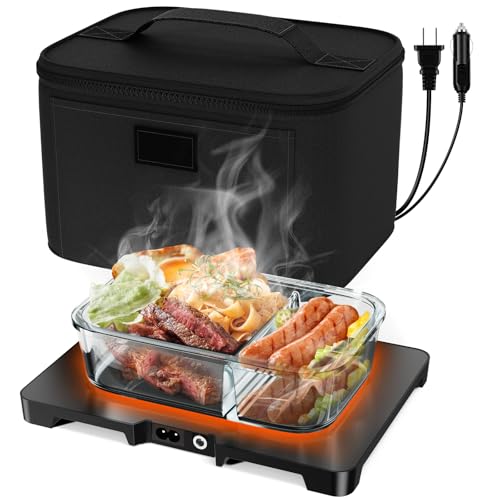
DDHTSAL Portable Oven Electric Lunch Box, 1.8QT, 12V/24V/110V — Best Large-Capacity Warmer
The DDHTSAL answers the capacity complaint. The verified listing describes a portable oven and electric lunch box food heater with 12 volt, 24 volt and mains inputs in a 3-in-1 design, with a 1.8 quart capacity pitched as a mini food warmer for car, truck, work, office and travel, and as a microwave alternative. That capacity — the largest among the warmers here — makes it the pick for drivers who pack a full meal rather than a portion.
Strengths
- 1.8 quart capacity holds a full meal with sides, not just a main
- Triple-voltage input keeps it useful from cab to break room
- Oven-style warming treats varied foods more evenly than a heated base alone
Trade-offs
- A warmer, not a cooker — raw ingredients are beyond its brief
- Larger body needs a permanent spot in the cab rather than a glovebox
- Bigger loads take longer to reach serving temperature; plan the plug-in time
| Capacity | 1.8 quart (per listing) |
| Power | 12V/24V/110V 3-in-1 (per listing) |
| Type | Portable oven electric lunch box warmer |
Capacity changes what a warmer is for. The small lunch boxes reheat a portion; a 1.8 quart oven reheats a dinner — protein, vegetables and starch together, in their own container, arriving at temperature as a meal rather than a snack. For the driver whose packed food replaces restaurant dinners rather than supplementing them, that difference is the whole purchase.
As with every warmer here, time is the ingredient owners must supply. A full, cold 1.8 quart load asks for a generous plug-in window, ideally from the start of the driving day. Build that habit and the DDHTSAL delivers the most complete packed-meal experience in this guide, on any of three power sources.
Best for: drivers and shift workers packing full meals who need warmer capacity / Not suited for: raw cooking, or anyone with only a glovebox to spare
Check the current price on Amazon
A Second RoadPro Slow Cooker for the Passenger Seat — A Note on Spares — Best Strategy for Full-Time Road Life
Most roundups would invent a sixth product here. This one instead tells you the useful truth: when we verified the catalog for this guide, the RoadPro RPSL-350 stood alone as the established, purpose-built 12 volt slow cooker, surrounded by warmers and pots wearing slow-cooker language in their listings. A guide that pretends otherwise would send you comparing appliances that do not cook against one that does.
Strengths
- Honesty that saves a purchase: a spare RPSL-350 beats an unknown “slow cooker” that turns out to be a warmer
- A second unit doubles capacity for couples cooking separately seasoned meals
- Spares matter on the road, where a failed appliance cannot be replaced at a kitchen shop
Trade-offs
- This is a strategy, not a distinct product — readers wanting six different appliances should use the five above by job
- Two units draw two sockets worth of power and need the alternator or auxiliary battery to match
- Market changes: new entrants should be verified against the cooker-versus-warmer test in this guide before buying
The practical advice for full-time road life follows from the market shape. If slow cooking is central to how you eat — and for many long-haul drivers it genuinely is — protect the routine the way you protect any critical system: with a spare. The RPSL-350 is inexpensive insurance compared with a week of truck-stop dinners while a replacement ships to a depot three states away.
And if a new 12 volt slow cooker appears after this guide, judge it by the test applied throughout: does the listing describe cooking raw food over hours, at a capacity the socket can honestly feed, from a maker who will exist next year? If yes, it deserves a place in a future revision. If the language is all warming and heating, it belongs with the warmers — useful appliances, honestly labelled, in the rankings above.
Best for: full-time drivers and RV cooks whose eating routine depends on the slow cooker / Not suited for: casual users, for whom one unit and the warmers above are plenty
No second distinct slow cooker model could be verified in the catalog at review time — see the honest market note in this review.
Comparison Table
The table that matters in this category has one extra column in spirit: cooks, or only warms. Everything else — capacity, power inputs — is secondary to that divide.
| Pick | Badge | Key spec | Best for |
|---|---|---|---|
| RoadPro RPSL-350 12V Slow Cooker, 1.5 Quart | Best Overall — The True 12 Volt Crock Pot | True slow cooker, 1.5 qt, 12V socket | long-haul drivers, RV travellers and couples who want real cooked meals from a driving day |
| Travel Time 12V Cooking Pot with Cover | Best for Faster Cooking | 12V cooking pot, non-stick, lidded | travellers who want hot simple meals at stops without an all-day cooking plan |
| RoadPro RPSC-197 Portable Electric Lunchbox Stove, 12V | Best Portable Oven | 12V lunchbox oven, portable stove | drivers who meal-prep and reheat frozen or leftover meals in the cab |
| Aotto Electric Lunch Box, 32 oz, 12V/24V/110V | Best Multi-Voltage Warmer | 32 oz warmer, 12/24/110V inputs | workers and travellers who want one warmer for vehicle, workplace and hotel |
| DDHTSAL Portable Oven Electric Lunch Box, 1.8QT, 12V/24V/110V | Best Large-Capacity Warmer | 1.8 qt warmer, triple-voltage input | drivers and shift workers packing full meals who need warmer capacity |
| A Second RoadPro Slow Cooker for the Passenger Seat — A Note on Spares | Best Strategy for Full-Time Road Life | Market note — one verified true slow cooker | full-time drivers and RV cooks whose eating routine depends on the slow cooker |
How to Choose the Best 12 Volt Crock Pot Setup for the Road
Begin with the only question that reorganises this whole category: do you need to cook, or to reheat? Cooking raw food from a vehicle socket is possible in exactly one format — the slow cooker, given hours and a driving day to work with. Everything else in the 12 volt kitchen heats prepared food at various speeds and capacities. Buyers who answer honestly at this step are happy with whatever they choose; buyers who buy a warmer with cooker expectations are the ones writing the angry reviews.
Match the appliance to the power you actually have
A vehicle socket is a shared, fused, modest resource. These appliances are designed for it, but the discipline still applies: run cooking loads while driving whenever the cook is long, so the alternator feeds them; reserve parked running for short warming on a healthy battery; and if road cooking becomes a lifestyle, graduate to an auxiliary battery setup so the starting battery is never the kitchen battery. The 12 volt air conditioner and fridge guides linked below assume the same discipline — it is the foundation of all vehicle electrics.
Capacity, honestly portioned
A quart and a half of stew is a generous meal for one and a fair one for two. The warmers scale from a 32 ounce single meal to the 1.8 quart full dinner. Resist the instinct to size up beyond the socket’s patience: in 12 volt cooking, a smaller load cooked properly beats a larger load that never quite gets there, every single time.
Food safety is part of the spec sheet
Slow cooking from a vehicle follows the same rules as slow cooking anywhere: start with cold, fresh ingredients; fill the cooker within its intended range; keep the lid on so heat stays in; bring food fully to temperature and keep it hot until serving; refrigerate leftovers promptly in the vehicle fridge rather than letting them ride warm for hours. A 12 volt cooker used with kitchen discipline is a kitchen. Used casually, it is a warm box — and warm boxes are where good intentions go bad.
How to Slow Cook Safely and Well on a Driving Day
The routine below is the one experienced road cooks converge on. It assumes the RoadPro slow cooker, but the principles apply to every appliance in this guide.
- Prep cold, prep sealed. Assemble ingredients the night before or in the morning, kept cold in the vehicle fridge until departure. Season boldly — slow cooking mellows flavours — and cut vegetables to even sizes so everything finishes together.
- Load, lid, then drive. Fill the cooker, seat the lid firmly, plug in as the driving day begins, and secure the cooker so braking and corners cannot move it — a bungee, a box, a footwell wedge. A cooker that travels safely cooks safely.
- Leave the lid on. Every peek costs the heat that a modest-wattage appliance replaces slowly. Trust the process and the clock; slow cooking rewards the patient and punishes the curious.
- Check temperature like a cook, not a fan. At the first stop after several hours, the meal should be steaming and clearly at a full simmer around the edges. If it is merely warm, something is wrong — socket, fuse or appliance — and the meal should be judged by food-safety rules, not by hope.
- Serve hot, store fast. Eat what you eat, then move leftovers to the fridge promptly. The cooker that made dinner should not become the overnight storage vessel.
- Rinse at the stop, wash at the base. A quick rinse prevents the baked-on archaeology that makes road cooks abandon good appliances. The non-stick and removable parts across this category exist to make that easy — use them.
Followed consistently, that routine turns the least promising kitchen in the world — a moving vehicle, hours from anywhere — into a reliable one that produces dinner on schedule in all weathers, which is a small daily miracle worth the modest price of admission and the minor discipline it asks in return.
The 12 Volt Kitchen, Assembled: What Pairs With a Crock Pot
A slow cooker alone is a meal; a slow cooker inside a small system is a lifestyle. The natural partners are a 12 volt fridge or compressor cooler holding ingredients cold until prep and leftovers cold after serving, a modest inverter for the occasional appliance that refuses to exist in 12 volt form, and the battery discipline covered in the charger and meter guides below. None of it needs to arrive at once — the cooker first, the fridge when the cooler-and-ice routine palls, the rest as the road teaches you what you miss.
What does not belong in the system is wishful thinking about power. Every addition is a draw, and the alternator and battery keep the only honest ledger. Road cooks who thrive are the ones who sized the kitchen to the ledger from the start — which is why this guide keeps returning to arithmetic when other guides return to adjectives.
Five Meals That Suit a Driving Day
Abstract praise for slow cooking helps nobody at a grocery stop, so here is the working repertoire, matched to the rhythm of a driving day and the capacity of the cooker that anchors this guide. Each follows the same pattern: ten minutes of morning assembly, a sealed lid, and a finished meal when the wheels stop.
- Chilli for the road. Brown the meat when you can, or use a no-brown recipe built on beans, tomatoes, onion and spice. It forgives every schedule, reheats beautifully in the warmers above, and improves on day two.
- Pulled chicken. Chicken thighs, a jar of salsa or a simple spice rub and a splash of stock. Shred at the stop, serve in wraps with whatever fresh crunch the fridge holds. The single most forgiving protein in the slow cooker repertoire.
- Beef and vegetable stew. The classic for a reason: portioned beef, potatoes, carrots and onion in stock. Cut the vegetables evenly, keep the lid shut, and arrive to the meal that defines the appliance.
- Lentil and sausage soup. Lentils need no soaking and thicken the pot themselves; a smoked sausage carries the seasoning for the whole dish. Cheap, filling, and nearly impossible to get wrong.
- Steel-cut oats, started at dawn. For drivers who start before light: oats, water, a pinch of salt and dried fruit, switched on with the engine. Breakfast at the first real stop beats every petrol-station pastry ever made.
Notice what the list avoids: delicate fish, quick greens, anything whose virtue is freshness or browning. The road kitchen plays to its strengths — hearty, patient, forgiving food — and leaves the rest to home kitchens and restaurants, which is exactly how a small appliance earns a permanent place in a cab.
What Road Cooking Actually Saves
The economics deserve plain numbers of a different kind — not prices, which this guide never prints, but meals. A driver eating two truck-stop meals a day spends the cost of the slow cooker in this guide roughly every week or two, and eats worse for it: heavier, saltier, and timed by hunger rather than by the road. The cooker inverts that. Groceries for a week of dinners cost a fraction of the restaurant equivalent, the food is seasoned by the person eating it, and the meal is ready at the stop the driver chose, not the exit the hunger chose.
The savings compound in less countable ways. Eating a real dinner in the cab turns the evening stop into rest rather than a second expedition. Sleep improves. The fridge-and-cooker routine makes the vehicle a place that feeds its driver instead of a place its driver escapes to eat. Ask long-haul drivers about their slow cooker and few mention the purchase price at all; they talk about the winter they stopped living on roller-grill food.
None of that requires the full system on day one. The pattern that works is the cooker, a week of groceries, and the discipline of the morning assembly. The fridge, the warmers and the rest of the 12 volt kitchen can arrive as the habit proves itself — and habits this good tend to prove themselves fast.
Common Buying Mistakes
Buying a warmer and expecting a cooker
The defining mistake of the category, repeated in thousands of disappointed reviews. If the listing language is heating, warming and reheating, the appliance does not cook raw food, whatever the search term that led you there said. This guide labels every pick; read the labels.
Cooking on the starting battery while parked
Hours of cooking draw will flatten a starting battery as surely as leaving the lights on, with dinner as the only consolation. Cook while driving, or cook from an auxiliary battery — never from the battery that has to start the vehicle in the morning.
Oversizing the meal to the socket
Doubling a slow cooker recipe into a vessel and power budget designed for one meal produces the worst outcome in food: hours in the danger zone, never properly cooked. Cook the portion the appliance was built for, twice if needed.
Ignoring the lid and the clock
Slow cooking is a sealed, timed process. Peeking, stirring and schedule improvisation all tax a low-wattage appliance beyond its design. Set it up, drive, and let the hours do the work.
Final Recommendation
The short version, with nothing held back: buy the RoadPro RPSL-350 if you want an actual crock pot experience from a vehicle socket — it is the one true slow cooker in the category, the centrepiece of road cooking, and the appliance around which every other pick in this guide is honestly arranged as a supporting act. Add the Travel Time pot for improvised hot meals, the RoadPro lunchbox stove if your food life runs on frozen and leftover portions, and the Aotto or DDHTSAL warmers if your need is a hot packed lunch at work or on the road, in the size that matches your appetite.
Build the rest of the road kitchen with the same honesty: ingredients stay cold in the units from Best 12 Volt Compressor Fridge, the battery that feeds everything is maintained by the picks in Best 12 Volt Dc Charger, and the cabin stays comfortable with Best 12 Volt Dc Air Conditioners. Drivers speccing a full sleeper setup should also see Best 12 Volt Coffee Maker For Truckers for the morning half of the routine, and Best 12 Volt Cooler For Truckers for the simpler cold-storage end of the spectrum.
Above all, buy the appliance for the job you actually have — cooking or warming, planned or improvised, solo or feeding a passenger — respect the socket and the clock and the sealed lid, and the modest physics of 12 volt power will reward you with hot, real, home-seasoned food in the least likely kitchens on earth: a cab at a rest stop, a van at a trailhead, a boat at anchor, anywhere the road happens to end for the night.
Frequently Asked Questions
Can a 12 volt crock pot really cook raw meat?
Yes — the RoadPro slow cooker in this guide is a genuine slow cooker, and raw meat with vegetables and liquid, given a full driving day of hours, cooks through completely, exactly as a home slow cooker handles it. The conditions are the same as at home: proper filling, the lid kept on, and enough time at temperature. What 12 volts changes is portion size and patience, not the fundamental cooking.
How long does a 12 volt slow cooker take?
Plan in hours, on the scale of a home slow cooker’s low setting — a stew assembled in the morning is dinner at the end of a driving day. That sounds like a limitation until you notice the cooking time is time you were spending driving anyway, and that the meal therefore costs no time at all in any sense that matters. Warmers and the cooking pot work faster for reheating and simple meals, which is why many road cooks carry both kinds.
Will cooking drain my vehicle battery?
While driving, the alternator carries the load and the battery is untouched in any meaningful sense. Parked, any of these appliances will drain a starting battery over hours — the warmers over a long stop, the cooker over a long cook. The rule is absolute: cook on the alternator or on an auxiliary battery, never as an all-day load on the battery that starts the vehicle.
What is the difference between a 12 volt slow cooker and an electric lunch box?
A slow cooker generates enough sustained heat to cook raw ingredients over hours. An electric lunch box is a warmer: it raises prepared food to serving temperature and holds it there, but it is not designed to cook raw food safely or completely. Both are useful; confusing them is the category’s classic disappointment, and this guide labels every pick with its true job.
Can I use a normal home slow cooker with an inverter instead?
You can, and some travellers do — a small home slow cooker on low draws a wattage a modest inverter and a healthy electrical system can supply. The costs are conversion losses, an inverter running for hours, and a kitchen appliance riding in a vehicle it was not built for. The purpose-built 12 volt cooker skips the inverter entirely and is shaped, lidded and powered for the road, which is why it anchors this guide.
What foods work best in a 12 volt slow cooker?
The slow cooker canon: stews, chilli, soups, pulled chicken and pork, pot roast in portion sizes, beans and lentil dishes. Foods that improve with hours and forgive timing are ideal for a cooking window defined by a driving day. Delicate foods, quick vegetables and anything wanting browning belong to other tools — or to the last half hour, added when the drive ends.


