Disclosure: airfryerkitchensupply.com is reader-supported. When you buy through links on our site, we may earn an affiliate commission at no extra cost to you.
Where to buy
When you shop for the best kitchen measuring spoons, Amazon is the natural hunting ground: the category is crowded with near-identical stamped-steel sets, and the verified listings below were each checked against live catalog data so the piece counts, materials, and size ranges printed here match what arrives in the box.
A practical tip before you order: decide your storage first. Magnetic sets want a fridge door or a steel strip; ring sets want a hook; loose sets want a drawer divider. The best set is partly the one your kitchen can keep together, because a measuring spoon set with a missing teaspoon is a tablespoon set.
- Spring Chef Stainless Steel Magnetic Measuring Spoons Set of 8, Black — Best Overall: check price on Amazon.
- U-Taste 18/8 Stainless Steel Measuring Spoons Set of 9 — Best for Bakers: check price on Amazon.
- Hudson Essentials Stainless Steel Measuring Spoons Set of 7 — Best for Spice Jars: check price on Amazon.
- Le Creuset Stainless Steel Measuring Spoons, Set of 5 — Best Premium: check price on Amazon.
- King Arthur Baking Company Spice Measuring Spoons, 7-Piece Set — Best for Spice and Baking Precision: check price on Amazon.
- Farberware Professional Kitchen Measuring Spoons, Set of 5 — Best Budget: check price on Amazon.
The best kitchen measuring spoons look like the simplest purchase in the kitchen, and they are the one most often bought wrong. A measuring spoon is a scientific instrument disguised as cutlery: its whole job is to deliver the same volume of baking soda, salt, or vanilla every single time. Sets fail that job quietly — with volumes that drift from the stamp on the handle, with bowls too wide for the spice jar, with handles that bend the first time they meet cold butter.
This roundup cuts the category down to six sets that each do something genuinely well. There is a dual-sided magnetic set for most kitchens, a nine-size set for bakers who need the odd fractions, a jar-fit set for spice cooks, two premium-leaning sets built to be owned for decades, and an honest budget plastic set for everyday cooking. Every pick was verified against live catalog data before being linked.
A word about who this guide is for. If you cook mostly by instinct and measure only spices and the occasional sauce, almost any honest set will serve you, and the budget pick below is a rational buy. If you bake — where a teaspoon is a chemical quantity, not a suggestion — the calculus changes: range and tolerance become the product, and the two baker-focused sets in this roundup earn their places on those grounds alone. Both kinds of cook are making a five-to-twenty-year purchase either way, because nobody replaces measuring spoons on a schedule; they replace them when a set finally annoys them enough. Buy the set that will not.
Notice what is not in these reviews: star ratings and review counts. Those numbers change constantly and say little about whether a spoon actually holds a true teaspoon. What decides that is material, manufacturing tolerance, and shape — and those are the things this guide examines.
In this guide
Quick Picks
The short version — six sets, six clear reasons to buy:
- Best Overall — Spring Chef Stainless Steel Magnetic Measuring Spoons Set of 8, Black. Dual-sided spoons — one end for dry, one for liquid — that nest magnetically and come with a leveler. The set most kitchens should just buy first.
- Best for Bakers — U-Taste 18/8 Stainless Steel Measuring Spoons Set of 9. Nine sizes including the odd ones recipes actually call for — 1/16, 1/8, 1/3 and 3/4 tsp — in 18/8 stainless. The accuracy nerd’s set.
- Best for Spice Jars — Hudson Essentials Stainless Steel Measuring Spoons Set of 7. Slim spoons shaped to fit inside standard spice jars, for dry or liquid. The set that ends the pour-into-your-palm routine.
- Best Premium — Le Creuset Stainless Steel Measuring Spoons, Set of 5. Five core sizes in Le Creuset’s heavy, beautifully finished stainless. Fewer spoons, better spoons — the buy-it-for-life slot.
- Best for Spice and Baking Precision — King Arthur Baking Company Spice Measuring Spoons, 7-Piece Set. A 7-piece 18/8 stainless set from a baking company, built as precision spice measures. When King Arthur puts its name on a measure, the volumes are the point.
- Best Budget — Farberware Professional Kitchen Measuring Spoons, Set of 5. Five standard sizes in lightweight nesting plastic with easy-read markings. The inexpensive, dishwasher-safe set for daily cooking and second kitchens.
How These Picks Were Chosen
We started from the measuring spoon sets actually sold through major US kitchen channels, then verified each candidate against live catalog data: piece count, material, size range, and any included extras such as a leveler. Sets whose listings could not confirm those basics were excluded rather than described from memory.
One methodological note: we did not rank these sets by sales rank or by the volume of online praise. Popular sets are often popular because they are cheap and cheerful, which is a fine reason to buy a spare set and a poor reason to crown a primary one. The ranking below follows the criteria instead — accuracy, range, shape, storage, and material — in that order.
Judging weighted the things that separate a good set from drawer clutter: volume accuracy and honest size ranges (including the fractional sizes recipes really use), bowl shape for dry versus liquid work, whether the spoons fit into spice jars, storage that keeps the set together, and materials that survive daily washing without rusting, staining, or bending.
- True volumes: stamped sizes that match real tsp/tbsp volumes, in a range that covers the fractions recipes call for.
- Shape that suits the ingredient: flatter bowls and levelers for dry goods; deeper, narrower bowls that hold a meniscus for liquids.
- Jar access: spoons slim enough to enter a standard spice jar instead of forcing a palm-pour.
- Storage that works: magnetic nesting, rings, or clips that keep the set complete in a real drawer.
- Materials for the job: stainless for longevity and precision; plastic only where budget and lightness genuinely win.
The 6 Best Kitchen Measuring Spoons

Spring Chef Stainless Steel Magnetic Measuring Spoons Set of 8, Black — Best Overall
The Spring Chef set of 8 solves the three annoyances that define cheap measuring spoons: it does not scatter in the drawer, it does not force one bowl shape to serve both flour and vanilla extract, and it includes the leveler that makes a ‘level tablespoon’ a fact instead of an estimate. Each spoon is dual-sided, with one end shaped for dry ingredients and the other for liquids.
The spoons nest together magnetically, so the set comes out of the drawer as one unit instead of a jangling ring. It suits the broad middle of home cooking — weeknight dinners, weekend baking, and everything that asks for a teaspoon of this and a tablespoon of that.
Strengths
- Dual-sided design: a dry-ingredient end and a liquid end on every spoon, so one set honestly covers both jobs.
- Magnetic nesting keeps the full set together in the drawer and on the fridge door, with no ring to fight.
- Included leveler turns heaped scoops into level measures, which is where baking accuracy actually comes from.
Trade-offs
- The black finish is a coating over the steel; buyers who want bare metal should look at the U-Taste set instead.
- Eight dual-sided spoons cover the standard sizes well, but ultra-odd measures still belong to a baker’s extended set.
- Magnets and leveler add pieces to keep track of — minimalists may prefer a plain ring set.
| Material | Stainless steel |
| Pieces | Set of 8, dual-sided |
| Design | Magnetic nesting, with leveler |
| Use | Dry and liquid ingredients |
| Care | Dishwasher safe |
The dual-sided idea sounds like a gimmick until you measure a tablespoon of olive oil in a spoon shaped for flour and watch it sheet over the rim. A narrower, deeper liquid end holds a meniscus properly; a flatter dry end lets the leveler — or a knife — sweep clean. Spring Chef builds both into every spoon, which is why this set, rather than a prettier one, takes the overall slot.
Magnetic nesting is the storage answer that actually survives contact with a real drawer. Ring sets tangle and lose the spoon you need; loose sets migrate. These stack into a single block that can also live on the side of the fridge, which is where ours would end up in a small kitchen.
Best for: most home cooks who want one accurate, tidy set for both dry and liquid measuring / Not suited for: buyers who want uncoated bare steel or an extended baker’s size range
Check the current price on Amazon
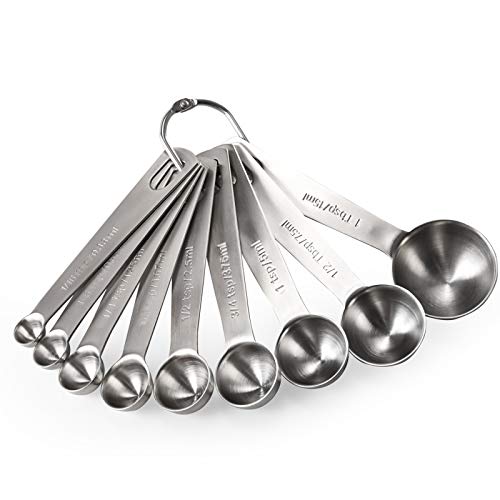
U-Taste 18/8 Stainless Steel Measuring Spoons Set of 9 — Best for Bakers
Most spoon sets give you four or five sizes and leave you estimating the rest. The U-Taste set of 9 covers 1/16 tsp through 1 tbsp, including the 1/3 tsp and 3/4 tsp that spice blends, sourdough formulas, and halved recipes call for constantly. If you have ever tried to measure ‘half of a half teaspoon’ of cayenne, you already know why this set exists.
The steel is 18/8 stainless — the food-grade alloy used in good flatware — with the sizes marked on the handles. It suits bakers and recipe developers, and anyone who scales recipes up and down and needs the fractions to be real.
Strengths
- Nine sizes including 1/16, 1/8, 1/3, and 3/4 tsp — the most complete standard range in this roundup.
- 18/8 stainless steel resists rust and flavor carryover from spices and extracts.
- Sized for both dry and liquid ingredients, so it can serve as a kitchen’s only set.
Trade-offs
- No leveler in the box; you will level with a knife or buy the leveler separately.
- Nine loose spoons need a ring, clip, or drawer discipline to stay together.
- The smallest 1/16 tsp spoon is genuinely tiny and easy to misplace in a busy drawer.
| Material | 18/8 stainless steel |
| Pieces | Set of 9 |
| Sizes | 1/16 tsp to 1 tbsp, incl. 1/3 and 3/4 tsp |
| Use | Dry and liquid ingredients |
Baking is a game of small numbers. A quarter-teaspoon error in baking soda is a soapy crumb; the same error in salt is a bland one. Sets that skip the in-between sizes push those errors into every scaled recipe. U-Taste’s range means the measure the recipe names is the measure you hold, which is the entire point of measuring spoons.
The 18/8 alloy choice matters for a set that will live in spice jars and extract bottles. Lesser steels can pick up a faint metallic note and, worse, rust at the stamped markings. This set is built to be washed daily and shoved into jars for years without either problem.
Best for: bakers, spice blenders, and recipe scalers who need the odd fractional sizes / Not suited for: cooks who only ever use tsp and tbsp and want the simplest possible set
Check the current price on Amazon

Hudson Essentials Stainless Steel Measuring Spoons Set of 7 — Best for Spice Jars
Hudson Essentials built this set of 7 around a single, underrated insight: a measuring spoon that cannot enter the spice jar is a spoon you will work around forever. These are shaped to fit in spice jars, so the cumin, paprika, and chili powder get measured at the jar instead of shaken into a palm and guessed.
The set covers the everyday sizes in stainless steel and works for dry or liquid ingredients. It suits spice-heavy cooking — curries, rubs, chili, baking blends — and smaller kitchens where one honest set has to do everything.
Strengths
- Jar-fit profile reaches into standard spice jars, eliminating palm-pouring and cross-contamination.
- Seven sizes cover the everyday range without drawer clutter.
- Stainless construction handles both dry spices and liquid extracts without staining or odor retention.
Trade-offs
- No magnetic nesting or leveler; storage and leveling are on you.
- The range stops at the standard sizes — no 1/16 or 3/4 tsp for precision bakers.
- Slim handles are a compromise for cooks with large hands who prefer a chunkier grip.
| Material | Stainless steel |
| Pieces | Set of 7 |
| Design | Fits in spice jars |
| Use | Dry or liquid ingredients |
There is a hygiene point hiding in the convenience: dipping a wide spoon into a spice jar usually means the spoon does not fit, so cooks pour spice into the spoon over the jar — and the excess, plus whatever was on the spoon, goes back in. A jar-fit spoon measures cleanly at the source and keeps jar contents uncontaminated, which matters for spices you keep for a year.
Hudson Essentials keeps the rest of the design plain, and that is the right call at this slot. No coatings to chip, no gimmicks — just steel, honest sizes, and the one shape decision that makes a daily difference.
Best for: spice-heavy cooks tired of pouring spices into their palm to measure them / Not suited for: precision bakers who need extended fractional sizes
Check the current price on Amazon

Le Creuset Stainless Steel Measuring Spoons, Set of 5 — Best Premium
Le Creuset’s set of 5 takes the opposite bet from the U-Taste: instead of every size, it offers the five core measures in stainless steel finished to the standard of the brand’s cookware. The spoons have the weight and polish of good flatware, because for many buyers they will sit in a crock next to it.
It suits cooks who measure constantly, value tools that feel right, and would rather own five excellent spoons for decades than nine adequate ones for a few years. It is also the giftable set in this roundup — the one that arrives feeling like an occasion.
Strengths
- Premium stainless construction with the heft and finish of quality flatware.
- The five core sizes cover the overwhelming majority of real recipes.
- Brand support and longevity: this is a decades-long purchase, not a seasonal one.
Trade-offs
- Five sizes means no 1/8, 1/3, or 3/4 tsp — serious bakers will still want an extended set.
- Premium tier pricing for a small set; the money buys finish and feel, not extra function.
- No leveler, no magnetic storage, no jar-fit shaping — deliberately classic, for better and worse.
| Material | Stainless steel |
| Pieces | Set of 5 |
| Sizes | Core tsp/tbsp range |
What the premium buys here is tolerance and finish. Cheap stamped spoons vary enough in volume to matter in baking, and their edges are often sharp enough to notice. A set made to a cookware brand’s standard holds its stamped sizes accurately and finishes its edges properly — small things you feel every single day you cook.
The honest limitation is the size range, and Le Creuset clearly knows its buyer: someone whose cooking lives in the standard measures and who reaches for a scale when a recipe gets fussy. If that is you, five perfect spoons beat nine ordinary ones. If it is not, the U-Taste above is your set.
Best for: cooks who want a small, heirloom-quality set of the core sizes / Not suited for: bakers who need fractional sizes beyond the standard five
Check the current price on Amazon

King Arthur Baking Company Spice Measuring Spoons, 7-Piece Set — Best for Spice and Baking Precision
King Arthur Baking Company sells flour and baking education, so its measuring spoons exist to be right. This 7-piece set is 18/8 stainless, described by the maker as precision measures for baking and cooking, and shaped with spice work in mind — the small end of cooking where a quarter teaspoon is a real quantity.
It suits bakers who weigh flour but still spoon their salt, soda, and spices, and anyone building spice blends where ratios are the recipe. Think of it as the specialist that pairs with a kitchen scale.
Strengths
- Precision positioning from a baking authority; volumes you can trust for soda, powder, and salt.
- 18/8 stainless steel for rust resistance and no flavor carryover between spices.
- Seven pieces aimed at spice measures, the sizes everyday sets under-serve.
Trade-offs
- A specialist set: cooks wanting one do-everything set may find the range spice-weighted.
- No storage system or leveler bundled; it assumes a baker’s existing setup.
- Premium-adjacent pricing for a focused tool.
| Material | 18/8 stainless steel |
| Pieces | 7-piece set |
| Focus | Precision spice measures for baking and cooking |
Baking chemistry runs on spoon measures: leaveners, salt, and spices are almost never weighed at home, so the spoon is the instrument of record. A set from a company whose reputation is baking accuracy is a reasonable proxy for tight manufacturing tolerance — the thing you cannot check in a product photo.
Pair this set with the habit that makes it pay off: spoon the ingredient into the measure and level it, every time, rather than scooping from the bag. Scooping compacts flour-based ingredients and spices alike and can add a third again to the intended amount. The spoon can only be as precise as the hand holding it.
Best for: bakers who want trustworthy small measures for leaveners, salt, and spices / Not suited for: cooks looking for a single general-purpose set with storage extras
Check the current price on Amazon

Farberware Professional Kitchen Measuring Spoons, Set of 5 — Best Budget
Not every kitchen needs stainless. Farberware’s Professional set of 5 is lightweight plastic, nests together, and carries easy-read markings for the five standard sizes — the set for daily cooking, dorms, RVs, lunchbox baking kits, and the drawer at a holiday house.
Plastic’s honest advantages are weight, price tier, and indifference to being dropped, plus it will not clang around a drawer or scratch a nonstick pan if a spoon ends up stirring something it should not. For cooking (as opposed to precision baking), that is often the whole argument.
Strengths
- Budget tier: the least expensive route to a complete standard set in this roundup.
- Lightweight nesting plastic with easy-read markings; dishwasher safe for zero-fuss cleanup.
- Gentle on nonstick surfaces and quiet in the drawer.
Trade-offs
- Plastic can stain from turmeric and tomato and can warp if it lives too close to the stove.
- Five standard sizes only; no fractional extras for bakers.
- Flex in the spoon bowls makes truly level dry measures slightly less crisp than steel.
| Material | Plastic |
| Pieces | Set of 5 |
| Sizes | 5 standard sizes |
| Design | Nesting, easy-read markings |
| Care | Dishwasher safe |
The right way to judge this set is by the cooking it will actually do: sauces, marinades, weeknight curries, pancake batter. In that world, a plastic spoon’s volume is plenty accurate, its lightness is pleasant, and its disposability at this tier is a feature — a lost spoon is an annoyance, not a loss.
Keep it away from the two things plastic hates: sustained heat and staining pigments left to sit. Rinse after turmeric or tomato paste, store it away from the hob, and it will serve for years. Ask it to be a baking instrument and it will disappoint; ask it to run a weeknight kitchen and it will not.
Best for: budget buyers, second kitchens, RVs, and everyday cooking where steel is overkill / Not suited for: precision baking or anyone who leaves utensils beside a hot stove
Check the current price on Amazon
Comparison Table
| Pick | Badge | Key spec | Best for |
|---|---|---|---|
| Spring Chef Stainless Steel Magnetic Measuring Spoons Set of 8, Black | Best Overall | 8 dual-sided stainless spoons, magnetic nesting, leveler included | most home cooks who want one accurate, tidy set for both dry and liquid measuring |
| U-Taste 18/8 Stainless Steel Measuring Spoons Set of 9 | Best for Bakers | 9 sizes, 1/16 tsp–1 tbsp, 18/8 stainless steel | bakers, spice blenders, and recipe scalers who need the odd fractional sizes |
| Hudson Essentials Stainless Steel Measuring Spoons Set of 7 | Best for Spice Jars | 7 stainless spoons shaped to fit standard spice jars | spice-heavy cooks tired of pouring spices into their palm to measure them |
| Le Creuset Stainless Steel Measuring Spoons, Set of 5 | Best Premium | 5 core sizes, premium stainless, cookware-brand finish | cooks who want a small, heirloom-quality set of the core sizes |
| King Arthur Baking Company Spice Measuring Spoons, 7-Piece Set | Best for Spice and Baking Precision | 7-piece 18/8 stainless precision spice measures | bakers who want trustworthy small measures for leaveners, salt, and spices |
| Farberware Professional Kitchen Measuring Spoons, Set of 5 | Best Budget | 5 standard sizes, lightweight nesting plastic, dishwasher safe | budget buyers, second kitchens, RVs, and everyday cooking where steel is overkill |
The pattern to notice: size range and storage separate these sets more than material does. If you bake, buy range (U-Taste, King Arthur). If you cook by feel with standard measures, buy storage and shape (Spring Chef, Hudson). The Le Creuset is the feel-and-finish splurge; the Farberware is the pragmatic spare.
How to Choose Kitchen Measuring Spoons
Start with the size range, because it is the spec buyers most often under-buy. A basic set has 1/4 tsp, 1/2 tsp, 1 tsp, 1/2 tbsp, and 1 tbsp. That covers most weeknight cooking but not most baking: recipes regularly call for 1/8 tsp of salt in a small batch, 3/4 tsp of spice in a blend, or 1/3 tsp when a recipe is scaled. If you bake more than occasionally, a set that includes the odd fractions (like the U-Taste’s nine) saves constant estimation — and estimation is exactly what measuring spoons exist to eliminate.
Material is the second decision. Stainless steel — ideally 18/8 or 18/10 — is the default for a reason: it does not rust at the stampings, does not hold spice odors, keeps a crisp edge for leveling, and survives decades of dishwashers. Plastic is lighter, cheaper, and kinder to nonstick, but flexes under a level sweep and stains with pigments. Silicone sits between, mostly in collapsible travel sets. For a primary kitchen set, steel is the honest recommendation; plastic earns its place as a spare, a travel set, or a budget starter.
Then look at the bowl shape. Dry ingredients want a flatter, wider bowl that a knife or leveler can sweep across in one pass. Liquids want the opposite — a deeper bowl that holds the surface tension dome without spilling at a breath. Dual-sided sets build both shapes into one spoon; single-shape sets force a compromise, which is fine for dry-leaning cooking and mildly annoying for oils and extracts.
- Bakers: prioritize size range and leveling — extended fractions plus a leveler or crisp bowl rims.
- Spice cooks: prioritize jar fit and narrow handles that reach into jars and tins.
- Small kitchens: prioritize magnetic or nesting storage; loose sets vanish one spoon at a time.
- Second kitchens and RVs: a light plastic set is genuinely the right tool.
Measuring Spoon Sizes, Conversions, and What ‘Level’ Really Means
The standard US set is built on simple ratios: 1 tablespoon equals 3 teaspoons; a 1/2 tablespoon is 1 1/2 teaspoons. Metric equivalents are stamped on better sets — a teaspoon is about 5 ml and a tablespoon about 15 ml — which matters when a recipe crosses the Atlantic. If you cook from international recipes, dual-stamped spoons (US and metric) remove a whole class of conversion errors.
The word that does the real work in recipes is ‘level’. A level spoonful is filled, then swept flat with a straight edge — a knife back, a chopstick, or the leveler bundled with sets like the Spring Chef. A heaped spoon of baking powder can hold half again the intended amount; a shaken-down spoon of flour can hold a third less. Dipping the spoon into the bag and shaking it level is the worst of both: compacted and uneven.
Two specialty measures deserve translation for home cooks. A ‘dash’ and a ‘pinch’ in older recipes correspond roughly to 1/8 tsp and 1/16 tsp — which is why extended sets include exactly those sizes. And coffee culture has its own spoon: a coffee measure is typically 2 tablespoons. Knowing these equivalents turns vague inherited recipes into measurable ones, and it is another quiet argument for owning the small sizes.
Technique, briefly: spoon the ingredient from its container into the measure (do not scoop with the measure itself), overfill slightly, then sweep once. For liquids, fill to the brim on a flat surface and lift steadily — the meniscus should dome just at the rim. Do that consistently and even a budget set measures well; skip it and the finest set in this roundup cannot save the recipe.
Stainless, Plastic, and Everything Between: Materials Compared
Stainless steel dominates serious sets for structural reasons. A spoon is a tiny lever: you press it into cold spice pastes, pry at packed brown sugar, and sweep it with a knife thousands of times. Steel takes that without bending, and a bent spoon is an inaccurate spoon — the bowl volume literally changes shape. Steel also shrugs off the dishwasher, does not absorb turmeric or paprika pigments, and will not melt against a hot pan rim.
Plastic’s case is narrower but real: it is light, cheap, quiet, and safe around nonstick coatings, and for cooking (rather than baking) its accuracy is adequate. Its enemies are heat, staining pigments left sitting, and the slow flex that makes leveling less crisp. Silicone and collapsible designs serve travelers and tiny kitchens; ceramic and stoneware sets are decorative objects that measure adequately and break enthusiastically — buy them as decor, not as instruments.
One more material note: finishes. Colored coatings on steel spoons — the copper and rose-gold sets in the wider market — look wonderful and measure identically when new. Over years of dishwashing, coatings can wear at the rims. If you love the look, hand-wash; if you want the lowest-maintenance tool, bare stainless like the U-Taste and Hudson sets is the forever finish.
Design Details That Separate Good Sets From Drawer Clutter
Beyond size and material, three design choices decide how a set behaves over years of daily use. The first is bowl geometry. Round bowls are traditional and fine for most work, but narrow oval and rectangular bowls — like the Spring Chef stackable design in the wider Spring Chef range — slide into spice jars and narrow bottle necks where round bowls simply cannot go. If your cooking leans on jarred spices, rubs, and small tins, geometry is not a detail; it is the feature you will use daily.
The second is how the sizes are marked. Stamped or etched markings survive; printed markings fade. A set whose teaspoon can no longer be told from its half-tablespoon is worse than no marking at all, because it lies with confidence. Steel sets in this roundup carry their sizes in the metal. Whatever set you buy, check the marking method before the finish — it is the part of the spoon that ages first.
The third is the storage system, which sounds trivial until a set loses its teaspoon. Rings are cheap and proven but tangle; magnetic nesting is the modern answer and genuinely works — the set leaves the drawer as one block and can live on a fridge door; clips and cases suit bakers who travel to classes or competitions. There is no wrong answer, but ‘loose in the drawer’ is the one choice that reliably ends with an incomplete set.
Handle length deserves a final mention. Short handles suit small jars; long handles reach into deep canisters and tall extract bottles and keep knuckles out of the flour bin. Cooks who bake from bulk containers notice handle length weekly. If that is you, favor the longer-handled designs and treat stubby novelty sets as what they are — gifts, not tools.
How to Use Measuring Spoons Accurately (and Keep Them That Way)
A measuring spoon set is only as accurate as the routine around it. This short method — used by test kitchens everywhere — takes no extra time once it is habit, and it is the difference between recipes that work ‘most of the time’ and recipes that work every time.
- Fluff before you measure. Stir flour, cocoa, and spices in their containers with a fork to undo settling and compaction. Ingredients measured from a compacted bag run heavy.
- Spoon in, never scoop. Use a separate spoon or the container’s own scoop to fill the measuring spoon. Scooping with the measure itself packs the ingredient and inflates the amount.
- Overfill, then sweep once. Heap the spoon slightly, then draw a straight edge — knife back, chopstick, or the set’s leveler — across the rim in one motion. One sweep; re-sweeping digs in and under-fills.
- Measure liquids on the counter, not in the air. Set the spoon on a flat surface, pour to a just-domed meniscus, then lift with a steady hand. Filling a spoon mid-air over a pot is how half of it ends up on the stove.
- Measure in recipe order. Dry ingredients first, then liquids, so a wet spoon does not cake the spice jar. If you must alternate, dry the spoon between measures.
- Wash and dry the set together. Dishwasher is fine for the steel sets here; dry plastic sets promptly to avoid pigment setting. Store the set as a unit — magnet block, ring, or clip — and do a full-set check monthly; replacing one lost size early beats discovering it mid-recipe.
Build the routine around your most common measures. Most home cooks reach for the teaspoon and tablespoon dozens of times for every use of the quarter teaspoon, so keep those two at the front of the ring or the top of the magnetic stack. When a recipe chains several small measures — a teaspoon of salt, half of soda, a quarter of spice — line the spoons up on the counter in recipe order before you start; it prevents the classic double-salt error and costs nothing but ten seconds of counter space.
Every few months, sanity-check your most-used spoon against a kitchen scale: a level tablespoon of water should weigh about 15 grams, a teaspoon about 5. If a spoon has bent or was stamped optimistically, the scale will tell you in ten seconds — and you will know to retire it to the coffee tin, where approximate measures do no harm.
Common Buying Mistakes
Scooping straight from the bag
The single most common measuring error. Scooping compacts dry ingredients, so a ‘cup’ or ‘spoon’ of flour or cocoa can run far heavier than the recipe intends. Spoon the ingredient in, then level — it takes two seconds longer and it is the whole ballgame for baking.
Buying the pretty set with four sizes
Decorative sets often stop at four standard sizes and skip the fractions bakers need. Count the sizes before you admire the finish: if 1/8, 1/3, and 3/4 tsp are missing and you bake, you have bought an estimation kit.
Ignoring spice-jar fit
Wide, round spoon bowls cannot enter standard spice jars, so every measure becomes a spill-prone pour. If your cooking is spice-led, jar fit is not a detail — it is the feature. Slim or rectangular bowls exist precisely for this.
Storing the set loose in a drawer
Loose spoons migrate, and the set quietly becomes incomplete. Magnetic nesting, a ring, or a simple clip keeps the set a set. The cheapest accuracy upgrade in this entire article is a one-dollar ring.
Trusting printed size markings
Printed markings are the first casualty of dishwashing; within a year or two a printed set becomes a guessing game with handles. Stamped or etched markings are cut into the metal and last the life of the spoon. When two sets look identical on the shelf, this is the difference worth paying for.
Treating plastic like steel
Plastic spoons left against a hot pan warp, and a warped spoon lies. Keep plastic sets away from the hob, rinse pigments off promptly, and retire any spoon whose bowl no longer sits flat.
Final Recommendation
Buy the Spring Chef set of 8 if you want one recommendation: dual-sided spoons that handle dry and liquid honestly, a leveler in the box, and magnetic storage that keeps the set together. It is the set that fits the most kitchens with the fewest caveats.
Bakers should step sideways to the U-Taste nine-piece for its fractional range, or pair the King Arthur set with a scale for spice-and-leavener precision. Spice-led cooks will feel the Hudson Essentials’ jar fit every single day. The Le Creuset five-piece is the splurge that justifies itself in hand-feel and longevity, and the Farberware is the right answer for a second kitchen, an RV, or a first apartment.
One last consideration is the rest of your measuring kit. Spoons do the small end; cups do the bulk; a scale does the truth. The sets above are chosen to sit comfortably in that system — accurate enough that the scale stays in the drawer for weeknight cooking, honest enough that when a recipe really matters, the spoon and the scale agree. That agreement, repeated daily in real kitchens, is what a good set actually sells.
Whichever set you choose, adopt the spoon-in-and-level technique from the how-to section. Accuracy lives as much in the hand as in the steel.
Keep researching the cluster: Best Liquid Measuring Spoons Best Measuring Cups Best Kitchen Measuring Spoons For Baking Best Stainless Steel Measuring Spoons Best Measuring Spoons For Spice Jars
Frequently Asked Questions
How many measuring spoons should a set have?
Five covers standard cooking: 1/4 tsp, 1/2 tsp, 1 tsp, 1/2 tbsp, 1 tbsp. Bakers are better served by seven to nine sizes that add 1/8 tsp, 1/3 tsp, and 3/4 tsp, because those fractions appear constantly in real recipes and scaling. More than that is rarely useful at home.
Are stainless steel measuring spoons better than plastic?
For a primary set, yes: steel keeps its shape (and therefore its volume), levels cleanly, resists stains and odors, and lasts for decades. Plastic is lighter, cheaper, and fine for everyday cooking, but it flexes, stains, and warps near heat. Many kitchens sensibly own one of each.
What does 18/8 stainless steel mean?
It describes the alloy: roughly 18% chromium and 8% nickel. Chromium provides rust resistance; nickel adds corrosion resistance and a smooth finish. 18/8 (and its close relative 18/10) is the standard food-grade choice for flatware and quality measuring tools.
Why do some measuring spoons have two ends?
Dual-sided spoons put a dry-ingredient bowl on one end and a narrower, deeper liquid bowl on the other. Dry goods level best from a flatter bowl; liquids measure best in a deeper one that holds the meniscus. It is a genuinely functional design, not a gimmick.
How do I check if my measuring spoons are accurate?
Use a kitchen scale and water: a level tablespoon of water weighs about 15 g and a teaspoon about 5 g (15 ml and 5 ml). Fill, level, weigh. Small deviations are normal; a spoon that is visibly bent or far off the mark should be retired.
What is the difference between a dry and a liquid measuring spoon?
Shape. A dry spoon is flatter and wider so a knife or leveler can sweep it perfectly flat; a liquid spoon is deeper and narrower so the liquid’s surface tension forms a stable dome at the rim without spilling. Dual-sided sets build both shapes into one tool; single-shape sets compromise, which matters most with oils and extracts that sheet over shallow rims.
Can measuring spoons go in the dishwasher?
The stainless sets in this roundup are dishwasher safe, and the Farberware plastic set is listed as dishwasher safe as well. Coated or colored finishes last longer with hand washing, and all sets benefit from being dried and stored together so no piece goes missing.

