Disclosure: airfryerkitchensupply.com is reader-supported. When you buy through links on our site, we may earn an affiliate commission at no extra cost to you.
Where to buy
The best compact food processors live in the 3- to 5-cup class, and every pick here is sold on Amazon. The balanced default is the KitchenAid 3.5 Cup Food Chopper; the classic alternative is the Cuisinart Mini-Prep Plus 4-Cup; and the budget door into the category is the Hamilton Beach Stack & Press 3-Cup.
Check the current price on Amazon through the links in this guide, and confirm bowl capacity in the listing title before ordering — in this category, one cup of capacity is the difference between the right machine and a second purchase.
Introduction
The best compact food processors exist because the full-size food processor has a dirty secret: for most daily jobs — a cup of onions, a batch of pesto, breadcrumbs, a sauce, nuts for a topping — it is oversized, over-lidded and over-cleaned, so it stays in the cupboard while a knife does the work slowly. A compact processor, in the 3- to 5-cup class, lives on the counter, rinses in seconds, and gets used daily. That usage difference, not any specification, is the category’s whole argument.
This guide ranks six verified compact machines by the jobs they do best: the all-round chopper, the small-job classic, the 4-cup step-up, the 5-cup with a whisk, the budget stack-and-press, and the one-touch power chopper. Every pick was confirmed against its manufacturer’s Amazon listing, with capacities and features taken from those listings. The buying guide explains where compact processors beat full-size machines, where they honestly can’t, and how to choose the capacity that matches your cooking.
In this guide
Quick Picks
1. KitchenAid 3.5 Cup Food Chopper (KFC3516) — Best Overall Compact. A 3.5-cup bowl, two speeds plus pulse, and thoughtful touches like a drizzle basin and cord wrap — the compact class done completely.
2. Cuisinart Mini-Prep Plus 3-Cup (DLC-2A) — Best for Small Jobs. The original mini processor: a 3-cup bowl and an auto-reversing blade that chops one way and grinds the other.
3. Cuisinart Mini-Prep Plus 4-Cup (DLC-4CHB) — Best 4-Cup Classic. The Mini-Prep formula grown to 4 cups with a 250-watt motor — the family-sized version of the classic.
4. KitchenAid 5 Cup Food Chopper (KFC0516) — Best Larger Compact (with Whisk). Five cups, two speeds plus pulse, and a whisk accessory that whips cream and eggs — the compact that borders on full-size usefulness.
5. Hamilton Beach Stack & Press 3-Cup Chopper — Best Budget Compact. Press the lid to chop — the simplest control in the category — with a 350-watt motor at the friendliest tier here.
6. Ninja Express Chop (NJ100GR) — Best One-Touch Power Chopper. Ninja’s stacked-blade pod design with one-touch pulsing — fast, even chopping and genuine pureeing power in a small bowl.
How These Picks Were Chosen
We defined ‘compact’ strictly: bowl capacities in the 3- to 5-cup range, footprints that fit a counter corner or a shallow drawer, and motors sized for chopping, grinding and pureeing rather than dough and heavy shredding. Machines above that class — however good — belong to our full-size coverage. Within the class, we required a locking, dishwasher-friendly bowl design and a blade system suited to both chopping and grinding, since a compact processor that only chops is a gadget, not a tool.
Each pick was verified against its manufacturer’s listing, and capacities, wattages and accessories quoted here come from those listings. We favoured designs with in-bowl simplicity — few parts, nothing that needs its own storage case — because a compact processor’s value is measured in seconds-to-use. Brand support mattered too: KitchenAid, Cuisinart, Hamilton Beach and Ninja all stand behind these small machines with real parts and service.
The 6 Best Compact Food Processors

1. KitchenAid 3.5 Cup Food Chopper (KFC3516) — Best Overall Compact
The KitchenAid 3.5 Cup is the compact processor against which the class is judged, because it sweats the details the others skip: a drizzle basin in the lid for emulsifying dressings and mayonnaise drop by drop, a pour spout and handle on a dishwasher-safe bowl, two speeds plus pulse for control, and a cord wrap that keeps the counter tidy. The stainless multi-purpose blade chops, purees and mixes with genuine competence at this scale.
It suits the daily cook in a small-to-medium kitchen: onions and herbs on weeknights, pesto and salsa on weekends, breadcrumbs and grated cheese whenever. In the colours KitchenAid is known for, it is also the rare small appliance that earns its visible counter place aesthetically — which matters, because compact processors only work if they stay out.
Strengths
- Drizzle basin makes dressings and mayo properly emulsified
- Two speeds plus pulse give real texture control
- Dishwasher-safe bowl and cord wrap keep ownership effortless
Trade-offs
- 3.5 cups is mid-class — big batches need two runs
- Chopper format: no slicing or shredding discs
- Premium positioning within the compact class
| Capacity | 3.5 cup |
| Controls | 2 speeds plus pulse |
| Bowl | Dishwasher-safe, with handle and pour spout |
What separates this chopper in daily use is control. Two speeds plus a pulse that responds instantly let you stop at coarse-chopped rather than pureed — the difference between a salsa and a soup is about four pulses, and the KitchenAid’s chop mode is geared low enough to respect that line. The blade’s design handles the small loads that big processors smear around their bowls: a single garlic-heavy sauce, a half-cup of nuts, herbs without bruising them black.
As the default recommendation for this search it earns the place the complete way: capacity in the class’s sweet spot, features that map to real recipes, and KitchenAid’s support behind it. Buyers who cook for one or two will rarely wish it bigger; buyers who batch-cook should read the 5-cup pick below before deciding.
Best for: daily cooks wanting the complete compact package / Not suited for: batch cooks or anyone needing slicing and shredding discs
Check the current price on Amazon

2. Cuisinart Mini-Prep Plus 3-Cup (DLC-2A) — Best for Small Jobs
The Mini-Prep Plus is the machine that defined this category, and its signature idea remains brilliant: the SmartPower blade auto-reverses — one direction’s sharp edge chops, the other’s blunt edge grinds — so a 3-cup bowl handles everything from parsley to coffee-adjacent grinding tasks and hard spices without a second attachment. It is small, light and quick enough that reaching for it is never a decision.
It suits cooks whose jobs run small: garlic and ginger pastes, herb oils, spice blends, baby-food portions, single sauces. In a tiny kitchen it can live in a drawer. As a second processor beside a full-size machine, it is the one that will actually see daily use — a pattern so common that many owners report their big processor becoming the backup.
Strengths
- Auto-reversing blade chops and grinds in one bowl
- The smallest, lightest serious tool in this guide
- Decades-proven design with full Cuisinart support
Trade-offs
- 3 cups is the class floor — family batches overflow it
- No feed tube or discs — chopping and grinding only
- Small loads only: it is a specialist by design
| Capacity | 3 cup |
| Blade | Auto-reversing SmartPower, chop/grind |
| Format | Mini chopper/processor |
The DLC-2A’s longevity in the catalogue is the review: designs that disappoint get replaced, and this one has introduced several generations of cooks to the mini format. Its genius is friction removal — the bowl is small enough to rinse without thought, the controls are two touches (chop, grind), and the results on its intended jobs are indistinguishable from machines triple its size and price.
Buy it for the jobs it names and it will be among your most-used tools. Ask it to be a family food processor and it will be a frustrating one — the 4- and 5-cup picks below exist precisely at that boundary, and honest sizing is this guide’s recurring sermon.
Best for: small households and small, frequent prep jobs / Not suited for: family-scale batches or disc-based prep
Check the current price on Amazon

3. Cuisinart Mini-Prep Plus 4-Cup (DLC-4CHB) — Best 4-Cup Classic
The DLC-4CHB takes everything that made the 3-cup Mini-Prep a classic — the auto-reversing stainless blade that chops in one direction and grinds in the other, the dishwasher-safe bowl and lid, the two-touch simplicity — and scales it to a 4-cup bowl on a 250-watt motor. That extra cup is the difference between a sauce for two and a sauce for the family, between hummus in one batch and hummus in two.
It suits households of three or four whose prep jobs are real but not industrial: a whole onion-and-pepper base, a full batch of pesto, breadcrumbs from several slices. If the 3-cup is a specialist, this is the generalist of the Mini-Prep line, and for many kitchens it is the sweet spot of the entire compact category.
Strengths
- 4-cup capacity covers family-size small jobs in one batch
- 250W motor with the proven auto-reversing blade
- Dishwasher-safe bowl and lid keep cleanup trivial
Trade-offs
- Still a chopper — no slicing or shredding discs
- Two-touch controls offer less finesse than multi-speed rivals
- Bowl shape favours chopping over liquid purees at full capacity
| Capacity | 4 cup |
| Motor | 250 watt |
| Blade | Auto-reversing stainless steel |
Capacity is a threshold feature: below it, a recipe is an annoyance of batches; above it, the machine disappears into the cooking. Four cups is where most family-scale ‘small jobs’ land — the full mirepoix, the double pesto, the party salsa — and the DLC-4CHB was clearly sized by people who measured real recipes rather than marketing brackets. The 250-watt motor keeps pace with the bigger bowl without straining on nuts and hard cheese.
Against its 3-cup sibling, choose this one if your household is three-plus or your cooking is batch-inclined; against the KitchenAid picks, it trades drizzle-basin refinement for Cuisinart’s chop/grind blade system and classic simplicity. All three are defensible; the DLC-4CHB is the traditionalist’s compact.
Best for: families of three or four wanting the classic mini, sized up / Not suited for: disc users or cooks wanting multi-speed finesse
Check the current price on Amazon

4. KitchenAid 5 Cup Food Chopper (KFC0516) — Best Larger Compact (with Whisk)
The 5 Cup KFC0516 is the compact class’s upper boundary, and it uses the space: a 5-cup bowl that swallows family batches whole, two speeds plus pulse, and — unique in this guide — a whisk accessory that whips cream, beats eggs and emulsifies in the same bowl. It is the pick for buyers who want one small machine to cover the widest possible job list.
It suits batch-oriented small kitchens and anyone downsizing from a full-size processor who refuses to give up capacity. The whisk is not a gimmick: whipped cream and meringue-adjacent jobs in a countertop chopper save hauling out a mixer, and the bowl remains dishwasher-safe with the same cord-wrap tidiness as its smaller sibling.
Strengths
- 5-cup bowl is the largest in this guide
- Whisk accessory adds whipping no rival here offers
- Two speeds plus pulse for texture range
Trade-offs
- Largest footprint here — ‘compact’ by courtesy at this size
- Still no slicing/shredding discs despite the capacity
- Whisk adds a part to store and wash
| Capacity | 5 cup |
| Controls | 2 speeds plus pulse |
| Accessory | Whisk included |
The buying question this machine answers is the downsizer’s dilemma: a full-size processor is too much, a 3-cup mini is too little, and the truth is in between. Five cups handles a whole cauliflower’s worth of chopping in two comfortable batches, a family hummus in one, and — with the whisk — the whipped jobs that otherwise justify a second appliance. For small households that cook seriously, it can be the only processor on the counter, full stop.
It concedes the true-compact virtues at the margins: it will not live in a drawer, and its bowl is a real wash rather than a rinse. Those are the right trades for its buyer, and the wrong ones for the drawer-kitchen shopper, who should take the DLC-2A and be happy.
Best for: serious small kitchens wanting maximum compact capacity / Not suited for: drawer-storage kitchens or minimalists
Check the current price on Amazon
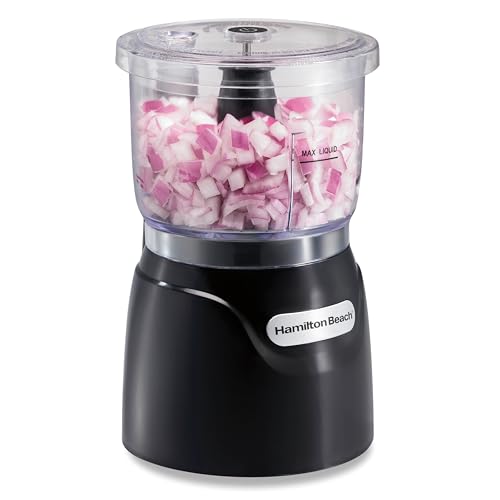
5. Hamilton Beach Stack & Press 3-Cup Chopper — Best Budget Compact
The Stack & Press removes the last excuse for knife work on small jobs: you stack the bowl, add food, and press the lid — the pressing is the switch. A 350-watt motor, strong for the class, drives the chopping, and everything dishwasher-safe comes apart in seconds. There are no speeds to learn and no buttons to find, which is precisely the design brief.
It suits budget buyers, older cooks, dorm and first kitchens, and anyone buying a second chopper for a specific station — the baking corner, the caravan, the holiday house. Hamilton Beach’s mass-market support stands behind a machine whose price invites scepticism it doesn’t deserve.
Strengths
- Press-lid operation is the simplest in the category
- 350W motor is strong for a budget compact
- Fully dishwasher-safe, minimal parts
Trade-offs
- Press control means pulse finesse is in your hand, literally
- 3-cup capacity is the class floor
- Budget build feel compared with KitchenAid and Cuisinart
| Capacity | 3 cup |
| Motor | 350 watt |
| Operation | Stack and press lid |
There is a real design intelligence in the press lid: the hand that holds the machine steady is the hand that runs it, so the chopper cannot walk across the counter, and the pulse rhythm — press, release, look, press — becomes instinctive within one onion. Owners consistently report it as the machine that finally got used daily, which in this category is the highest praise available.
Its ceiling is control and capacity, both honestly labelled. For chopping onions, nuts, herbs and breadcrumbs at the lowest cost of entry in this guide, it is not merely adequate — it is arguably the value pick of the entire compact class, and the machine we would hand a sceptic to convert them.
Best for: budget buyers and simplicity-first kitchens / Not suited for: texture perfectionists or family batches
Check the current price on Amazon
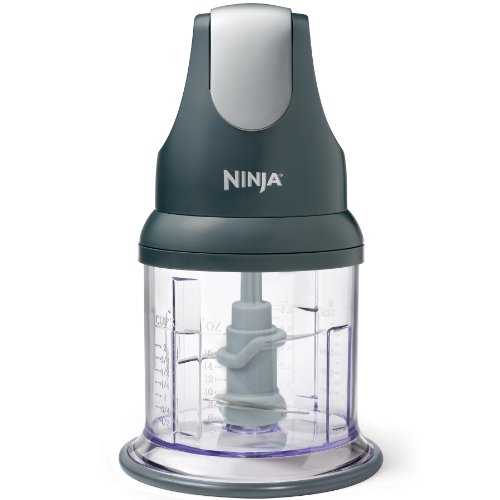
6. Ninja Express Chop (NJ100GR) — Best One-Touch Power Chopper
The Express Chop borrows Ninja’s blender thinking: a pod motor on top driving a stacked blade assembly that works the whole bowl height at once, so food chops evenly instead of riding in layers. One-touch pulsing keeps operation trivial, the bowl is dishwasher safe, and the results — especially purees, salsas and evenly minced garlic and herbs — are the most consistent in this guide at speed.
It suits cooks who value results over ritual: the salsa maker, the baby-food and sauce maker, anyone who has watched a conventional mini leave whole onion chunks orbiting a blade. Its bowl is the smallest here by working volume, which is the honest price of its design.
Strengths
- Stacked blades chop evenly through the whole bowl
- One-touch pulse is fast and foolproof
- Purees and salsas come out notably uniform
Trade-offs
- Smallest working capacity in this guide
- Pod design is a different storage shape than bowl machines
- Chopping only — no grind mode or discs
| Capacity | 16 oz bowl (3-cup class) |
| Blade | Stacked blade assembly |
| Operation | One-touch pulse |
Evenness is the Express Chop’s argument, and it is a strong one: the stacked blades engage food at multiple heights, so the top of the load processes with the bottom, and a handful of pulses yields a uniform chop that single-blade minis approach only with scraping and shaking. For emulsion-adjacent jobs — pesto, chimichurri, salsa — that uniformity is visible in the bowl and on the plate.
Choose it when your compact jobs are frequent, small and quality-sensitive, and when its pod shape fits your storage. Choose the bowl machines when capacity or grinding matters more. In a category of honest tools, the Ninja is the specialist in evenness, and specialists earn their place by being best at one thing that matters.
Best for: salsa, pesto and puree makers wanting even results fast / Not suited for: capacity seekers or spice grinders
Check the current price on Amazon
Comparison Table
| Pick | Badge | Key spec | Best for |
|---|---|---|---|
| KitchenAid 3.5 Cup Food Chopper (KFC3516) | Best Overall Compact | 3.5-cup, 2 speeds + pulse, drizzle basin | Overall compact default |
| Cuisinart Mini-Prep Plus 3-Cup (DLC-2A) | Best for Small Jobs | 3-cup, auto-reversing chop/grind blade | Tiny jobs, tiny kitchens |
| Cuisinart Mini-Prep Plus 4-Cup (DLC-4CHB) | Best 4-Cup Classic | 4-cup, 250W, auto-reversing blade | Family-size compact classic |
| KitchenAid 5 Cup Food Chopper (KFC0516) | Best Larger Compact (with Whisk) | 5-cup, whisk accessory, 2 speeds + pulse | Capacity plus whipping |
| Hamilton Beach Stack & Press 3-Cup Chopper | Best Budget Compact | 3-cup, 350W, press-lid control | Lowest-cost daily chopping |
| Ninja Express Chop (NJ100GR) | Best One-Touch Power Chopper | Stacked blades, one-touch pulse, 16 oz bowl | Most even chopping |
How to Choose a Compact Food Processor
Start with capacity, because it is the one spec you cannot work around. Three cups serves singles, couples and small-job specialists; four cups is the family sweet spot for sauces and prep; five cups borders on full-size usefulness for batch cooks. Buy for your largest regular job, not your largest imaginable one — the holiday batch can run twice, but an oversized daily machine that lives in a cupboard helps no one. Then choose your control style: press-lid simplicity (Hamilton Beach), two-touch chop/grind (Cuisinart), multi-speed finesse (KitchenAid), or one-touch pulsing (Ninja).
Finally, check the parts count and the wash story. A compact processor earns its place by being faster than a knife including cleanup; machines with dishwasher-safe bowls and two or three parts keep that promise, while fussy assemblies break it. Every pick in this guide passes that test, which is not true of the category at large.
- Match capacity to your largest weekly job, not your largest ever
- Prefer dishwasher-safe bowls — cleanup speed is the category’s point
- Decide if you need grinding (Cuisinart’s reversing blade) or whipping (KitchenAid 5 Cup)
- Count the parts; fewer parts means more daily use
- Keep it on the counter or in the front of a drawer — storage depth decides usage
Compact vs Full-Size Food Processors: An Honest Boundary
A compact processor chops, grinds, purees and emulsifies small loads superbly. What it cannot do defines the boundary: no slicing or shredding discs (the full-size machine’s great party trick), no dough capacity worth the name, no litre-plus soup purees, and no patience for rock-hard loads in bulk. If your cooking leans on shredded cheese by the block, sliced potatoes by the kilo, or bread dough weekly, you need a full-size machine and this guide’s picks become its companions, not its replacements.
For the majority of home cooking, though, the honest usage data runs the other way: the daily jobs are small, and the compact machine handles them faster end-to-end than the big machine can be assembled. Many households that own both report the compact working daily and the full-size earning its shelf monthly. Buy in that order — compact first, full-size when a specific recurring job demands it — and you will spend less and cook more.
What Each Capacity Actually Holds: A Reality Check
Manufacturers rate bowls to the brim; cooks should rate them to the working line, roughly two-thirds for chopping and half for liquids. A 3-cup bowl comfortably chops one large onion or a cup and a half of nuts, and purees about a cup and a half of sauce. A 4-cup bowl takes two onions, a family pesto, or a standard hummus batch. The 5-cup KitchenAid stretches to small-batch meal prep: a head of cauliflower in two runs, a double sauce, whipped cream for a crowd of desserts.
Overfilling is the compact category’s cardinal sin: food above the blade’s working zone rides unprocessed, liquids escape the lid line, and motors strain. The machines in this guide all reward honest loading with fast, even results — and punish ambition with exactly the mess that makes owners abandon small processors. Size to your recipes using the working numbers above, not the box numbers, and the machine will feel bigger than it is.
Blade Systems Compared: Reversing, Multi-Speed and Stacked
Three blade philosophies compete in this guide, and each maps to a cooking style. Cuisinart’s auto-reversing blade uses one edge to chop and the other to grind, making it the only system here that handles spices and coffee-style grinding respectably — the choice for cooks who make pastes and rubs. KitchenAid’s multi-speed approach gives texture control through gearing and pulse, the choice for cooks who care whether the salsa is coarse or fine today. Ninja’s stacked blades maximise evenness and puree quality, the choice for sauce makers. Hamilton Beach’s press system optimises for zero-thought operation.
None is ‘best’ outside its job. The buyer’s task is to name their three most frequent processor jobs — write them down, actually — and match the blade to the list. That ten-second exercise predicts satisfaction better than any review, including this one, because compact processors are specialists wearing a generalist category name.
Care and Storage: Keeping a Small Machine Ready
Compact processors ask little: rinse or dishwasher the bowl and blade after use, dry the blade before storing it in the bowl (its edge is the machine’s whole value), and keep the motor base wiped and dry. The blade deserves one caution repeated everywhere in this category — it is genuinely sharp, and small bowls invite fingers. Wash it separately, store it in the bowl with the lid on, and never reach into a plugged-in machine’s bowl for ‘one last chunk.’
Storage is a usage feature: cord wraps (KitchenAid), stackable shapes (Hamilton Beach), and drawer-friendly heights (Cuisinart) exist because a compact processor stored at the back of a deep cupboard is a knife with extra steps. Put it where your hand lands when an onion appears, and it will pay for itself in saved minutes within the month.
Recipes That Justify the Machine: A Week of Compact Processing
Monday: a double batch of weeknight salsa in the Ninja, five pulses to restaurant texture. Tuesday: the KitchenAid 3.5 emulsifies a vinaigrette through its drizzle basin while the chicken rests. Wednesday: Cuisinart grinds a spice rub for ribs, then chops the onion-pepper base without a wash in between that anyone would call work. Thursday: hummus in the 4-cup, one batch, ninety seconds. Friday: breadcrumbs from the heel of the week’s loaf, thirty seconds in any pick here. Saturday: pesto — basil, nuts, cheese — in whichever machine is nearest, because at this size they all live within reach. Sunday: whipped cream in the 5-cup KitchenAid while the pie cools.
Read that week again and notice what is absent: no job required a full-size processor, no job took longer to clean than to do, and no job was skipped because the tool was in a cupboard. That is the compact category’s actual product — not processing power, but processed food that happens on ordinary days. If your cooking week resembles this one, any pick in this guide will be among the highest-use appliances you own. If your week is dough, shredding and banquet batches, the boundary section above has already given you the honest answer.
Compact Processors for Special Diets and Stages of Life
Certain kitchens get outsized value from this category. Baby and toddler households puree constantly in exactly these volumes — steamed vegetables, fruits and family meals adapted in 2-cup batches — and a compact processor does it faster and cheaper than dedicated baby-food appliances, then graduates to family duty when the stage passes. Small-batch sauce and condiment makers — the hot-sauce fermenter, the chutney maker, the herb-oil enthusiast — live in 3-cup territory permanently. Elderly cooks and anyone with limited hand strength benefit from press-lid and one-touch designs that replace knife force with motor force, provided the blade-handling caution in this guide is respected.
Singles deserve a specific mention, because full-size marketing ignores them: a 3-cup machine is correctly sized for one person’s cooking in a way no standard appliance is, and the DLC-2A and Stack & Press have quietly become standard equipment in single households and studio flats. Right-sizing is not a compromise at any of these life stages; it is the entire point, and this category is where kitchen appliances finally practise it.
Noise, Speed and Counter Manners: Living With a Compact Processor
Small motors are loud in short bursts — the honest description is a few seconds of real noise per job, which neighbours and sleeping babies tolerate better than a blender’s sustained roar but worse than silence. Morning smoothie households should note the Ninja and Hamilton Beach do their work in under half a minute total; nobody’s compact processor runs long enough to be a lifestyle problem. Speed at the job itself is where these machines shine: from counter to chopped onion, including the rinse, is a two-minute round trip that knife work cannot match for uniformity.
Counter manners matter at this size because the machines are meant to live out. Look for the details this guide weighted: cord storage so the tail doesn’t snake, bowls with handles and spouts so the machine pours like a jug, and lids that sit flat for stacking in a drawer. The KitchenAid picks lead on these civilities, the Cuisinart on drawer-friendly plainness, and all six were chosen partly because none of them punishes you for keeping it visible — which, one final time, is where compact processors either live or die.
Compact Processor vs Blender vs Knife: Choosing the Right Tool per Job
Three tools contest the small-prep territory, and each wins somewhere. The knife wins on single small items — one garlic clove, half an onion for a sandwich — where any machine’s assembly costs more time than the cut. The blender wins on liquids at volume: smoothies, soups and sauces beyond two cups belong in its tall jar, where compact processors splash and stall. The compact processor wins everything in between: dry and semi-dry chopping, grinding, pastes, crumbs, emulsions and purees at cup scale, with a cleanup the blender cannot approach.
Households that understand the map stop asking one tool to cover it all, and the compact processor’s place in the map is the largest territory of daily cooking. That is why this guide treats it as a primary appliance rather than a miniaturised accessory — and why buyers who already own a blender and good knives still find, to their own surprise, that the little processor becomes the most-touched motor in the kitchen.
What to Process First: A Starter Sequence for New Owners
New compact owners should run three jobs in their first week to learn the machine’s language. First, an onion: cut into eighths, pulse five times, look, pulse twice more — you now know your machine’s chop speed and the sound of done. Second, a sauce with liquid — salsa or pesto — to learn the working fill line and how the load circulates. Third, something dry and hard in small quantity — nuts or breadcrumbs — to learn the grind behaviour and the moment chopped becomes powdered. Those three jobs teach every variable the machine has: load size, pulse rhythm, liquid behaviour and texture endpoints.
Write nothing down; your hands learn it. By the second week the machine disappears into your cooking the way a good knife does, which is the goal state for every tool in this category. Owners who skip the learning sequence and start with an ambitious overloaded recipe are the ones who conclude, wrongly, that compact processors don’t work — the starter sequence exists so that conclusion never gets the chance to form.
Buying a Compact Processor as a Gift or for a Second Kitchen
Compact processors are among the safest kitchen gifts because they solve a universal annoyance at a modest tier, and the picks here map to recipients cleanly: the Stack & Press for the new graduate and the technophobe, the DLC-2A for the keen cook in a small flat, the KitchenAid 3.5 in a favourite colour for the wedding registry, and the 5 Cup for the downsizing parent whose full-size machine has become a burden. Second kitchens — cabins, caravans, office kitchenettes — want the budget and mid picks, whose loss or hard use would not sting, and whose simplicity survives unfamiliar users.
One gifting caution: include the first job with the machine, metaphorically — a note suggesting the onion test from this guide, or the ingredients for a first pesto. Small appliances fail as gifts when they arrive as homework; they succeed when they arrive as an experience already half-started. The machines themselves need no help being useful, but the nudge costs nothing and changes the first week’s usage, which decides everything after.
How to Get the Most From a Compact Food Processor
Technique matters more in small bowls, where loads are close to the blade. Work this way and every pick in this guide performs at its best:
- Cut food into roughly even, small pieces before loading — a compact blade rewards uniformity and punishes whole onions
- Fill to the working line: about two-thirds for chopping, half for liquids; run two batches rather than one overloaded one
- Pulse in short bursts, stopping to check: most chopping jobs are done in five to ten pulses, and the line between chopped and pureed is two pulses wide
- For dressings and mayonnaise, use the drizzle approach — add oil in the thinnest stream (the KitchenAid’s basin automates this) while the machine runs
- For pastes and pesto, add a spoon of liquid early to keep the load circulating, and scrape once, halfway, with the machine off and unplugged
Cleaning immediately is part of the technique: a thirty-second rinse now beats a ten-minute soak later, and a clean machine stored ready is a machine that gets used tomorrow. That rhythm — load honestly, pulse briefly, rinse instantly — is the entire operating system of the compact category.
A last storage note that doubles as a safety rule: keep the blade inside the bowl with the lid on, and the bowl on or in the machine — never loose in a drawer where a hand will find it by touch. Every pick in this guide is designed to store assembled; let it. A compact processor stored safely and visibly is a tool; stored loose and hidden, it is a hazard and a forgotten purchase in equal measure.
Common Buying Mistakes
Buying capacity by the box number. Bowls are rated to the brim; working capacity is two-thirds of that. Size by the reality numbers in this guide or you’ll own a machine that’s always overloaded.
Expecting discs from a chopper. No pick here slices or shreds — that’s full-size territory. Buy a compact for chopping, grinding and pureeing, and it will delight you.
Over-processing everything. Small bowls reach puree fast. Pulse and check, or your salsa becomes soup and your breadcrumbs become dust.
Hiding it in a deep cupboard. A compact processor’s value is speed of access. If it isn’t within one easy reach, a knife wins and the machine was wasted money.
Washing the blade carelessly. These blades are the sharpest objects in most kitchens relative to their size. Wash separately, dry carefully, store in the bowl.
Running liquids to the brim. Small bowls slosh: a sauce filled to the rated line will decorate the counter. Half-full for liquids is not caution, it is the design’s actual working specification.
Final Recommendation
The KitchenAid 3.5 Cup is the compact processor to buy first: complete, controlled and pleasant enough to live on the counter where it belongs. Traditionalists and families should take the Cuisinart Mini-Prep Plus 4-Cup for its chop-and-grind blade at family capacity, or its 3-cup sibling for small-job purity. The KitchenAid 5 Cup serves serious small kitchens that need capacity and a whisk; the Hamilton Beach Stack & Press owns the budget and the simplicity brief; and the Ninja Express Chop is the evenness specialist for salsa and sauce makers.
Check the current price on Amazon through the links above, confirm the capacity in the listing, and then put the machine where your hand lands when cooking starts. A compact processor’s promise is not power — it is that the small jobs of daily cooking stop being chores. Every single pick here keeps that promise.
If you take one idea from this guide, take the working-capacity rule: buy the bowl your weekly cooking actually fills, keep the machine within arm’s reach, and let it be small on purpose. The best compact food processor is not the most powerful one — it is the one that has chopped a thousand onions because it was never once a hassle to use.
Keep exploring: Best Cuisinart Food Processors Best Economy Food Processors Best Blenders And Food Processors Best Baby Food Processors
Frequently Asked Questions
What size compact food processor do I need?
Singles and couples: 3 cups covers nearly everything. Families of three or four: 4 cups is the sweet spot for sauces and prep batches. Serious small-kitchen cooks and downsizers: the 5-cup class borders on full-size usefulness. Rate by working capacity — about two-thirds of the box number — and by your largest weekly job.
Can a compact food processor replace a full-size one?
For chopping, grinding, pureeing and emulsifying in small loads, yes — and it will be used more. It cannot slice or shred with discs, knead dough, or take litre-scale loads. Households whose cooking needs those jobs should own both, compact first; households that don’t can happily own only the compact.
Can compact processors grind spices and coffee?
Cuisinart’s auto-reversing blade grinds respectably — its blunt edge is designed for it — and handles spices, nuts and small hard loads well. Coffee for espresso is beyond any food processor (that needs a burr grinder), but for rubs, pastes and coarse grinding, the Mini-Prep models here are the class standard.
Are compact food processors hard to clean?
The picks here are chosen partly because they aren’t: dishwasher-safe bowls and lids, two or three parts, nothing with hidden crevices. The blade is the one careful item — wash it separately and mind the edge. Total cleanup is under a minute for most jobs, which is the category’s founding promise.
What can I make in a compact food processor?
Chopped onions, garlic and herbs; pesto, salsa, chimichurri and hummus; breadcrumbs and cracker crumbs; grated hard cheese in small loads; nut butters in patient batches; dressings and mayonnaise; baby food purees; and, with the KitchenAid 5 Cup’s whisk, whipped cream and beaten eggs. That list covers the majority of what home cooks actually process.
Why does my compact processor leave big chunks unprocessed?
Almost always overloading or uneven loading: food above the blade’s reach rides untouched. Load to the working line, cut pieces evenly, and pulse with a shake or a single scrape halfway. If chunks persist at honest loads, the job has outgrown the compact class — the honest signal to run two batches or reach for the full-size machine.
Can a compact food processor chop meat?
Yes, in small, partially chilled cubes, pulsed briefly — suitable for dumpling fillings, chicken salad mince and small batches of ground meat for one meal. Keep loads small, work in pulses, and chill the bowl’s contents beforehand for the cleanest cut. It is a capable occasional tool for the job, not a meat grinder’s replacement for bulk work.
How long do compact food processors last?
The motors in these small machines are lightly stressed by their intended jobs, and the branded picks here commonly serve for many years of daily chopping. What wears is the blade’s edge and the bowl’s clarity, both cosmetic-to-manageable over time. What kills them early is overloading — forcing family-size, full-processor jobs through a compact motor weekly. Used within their class, they are among the longest-lived small appliances per dollar in the kitchen.


