Disclosure: airfryerkitchensupply.com is reader-supported. When you buy through links on our site, we may earn an affiliate commission at no extra cost to you.
Where to buy
Every linked pick in this guide to the best comfortable kitchen sink faucets was verified against Amazon’s catalog on 2026-11-21, so the model names, capacities and features below match the listings you will actually land on. Start with Moen Essie 87014SRS Pulldown Kitchen Faucet, Moen Adler 87233SRS Pulldown Kitchen Faucet, Delta Boyd 19893Z-SPSD-DST with Soap Dispenser. Picks that could not be pinned to a confident API match are written unlinked and flagged honestly, with no link attached. For any linked pick, check the current price on Amazon from its link, because finishes, bundles and configurations rotate often.
The best comfortable kitchen sink faucets are chosen the way you would choose a good knife handle or a good chair: by how they treat your hands across thousands of repetitions. Comfort in a faucet is not a vague luxury word. It is a specific list of physical facts — a lever you can move with a wrist or the side of a hand when your fingers are covered in flour, a spray head that reaches the pot instead of forcing you to lift the pot to the water, docking that clicks home without a shove, and nozzles that clear limescale with a fingertip instead of a descaling soak and a pin.
This lens matters more than most buyers realize, because the kitchen faucet is the most-operated fixture in the house. Comfort failures compound quietly: the stiff handle you fight becomes the wrist you baby, the short hose becomes the heavy stockpot lifted one-handed, the sprayer that will not dock becomes the one left dangling. Households cooking with arthritis, carpal tunnel, limited grip strength, or simply very full hands benefit most, but honestly every cook benefits — comfort features are just good ergonomics wearing a friendlier name.
Every pick below was verified against Amazon’s catalog, and each earned its badge for a distinct comfort mechanism: lever geometry, docking systems, spray design, hose reach or control effort. The guide is explicit about what each model does not do, because comfort is personal — the faucet that relieves one cook’s problem can be irrelevant to another’s. Match the mechanism to your actual friction point, and the right pick is usually obvious.
In this guide
Quick Picks
Six models made the cut for this guide to the best comfortable kitchen sink faucets. Each carries its own badge, and the same badge follows it into the full review below, so you can track a recommendation from summary to verdict without losing the thread.
- Best Overall — Moen Essie 87014SRS Pulldown Kitchen Faucet: Moen’s Reflex docking and Power Clean spray in a Spot Resist finish — the most complete comfort package here. Key spec: 15.75-inch height / Reflex docking / Power Clean spray.
- Best for Limited Grip Strength — Moen Adler 87233SRS Pulldown Kitchen Faucet: A lighter, lower-effort lever and pull-down in Spot Resist Stainless — the gentlest control effort in this guide. Key spec: 14.56-inch height / Power Clean / Reflex docking.
- Best Magnetic Docking — Delta Boyd 19893Z-SPSD-DST with Soap Dispenser: MagnaTite magnetic docking that snaps the wand home, ShieldSpray cleaning power, and an included soap dispenser. Key spec: MagnaTite docking / ShieldSpray / soap dispenser included.
- Best Easy-Clean Spray Head — Kohler Simplice K-596-BL Pull-Down Faucet: A three-function spray head with easy-clean face, DockNetik magnetic docking and temperature memory in matte black. Key spec: 3-spray head / DockNetik docking / temperature memory.
- Best Budget Comfort — FORIOUS Pull-Down Kitchen Faucet: Three spray modes including pause, an 18-inch hose and a ceramic cartridge at a budget tier. Key spec: 1.8 GPM / 3 modes incl. pause / 18-inch hose.
- Best Hose Reach — WEWE High-Arc Pull-Down Kitchen Faucet: A verified 20-inch pull-down reach, soft silicone nozzles you clean by rubbing, and full 360-degree swivel. Key spec: 20-inch pull-down reach / silicone nozzles / 360° swivel.
How These Picks Were Chosen
Candidates were drawn from the verified kitchen faucet catalog and screened specifically for ergonomic evidence in their listing record: single-lever operation, pull-down hoses with stated reach, magnetic or weighted docking systems, multi-mode spray heads, easy-clean nozzle materials, and handle designs operable without a full grip. Touchless models were deliberately left to their own guide; this one is about mechanical comfort that works with wet, messy, occupied hands.
Ranking weighed control effort first — a lever that moves with light, smooth resistance beats every other feature, because you operate it far more often than any spray mode. Docking came second: a spray head you must push, twist or hang carefully will eventually be left undocked, so positive magnetic or Reflex-style docking scored heavily. Third was reach, using verified hose and spout figures where listings provided them. Fourth, maintenance comfort: silicone nozzles and spot-resistant finishes reduce the scrubbing burden that quietly dominates faucet ownership.
Specifications in the mini boxes come only from the Amazon listing records. Where a listing verified no dimension, the box says what is known and omits the rest. No prices or fixed ratings appear in this guide; check the current price on Amazon through any pick’s link.
The 6 Best Comfortable Kitchen Sink Faucets, Reviewed
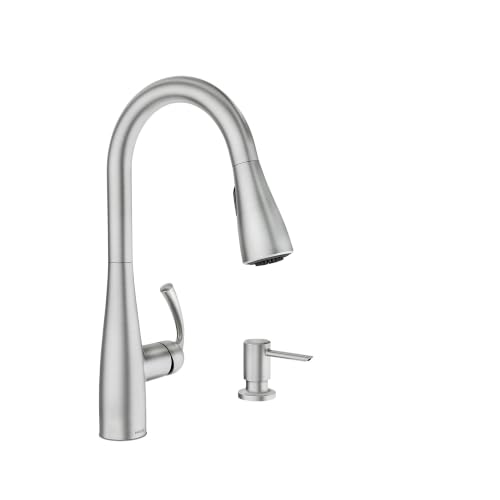
Moen Essie 87014SRS Pulldown Kitchen Faucet — Best Overall
The Essie earns Best Overall for comfortable use because it attacks the three biggest daily friction points at once. Its single lever is shaped for palm-and-wrist operation — you can start, stop and blend water with the side of a hand while the other hand holds a colander. Moen’s Reflex system, confirmed in the listing features, makes the pull-down hose retract smoothly and dock positively, so the spray head goes home with a gentle push instead of a wrestling match. And Power Clean spray delivers a stronger rinse stream, which means less time holding heavy pans under the water at awkward angles.
The 15.75-inch height clears tall pots without forcing you to tilt them under a low spout, and the Spot Resist Stainless finish reduces the grip-and-twist wiping that shiny faucets demand — a small comfort that repeats daily. The included soap dispenser, noted in the listing features, clears counter clutter and puts soap at a pump-press beside the faucet rather than in a bottle across the counter.
Its honest limits: the Essie is a full-size faucet that can overwhelm a small sink visually, and its comfort systems are mechanical — there is no touch or sensor activation here. Households wanting hands-free operation should read the touchless guide; households wanting the most refined manual ergonomics in this list should start here.
Strengths
- Reflex docking returns the spray head with minimal effort
- Power Clean spray shortens time holding pans under water
- Spot Resist finish reduces daily wiping effort
Trade-offs
- Full-size presence on small sinks
- No touchless activation
- Premium Moen tier positioning
| Height | 15.75 in |
| Dimensions | 8.78 x 2.31 x 15.75 in |
| Holes | 1, 2, 3 or 4-hole, deck plate included (API features) |
| Notes | Power Clean spray, Reflex docking, Duralock; soap dispenser included (API features) |
Best for: Most households wanting the strongest all-round manual ergonomics / Not suited for: Buyers who specifically want sensor or touch activation
Check on Amazon — check the current price on Amazon and confirm the exact configuration before ordering.

Moen Adler 87233SRS Pulldown Kitchen Faucet — Best for Limited Grip Strength
The Adler line is Moen’s accessible workhorse, and its comfort case rests on control effort. The lever is long, lightly sprung and forgiving of imprecise movement — exactly what hands with arthritis, reduced grip or bandaged fingers need at 6 a.m. with a kettle to fill. It shares the Essie’s Power Clean spray and Reflex docking from the listing record, so the spray head still retracts and seats without force.
At 14.56 inches tall it is also the more comfortable physical fit for shorter cooks and for sinks under low cabinets or windows, where a taller faucet forces the spray head’s arc into awkward territory. The slightly lower spout still fills standard stockpots; only the very tallest pots will ask for the side-filling workaround of pulling the spray head out, which the hose happily allows.
Choose the Adler when effort is the primary criterion — it is the pick occupational therapists would recognize fastest. Step up to the Essie if you want the extra height and the included soap dispenser, and your hands can use a marginally firmer control without noticing.
Strengths
- Light, forgiving lever effort for limited grip strength
- Reflex docking and Power Clean shared with the Essie
- Moderate height suits shorter cooks and low clearances
Trade-offs
- Lower spout than the Essie for the tallest pots
- No included soap dispenser
- Simpler styling than Moen’s design lines
| Height | 14.5625 in |
| Dimensions | 7.5 x 10.25 x 14.5625 in |
| Holes | 1 or 3, deckplate included |
| Notes | Power Clean, Reflex, dual-function spray |
Best for: Cooks with arthritis or limited grip, and shorter cooks at standard sinks / Not suited for: Households wanting maximum spout height
Check on Amazon — check the current price on Amazon and confirm the exact configuration before ordering.

Delta Boyd 19893Z-SPSD-DST with Soap Dispenser — Best Magnetic Docking
Docking is the comfort feature buyers underestimate until they live without it. Delta’s MagnaTite system uses a magnet strong enough that the spray wand visibly pulls itself the last fraction of an inch into place and stays there — no push, no twist, no dangling head bumping the sink rim. For one-handed operation with a pan in the other hand, that self-seating behavior is the difference between a faucet that helps and a faucet that nags.
The Boyd adds two more comfort-relevant systems from its API features. ShieldSpray concentrates a protective water shield around a powerful cleaning jet, which scrubs baked-on food with far less time spent holding dishes in the stream — and with noticeably less splatter onto your sleeves. The included soap dispenser keeps the counter clear and the soap at a one-press pump. Delta’s DIAMOND Seal valve is the durability story underneath, designed to reduce leak points over the faucet’s life.
The trade-off is learning curve and focus: ShieldSpray is a third spray behavior to understand, and the Boyd’s comfort strengths are concentrated at the spray head rather than in an especially light lever. If your friction point is docking and dish scrubbing, this is your pick; if it is handle effort, the Adler above is the better tool.
Strengths
- MagnaTite docking seats the wand with almost no effort
- ShieldSpray cuts scrubbing time and splatter
- Soap dispenser included in the box
Trade-offs
- Extra spray mode to learn
- Lever effort is standard rather than extra-light
- Feature set centers on the spray head
| Docking | MagnaTite magnetic docking (API features) |
| Spray | ShieldSpray (API features) |
| Valve | DIAMOND Seal (API features) |
| Notes | Soap dispenser included; SpotShield finish (API features) |
Best for: One-handed cooks whose pain points are docking and dish scrubbing / Not suited for: Buyers wanting the lightest possible lever action
Check on Amazon — check the current price on Amazon and confirm the exact configuration before ordering.

Kohler Simplice K-596-BL Pull-Down Faucet — Best Easy-Clean Spray Head
The Simplice’s comfort argument is about the jobs between cooking sessions. Its spray face is designed to be wiped clean of mineral buildup with a fingertip — in hard-water homes, that replaces the vinegar soak, the pin, and the increasingly ragged spray pattern that makes rinsing a two-handed wrestling match. The API features confirm the supporting cast: DockNetik magnetic docking, ceramic disc valves, and a three-function head whose Boost mode raises flow for fast pot filling and whose Sweep mode pushes debris across the sink with a wide blade of water.
Temperature memory is the quiet comfort star here: the faucet can return to the temperature you last used, which removes the daily hunt for the warm-water position with soapy hands. In matte black, it also suits the growing number of kitchens that find stainless visually cold, though black finishes ask for a soft cloth rather than abrasives.
One sourcing honesty note: the API dimension record for this model was unreliable, so this guide prints no dimension box figures beyond what the features verify — confirm height and reach on the listing against your sink before ordering. Buyers in very hard-water areas who hate descaling will find this the most comfortable ownership experience in the list.
Strengths
- Easy-clean spray face fights hard-water buildup with a fingertip wipe
- Temperature memory removes daily temperature hunting
- Boost and Sweep modes are genuinely task-specific
Trade-offs
- API dimensions unreliable — verify size on the listing
- Matte black needs non-abrasive cleaning
- Three modes are more than minimalist cooks need
| Spray | 3-function: stream, Sweep, Boost (+30% flow on Boost) (API features) |
| Docking | DockNetik magnetic docking (API features) |
| Valve | Ceramic disc valves (API features) |
| Finish | Matte black |
Best for: Hard-water households tired of descaling spray heads / Not suited for: Buyers who need verified dimensions before ordering anything
Check on Amazon — check the current price on Amazon and confirm the exact configuration before ordering.

FORIOUS Pull-Down Kitchen Faucet — Best Budget Comfort
Comfort is not only a premium purchase. The FORIOUS pull-down brings the core ergonomic kit — single lever, high arc, three spray modes — to a budget tier, and it includes the single most underrated comfort mode of all: pause. Pause stops the water from the spray head itself, so you can move the wand between pots, or set a filled pot down, without either wasting water or making a second trip to the lever with wet hands.
The API features verify a respectable foundation under the price: SUS304 stainless construction, a ceramic cartridge, an 18-inch hose for genuine reach around a double basin, and cUPC plus NSF/ANSI/CAN 61 certification. The 14.76-inch height is a comfortable middle — tall enough for stockpots, low enough for under-window sinks.
The honest budget caveats apply: docking is weight-based rather than magnetic, so it seats with less authority than the Delta or Moen systems, and long-term cartridge availability from a value brand is less certain than Moen’s or Delta’s parts ecosystems. For a rental, a first kitchen, or a laundry and bar sink that works hard, those are fair trades. For a forever kitchen, the picks above earn their premium in docking and parts support.
Strengths
- Pause mode on the spray head is a real ergonomic win
- Certified construction and ceramic cartridge per API features
- 18-inch hose reach at a budget tier
Trade-offs
- Gravity docking is less positive than magnetic systems
- Value-brand parts support is less certain long-term
- Finish range is narrow
| Flow | 1.8 GPM |
| Height | 14.76 in |
| Holes | 1 or 3, 10-inch deck plate |
| Notes | SUS304 stainless, ceramic cartridge, cUPC and NSF/ANSI/CAN 61 (API features) |
Best for: Budget kitchens, rentals and utility sinks wanting real comfort features / Not suited for: Forever kitchens prioritizing decades of parts support
Check on Amazon — check the current price on Amazon and confirm the exact configuration before ordering.
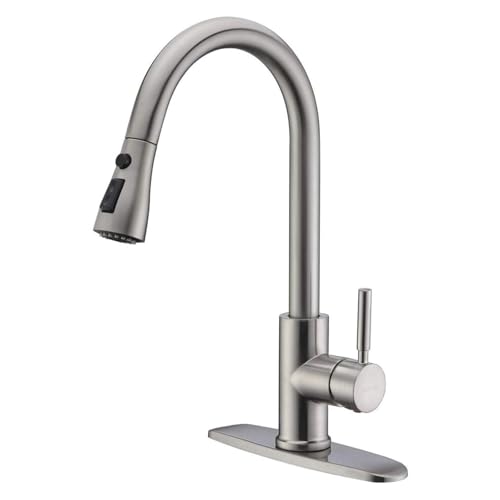
WEWE High-Arc Pull-Down Kitchen Faucet — Best Hose Reach
Reach is comfort when the alternative is lifting. The WEWE’s Amazon title verifies a 20-inch pull-down reach — among the longest in this guide — which means the water goes to the pot on the counter, the bucket on the floor beside the sink, and the far corner of a wide double basin, instead of all of those coming to the water. Combined with a full 360-degree spout swivel, the faucet adapts to the cook’s position rather than dictating it.
Its nozzles make the maintenance case: soft silicone that you clear of limescale by rubbing with a finger, the same easy-clean principle as the Kohler pick, here at a mid-market tier. The high-arc body and three spray modes cover the standard comfort checklist, and SUS 304 construction with a ceramic cartridge, per the title, is the right foundation.
Where it concedes ground to the premium picks is refinement: docking and lever feel are functional rather than engineered, and brand parts support sits between FORIOUS and the big three. Choose it when your sink is wide, your pots are heavy, and twenty inches of verified reach solves the problem you actually have.
Strengths
- 20-inch verified pull-down reach — the longest here
- Rub-clean silicone nozzles simplify hard-water upkeep
- Full 360-degree swivel for position freedom
Trade-offs
- Docking feel is functional, not magnetic-positive
- Brand support ecosystem is mid-tier
- Styling is generic modern rather than distinctive
| Reach | 20-inch pull-down reach (Amazon title) |
| Swivel | 360° |
| Holes | 1 or 3 |
| Notes | Soft silicone nozzles, SUS 304, ceramic cartridge (Amazon title) |
Best for: Wide double sinks and cooks who fill heavy pots outside the basin / Not suited for: Buyers prioritizing the most refined docking and lever feel
Check on Amazon — check the current price on Amazon and confirm the exact configuration before ordering.
Comparison Table
| Pick | Badge | Key spec | Best for |
|---|---|---|---|
| Moen Essie 87014SRS Pulldown Kitchen Faucet | Best Overall | 15.75-inch height / Reflex docking / Power Clean spray | Most households wanting the strongest all-round manual ergonomics |
| Moen Adler 87233SRS Pulldown Kitchen Faucet | Best for Limited Grip Strength | 14.56-inch height / Power Clean / Reflex docking | Cooks with arthritis or limited grip, and shorter cooks at standard sinks |
| Delta Boyd 19893Z-SPSD-DST with Soap Dispenser | Best Magnetic Docking | MagnaTite docking / ShieldSpray / soap dispenser included | One-handed cooks whose pain points are docking and dish scrubbing |
| Kohler Simplice K-596-BL Pull-Down Faucet | Best Easy-Clean Spray Head | 3-spray head / DockNetik docking / temperature memory | Hard-water households tired of descaling spray heads |
| FORIOUS Pull-Down Kitchen Faucet | Best Budget Comfort | 1.8 GPM / 3 modes incl. pause / 18-inch hose | Budget kitchens, rentals and utility sinks wanting real comfort features |
| WEWE High-Arc Pull-Down Kitchen Faucet | Best Hose Reach | 20-inch pull-down reach / silicone nozzles / 360° swivel | Wide double sinks and cooks who fill heavy pots outside the basin |
The fastest way to read this table is by friction point. Handle effort points to the Adler. Docking frustration points to the Boyd or the Essie. Descaling drudgery points to the Simplice or the WEWE. Heavy pots and wide sinks point to the WEWE’s reach. A tight budget with real ergonomic needs points to the FORIOUS and its pause mode.
Notice what does not appear as a comfort mechanism anywhere here: touchless sensors. They solve a different problem — activation with messy hands — and they have their own guide. Mechanical comfort, the subject of this one, keeps working during power cuts, with gloves on, and for guests who do not know the sensor is there.
How to Choose a Comfortable Kitchen Sink Faucet
Begin by naming your actual friction point, in one sentence, before looking at any product. ‘My wrist hurts by the end of washing up’ is a handle-effort problem. ‘The sprayer never stays put’ is a docking problem. ‘I cannot fill the big pot without lifting it into the sink’ is a reach problem. Comfort marketing blurs these together; your hands will not. The right mechanism, bought deliberately, outperforms a faucet that is vaguely ergonomic in every direction.
For handle effort, prioritize lever length and single-lever designs. A longer lever multiplies your force, so the same valve feels lighter, and a lever you can push with a wrist, forearm or the back of a hand removes grip from the equation entirely. If grip strength is the issue, also weigh ADA-compliant designs — the compliance process effectively audits operability without tight grasping, which is exactly the comfort criterion that matters.
For docking, insist on a named system. Magnetic docking (Delta’s MagnaTite, Kohler’s DockNetik) and Moen’s Reflex are engineered answers with positive seating. Gravity-and-weight systems work, but they seat with less certainty and can loosen as hoses age. If a listing cannot name its docking method, expect the dangling-sprayer outcome within a couple of years.
Finally, count the maintenance motions. Silicone rub-clean nozzles, spot-resistant finishes and smooth single-post bodies all reduce the wiping, descaling and scrubbing that dominate faucet ownership between the glamorous moments. Comfort is mostly the absence of small repeated annoyances, and those three features remove more of them per dollar than any spray mode.
Comfort Features Worth Paying For — and Those That Are Not
Worth it: a named docking system, because you will dock the sprayer several times a day for a decade. Worth it: an extra-long hose if your sink is wide or your pots are heavy, because reach substitutes for lifting. Worth it: a pause mode on the spray head if you fill multiple vessels, because it removes repeated trips to the lever with wet hands. Worth it: temperature memory if your household runs warm water constantly and hates the daily hunt for the position.
Not worth much: spray-mode counts beyond three. Stream, spray and one specialty mode — boost, sweep or pause — cover real tasks; modes four through seven mostly duplicate each other at different pressures. Not worth much: decorative LED temperature lights, which entertain for a week. And not worth a premium by itself: the word ‘ergonomic’ in a listing with no mechanism behind it. Comfort you cannot trace to a lever, a magnet, a hose length or a nozzle material is a label, not a feature.
Budget tiers behave predictably here. The value tier buys the core kit — lever, pull-down, modes — with gravity docking and thinner parts support. The mid and premium tiers buy the engineered docking, the lighter valves and the decade-long cartridge availability. Since comfort failures announce themselves daily, this is one category where the premium mechanisms genuinely repay their cost for cooks with any hand, wrist or reach limitation.
The Ergonomics Behind the Badges: How Comfort Was Judged
Comfort claims in faucet marketing are usually vibes; this guide tried to judge mechanisms instead, and it is worth explaining the reasoning so you can apply it to any model, including ones not listed here. The first mechanism is force multiplication at the lever. A valve requires a certain torque to open and modulate; a longer lever arm delivers that torque with less hand force, which is why the Adler’s long, light lever outperforms shorter, stiffer designer handles for limited-grip cooks. When you shop, the honest test is the back-of-the-hand test: if you cannot start, stop and blend the water using only the back of one hand, the faucet will fail you on your worst cooking day, not your best.
The second mechanism is task relocation. Every comfort feature that matters moves work from your body to the faucet: a pull-down hose relocates the water instead of your lifting the pot; a pause button relocates flow control to the hand already holding the sprayer; temperature memory relocates the daily search for the warm position into the valve. Judge any claimed comfort feature by asking what motion it deletes. If the answer is none — if the feature is a light, a finish or a mode count — it is not ergonomics, however pleasant it may be.
The third mechanism is error tolerance. Magnetic docking forgives an imprecise push; a wide, forgiving lever throw forgives an imprecise grip; rub-clean nozzles forgive a skipped month of maintenance. Human hands cooking dinner are wet, occupied and hurried, so the comfortable faucet is the one designed for imprecise operation. That principle, more than any single pick, is what this guide hopes you take to whatever faucet you eventually buy.
Comfort for Every Cook: Adapting the Sink to the Household
A faucet is one component in a sink workstation, and the most comfortable faucet can be undermined by everything around it. Start with sink depth: deep basins protect against splashing from high arcs but force shorter cooks to lean and reach down, trading arm comfort for shoulder strain. If your household spans a wide height range, a pull-down sprayer is the great equalizer, because it brings the water up to wherever each cook naturally works. This is one reason five of the six picks here are pull-downs despite this guide covering comfort broadly.
Next, consider the controls ecosystem around the faucet. A soap dispenser at the deck — included with the Essie and Boyd picks — removes the reach-and-squeeze of a bottle stored across the counter. A disposal switch relocated to an air switch on the deck removes the under-sink cabinet dive. None of these are faucet features, but comfort is a property of the whole station, and buyers planning a renovation should budget the small pieces alongside the headline fixture.
Finally, plan for change. Hands that are comfortable today may not be in fifteen years, and the faucet is the longest-lived object at the sink. Choosing a model whose lever, docking and maintenance all assume imprecise operation — as the picks here do — is a quiet form of future-proofing that costs nothing extra at purchase. Comfort bought once, properly, is comfort that survives the household changing around it.
Setting Up for Comfort: Water Temperature, Pressure and the Small Adjustments
Two faucet comfort factors are set at the house level rather than bought at the fixture level, and both are worth an hour of attention. The first is water temperature delivery. A faucet whose lever spends its comfortable middle travel producing lukewarm water — because the heater is set low or the hot line runs long and uninsulated — forces every warm-water task to the lever’s extreme end, where fine control is hardest. Setting the heater to a safe but genuinely hot temperature, and using the faucet’s limit stop to cap the maximum, centers daily operation in the lever’s most forgiving range. Households with children or elderly cooks should make that limit-stop adjustment deliberately rather than by default, balancing scald protection against the control penalty of an over-restricted range.
The second factor is pressure balance. Spray modes, boost functions and pull-down rinsing all assume reasonable household pressure; a home with tired supply lines or a failing pressure regulator will make even the best spray head feel feeble, and owners routinely blame the new faucet for an old plumbing condition. Before replacing a faucet for weak spray, check the aerator for sediment and the angle stops for full opening — the two cheapest fixes in plumbing. If pressure is genuinely low, favor picks whose specialty modes concentrate flow, like ShieldSpray and Boost, because they are engineered to do more with the pressure available.
Together with the installation habits in the how-to section — lever orientation, a free hose loop, weekly nozzle care — these adjustments complete the comfort picture. The faucet you buy sets the ceiling; the setup decides how close to that ceiling your daily experience actually lives.
Comfort Across Two Hands: Why One-Handed Operation Is the Real Standard
Watch any experienced cook at a sink and you will notice the pattern this guide’s picks were chosen around: one hand is almost always occupied. It holds the pan, steadies the colander, supports the cutting board, or braces the heavy pot. The faucet, therefore, is a one-handed tool in practice whatever the brochure shows, and every comfort mechanism that matters can be re-described as a one-handed-operation feature. The lever starts and blends with a wrist. The sprayer docks itself magnetically. The pause button lives on the head the free hand already holds. Temperature memory removes the two-handed hunt entirely.
This is also why comfort testing in a showroom misleads. Two dry hands, standing still, with nothing at stake, can operate almost any faucet pleasantly. The honest test — the one worth performing mentally against every pick — is the worst-moment test: hands wet and soapy, one holding a hot pan, water needed now at the right temperature, and the sprayer needed back in its dock without looking. Faucets that pass that imagined moment are comfortable. Faucets that merely feel nice on a display board are decorated.
Households should apply the same test across their members. The cook with the smallest hands, the grandparent with the weakest grip, the child old enough to rinse a dish — the faucet that serves the least-able operator at their worst moment serves everyone at every moment. That is the standard the badges in this guide were awarded against, and it is the standard worth carrying into any faucet purchase, on this list or off it.
Grip, Reach and Height: Sizing a Faucet to the Cook
Bodies differ, and comfort is partly a sizing exercise. Shorter cooks benefit from moderate spout heights and spray heads that come to them; taller cooks need arcs that clear their natural working posture without forcing a stoop to see into the pot. Where a household spans both, the pull-down format is again the mediator, because the water’s working position adjusts while the fixture stays fixed. Lever placement deserves the same personal check: a side-mounted lever favors the hand on that side, and right- and left-handed cooks genuinely experience the same faucet differently. None of this appears in specification tables, yet all of it decides daily comfort — which is why this guide describes mechanisms and motions rather than pretending a single dimension could rank them.
How to Set Up a Kitchen Faucet for Comfortable Daily Use
Installation choices decide half of a faucet’s comfort before the first meal is cooked, and they are free to get right. Start with lever position: on single-post faucets the handle can often be oriented to the side your dominant hand prefers, or even toward the front for wrist operation. Decide before the mounting nut is tightened, standing at the sink miming your real motions — filling a kettle, starting water with a pan in hand — rather than accepting the default orientation in the manual’s diagram.
Second, route the pull-down hose deliberately. Under the sink, the hose’s weighted loop must hang clear of the angle stops, stored bottles and the disposal body. Every snag point becomes a tug you feel in the spray head a dozen times a day, and a hose that hangs in a clean, full loop both retracts more smoothly and docks more positively. Shift stored items rather than compromising the loop; the loop is used constantly and the bottles are not.
Third, set your water heater and the faucet’s temperature stops so the lever’s comfortable middle range lands on genuinely warm water. Many faucets allow a rotational limit stop adjustment for maximum hot temperature — set it for safety with children or elderly cooks, but not so conservatively that everyday warm water lives at the very end of the lever’s travel, which forces full-extension operation every time.
Finally, build the maintenance habit while the faucet is new: a fingertip rub across silicone nozzles during the weekly wipe-down prevents the buildup that eventually makes spray patterns ragged and rinsing two-handed. Comfort degrades by accretion; thirty seconds a week keeps a comfortable faucet comfortable.
Common Buying Mistakes
**Buying ‘ergonomic’ without a mechanism.** If the listing cannot point to a lever design, a docking system, a hose length or a nozzle material, the comfort claim is decoration. Trace every comfort promise to hardware before paying for it.
**Ignoring docking until the sprayer dangles.** Gravity-docked sprayers loosen as hoses age. If you cook daily, a named magnetic or Reflex system is not a luxury; it is the difference between a faucet that seats itself and one you seat, forever.
**Choosing spout height by looks.** A very tall arc over a shallow sink increases splashing onto your arms and counters; a low arc forces pot-tilting. Match height to your sink depth and tallest cookware, not to the showroom photograph.
**Forgetting the under-sink hose loop.** Installers who leave the pull-down hose snagged on a stop valve create a faucet that tugs and docks badly from day one — and owners blame the faucet. Check the loop hangs free before the installer leaves.
**Overlooking who else uses the sink.** Children, elderly parents and guests all operate your faucet. A lever that needs a firm, precise grip fails them even if it suits you. The most comfortable faucet is the one the whole household can run one-handed, half-asleep, with wet hands.
Final Recommendation
Start with the Moen Essie if you want the most complete comfort package — Reflex docking, Power Clean spray, spot-resistant finish — in one mainstream faucet. Choose the Moen Adler instead when lever effort is the deciding factor, as it is for cooks with limited grip strength, and the Delta Boyd when docking certainty and scrub-free rinsing top your list.
The Kohler Simplice is the hard-water household’s pick, the WEWE is the wide-sink, heavy-pot pick on the strength of its verified 20-inch reach, and the FORIOUS proves the core comfort kit — including a genuinely useful pause mode — is available at a budget tier for rentals and utility sinks. Comfort is a mechanism, not a mood: name your friction point and one of these six is built for exactly it.
Three more verified options round out the list if the headline picks do not fit your space or budget tier: Kohler Simplice K-596-BL Pull-Down Faucet; FORIOUS Pull-Down Kitchen Faucet; WEWE High-Arc Pull-Down Kitchen Faucet. Each one earned its place in the reviews above for a specific reason, so match the badge to your actual routine rather than buying the longest feature list.
Shortlist it this way: Moen Essie 87014SRS Pulldown Kitchen Faucet if you want the safest all-round choice, Moen Adler 87233SRS Pulldown Kitchen Faucet if the second badge matches your kitchen better, and Delta Boyd 19893Z-SPSD-DST with Soap Dispenser if the third badge names your priority. Every other pick in this guide is a specialist — buy those when their specialty is your actual problem.
Best Kitchen Faucets Best Classic Kitchen Faucets Best Commercial Grade Kitchen Faucets Best Pull Down Kitchen Faucets Best Touchless Kitchen Faucets Best Kitchen Faucets For Hard Water
Frequently Asked Questions
What makes a kitchen faucet comfortable for arthritis?
Three things: a long single lever that moves with light effort and can be pushed with a wrist or palm, a pull-down sprayer that brings water to the pot instead of requiring lifts, and docking that seats without force. ADA-compliant designs are a useful shortcut, since compliance audits operation without tight grasping or twisting.
Is magnetic docking really better than a weighted hose?
In daily use, yes. Magnets pull the spray head into its seat over the last fraction of an inch and hold it there positively. Weighted hoses rely on gravity and hose condition, and they commonly begin to droop as the hose ages. For one-handed cooks the difference is felt at every single use.
What does a pause button on a spray head actually do for me?
It stops water flow at the head itself. Filling several pots, moving between a sink and a nearby stove, or setting down a full vessel no longer requires a free hand for the lever or a tolerance for wasted water. It is a small feature that removes a repeated two-handed moment from every cooking session.
How long should a pull-down hose reach for comfortable use?
Enough to reach every corner of your basin and the counter immediately beside it. Standard hoses manage the basin; verified reaches around 20 inches, like the WEWE pick in this guide, comfortably cover wide double sinks and counter-side filling. Measure your sink’s diagonal and compare before buying.
Can a comfortable faucet also be a classic-looking faucet?
Partially. Classic two-handle designs offer precise blending and levers that suit many hands, and they are covered in this site’s classic faucet guide. What they generally lack is the pull-down reach and docking systems, so the most comfort-critical features live in modern single-lever designs like the picks here.
Do easy-clean nozzles make a real difference?
In hard-water homes, absolutely. Silicone nozzles cleared by a fingertip rub keep the spray pattern even, and an even pattern is what makes one-handed rinsing possible. The alternative — vinegar soaks and pin-clearing — is the maintenance chore most likely to be skipped until rinsing becomes a two-handed fight.


