Disclosure: airfryerkitchensupply.com is reader-supported. When you buy through links on our site, we may earn an affiliate commission at no extra cost to you.
Where to buy
Every linked pick in this guide to the best classic kitchen faucets was verified against Amazon’s catalog on 2026-11-21, so the model names, capacities and features below match the listings you will actually land on. Start with Kingston Brass Heritage Bridge KS1278ALBS, Moen Belfield 7255SRS Traditional Two-Handle Faucet, Kingston Brass Heritage Bridge KS1273ALBS Antique Brass. Picks that could not be pinned to a confident API match are written unlinked and flagged honestly, with no link attached. For any linked pick, check the current price on Amazon from its link, because finishes, bundles and configurations rotate often.
The best classic kitchen faucets solve a problem modern pull-downs often create: a kitchen that was designed around traditional lines — inset cabinets, a farmhouse or cast-iron sink, oil-rubbed bronze or brushed nickel hardware — suddenly wearing a faucet that looks like it belongs in a tech showroom. Classic styling is not nostalgia for its own sake. Bridge faucets, two-handle widespread sets and high-arc spouts with cross or lever handles have survived for a century because the format is genuinely good: separate hot and cold control you can set by feel, spouts that clear stockpots, and silhouettes that still look right after two or three appliance generations have come and gone.
There is an honest catch in this category, and it shapes this whole guide. The classic market splits into two very different worlds. On one side sit the heritage brands — Kingston Brass, Moen, Delta and American Standard — building traditional faucets with ceramic cartridges, metal bodies and real parts support. On the other side sit unbranded lookalikes that copy the bridge silhouette in thin, lightweight castings with cartridges nobody stocks replacements for. The silhouette photographs identically; the faucet does not age identically. Every pick below comes from the first world, verified against Amazon’s catalog, and the buying guide explains exactly how to tell the two worlds apart before money changes hands.
A second reality: true classic faucets rarely offer pull-down spray wands. The traditional answer is the separate side sprayer, usually in matching brass or metal, and several picks here include one. If your cooking genuinely depends on a wand that travels around the sink, read the comfortable and modern guides linked at the end instead — forcing a classic faucet to do a modern faucet’s job is how buyers end up unhappy with a perfectly good product. This guide is for kitchens where the classic format is the point: deliberate temperature control, timeless proportions, and hardware that will still be serviceable when the trend cycle has moved on twice.
In this guide
Quick Picks
Six models made the cut for this guide to the best classic kitchen faucets. Each carries its own badge, and the same badge follows it into the full review below, so you can track a recommendation from summary to verdict without losing the thread.
- Best Overall — Kingston Brass Heritage Bridge KS1278ALBS: The definitive bridge faucet: exposed bridge body, lever handles and a matching brass side sprayer in brushed nickel. Key spec: Bridge mount / 8.75-inch spout reach / brass side sprayer.
- Best Traditional Two-Handle — Moen Belfield 7255SRS Traditional Two-Handle Faucet: Moen’s traditional two-handle high-arc design with side spray, Duralock installation and a spot-resistant finish. Key spec: Two-handle high arc / side spray / Spot Resist Stainless.
- Best Antique Finish — Kingston Brass Heritage Bridge KS1273ALBS Antique Brass: The Heritage bridge in a warm antique brass finish, with the same brass sprayer and 8-inch bridge layout. Key spec: Bridge mount / antique brass / brass sprayer.
- Best Widespread Classic — Kingston Brass French Country KB1795TXBS Widespread: A French Country widespread set in oil-rubbed bronze with an 8.25-inch spout reach and brass sprayer. Key spec: Widespread / 8.25-inch spout reach / oil-rubbed bronze.
- Best Classic Value — Moen Banbury CA87000SRS Two-Handle High Arc: Moen’s accessible traditional line: two-handle high-arc styling in Spot Resist Stainless at a value tier. Key spec: Two-handle high arc / Spot Resist Stainless / value tier.
- Best Classic with Side Sprayer — Delta Windemere 21996LF Two-Handle with Side Sprayer: Delta’s traditional four-hole two-handle faucet with side sprayer and an 11.63-inch height in chrome. Key spec: 4-hole / two-handle / 11.63-inch height / side sprayer.
How These Picks Were Chosen
Selection started from the traditional end of the verified kitchen faucet catalog: bridge faucets, two-handle widespread and centerset designs, and high-arc models whose styling language is deliberately pre-modern. Each candidate had to be a real, currently listed model from a manufacturer with a support channel, matched by brand and model number against Amazon listing data response before any link was attached. Models whose listing record looked corrupted or mismatched — a known hazard in this category — were excluded rather than guessed at.
Within that pool, picks were ranked on the things that actually separate classic faucets in daily use. First, cartridge quality and replaceability, because a two-handle faucet lives or dies by its valves. Second, spout geometry: reach and height figures verified from listing data, judged against farmhouse sinks and stockpot filling. Third, spray provision — a matching metal side sprayer counts for far more than a plastic one. Fourth, finish integrity across the range a classic kitchen might need, from brushed nickel to oil-rubbed bronze and antique brass. Finally, installation format: bridge, widespread and centerset mounts fit different sinks, so the six picks deliberately span formats instead of crowning six near-identical faucets.
Every specification printed in the mini spec boxes below comes from the Amazon listing record for that exact model. Where a listing did not verify a figure, the box omits it rather than estimating. No prices and no fixed ratings appear anywhere in this guide, because both change constantly; use the Amazon links to check the current price on Amazon for the finish you want.
The 6 Best Classic Kitchen Faucets, Reviewed
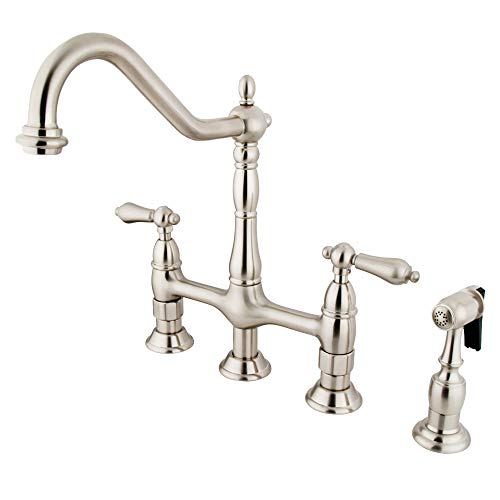
Kingston Brass Heritage Bridge KS1278ALBS — Best Overall
The bridge faucet is the classic kitchen faucet in its purest form: hot and cold valves standing on the deck, joined by an exposed horizontal bridge that carries water up to a central high-arc spout. Kingston Brass’s Heritage KS1278ALBS is the reference example in brushed nickel, and it earns Best Overall because it commits to the format completely — including the detail cheaper bridges skip, a side sprayer made of brass rather than plastic, denoted by the BS suffix in the model number.
In daily use the format’s virtues are tactile. The lever handles give precise, repeatable temperature blending you set by position memory, and the 8.75-inch spout reach verified in the Amazon title places the stream properly into a deep farmhouse basin rather than against its back wall. The separate sprayer handles the jobs a fixed spout cannot: rinsing the sink corners, filling a pot sitting on the counter beside the sink, and washing down sheet pans too large to maneuver under any spout.
The honest limitations are format limitations, not quality ones. A bridge faucet needs the right hole pattern and deck space, it puts two handles plus a sprayer on your counter to wipe around, and there is no pull-down wand. Buyers renovating around an existing four-hole sink with a sprayer hole will find it drops in naturally; buyers with a single-hole modern sink should look at the widespread pick below instead.
Strengths
- True bridge architecture with exposed body and lever handles
- Matching brass side sprayer, not a plastic substitute
- 8.75-inch spout reach verified from the Amazon listing
Trade-offs
- Needs a compatible multi-hole deck layout
- No pull-down wand for in-sink maneuvering
- More hardware on the deck to clean around
| Mount | Bridge, deck-mount |
| Spout reach | 8.75 in (Amazon title) |
| Sprayer | Brass side sprayer (BS suffix) |
| Finish | Brushed nickel |
Best for: Farmhouse and traditional kitchens wanting the authentic bridge format / Not suited for: Single-hole sinks or buyers who rely on a pull-down wand
Check on Amazon — check the current price on Amazon and confirm the exact configuration before ordering.

Moen Belfield 7255SRS Traditional Two-Handle Faucet — Best Traditional Two-Handle
Not every classic kitchen wants a bridge. The Belfield is Moen’s answer for buyers who want traditional styling in the more familiar two-handle, single-spout layout: a high-arc spout flanked by lever handles, with a separate side spray for reach. The styling is period-appropriate without tipping into costume — bell-shaped escutcheons and gentle curves that sit comfortably beside shaker cabinets and honed stone counters.
Moen’s practical touches carry the pick. The Spot Resist Stainless finish genuinely reduces the fingerprint-and-waterspot wiping that polished traditional faucets demand, which matters on a faucet you touch with wet hands forty times a day. Duralock quick-connect fittings simplify the under-sink work, and the API features confirm ADA-compliant lever operation — useful in any household where grip strength varies, and a reminder that classic and accessible are not opposites.
Choose the Belfield if your sink already has the widespread-style holes and you want the strongest parts-and-support story in this guide; Moen’s cartridge ecosystem is the easiest in North America to service a decade from now. Skip it if the exposed bridge silhouette is the whole point of your renovation — this is traditional, but it is not a bridge.
Strengths
- Moen parts and cartridge support for the long term
- Spot Resist finish cuts daily wiping
- ADA-compliant levers noted in API features
Trade-offs
- Traditional rather than true bridge styling
- Side sprayer adds a fourth deck element
- Premium brand tier positioning
| Handles | Two-handle lever |
| Sprayer | Side spray |
| Install | Duralock quick connect (API features) |
| Compliance | ADA compliant (API features) |
Best for: Traditional kitchens prioritizing serviceability and a big-brand warranty path / Not suited for: Purists who want an exposed bridge body
Check on Amazon — check the current price on Amazon and confirm the exact configuration before ordering.
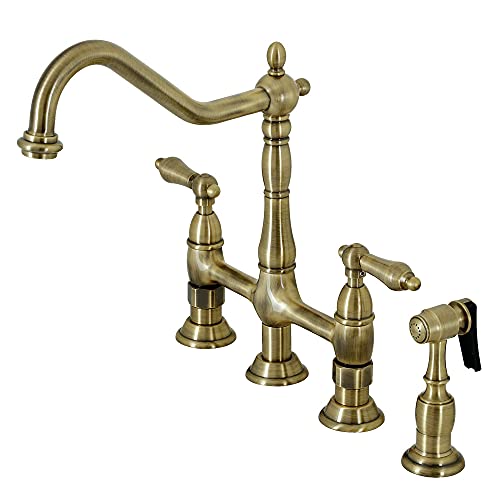
Kingston Brass Heritage Bridge KS1273ALBS Antique Brass — Best Antique Finish
Finish is where classic kitchens succeed or fail, and antique brass is the hardest finish to buy well: done badly it reads as painted plastic, done well it anchors a kitchen of unlacquered warmth — wood counters, copper pans, cream cabinetry. This Heritage variant carries the same bridge architecture and brass sprayer as our Best Overall pick, finished in the antique brass that Kingston Brass built its traditional reputation on.
Because it shares the Heritage platform, everything said about the format above applies: position-memory temperature control from two levers, a sprayer that reaches where the spout cannot, and proportions drawn from pre-war originals. The 8-inch bridge designation in the Amazon title refers to the standard centerset spacing your sink or deck must provide, so measure your existing holes before ordering — antique-finish disappointment is usually a fit problem discovered too late, not a finish problem.
One honest caution applies to all living-look finishes: antique brass will develop character with use and should be cleaned with soft cloths and mild soap only. If your household reaches for abrasive pads and vinegar sprays by default, the brushed nickel Best Overall pick will forgive far more. Buy this one for the look, and keep it with gentle care.
Strengths
- Authentic antique brass finish on a real bridge body
- Brass sprayer included, per Amazon title
- Same proven Heritage platform as the Best Overall pick
Trade-offs
- Finish needs gentle, non-abrasive cleaning
- 8-inch centers must match your deck
- Warm finish limits future hardware mixing
| Mount | 8-inch bridge |
| Sprayer | Brass sprayer (Amazon title) |
| Finish | Antique brass |
Best for: Warm, heritage kitchens built around antique brass and wood tones / Not suited for: Households that clean aggressively or may change finish direction soon
Check on Amazon — check the current price on Amazon and confirm the exact configuration before ordering.

Kingston Brass French Country KB1795TXBS Widespread — Best Widespread Classic
Widespread faucets separate the spout and handles into independent deck pieces, which gives a classic kitchen two advantages: flexible spacing to suit an existing deck or a statement sink, and the most furniture-like, least ‘fixture-like’ presence of any format here. The French Country KB1795TXBS leans into that with curved, almost pastoral detailing and an oil-rubbed bronze finish that pairs naturally with copper sinks, dark wood and stone.
The verified 8.25-inch spout reach is slightly shorter than the bridge picks, which suits standard-depth basins better than extra-deep farmhouse sinks — on a very deep sink, a shorter reach can leave the stream closer to the back wall than ideal. The brass sprayer, again metal rather than plastic, covers the corners and the counter-side filling work.
Pick the French Country if your renovation includes a new deck or sink top where hole placement is yours to choose, and you want the bronze-and-curves country look executed by a heritage specialist. If your holes are already drilled in a tight 8-inch bridge pattern, the Heritage models above fit that reality better.
Strengths
- Flexible widespread spacing for custom decks
- Oil-rubbed bronze finish with real country detailing
- Brass sprayer included
Trade-offs
- 8.25-inch reach is short for extra-deep farmhouse sinks
- Widespread installs take longer under the sink
- Dark finish shows hard-water spots more visibly
| Mount | Widespread |
| Spout reach | 8.25 in (Amazon title) |
| Sprayer | Brass sprayer |
| Finish | Oil rubbed bronze |
Best for: Country and bronze-accented kitchens with freedom on hole placement / Not suited for: Extra-deep sinks needing maximum spout reach
Check on Amazon — check the current price on Amazon and confirm the exact configuration before ordering.

Moen Banbury CA87000SRS Two-Handle High Arc — Best Classic Value
Classic styling does not have to mean heritage-specialist pricing. The Banbury is Moen’s long-running traditional collection aimed at the value tier: a two-handle high-arc faucet whose curves read unmistakably classic, in the same Spot Resist Stainless finish as its pricier siblings, backed by the same Moen support ecosystem that makes the Belfield so serviceable.
What the value tier gives up is mostly ornament and extras. The silhouette is simpler, the detailing less sculptural, and you should confirm on the listing whether a side sprayer is included in the configuration you choose, since Banbury variants differ. What it keeps is the important part: Moen valving with widely available replacement cartridges, so a drip in year eight is a small part and a half hour, not a new faucet.
This is the right classic pick for rental properties, guest-house kitchens, and budget-true renovations where the look must be traditional but the faucet is one line item among many. If the kitchen is your forever renovation and the budget allows, the Belfield and the Kingston Brass bridges reward the step up in presence and spray hardware.
Strengths
- Moen cartridge availability at a value tier
- Spot Resist finish reduces visible spotting
- Unmistakably classic two-handle silhouette
Trade-offs
- Simpler detailing than the heritage picks
- Sprayer inclusion varies by configuration — verify on listing
- Less sculptural presence on a statement sink
| Handles | Two-handle |
| Spout | High arc |
| Finish | Spot Resist Stainless |
Best for: Value-tier traditional kitchens and rentals that still want Moen serviceability / Not suited for: Statement renovations wanting maximum ornament
Check on Amazon — check the current price on Amazon and confirm the exact configuration before ordering.

Delta Windemere 21996LF Two-Handle with Side Sprayer — Best Classic with Side Sprayer
The Windemere represents the classic American kitchen faucet as generations actually bought it: two handles, a gracefully arched spout, a side sprayer in the fourth hole, and chrome everywhere. Delta’s version earns its place on durability evidence rather than nostalgia — the API features note a cartridge tested to 500,000 uses, the kind of cycle figure that separates a faucet you service from a faucet you replace.
At 11.63 inches tall with an 8-inch centerset footprint, it fits the standard four-hole sinks found in an enormous share of existing kitchens, which makes it the lowest-friction classic replacement in this guide: measure your centers, confirm four holes, and the swap is an afternoon. Chrome also remains the easiest finish to match with existing appliances and hardware in a kitchen that is being refreshed rather than rebuilt.
Its trade-offs are the format’s age showing in two places: the spout height, while fine for most pots, is lower than the bridge picks for the very tallest stockpots, and a side sprayer’s hose lives under the sink where it can snag on stored bottles. Neither matters in a standard kitchen; both matter in a small-sink, tall-pot household, which should take the Heritage bridge instead.
Strengths
- Cartridge cycle-tested per API features
- Fits standard 4-hole, 8-inch-center sinks
- Chrome matches existing kitchens easily
Trade-offs
- Lower spout than the bridge picks
- Side sprayer hose can snag under crowded sinks
- Chrome shows water spots more than Spot Resist finishes
| Height | 11.63 in |
| Dimensions | 8 x 10.25 x 11.63 in |
| Holes | 4-hole, 8-inch centers |
| Notes | Cartridge tested to 500,000 uses (API features) |
Best for: Straightforward classic replacements in standard four-hole sinks / Not suited for: Very tall stockpot households needing maximum spout height
Check on Amazon — check the current price on Amazon and confirm the exact configuration before ordering.
Comparison Table
| Pick | Badge | Key spec | Best for |
|---|---|---|---|
| Kingston Brass Heritage Bridge KS1278ALBS | Best Overall | Bridge mount / 8.75-inch spout reach / brass side sprayer | Farmhouse and traditional kitchens wanting the authentic bridge format |
| Moen Belfield 7255SRS Traditional Two-Handle Faucet | Best Traditional Two-Handle | Two-handle high arc / side spray / Spot Resist Stainless | Traditional kitchens prioritizing serviceability and a big-brand warranty path |
| Kingston Brass Heritage Bridge KS1273ALBS Antique Brass | Best Antique Finish | Bridge mount / antique brass / brass sprayer | Warm, heritage kitchens built around antique brass and wood tones |
| Kingston Brass French Country KB1795TXBS Widespread | Best Widespread Classic | Widespread / 8.25-inch spout reach / oil-rubbed bronze | Country and bronze-accented kitchens with freedom on hole placement |
| Moen Banbury CA87000SRS Two-Handle High Arc | Best Classic Value | Two-handle high arc / Spot Resist Stainless / value tier | Value-tier traditional kitchens and rentals that still want Moen serviceability |
| Delta Windemere 21996LF Two-Handle with Side Sprayer | Best Classic with Side Sprayer | 4-hole / two-handle / 11.63-inch height / side sprayer | Straightforward classic replacements in standard four-hole sinks |
Read the table by format first and finish second. Bridge, widespread and centerset faucets are not interchangeable on an existing sink: the hole pattern you already own eliminates half this list before style enters the discussion. Only once format is settled do finishes and sprayer materials decide between the survivors.
The second dividing line is the sprayer. Four of the six picks include a side sprayer, and on the Kingston Brass models it is brass — a detail worth more in year five than any styling flourish, because side sprayers are the highest-wear component on a classic faucet and plastic ones crack at the neck. If your cooking never leaves the basin, a sprayer-free configuration is simpler; if you fill pots on the counter or rinse sheet pans, insist on metal.
How to Choose a Classic Kitchen Faucet
Start with the deck, not the catalog. Count your sink’s holes and measure their spacing: bridge faucets need their specific two-post pattern plus a sprayer hole, widespread sets want three holes with flexible spacing, and centerset two-handle models like the Windemere fit the standard 8-inch, four-hole layout. Photograph the underside of your deck before ordering anything; older kitchens hide nonstandard drilling under escutcheons that have not moved in decades.
Next, judge the valve, because it is the faucet’s lifespan. Ceramic disc cartridges from Moen, Delta and Kingston Brass are the proven technology in this class, and the real question is replaceability: can you buy that cartridge, by name, in ten years? Heritage brands publish cartridge numbers and stock them widely; unbranded lookalikes generally cannot name theirs at all. A classic faucet is a twenty-year purchase, and twenty-year purchases should be made from companies that answer the phone.
Spout geometry deserves the same rigor as the valve. Reach determines where the stream lands in your basin — deep farmhouse sinks want the 8.75-inch class, standard basins are happy at 8.25 inches — and height determines what fits underneath. Measure your tallest stockpot with its lid knob, add an inch of maneuvering room, and compare honestly against each pick’s verified height or arc before falling for a silhouette.
Finally, treat finish as a system decision. Antique brass and oil-rubbed bronze are beautiful and directional: they commit your cabinet hardware, lighting and appliance accents for years. Brushed nickel and Spot Resist stainless are the flexible middle, and chrome is the easiest match to what an existing kitchen already owns. Choose the finish your household’s cleaning habits can maintain — gentle cloths for the living-look finishes, almost anything for the resist finishes.
Classic Faucet Budget Tiers, Honestly
The keyword carries no price frame, so tiers here are qualitative. The value tier, represented by the Banbury, buys a big-brand cartridge and honest traditional styling with simpler ornament. That is a rational place to land for secondary kitchens and rentals, and it is where the smart money in this category often goes.
The mid tier — the Windemere and the Belfield — adds the things you touch daily: better sprayers, resist finishes, cycle-tested cartridges and more sculptural detailing. Most forever-kitchen buyers should shop here first. The heritage tier, the Kingston Brass bridge and widespread models, buys authenticity of format: exposed bridges, brass sprayers and finishes like antique brass that volume brands do not attempt. You are paying for the silhouette and the metal, and on a statement farmhouse sink that payment is visible every single day.
What no tier buys you in the classic world is a pull-down wand or touch activation. If those features matter, they live in other guides on this site, and mixing the briefs produces a faucet that satisfies neither. Spend within the classic brief on valve quality and sprayer metal first; ornament last.
Classic Faucet Materials and Construction, Explained
Classic styling hides construction differences that modern faucets make more obvious, because a traditional silhouette can be cast in solid brass or in thin zinc alloy and photograph exactly the same. Brass is the historical material for a reason: it machines cleanly, resists dezincification in most water chemistries when properly alloyed, and gives a faucet the heft that lets mounting hardware stay tight for decades. When a listing or spec sheet states a brass body — as the Kingston Brass sprayers in this guide state brass construction for their highest-wear component — that is a meaningful signal. When a listing says only ‘metal construction’ with no alloy named, assume the lighter alloys and price your expectations accordingly.
Cartridge construction is the second material story. Ceramic disc cartridges dominate the quality end of the classic market because the discs are extremely hard, resist the mineral abrasion that destroys rubber-sealed compression valves, and can be manufactured to tight tolerances that stay drip-free through hundreds of thousands of cycles — the Windemere’s listing record cites cartridge testing to 500,000 uses, which is the right order of magnitude for a faucet bought as a twenty-year fixture. Older classic designs used compression valves with replaceable washers; they are serviceable forever but need washer changes and feel less precise. Neither is wrong, but ceramic is the modern answer inside a period silhouette.
Finish construction matters as much as body construction. Quality traditional finishes are applied over proper plating stacks and, in the case of the physical-vapor-deposition finishes used on premium lines, are substantially harder than the base metal. Living finishes — unlacquered and antique brass treatments — are intentionally the opposite: a surface meant to change. Knowing which philosophy you are buying prevents the most common classic-faucet disappointment, which is expecting a living finish to behave like a sealed one, or paying for a sealed finish and mourning that it never develops character.
Living With a Classic Faucet: Care That Keeps It Classic
A classic faucet asks slightly more of its owner than a sealed modern one, and repays it by aging gracefully instead of merely aging. The weekly routine is simple: wipe the body and handles with a soft, damp cloth and dry them, especially in hard-water homes where dried droplets leave mineral outlines on bronze and brass. That thirty-second habit prevents the vast majority of finish complaints, because mineral scale, not the finish, is what usually dulls a traditional faucet’s looks.
Monthly, remove and rinse the aerator — classic spouts use standard aerators — and run the side sprayer through its full extension, checking the hose for the stiffness that precedes cracking. Sprayer hoses are consumables even on heritage faucets; replacing one at the first sign of fatigue is a small part and a short job, while ignoring it risks a leak inside the cabinet. Keep a folded towel and a small parts kit — aerator, spare cartridge number written down, plumber’s tape — in the sink cabinet, and the faucet’s maintenance becomes a system rather than a series of surprises.
Annually, exercise every valve through its full travel and check the mounting nuts for the quarter-turn of relaxation that vibration and thermal cycling produce. Two-handle faucets also reward a drop of food-safe silicone grease on handle splines if operation grows stiff. None of this exceeds an hour a year, and it is precisely this light, regular attention that lets a classic faucet reach the decades-long lifespan its construction promises — the entire economic argument for buying one.
Classic Faucets and Sink Pairings: Getting the Proportions Right
A classic faucet succeeds or fails as part of a composition, and the sink is the other half of it. Farmhouse and apron-front sinks, with their deep basins and forward presence, want the longest reaches and tallest arcs in this guide — the Heritage bridge’s verified 8.75-inch reach exists for exactly this pairing, landing the stream near the basin’s center instead of against its back wall. On a standard stainless undermount, that same reach can overshoot, splashing the front wall of the basin; the Windemere’s more compact geometry is the proportionate choice there. Proportion is not aesthetics alone: a stream that lands wrong is a stream that splashes, every time, for years.
Cast-iron and fireclay sinks bring a second consideration: weight and drilling. These sinks are heavy, their decks are thick, and their hole patterns are often fixed at manufacture. Widespread and bridge faucets must match those patterns exactly, and the time to discover a mismatch is with a tape measure before ordering, not with the old faucet already removed. If your sink is a vintage piece with nonstandard spacing, the widespread French Country format offers the most placement forgiveness in this guide, because its components mount independently.
Finally, consider the backsplash and window reality behind the sink. Tall bridge faucets need vertical room for their arc and for the pots passing under it; a low window sill or a shallow shelf behind the sink can quietly veto the tallest silhouettes. Measure from deck to the lowest obstruction, compare it with the faucet’s height plus your tallest pot, and let the room — not the catalog photograph — cast the deciding vote. Classic kitchens are composed, and composition begins with honest measurements.
When a Classic Faucet Is the Wrong Choice
Honesty about a category includes naming its limits, and there are kitchens where a classic faucet is simply the wrong tool. If your cooking depends on moving water around a large sink — rinsing sheet pans corner to corner, filling pots wherever they sit, washing a dog in the basin — the fixed-spout-plus-side-sprayer format will feel like a compromise every single day, and a modern pull-down will serve you better regardless of how the kitchen looks. Style regret fades; functional regret compounds. The comfortable-faucet guide linked below exists for exactly that household.
Classic faucets are also the wrong choice when the renovation timeline is short and the plumbing is unknown. Their format specificity — hole patterns, deck thickness, sprayer holes — punishes improvisation, and discovering a nonstandard vintage deck mid-project with the water off is a miserable afternoon. Buyers on a deadline with an unmeasured sink should either measure first, as this guide keeps insisting, or choose a deck-plate modern faucet that forgives surprises.
Finally, a classic faucet is wasted in a kitchen that will be re-styled within a few years. Its entire value proposition — decades of service, a silhouette that outlasts trends — assumes the kitchen around it stays classic too. If the room is a phase, buy for the phase honestly and spend the difference elsewhere. If the room is the keeper, the picks in this guide are built to be kept with it.
A Note on Mixing Classic Faucets With Modern Appliances
Most classic kitchens are not period restorations; they are working kitchens with modern refrigeration, dishwashers and ranges wearing traditional cabinetry. The faucet does not need to pretend otherwise. Brushed nickel and stainless-adjacent classic finishes, like the Spot Resist models in this guide, bridge the two worlds gracefully, letting a bridge or two-handle silhouette coexist with stainless appliances without either looking like a mistake. Save the directional finishes — antique brass, oil-rubbed bronze — for kitchens whose appliances are paneled, black or otherwise visually quiet, and the composition will hold together for the decades the faucet is built to serve.
How to Install a Two-Handle or Bridge Kitchen Faucet
Classic faucet installation is well within careful DIY range, and the format’s separate valves make some steps easier than a modern single-post faucet. Work in this order and do not skip the dry-fit. First, shut off the hot and cold angle stops under the sink and open the old faucet to confirm the water is truly off. Disconnect the supply lines, unthread the old mounting nuts — a basin wrench earns its price here — and lift the old faucet out. Scrape the deck clean of old putty and mineral crust so the new escutcheons sit flat.
Second, dry-fit the new faucet completely before any sealant: posts or spout through their holes, sprayer in its hole, and check from above that handles swing without striking the backsplash and from below that the mounting hardware has clear access. Bridge faucets reward a second pair of eyes at this stage, because the bridge must sit level across both posts; a slight twist here becomes a permanent visual annoyance.
Third, set the faucet with plumber’s putty or the manufacturer’s gasket as the instructions specify, thread the mounting nuts hand-tight, align the spout to the exact center of the basin, then tighten evenly in small alternations. Connect supply lines to the angle stops — hand-tight plus a quarter turn with a wrench is the standard feel — and route the sprayer hose with a smooth loop that cannot kink or snag on the stop valves.
Finally, remove the aerator, turn the water on, and flush each side for a full minute to clear debris before it can lodge in the new cartridges. Check every joint with a dry fingertip, run the sprayer through its full extension, and re-check the joints again the next morning. Keep the cartridge model numbers and the manual in a labeled bag under the sink; the classic faucet you can document is the classic faucet you can keep for decades.
Common Buying Mistakes
**Buying the silhouette before measuring the deck.** Bridge and widespread faucets are format-specific in a way modern faucets are not. A beautiful bridge faucet over the wrong hole pattern becomes a countertop drilling project or a return. Measure holes and spacing first; shop second.
**Accepting a plastic side sprayer on a premium faucet.** The sprayer is the hardest-working, most-dropped component in a classic setup. On the heritage picks here it is brass for a reason. If a listing does not state the sprayer material, treat that silence as your answer.
**Choosing a living finish for a hard-water, hard-cleaning household.** Antique brass and oil-rubbed bronze patina and spot by design. In a home that cleans with abrasives, they will look neglected within a year through no fault of the metal. Match the finish to the cleaning reality.
**Ignoring cartridge replaceability.** A classic faucet’s promise is longevity, and longevity is a parts question. If the manufacturer cannot name the replacement cartridge, the faucet is disposable regardless of how heavy it feels in the hand.
**Forgetting the stockpot test.** Classic spouts vary in height and reach more than modern ones. Measure your tallest pot against the verified spout figures before ordering, especially with deep farmhouse sinks where reach decides whether the stream lands in the basin or on its back wall.
Final Recommendation
If your kitchen is being built around the classic format itself, the Kingston Brass Heritage Bridge in brushed nickel is the complete expression of it — real bridge architecture, a brass sprayer and reach sized for farmhouse basins. Choose the antique brass Heritage when the room’s palette is warm and you will care for the finish gently, and the French Country widespread when your deck layout is yours to design and bronze is the accent.
For buyers who want traditional styling with the easiest ownership story, the Moen Belfield pairs period looks with Moen’s cartridge ecosystem and a spot-resistant finish, while the Delta Windemere is the lowest-friction replacement for the standard four-hole sink. The Banbury holds the value end honestly: same Moen serviceability, simpler ornament, for kitchens where the faucet is one line in a longer renovation list.
Three more verified options round out the list if the headline picks do not fit your space or budget tier: Kingston Brass French Country KB1795TXBS Widespread; Moen Banbury CA87000SRS Two-Handle High Arc; Delta Windemere 21996LF Two-Handle with Side Sprayer. Each one earned its place in the reviews above for a specific reason, so match the badge to your actual routine rather than buying the longest feature list.
Shortlist it this way: Kingston Brass Heritage Bridge KS1278ALBS if you want the safest all-round choice, Moen Belfield 7255SRS Traditional Two-Handle Faucet if the second badge matches your kitchen better, and Kingston Brass Heritage Bridge KS1273ALBS Antique Brass if the third badge names your priority. Every other pick in this guide is a specialist — buy those when their specialty is your actual problem.
Best Kitchen Faucets Best Pull Down Kitchen Faucets Best Commercial Grade Kitchen Faucets Best Comfortable Kitchen Sink Faucets Best Bridge Kitchen Faucets Best Touchless Kitchen Faucets
Frequently Asked Questions
Are bridge faucets practical for everyday cooking, or just decorative?
Practical, with one honest caveat. Two levers give precise temperature blending by feel, the high spouts clear stockpots, and a metal side sprayer covers rinsing work. The caveat is the absence of a pull-down wand: if your routine depends on moving the spray head around inside the sink, a modern pull-down suits you better than any bridge.
What hole pattern does a bridge faucet need?
A bridge faucet mounts its two valve posts through two deck holes at the spacing the model specifies — 8-inch centers are typical — with the bridge spanning between them, plus a separate hole if a side sprayer is included. Measure your existing holes before ordering; bridges are the least forgiving format about drilling.
Is a brass side sprayer really better than a plastic one?
Yes, measurably in service life. Sprayers get dropped, knocked against cast iron and cycled thousands of times. Brass-bodied sprayers survive that treatment and can usually be serviced; plastic sprayer necks commonly crack at the stress point. On a faucet bought for twenty years, sprayer material is a first-order detail.
How long should a classic kitchen faucet last?
With a ceramic cartridge from a heritage brand and replaceable parts, the body should outlast several cartridges — decades is a realistic frame. The limiting factor is almost never the casting; it is whether the manufacturer still sells the cartridge and seals, which is why this guide favors brands with published parts ecosystems.
Can I install a two-handle classic faucet where a single-handle faucet was?
Often yes, if the hole count and spacing work out or a deck plate covers the difference, but bridge faucets specifically need their two-post pattern. Photograph and measure the existing deck first. Where holes do not align, a widespread set offers the most placement flexibility without new drilling.
Do classic faucets come in finishes that hide water spots?
Yes. Spot-resist stainless and brushed finishes, like Moen’s Spot Resist Stainless on the Belfield and Banbury, visibly reduce spotting and fingerprints. Polished chrome and the living finishes — antique brass, oil-rubbed bronze — show more and ask for gentler, more frequent wiping.


