Disclosure: airfryerkitchensupply.com is reader-supported. When you buy through links on our site, we may earn an affiliate commission at no extra cost to you.
Where to buy
When you shop for the best ceramic kitchen sinks, you are almost always shopping fireclay, a ceramic body fired until the glaze and clay fuse — are sold through Amazon, plumbing showrooms, and the sink brands’ own stores. Buying through Amazon makes returns of a heavy, fragile item far simpler if the basin arrives chipped, which is the single most common problem with this category.
Whichever route you take, inspect the sink the day it arrives, before the counter is cut. Run your hand over the rim and apron, check the glaze under a bright light for crazing or pinholes, and photograph anything questionable. Exchanging a fireclay sink is easy in week one and miserable in week six.
- Kraus KFDW1-33GWH Gloss White Fireclay Workstation Sink, 33 in — Best Overall: check price on Amazon.
- Lordear 33 Inch White Fireclay Undermount Workstation Sink — Best Undermount Workstation: check price on Amazon.
- TUKTUK White Farmhouse Sink, 33 inch Fireclay Apron Front — Best Farmhouse Look: check price on Amazon.
- Sinkology Jackson 33 in White Fireclay Drop-In Kitchen Sink — Best for DIY Drop-In: check price on Amazon.
- Ruvati 33×20-in White Reversible Fireclay Farmhouse Sink RVL2300WH — Best Premium Apron Front: check price on Amazon.
- Elkay Fireclay SWUF28179WH Single Bowl Farmhouse Sink, 30 Inch — Best Compact Farmhouse: check price on Amazon.
Finding the best ceramic kitchen sinks starts with a vocabulary lesson: nearly every white “ceramic” kitchen sink sold today is fireclay, a ceramic material fired at extreme heat until it becomes dense, glassy, and far tougher than ordinary pottery. That is good news — true fireclay is the most stain-resistant sink surface you can buy — but it also means the differences between models come down to glaze quality, mounting style, and bowl geometry rather than the material name on the box.
The six sinks below cover the realistic ceramic market: two workstation designs for cooks who prep at the sink, two apron-front farmhouse models plus a compact 30-inch version, and one DIY-friendly drop-in for remodels that keep the existing counter. Every pick was verified against Amazon’s catalog data before being linked here, and each listing was checked for the mounting style and dimensions described.
It is also worth knowing what ceramic is not. It is not the lightest choice, not the cheapest choice, and not the forgiving choice a thin stainless sink can be in a rental or a first apartment. Ceramic rewards a settled kitchen — owned cabinets, a counter you plan to keep, and cooks who set pans down rather than dropping them. If that describes your household, the payoff is a sink that still looks deliberate and bright long after trendier finishes have dated.
One honest warning up front: ceramic is heavy and it is hard. A fireclay sink can weigh as much as a small adult, it will chip if a cast-iron skillet falls edge-first into it, and undermount and apron-front installs are real carpentry. None of that should scare you off — fireclay sinks routinely outlive the kitchens around them — but buy with your eyes open and this guide will walk through each trade-off.
In this guide
Quick Picks
Short on time? These are the six ceramic sinks worth your money, each with a distinct reason to buy it:
- Best Overall — Kraus KFDW1-33GWH Gloss White Fireclay Workstation Sink, 33 in. Italian-made fireclay, an integrated accessory ledge, and a cutting board and colander in the box. It is the most complete ceramic package here and the easiest one to recommend to most kitchens.
- Best Undermount Workstation — Lordear 33 Inch White Fireclay Undermount Workstation Sink. A 33x19x10 inch fireclay basin with a slide ledge and dual-mount flexibility. It gives you the clean undermount line most ceramic shoppers actually want, at the value end of the fireclay market.
- Best Farmhouse Look — TUKTUK White Farmhouse Sink, 33 inch Fireclay Apron Front. The classic apron-front silhouette in fireclay, reversible so you can choose the front profile, and flexible enough to drop in or undermount. This is the statement-piece pick.
- Best for DIY Drop-In — Sinkology Jackson 33 in White Fireclay Drop-In Kitchen Sink. A fireclay sink designed around an easier install: drop-in mounting, a 1-hole faucet deck, and crack-resistant material claims. The remodel-friendly ceramic pick.
- Best Premium Apron Front — Ruvati 33×20-in White Reversible Fireclay Farmhouse Sink RVL2300WH. A 33×20 reversible fireclay apron front from a sink specialist brand. Bigger front-to-back than most, with the fit and finish buyers paying for a forever sink expect.
- Best Compact Farmhouse — Elkay Fireclay SWUF28179WH Single Bowl Farmhouse Sink, 30 Inch. A 30-inch fireclay farmhouse from Elkay, the name most plumbers already know. The way to get the apron-front ceramic look into a smaller kitchen.
How These Picks Were Chosen
We built this list from the fireclay and ceramic sinks actually sold through major US channels, then verified each model against live catalog data so the dimensions, mounting styles, and included accessories in this article match what you will see on the product page. Models that could not be verified were left out rather than guessed at.
Ceramic sinks were judged on the things that decide satisfaction five years in: glaze quality and stain resistance, bowl depth and usable area, mounting style and the cabinet work it demands, and whether the design earns its keep daily (a workstation ledge) or is purely decorative. We also weighted brand support, because a sink is a 20-year purchase and spare grids and drains should still exist in year fifteen.
- Material honesty: genuine fireclay construction, not a thin ceramic coating over another substrate.
- Glaze quality: a dense, smooth finish that resists staining and metal marks and can be cleaned without harsh chemicals.
- Mounting fit: the install style (drop-in, undermount, apron front) must suit real cabinets and counters, with the modification work stated plainly.
- Bowl usability: depth and footprint matched to real cookware — sheet pans, stockpots, roasting trays.
- Support ecosystem: grids, drains, and replacement accessories that will still be findable years from now.
The 6 Best Ceramic Kitchen Sinks

Kraus KFDW1-33GWH Gloss White Fireclay Workstation Sink, 33 in — Best Overall
The Kraus KFDW1-33GWH is the pick for buyers who want the classic white ceramic look without giving up the modern workstation layout. The basin is fireclay made in Italy, finished in gloss white, and the rim carries an integrated ledge so the included cutting board and colander slide over the bowl instead of cluttering the counter.
It suits a 33-inch sink base in a kitchen that does real daily cooking: sheet pans, stockpots, and a steady stream of produce washing. Because it installs as a drop-in, it is also one of the more forgiving ceramic options for a remodel that keeps the existing countertop.
Strengths
- Fireclay made in Italy with a dense, glass-smooth gloss white finish that resists staining from coffee, wine, and tomato sauces.
- Integrated workstation ledge with a cutting board and colander included, so prep happens over the sink instead of beside it.
- Heat-safe surface rated to 300F per the manufacturer listing, which covers hot pans set down briefly without scorching the glaze.
Trade-offs
- Drop-in rim sits on the counter, so the seamless undermount look is off the table with this model.
- Fireclay is heavy; plan on a helper and confirm the cabinet and counter can carry the load before install day.
- The 33-inch footprint needs a full-size base cabinet, which rules it out for compact galley kitchens.
| Material | Fireclay (made in Italy) |
| Overall size | 33 in |
| Mount type | Drop-in with integrated workstation ledge |
| Finish | Gloss white |
| Heat rating | Heat-safe to 300F (manufacturer listing) |
| Included | Cutting board and colander |
What separates this Kraus from cheaper white sinks is density. Fireclay is fired at very high temperatures until the clay body and glaze fuse, which is why a well-made fireclay basin shrugs off the metal marks and tea stains that etch into thinner ceramic coatings. In daily use that means you can scrub with a melamine sponge and baking soda rather than babying the surface.
The workstation ledge is more than a styling cue. Sliding the board over the bowl turns the sink into a prep station: peel and chop over the basin, sweep scraps straight into the bowl, then slide the colander across to rinse. For small counters this reclaimed workspace is the difference between a cramped cook and a comfortable one.
Best for: cooks who want the white ceramic look plus a true workstation layout in a 33-inch base / Not suited for: buyers who insist on a flush undermount installation or have a narrow sink cabinet
Check the current price on Amazon

Lordear 33 Inch White Fireclay Undermount Workstation Sink — Best Undermount Workstation
Lordear’s 33-inch white fireclay sink is built for the buyer who wants the countertop to run clean into the bowl. It mounts undermount for that wipe-straight-in edge, and the listing also describes dual-mount flexibility, which helps if your remodel plans change mid-project.
The basin is a generous single bowl at 33 by 19 inches with a 10-inch depth, and a slide ledge runs along the top so accessories can bridge the bowl. It suits family kitchens that wash roasting pans and baking trays daily.
Strengths
- True undermount installation gives the seamless counter-to-bowl transition ceramic buyers usually picture.
- Deep 10-inch single bowl swallows sheet pans, stockpots, and tall vases without splashing the counter.
- Slide ledge supports workstation accessories so prep and drying can happen over the basin.
Trade-offs
- Undermount fireclay demands a solid counter (stone or solid surface) and careful support; it is not a casual DIY swap.
- Accessories are not the headline inclusion here, so budget separately if you want boards and racks fitted to the ledge.
- Single-bowl layout means soaking and washing share one space; committed double-bowl households should look elsewhere.
| Material | Fireclay porcelain ceramic |
| Overall size | 33 x 19 in |
| Bowl depth | 10 in |
| Mount type | Undermount, dual mount |
| Layout | Single bowl with slide ledge |
Undermounting a fireclay sink is a commitment: the basin is heavy, the counter edge must be finished, and the sink needs proper under-counter support rather than relying on adhesive and clips alone. In exchange you get the easiest cleanup geometry in this roundup — crumbs and water sweep straight off the counter into the bowl with no rim to catch them.
The 10-inch depth deserves attention. Deep bowls reduce splashback and hide a day of dishes below the counter line, but they also mean shorter users reach further down. If the primary cook is petite or has back trouble, dry-fit the reach in a showroom or mock it up with a cardboard box before committing.
Best for: remodels with stone counters that want a seamless undermount ceramic workstation / Not suited for: renters, laminate-counter kitchens, or anyone who cannot reinforce the cabinet for a heavy basin
Check the current price on Amazon

TUKTUK White Farmhouse Sink, 33 inch Fireclay Apron Front — Best Farmhouse Look
If the whole point of choosing ceramic is the farmhouse look, the TUKTUK 33-inch apron front is the honest answer. The exposed fireclay front panel gives the kitchen its focal point, and because the apron is reversible you can pick between front profiles at install time instead of at order time.
The single bowl is deep, the porcelain basin is described as easy to clean, and the sink supports both drop-in and undermount installation. It suits country, cottage, and transitional kitchens where the sink is meant to be seen.
Strengths
- Reversible apron front lets you choose the finished look during installation rather than weeks earlier.
- Deep single bowl handles roasting pans and canning pots that overwhelm standard-depth sinks.
- Mounting flexibility (drop-in or undermount) widens the range of cabinets and counters it can work with.
Trade-offs
- Apron-front installs usually require cabinet modification; measure the cabinet face carefully before ordering.
- The exposed front is the first thing a dropped skillet will hit, and fireclay chips are repaired, not buffed out.
- Farmhouse styling is a long-term commitment; it anchors the whole kitchen design around one look.
| Material | Fireclay porcelain |
| Overall size | 33 in |
| Mount type | Apron front; drop-in or undermount |
| Layout | Single bowl, deep basin |
| Front | Reversible apron |
Apron-front sinks change how you stand at the sink: the basin reaches a few inches closer to your body, which reduces leaning and is genuinely kinder on your back during long wash-ups. That ergonomic gain is the functional argument behind the farmhouse trend, beyond the styling.
The reversible front matters more than it sounds. One face typically reads more traditional and the other cleaner and flatter, so the same sink can sit in a rustic kitchen or a modern-transitional one. Decide before the counter is cut, though — reversing is an install-time choice, not a weekend change.
Best for: farmhouse and cottage kitchens that want the apron-front statement with install flexibility / Not suited for: flush, minimalist kitchens or cabinets that cannot be modified for an apron front
Check the current price on Amazon

Sinkology Jackson 33 in White Fireclay Drop-In Kitchen Sink — Best for DIY Drop-In
Sinkology’s Jackson takes a different route to ceramic: instead of asking you to rework the kitchen around the sink, it is designed to drop into a standard cutout with a 1-hole faucet deck built into the sink itself. For a weekend remodel that keeps the existing counter, that matters more than any other spec.
The fireclay body is described as crack resistant with easy-clean corners, and the single bowl keeps the layout simple. It suits homeowners replacing a tired stainless drop-in who want the white ceramic look without a contractor-grade installation.
Strengths
- DIY-friendly drop-in design with an integrated 1-hole faucet deck simplifies a counter-preserving remodel.
- Crack-resistant fireclay construction addresses the main durability worry buyers have about ceramic.
- Easy-clean corner geometry reduces the grime traps that plague square-cornered basins.
Trade-offs
- The faucet deck limits faucet choice to deck-mount, single-hole configurations.
- Drop-in rim interrupts the counter line, so it will not satisfy buyers chasing a seamless look.
- As with all fireclay, the sink is heavy for its size; the counter and cabinet still need to be sound.
| Material | Fireclay |
| Overall size | 33 in |
| Mount type | Drop-in |
| Faucet deck | 1-hole integrated deck |
| Layout | Single bowl |
The integrated faucet deck is the Jackson’s defining trade. Mounting the faucet on the sink rather than the counter means one less set of holes drilled in stone, and the whole unit can be lifted out later without disturbing the faucet plumbing as much. The cost is flexibility: wall-mount and counter-mount faucet plans do not apply here.
Sinkology positions this sink at the practical end of the fireclay market — the brand’s pitch is a handcrafted look with an install a confident homeowner can finish in a day. If your project is a full gut renovation with a fabricator involved anyway, the Kraus or Lordear workstations give you more; if the counter stays, this is the sensible ceramic upgrade.
Best for: DIY remodels keeping the existing counter who want fireclay without an undermount install / Not suited for: buyers who want a counter-mounted or wall-mounted faucet, or a rimless look
Check the current price on Amazon

Ruvati 33×20-in White Reversible Fireclay Farmhouse Sink RVL2300WH — Best Premium Apron Front
Ruvati’s RVL2300WH is the premium apron-front option in this roundup: a 33 by 20 inch reversible fireclay farmhouse sink from a brand that builds its reputation on sinks alone. The extra front-to-back depth over typical 33-inch models gives the bowl a more generous working area.
It suits a planned renovation — new cabinets or a modified sink base, a stone counter, and a buyer choosing a sink meant to stay for decades. This is the buy-it-once end of the ceramic market.
Strengths
- Reversible apron gives two front profiles in one sink, traditional or flat, chosen at installation.
- 33×20 footprint offers more bowl area than standard 33-inch apron fronts.
- Sink-specialist brand with a strong support and accessory ecosystem behind the product.
Trade-offs
- Premium positioning: this is the top tier of the roundup’s price range, so it needs a long-term kitchen to justify itself.
- Apron-front installation requires cabinet planning; it is not a drop-in replacement for a standard sink.
- The large, heavy basin is a two-person, plan-ahead install, not a spontaneous weekend swap.
| Material | Fireclay |
| Overall size | 33 x 20 in |
| Mount type | Apron front farmhouse |
| Front | Reversible |
Fireclay quality shows in the glaze: on a well-fired sink the surface stays glassy and white for years, while thin or under-fired ceramic can craze — a network of fine cracks in the glaze that traps stains. Ruvati’s fireclay is the reason this sink anchors the premium slot; the finish is the thing you are paying for, and it is the thing that decides whether a white sink still looks good in year ten.
Plan the install around the apron. The cabinet needs an opening sized to the apron with support beneath the bowl, and the counter cut follows the sink, not the other way round. Order the sink before the counter is templated — fabricators consistently prefer to measure from the physical sink for apron-front jobs.
Best for: full renovations choosing a long-life apron-front sink with a premium glaze / Not suited for: budget remodels or anyone replacing a sink inside an unmodified standard cabinet
Check the current price on Amazon
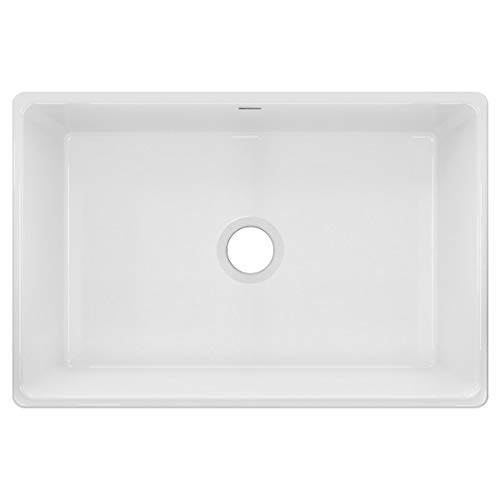
Elkay Fireclay SWUF28179WH Single Bowl Farmhouse Sink, 30 Inch — Best Compact Farmhouse
Not every kitchen can take a 33-inch sink. Elkay’s SWUF28179WH shrinks the fireclay farmhouse formula to 30 inches, which opens the apron-front look to smaller base cabinets and galley layouts that the bigger sinks in this roundup simply cannot fit.
Elkay is a long-established American sink maker, and this single-bowl fireclay farmhouse carries that mainstream support network with it. It suits smaller homes, cottages, and butler’s pantries that want ceramic character without surrendering the whole run of cabinets.
Strengths
- 30-inch width fits smaller sink bases where 33-inch farmhouse sinks cannot go.
- Elkay’s dealer and support network makes parts, grids, and advice easy to find years later.
- Single-bowl farmhouse layout keeps the classic look and the back-friendly reach of an apron front.
Trade-offs
- The smaller bowl is a real limit: half-sheet pans fit, but oversized roasters will bridge the rim.
- As an older, established model it skips workstation ledges and bundled accessories entirely.
- Apron-front cabinet modification is still required despite the smaller size.
| Material | Fireclay |
| Overall size | 30 in |
| Mount type | Farmhouse apron front |
| Layout | Single bowl |
The honest case for the 30-inch size is proportion. A 33-inch apron front can visually swallow a short run of cabinets; the 30 keeps the farmhouse gesture while leaving counter on both sides that a small kitchen cannot spare. In a cottage kitchen or a pantry sink, that balance looks intentional rather than squeezed.
Because this is a long-running Elkay model, the practical ecosystem is deep: bottom grids, drains, and mounting hardware are commodity items, and any plumber you call has likely installed one. For a product category where the install is half the cost, that familiarity has real value.
Best for: smaller kitchens and pantries that want a genuine fireclay farmhouse in a 30-inch base / Not suited for: households that routinely wash oversized roasting pans or want workstation accessories
Check the current price on Amazon
Comparison Table
| Pick | Badge | Key spec | Best for |
|---|---|---|---|
| Kraus KFDW1-33GWH Gloss White Fireclay Workstation Sink, 33 in | Best Overall | 33 in Italian fireclay, drop-in workstation ledge, board + colander included | cooks who want the white ceramic look plus a true workstation layout in a 33-inch base |
| Lordear 33 Inch White Fireclay Undermount Workstation Sink | Best Undermount Workstation | 33 x 19 x 10 in fireclay, undermount/dual mount, slide ledge | remodels with stone counters that want a seamless undermount ceramic workstation |
| TUKTUK White Farmhouse Sink, 33 inch Fireclay Apron Front | Best Farmhouse Look | 33 in fireclay apron front, reversible, drop-in or undermount | farmhouse and cottage kitchens that want the apron-front statement with install flexibility |
| Sinkology Jackson 33 in White Fireclay Drop-In Kitchen Sink | Best for DIY Drop-In | 33 in fireclay drop-in, 1-hole faucet deck, crack-resistant body | DIY remodels keeping the existing counter who want fireclay without an undermount install |
| Ruvati 33×20-in White Reversible Fireclay Farmhouse Sink RVL2300WH | Best Premium Apron Front | 33 x 20 in reversible fireclay apron front, premium tier | full renovations choosing a long-life apron-front sink with a premium glaze |
| Elkay Fireclay SWUF28179WH Single Bowl Farmhouse Sink, 30 Inch | Best Compact Farmhouse | 30 in fireclay farmhouse single bowl, compact apron front | smaller kitchens and pantries that want a genuine fireclay farmhouse in a 30-inch base |
Read the table with your cabinet, not your eyes: the right ceramic sink is the one whose mounting style and width your kitchen can actually accept. A 33-inch apron front in a 30-inch cabinet is not a bargain at any price, and an undermount sink under a laminate counter is a leak waiting for a date.
How to Choose a Ceramic Kitchen Sink
Start with the material definition, because “ceramic” is used loosely in listings. Fireclay is a ceramic body made from clay and glaze fused together at very high temperature; the result is a sink that is ceramic all the way through its surface layer, extremely hard, and naturally non-porous. Cheaper “ceramic” sinks are sometimes vitreous china — fine for a bathroom, thinner and less impact-tolerant in a kitchen — or a coated metal. For a kitchen that sees daily cooking, fireclay is the version of ceramic worth paying for, and every pick in this roundup is fireclay.
Next, choose your mounting style, because it decides your budget, your counter options, and your cleaning routine:
- Drop-in (top-mount): the sink rests on a rim over the counter. Easiest and cheapest to install, works with any counter material including laminate, but the rim traps crumbs and dates the look.
- Undermount: the basin hangs below the counter for a seamless wipe-in edge. Requires a waterproof solid counter (stone, quartz, solid surface) and real under-sink support for a heavy fireclay basin.
- Apron front (farmhouse): the front panel is exposed. Ergonomic and characterful, but needs a cabinet with a modified or purpose-built sink base and careful templating.
Then size honestly. Measure your sink base cabinet’s interior width and subtract the cabinet walls: a 33-inch sink typically needs a 36-inch base, a 30-inch sink a 33-inch base. Bowl depth between 9 and 10 inches is the sweet spot for family cooking — deep enough to hide dishes and soak pans, shallow enough that you are not stooping into the basin.
Then think about how the sink meets the faucet and the disposal, because ceramic punishes improvisation. Deck-mount sinks like the Jackson carry the faucet on the sink itself, which simplifies the counter but fixes your faucet style. Undermount and apron-front sinks leave the faucet to the counter or wall, so the holes must be planned with the counter fabricator — there is no drilling a fireclay rim as an afterthought. If you run a garbage disposal, confirm the drain opening is the standard size your disposal expects and order the flange finish to match the faucet, not the sink.
Finally, weigh single against double bowls honestly. Ceramic sinks are overwhelmingly single-bowl, and for good reason: one large basin fits the sheet pans and roasters that define modern cooking, and a basin insert or a small tub creates a temporary second bowl when you need one. Committed soak-and-wash separators can find double-bowl fireclay, but they trade away the pan-swallowing space that makes the single bowl so useful — and none of the verified double-bowl ceramic models matched the quality bar of the six picks above.
Ceramic vs Stainless Steel vs Granite Composite
Buyers cross-shopping ceramic against the two other big sink materials should know the honest trade-offs. Stainless steel is lighter, cheaper to install, and dents rather than chips; it also shows water spots relentlessly and sounds hollow without good soundproofing. Granite composite is extremely hard and comes in matte colors, but its surface can be rough on glassware and light colors can stain.
Ceramic’s case is the glaze: nothing else feels as smooth, cleans as easily, or keeps a bright white finish as long. A quality fireclay glaze resists the turmeric, beet, and red-wine stains that mark other materials, and it never needs sealing. Its weaknesses are weight and brittleness — it is a material that rewards careful installation and punishes dropped cast iron.
Choose ceramic if the sink is a design anchor and you cook with care; choose stainless if the kitchen is a high-impact family workspace; choose composite if you want a dark, matte basin. There is no universal winner, only the right match for how your kitchen actually gets used.
Ceramic Sink Care, Chip Repair, and Long-Term Ownership
A fireclay sink asks little of its owner, but the little it asks matters. Rinse and wipe the basin after heavy use — not because stains soak in (the glaze is non-porous, so they cannot), but because dried-on debris is always harder to remove than fresh. Once a week, or whenever metal marks appear from pans and cutlery, work a baking-soda paste over the basin with a soft sponge or melamine eraser and rinse. The grey streaks that alarm new owners are metal deposits sitting on top of the glaze, not damage to it, and they lift off completely.
Keep two products away from the sink. The first is gritty scouring powder and steel wool: the glaze’s stain resistance comes from its glassy smoothness, and abrasives slowly dull that finish, after which the sink genuinely does get harder to clean. The second is a heavy cast-iron pan swung carelessly by its handle — point impacts are the one attack fireclay cannot shrug off. Wash cast iron with the pan resting on the bottom grid, not balanced on the rim.
If a chip does happen, it is a repair, not a death sentence. Porcelain and fireclay chip-repair kits use a color-matched epoxy filler: clean and dry the chip, fill slightly proud, let it cure fully, then wet-sand level and polish. On a white sink a careful repair is visible only if you go looking for it. Deep cracks that run into the basin wall are a different matter — those compromise the sink and mean replacement, which is why the grid and careful handling are worth the small effort.
Over a decade, the other maintenance item is the sealant line where sink meets counter. Kitchen silicone eventually blackens or lifts; when it does, cut it out, clean the joint with denatured alcohol, and re-bead with fresh kitchen-and-bath silicone. It is a half-hour job that prevents the slow water damage that ruins cabinets under any sink, ceramic or otherwise.
What to Budget for a Ceramic Sink (Without the Sticker Shock)
Ceramic sinks span three broad tiers. The budget tier covers smaller fireclay drop-ins and lesser-known brands; expect thinner walls and simpler glazes, and inspect the finish carefully on arrival. The mid-range tier — where most of this roundup sits — buys established fireclay construction, workstation options, and reliable quality control. The premium tier pays for sink-specialist brands, thicker fireclay, finer glaze work, and reversible aprons with two finished faces.
The sink itself is only part of the bill. Budget for a bottom grid (it prevents most chips and scratches and is close to mandatory with ceramic), a drain assembly matched to your disposal, and, for undermount and apron-front installs, the cabinet and counter work. Installation can rival the sink’s price on an apron front; get the carpentry quote before you fall in love with a model.
What you should not do is stretch for the sink and skip the grid. With ceramic, the accessory that protects the basin pays for itself the first time a skillet slides instead of landing flat.
How to Install a Ceramic Kitchen Sink (Drop-In Overview and Checks for Every Mount)
Full undermount and apron-front installations belong to experienced DIYers or pros, but the drop-in route — the Sinkology Jackson style of install — is a realistic weekend project. The sequence below covers a drop-in swap and flags the points where undermount and apron-front jobs diverge. Read your sink’s own manual first; it wins any argument with a general guide.
- Shut off water and clear the cabinet. Close the supply valves, open the faucet to drain pressure, and remove everything stored under the sink. Disconnect the supply lines, the drain trap, and the garbage disposal if fitted.
- Remove the old sink. Cut the old sealant bead, release any under-counter clips, and lift the sink straight up. Scrape the counter clean of old silicone so the new rim seats flat.
- Dry-fit the new ceramic sink. Lower it into the cutout with a helper — fireclay is heavy and awkward. Check the rim sits flat all round and the faucet deck holes align with your plan. Mark the outline lightly in pencil.
- Fit the faucet and drain before the sink goes in. With a deck-mount design, install the faucet and drain assembly on the sink while it is still on the floor or a padded worktop. Working upright beats working blind under a cabinet every time.
- Bed the rim in sealant. Run a continuous bead of kitchen-and-bath silicone under the rim (see the caulking guidance in the FAQ if you are choosing a sealant), lower the sink in, and press it home. Fit the mounting clips from below and snug them evenly, alternating sides.
- Reconnect and test. Refit the trap and disposal, reconnect supplies, restore water, and run the faucet while you inspect every joint with a dry paper towel. Fill the bowl to the rim, let it stand, and check below again before calling it done.
For undermount fireclay, add two non-negotiables: a proper support frame or rails inside the cabinet carrying the basin’s weight (adhesive and clips alone are not a structure), and a fabricator-cut counter opening templated from the actual sink. For apron fronts, the cabinet opening and support shelf must be built before the counter is templated. In both cases the sink should be on site before any stone is cut.
After installation, let the sealant cure for the full time stated on its tube before the first real wash-up. Silicone skinned over in an hour is not cured through, and a heavy basin of water is a poor way to discover that.
Common Buying Mistakes
Ordering before measuring the cabinet
The most common ceramic-sink failure happens before checkout: a 33-inch sink ordered for a cabinet that cannot accept it. Measure the cabinet interior, the counter cutout if one exists, and the clearance for the apron or the undermount hardware. Sinks are heavy and returns are freight, not a parcel drop-off.
Skipping the bottom grid
Ceramic’s one real fragility is point impact. A fitted bottom grid keeps pans from striking the glaze, stops glasses tipping, and costs a fraction of a chip repair. Treat it as part of the sink’s price, not an optional extra.
Using the wrong sealant — or none rated for kitchens
The seam around any sink lives wet. Use a kitchen-and-bath silicone rated for constant water contact and mold resistance, and replace it when it blackens or lifts. Bargain construction adhesive and painter’s caulk both fail early in sink duty.
Undermounting on clips and glue alone
A filled fireclay basin plus a load of dishes is a serious weight hanging under your counter. Without rails or a frame carrying the load to the cabinet, undermount installs creep, gaps open, and water follows. Support is structure, not paranoia.
Scrubbing the glaze with abrasive powders
Fireclay glaze cleans easily precisely because it is smooth; harsh abrasives and steel wool dull it over time and give stains something to grip. Baking soda paste, a soft sponge, and patience handle almost everything a ceramic sink will meet.
Final Recommendation
For most kitchens, the Kraus KFDW1-33GWH is the ceramic sink to buy: Italian fireclay, a workstation ledge with the board and colander included, and a drop-in install that does not demand a counter replacement. It is the shortest path from an ordinary kitchen to the white ceramic look, done properly.
If your remodel includes new stone counters, step to the Lordear 33-inch undermount for the seamless edge, or to the Ruvati RVL2300WH if the design calls for an apron front with a premium glaze. Farmhouse fans on a tighter footprint should look at the TUKTUK 33 for value or the Elkay 30-inch when the cabinet simply will not take a 33. And if the counter stays and the work is yours, the Sinkology Jackson is the honest DIY route.
Whichever you choose, order the grid with the sink, measure the cabinet twice, and inspect the glaze the day the box opens. Do those three things and a ceramic sink will outlast everything around it.
Keep researching the cluster: Best Cast Iron Kitchen Sinks Best Cast Iron Single Kitchen Sinks Best White Kitchen Sinks Best Caulking For Kitchen Sinks Best Kitchen Sinks
Frequently Asked Questions
Is a ceramic sink the same as a fireclay sink?
Mostly, yes, in today’s kitchen market. Fireclay is a type of ceramic — clay and glaze fired together at very high temperature until they fuse — and nearly every kitchen sink sold as ceramic is fireclay. It is denser and more chip- and stain-resistant than ordinary ceramic or vitreous china, which is why it is the right form of ceramic for a working kitchen.
Do ceramic kitchen sinks chip easily?
They chip on point impact — a cast-iron skillet dropped edge-first is the classic case — but they do not chip in normal washing use. A fitted bottom grid removes most of the risk, and small chips can be filled with color-matched epoxy repair kits. Treat the sink firmly but not carelessly and chipping is a non-issue for most owners.
Can you put hot pans in a ceramic sink?
Fireclay handles heat far better than most sink materials, and the Kraus in this roundup is listed as heat-safe to 300F. Brief contact with hot cookware is fine; resting a pan straight off a burner for a long soak is still better done on a trivet, mainly to protect the pan’s seasoning and your hands.
How do you clean a white ceramic sink without damaging it?
Daily: dish soap, warm water, a soft sponge. For marks: a paste of baking soda and water worked with a melamine sponge lifts metal marks and coffee stains. Avoid steel wool and gritty scouring powders, which dull the glaze over time. The glaze is non-porous, so stains sit on the surface rather than soaking in — patience beats aggression.
Are ceramic sinks hard to install?
Drop-in models are a realistic DIY job. Undermount and apron-front fireclay sinks are heavier work: the basin needs real support, the counter opening must be accurate, and apron fronts need cabinet modification. Many buyers reasonably hire this out — installation is a one-time cost on a sink that lasts decades.
Can a ceramic sink be used with a garbage disposal?
Yes. Fireclay sinks use standard drain openings, so a typical disposal mounts the same way it would under a stainless sink. Order the disposal flange in a finish that matches your faucet, support the disposal properly during installation, and avoid overtightening mounting hardware against the ceramic — snug and sealed is the goal, not maximum torque.
Will a white ceramic sink stay white?
A quality fireclay glaze, yes. The color is the glaze itself, fired in, not a coating, so it does not yellow or peel. Surface stains from tea, coffee, and hard water sit on top of the glaze and clean off with the baking-soda method above. Under-fired budget ceramic can craze over time, which is one reason this roundup sticks to established fireclay models.


