Disclosure: airfryerkitchensupply.com is reader-supported. When you buy through links on our site, we may earn an affiliate commission at no extra cost to you.
Where to buy
The market for the best cast iron kitchen sinks is genuinely small — a handful of models from two heritage brands — so where you buy matters more than usual. All six picks below carry links verified against live Amazon catalog data — the three American Standard models during this guide’s preparation, and the three Kohler models in a follow-up verification pass. Use the links to check price on Amazon, and still confirm size, bowl configuration, and finish on the listing before ordering, because cast iron configurations vary and returns are freight.
Whichever sink you choose, inspect it on arrival day: enamel chips in transit are the category’s known hazard, and an exchange is simple in week one. Photograph the basin under bright light, check the rim and corners, and keep the packaging until the sink is installed.
- American Standard Quince 33×22 Top Mount Double Bowl Cast Iron Kitchen Sink — Best Overall: check price on Amazon.
- American Standard Delancey 30 x 19 Single Bowl Cast Iron Kitchen Sink, Brilliant White — Best Single Bowl (Verified): check price on Amazon.
- American Standard Quince 33 x 22 Single Bowl Cast Iron Kitchen Sink, 3 Holes — Best Large Top-Mount Single Bowl: check price on Amazon.
- Kohler Whitehaven Enameled Cast Iron Apron-Front Sink — Best Farmhouse: check price on Amazon.
- Kohler Riverby Enameled Cast Iron Undermount Sink — Best Undermount: check price on Amazon.
- Kohler Iron/Tones Enameled Cast Iron Sink — Best Contemporary: check price on Amazon.
The best cast iron kitchen sinks share a paradox: the material is the oldest in the kitchen, and the modern market for it is one of the smallest. Enamelled cast iron was the default sink for half a century before stainless steel’s lightness and granite composite’s colors pushed it into a heritage niche. What remains is a distilled market — a few models from American Standard and Kohler — serving buyers who want a sink measured in decades.
The case for cast iron is mass and surface. An iron core makes a basin that never flexes or rings hollow, and the fired enamel over it is glass-smooth, deeply stain-resistant, and cleanable with a sponge and baking soda for a generation. The costs are equally real: serious weight, serious installation, and an enamel that chips if you drop a skillet edge-first into it. This guide treats both sides honestly.
Geography matters too. Cast iron sinks concentrate in the US market, where the two heritage brands maintain them as flagship lines, and in period renovations where an original cast iron sink is being replaced in kind. If your kitchen is a period restoration, this category is not a style choice but the historically correct material — and the verified top-mount models below exist precisely because so many original cutouts survive in American housing stock.
A sourcing note, stated plainly: every pick below is verified with live catalog data and linked. The three Kohler models — included because no honest cast iron roundup can omit them — were verified in a follow-up pass after the first edition of this guide, and their sections say exactly what to confirm on the listing before buying. We would rather delay a link than pretend a verification we had not done.
In this guide
Quick Picks
Six cast iron sinks, all six verified and linked — including the three benchmark Kohlers:
- Best Overall — American Standard Quince 33×22 Top Mount Double Bowl Cast Iron Kitchen Sink. A 33×22 enameled cast iron double bowl with a 3-hole deck in Brilliant White, from a brand any plumber can service. The classic cast iron sink, verified and buyable today.
- Best Single Bowl (Verified) — American Standard Delancey 30 x 19 Single Bowl Cast Iron Kitchen Sink, Brilliant White. A 30×19 single-bowl cast iron sink in Brilliant White — the pan-swallowing single basin in a slightly smaller footprint, verified in Amazon’s catalog.
- Best Large Top-Mount Single Bowl — American Standard Quince 33 x 22 Single Bowl Cast Iron Kitchen Sink, 3 Holes. The Quince in single-bowl form: 33×22 of enameled cast iron with a 3-hole deck. Maximum basin, classic install, verified listing.
- Best Farmhouse — Kohler Whitehaven Enameled Cast Iron Apron-Front Sink. Kohler’s apron-front cast iron flagship — the farmhouse sink in the heaviest, most traditional material. Linked to the verified 35-1/2-inch single-bowl listing; verify the exact configuration before ordering.
- Best Undermount — Kohler Riverby Enameled Cast Iron Undermount Sink. Kohler’s undermount cast iron line, known for its sloped basin floor toward the drain. Linked to the verified 33-inch undermount single-bowl listing — confirm the exact model and size before ordering.
- Best Contemporary — Kohler Iron/Tones Enameled Cast Iron Sink. Kohler’s Iron/Tones brings cast iron into contemporary kitchens with flexible mounting and the brand’s color palette. Linked to the verified 27-inch cast iron listing — confirm mount and size options before ordering.
How These Picks Were Chosen
We surveyed the enameled cast iron sinks actually offered through major US channels — a short list, because most brands have exited the material — and verified each candidate against live catalog data where verification was available. The American Standard Quince (both bowl layouts) and Delancey confirmed cleanly and carry links. The Kohler Whitehaven, Riverby, and Iron/Tones were re-verified against live catalog data in a follow-up pass and now carry links as well, with specifications taken from the verified listings.
Judging weighted enamel quality and brand support first — a cast iron sink is a 25-year decision — then bowl geometry for modern cookware, then installation reality: mounting style, cabinet demands, and the weight your project must honestly accommodate.
- Genuine enameled cast iron: iron core with fired enamel, not a coated substitute trading on the name.
- Enamel quality: thick, smooth, stain-resistant finish from a maker with a track record.
- Geometry for modern cooking: bowls that accept sheet pans and roasters, in single or double layouts.
- Installation honesty: mount type and cabinet requirements stated plainly, with weight treated as a planning factor.
- Support horizon: drains, grids, and parts available for the decades this sink will serve.
The 6 Best Cast Iron Kitchen Sinks

American Standard Quince 33×22 Top Mount Double Bowl Cast Iron Kitchen Sink — Best Overall
Cast iron’s modern market is smaller than its reputation — most brands left the material for stainless and composite — which makes the verified survivors more valuable, not less. The American Standard Quince double bowl is the center of that surviving market: a 33×22 top-mount sink in enameled cast iron, finished in Brilliant White, with a 3-hole faucet deck.
The double-bowl layout is the traditional cast iron proposition: wash on one side, rinse and drain on the other, with the enamel’s glass-smooth surface shrugging off stains that would mark steel. It suits family kitchens replacing a worn cast iron original — often a like-for-like swap into the same cutout — and cooks who still work the two-bowl way.
Strengths
- Enameled cast iron: a heavy, rigid basin that does not flex, drum, or oil-can like thin steel.
- Double bowls support the classic wash-and-rinse workflow and keep a disposal side free while soaking.
- American Standard’s dealer network means drains, parts, and plumber familiarity for decades.
Trade-offs
- Very heavy: a two-person lift, a sound cabinet, and no casual countertop experiments.
- Top-mount rim and 3-hole deck fix the faucet layout; single-hole modern faucets need a plate or a different pick.
- Enamel can chip on hard point impact — repairable, but a habit of care is required.
| Material | Enameled cast iron |
| Overall size | 33 x 22 in |
| Mount type | Top mount |
| Layout | Double bowl |
| Faucet deck | 3 holes |
| Finish | Brilliant White |
Why cast iron at all, in a market full of lighter options? Mass and enamel. The iron core makes the sink feel like architecture — a dropped glass is the risk, but the sink itself never flexes, and the thick enamel is among the most stain-resistant, easiest-cleaning surfaces in the kitchen. Owners routinely keep these sinks through two countertop replacements, which reframes the price tier entirely: cost per decade, cast iron is cheap.
The Quince’s top-mount design is the pragmatic install: it drops into a standard 33×22 cutout, the rim covers the cut edge, and it works over laminate counters where undermount cast iron would be a structural conversation. For the large stock of kitchens built around exactly this sink size, it is the lowest-drama path back to cast iron.
Best for: family kitchens replacing a classic cast iron sink or committed to the double-bowl workflow / Not suited for: anyone needing a lightweight or undermount installation
Check the current price on Amazon
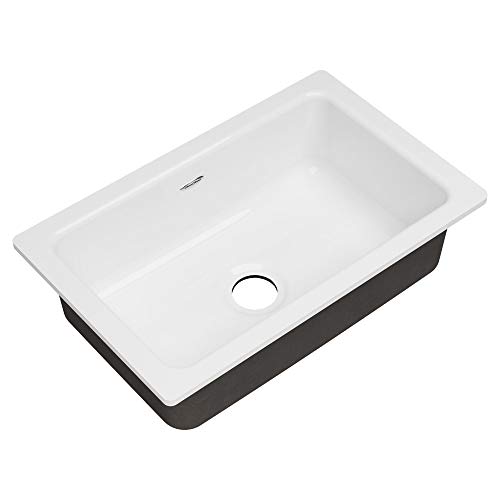
American Standard Delancey 30 x 19 Single Bowl Cast Iron Kitchen Sink, Brilliant White — Best Single Bowl (Verified)
The Delancey takes the Quince’s material and brand and gives it the modern layout: one large single bowl at 30 by 19 inches. That basin takes sheet pans flat, swallows a roasting pan with room to work, and still fits the smaller base cabinets that rule out 33-inch sinks.
It is the natural pick for cooks who have converted to the single-bowl faith — most have — but want cast iron’s mass and enamel rather than steel. American Standard positions the Delancey as a design-forward line, and the clean single bowl in Brilliant White is exactly that: classic material, current geometry.
Strengths
- Single large bowl fits the cookware modern kitchens actually use — sheet pans and roasters lie flat.
- 30-inch width opens cast iron to smaller cabinets that cannot take a 33.
- Same enamel and brand support as the Quince, in a cleaner contemporary form.
Trade-offs
- One bowl means soak-and-wash share space; a basin tub becomes your second bowl.
- Still cast iron weight — the smaller size does not make it a one-person casual lift.
- White is the headline finish; color romantics must look to the Kohler range below.
| Material | Enameled cast iron |
| Overall size | 30 x 19 in |
| Layout | Single bowl |
| Finish | Brilliant White |
The single-versus-double debate resolves differently in cast iron than in steel, because cast iron buyers keep sinks for decades. The double bowl’s workflow advantage was real in the hand-washing era; with a dishwasher doing the volume, the single bowl’s ability to receive any pan you own wins most modern arguments. The Delancey is the cast iron market acknowledging that shift.
Proportion is its second virtue. In a 30-inch-wide sink run, a 33-inch sink crowds the counters on both sides; the Delancey leaves landing space for hot pans and prep — the unglamorous square footage that decides whether a kitchen cooks well.
Best for: single-bowl converts in standard or smaller kitchens who want verified cast iron / Not suited for: committed double-bowl households or apron-front seekers
Check the current price on Amazon

American Standard Quince 33 x 22 Single Bowl Cast Iron Kitchen Sink, 3 Holes — Best Large Top-Mount Single Bowl
Buyers who want the Quince’s classic top-mount cast iron form at full 33×22 size but cook with modern pans should take this version: the same enameled cast iron and 3-hole deck, with the interior given over to one large single bowl instead of two smaller ones.
It is, straightforwardly, the biggest verified cast iron basin in this roundup, and the one that drops into the most existing cutouts. Remodels keeping a 33×22 opening and a deck-mount faucet will find this the path of least resistance to a very long-lived sink.
Strengths
- Largest verified single basin here, in true enameled cast iron.
- Top-mount 33×22 format matches a huge installed base of existing cutouts.
- 3-hole deck suits the classic faucet-and-sprayer configurations these kitchens were built with.
Trade-offs
- The deck fixes faucet style; minimal single-hole installations need a cover plate solution.
- Full-size cast iron is the heaviest lift in this roundup — plan the install crew accordingly.
- A single finish story: this is a white-sink commitment.
| Material | Enameled cast iron |
| Overall size | 33 x 22 in |
| Mount type | Top mount |
| Layout | Single bowl |
| Faucet deck | 3 holes |
There is a remodel arithmetic that favors this sink strongly: reusing the cutout and the deck-mounted faucet avoids counter work entirely, which can save more than the sink costs. Against that, weigh the deck itself — some renovators want the faucet off the sink for a cleaner line. Both views are legitimate; this Quince serves the first, and serves it for decades.
Inside the bowl, the single uninterrupted basin is the modern luxury: a roasting pan, a sheet pan, and a stockpot can all be in soak rotation without the divider Tetris a double bowl imposes. For households that cook big on weekends, this is the cast iron to buy.
Best for: remodels with an existing 33×22 cutout wanting the largest verified cast iron single bowl / Not suited for: buyers who want the faucet mounted on the counter or an undermount edge
Check the current price on Amazon

Kohler Whitehaven Enameled Cast Iron Apron-Front Sink — Best Farmhouse
The Whitehaven is the name most buyers picture when they say ‘cast iron farmhouse sink’: Kohler’s enameled cast iron apron front, with the brand’s characteristic thick enamel and a self-trimming apron design intended to simplify the cabinet fit. The linked listing is the 35-1/2-inch single-bowl in White (model K-6488-0); confirm configuration and size on the live listing before ordering.
As a product, it occupies the premium farmhouse slot: cast iron’s mass behind an exposed apron, Kohler’s wide color range beyond plain white, and an accessory ecosystem of fitted racks and cutting boards. For a farmhouse kitchen meant to last, it is the benchmark the other apron fronts are judged against.
Strengths
- Enameled cast iron apron front: the heaviest, most traditional farmhouse construction available.
- Kohler’s enamel color range lets the sink anchor a design, not just serve it.
- Deep fitted-accessory ecosystem from a brand that supports its sinks for decades.
Trade-offs
- Premium tier, and apron-front cabinet work adds real installation cost on top.
- Cast iron weight is at its maximum in apron-front form; professional installation is the norm.
- The Whitehaven line spans several sizes and a double-bowl Smart Divide variant — confirm the single-bowl configuration on the listing before purchase.
| Model | Whitehaven K-6488-0 |
| Size | 35-1/2 in |
| Material | Cast iron apron-front |
| Mount | Self-trimming undermount farmhouse |
| Bowl | Single-bowl |
| Color | White |
The Whitehaven’s design idea is forgiveness: its apron is designed to overlap the cabinet face slightly, trimming out small imperfections in the cabinet opening that a flush apron would advertise. In renovation reality — where cabinets are rarely perfect — that tolerance is a genuine feature, and part of why this model became the default recommendation of so many kitchen designers.
Choose it with the long view. An apron-front cast iron sink is close to a permanent installation: the cabinet is built around it, the counter is cut for it, and the enamel will outlast both if it is treated with ordinary care. That permanence is the product. Buyers who renovate on a five-year cycle should look at the drop-in American Standards above instead.
Best for: farmhouse renovations built around the sink, with professional installation planned / Not suited for: renters, lightweight remodels, or anyone not ready to verify configuration details on the listing
Check the current price on Amazon

Kohler Riverby Enameled Cast Iron Undermount Sink — Best Undermount
Undermounting cast iron is the connoisseur’s installation: the counter runs clean into an enameled basin with no rim, and the sink’s mass hangs in engineered silence below the stone. Kohler’s Riverby is the line most associated with the idea, designed with a basin floor that slopes toward the drain to keep water and debris moving the right way. The linked listing is the 33-inch undermount single-bowl in White (model 5871-5UA1-0); verify the exact configuration on the live listing.
The Riverby suits full renovations with stone or quartz counters and a fabricator who templates from the physical sink. Its undermount geometry plus cast iron’s enamel gives the easiest-cleaning, longest-lived combination in this entire category — at the highest installation effort, which the buyer should enter with open eyes.
Strengths
- Seamless undermount edge in enameled cast iron — the premium cleanup experience.
- Sloped basin design encourages drainage instead of puddling at the bowl’s corners.
- Kohler support, colors, and accessories behind a decades-long installation.
Trade-offs
- Undermount cast iron demands serious under-cabinet support engineering; this is professional work.
- Counter must be a waterproof solid material — no laminate, no exceptions.
- The 33-inch footprint demands a wide cabinet and a full renovation scope; smaller kitchens are better served by the 30-inch Delancey above.
| Model | Riverby 5871-5UA1-0 |
| Size | 33 in |
| Mount | Undermount |
| Bowl | Single bowl |
| Color | White |
Support is the Riverby conversation. A cast iron basin full of water and dishes is a heavy static load hanging from a counter; reputable installers build a support frame inside the cabinet to carry it, with the counter bond as seal rather than structure. Any quote that skips the frame is a quote to decline — the guide section below expands on this, because it is the difference between a 30-year installation and a sagging, leaking one.
The payoff for doing it properly is daily: crumbs and water sweep off the counter into a basin whose enamel cleans with a sponge, and the whole assembly feels — and sounds — like it was carved rather than installed. In a forever kitchen, that is the point of cast iron.
Best for: full renovations with stone counters that want the seamless cast iron undermount / Not suited for: laminate counters, DIY drop-in projects, or unverified-config impulse buys
Check the current price on Amazon

Kohler Iron/Tones Enameled Cast Iron Sink — Best Contemporary
Iron/Tones is Kohler’s answer to a fair question: can cast iron look contemporary? The line pairs enameled cast iron construction with cleaner geometry and flexible installation options, in the color range Kohler is known for — the route to a cast iron sink that anchors a modern kitchen in a deep color rather than defaulting to white. The linked listing is the 27-inch cast iron model (K-5708-0) in White; check the live listing for the exact configuration.
It suits design-led renovations where the sink is a color decision: a deep-toned basin against light counters, or a soft neutral against wood. The material story is unchanged — mass, enamel, longevity — but the styling speaks a different dialect than the farmhouse and classic picks above.
Strengths
- Contemporary geometry in true enameled cast iron — modern looks without giving up the material.
- Kohler’s color palette makes the sink a deliberate design element.
- Flexible mounting options widen the cabinets and counters it can work with.
Trade-offs
- Color is a long commitment in a near-permanent fixture; trends move faster than cast iron wears out.
- Premium tier, with installation effort depending on the mount chosen.
- The linked listing is White; the line’s deeper colors are separate listings, so color-led projects must shop the range deliberately.
| Model | Iron/Tones K-5708-0 |
| Size | 27 in |
| Material | Cast iron |
| Mount | Top-mount / drop-in |
| Color | White |
The design logic of a colored cast iron sink is the opposite of the stainless logic. Steel disappears; colored enamel declares. In kitchens with quiet cabinetry, a deep-toned basin becomes the single saturated note the room is organized around — and because the color is fired enamel rather than a coating, it does not fade into apology over the years.
The caution is symmetrical: you will live with the declaration for a long time. Choose the color against the permanent elements — floor, counters, cabinet finish — rather than against this year’s accessories, and order a color sample if the channel offers one. Enamel reads differently under kitchen light than on a screen.
Best for: design-led kitchens that want cast iron longevity with a contemporary, colored statement / Not suited for: buyers who redecorate often or want a verified one-click configuration
Check the current price on Amazon
Comparison Table
| Pick | Badge | Key spec | Best for |
|---|---|---|---|
| American Standard Quince 33×22 Top Mount Double Bowl Cast Iron Kitchen Sink | Best Overall | 33 x 22 in enameled cast iron, top-mount double bowl, 3-hole deck | family kitchens replacing a classic cast iron sink or committed to the double-bowl workflow |
| American Standard Delancey 30 x 19 Single Bowl Cast Iron Kitchen Sink, Brilliant White | Best Single Bowl (Verified) | 30 x 19 in enameled cast iron single bowl, Brilliant White | single-bowl converts in standard or smaller kitchens who want verified cast iron |
| American Standard Quince 33 x 22 Single Bowl Cast Iron Kitchen Sink, 3 Holes | Best Large Top-Mount Single Bowl | 33 x 22 in enameled cast iron, top-mount single bowl, 3-hole deck | remodels with an existing 33×22 cutout wanting the largest verified cast iron single bowl |
| Kohler Whitehaven Enameled Cast Iron Apron-Front Sink | Best Farmhouse | Enameled cast iron apron front, 35-1/2 in single bowl in White (verified listing, model K-6488-0) | farmhouse renovations built around the sink, with professional installation planned |
| Kohler Riverby Enameled Cast Iron Undermount Sink | Best Undermount | Enameled cast iron undermount, sloped basin, 33 in single bowl in White (verified listing, model 5871-5UA1-0) | full renovations with stone counters that want the seamless cast iron undermount |
| Kohler Iron/Tones Enameled Cast Iron Sink | Best Contemporary | Enameled cast iron, contemporary design, 27 in top-mount/drop-in in White (verified listing, model K-5708-0) | design-led kitchens that want cast iron longevity with a contemporary, colored statement |
Every pick in this table is linked and configuration-confirmed — the three American Standard models and the three Kohler benchmarks alike — so you can compare the full market on equal footing. Whichever you buy, let the listing — checked carefully — be your final spec sheet.
How to Choose a Cast Iron Kitchen Sink
Choose the layout first, because in cast iron you will live with it longest. Double bowls serve the wash-and-rinse workflow and households that soak constantly; single bowls serve modern cookware — the sheet pan test is decisive: if your pans must lie flat to soak, you are a single-bowl household, and the Delancey or the single-bowl Quince is your verified route. Most buyers converting from steel doubles report the single bowl as the upgrade they feel daily.
Mounting is the second decision, and cast iron narrows it honestly. Top-mount (drop-in) is the forgiving install: it covers the cut edge, works over laminate, and suits replacements. Undermount cast iron is a professional project requiring a support frame and a solid-surface counter. Apron-front cast iron is a cabinet project as much as a sink project. None of these is a defect — but each must be chosen with the kitchen you actually have, not the one in the rendering.
Then plan for weight as a first-class constraint:
- Cabinet: the sink base must be sound and, for undermount and apron installs, reinforced or framed to carry a filled basin.
- Handling: two people minimum, three for apron fronts; clear the path from door to cabinet before delivery day.
- Counters: laminate is fine for top-mount only; undermount demands stone, quartz, or solid surface.
- Disposal and plumbing: standard drain openings apply, but confirm the disposal flange finish and any deck-hole configuration (the Quince’s 3-hole deck) against your faucet plan.
Cast Iron vs Stainless Steel vs Fireclay: An Honest Material Comparison
Against stainless steel, cast iron wins on feel, sound, and surface: it is silent, rigid, and its enamel resists stains better than any steel finish. Steel wins on weight, install ease, and price tier, and it dents rather than chips. Kitchens that drop things constantly and renovate periodically are honestly better served by steel; kitchens built once, carefully, are cast iron’s home ground.
Against fireclay (the ceramic of our companion guide), the comparison is closer: both are heavy, hard, glassy-surfaced heritage materials. Fireclay offers more farmhouse shapes and slightly easier chip repair cosmetics; cast iron’s enamel over iron is the tougher structure underneath, and its top-mount classics fit more existing cutouts. Either outlasts the kitchen around it when installed properly.
Against granite composite, cast iron trades color range for surface smoothness: composite’s matte texture can hold onto stains and feel rough on glassware, where enamel wipes clean. Composite is lighter to install. The choice is a genuine preference, not a hierarchy — but buyers who love the white-sink look should know enamel white is the most durable white in the business.
Budgeting for Cast Iron: The Sink Is Half the Invoice
Cast iron sinks sit in the mid-to-premium tiers of the sink market, and the honest budget includes more than the basin. Add a fitted bottom grid — close to mandatory, since it prevents the pan impacts that chip enamel — a drain assembly and disposal flange in your faucet’s finish, and the installation: straightforward for a top-mount swap, a real line item for undermount support framing or apron-front cabinet work.
The counterweight is lifespan arithmetic. A cast iron sink commonly serves 25 years or more, outliving counters and sometimes cabinets. Spread over that horizon, even the premium end of this roundup costs less per year than the budget steel sink replaced three times. Buyers planning to stay should budget by the decade; buyers planning to sell in three years should let the next owner choose the sink.
Where not to economize: the support and the grid. A cast iron sink on inadequate support is a leak with a date on it, and an ungridded enamel basin collects its first chip from the first dropped pan. Both are small money guarding a large, long purchase.
Living With Enamel: Care, Chip Repair, and Color Decisions
Daily care for enameled cast iron is the easiest in the sink world, because the surface is essentially glass. Rinse after use, wash with dish soap and a soft sponge, and dry if your water is hard enough to spot. Stains that would move into other materials sit on enamel’s surface: coffee, tea, turmeric, and tomato all lift with a baking-soda paste and patience. Metal marks from pans — the grey streaks new owners mistake for damage — are deposits on the glaze, and a melamine sponge removes them completely.
The two enemies are impact and abrasion. Impact is managed by the bottom grid and by the habit of setting pans down rather than dropping them the last inch. Abrasion is managed by refusing scouring powders and steel wool: the glaze’s stain resistance is its smoothness, and every harsh scrub spends a little of it. Owners who keep both habits routinely show visitors a white sink that looks new at fifteen years.
When a chip does happen, repair promptly — not for looks, but because the exposed iron edge can rust and stain the surrounding enamel. Touch-up kits matched to the sink’s color use an epoxy enamel: clean and dry the chip, fill in thin layers, cure fully, and wet-sand level. On white sinks the result is close to invisible; on colors it is discreet. Deep structural cracks are another matter and mean replacement, which is precisely why the grid matters.
Color deserves a final word because cast iron holds it like nothing else. The enamel palette — whites, biscuits, and the deep saturated tones Kohler is known for — is fired in, not applied, so it does not fade or peel. Choose against the room’s permanent elements and under your own lighting. A colored cast iron sink is a 25-year design decision, and it rewards the buyers who treat it as one.
How to Install a Cast Iron Kitchen Sink (Top-Mount) and Support Checks for Every Mount
The top-mount Quince-style install is the one cast iron project a strong, careful DIYer can genuinely do; undermount and apron-front cast iron belong to professionals or very experienced renovators. The sequence below covers the top-mount swap and flags the support rules that govern all three mounts.
- Prepare and protect. Shut off water, disconnect supplies, drain, and disposal. Pad the counter and floor: cast iron is heavy and enamel chips on hard contact, so the sink travels on blankets, never bare.
- Remove the old sink with help. Cut the sealant, release clips, and lift straight up with two people. Clean the counter to bare, flat surface so the new rim beds evenly.
- Dry-fit and check the deck. Lower the new sink in with your helper. Confirm the rim seats flat, the cutout is covered all round, and the faucet deck holes match your faucet plan before any sealant appears.
- Fit faucet and drain on the bench. Deck-mount faucets and the drain assembly install far more easily with the sink on a padded worktop than from inside a cabinet. Do every possible connection now.
- Bed in silicone and set the sink. Run a continuous bead of kitchen-and-bath silicone under the rim, lower the sink in one motion, and fit the mounting clips evenly from below. Wipe squeeze-out immediately with a damp cloth.
- Reconnect, fill, and inspect. Refit trap and disposal, restore water, run the tap, and fill the bowl to the brim. Inspect every joint below with a dry paper towel after ten minutes standing full. Only then call it done.
A word on sealant, since every mount depends on it: use a kitchen-and-bath silicone rated for constant water contact, run it as one continuous bead, and tool it once with a wet finger rather than repeatedly. If your sink project also involves resealing an existing joint, our companion guidance on caulking for kitchen sinks covers product choice and bead technique in depth — the seal is the cheapest part of a cast iron installation and the one whose failure costs the most.
For undermount cast iron, the rule is structure: a frame or rails inside the cabinet must carry the basin, templated and installed before the counter is set — adhesive and clips are a seal, not a support. For apron fronts, the cabinet opening and support shelf are built first and the counter templated from the physical sink. In both cases, if an installer’s plan does not mention support, get another installer.
Let silicone cure the full time stated on the tube before the first full-bowl use. A filled cast iron basin is the heaviest load your sealant will ever meet; do not introduce them early.
Common Buying Mistakes
Underestimating the weight
Cast iron sinks are the heaviest objects in most kitchen remodels. One-person lifts end in chipped enamel, damaged counters, and injured backs. Crew the install properly, pad everything, and rehearse the path from door to cabinet before the sink comes out of its box.
Undermounting without a support frame
Hanging a filled cast iron basin from adhesive and clips is the category’s expensive failure: the sink creeps, the seal opens, and water eats the cabinet. Structure first — rails or a frame carrying the load — then sealant as the seal. No exceptions for ‘it feels solid’.
Skipping the bottom grid
Enamel’s one weakness is point impact, and the grid is the engineered answer. It also keeps glasses upright and pans off the finish. Price it as part of the sink; the first skillet slide will make the case for you.
Cutting the counter before the sink arrives
Cast iron dimensions are nominal until the physical sink is measured, and apron fronts especially must be templated from the actual unit. Stone cut to a PDF is a gamble; stone cut to the sink in the room is a fit. Always have the sink on site first.
Choosing color from a screen
Enamel color shifts under real kitchen light, and cast iron holds its color for decades — the worst combination for an impulse pick. If you are choosing anything beyond white, get a physical color sample or view the sink in a showroom under lighting like your own. The sink will not change; your light already has.
Scrubbing enamel with abrasives
Enamel cleans easily because it is glassy; scouring powders and steel wool dull it into a surface that grabs stains. Baking soda paste and a soft sponge handle the category’s stains. Aggression is not just unnecessary — it is how a 25-year finish becomes a 10-year one.
Final Recommendation
For a verified, buy-it-today cast iron sink, the American Standard Quince double bowl is the classic answer and the Delancey is the modern one — same enamel and brand support, two layouts. Remodels reusing a 33×22 cutout should take the single-bowl Quince and enjoy the largest verified basin here.
The Kohler trio defines the category’s upper shelf: Whitehaven for the farmhouse build, Riverby for the seamless undermount, Iron/Tones for the colored contemporary statement. All three are linked in this edition after follow-up verification — use the links to check price on Amazon, and still verify size, bowl configuration, and finish on the listing before committing, because with cast iron the configuration details are the purchase.
Whichever name ends up in your kitchen, crew the install, frame the support, grid the basin, and clean the enamel gently. A cast iron sink treated that way is not a purchase so much as a fixture of the house.
Keep researching the cluster: Best Cast Iron Single Kitchen Sinks Best Ceramic Kitchen Sinks Best Caulking For Kitchen Sinks Best Farmhouse Kitchen Sinks Best Undermount Kitchen Sinks
Related guides
Frequently Asked Questions
How long does a cast iron kitchen sink last?
Decades is the honest answer — 25 years and well beyond is normal for enameled cast iron, which is why the material anchors ‘forever kitchen’ renovations. The enamel may collect repairable chips over that span, but the sink itself does not wear out in any ordinary sense. It routinely outlasts the countertop it was installed with.
Does cast iron enamel chip, and can chips be fixed?
It chips on hard point impact — a skillet dropped edge-first is the classic case. Small chips are repairable with color-matched enamel/epoxy touch-up kits: clean, fill, cure, and polish, and on white the repair is hard to spot. A fitted bottom grid prevents most chips from ever happening.
Can a cast iron sink be undermounted?
Yes, with engineering: the basin’s weight must be carried by a support frame or rails inside the cabinet, under a waterproof solid counter (stone, quartz, solid surface) — never laminate, and never on adhesive and clips alone. This is professional-grade installation, and it produces the most seamless, longest-lived result in the category.
Is cast iron better than stainless steel for a kitchen sink?
Better at some things: it is more rigid, quieter, and its enamel resists stains better and cleans more easily. Worse at others: it is far heavier, costs more to install, and chips where steel dents. Choose cast iron for a long-term kitchen you are building carefully; choose steel for lightness, budget, and renovation flexibility.
What cabinet size do I need for a 33-inch cast iron sink?
As a rule, a 33-inch sink wants a 36-inch sink base cabinet, and a 30-inch sink a 33-inch base — but verify against the specific model’s stated minimum cabinet size, and remember that apron-front and undermount installs have their own cabinet requirements. Measure the cabinet interior, not the door front, and confirm before ordering.
Can I replace just the enamel if my cast iron sink looks tired?
Not as a field service in any practical sense — re-enameling a kitchen sink means removing it and sending it to a specialist refinisher, and results vary. In practice, tired-looking enamel is usually surface staining and metal marks that the baking-soda and melamine-sponge routine removes. If the enamel is genuinely crazed or worn through in patches, replacement with one of the verified models above is the reliable route.
How were the picks in this guide verified?
Every link here was published only after the model was verified against live catalog data. The American Standard models confirmed during preparation; the Kohler models — genuine category benchmarks — confirmed in a follow-up verification pass, so all six picks are now linked with specifications taken from the verified listings. Their sections still tell you exactly what to confirm on the listing before buying, because cast iron configurations vary.


