Disclosure: airfryerkitchensupply.com is reader-supported. When you buy through links on our site, we may earn an affiliate commission at no extra cost to you.
Where to buy
Shopping for the best cassette toilets for bus living? Every toilet below is sold on Amazon, and every model named here was cross-checked against Amazon’s own catalogue data before a link was attached, so the name, tank size and flush type in each review match the listing you will land on. Bus conversions sell and resell constantly, so check the current price on Amazon rather than trusting any number quoted in a forum post or an older roundup.
- Kohree 5.8 Gallon Cassette Portable Toilet (Best Overall) — Check the current price on Amazon
- Thetford Porta Potti 365 (Best for Long-Term Reliability) — Check the current price on Amazon
- Camco Portable RV Toilet 5.3 Gallon (Best Sealing Slide Valve) — Check the current price on Amazon
- Dometic 976 Portable Toilet 5.0 Gallon (Best Pressurised Flush) — Check the current price on Amazon
- Thetford Porta Potti Curve 565E (Best Comfort and Electric Flush) — Check the current price on Amazon
- SereneLife 5.2 Gallon Portable Toilet (Best High Flush Count) — Check the current price on Amazon
If you are shopping for the best cassette toilets for bus living, start with one honest piece of context: in North America the word ‘cassette’ is used loosely. A true European-style cassette toilet is built into the vehicle, plumbed to a fixed bench, and its waste cassette slides out through an exterior service hatch. Very few converted school buses and shuttle buses in the US have that hatch, so most bus dwellers actually live with the cassette concept in its portable form — a self-contained toilet whose sealed waste tank detaches, carries to a dump point, and empties like a suitcase. Every pick in this guide follows that real-world pattern: a detachable, sealable waste cassette you can carry one-handed, sized for a bus floor plan.
That distinction matters because it changes what you should optimise for. In a bus you are not choosing porcelain and flush power; you are choosing tank capacity against dump frequency, a seal you trust at highway vibration, a seat height your knees can live with at 6 a.m., and a footprint that fits between a wheel well and a bed frame. The six toilets below cover the realistic spread: a cassette-labelled large-tank model, the long-running Thetford Porta Potti line, a slide-valve Camco, a pressurised-flush Dometic, a curved electric-flush option, and a high-flush-count SereneLife.
None of them needs a black-water tank, a macerator or a vent stack, which is exactly why the cassette format suits bus living: you can start with the toilet on day one of the build, move it while you finish the interior, and service it at any RV dump station, rest area vault toilet or home cleanout. Read the reviews with your own floor plan in mind — the best cassette toilet for a full-time skoolie couple is not the best one for a weekend shuttle-bus camper, and this guide separates those cases pick by pick.
A final framing before the picks: a bus is the hardest environment a portable toilet serves. It vibrates for hours, bakes in summer sun and freezes in winter layups, and its toilet often lives inches from where people sleep and cook. That is why this guide weights seals, carry design and parts support so heavily — in a house, a mediocre portable toilet is an inconvenience; in a bus, it is a roommate. The picks below were chosen to be good roommates.
In this guide
Quick Picks
Kohree 5.8 Gallon Cassette Portable Toilet — Best Overall. The rare listing that actually uses the word cassette: a 5.8-gallon detachable waste tank, a level indicator so you never guess, and a diagonal elongated seat that is kinder on longer sits than the usual round portable bowl. Check the current price on Amazon
Thetford Porta Potti 365 — Best for Long-Term Reliability. The benchmark portable cassette toilet from the company that defined the category, with a piston flush, a rotating pour spout and the deepest spare-parts support of anything here. Check the current price on Amazon
Camco Portable RV Toilet 5.3 Gallon — Best Sealing Slide Valve. A 5.3-gallon detachable tank closed by a sealing slide valve, flushed by a simple bellows pump, with a built-in carry handle — the straightforward, lightweight cassette for smaller buses. Check the current price on Amazon
Dometic 976 Portable Toilet 5.0 Gallon — Best Pressurised Flush. Dometic’s 976 pairs a five-gallon holding tank with a pressurised flush that actually rinses the bowl, backed by one of the biggest names in RV sanitation. Check the current price on Amazon
Thetford Porta Potti Curve 565E — Best Comfort and Electric Flush. The Curve trades field simplicity for comfort: a taller, sculpted seat, battery-powered electric flush and a larger home-style presence for buses with a dedicated bathroom corner. Check the current price on Amazon
SereneLife 5.2 Gallon Portable Toilet — Best High Flush Count. A 5.2-gallon detachable tank rated by its maker for 100-plus flushes per fill, with a level indicator, leak-proof sealing and a sturdy weight capacity for bigger users. Check the current price on Amazon
How These Picks Were Chosen
Each candidate was checked against Amazon’s catalogue before it earned a link here: the brand, model name, tank capacity and flush mechanism in the listing title had to match the product described in the review. Models that could not be matched with confidence were left out rather than guessed at, and no prices or ratings are printed anywhere in this article because both change too often to stay true.
The shortlist was then filtered through bus-specific criteria. First, the waste tank must detach and seal — a fixed tank is a black tank by another name and defeats the cassette idea. Second, capacity: tanks in the five-to-six-gallon class are the full-time sweet spot, because a two-person bus fills roughly a gallon of waste capacity a day in normal use. Third, the seal and valve design, since a cassette gets carried horizontally through a living space. Fourth, seat height and footprint against typical bus interior layouts. Finally, parts support: latches, seals and replacement cassettes should be buyable years later, which favours established RV brands.
We also weighed how each toilet behaves between dumps — odour control with standard holding-tank treatment, how completely the bowl rinses, and whether the tank has a level indicator or a pour spout that makes emptying less of an event. Those daily-life details, not headline capacity, are what owners praise or curse after six months on the road.
The scoring behind the shortlist, in the order a bus owner feels it: seal and valve design first, because the cassette is carried through the living space; real-world capacity second, measured against a two-person dump rhythm rather than a brochure maximum; seat comfort third, because this is a daily-use fixture, not emergency equipment; flush effectiveness fourth, because bowl cleanliness is where odour starts; and parts support fifth, because a toilet that cannot be re-sealed in year three is a disposable. Price tier was used only to separate near-equals — in a product this intimate, cheap and bad is the most expensive combination there is.
The 6 Best Cassette Toilets for Bus Living, Reviewed

Kohree 5.8 Gallon Cassette Portable Toilet — Best Overall
For a bus that moves weekly rather than daily, this Kohree is the easiest recommendation in the group. The cassette itself is the point: it detaches cleanly, seals, and carries by its handle, and at 5.8 gallons it holds meaningfully more than the five-gallon class that dominates this category. A couple living aboard can typically stretch several days between dumps, which changes route planning — you stop at dump stations when convenient, not out of urgency.
Strengths
- Largest practical cassette in this roundup, stretching dump runs for two people
- Level indicator removes the lift-and-guess routine before a drive day
- Elongated diagonal seat is noticeably more comfortable than round portable bowls
Trade-offs
- A full 5.8-gallon cassette is a heavy one-handed carry to the dump point
- Taller body needs a dedicated floor spot, not a closet corner
- Flush water comes from a separate fill, so total weight climbs further when full
| Waste tank | 5.8 gallons, detachable cassette |
| Seat | Diagonal elongated bowl seat |
| Indicator | Waste level indicator |
| Design | Leak-proof sealed tank |
The diagonal elongated seat sounds like a marketing detail until you use a round portable toilet for a month; the extra room matters, particularly for larger adults. The level indicator is the other quiet win, because in a bus the toilet often lives inside a cabinet or under a bench where you cannot see the tank. Knowing the cassette is at three-quarters before you leave a campsite is the difference between a planned stop and a roadside problem.
Emptying is conventional cassette work: remove the tank, carry it upright, open the pour spout, and rinse. The seal design is rated leak-proof by the maker, and the sensible bus habit still applies — treat the cassette gently, keep the blade seal clean, and dose it with holding-tank treatment after every empty.
Best for: full-time bus couples who want the longest interval between dumps / Not suited for: solo travellers who cannot comfortably carry a full large cassette

Thetford Porta Potti 365 — Best for Long-Term Reliability
If your bus is a five-year home rather than a season’s project, the Porta Potti 365 is the conservative, proven choice. Thetford has sold this format for decades across RV and marine use, and that history shows up where it counts: replacement seals, pour spouts and latches are stocked items, not special orders. In a vehicle that vibrates everything loose eventually, being able to refresh a worn seal in an afternoon is worth more than a novel feature.
Strengths
- Thetford’s parts network means seals, latches and caps stay buyable for years
- Rotating pour spout makes emptying controlled rather than splashy
- Piston pump flush is simple, strong and has nothing electrical to fail
Trade-offs
- Seat height is lower than home toilets, which some knees dislike
- Design is functional rather than pretty inside a finished build
- Fresh and waste tanks are mid-size, so solo full-timers still dump often
| Brand line | Porta Potti 365 (model 92820) |
| Use cases per maker | RV, marine, camping, vans, trucks |
| Tank style | Detachable sealed waste cassette |
The rotating pour spout deserves its reputation. Emptying a cassette is nobody’s favourite chore, and the spout lets you direct the pour and vent air so the tank empties smoothly instead of glugging. The piston flush rinses the bowl with decent pressure and keeps working in freezing trailheads and hot desert stops alike, because there is no battery or motor in the loop.
Seat height is the honest compromise: it sits lower than a household toilet, and tall users or anyone with knee trouble should read the chair-height discussion in the buying guide below and consider a stable riser platform inside the bus. For everyone else, the 365 is the set-it-and-forget-it cassette this category is judged against.
Best for: full-timers who value spare parts and proven seals over novelty / Not suited for: tall users who need a genuinely tall seat without a platform

Camco Portable RV Toilet 5.3 Gallon — Best Sealing Slide Valve
Camco’s take on the cassette toilet is the minimalist one, and for a lot of bus builds minimalist is right. The sealing slide valve is the headline: it closes the waste tank with a firm mechanical seal, so when you detach the cassette and carry it through your living space to the door, you are not relying on a flap and optimism. Anyone who has crossed a finished floor with a full cassette will understand why that matters.
Strengths
- Slide valve seals the cassette positively, which suits carrying through the bus
- Bellows flush has no seals-and-piston assembly to service
- Light, compact body fits short buses and tight wet-bath corners
Trade-offs
- Bellows flush rinses less forcefully than piston or pressurised systems
- Basic feature set: no level indicator on this model
- Gray plastic shows scuffs quickly in a hard-working build
| Waste tank | 5.3 gallons, detachable |
| Valve | Sealing slide valve |
| Flush | Bellows-type manual flush |
| Carry | Built-in carry handle |
The bellows flush is the trade that keeps the price tier and weight down. Squeeze-pump flushing will not scour the bowl the way a pressurised system does, so a quick brush pass becomes part of the routine. In exchange there is very little to break, clog or winterise, and the whole unit is light enough to move one-handed when empty — useful in buses where the toilet shares space with storage and gets relocated as the build evolves.
Treat this as the weekend-plus and solo-traveller cassette: honest capacity, a trustworthy seal, and no features you will pay for and never use. Couples living aboard full-time will simply out-fill it faster than the larger tanks above.
Best for: solo bus dwellers and weekend builds that prize a positive seal / Not suited for: couples who need maximum days between dumps
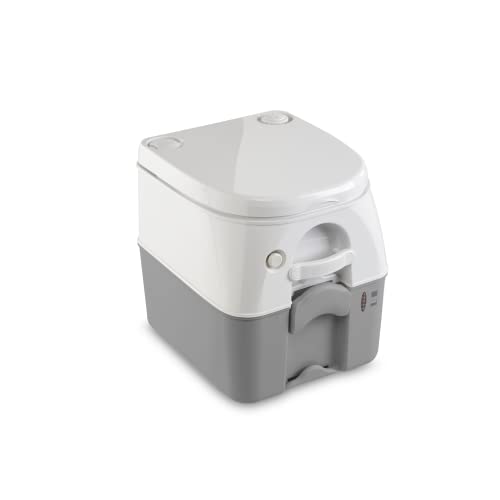
Dometic 976 Portable Toilet 5.0 Gallon — Best Pressurised Flush
The Dometic 976 exists for people who hate the portable-toilet flush more than the portable-toilet concept. Its pressurised flush pushes water around the bowl with genuine force, so the bowl stays cleaner between dumps and you use less treatment chasing odours that start with a poorly rinsed bowl. In a small bus interior, where the toilet is never far from the bed, that cleanliness margin is a quality-of-life feature, not a luxury.
Strengths
- Pressurised flush gives the most home-like bowl rinse in this group
- Dometic’s RV dealer network is a real advantage on long routes
- Adult-size seat and sturdy latches suit daily full-time use
Trade-offs
- Five gallons is mid-pack; heavy users dump more often than with 5.8-gallon tanks
- Pressurised system has more components than a bellows flush
- Heavier empty weight than the lightest portables
| Holding tank | 5.0 gallons |
| Brand | Dometic 976 series |
| Format | Two-piece portable with detachable tank |
Dometic is the other half of the RV sanitation duopoly, and the 976 benefits: seals and service parts travel through the same dealer and online network that supports its fixed RV toilets. The five-gallon tank is the compromise — big enough for a couple’s long weekend, small enough that full-timers will plan dump stops roughly twice a week depending on use and treatment habits.
Construction feels a step above the budget portables, with latches that close positively and a seat that does not flex disconcertingly. If your bus build is finished to a high standard and the toilet lives in a proper wet bath or cabinet, the 976 looks and behaves the part.
Best for: bus owners who want the cleanest-rinsing flush and dealer support / Not suited for: weight-obsessed minimalist builds counting every pound
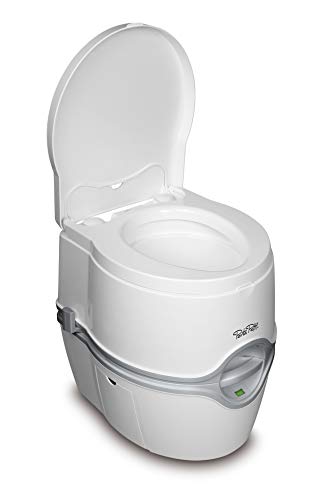
Thetford Porta Potti Curve 565E — Best Comfort and Electric Flush
Some bus conversions are campers; others are small apartments that happen to have wheels. The Porta Potti Curve 565E is built for the second kind. Its seat sits higher and is shaped more like a household toilet than anything else in this roundup, and the electric flush delivers the same even rinse every time at the push of a button — small things that, repeated daily for years, define whether the bathroom corner of a bus feels like a compromise.
Strengths
- Tallest, most home-like seat of the portable cassette group
- Push-button electric flush is effortless and even
- Integrated toilet-paper storage and a polished look suit finished interiors
Trade-offs
- Batteries are one more consumable to monitor on the road
- Larger footprint demands a dedicated spot in the floor plan
- Electric flush is a failure point a manual pump does not have
| Model | Porta Potti Curve 565E |
| Flush | Battery-powered electric push-button |
| Tanks | Fresh and waste tanks in the 4 to 5.5 gallon class per maker designation |
The Curve’s size cuts both ways. In a skoolie with a real bathroom compartment it looks intentional and finished; in a short shuttle bus it will eat floor space you may not have. Measure before you fall for the comfort. The battery-powered flush also asks for a habit: keep spare batteries aboard, because a dead flush pump on a full cassette is an annoyance you only accept once.
For stationary-leaning bus living — parked seasons, homestead skoolies, buses that move a few times a year — the Curve’s comfort-first design makes daily life measurably nicer, and its Thetford badge keeps parts support strong.
Best for: finished skoolie bathrooms where comfort outranks compactness / Not suited for: tight short-bus layouts or off-grid minimalists avoiding batteries

SereneLife 5.2 Gallon Portable Toilet — Best High Flush Count
SereneLife’s portable cassette plays the numbers game and mostly wins it. The maker’s 100-plus flushes per fill figure reflects an efficient flush that sips fresh water, and in a bus — where every gallon aboard was carried there by you — fresh-water efficiency is range. Paired with a 5.2-gallon waste cassette and a level indicator, it is a practical specification for couples who boondock and count days between services.
Strengths
- High flushes-per-fill rating stretches the fresh-water side of the equation
- Level indicator and leak-proof tank suit cabinet installations
- Sturdy rated capacity reassures larger users
Trade-offs
- Lesser-known brand: long-term seal and latch parts are a question mark
- Flush-count figure depends heavily on how much water each user uses
- Finish and plastics feel budget-grade next to Thetford and Dometic
| Waste tank | 5.2 gallons, detachable |
| Flush rating | 100+ flushes per fill (maker figure) |
| Indicator | Waste level indicator |
| Capacity | 330 lb user capacity (maker figure) |
The sturdy rated user capacity is worth noting for larger adults, who are often an afterthought in portable-toilet design; a seat that feels solid changes daily comfort completely. Sealing is leak-proof by design, and the cassette detaches and carries conventionally.
The reservation is longevity rather than function. SereneLife does not have Thetford’s or Dometic’s decades of seal kits on shelves, so the sensible ownership plan is to buy a spare seal early while the model is current. As a value-tier cassette for a bus that camps more than it full-times, it earns its place; as a ten-year appliance, the established brands above are safer bets.
Best for: boondocking couples who want fresh-water efficiency on a budget tier / Not suited for: decade-long full-timers who need guaranteed parts availability
Comparison Table
| Pick | Badge | Key spec | Best for |
|---|---|---|---|
| Kohree 5.8 Gallon Cassette Portable Toilet | Best Overall | 5.8 gallons, detachable cassette | full-time bus couples who want the longest interval between dumps |
| Thetford Porta Potti 365 | Best for Long-Term Reliability | Porta Potti 365 (model 92820) | full-timers who value spare parts and proven seals over novelty |
| Camco Portable RV Toilet 5.3 Gallon | Best Sealing Slide Valve | 5.3 gallons, detachable | solo bus dwellers and weekend builds that prize a positive seal |
| Dometic 976 Portable Toilet 5.0 Gallon | Best Pressurised Flush | 5.0 gallons | bus owners who want the cleanest-rinsing flush and dealer support |
| Thetford Porta Potti Curve 565E | Best Comfort and Electric Flush | Porta Potti Curve 565E | finished skoolie bathrooms where comfort outranks compactness |
| SereneLife 5.2 Gallon Portable Toilet | Best High Flush Count | 5.2 gallons, detachable | boondocking couples who want fresh-water efficiency on a budget tier |
How to Choose a Cassette Toilet for a Bus Conversion
The first decision is architectural, and it is the one most buyers get wrong: are you building a true built-in cassette bench with an exterior hatch, or using a portable cassette toilet inside the bus? True built-in cassettes are rare in US conversions because the bench, hatch and cassette ecosystem is a European caravan pattern. Portable cassette toilets deliver the same service model — sealed detachable waste tank, dump anywhere — with none of the bodywork. Unless your bus already has a hatch, shop portable and spend the saved effort on a good cabinet or wet-bath corner.
Capacity is the second decision, and it is really a question about your dump rhythm. Waste cassettes in this class run from about two and a half gallons in compact models to just under six in the largest. A full-time couple should treat five gallons as the floor; smaller tanks are weekend equipment. Remember the cassette’s weight when full: waste is mostly water, so a near-six-gallon cassette is a serious one-handed carry across a campsite. If your strength or mobility makes that marginal, a mid-size cassette emptied more often is the safer system, not a failure.
Third, think about where the toilet lives. In a cabinet, you need front or top access to detach the cassette without dragging it across seals; in a wet bath, you need a footprint that leaves shower room and a base that tolerates water. Measure the space with the seat lid open, not closed — lid swing is the dimension that collides with walls.
Seat Height, Seals and Odour: The Daily-Living Criteria
Portable cassette toilets sit lower than household toilets, typically closer to a camping chair than to the chair-height fixtures discussed elsewhere on this site. For young knees that is trivia; for older joints, taller users, or anyone recovering from injury, it is the whole ballgame. A stable, purpose-built platform under the toilet inside the bus is a legitimate fix — but it must be fixed in place, because a sliding base under a full cassette is a spill waiting for a braking event.
Seals are the product. The blade or slide seal between bowl and cassette is what stands between your living space and the tank’s contents and smells. Judge a toilet by how that seal is made and whether you can buy a replacement: established RV brands sell seal kits; no-name imports often do not. Keep the seal clean, treat it with a silicone-friendly lubricant as the maker directs, and never store the cassette with waste in it longer than you must.
Odour control is a system, not a product: an intact seal, holding-tank treatment dosed after every empty, a bowl rinsed properly at each flush, and a cassette emptied before it is brim-full. Buses add one variable — heat. A cassette in a sun-baked bus in July will announce chemistry failures quickly, which is why full-timers in hot climates dump more often than capacity alone requires.
Cassette Toilet vs Composting and Black-Tank Systems in a Bus
Every bus builder relitigates this choice, so here is the honest map. A black-tank system gives you a fixed, home-style toilet and the longest intervals, at the cost of plumbing, venting, tank space under the floor, and dump-station dependence for a large volume at once. A composting toilet eliminates dump stations and black water entirely, at the cost of a premium price tier, a constant vent fan, and managing solids media — an excellent choice for many, but a different appliance class than this guide covers.
The cassette sits between them: cheapest to start, zero installation, serviceable in small volumes at many more places than a black tank can use, including vault toilets and home cleanouts where local rules allow. Its costs are frequency and intimacy — you carry your waste, regularly, in a suitcase. For buses that travel slowly, park on private land, or are still mid-build, that trade is usually right. For a bus that will sit plumbed at an RV park for years, a fixed system eventually wins. Choose for the life you are actually living this year; the cassette’s lack of installation means the decision is reversible.
Living With a Cassette Toilet: The First Month vs the First Year
New cassette owners judge the toilet by its first week, and the first week is unrepresentative in both directions. The novelty of a private toilet in the bus makes week one feel luxurious; the first full-tank carry, usually around week two, is the format’s honest initiation. Owners who arrange their dump rhythm deliberately — a known station on a known route, gloves and treatment stored with the toilet — pass through that initiation and settle into the long plateau where the cassette simply works, unconsidered, for months at a time.
Year one asks different questions. The blade seal, cycled thousands of times, begins to stiffen; the pour-spout cap’s tether frays; a latch loosens under vibration. This is where the brands in this guide separate: the established names sell the seal, the cap and the latch as stocked spares, so year one’s maintenance is an afternoon. No-name cassettes meet the same wear with no parts channel, and their year one is often their last. When you compare picks, you are really comparing year-three ownership — the first month will take care of itself.
A related long-view habit: keep a simple log. Date of each empty, treatment used, seal changed. It feels excessive for a toilet, and it converts guesswork — ‘is it filling faster than it used to?’ — into data that tells you when a seal is passing or a habit has changed. Bus life rewards the owners who instrument the boring systems.
Ventilation, Placement and the Bus Bathroom Corner
Where the toilet sits in the bus decides half its manners. A cassette toilet needs no vent stack — the sealed tank is the system — but the corner it occupies benefits from the same thinking as any bathroom: a little airflow, distance from the pillow, and a surface beneath that tolerates the day a seal is old or a carry goes wrong. Many builds place the toilet inside a cabinet with a door; the cabinet contains the appliance visually and gives the cassette a defined slide-out path, which matters more than it sounds when you are extracting a full tank at a rest area in the rain.
Height deserves a tape measure before the cabinet is built. Portable toilets sit low; a platform raises the seat toward household height and creates storage beneath, but it must be structural — fixed, level, and strong enough that a full cassette plus a seated adult never shifts it. Build the platform as furniture, not as a prop, and leave hand clearance to work the latches on both sides of the toilet.
Finally, think about the carry route as architecture. From toilet to door, the path a full cassette travels should be short, level and free of the rug edges, steps and clutter that turn a routine carry into the story you tell about the bus. Design that route on the floor plan, not on the first dump day.
A Note on True Built-In Cassettes for Bus Builders
If your heart is set on the genuine European pattern — a fixed bench toilet whose cassette slides out through an exterior hatch — know what the project actually involves before the hole is cut. The bench, hatch and cassette ecosystem is a caravan product line; sourcing it in North America means importing the toilet and its spare cassettes, and committing your floor plan to a bench whose dimensions you cannot change later. The payoff is real: the cassette is serviced from outside, never carried through the living space, and the bathroom reads as a built room rather than an appliance corner.
Most builders who price the full project honestly land back on the portable format in this guide, and they are not settling — they are choosing the format whose parts, replacements and upgrades exist on this continent. If the bus is a long-term home being built slowly, the portable cassette also has a staging virtue: it serves from the first night of the build, years before a bench bathroom would be finished. The toilet you can use tonight is a feature no specification table captures.
How to Empty and Maintain a Cassette Toilet in a Bus
Emptying a cassette is a five-minute routine once it is a habit. Done carelessly it is the worst five minutes of your week, so build the habit properly from the first dump.
- Check the level indicator before a travel day, and plan the dump into the day’s route — an RV dump station, a campground facility, or another legal disposal point. Never empty a cassette into storm drains or open ground.
- Close the bowl’s sealing valve fully, detach the cassette from the toilet base, and confirm the cap and valve are shut before lifting. Carry it upright by its handle, like a full suitcase.
- At the dump point, put on disposable gloves, rotate the pour spout outward, and remove the cap while pointing the spout into the receptacle. Press the vent button if your cassette has one, so the tank pours smoothly without glugging.
- Empty completely, then rinse the cassette with clean water, swirling to lift residue from the corners. A cassette that is rinsed at every dump never develops the scale and smell that make the job dreaded.
- Add fresh water and the correct dose of holding-tank treatment to the cassette before refitting it — treatment works from the first flush, not as a rescue later. Refit the cassette, confirm the seal seats, and open the valve for use.
- Wash your hands and any splashed surfaces, dispose of gloves responsibly, and stow the cassette’s cap and spout clean and dry. Once a season, remove and inspect the blade seal, clean it, and replace it if it is stiff, nicked or no longer sealing smoothly.
One bus-specific addition: secure the toilet itself for travel. A cassette toilet that walks across the floor under braking can crack its own tank or tear a seal. Most builds use a discreet strap, a fitted recess, or cabinet walls that hold the unit in place while still allowing the cassette to slide out for emptying. Build that restraint in before the first trip, not after the first spill.
Troubleshooting, briefly: a cassette that smells with the valve closed has a seal problem — clean the blade first, then inspect it for nicks and stiffness, and replace it if cleaning does not restore the seal. A pour that glugs and splashes means the vent is not being opened or the spout is not fully rotated; slow down and vent first. A flush that weakens on a piston model usually traces to a worn pump seal, another stocked spare on the established brands. And a cassette that rocks on its base after travel has usually lost a latch’s tension — reseat it, and add the travel restraint described above before the next drive.
A word on dump-station etiquette, because bus dwellers are ambassadors for the format: rinse the area after yourself, never use the potable-water tap to rinse a cassette — the non-potable rinse hose exists for exactly this — and keep the job brisk at busy stations. The cassette system’s social licence depends on ten thousand unremarkable dumps for every memorable one.
Common Buying Mistakes
Buying the smallest cassette to save space. Compact two-to-three-gallon cassettes are weekend equipment. In full-time bus living they mean dumping every day or two, and the chore you do daily is the chore you start to resent — and then postpone, which is worse. Buy for your dump rhythm, not your floor plan alone.
Ignoring the weight of a full cassette. Capacity figures hide the carry. A large cassette full of waste and flush water is a heavy, awkward suitcase, and the dump walk is often over gravel or grass. If the carry is beyond you, a mid-size tank emptied more often is the correct engineering choice.
Skipping treatment or using the wrong chemicals. Holding-tank treatment dosed after every empty keeps odour and breakdown under control. Harsh household chemicals can attack seals, and formaldehyde-era habits are unwelcome at many dump points. Use a modern RV treatment and dose it consistently.
Leaving waste sitting in a hot bus. Heat accelerates everything you do not want. In summer, dump earlier than the indicator demands, keep the cassette out of direct sun where possible, and never store the bus for weeks with a part-full cassette aboard.
Forgetting spare seals and the pour-spout cap. The cheapest insurance in bus living is a spare blade seal and cap in a drawer. A lost cap turns a sealed cassette into an open container; a worn seal turns it into an air freshener for the wrong scent.
Final Recommendation
For most bus dwellers the Kohree 5.8-gallon cassette is the right default: the biggest practical tank, a level indicator and a seat that respects adults. If your bus is a long-term home and parts support matters most, the Thetford Porta Potti 365 remains the benchmark, while the Dometic 976 is the pick when flush quality and a cleaner bowl top your list. The Camco serves solo and weekend builds with the most reassuring seal design, the Curve 565E turns a finished skoolie bathroom into something close to home, and the SereneLife stretches fresh water furthest on a budget tier.
Whichever you choose, decide with your real dump rhythm, your real carry strength and your real floor plan — the cassette toilet you service willingly is the best one, because the alternative is a chore deferred in a very small home. Round out the bathroom corner of your build with the related guides below.
Shortlist: Kohree 5.8 Gallon Cassette Portable Toilet (Best Overall) · Thetford Porta Potti 365 (Best for Long-Term Reliability) · Camco Portable RV Toilet 5.3 Gallon (Best Sealing Slide Valve)
Best Chemical Toilets Best Chemical Toilets For Camping Best Chair Height Toilets Best Cassette Toilets For Bus Living Best Caulk For Around Toilets
Frequently Asked Questions
What makes a toilet a ‘cassette’ toilet in a bus?
The waste tank — the cassette — detaches from the toilet, seals shut, and is carried to a dump point to empty, rather than the toilet draining into a fixed black-water tank. In US bus conversions the term usually means a portable toilet with a removable sealed cassette, since true built-in bench cassettes with exterior hatches are a European caravan pattern that is rare in American builds.
How often will two people need to empty a five-gallon cassette?
As a planning figure, a couple in full-time use typically gets a few days from a five-gallon-class cassette, depending on flush habits, diet and how much the bus toilet shares duty with campground facilities. Heat shortens the comfortable interval more than capacity does — in summer, most full-timers dump early rather than at the indicator’s limit.
Where can you legally empty a cassette toilet?
RV dump stations, campground dump points, and — where local rules and the facility allow — residential sewer cleanouts and suitable public restrooms are the usual options. Never use storm drains, open ground or waterways. If you are parked on private land, check local regulations before considering any on-property disposal.
Do cassette toilets smell inside a small bus?
A cassette with a healthy blade seal, dosed with holding-tank treatment after every empty and rinsed at every dump, should not smell in normal use. Odour almost always traces to a worn seal, a skipped treatment dose, waste left sitting in heat, or a bowl that is not being rinsed properly — all fixable maintenance issues rather than a flaw of the format.
Can a cassette toilet be used while the bus is moving?
It can be used when parked anywhere, which is most of its charm. While driving, passengers should be belted, not in the bathroom — and the toilet itself must be secured against sliding before the bus moves, because a travelling cassette toilet can damage its own tank and seals.
What supplies should a bus keep for a cassette toilet?
Holding-tank treatment, disposable gloves, a spare blade seal and pour-spout cap, a small brush for the bowl, and spare batteries if your model has an electric flush. That short list covers nearly every cassette problem you can meet on the road.
Can a cassette toilet freeze in a winter-parked bus?
Waste and fresh water expand as they freeze and can crack tanks and valves. If the bus will sit below freezing, empty, rinse and drain the toilet completely, leave the valve open so no water is trapped, and store the cassette dry. In a bus that stays lived-in and heated, normal use is fine — it is the unheated layup that does the damage.
How do I stop the cassette from smelling when I open the valve?
A brief breath of tank air on opening is normal; a strong smell is a maintenance report. Confirm the treatment dose is correct and current, the bowl is being rinsed properly at each flush, and the blade seal is clean and supple. In hot weather, empty earlier — chemistry slows nothing down in a sun-baked bus.
Is a cassette toilet a good choice for a bus that is mostly parked?
Yes — arguably its best duty. A parked bus on private land or at a long-term site still needs serviced sanitation, and the cassette’s small, portable volumes suit arrangements a black tank cannot serve. Keep the treatment dosed, empty on rhythm, and shade the toilet from direct sun where you can.


