Disclosure: airfryerkitchensupply.com is reader-supported. When you buy through links on our site, we may earn an affiliate commission at no extra cost to you.
Where to buy
Below are the best can openers we recommend after verifying every model. Every can opener in this box was verified against Amazon’s catalog data before it earned a link — electric countertop models, hands-free electrics and the manual openers that outlast them all. Check the current price on Amazon for the style that fits your hands and your kitchen.
- Hamilton Beach Smooth Touch 76606AG — Best Overall Electric: Check the current price on Amazon
- OXO Good Grips Smooth Edge Can Opener — Best Manual Smooth-Edge: Check the current price on Amazon
- Kitchen Mama Auto Electric Can Opener — Best Hands-Free Electric: Check the current price on Amazon
- Cuisinart CCO-50BKN Deluxe Electric Can Opener — Best Countertop Classic: Check the current price on Amazon
- Zyliss Lock & Lift Can Opener — Best Manual for Hand Strain: Check the current price on Amazon
- OXO Good Grips Manual Can Opener (Classic) — Best Budget Manual: Check the current price on Amazon
Can openers are cheap enough that the real cost of a bad one is frustration, not money: a opener that skips, drops lids into food or hurts your hands will be hated daily. Spend the small difference on the right design the first time.
The best can openers share one trait: you stop thinking about them. A good opener locks on, cuts cleanly, releases the lid safely and rinses in seconds, every time, for years. A bad one — and most kitchens have owned several — skips around the rim, leaves jagged edges, drops lids into the food and demands a wrestling match for every tin of beans. This guide ranks the six best can openers across the three real categories: countertop electrics, hands-free electrics that walk the rim themselves, and quality manuals.
We verified every model against Amazon’s catalog data and judged them on the things that decide daily satisfaction: how the cut is made (top-cut versus smooth-edge side-cut), how the lid is handled afterward, how much hand strength and dexterity each design demands, how the parts clean, and how the mechanism ages. Price barely matters in this category — the spread between a poor opener and an excellent one is the cost of a pizza — so this list optimizes purely for performance and fit.
The most important decision comes before the picks: top-cut openers slice inside the rim and leave a sharp lid and a sharp can edge, while smooth-edge openers cut from the side, below the rim, leaving both lid and can safe to touch and letting the lid reseal loosely for storage. Neither is universally better — smooth-edge designs cost more and can struggle with odd rim shapes — but most households that try side-cutting never go back. The list leads with the best of each style so you can choose with your eyes open.
In this guide
Quick Picks
Best Overall Electric — Hamilton Beach Smooth Touch 76606AG
The countertop electric most kitchens should buy: it cuts from the side so lids and rims have no sharp edges, and the big easy-push lever asks almost nothing of your hands. Check on Amazon
Best Manual Smooth-Edge — OXO Good Grips Smooth Edge Can Opener
The manual benchmark for smooth-edge cutting: a soft, fat handle, a side-cut wheel that leaves no sharp edges, and little pliers that lift the lid so your fingers never go near it. Check on Amazon
Best Hands-Free Electric — Kitchen Mama Auto Electric Can Opener
Press one button and it walks around the rim by itself, then stops with the lid held by its magnet. The true hands-free option for anyone who cannot grip, squeeze or turn. Check on Amazon
Best Countertop Classic — Cuisinart CCO-50BKN Deluxe Electric Can Opener
The traditional countertop electric done well: a quality top-cut blade, a magnetic lid holder and a base stable enough for tall cans, in Cuisinart’s clean styling. Check on Amazon
Best Manual for Hand Strain — Zyliss Lock & Lift Can Opener
A manual that locks onto the can so your hand does not have to squeeze continuously, with a magnet to lift the lid away. Swiss design aimed squarely at reducing hand strain. Check on Amazon
Best Budget Manual — OXO Good Grips Manual Can Opener (Classic)
The inexpensive classic: a sharp top-cut wheel, OXO’s signature soft handle and a bottle opener in the head. The budget manual that does not feel like a punishment. Check on Amazon
How These Picks Were Chosen
We chose six openers to cover the category’s genuine variety rather than six near-identical manuals. Two are countertop electrics for hands that cannot grip and turn, one is a hands-free electric that does the whole job at a button press, one is a premium smooth-edge electric, and two are the manual benchmarks — one smooth-edge, one traditional — against which everything else is measured.
Every model was cross-checked against Amazon’s catalog data on 2026-11-21, and only confirmed models carry purchase links. We assessed cutting reliability across standard cans, dented rims and tall tins; lid handling; cleaning; and the availability of the brand behind the tool. We excluded openers with active recalls and the ultra-cheap manuals whose cutting wheels dull within a year — in this category, a dull wheel is the product failing, and it is the most common failure there is.
Accessibility ran through every decision. Several picks exist specifically for users with arthritis, weak grip or one-handed operation, and each review states plainly who the design serves and who it will frustrate. The best can opener is the one your hands can use on your worst day, not your best.
A note on what did not make the list: the ultra-cheap openers sold in supermarket bins were excluded as a class, not because they are inexpensive — our budget pick is inexpensive — but because their wheels are not hardened, and an opener whose wheel dulls in months fails its only job. The price gap between disposable and durable in this category is a few dollars, and it is the worst place in the kitchen to save them.
The 6 Best Can Openers

Hamilton Beach Smooth Touch 76606AG — Best Overall Electric
The Smooth Touch is the best-selling answer to the can opener question for good reason. It cuts around the side of the can, just under the rim, so the lid lifts off with smooth, touch-safe edges and the can itself has no sharp lip — a genuine safety upgrade around kids and a convenience when you want to rest the lid back on top. The push-down lever needs minimal force, making it the default recommendation for anyone whose grip is not what it was.
Strengths
- Side cut leaves lids and can rims smooth and safe to handle
- Easy-push lever suits weak or arthritic hands
- Lid lifts cleanly away instead of falling into the food
Trade-offs
- Countertop footprint and a cord to manage
- Side-cutting can hesitate on heavily dented or unusual rims
- Costs more than a basic manual, as all good electrics do
| Cut style | Smooth-edge side cut |
| Operation | Electric with easy-push lever |
| Brand | Hamilton Beach |
The side-cut mechanism deserves a moment of explanation, because it changes the whole experience. A traditional opener’s wheel slices the lid inside the rim, leaving the lid razor-edged and the can with a sharp lip. The Smooth Touch’s wheel grips under the rim and unrolls the seam, so the entire lid separates cleanly and can even sit back on the can for short storage. Once you have fished one sharp lid out of a pot of tomatoes, the appeal is obvious.
As an electric it asks little: place the can, push the lever, let it walk the rim, lift the lid. It handles standard cans of all heights well and only occasionally balks at badly dented rims where any side-cutter struggles. For households opening cans daily — and especially for anyone with grip issues — it is the most complete opener in this guide and the one we recommend first.
Best for: most households, especially anyone with grip or arthritis concerns / Not suited for: minimalists who want a drawer tool with no cord or counter footprint

OXO Good Grips Smooth Edge Can Opener — Best Manual Smooth-Edge
If you want one manual opener for life, this is the design to beat. OXO’s smooth-edge model cuts from the side like the electric above, and adds the detail everyone else forgets: a pair of lid pliers built into the head, so the separated lid is gripped and lifted without fingers near the rim. The oversized soft handle and easy-turn knob make it the manual most often recommended for arthritic hands.
Strengths
- Smooth side cut with no sharp edges on lid or can
- Built-in lid pliers keep fingers away from the rim entirely
- Oversized soft-grip handle and knob suit weak hands
Trade-offs
- Side-cutting takes a can or two to learn if you grew up with top-cutters
- Premium price among manual openers
- Can hesitate on badly dented rims, like all side-cutters
| Cut style | Smooth-edge side cut |
| Handle | Soft grip, easy-turn knob |
| Extras | Built-in lid pliers |
What separates this OXO from cheaper smooth-edge manuals is the completeness of the system: the wheel aligns easily on the rim, the cut proceeds without the skipping that plagues budget side-cutters, and the pliers finish the job hygienically. It also demonstrates the manual advantage at its best — no cord, no counter space, works in a power cut, and goes in a drawer. Washed and dried after use, the wheel stays sharp for years.
The honest caveats are the category caveats. Side-cutting feels wrong for the first can or two if your muscle memory is top-cut, and a badly dented rim can defeat the grip where a traditional opener might power through. Keep it as your daily opener and it will convert you; it has converted more skeptics than any tool in this guide.
Best for: manual-opener loyalists who want the safest, most hand-friendly design / Not suited for: users who cannot turn a knob at all and need full electric operation

Kitchen Mama Auto Electric Can Opener — Best Hands-Free Electric
The Kitchen Mama Auto removes the hands from can opening entirely. You set it on the can, press the button, and the little unit travels around the rim under its own power, cutting from the side for a smooth edge, then stops with the lid held on its magnet. For users with severe arthritis, post-surgery limitations or one functional hand, it is not a convenience — it is independence in a kitchen task everyone else takes for granted.
Strengths
- Fully automatic one-touch operation; no grip strength required
- Smooth-edge cut and magnetic lid lift
- Battery powered, so it lives in a drawer and travels anywhere
Trade-offs
- Batteries are an ongoing cost and a failure point if they die mid-can
- Slower than a countertop electric or a strong manual
- Small unit is easy to misplace in a busy drawer
| Operation | One-touch automatic, battery powered |
| Cut style | Smooth-edge side cut |
| Lid handling | Magnetic lid hold |
Judge this opener by its audience and it is superb. The mechanism is genuinely reliable on standard cans, the cut is clean, and the whole interaction is one button press — there is no lever to push, no knob to turn, no squeezing at all. It also earns a place in ordinary kitchens as the opener grandparents and guests can use without instruction, and its drawer size beats any countertop electric for small spaces.
The compromises are batteries and pace. Keep spare batteries in the same drawer and the first disappears; the second is simply the nature of a small motor doing careful work. Households opening many cans a day will prefer the countertop Hamilton Beach. Households where one person’s hands are the constraint will find this little machine genuinely life-improving, and it is priced fairly for that.
Best for: anyone with severe grip limitations, and small kitchens wanting drawer-stored electric help / Not suited for: high-volume households opening many cans daily

Cuisinart CCO-50BKN Deluxe Electric Can Opener — Best Countertop Classic
Some kitchens simply want the classic countertop electric — the kind that has stood next to the toaster for forty years — and the Cuisinart Deluxe is the best current version of it. It top-cuts with a quality blade assembly, holds the lid on a magnet after the cut, handles tall cans on its stable base, and wipes clean. It is the pick for traditionalists and for households whose cans include the odd shapes side-cutters dislike.
Strengths
- Reliable top-cut performance on standard and odd-shaped cans
- Magnetic lid holder keeps lids out of the food
- Stable base handles tall cans without tipping
Trade-offs
- Top-cut leaves sharp lid and rim edges; handle with care
- Permanent counter footprint
- Cutting assembly needs regular cleaning to stay hygienic
| Cut style | Top cut |
| Operation | Electric, press lever |
| Extras | Magnetic lid holder |
Top-cutting has one real advantage that keeps it alive: it is indifferent to rim shape. Dented cans, oval cans and odd European rims that make side-cutters slip are usually still openable by a good top-cutter, because the wheel bites the lid itself rather than the seam. In a household that buys varied and imported groceries, that robustness is worth the sharp-edge trade-off — which the magnetic holder partly solves by keeping the lid controlled from cut to bin.
The ownership duties are the classic ones: the blade assembly collects food residue and must be wiped or washed regularly, and the unit owns its patch of counter permanently. Accept those, and the Cuisinart is the most dependable of the traditional electrics — the one to buy when the goal is to stop thinking about can openers for a decade.
Best for: traditionalists and households with varied, odd-shaped cans / Not suited for: buyers who specifically want smooth, touch-safe edges
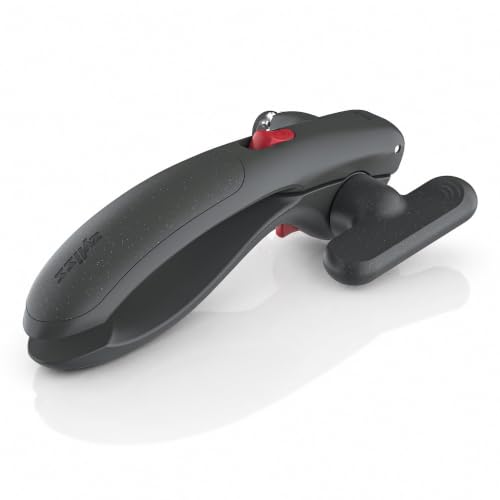
Zyliss Lock & Lift Can Opener — Best Manual for Hand Strain
The Lock & Lift attacks the manual opener’s hidden flaw: most designs demand a constant hard squeeze to keep the wheel engaged, which is what actually exhausts weak hands. Zyliss’s mechanism locks onto the rim, so the squeeze is needed once, briefly, and the turning does the rest. A magnet lifts the cut lid away cleanly. It is the manual we recommend when hands are the constraint but a drawer tool is still preferred over an electric.
Strengths
- Locking mechanism removes the continuous squeeze other manuals demand
- Magnet lifts lids without fingers near edges
- High-grade sharpened stainless cutting wheel for clean cuts
Trade-offs
- Top-cut design leaves sharper edges than the smooth-edge picks
- Locking action has a small learning curve
- Costs more than basic manuals
| Cut style | Top cut with locking mechanism |
| Wheel | High-grade sharpened stainless steel |
| Extras | Magnetic lid lifter |
The ergonomics here are the product. Arthritis and grip problems rarely make turning impossible — they make sustained squeezing painful. By transferring the holding work to a mechanical lock, the Lock & Lift reduces the job to turning a comfortable handle, which is a categorically easier task. In testing terms used by occupational therapists, it is the difference between a tool someone can use on a bad day and one they cannot.
It remains a top-cutter, so lids need the respect sharp edges deserve, mitigated by the magnet doing the lifting. And the lock, while simple, rewards a read of the one-line instruction the first time. For its intended buyer — manual loyalist, complaining hands — it is the most thoughtfully designed option in the category.
Best for: manual-opener users with arthritis or grip pain who still want a drawer tool / Not suited for: smooth-edge devotees, or users who need fully effort-free electric operation

OXO Good Grips Manual Can Opener (Classic) — Best Budget Manual
Every category needs its honest budget benchmark, and among can openers it is OXO’s classic manual. It top-cuts in the traditional way, but with the two things cheap openers skimp on: a properly sharp, durable cutting wheel and a handle shaped for actual hands. It also folds a bottle opener into the head. For a drawer tool at a low price, it is the standard recommendation year after year.
Strengths
- Sharp, durable wheel at a genuinely low price
- Comfortable soft-grip handle beats every bargain-bin rival
- Built-in bottle opener adds everyday utility
Trade-offs
- Top-cut sharp edges, as with all traditional manuals
- Requires continuous squeeze and turning; not for weak hands
- Hand-washing and drying keep the wheel at its best
| Cut style | Top cut |
| Handle | Soft grip |
| Extras | Bottle opener |
The classic OXO demonstrates why the cheapest opener is a false economy and this one is not. Bargain openers fail by dulling: within a year the wheel skates, the cut tears instead of slicing, and every can becomes a fight. This wheel is hardened properly and stays cutting for years, and the handle means the force you apply goes into the cut rather than into hurting your palm. It is a small masterclass in spending a little more exactly where it matters.
Its limits are the traditional design’s limits: sharp lids, real hand effort, and no help for anyone with grip problems — those buyers should take the Lock & Lift or an electric above. For able hands and a tight budget, though, this is the manual to buy once instead of the disposable one bought yearly.
Best for: budget buyers with healthy hands who want a manual that lasts / Not suited for: anyone with grip or arthritis issues, or smooth-edge seekers
Comparison Table
| Pick | Badge | Key spec | Best for |
|---|---|---|---|
| Hamilton Beach Smooth Touch 76606AG | Best Overall Electric | Smooth-edge electric, side-cutting, easy-push lever | most households, especially anyone with grip or arthritis concerns |
| OXO Good Grips Smooth Edge Can Opener | Best Manual Smooth-Edge | Manual side-cut, soft grip, lid pliers built in | manual-opener loyalists who want the safest, most hand-friendly design |
| Kitchen Mama Auto Electric Can Opener | Best Hands-Free Electric | Battery powered, one-touch, walks the rim automatically, smooth edge | anyone with severe grip limitations, and small kitchens wanting drawer-stored electric help |
| Cuisinart CCO-50BKN Deluxe Electric Can Opener | Best Countertop Classic | Top-cut electric, power cut blade, magnetic lid holder, tall-can capable | traditionalists and households with varied, odd-shaped cans |
| Zyliss Lock & Lift Can Opener | Best Manual for Hand Strain | Manual, locking mechanism, magnet lifts lid, designed to reduce hand strain | manual-opener users with arthritis or grip pain who still want a drawer tool |
| OXO Good Grips Manual Can Opener (Classic) | Best Budget Manual | Classic top-cut manual, soft grip handle, bottle opener included | budget buyers with healthy hands who want a manual that lasts |
How to Choose the Best Can Openers
Decide the cut first. Smooth-edge (side-cut) openers unroll the seam below the rim: lids and cans are safe to touch, lids can loosely reseal the can, and the wheel never touches food. Top-cut openers slice inside the rim: they handle dented and odd-shaped cans better and cost less, but leave sharp edges on both lid and can. Most households are happier with smooth-edge; households with varied imported cans or tight budgets may prefer top-cut.
Decide the power second. Manuals are cheap, drawer-sized, silent and immortal if the wheel is good — but they demand grip and turning. Countertop electrics demand counter space and do the work with a lever press. Hands-free battery electrics demand nothing of your hands at all and ask only for batteries and a little patience. Match the power to the hands that will use it most, on their worst day.
The hand test
If the primary user has arthritis, neuropathy, post-surgical limits or general grip weakness, filter in this order: hands-free electric first, countertop smooth-edge electric second, locking or oversized-handle manuals third, and standard manuals not at all. A can opener is used daily and often when hands are tired or wet; accessibility is not a niche feature in this category, it is the product.
Cutting Wheels, Magnets and Cleaning
The cutting wheel is the whole tool. Hardened stainless wheels stay sharp for years; soft cheap wheels dull within months and begin tearing lids instead of cutting them, which is both frustrating and less safe. This is why every pick in this guide comes from a maker that treats the wheel as an engineered part, and why replacing a dull opener matters more than nursing it along.
Lid handling separates good designs from careless ones. Magnets that hold the lid after cutting, and pliers that grip it for removal, keep fingers away from the sharpest object in the process. If your opener lacks both, use a fork or a paper towel to lift lids — never fingertips along the rim.
For cleaning, the rule is simple: anything that touched the can’s contents gets washed. Electric heads with removable cutting assemblies are the hygienic winners among electrics; manuals should be washed and — the step everyone skips — dried, because a wheel left wet in a drawer is a wheel that rusts, and rust is the second great killer of can openers after dullness.
Budget Tiers for Can Openers
This is the flattest price landscape in the kitchen. The budget tier buys a genuinely good manual like the classic OXO. The mid tier buys premium manuals — smooth-edge designs, locking mechanisms, better ergonomics — and the entry electrics. The top tier buys countertop electrics and the hands-free automatics, and even it is modest by appliance standards.
Because the spread is so small, buy for fit rather than savings. The difference between the cheapest pick and the most expensive in this guide is less than a family takeaway, spread over years of daily use. Choose the cut style and power source that suit your hands and your cans, and let the price fall where it falls.
Can Opener Design: A Short History of Two Cuts
The can opener spent a century as a single idea: a wheel that slices the lid inside the rim, leaving the familiar sharp disc and the sharp can edge that everyone over thirty has a scar story about. The design worked, it was cheap, and its hazards were simply accepted as part of cooking. The butterfly manual and the countertop electric refined that idea — better gears, magnets, motors — without questioning the cut itself.
The side-cut design questioned it. By gripping under the rim and unrolling the factory seam, a smooth-edge opener separates the lid whole, leaves both surfaces safe, and keeps the wheel out of the food entirely. It began as a European specialty design — Zyliss and Kuhn Rikon are Swiss names for a reason — and spent years as a connoisseur’s choice before American brands like Hamilton Beach and OXO brought it mainstream. The modern market is the story of that idea winning: most of the openers recommended in this guide cut from the side, and the top-cutters that remain earn their place on price, tradition or tolerance for damaged rims.
Knowing the history helps you shop the present, because the category’s marketing rarely explains which cut a given opener makes — it is the most important spec and often the least labeled. When a listing says “smooth edge”, “safety” or “side cut”, it is the new design; when it says nothing, assume the century-old one and price it accordingly.
Openers for Special Situations
Left-handed users are the category’s forgotten customers: most manual openers are geared for a right hand turning clockwise with the opener riding the far side of the rim. Some designs — the OXO Steel in our dishwasher-safe guide is one — are explicitly ambidextrous, and electrics sidestep the question entirely, which is one more reason hands-free and countertop electric models punch above their price for the households they suit. If you are left-handed and a manual has always felt awkward, it is not you; it is the gearing.
One-handed operation, after injury or by permanent circumstance, rules out every manual and most countertop electrics, whose levers still want a steadying hand on the can. The hands-free automatics in this guide exist precisely for that situation: the can sits on the counter, the unit rides the rim, and the only hand needed is the one that presses the button and later lifts the lid by its magnet. For caregivers buying for someone else, that single feature should outweigh every other consideration in this article.
Camping, RVs and emergency kits argue the opposite direction: the simplest possible manual, no batteries, no cord, nothing to break, in a drawer for a decade. The classic budget manual in this guide is the right tool there — and the same logic makes a quality manual the correct backup in any kitchen that otherwise relies on an electric.
Can Openers and the Cans Themselves: Sizes, Rims and Problem Tins
Not all cans are equal, and the can is half the system. Standard cans with rolled rims suit every opener in this guide. Tall institutional cans need an opener with clearance — the countertop electrics and full-size manuals here handle them; compact manuals can struggle for leverage. Dented rims are the great divider: top-cut openers bite the lid and usually power through damage that makes a side-cutter’s seam grip slip, which is why this guide keeps strong top-cut options despite the smooth-edge trend. If your groceries arrive dented often — warehouse clubs and delivery orders are the usual sources — weight that tolerance heavily.
Rimless and pull-tab cans are changing the category slowly. Much canned fish, pet food and ready food now opens by ring pull and needs no opener at all, and some European cans use thin rims that side-cutters grip less surely. The household can inventory of 2026 is mixed, which argues for the boring virtue of versatility: a primary opener chosen for your most common cans, and the awareness that no single design is best at every tin ever made.
Two specialty cases deserve mention. Large cans of tomatoes and beans — the cooking staples — reward a geared manual or an electric, because the rim length makes cheap openers skip. And small cans, like tomato paste, punish oversized electric heads that cannot align on the little rim; a manual earns its drawer space on those alone. Most kitchens that cook seriously end up, knowingly or not, with a two-opener system: a primary and a manual backup that covers the primary’s blind spots.
None of this complicates the recommendations above — it explains their badges. The best can opener is best at your cans, and the reviews state plainly which cans those are.
Safety: The Honest Risks of a Small Tool
Can openers cause a quiet stream of kitchen injuries, and nearly all of them trace to three moments. The first is the lid: a top-cut lid is a serrated disc of thin metal, and the classic injury is reaching into the can or the bin and meeting its edge. The defenses are design — smooth-edge openers eliminate the hazard, magnets and pliers keep fingers off it — and habit: lids go directly into the bin, pressed inside the empty can where possible, never loose in a sink of washing water where they wait invisibly. The second moment is the can’s own rim after a top cut, which is why food should be spooned out rather than scraped with fingers, and why cans being emptied by hand deserve a second of respect.
The third moment is the struggle: forcing a dull or slipping opener concentrates force in a tool that can skate off the rim into the holding hand. This is the injury pattern behind this guide’s repeated advice to replace dull openers early and never to wrestle a can. A can that will not open cleanly can be approached from the other side, or with a second opener, or — in the true worst case — left unopened. No tin of beans is worth stitches.
Children change the calculation again. Households with small children should weight smooth-edge designs and magnetic lid handling heavily, store openers out of reach like the edged tools they are, and prefer electrics that keep small hands away from the mechanism entirely. The few dollars of difference between designs is not the place a family kitchen saves money.
None of this should make the category sound dangerous — it is a daily tool used safely billions of times. It should make the design choices in this guide legible: nearly every badge above is, at bottom, a judgment about whose hands meet which edges.
How to Open a Can Cleanly and Safely, Every Time
Technique fixes most can-opener complaints. Whether your opener is manual or electric, smooth-edge or top-cut, these habits produce clean cuts, safe lids and a tool that lasts.
- Wipe the lid first. A quick rinse or wipe removes dust and warehouse grime before the wheel — or the lid itself — goes anywhere near the food.
- Seat the opener fully before cutting. On manuals, clamp until you feel the wheel bite the rim; on electrics, align the can under the cutter as the maker directs. A half-seated start is the cause of most skipped, jagged cuts.
- Cut at a steady pace. Turn the knob or hold the lever evenly. Rushing a manual makes the wheel skate; stopping and restarting mid-rim leaves the burrs that catch and tear.
- Leave a hinge on top-cut cans. Stop just before the final inch so the lid stays attached, bend it back with a utensil, and the lid never falls into the food or needs fishing out.
- Lift lids with a tool, not fingers. Use the magnet, the built-in pliers, a fork or a folded paper towel. The lid’s edge is the sharpest object in your kitchen at that moment.
- Rinse and dry the opener. Wash off food contact, then dry the wheel and mechanism before it goes back in the drawer. Dry storage is the entire secret of a long-lived opener.
If your opener still skips or tears after correct seating and a clean rim, the wheel is dull and the tool is done — no technique compensates for a dead wheel, and replacing it is cheaper than the frustration of keeping it.
Common Buying Mistakes
Buying the cheapest opener on the peg. Soft cutting wheels dull within months and turn every can into a struggle. A hardened wheel from a real maker costs slightly more and lasts for years — the cheapest category in the kitchen is the worst place to economize.
Ignoring the cut style. Top-cut and smooth-edge openers produce different lids, different edges and different strengths. Buying without knowing which you are getting is how households end up with an opener they dislike for a decade.
Letting lids fall into food. An unheld lid contaminates the contents and then has to be fished out by its sharp edge. Choose an opener with a magnet or pliers, or leave a hinge and bend the lid back.
Storing the opener wet. A damp wheel in a closed drawer rusts, and rust ruins both the cut and hygiene. Ten seconds with a towel doubles an opener’s life.
Forcing a dull opener through a can. A tearing, slipping opener is how hands get cut. If the wheel skates, stop, and replace the tool — the can is not worth the stitches.
Final Recommendation
The short version: most households should buy the Hamilton Beach Smooth Touch for effortless, smooth-edge electric cutting, or the OXO Smooth Edge if they prefer a manual. Hands that cannot grip should go straight to the Kitchen Mama Auto; traditionalists with varied cans to the Cuisinart Deluxe; sore hands that still want a manual to the Zyliss Lock & Lift; and tight budgets to the classic OXO, which embarrasses openers three times its price.
Check the current price on Amazon for your pick — in a category this inexpensive, the right design bought once beats the wrong one bought three times, every time.
Whichever pick you take, do the two things that make any opener the best one: keep it clean and dry, and replace it the season its wheel starts to tear instead of cut. A sharp opener is a safe opener, and in this category safety and performance are the same purchase.
It is worth closing on the strangest truth in this category: the can opener is the tool most likely to be bought in a hurry, at a supermarket, in the moment the old one fails mid-recipe — and that emergency purchase is how bad openers perpetuate themselves, one dull wheel at a time. Breaking the cycle takes ten deliberate minutes now, with this guide open, instead of thirty irritated seconds later with dinner half-made. Choose the design that fits your hands and your cans, order it before the emergency, and let the next decade of tins be the uneventful kind. That small act of foresight is the entire difference between kitchens that think about their can opener and kitchens that never have to.
Keep exploring the cluster: Best Can Openers Dishwasher Safe Best American Made Bread Machines Best Blenders Below 200 Best Blenders And Ice Crushers Best Blenders Breville Chef
Frequently Asked Questions
What is the difference between smooth-edge and regular can openers?
A regular (top-cut) opener slices the lid inside the rim, leaving sharp edges on the lid and the can. A smooth-edge (side-cut) opener unrolls the seam below the rim, so both lid and can are safe to touch and the lid can rest back on the can. Smooth-edge models cost more and can struggle with badly dented rims; top-cutters are cheaper and more tolerant of odd cans.
What is the best can opener for arthritis?
The Kitchen Mama Auto, because it requires no gripping, squeezing or turning at all — one button press. Next best is a countertop smooth-edge electric with an easy-push lever, like the Hamilton Beach Smooth Touch. Among manuals, choose a locking design or an oversized soft-grip model rather than a standard opener.
Why does my can opener keep slipping off the rim?
Usually the cutting wheel is dull, the opener is not fully seated before cutting, or the rim is dented. Clean the wheel, seat the opener firmly and try again on an undented can. If it still slips, the wheel is worn and the opener should be replaced — forcing it is how cuts happen.
How long should a can opener last?
A quality manual with a hardened wheel should last many years with washing and drying after use. Electrics typically serve five years or more. The ultra-cheap manuals that dull within a year are the exception, not the rule — in this category, longevity is mostly about wheel quality and dry storage.
Are electric can openers better than manual ones?
Better at effort, not at cutting. A good manual cuts as cleanly as any electric and never needs power or counter space. Electrics win when hands are weak, when many cans are opened daily, or when a hands-free model restores independence to a user with serious grip limitations.
Can a smooth-edge opener reseal a can?
It leaves the lid intact and smooth, so the lid can be placed back on the can as a loose cover for short refrigerator storage. It is not an airtight seal, so treat the contents as you would any opened food — refrigerate promptly and use soon.
Why do smooth-edge openers cost more?
The side-cutting mechanism is more complex: it must grip the seam precisely, unroll it without slipping, and often adds lid-handling features like pliers or magnets. The hardened components cost more to make than a simple top-cut wheel. The premium is small and buys safer edges on every can for years.
Can I sharpen a dull can opener wheel?
Not practically. The wheels are small, hardened and precisely angled; home sharpening rarely restores the cutting geometry and can make the wheel bite worse. Replacement is the correct maintenance for a dull wheel — one reason to buy openers whose wheels are built to stay sharp for years.


