Disclosure: airfryerkitchensupply.com is reader-supported. When you buy through links on our site, we may earn an affiliate commission at no extra cost to you.
Where to buy
Every verified pick in this guide is sold on Amazon. Prices in this category shift with promotions and stock, so we do not print fixed numbers that would go stale; use the links to check price on Amazon on the day you buy. A pick without a link is deliberate and is explained in its review.
- GSI Ultralight JavaDrip — check price on Amazon
- AeroPress Go — check price on Amazon
- GSI Pour-Over Java Drip — check price on Amazon
- GSI Coffee Rocket — check price on Amazon
- Snow Peak Pour Over — check price on Amazon
- Wacaco Minipresso GR — check price on Amazon
The best camping coffee makers for backpacking are judged by a stricter court than any other coffee gear: every gram rides on your back, every cubic inch competes with food and insulation, and every cleanup happens with rationed water far from a sink. That discipline eliminates most camping brewers immediately. What survives is a short list of featherweight drip cones, one legendary travel press, a pocket espresso pump, and a folding steel dripper — each making a different trade between cup quality, weight, and the number of mornings it must serve.
All six picks were verified in the site product feed, and each review states its carrying logic plainly: what it weighs against your base weight in spirit, how it packs, whether it needs a consumable you must also carry, and how it behaves when the only heat is a small canister stove and a single pot. Backpacking coffee fails in predictable ways — forgotten filters, a brewer that needs its own bulky mug, grounds with nowhere legal to go — and the picks were chosen to fail least.
Be honest with yourself about which backpacker you are before choosing. The ultralight hiker who drinks one dawn cup and walks will pick differently from the basecamp wanderer who carries a little luxury gladly. Both are served below, labeled as such. What neither should carry is a glass press, a group percolator, or anything whose coffee is not worth its weight by the third morning.
In this guide
Quick Picks
- Best Overall for Backpacking: GSI Ultralight JavaDrip — a cloth-filter drip cone that clips onto a mug and all but disappears into a pack.
- Best Cup Quality: AeroPress Go — the travel press kit that nests into its own mug, for hikers who rank taste first and weight second.
- Best Collapsible Cone: GSI Pour-Over Java Drip — a silicone-style collapsible cone that fits nearly any mug and travels in a jacket pocket.
- Best Nesting System: GSI Coffee Rocket — a collapsible drip set engineered to nest inside standard backpacking mugs and cook pots.
- Best Durability: Snow Peak Pour Over — a folding stainless dripper built to outlast every other item in your pack.
- Best Ultralight Espresso: Wacaco Minipresso GR — a hand-powered espresso maker for hikers who will trade effort, not standards.
How These Picks Were Chosen
We built this shortlist for backpacking coffee makers by starting with products we could verify in the site product feed, then filtering for the features that actually decide satisfaction in daily use. Listings with mismatched titles, accessory-only results, and bundles built around unbranded extras were removed, because the most common buying failure in this category is ordering a familiar name and receiving a different configuration than the review described.
Weight, packed volume, and consumables were scored together, because a light brewer that needs heavy accessories is not light. Drip cones that fold flat or nest into a mug scored highest on carry; the AeroPress Go scored on its all-in-one kit logic; the espresso pump scored as a deliberate luxury whose weight buys a category of coffee nothing lighter can make. Group percolators and insulated presses were excluded on weight alone, however good their camp coffee is.
Water discipline was the final filter. Every pick can be cleaned with a wipe and a few spoonfuls of water, produces grounds in a form that packs out without mess, and works with the single-pot reality of a backpacking stove. A brewer that needs a full rinse cycle at a creek is a brewer that teaches its owner to skip cleaning — and to taste that decision the next morning.
The 6 Best Camping Coffee Makers for Backpacking

GSI Outdoors Ultralight JavaDrip Pour-Over Cone — Best Overall for Backpacking
The Ultralight JavaDrip is what experienced backpackers picture when they picture trail coffee: a collapsible cone, a reusable cloth filter, and legs that clip securely onto the rim of a mug. It asks for nothing consumable, packs essentially flat, and brews a clean, honest drip cup with the hot water your stove was already boiling for breakfast. It suits thru-hikers, section hikers, and anyone whose coffee must justify itself in grams.
Strengths
- Featherweight and packs nearly flat
- Reusable cloth filter means zero consumables
- Clean pour-over cup from any mug and kettle
Trade-offs
- Brews one mug at a time
- Cloth filter needs a real wash after the trip
- Pour technique affects the cup more than press methods
| Detail | What to know |
|---|---|
| Method | Pour-over drip cone |
| Filter | Reusable cloth, included |
| Packing | Collapses flat, clips to mug rim |
| Serves | One mug per brew |
The cup quality surprises people who expect a compromise. Pour-over extraction with a level bed and a slow spiral pour produces coffee recognizably related to a home V60 cup — lighter and cleaner than press coffee, without a percolator’s boiled edge. The cloth filter is the system’s heart: it flows freely, cleans with a shake and a rinse, and eliminates the paper-filter packing problem entirely, at the cost of needing a proper wash when you get home.
Trail discipline is simple: shake the grounds into your waste bag, rinse the cloth when water allows, and let it dry on the outside of the pack while you walk. The cone’s legs deserve a test fit on your actual mug before the trip, because clip systems and mug rims vary. For one or two drinkers who count weight honestly, this is the most complete answer in backpacking coffee — the brewer most likely to be carried on every trip rather than admired at home.
Best for: backpackers who want real drip coffee at minimal weight / Not suited for: espresso drinkers or large groups
Check the current price on Amazon — look for the listing titled exactly as shown in our sources file so you land on the right model and configuration.

AeroPress Go Portable Coffee Maker Kit — Best Cup Quality
The AeroPress Go takes the original’s clean, fast cup and re-engineers it as a self-contained kit: brewer, scoop, stirrer, and filters all nest inside the included travel mug with its lid. For a backpacker, that nesting is the argument — there are no loose parts to lose in leaf litter, and the mug earns its pack space twice. It suits hikers who will carry a little more than the minimum in exchange for the best-tasting coffee on this list.
Strengths
- Best-tasting cup of any backpacking method here
- Entire kit nests into its own lidded mug
- Puck-eject cleanup uses almost no water
Trade-offs
- Heavier and bulkier than drip cones
- One serving per brew cycle
- Paper filters unless you add a metal disc
| Detail | What to know |
|---|---|
| Method | Immersion press |
| Kit | Brewer, scoop, stirrer, filters, mug and lid |
| Brew time | About 2 minutes |
| Packing | All components nest in the mug |
In the cup, it is the AeroPress standard: smooth, sweet, low in bitterness and silt, ready in about two minutes, and forgiving of imperfect trail technique. It brews a concentrated serving that drinks beautifully straight or lengthened with hot water for a longer mug. Cleanup remains the method’s party trick — a plunger push ejects the grounds puck straight into your waste bag, which at a dry camp with rationed water is worth real grams of carried frustration avoided.
The honest cost is weight and bulk next to a drip cone: this is a kit, not a sliver. Ultralight purists will feel it; everyone else will forget it by the second morning’s coffee. Store the plunger pushed through the chamber so the seal is not compressed in the pack, and consider the reusable metal filter if paper supplies annoy you. If taste leads your packing list, the Go is the backpacking brewer to beat.
Best for: taste-first backpackers and bikepackers / Not suited for: gram counters chasing the absolute minimum
Check the current price on Amazon — look for the listing titled exactly as shown in our sources file so you land on the right model and configuration.
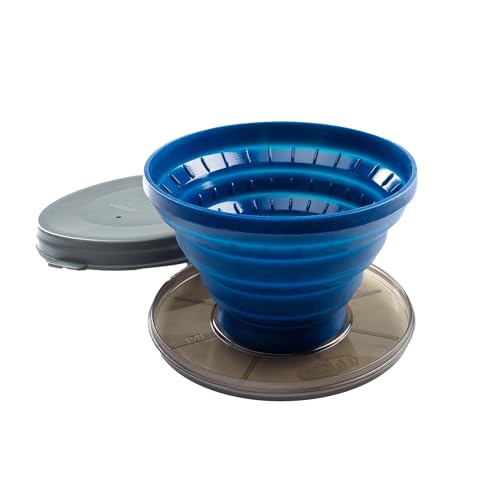
GSI Outdoors Pour-Over Java Drip Collapsible Cone — Best Collapsible Cone
Where the Ultralight JavaDrip is a specialist’s minimal cone, this GSI pour-over is the generalist: a collapsible cone designed to sit securely on almost any cup or mug, with a reusable filter setup that travels in a pocket. It suits backpackers who borrow gear, share kits, or move between trail, caravan, and hostel, because it adapts to whatever vessel the trip provides.
Strengths
- Collapses flat and fits nearly any mug
- Reusable filter removes consumable planning
- Bright, clean drip cup with no power or pressure
Trade-offs
- One mug at a time, poured by hand
- Reusable filter needs post-trip washing
- Slightly less minimal than the JavaDrip
| Detail | What to know |
|---|---|
| Method | Pour-over drip cone |
| Packing | Collapsible, pocket-flat |
| Fit | Designed for most cups and mugs |
| Filter | Reusable system |
The brew is classic drip: bright, clean, and dependent on a patient pour, which on a still morning at a high camp is less a chore than a ceremony. The cone’s collapsible body is its travel genius — it flattens into a disc that slides into a cook kit or a side pocket, protected by its own shape rather than by careful packing. Paired with a reusable filter, the whole system adds coffee to a trip without adding a consumables list.
Reusable filters ask for the same homecoming wash as any cloth or mesh system, and the cone should be dried before long storage. Owners who want the absolute lightest possible setup should compare the JavaDrip above; owners who value fit-anything versatility will prefer this cone. Either way, the pour-over pattern remains the weight champion’s method: hot water, gravity, and almost nothing to carry.
Best for: mixed-gear trips where mugs vary / Not suited for: buyers who dislike reusable-filter upkeep
Check the current price on Amazon — look for the listing titled exactly as shown in our sources file so you land on the right model and configuration.

GSI Outdoors Coffee Rocket Pour-Over Maker — Best Nesting System
The Coffee Rocket is designed around a single elegant idea: your coffee kit should occupy space already claimed by your mug. Its collapsible drip body nests inside standard backpacking vessels, so the brewer effectively travels for free inside a cook system you were carrying anyway. It suits organized backpackers who build their kit as a nesting system and feel genuine satisfaction when every component has a home.
Strengths
- Nests inside your mug or pot, traveling for free
- Collapsible body built for cook-kit systems
- Dependable, clean pour-over results
Trade-offs
- Works best kept as a complete set
- One serving per brew
- Reusable filter care after trips
| Detail | What to know |
|---|---|
| Method | Pour-over drip |
| Packing | Collapsible and nesting |
| Design | Made for backpacking mug systems |
| Serves | One mug per brew |
The coffee itself is dependable pour-over — clean, adjustable, and quick — with the small ritual of a morning pour that many hikers come to treasure as the day’s quiet start. Because the set lives inside the mug, it is also the brewer least likely to be left behind in a pre-dawn packing scramble, which is a real-world virtue no laboratory test captures. Systems that travel together get used together.
Nesting systems reward owners who keep the set together and punish those who separate the parts across bags. Rinse or wipe the filter after use, dry it during the day’s walk, and give it a proper wash at home. If your kit is a carefully nested system, the Rocket completes it; if your mug changes every trip, choose the fit-anything cone above instead.
Best for: organized packers with nesting cook kits / Not suited for: improvisers who brew in borrowed vessels
Check the current price on Amazon — look for the listing titled exactly as shown in our sources file so you land on the right model and configuration.

Snow Peak Portable Pour Over Coffee Set, Stainless Steel — Best Durability
Snow Peak builds for the hiker who is tired of replacing things. This folding stainless pour-over dripper trades a few grams against the plastic and silicone field and returns a tool that can be dropped, sat on, scorched, and inherited. It suits long-distance hikers with hard packing habits, guides, and anyone whose gear philosophy is buy once, carry forever.
Strengths
- Stainless construction survives expedition abuse
- Folds for packing without fragile hinges of plastic
- Rinses flavor-neutral, trip after trip
Trade-offs
- Heaviest dripper in this guide
- Premium reflects materials and manufacture
- Still a one-mug, hand-poured method
| Detail | What to know |
|---|---|
| Method | Pour-over dripper |
| Material | Stainless steel |
| Packing | Folding design |
| Use | Coffee and tea essentials for camp |
Steel brings trail virtues beyond toughness: it does not hold yesterday’s flavors, it rinses clean with a splash and a wipe, and it tolerates being set down on any surface a campsite offers. The pour-over it produces is the clean drip cup the method promises, with the added confidence that the dripper will work identically on the five-hundredth morning as on the first. In a category of clever collapsibles, permanence is its own feature.
The weight is real and should be admitted rather than argued away: gram-for-gram, the cones above are lighter. What the Snow Peak asks you to decide is whether your trips are the kind where gear failure or degradation is a genuine risk worth insuring against. For expedition-style use, rental fleets, and hard daily service, the answer is often yes — and this is the dripper built for exactly that answer.
Best for: hard-use hikers who buy gear for decades / Not suited for: ultralight hikers minimizing metal
Check the current price on Amazon — look for the listing titled exactly as shown in our sources file so you land on the right model and configuration.

WACACO Minipresso GR Portable Espresso Machine — Best Ultralight Espresso
Every backpacking list needs its honest luxury, and the Minipresso GR is this one’s: a hand-powered espresso machine, small enough for a pack’s top lid, that asks pumping effort and returns a real shot. It suits the espresso drinker for whom trail coffee is otherwise a daily small grief — the hiker who will carry a deliberate luxury and use it every single morning with ceremony.
Strengths
- Real hand-pumped espresso, anywhere water boils
- Compact enough for a pack lid or side pocket
- Uses ground coffee, no pods or power
Trade-offs
- A deliberate luxury by backpacking weight logic
- Shots for one; groups wait their turn
- Small parts need a pouch and a rinse routine
| Detail | What to know |
|---|---|
| Method | Manual pump espresso |
| Coffee | Ground coffee |
| Power | None, hand-operated |
| Carry | Pocket-size travel format |
The shot is the argument. Proper pressure, ground coffee, and hot water from your stove produce an intense, crema-topped espresso that no drip cone can imitate, and diluted with hot water it makes a respectable trail americano for those who want a longer drink. The ritual itself — grind or scoop, tamp, pump — becomes the morning’s deliberate pause before the miles, which owners consistently describe as the point, not the price.
It remains a luxury by weight and by effort, and making shots for a group on a cold morning will test any friendship. Small parts need rinsing and keeping together, ideally in a small pouch that lives with the stove kit. Buy the Minipresso with clear eyes as the one indulgence in an otherwise disciplined pack, and it will be the item other hikers ask about at every shelter.
Best for: espresso loyalists on foot / Not suited for: mug-of-drip drinkers or groups
Check the current price on Amazon — look for the listing titled exactly as shown in our sources file so you land on the right model and configuration.
Comparison Table
| Pick | Badge | Key spec | Best for |
|---|---|---|---|
| GSI Ultralight JavaDrip | Best Overall for Backpacking | Collapsible drip cone with reusable cloth filter | backpackers who want real drip coffee at minimal weight |
| AeroPress Go | Best Cup Quality | All-in-one press kit nesting into its travel mug | taste-first backpackers and bikepackers |
| GSI Pour-Over Java Drip | Best Collapsible Cone | Collapsible pour-over cone, fits most mugs | mixed-gear trips where mugs vary |
| GSI Coffee Rocket | Best Nesting System | Collapsible, nesting pour-over set | organized packers with nesting cook kits |
| Snow Peak Pour Over | Best Durability | Stainless steel folding dripper | hard-use hikers who buy gear for decades |
| Wacaco Minipresso GR | Best Ultralight Espresso | Manual espresso pump, ground coffee, no power | espresso loyalists on foot |
Read the table as a shortlist, not a ranking. The right choice for best camping coffee makers for backpacking depends on the constraint that bites hardest in your routine — counter space, batch size, grind control, weight, or how much cleaning you will honestly do every day. The buying guide below turns each of those constraints into a decision you can make before you spend anything.
How to Choose the Best Camping Coffee Makers for Backpacking
Weigh the system, never the brewer alone. A cone that needs paper filters, a separate mug it fits, and a pouring kettle is a system with a total trail weight; a press kit that nests into its own mug may be the lighter honest total. List every component your chosen method requires — brewer, filter, vessel, grounds storage, waste bag — and weigh the pile. Backpackers who shop by system weight stop being surprised at the trailhead scale.
Then choose by drink, because method decides flavor more than brand does. Pour-over cones give the cleanest, brightest cup and the lightest carry. The AeroPress Go gives the richest, most forgiving cup at a moderate carry. The Minipresso gives espresso and nothing else, gloriously. Presses and percolators, the heroes of car camping, mostly fail the backpacking weight test and were excluded here for that reason — respect the category you are actually shopping in.
Finally, rehearse the cleanup with trail water before you commit. Shake-out grounds, a wipe, and a few spoonfuls of rinse water are the sustainable standard; anything thirstier will be skipped by day three, and you will taste the skipping. The best backpacking brewer is the one whose entire routine — brew, drink, clean, pack — still feels easy at a cold dawn camp on the fourth morning.
Filters, Grounds, and Waste: The Hidden Weight of Trail Coffee
Consumables are weight with a schedule. Paper filters weigh almost nothing each, but they must stay dry, they must be counted, and every used one becomes wet waste to carry out. Cloth and metal reusable filters weigh a little more once and then work indefinitely, asking only for shakes, rinses, and a homecoming wash. For short trips the difference is trivial; for a week or more, reusables win on weight, waste, and the simple relief of never counting filters by headlamp.
Grounds themselves are the other half of the ledger. Wet grounds weigh more than the dry coffee they came from, and they must all leave with you — grounds scattered at a site are litter, and grounds rinsed into water are pollution, whatever the folklore says. Press methods that eject a compact puck and cones whose filters lift out cleanly make this duty nearly automatic. Build the waste bag into your coffee kit at home, and the trail routine takes care of itself.
Brewing at Altitude and in Cold: Trail Conditions That Change the Cup
Backpacking happens where water misbehaves. At altitude it boils cooler, which under-extracts coffee and thins the cup; compensate with a slightly finer grind, a longer steep for immersion methods, and water used the moment it boils rather than after it sits. In cold weather the opposite problem bites: thin air and cold vessels steal heat during the brew, so warm your mug with a splash of the hot water first and brew immediately into it.
Wind is the third condition, and it attacks the stove, not the coffee. A windscreen used safely, a sheltered cooking spot, and a method that needs only one boil — rather than a sustained percolator cycle — will save fuel and patience together. This is a quiet structural reason pour-over and press methods dominate backpacking: they ask the stove for a single pot of hot water and then leave it alone.
How to Brew Coffee on a Backpacking Stove, Morning by Morning
The trail routine below assumes the standard backpacking reality: one stove, one pot, rationed water, and a pack to close afterwards. It works for every method in this guide with the small adaptations noted, and it is designed to be repeatable at dawn, in the cold, without thinking.
- Boil one pot of water — enough for coffee plus the mug-warming splash — while you ready the brewer and grounds.
- Warm the mug with a splash of hot water, discard it onto the ground away from camp water sources, and set the brewer in place.
- For drip cones, pour slowly in stages, keeping the bed wet and the total pour unhurried.
- For the AeroPress Go, steep briefly, press gently into the mug, and eject the puck straight into your waste bag.
- For the Minipresso, load, tamp, and pump at a steady rhythm, diluting the shot with hot water only if you want a longer drink.
- Shake or wipe the brewer clean immediately, stow grounds waste, and let the filter dry on the pack as you walk.
Notice what the routine never includes: a trip to the creek with an armful of parts. Design your home preparation — grounds portioned, filter ready, waste bag packed with the kit — so the trail version of you, cold and hungry at dawn, has almost nothing to decide. Systems survive trips; intentions do not.
Common Buying Mistakes
- Weighing the brewer and forgetting the system. Filters, vessels, and accessories are trail weight too; weigh the pile.
- Packing paper filters loose. One wet morning ruins an unprotected filter supply; use a sealed bag or go reusable.
- Carrying a car-camping brewer on foot. Percolators and insulated presses are wonderful — at a car. On foot they are ballast.
- Scattering grounds at the site. Wet grounds are pack-out waste, every time, however biodegradable they sound.
- Testing new gear at the trailhead. Brew with it twice at home; dawn at altitude is no place to learn a filter’s fit.
None of these mistakes comes from buying a bad product. They come from buying a good product for the wrong job, the wrong household, or the wrong daily routine — which is why this guide keeps returning to fit rather than headline features.
Final Recommendation
Start with the GSI Ultralight JavaDrip if your priorities are weight, simplicity, and a genuinely good drip cup — it is the backpacking default for a reason. Choose the AeroPress Go when taste outranks grams and you want the most forgiving, best-cleaning cup on the trail. The collapsible GSI cone and the nesting Coffee Rocket serve versatile and system-minded packers respectively, the Snow Peak is the buy-it-for-life dripper, and the Minipresso GR is the espresso luxury worth its deliberate weight.
Whichever you carry, weigh the whole system, rehearse the routine at home, and pack the waste bag with the kit. Backpacking coffee done right is one of the trail’s great small pleasures — a hot, real cup in a place with no business offering one — and every gram of these picks earns that moment.
- GSI Ultralight JavaDrip — Best Overall for Backpacking: backpackers who want real drip coffee at minimal weight
- AeroPress Go — Best Cup Quality: taste-first backpackers and bikepackers
- GSI Pour-Over Java Drip — Best Collapsible Cone: mixed-gear trips where mugs vary
- GSI Coffee Rocket — Best Nesting System: organized packers with nesting cook kits
- Snow Peak Pour Over — Best Durability: hard-use hikers who buy gear for decades
- Wacaco Minipresso GR — Best Ultralight Espresso: espresso loyalists on foot
Best Camping Coffee Makers For Backpacking Best Camping Coffee Makers Best Carafe Less Coffee Makers Best 1 Cup Coffee Makers Best Bunn Coffee Makers For Home
Who This Guide Is For — and Who Should Shop Differently
This guide is written for the buyer whose problem is genuinely best camping coffee makers for backpacking: a defined need, a real counter or campsite or shelf waiting, and a willingness to match a product to a routine rather than to a headline. If that is you, the picks above are sequenced so that your constraint — size, speed, volume, weight, input, or confidence — leads you to a small number of right answers quickly, and the field notes and ownership sections exist to confirm the match before money moves.
Shop differently if your underlying need is a different category wearing this search’s clothes. A household that wants a shared pot should not force a single-serve answer; a beginner who needs teaching should not buy an expert’s reference and hope; a hiker should not carry a basecamp’s brewer and call the weight a detail. The most expensive purchase in any category is the almost-right one, because it must be lived with or bought twice. Use this guide’s verdicts — including its not-suited-for lines — as seriously as its recommendations, and you will buy once.
Field Notes: What Living With Each Pick Is Actually Like
Specifications tell you what a product is; routines tell you what it becomes. These notes translate each pick for best camping coffee makers for backpacking into the daily reality an owner actually meets — the morning it saves, the chore it keeps, and the small condition under which it earns or loses its place. Read them as the second opinion after the reviews above: same products, viewed from the far side of the purchase.
GSI Ultralight JavaDrip (Best Overall for Backpacking). In week one, owners notice the headline virtue: a cloth-filter drip cone that clips onto a mug and all but disappears into a pack. By month three, what matters is quieter — whether the routine around its key specification (Collapsible drip cone with reusable cloth filter) has become automatic. This is the pick for backpackers who want real drip coffee at minimal weight, and in that household it tends to disappear into the day, which is the highest compliment home coffee gear can earn. Its known limit — it is not the answer for espresso drinkers or large groups — rarely troubles the right owner, because the right owner never asks it to be. Buy it for the job named in its verdict and it will keep that job for years.
AeroPress Go (Best Cup Quality). The lived experience of this pick is defined by a trade most owners make gladly: the travel press kit that nests into its own mug, for hikers who rank taste first and weight second. Daily use smooths its edges quickly. The controls become memory, the cleaning becomes a rhythm rather than an event, and its defining specification — All-in-one press kit nesting into its travel mug — proves itself in the unglamorous repetitions that specifications never capture. It serves taste-first backpackers and bikepackers best, and it stays honest about the opposite case: gram counters chasing the absolute minimum should look elsewhere in this guide rather than fight a product working exactly as designed.
GSI Pour-Over Java Drip (Best Collapsible Cone). Ask what this pick is like after the novelty ends and the answer is consistency. It was chosen because a silicone-style collapsible cone that fits nearly any mug and travels in a jacket pocket. and that promise survives contact with real mornings, real water, and real levels of patience. Owners who match it to its purpose — mixed-gear trips where mugs vary — describe the same arc: a short learning period, a long plateau of satisfaction. The mismatch cases are equally predictable, and they all begin with asking it to serve buyers who dislike reusable-filter upkeep. The guide’s verdict stands after long use, which is the only verdict that matters.
GSI Coffee Rocket (Best Nesting System). In week one, owners notice the headline virtue: a collapsible drip set engineered to nest inside standard backpacking mugs and cook pots. By month three, what matters is quieter — whether the routine around its key specification (Collapsible, nesting pour-over set) has become automatic. This is the pick for organized packers with nesting cook kits, and in that household it tends to disappear into the day, which is the highest compliment home coffee gear can earn. Its known limit — it is not the answer for improvisers who brew in borrowed vessels — rarely troubles the right owner, because the right owner never asks it to be. Buy it for the job named in its verdict and it will keep that job for years.
Snow Peak Pour Over (Best Durability). The lived experience of this pick is defined by a trade most owners make gladly: a folding stainless dripper built to outlast every other item in your pack. Daily use smooths its edges quickly. The controls become memory, the cleaning becomes a rhythm rather than an event, and its defining specification — Stainless steel folding dripper — proves itself in the unglamorous repetitions that specifications never capture. It serves hard-use hikers who buy gear for decades best, and it stays honest about the opposite case: ultralight hikers minimizing metal should look elsewhere in this guide rather than fight a product working exactly as designed.
Wacaco Minipresso GR (Best Ultralight Espresso). Ask what this pick is like after the novelty ends and the answer is consistency. It was chosen because a hand-powered espresso maker for hikers who will trade effort, not standards. and that promise survives contact with real mornings, real water, and real levels of patience. Owners who match it to its purpose — espresso loyalists on foot — describe the same arc: a short learning period, a long plateau of satisfaction. The mismatch cases are equally predictable, and they all begin with asking it to serve mug-of-drip drinkers or groups. The guide’s verdict stands after long use, which is the only verdict that matters.
Ownership, Value, and When to Replace What You Have
Value in the search for best camping coffee makers for backpacking is rarely about the ticket on the day of purchase. It is about cost per year of mornings improved, and that arithmetic favors the product you will use daily, clean willingly, and repair rather than replace. Before buying, run the honest comparison against your current setup: if what you own fails on flavor, a pick here fixes it; if it fails on routine — too slow, too fiddly, too large — a pick here fixes that instead. Naming the failure correctly is what makes the purchase feel, a year later, like money that solved something.
Timing matters less than fit. Sales recur, models persist, and the difference between the right pick bought next month and the wrong pick bought today at a discount is measured in years of small dissatisfactions. Use the time to verify your constraints: the space, the users, the water, the routine described throughout this guide. When a product like the GSI Ultralight JavaDrip matches those constraints on paper and in the reviews above, waiting for a promotion is reasonable. When only the Wacaco Minipresso GR matches them, the promotion to wait for is on that product, not on its rival.
Finally, plan the ownership, not just the arrival. Decide where the product lives, who cleans it, and what its consumables rhythm will be, before the box opens. Keep the manual’s care schedule somewhere you will actually see it, and give any new routine a full month before judging it — palates, habits, and households all calibrate more slowly than unboxings suggest. The buyers who love their choice in year three are rarely the ones who bought the most impressive product. They are the ones who bought the most suitable one, and then kept the small promises that suitability required.
Two Hikers, One Kit: Sharing Coffee on the Trail
Most backpacking coffee advice assumes a solo hiker, but most backpacking happens in pairs — and a shared kit changes the arithmetic in ways worth planning at home. Two drinkers double the grounds, double the waste to pack out, and double the morning stove time, while the brewer itself is carried once. That asymmetry favors methods whose second cup is cheap: a drip cone pours a second mug for the price of more hot water, while a press kit repeats its full cycle and a pump espresso doubles its ritual. Pairs who both drink coffee should choose for the second cup, not the first.
Sharing also argues for splitting the system across two packs. One hiker carries the brewer and filter; the other carries grounds, mugs, and the waste bag. The coffee kit then weighs almost nothing per person, survives one pack being unpacked at a different pace, and creates the small social contract that makes trail coffee a pleasure rather than a chore: whoever carries the brewer never washes it alone. Decide the split at home, write it on the stuff sack, and the dawn routine at a cold camp will run itself — two mugs, one stove, and a day that starts the way days in the mountains should.
Frequently Asked Questions
What is the lightest way to make coffee backpacking?
A collapsible pour-over cone with a reusable cloth filter, like the GSI Ultralight JavaDrip. The system adds almost no weight, packs flat, needs no consumables, and makes a clean drip cup from any mug. Instant coffee is lighter still, but among brewed methods the reusable drip cone is the weight champion.
Is the AeroPress Go worth its weight for backpacking?
For hikers who rank taste and easy cleanup highly, yes. It is heavier than a drip cone, but the whole kit nests into its own mug, brews the best cup in this guide, and ejects its grounds as a tidy puck that packs out without mess or water. Gram counters will choose a cone; taste-first hikers will not regret the Go.
How do I deal with coffee grounds in the backcountry?
Pack them out, always. Used grounds are food waste and litter at a site, and rinsing them into streams or lakes pollutes the water. Carry a dedicated small waste bag inside your coffee kit, eject or shake grounds into it after each brew, and dispose of it with your trash when you reach a bin.
Can I make espresso while backpacking?
Yes, with a manual pump like the Wacaco Minipresso GR. It needs only ground coffee and hot water, builds real espresso pressure by hand, and packs small enough for a top lid. It is a deliberate luxury by weight and serves one shot at a time, so it suits espresso drinkers rather than groups.
Should I carry whole beans or pre-ground coffee on a trip?
Pre-ground, portioned and sealed, is the pragmatic choice for most backpackers: no grinder weight, no grinding in the cold, and perfectly good flavor over a trip’s span if it was fresh when packed. Whole beans with a tiny hand grinder suit short, taste-focused trips where the ritual is part of the pleasure.
Why does coffee taste weaker at altitude?
Water boils at a lower temperature in the mountains, so it extracts less from the grounds. Compensate with a slightly finer grind, a longer steep for press methods, and water poured the moment it boils. Warming your mug first also helps, because cold vessels steal heat that high-altitude brewing cannot spare.


