Disclosure: airfryerkitchensupply.com is reader-supported. When you buy through links on our site, we may earn an affiliate commission at no extra cost to you.
Where to buy
These are the best blenders bodybuilding routines can actually rely on, verified one by one. Bodybuilding shakes are a daily-use case, so every model in this box was verified against Amazon’s catalog data and chosen for repeat performance: pulverizing oats and frozen fruit, blending thick high-calorie shakes without stalling, and cleaning up in under a minute. Use the links to check the current price on Amazon.
- Vitamix 5200 Professional-Grade Blender — Best Overall for Bodybuilding: Check the current price on Amazon
- nutribullet Pro+ N12-1001MK — Best for Daily Protein Shakes: Check the current price on Amazon
- Blendtec Classic 575 with WildSide+ Jar — Best for Big Meal-Prep Batches: Check the current price on Amazon
- Ninja Nutri-Blender Pro BN401 — Best for Gym-Bag Convenience: Check the current price on Amazon
- Vitamix Propel Series 510 — Best with Presets, Premium Tier: Check the current price on Amazon
- Ninja Fit QB3001SS — Best Budget Starter: Check the current price on Amazon
If you blend twice a day, treat the blender as training equipment: buy the strongest model your budget comfortably allows, because you will feel the difference in texture and time every single day, twice a day.
The best blenders bodybuilding athletes actually keep using are not chosen the way other blenders are. A bodybuilding shake routine is a stress test no other kitchen habit matches: two or more blends a day, every day, built from the ingredients blenders hate most — raw oats that must be milled to powder, frozen fruit that arrives as rocks, peanut butter that coats everything, ice, and protein powder that turns to glue on a wet jar wall. A blender that survives this routine and still makes a shake you actually want to drink is a genuinely strong machine.
This guide ranks the six best options for that routine, from a professional workhorse that will outlast your current training program to a budget personal blender that covers the basics for a first bulk. Every model was verified against Amazon’s catalog data. We judged them on the things that matter in a bodybuilding kitchen: grinding dry oats without a separate mill, handling thick mass-gainer shakes without cavitation, breaking down frozen fruit completely, cup and pitcher sizes that match real shake volumes, and cleanup fast enough that twice-daily blending stays sustainable.
A note on expectations: a blender cannot fix a bad recipe, and the thickest gainer shakes — oats, banana, peanut butter, milk, powder, ice — will challenge every machine here. The difference between the top and bottom of this list is how much help the machine needs: liquid ratios, staging and scraping. Choose based on how thick you actually blend, not how thick you blend on your best day.
In this guide
Quick Picks
Best Overall for Bodybuilding — Vitamix 5200 Professional-Grade Blender
The shake machine that does everything the routine demands: mills oats dry, plows through frozen fruit and peanut butter with the tamper, and rinses clean in thirty seconds. Check on Amazon
Best for Daily Protein Shakes — nutribullet Pro+ N12-1001MK
A 1200W personal blender that mills oats, crushes frozen fruit and turns a full gainer recipe in its 32 oz cup — then the cup goes with you to the gym. Check on Amazon
Best for Big Meal-Prep Batches — Blendtec Classic 575 with WildSide+ Jar
The meal-prep pick: a big five-sided jar and programmed cycles that let you blend a day’s worth of shake base in one run, with a blunt blade that powders oats and laughs at ice. Check on Amazon
Best for Gym-Bag Convenience — Ninja Nutri-Blender Pro BN401
Auto-iQ programs in a personal blender: press once and it pulses through frozen fruit and ice on a programmed pattern, filling the 24 oz cups that go straight into a gym bag. Check on Amazon
Best with Presets, Premium Tier — Vitamix Propel Series 510
Vitamix power with walk-away programs: three presets including a smoothie cycle, in a 48 oz container that suits one or two generous shakes at a time. Check on Amazon
Best Budget Starter — Ninja Fit QB3001SS
The starter pick: a simple 700W personal blender with two 16 oz cups that handles protein powder, milk, banana and a modest hand of frozen fruit — enough to build the habit. Check on Amazon
How These Picks Were Chosen
We selected for the bodybuilding use case specifically. First, dry-grinding ability: the pick had to turn rolled oats into a fine powder, because pre-blending oats is the foundation of most homemade gainer shakes. Second, thick-load behavior: how the machine handles a full, heavy shake without forming an air pocket around the blades. Third, volume: pitchers and cups sized for 20–40 oz shakes, not dainty 12 oz servings. Fourth, cleanup speed and durability, because a twice-daily tool that takes five minutes to wash will be abandoned by February.
Every model was cross-checked against Amazon’s catalog data on 2026-11-21 and only confirmed models carry purchase links. We excluded weak personal blenders that cannot mill oats, machines with active recalls, and models whose cups are too small for a serious gainer shake. We also kept health claims out of this guide entirely: these are appliances for preparing food and drinks, judged on performance, not on promises.
The list spans the realistic budgets of the audience: one premium anchor, two strong mid-range systems, a big-batch specialist, a preset convenience pick and a budget starter. Most lifters should buy the strongest option they can justify, because in this category usage frequency is the highest of any blender buyer.
We also cut two popular machines late in selection: a stylish personal blender whose cups were too small for any real gainer recipe, and a powerful full-size model whose jar design trapped powder in dry pockets no matter how it was loaded. In this category, recipe realism outranks reputation, and both cuts were made on recipes, not specs.
The 6 Best Blenders Bodybuilding Athletes Trust

Vitamix 5200 Professional-Grade Blender — Best Overall for Bodybuilding
For a serious training diet, the Vitamix 5200 is the end of the search. It is the only class of machine here that does all three bodybuilding jobs at full standard: dry-milling oats and flax to powder before liquid goes in, powering through a 40 oz gainer shake with the tamper keeping the thick mass moving, and self-cleaning fast enough that a 6 a.m. blend does not make you late. It costs the most and it is worth it at twice-daily use.
Strengths
- Dry-grinds oats, seeds and nuts to powder with no separate mill
- Tamper keeps thick gainer shakes moving without adding extra liquid
- Self-cleaning cycle makes twice-daily use sustainable for years
Trade-offs
- Premium tier price, the highest on this list
- No presets; you learn the dial and the tamper technique
- Tall container needs cabinet clearance
| Container | 64 oz |
| Controls | Variable speed dial with high-speed switch |
| Blades | Stainless steel |
| Care | Self-cleaning program |
The oat test is where pretenders fail. Rolled oats in a weak blender become oat chunks in milk; in the 5200, thirty seconds on high before adding liquid turns them into a flour that disappears into the shake, adding calories and body without grit. The same power handles frozen bananas and berries without the stop-start pulsing weaker machines need, and the variable dial lets you start thick shakes slow — which prevents the air pocket that stalls fixed-speed machines — then ramp up as the mixture loosens.
Ownership is the other half of the case. Twice-daily blending destroys budget machines in a year or two; this is the class of blender people keep for a decade, with a jar and blade assembly that shrug off the abuse. If your training is a long-term project, amortize the price over the shakes: at two a day, the cost per blend becomes trivial within the first year, and the texture of every one of those shakes is better.
Best for: serious lifters blending twice daily who want one machine for years / Not suited for: beginners unsure the habit will stick, or anyone on a starter budget

nutribullet Pro+ N12-1001MK — Best for Daily Protein Shakes
Most bodybuilding shakes are solo shakes, and the Pro+ is built exactly for that: a 1200-watt personal blender, strong for its class, with cups up to 32 oz that hold a genuine gainer recipe. It mills oats credibly, handles frozen fruit without the stalling that plagues weaker personal blenders, and its blend-and-go workflow is the fastest on this list from cupboard to gym bag.
Strengths
- 1200W is serious power in a personal format; oats and frozen fruit included
- 32 oz cup fits a full mass-gainer recipe for one
- Pulse function helps thick shakes that need coaxing
Trade-offs
- One serving at a time; no use for couples or families blending together
- Thickest shakes still need sensible liquid ratios
- Cups, lids and gaskets are consumables over years of daily use
| Motor | 1200W |
| Cups | 32 oz and 24 oz cups |
| Functions | Blend and pulse |
The Pro+ earns its spot by refusing to be the weak link in a daily routine. Personal blenders fail bodybuilders in two ways — motors too weak for oats and ice, and cups too small for real recipes — and this model fixes both. The workflow matters as much as the power: blend in the cup, drink from the cup, rinse the blade. At two shakes a day, saving three minutes of decanting and washing per shake returns hours every month.
Be realistic about the ceiling. A maximal gainer — oats, two bananas, big peanut butter, milk, powder, ice — is at the top of what any personal blender can turn, and you will learn to add liquid in two stages and use the pulse. If your shakes keep growing, the full-size machines above and below are the upgrade path. As the daily driver for standard training shakes, though, this is the sweet spot of power, size and price.
Best for: solo lifters making one or two protein or gainer shakes daily / Not suited for: households blending for several people, or makers of extremely thick shakes

Blendtec Classic 575 with WildSide+ Jar — Best for Big Meal-Prep Batches
Some lifters blend fresh twice a day; others prep. For the prep approach — a big batch of shake base in the morning or the night before — the Blendtec Classic 575 is the strongest tool here. The WildSide+ jar’s fifth side keeps large, thick loads circulating, the blunt blade powders oats and crushes ice without ever needing sharpening, and programmed cycles run the whole batch hands-off.
Strengths
- Large jar and vortex geometry suit full-day batch blending
- Blunt blade is durable, safe to clean and never dulls
- Programmed cycles free you from babysitting thick blends
Trade-offs
- Very loud, which matters for early-morning prep in shared housing
- No tamper for the very thickest mixtures
- Batch shakes separate in the fridge; a quick re-blend or shake is needed
| Jar | WildSide+ five-sided jar |
| Blade | Blunt stainless safety blade |
| Controls | Programmed cycles plus manual speeds and pulse |
Batch blending changes the buying criteria: single-cup convenience stops mattering and jar dynamics take over. A thick litre-plus load in a conventional jar forms dead zones; the WildSide+ shape breaks the rotation pattern on every turn, which is why Blendtec machines clear big frozen and fibrous loads with fewer interventions. Oats, frozen fruit and greens for a full day’s shakes come out uniformly smooth in one cycle, ready to portion into bottles.
The honest costs are noise and freshness. This machine at full power is not apartment-at-6 a.m. friendly, and any prepped shake with oats and banana will thicken and separate in the fridge — a ten-second re-blend or a hard shake fixes it, but fresh-blend purists should buy the Pro+ or the Vitamix instead. For prep-driven routines, though, no other pick matches its batch competence.
Best for: meal preppers who blend a day or more of shakes in one session / Not suited for: fresh-shake purists or quiet early-morning households
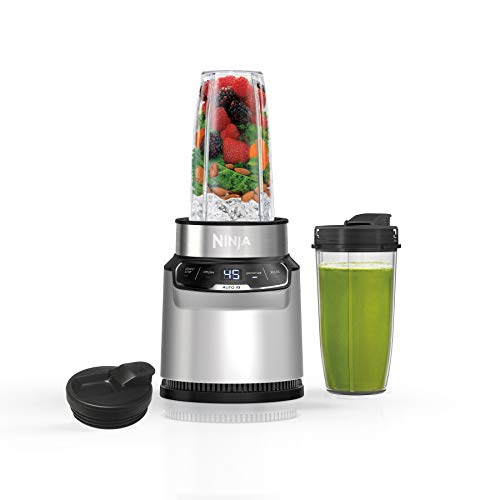
Ninja Nutri-Blender Pro BN401 — Best for Gym-Bag Convenience
The BN401 is the convenience pick: a personal blender with the programmed intelligence of Ninja’s full-size machines. Its Auto-iQ patterns handle the pulse sequence for frozen shakes automatically, the 1100 peak-watt motor is strong for the format, and the two 24 oz cups are sized for a standard post-workout shake with room for oats and fruit.
Strengths
- Auto-iQ programs automate the pulse work other personal blenders make you do
- Strong motor for the class; frozen fruit and ice are routine
- Two lidded cups make blend-and-go genuinely seamless
Trade-offs
- 24 oz cups are tight for maximal gainer recipes
- Less dry-milling finesse than the nutribullet Pro+
- Preset reliance means less manual control for odd recipes
| Motor | 1100W peak |
| Cups | Two 24 oz to-go cups |
| Programs | Auto-iQ programs |
The post-workout window is where routines die: you are tired, hungry and short on patience, and a fussy blender loses to a ready-made drink. The BN401’s one-press programs exist for exactly that moment. Load the cup, press blend, and the programmed pulses fracture the frozen layer before the continuous run, producing a smooth shake while you change out of your gym clothes. That automation, more than the wattage, is the product.
Its trade-offs are capacity and control. Serious gainers will find 24 oz limiting once oats, banana, milk and powder all go in, and the presets occasionally under- or over-run an unusual recipe where a manual machine would let you adapt. For standard shakes at standard sizes, though, it is the most frictionless option on this list, and frictionless is what daily habits are made of.
Best for: lifters who want one-press post-workout shakes to take to the gym / Not suited for: high-calorie gainers who need 32 oz-plus servings

Vitamix Propel Series 510 — Best with Presets, Premium Tier
The Propel 510 answers the one complaint about the 5200 above: no presets. It keeps the Vitamix formula — serious motor, stainless blades, self-cleaning — and adds three programs, including a smoothie cycle that runs the ramp-up for you. The 48 oz container is sized for one large or two standard shakes, which matches how most training households actually blend.
Strengths
- Vitamix durability and texture with preset convenience
- 48 oz container forms a strong vortex at shake-size volumes
- Self-cleaning and dishwasher-friendly ownership routine
Trade-offs
- Premium tier pricing close to the 5200
- Smaller container limits big batch prep
- Fewer programs than cheaper rivals; you pay for the motor, not features
| Container | 48 oz |
| Programs | 3 programs including smoothies |
| Controls | Pulse and variable speed, self-cleaning |
Container size is an underrated spec for shake making. A 64 oz jar half-filled with a single shake forms a weaker vortex than a 48 oz jar properly filled, and the Propel’s size means solo and duo shakes blend faster and smoother. The smoothie preset handles the speed ramp that thick oat-based shakes need, so the result is close to the 5200’s with none of the dial-sitting. For a lifter who blends for themselves and a partner, this is arguably the best-matched premium pick.
What you give up versus the 5200 is batch headroom and a little of the old-school indestructibility story; what you give up versus the mid-range picks is money. The Propel makes sense when the routine is proven and daily — it is an upgrade purchase, not an experiment. Buy it when you already know you blend every day and simply want the best version of that habit with presets included.
Best for: committed daily blenders for one or two people who want presets plus premium power / Not suited for: batch preppers needing maximum jar size, or first-time buyers testing the habit

Ninja Fit QB3001SS — Best Budget Starter
Not every bodybuilding blender needs to mill oats and crush a kilo of ice. The Ninja Fit is for the first phase of the journey: protein powder, milk or water, a banana, some frozen berries. Its 700-watt motor and simple pulse operation handle that menu easily, the 16 oz cups are portion-appropriate for standard shakes, and the price leaves your budget for the things that matter more at the start — food and a gym membership.
Strengths
- Low price makes it the painless way to start a shake routine
- Dead simple: fill, pulse, drink from the same cup
- Compact enough for small kitchens, dorms and office corners
Trade-offs
- 16 oz cups cannot hold a serious gainer shake
- Oats come out gritty rather than powdered
- Motor is not built for twice-daily heavy use over years
| Motor | 700W |
| Cups | Two 16 oz Nutri Ninja cups |
| Operation | Pulse blending |
Judge the Fit by the starter standard: does it make a decent shake fast, every day, without fuss? Yes. Powder disperses fully, bananas and soft frozen fruit blend smooth, and the whole cycle including rinsing takes about two minutes. For a beginner whose shakes are powder-and-milk based, the expensive machines above would be idle capacity. This is the blender that proves the habit before you invest in it.
Know when you have outgrown it. The signs are specific: you start adding oats and they stay gritty, your gainer recipe overflows the cup, frozen mango defeats the motor, or you are blending for a training partner too. At that point the Pro+ or BN401 is the natural next step, and the Fit retires honorably to travel or office duty. Every lifter we know who blends daily started somewhere like this.
Best for: beginners building a basic protein-shake habit on a budget / Not suited for: anyone making oat-based gainers or blending twice daily long-term
Comparison Table
| Pick | Badge | Key spec | Best for |
|---|---|---|---|
| Vitamix 5200 Professional-Grade Blender | Best Overall for Bodybuilding | 64 oz container, variable speed, tamper included by design | serious lifters blending twice daily who want one machine for years |
| nutribullet Pro+ N12-1001MK | Best for Daily Protein Shakes | 1200W personal blender, 32 oz and 24 oz cups, pulse | solo lifters making one or two protein or gainer shakes daily |
| Blendtec Classic 575 with WildSide+ Jar | Best for Big Meal-Prep Batches | WildSide+ jar, programmed cycles, blunt blade | meal preppers who blend a day or more of shakes in one session |
| Ninja Nutri-Blender Pro BN401 | Best for Gym-Bag Convenience | 1100 peak watts, two 24 oz cups, Auto-iQ programs | lifters who want one-press post-workout shakes to take to the gym |
| Vitamix Propel Series 510 | Best with Presets, Premium Tier | 48 oz container, 3 programs including smoothies | committed daily blenders for one or two people who want presets plus premium power |
| Ninja Fit QB3001SS | Best Budget Starter | 700W personal blender, two 16 oz cups | beginners building a basic protein-shake habit on a budget |
How to Choose the Best Blenders for Bodybuilding
Begin with your thickest regular recipe, because that is the blend your machine must survive. Write down what actually goes into your biggest shake — oats, frozen fruit, nut butter, powder, liquid, ice — and total the volume. That single exercise eliminates half the market: cups under 24 oz cannot hold a real gainer, and motors under about 900 watts in personal format will struggle with the frozen and fibrous load. Buy for your biggest weekly shake, not your average one.
Then rank the three capabilities that matter. Dry milling first: if oats, flax or nuts go in dry, you need genuine grinding power, which in practice means a premium full-size machine or the strongest personal blenders. Thick-load management second: tampers and variable speeds beat raw wattage for gainer shakes, because the failure mode is an air pocket, not a lack of power. Cleanup third: at twice-daily use, a self-clean cycle or a rinse-and-go cup is worth more than any preset.
Personal vs full-size for lifters
Personal blenders win on workflow: blend in the cup, drink from the cup, rinse the blade. For one person making standard shakes, nothing is faster. Full-size machines win on capability: they mill dry ingredients properly, hold double servings and thick gainers, and last longer under daily loads. Couples who train together and anyone whose shakes exceed 24 oz should go full-size; solo lifters with standard recipes should go personal and spend the savings on food.
The Ingredients That Break Blenders
Oats are the first test. Rolled oats need either a dry pre-grind on a powerful machine or an overnight soak; in a weak blender they survive as gritty flakes that ruin texture and settle at the bottom. Steel-cut oats are harder still and should be soaked or cooked for any machine on this list. If oats are non-negotiable in your shakes, they are the spec that decides your blender.
Frozen fruit is the second test, and size matters more than temperature: a frozen banana in chunks blends in any decent machine, while a solid cup of frozen mango cubes needs real power or a thaw of ten minutes on the counter. Peanut butter and other nut butters are the third test — they coat jar walls and blades, so add them after some liquid and let the vortex pull them in rather than dropping them onto dry powder.
Protein powder itself is easy to blend but easy to ruin: added to a dry jar wall it cakes, and over-blending whey whips in air that makes shakes foamy. Add powder on top of liquid, blend the minimum time needed, and your shakes will taste like the recipe intended rather than like the machine’s limitations.
Budget Tiers for a Bodybuilding Blender
The budget tier buys a starter personal blender that covers powder-based shakes and soft ingredients. It is the right spend for the first months of training. The mid-range tier — the strong personal blenders and entry full-size systems — is where most lifters should live: enough power for oats and frozen fruit, cups and pitchers sized for real shakes, and durability measured in years of daily use.
The premium tier buys the professional machines, and bodybuilding is one of the few use cases where the premium genuinely pays: usage frequency is extreme, the ingredient loads are the hardest in home blending, and the cost per blend over a machine’s life is lower than any other category of buyer achieves. If you blend twice a day and your budget stretches, buy the premium pick once rather than two mid-range machines in succession.
Shake Architecture: Building Recipes Your Blender Can Win
Every gainer shake is a negotiation between calories and physics. The ingredients that add calories most efficiently — oats, nut butters, oils, dried fruit — are precisely the ones that thicken, coat and stall a blend, while the ingredients that keep a shake moving — milk, water, fresh fruit — add volume faster than calories. Understanding that tension lets you build shakes at the edge of what your machine can do instead of past it. The core technique is sequencing: the dry base milled or soaked first, the liquid foundation second, the sticky calories third, and the frozen mass last, so the vortex is established before the load arrives.
Ratios matter as much as order. A shake that is more than about two-thirds solids by volume will challenge any machine in this guide; adding liquid is not dilution if the alternative is a stalled blend with unmixed pockets of powder. Fat is the secret lever: a tablespoon of oil or a generous spoon of nut butter adds serious calories while lubricating the mixture, often making a thick shake blend more easily, not less — provided it goes in after the liquid and before the frozen ingredients, where the vortex can pull it off the walls.
Temperature is the last variable. Room-temperature liquid and briefly rested frozen fruit blend dramatically easier than a fully frozen load in cold milk, and the calorie count does not care. Lifters who blend at 6 a.m. on a schedule should build the recipe around the machine they own: soak the oats overnight in the milk, portion frozen fruit in blend-sized pieces, and even the budget pick in this guide will produce a shake that drinks like it came from a flagship.
The Blender as Training Equipment: Cost Per Shake
It helps to do the arithmetic that justifies this category’s premium tier. A lifter blending twice a day makes roughly seven hundred shakes a year. A budget personal blender that survives eighteen months of that duty costs little per shake but will be replaced mid-program, usually at the least convenient moment. A premium machine that serves six years at the same duty costs more up front and less per shake than the budget route — and returns a better-textured shake on every one of those thousands of blends, which is not a trivial thing when the shake is a meal you must finish on days when appetite is the limiting factor.
Texture is a compliance tool, and compliance is the whole game in a gaining or cutting diet. A gritty, half-blended shake gets skipped on tired days; a smooth one gets finished. Coaches who would never let an athlete train on broken equipment sometimes miss that the blender is equipment too — the piece that delivers a meaningful share of the day’s nutrition. Buy it like equipment: sized to the job, strong enough for the hardest regular load, and maintained like it matters.
Maintenance, for the record, is mostly the rinse discipline described throughout this guide, plus two habits specific to this use: never let protein residue dry in the gasket, where it hardens and smells, and replace cups and seals on personal blenders at the first sign of cracking rather than after the first leak in a gym bag. Treated that way, any pick in this guide will outlast the training cycle you bought it for.
Cutting Season vs Gaining Season: Two Different Blenders?
The shake changes with the season, and so does the load on the machine. A gaining shake is a maximal event: oats, nut butter, banana, milk, powder, sometimes ice — the thickest mixture in home blending, testing milling, circulation and motor stamina at once. A cutting shake is the opposite problem: mostly liquid, ice, frozen berries and greens, where the challenge is not thickness but volume of ice and fiber, and where a watery, under-blended result ruins the one meal a hungry athlete is allowed to enjoy. The same blender rarely tops both briefs, which is why this guide’s badges split the way they do.
For gaining, prioritize in order: container volume for the full recipe, dry-milling ability for the oat base, and thick-load management — a tamper, a variable dial, or a jar geometry that keeps a heavy mixture turning. For cutting, prioritize ice and frozen-fruit finesse and raw speed, because a cutting shake made in ninety seconds gets made on the days a ten-minute production would get skipped. Personal blenders shine in cutting season, when recipes are small and speed rules; full-size machines earn their counter in gaining season, when every shake is a construction project.
Athletes who run both seasons seriously and blend year-round are the strongest candidates in this guide for the premium full-size picks: one machine that mills in winter and pulverizes in summer, with the durability to run both cycles for years. Athletes in a single long phase should buy for that phase and let the other season make do — a cutting-phase lifter on the budget personal pick loses almost nothing.
Whichever season you are in, keep the recipe honest with the machine. A gaining shake diluted to suit a weak blender fails its purpose; a cutting shake thickened past a personal blender’s ability fails in the jar. Match the mixture to the machine you own, or the machine to the mixture you need — those are the only two strategies, and this guide exists to make either one deliberate.
Travel, Gyms and the Second-Location Problem
Serious routines travel badly. The home blender stays home, and the lifter faces hotel rooms, office kitchens and training camps with a shaker bottle and regret. The realistic solutions are the portable end of this category: a personal blender small enough to live in a gym bag or office drawer transforms travel weeks from a nutritional write-off into a continuation of the routine. The budget pick in this guide doubles as exactly that second machine for owners of a full-size home unit — cheap enough to leave at the office, capable enough for powder, fruit and milk.
What travels worst is the recipe, not the machine. Oats need the home mill or an overnight soak in a travel cup; frozen fruit becomes fresh fruit and ice from the hotel machine; nut butter packets replace the jar. Athletes who compete learn to build a travel version of their shake that any personal blender in this guide can execute, and to test it at home before the trip rather than discovering its failures in a hotel bathroom at midnight.
Hygiene is the travel detail nobody plans for. A personal blender rinsed in a hotel sink and dried on a towel is fine; the same blender sealed wet in a gym bag for two days is a science project. The blend-and-go cup should be rinsed immediately, left open to dry, and washed properly at the first real kitchen. Gaskets deserve a weekly inspection during heavy travel use, since they are the part that suffers first and complains last.
None of this requires a second premium machine. It requires the modest second unit, a travel-tested recipe, and the rinse discipline — after which the routine survives the road, which is the entire point.
How to Build a Gainer Shake That Any Blender Can Handle
Recipe engineering matters as much as machine power. Built in the right order, even the budget pick on this list can produce a thick, smooth, high-calorie shake; built carelessly, the same ingredients stall a flagship.
- Mill the dry base first, if your machine can. Blend oats (and flax or nuts) alone on high for 20–30 seconds before any liquid. On weaker machines, soak the oats in the shake liquid for at least 20 minutes or overnight instead.
- Add liquid next, and enough of it. Milk or your preferred alternative goes in before anything sticky or frozen. Thick shakes still need a liquid foundation — roughly a cup per serving — to form the vortex.
- Add the sticky and soft ingredients. Peanut butter, banana, yogurt and honey go in now, while the liquid can pull them off the walls and into the blend.
- Add powder on top of the liquid layer. Protein powder dropped onto wet liquid disperses; powder dropped onto a dry jar wall cakes into lumps no blender fully rescues.
- Frozen fruit and ice go last, in two additions. Blend the first half in, then add the rest. This keeps the load moving and prevents the frozen bridge that stalls thick shakes.
- Blend in a ramp, then stop early. Start low for a few seconds, then high for 30–45 seconds. Stop as soon as the surface turns over smoothly; extra time only adds air and warmth.
If a shake still comes out gritty, the fix is almost never a new blender: it is a longer oat soak, smaller frozen pieces, or ten percent more liquid. Adjust the recipe in that order before you blame the machine.
Common Buying Mistakes
Buying a cup that is too small. The most common bodybuilding blender regret. A gainer recipe with oats, fruit, milk and powder easily exceeds 24 oz; measure your real recipe before choosing between the personal formats.
Adding protein powder first. Powder on a dry jar base or wall cakes into concrete-like lumps. Liquid first, powder onto liquid — every time.
Expecting a budget personal blender to mill oats. Dry milling is the hardest job in blending. Budget machines need soaked oats; pretending otherwise just produces gritty shakes and a strained motor.
Over-blending whey shakes. Extended blending whips air into whey shakes, making them foamy and less pleasant, and warms the mixture. Blend to smooth, then stop.
Skipping cleanup until later. Dried protein and oat residue is genuinely difficult to remove and breeds odors in gaskets. A thirty-second rinse immediately after drinking keeps a daily blender pleasant for years.
Final Recommendation
The recommendations by situation: the Vitamix 5200 for the committed lifter who wants the best tool for a decade; the nutribullet Pro+ for the solo daily shake maker; the Blendtec Classic 575 for batch preppers; the Ninja BN401 for one-press post-workout convenience; the Vitamix Propel 510 for premium power with presets in a shake-sized jar; and the Ninja Fit for beginners proving the habit. Every one of them was verified for this guide, and every one will make a better shake than the machine most kitchens currently own.
Check the current price on Amazon for your pick, and remember the real math of this category: at two shakes a day, even the premium machine costs less per blend than the powder inside it within the first year.
Treat the purchase like a program decision: pick the machine that matches the next twelve weeks of shakes, not the next twelve years of hypothetical ones — unless you are choosing between the premium picks, in which case twelve years is exactly the right horizon and the Vitamix earns its place on it.
Keep exploring the cluster: Best Blenders And Ice Crushers Best Blenders Below 200 Best Blenders And Juicers Best Blenders Breville Chef Best Affordable Blenders For Green Smoothies
Frequently Asked Questions
What is the best blender size for protein shakes?
For one person, a 24–32 oz cup or container is the sweet spot: it holds a full shake with oats and fruit without leaving so much headspace that the vortex weakens. For two people or batch prep, a 48–64 oz pitcher is better. Oversized 72 oz pitchers are the least efficient choice for single shakes.
Can a blender grind oats for gainer shakes?
A strong one can. Premium full-size blenders and the most powerful personal models mill rolled oats to a fine powder in 20–30 seconds of dry blending. Weaker machines leave grit; with those, soak the oats in the shake liquid for at least 20 minutes — or overnight — and they will blend smoothly.
Why does my thick shake stop blending?
An air pocket — cavitation — forms around the blades when a mixture is too thick to circulate. Fix it by starting on low speed, adding liquid in small amounts, using a tamper if your machine has one, or stopping to stir once. It is a circulation problem, not usually a power problem.
Personal blender or full-size for bodybuilding?
Personal if you train and blend solo with standard recipes: the workflow is faster and cleanup is minimal. Full-size if your shakes exceed 24 oz, if you dry-mill oats daily, if you blend for a partner, or if you batch-prep. Many serious lifters eventually own the full-size machine and keep a personal one for travel.
How do I stop protein shakes tasting gritty?
In order: mill or soak the oats properly, use smaller or briefly thawed frozen fruit pieces, add powder onto liquid rather than dry surfaces, and do not under-blend — most shakes need a full 30–45 seconds at high speed once the load is moving. Grit is almost always one of those four causes.
How long will a blender survive twice-daily use?
A premium machine should last many years; a strong mid-range personal blender typically gives two to four years of twice-daily service before cups, gaskets or the motor tire; budget starters are a one-to-two-year proposition at that intensity. Rinsing immediately and not overloading frozen loads extends every tier’s life.
Should I blend protein powder with ice?
Ice is fine in shakes and will not damage protein powder. Add the ice as part of the frozen load, after liquid and powder, and blend only until smooth — over-blending with ice whips in air and melts the ice, thinning a shake you wanted thick.
What is the best liquid base for a gainer shake?
Whole milk is the classic choice for calories and texture where dairy suits you. Otherwise, oat milk gives the best body among common alternatives, and any base improves with a spoon of nut butter or oil for calories and blendability. The blender does not care which you choose; the ratio of liquid to solids is what it feels.


