Disclosure: airfryerkitchensupply.com is reader-supported. When you buy through links on our site, we may earn an affiliate commission at no extra cost to you.
Where to buy
Start here if you are comparing the best blenders and juicers for a home routine. Blenders and juicers do different jobs, so this where-to-buy box is organized by role: true two-in-one machines first, then the dedicated juicers and blender systems that cover both jobs as a pair. Every linked model was verified against Amazon’s catalog data before inclusion.
- Breville 3X Bluicer Pro BJB815 — Best Overall Two-in-One: Check the current price on Amazon
- Nama J2 Cold Press Juicer — Best Cold Press Juicer: Check the current price on Amazon
- Breville Juice Fountain Plus JE98XL — Best Fast Juicer: Check the current price on Amazon
- Hamilton Beach Juice & Blend 2-in-1 67970 — Best Budget Two-in-One: Check the current price on Amazon
- Kuvings AUTO10 Cold Press Juicer — Best Hands-Free Batch Juicer: Check the current price on Amazon
- nutribullet Full-Size Blender Combo NBF50500 — Best Blender-First Combo: Check the current price on Amazon
This category is promoted heavily and prices swing week to week, so this page lists no fixed prices. Check the current price on Amazon for the models that fit your routine, and remember that a juicer’s real cost includes the produce you will run through it.
Shopping for the best blenders and juicers usually starts with a wrong assumption: that one machine naturally does both jobs. It does not. A blender keeps everything you put in — fiber, pulp and all — and turns it into a thick drink. A juicer separates juice from pulp and gives you a thin, clear drink while discarding the fiber. The best blenders and juicers, then, are either genuine two-in-one machines built to swap between the two tasks, or a well-chosen dedicated machine for the job you will actually do most.
This guide covers both honest paths. We verified two-in-one systems that blend and juice from one base, the best cold press juicers for people who juice daily, a fast centrifugal juicer for busy mornings, and a blender combo that covers the smoothie side completely. Every model was cross-checked against Amazon’s catalog data, and we are blunt about the trade-offs: two-in-one machines compromise somewhere, cold press juicers are slow, and centrifugal juicers oxidize juice faster.
Decide one thing before you read the picks: which drink do you make more often? If the answer is smoothies, buy the blender side first and let the juicer be secondary. If you juice greens and roots several times a week, a dedicated juicer will make you happier than any combo. The list is ordered so both kinds of readers find their machine early.
In this guide
Quick Picks
Best Overall Two-in-One — Breville 3X Bluicer Pro BJB815
One brushed-steel base that takes both a full blender jar and a juicing attachment with an extra-wide chute. The most complete single answer to the blenders-and-juicers question. Check on Amazon
Best Cold Press Juicer — Nama J2 Cold Press Juicer
Load the hopper with a whole recipe, close the lid and walk away: the J2 feeds itself, presses slowly at 50 RPM and produces high-yield, low-pulp juice with very little prep or noise. Check on Amazon
Best Fast Juicer — Breville Juice Fountain Plus JE98XL
The classic fast juicer: an 850W motor, a 3-inch chute that swallows whole apples and two speeds for hard and soft produce. Juice for the family in minutes, not tens of minutes. Check on Amazon
Best Budget Two-in-One — Hamilton Beach Juice & Blend 2-in-1 67970
A centrifugal juicer and a personal blender sharing one 800W base at a budget tier. The blender side is a 20 oz travel jar — perfect for a smoothie for one, right after juicing. Check on Amazon
Best Hands-Free Batch Juicer — Kuvings AUTO10 Cold Press Juicer
The biggest hopper in the cold press class: load 100 oz of produce, let the quiet 240W motor work through it unattended and come back to a full batch of low-pulp juice. Check on Amazon
Best Blender-First Combo — nutribullet Full-Size Blender Combo NBF50500
The smoothie household’s answer: a 1200W full-size pitcher for family blends and a 24 oz tumbler for personal shakes. It does not extract juice — it blends whole, fiber and all. Check on Amazon
How These Picks Were Chosen
We chose these six machines to cover the real ways people combine blending and juicing at home. Two are true two-in-one systems that share a motor base between a blender jar and a juicing attachment. Three are dedicated juicers representing the main technologies — self-feeding cold press, hands-free batch cold press, and fast centrifugal. One is a blender combo that anchors the smoothie side with single-serve cups for households whose juicing is occasional.
Every product was verified against Amazon’s catalog data on 2026-11-21; only confirmed models carry purchase links. For juicers we weighed yield on leafy greens and hard produce, pulp dryness, chute size, cleaning time and noise. For blenders and combos we weighed ice and frozen-fruit performance, jar and cup sizes, and how the parts store. We excluded machines with active recalls and no-name juicers whose replacement screens and augers cannot be bought separately, because a juicer you cannot get parts for is a disposable appliance.
We also kept the list honest about cost of ownership. Cold press juicers extract more juice per pound of produce, which quietly repays their higher tier over a year of daily juicing. Centrifugal machines cost less up front and juice faster, but leave wetter pulp. Neither is wrong; they suit different routines, and the reviews below say which is which.
We also pressure-tested our own shortlist against a simple question: would we tell a friend to spend their own money on this? Two well-known machines failed that test on parts availability alone and were cut, because a juicer whose screen cannot be replaced is a subscription to a future purchase, not an appliance.
The 6 Best Blenders and Juicers

Breville 3X Bluicer Pro BJB815 — Best Overall Two-in-One
If you want one appliance that genuinely does both jobs well, the Bluicer Pro is it. Breville built the machine around a single powerful base: click on the blender jar for smoothies and frozen drinks, or the juicer attachment — with the wide feed chute from the Juice Fountain line — for fresh juice. It is a premium-tier machine, but it replaces two appliances and does neither job as a token effort.
Strengths
- Real blending and real juicing performance from one base and one footprint
- Extra-wide chute takes whole apples, cutting prep to almost nothing
- Blender side handles ice and frozen fruit credibly, not just soft smoothies
Trade-offs
- Premium tier pricing; costs more than a mid-range blender and juicer bought separately
- Two sets of parts to wash and store
- Juicing side is centrifugal, so juice is best drunk fresh
| Type | Blender and juicer combo, one base |
| Finish | Brushed stainless steel |
| Juicer style | Centrifugal with wide feed chute |
The Bluicer concept works because Breville refused to miniaturize either side. The juicer uses the same cold-spin style basket and chute as the dedicated Juice Fountain models, and the blender jar is a full-size vessel rather than a token cup. In a small kitchen, that matters: one base on the counter, attachments in a cupboard, and no second motor housing eating space. The interlock system is also well judged — the machine will not run with a half-seated attachment, which sounds fussy until you have seen a juicer lid walk at full speed.
The compromises are the ones inherent to centrifugal juicing and shared appliances. Juice from any centrifugal machine foams more and keeps for a shorter time than cold press juice, and if one side of this machine fails years from now, both sides are out of service. Households that blend and juice in roughly equal measure will not care. Households that juice daily and blend rarely should put the money into a dedicated cold press machine instead.
Best for: small kitchens and mixed routines that blend and juice in equal measure / Not suited for: daily juicers who want cold press yield, or buyers who only ever do one of the two jobs

Nama J2 Cold Press Juicer — Best Cold Press Juicer
The Nama J2 changed what a home cold press juicer feels like to use. Traditional masticating juicers ask you to chop produce small and feed it piece by piece while pushing it down. The J2’s self-feeding hopper takes a whole recipe at once — apples, carrots, greens and all — and the auger draws it down at a quiet 50 RPM. For daily juicers, it removes the two frictions that kill the habit: prep and babysitting.
Strengths
- Self-feeding hopper eliminates most chopping and all hand-feeding
- Slow 50 RPM pressing gives high yield and dry pulp, especially on greens
- Quiet enough for early mornings and easy to rinse clean
Trade-offs
- Premium tier price for a single-purpose machine
- Juicing is slow by design; big batches take patience
- Soft fruits can turn mushy if loaded without harder produce between them
| Type | Masticating cold press juicer |
| Speed | 50 RPM |
| Warranty | 15-year warranty |
| Material | BPA-free parts |
Yield is where the J2 earns its tier. Slow pressing squeezes leafy greens and fibrous roots far more completely than a centrifugal basket, and the pulp comes out noticeably drier — which means more juice from the same grocery bag. If you juice four or five times a week, that difference quietly pays for the machine over a year or two, and the juice keeps better in the fridge because less air is whipped into it.
The ownership experience is equally considered. The parts count is low, most of them rinse clean under the tap, and the long warranty signals a maker that expects the machine to last. What the J2 will not do is blend, chop ice or make a smoothie — it is a specialist. Pair it with even a mid-range blender and you have the strongest two-machine setup on this page; buy it alone only if juice, not smoothies, is your daily drink.
Best for: daily juicers who value yield, quiet operation and minimal prep / Not suited for: smoothie-first households, or anyone who wants juice in under two minutes
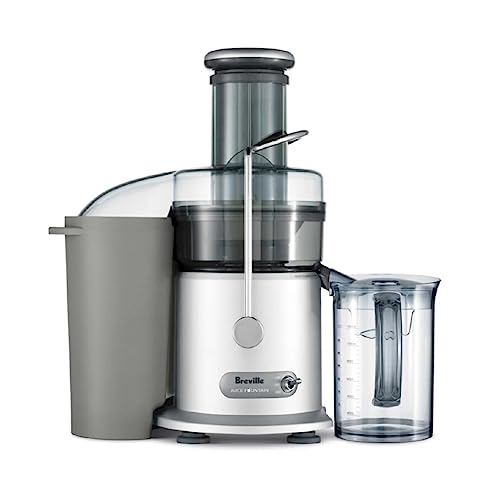
Breville Juice Fountain Plus JE98XL — Best Fast Juicer
Some mornings, juice needs to happen in five minutes, and that is the Juice Fountain Plus’s entire argument. Its centrifugal design spins produce against a fine mesh at high speed, extracting juice almost as fast as you can feed the chute. It has been a best-seller for years because it is simple, tough and quick, and for households juicing fruit and hard vegetables a few times a week, speed beats the last few percent of yield.
Strengths
- Whole-fruit chute and 850W motor make juicing genuinely fast
- Two speeds handle both hard roots and soft fruit properly
- Simple, proven design with widely available replacement parts
Trade-offs
- Wetter pulp than cold press machines means lower yield on greens
- Loud at full speed and juice foams more
- More parts to scrub, including a fine mesh basket
| Motor | 850W |
| Chute | 3-inch wide feed chute |
| Speeds | Dual speed for hard and soft produce |
The honest way to frame centrifugal versus cold press is time versus yield. The JE98XL will juice a kilo of apples and carrots while a masticating machine is still on its first apples. For a family making juice at breakfast, that speed is the difference between a habit that sticks and a machine that migrates to a cupboard. Where it loses is leafy greens, wheatgrass and soft berries, which it processes inefficiently, and in juice storage: drink centrifugal juice the same day for the best flavor.
As a blending partner it is equally pragmatic. This is the juicer to pair with the blender you already own if your juicing is fruit-led and occasional-to-regular. It is not the machine for a dedicated green-juice routine, and the reviews above and below this one cover that need better. Judge it as the fast, affordable gateway into juicing and it is excellent.
Best for: busy households juicing fruit and hard vegetables a few times a week / Not suited for: green-juice devotees or anyone who batches juice for several days
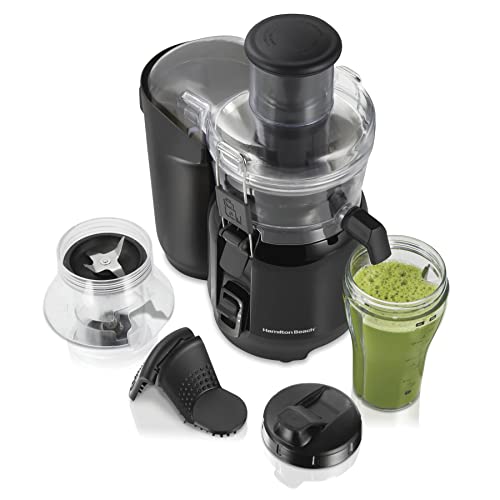
Hamilton Beach Juice & Blend 2-in-1 67970 — Best Budget Two-in-One
The Juice & Blend is the two-in-one for people who are not sure yet whether juicing will stick. One compact 800W base drives a Big Mouth centrifugal juicer and a 20 oz personal blending jar, so you can juice carrots and ginger, rinse, then blend a smoothie for the road. It costs a fraction of the premium combo above and asks for very little counter space in return.
Strengths
- Lowest-cost way to own both functions in one appliance
- 3-inch chute keeps juicing prep minimal
- Personal blender jar doubles as a travel cup
Trade-offs
- Blender side is single-serve only; no family-size jar
- 800W motor is adequate, not powerful, on frozen fruit
- Budget build quality throughout
| Motor | 800W |
| Chute | Big Mouth 3-inch feed chute |
| Blender jar | 20 oz personal jar |
Think of this machine as a sampler platter. The juicer is a competent entry centrifugal — fine for apples, carrots, citrus and celery — and the blender jar handles a banana, a handful of frozen berries and liquid without complaint, as long as you do not ask it to crush a full load of ice. For a single person or a couple building a morning routine, that covers the realistic menu at a price that does not hurt if the routine fades by spring.
The limits show up exactly where you would expect. There is no upgrade path to bigger batches, the parts are lighter than the Breville’s, and heavy daily use will wear it faster than a dedicated machine. But as a first step into owning both functions — or as a compact solution for a small apartment or dorm-adjacent kitchen — it is sensibly designed and honestly priced.
Best for: singles and couples testing a juice-and-smoothie routine on a budget / Not suited for: families, heavy daily users, or anyone blending full pitchers

Kuvings AUTO10 Cold Press Juicer — Best Hands-Free Batch Juicer
The AUTO10 takes the self-feeding idea of the Nama J2 and scales it for batch juicers. Its hopper holds around 100 oz of produce — several full recipes — and the machine works through the load on its own while you do something else. If your routine is a big Sunday batch for the week, or juice for the whole family at once, this is the most convenient cold press design currently sold.
Strengths
- Largest self-feeding hopper in its class for true batch juicing
- Quiet motor and slow pressing for high yield and low pulp
- Easy-clean design reduces the worst part of batch day
Trade-offs
- Big machine with a big footprint and premium tier price
- Batch juicing still produces juice best consumed within a few days
- Overloading with only soft fruit can slow the auger
| Hopper | 100 oz self-feeding |
| Motor | 240W, quiet operation |
| Type | Masticating cold press juicer |
Batch juicing lives or dies on friction, and the AUTO10 attacks friction from both ends: less feeding at the front, less scrubbing at the back. The self-feeding hopper genuinely changes the workflow — you prep produce in handfuls, drop it in and the auger meters it through. Alternating hard and soft produce, a habit worth learning on any cold press machine, keeps the press cake moving and the yield high on everything from beetroot to spinach.
Size is the honest cost. This is not a machine that tucks into a corner, and its price puts it against the Nama J2, which is smaller and carries the longer warranty story. Choose the AUTO10 when volume is your pain point — family batches, weekly prep, entertaining. Choose the J2 when it is a daily two-glass routine. Both are excellent; they are excellent for different kitchens.
Best for: batch juicers and families who juice in volume once or twice a week / Not suited for: small kitchens, or single-glass juicers who will never fill the hopper

nutribullet Full-Size Blender Combo NBF50500 — Best Blender-First Combo
This pick comes with a clarification the whole category needs: the nutribullet Blender Combo is not a juicer, and we include it because for many households it is the right alternative to one. It blends whole fruits and vegetables into smoothies that keep the fiber, with a 1200W motor, a 64 oz pitcher and a personal tumbler. If your goal is nutrition and fullness rather than clear juice, this is arguably the better tool — and it costs less than most juicers here.
Strengths
- Powerful 1200W blending for smoothies, including frozen fruit and greens
- Pitcher plus tumbler covers family batches and single servings
- Keeps fiber, so drinks are more filling than juice
Trade-offs
- Cannot make clear juice; pulp stays in the drink
- Texture with seedy or fibrous produce is thick, not silky
- No juicing attachment exists for this base
| Motor | 1200W |
| Pitcher | 64 oz |
| Cup | 24 oz tumbler cup |
The blender-versus-juicer decision is really a fiber decision. Juicing removes fiber and concentrates flavor and sugar; blending keeps everything, producing a drink closer to a light meal. For breakfast routines, post-workout shakes and getting greens into reluctant family members, the blended route is often the more practical and satisfying one — and this combo executes it well, with enough power to break down kale stems and frozen mango without the stalling that plagues cheaper personal blenders.
Where the combo cannot follow is the juice bar experience: no clear apple juice, no pure ginger shots, no celery juice. Households that want both experiences should pair a dedicated juicer from this list with a blender like this one over time, starting with whichever drink they will make more. As the blender half of that pair — or as the single appliance for smoothie households — it is the strongest value here.
Best for: smoothie-first households who want fiber-rich drinks and occasional juice alternatives / Not suited for: anyone whose goal is clear, pulp-free juice
Comparison Table
| Pick | Badge | Key spec | Best for |
|---|---|---|---|
| Breville 3X Bluicer Pro BJB815 | Best Overall Two-in-One | Blender and juicer on one base, brushed stainless steel | small kitchens and mixed routines that blend and juice in equal measure |
| Nama J2 Cold Press Juicer | Best Cold Press Juicer | Self-feeding hopper, 50 RPM, 15-year warranty | daily juicers who value yield, quiet operation and minimal prep |
| Breville Juice Fountain Plus JE98XL | Best Fast Juicer | 850W centrifugal, 3-inch wide chute, dual speed | busy households juicing fruit and hard vegetables a few times a week |
| Hamilton Beach Juice & Blend 2-in-1 67970 | Best Budget Two-in-One | 800W, centrifugal juicer plus 20 oz blender jar, 3-inch chute | singles and couples testing a juice-and-smoothie routine on a budget |
| Kuvings AUTO10 Cold Press Juicer | Best Hands-Free Batch Juicer | 100 oz self-feeding hopper, 240W quiet motor | batch juicers and families who juice in volume once or twice a week |
| nutribullet Full-Size Blender Combo NBF50500 | Best Blender-First Combo | 1200W, 64 oz pitcher plus 24 oz tumbler cup | smoothie-first households who want fiber-rich drinks and occasional juice alternatives |
How to Choose Between Blenders and Juicers
The choice starts with texture. Juice is a drink: light, clear and quick to absorb, made by separating liquid from fiber. A smoothie is a blended whole food: thick, filling and slower to drink. Neither is universally healthier or better; they are different tools. People who struggle to eat enough vegetables often do better with juice, because a large volume of produce reduces to one glass. People replacing breakfast often do better with smoothies, because fiber and protein keep them full.
Then consider the three ownership paths. A two-in-one machine saves space and money and suits households that split their routine evenly, at the cost of some compromise on both sides. Two dedicated machines cost more and take more space but each does its job properly. A blender alone is the budget path and the right one if juice would be a monthly novelty in your house. Be honest about frequency: the best machine is the one still in use in six months.
Juicer technologies, explained
Centrifugal juicers spin produce against a mesh basket at high speed. They are fast, cheaper and great with hard produce, but noisier, lower-yielding on greens and their juice keeps for a shorter time. Cold press (masticating) juicers crush produce slowly with an auger. They are quiet, high-yielding and better with greens and for storing juice, but slower and more expensive. Self-feeding hoppers, as on the Nama J2 and Kuvings AUTO10, remove the hand-feeding chore that older cold press designs demanded.
What Each Machine Costs You Beyond the Price
Produce is the real running cost of juicing. A low-yield juicer quietly taxes every recipe: wetter pulp means more apples per glass, forever. Daily juicers recover a cold press machine’s higher tier through yield alone, while occasional juicers never will — which is why the budget centrifugal and budget combo picks on this list are honest recommendations rather than compromises to apologize for.
Time is the second cost. Count total minutes honestly: prep, the juicing or blending itself, and cleaning. A centrifugal juicer that juices in two minutes but needs six minutes of mesh-scrubbing is not faster than a cold press machine that presses in eight minutes and rinses in two. Self-clean blender cycles and dishwasher-safe juicer parts are worth real money to anyone whose routine happens before work.
Storage is the third. Two-in-one bases earn their keep in small kitchens, but only if the attachments have a home; a juicer attachment lost in a deep cupboard is functionally a machine you do not own. Measure your cupboard space for attachments before choosing the combo route.
Budget Tiers for Blenders and Juicers
At the budget tier, expect a competent centrifugal juicer, a personal-blender combo like the Hamilton Beach, or a strong blender alone. This tier suits beginners and occasional users perfectly well. The mid-range tier buys the classic dedicated machines — proven centrifugal juicers and full-size blender systems — and is where most households should land if they already know their routine.
The premium tier buys cold press yield, self-feeding convenience, quiet motors and long warranties, plus the one true premium two-in-one in the Bluicer Pro. Premium money is well spent by daily users and wasted by monthly ones. A useful rule: if you will use the machine four or more times a week, buy a tier up from your instinct; if twice a week or less, buy a tier down and spend the difference on better produce.
Cold Press vs Centrifugal: The Yield Question in Real Numbers of Juice
The practical difference between juicer types shows up in the pulp bin. Run a kilo of carrots through a centrifugal machine and the pulp comes out damp — squeeze a handful and juice runs. Run the same carrots through a cold press machine and the pulp is crumbly and dry. That retained moisture is juice you paid for and did not drink, and on leafy greens the gap widens further, because a spinning basket simply cannot wring leaves the way an auger can. Over a single glass the difference is a few mouthfuls; over a year of daily juicing it is a significant fraction of your produce budget.
Speed runs the other way. The centrifugal machine finishes that kilo of carrots in the time the cold press machine takes to get properly started, and for a family of four at breakfast that difference decides whether juicing happens at all. This is why this guide refuses to declare a universal winner: the right juicer is the one matched to your volume and your clock. High volume and tight mornings argue centrifugal despite the yield tax; a daily two-glass ritual with expensive organic greens argues cold press despite the minutes.
Taste and keeping quality sit between the two. Cold press juice, with less air beaten into it, tastes smoother and keeps its flavor in the fridge for two to three days. Centrifugal juice foams, separates faster and is at its best within hours. Batch juicers should read that as a hard constraint: a Sunday batch from a centrifugal machine is a compromise, while the same batch from a self-feeding cold press machine is a system that works.
Building a Two-Machine Setup Over Time
Most households that end up owning both a blender and a juicer did not buy them together, and the staged approach is usually smarter than the combo purchase. Stage one is whichever drink you will make more — for most people a blender, because smoothies double as breakfasts in a way juice does not. Buy that machine properly, at the level your frequency justifies, and live with it for a season. The season teaches you what the second machine actually needs to be: the smoothie household that starts juicing celery and ginger on weekends needs a different juicer from the one that discovers a daily green-juice habit.
Stage two is the complement, bought with the lessons of stage one. Notice how much counter the first machine really uses, how much cleaning your routine tolerates, and whether your produce shopping has shifted toward juice-friendly items. Those observations pick the juicer — or the blender — better than any review can, including this one. The two-in-one machines in this guide exist for the households that already know both answers, usually because they are replacing a pair of machines they have worn out.
A final staging note: accessories and parts are where ecosystems quietly lock you in. Blender jars, juicer screens and augers are model-specific and add up over years. Staying within one brand across both machines, as the Breville pairing in this guide allows, simplifies spares and support — a modest but real argument for brand loyalty once your two-machine setup takes shape.
What to Juice, What to Blend: A Practical Produce Map
Some produce belongs to the juicer, some to the blender, and some to whichever machine is already dirty. Hard, watery produce is juicer territory: carrots, apples, celery, cucumber, beetroot and ginger give up their liquid cleanly and leave their fiber behind, producing drinks that would be unpleasantly pulpy if blended whole. Soft, creamy produce is blender territory: bananas, avocados, mangoes and nut butters have almost no free juice to extract and exist to give smoothies body. Sending a banana through a juicer produces a spoonful of mush and a clogged screen; sending carrots through a blender produces a chewable soup. The machines are not rivals — they partition the produce drawer between them.
Leafy greens sit on the border and reward thought. In a cold press juicer they yield real juice and belong there. In a centrifugal juicer they mostly pass through, and the same leaves blended into a smoothie deliver their substance with the fiber — often the better outcome. Berries divide similarly: juiced, they give intense flavor at high cost per glass; blended, they give texture and value. Citrus is its own case — a dedicated press beats both machines, but a juicer handles peeled citrus well, while a blender should only meet citrus as juice or carefully peeled segments, since pith turns a smoothie bitter.
The hybrid recipes are where owning both machines pays off. A green juice base — cucumber, celery, apple, ginger from the juicer — blended with avocado, spinach and ice becomes a drink neither machine makes alone: clear-flavored, creamy and genuinely filling. Juice bars build their premium menus exactly this way. If your routine grows toward those recipes, the two-machine path in this guide stops being a luxury and becomes the kitchen you actually wanted.
When in doubt, ask what you want in the glass: liquid or substance. Liquid belongs to the juicer, substance to the blender, and the honest answer for many households — some mornings one, some mornings the other — is why this category exists at all.
Cleaning, Screens and Augers: Owning a Juicer Honestly
Juicers have the worst cleaning reputation in the kitchen, and the reputation is half earned. A centrifugal juicer’s mesh basket genuinely needs scrubbing — pulp packs into thousands of tiny holes, and a neglected basket both underperforms and harbors odor. The brush that comes in the box is not an accessory; it is part of the machine, and thirty seconds with it under running water immediately after juicing keeps the basket at full performance for years. Cold press machines trade the basket for an auger and screen that mostly rinse, which is a large part of their ownership appeal, but their pulp outlets clog if fibrous produce is forced, and a monthly soak-and-inspect routine keeps them honest.
Blenders ask less. A rinse, or a blend cycle with warm water and a drop of soap, handles daily duty; the long-term enemy is the gasket under the blade assembly, which traps residue and should be removed and washed weekly on models that allow it. Jars cloud over years of ice and dishwasher cycles — cosmetic, but worth knowing before you pay for showroom clarity.
The universal rule is timing. Every machine in this guide cleans in two minutes immediately after use and in fifteen after a day of drying. Juice and smoothie residue is essentially food glue once dry, and no design defeats it. Households that build the rinse into the routine — juice, drink, rinse, in that order — keep their machines for years and use them daily. Households that leave machines “to soak” in the sink are the ones whose juicers migrate to cupboards by spring.
Parts, finally: screens, augers and baskets are wear items with finite lives, and every brand in this guide sells them. Budget a replacement screen or basket into year three or four of daily juicing and the machine runs like new; treat the parts as unreplaceable and the whole appliance becomes disposable, which it was never designed to be.
How to Get the Most From a Blender and Juicer Routine
Owning both machines is only half the system. These habits — learned from the way juice bars actually work — keep yield high, cleaning low and both machines in weekly use instead of gathering dust.
- Prep in one session. Wash and chop the week’s produce in one go and store it in sealed containers. Removing daily prep is the single biggest factor in whether a juicing habit survives.
- Alternate hard and soft produce. In any juicer, follow soft items like spinach or berries with a hard carrot or apple piece. The hard piece pushes the soft pulp through and raises yield noticeably.
- Juice first, blend second. When a recipe uses both — a green juice base blended with avocado or banana, for example — juice the produce first, then blend. Blending first clogs juicer screens and wastes both machines’ strengths.
- Line the pulp bin. A small compost or produce bag in the pulp container turns a messy emptying job into a lift-and-tie one, and the pulp itself is excellent for compost, stocks and baking.
- Rinse immediately, wash later. A 30-second rinse of juicer screens and blender jars right after use prevents the dried-on residue that makes cleaning miserable. Screens especially should never sit dirty.
- Store juice properly. Fill glass jars to the brim to exclude air, refrigerate immediately and drink cold press juice within two to three days and centrifugal juice the same day for best flavor.
Finally, keep both machines visible. Appliances stored in cupboards get used a fraction as often as appliances on the counter. If space forces a choice, keep the machine for your most frequent drink out, and give the other a fixed, easy-to-reach cupboard spot rather than a rotating exile.
Common Buying Mistakes
Buying a juicer to make smoothies, or a blender to make juice. They are different processes with different results. A blender cannot produce clear juice and a juicer cannot produce a smoothie. Decide which drink you actually want before choosing the machine.
Judging a juicer by its motor wattage. Cold press juicers use low wattage by design and outperform high-wattage centrifugal machines on yield. Chute size, auger design and screen quality predict results better than the watt number on the box.
Letting the screen sit dirty. Dried pulp in a juicer mesh is the number one reason people abandon juicing. Rinse the screen within minutes of finishing and cleaning stays a two-minute job for the life of the machine.
Overfilling a self-feeding hopper with soft fruit only. Soft produce alone can turn to mush around the auger. Mix soft and hard items so the press cake forms properly and keeps moving.
Ignoring pulp. Throwing away large amounts of wet pulp means you bought produce and discarded juice. If your pulp is consistently wet, the machine is wrong for your produce mix — that is a yield problem, not a recipe problem.
Final Recommendation
For most households asking this question, the answer is the Breville 3X Bluicer Pro if budget allows, or the Hamilton Beach Juice & Blend if it does not: one base, both jobs, no second appliance to store. If your routine is juice-led, skip the combos — the Nama J2 for daily glasses, the Kuvings AUTO10 for weekly batches and the Juice Fountain Plus for fast fruit juicing are each better at juicing than any combo. And if your routine is smoothie-led, the nutribullet Blender Combo plus patience will serve you better than a juicer gathering dust.
Whatever you choose, check the current price on Amazon first, and think about the second month of ownership, not the first weekend: yield, cleaning time and counter space decide satisfaction long after the novelty fades.
A parting thought on sequencing: if you can only afford one machine this year, buy the one for the drink you already make in your head every morning — that craving is the best predictor of use anyone has. The other machine will still be here next year, and by then you will know exactly which one it should be.
Keep exploring the cluster: Best Blenders And Ice Crushers Best Blenders Below 200 Best Blenders Bodybuilding Best Blenders Breville Chef Best Affordable Blenders For Green Smoothies
Frequently Asked Questions
Can one machine really work as both a blender and a juicer?
Yes, with the right design. True two-in-one machines like the Breville Bluicer Pro and the Hamilton Beach Juice & Blend use one motor base with separate blender and juicer attachments, and each attachment does its job properly. What does not work is expecting a blender jar alone to make clear juice — without a separation screen, you get a smoothie, pulp included.
Which is better for leafy greens, a centrifugal or cold press juicer?
Cold press, clearly. A masticating auger squeezes greens and extracts far more juice, while a centrifugal basket tends to fling leaves through with much of their juice still in the pulp. If green juice is your main drink, choose a cold press model like the Nama J2 or Kuvings AUTO10.
How long does fresh juice keep?
Cold press juice stored full-to-the-brim in a sealed glass jar in the fridge keeps well for about two to three days. Centrifugal juice, which has more air whipped into it, is best the same day. Freezing juice in portions is a good option for batch juicers who cannot finish a batch in time.
Is juicing healthier than blending?
They do different things. Juicing concentrates the liquid and micronutrients of a large amount of produce into one glass but removes the fiber. Blending keeps the fiber, making drinks more filling and slower to absorb. Which suits you depends on whether you want a light nutrient drink or a meal-like smoothie; many households use both.
Why is my juicer pulp still wet?
Wet pulp usually means the machine is mismatched to the produce — common when leafy or soft produce goes through a centrifugal juicer — or that you are feeding too fast. Slow down, alternate hard and soft items, and if greens are your staple, a cold press machine will dry the pulp out considerably.
What size feed chute do I need?
A 3-inch or wider chute takes whole apples and large carrot pieces, cutting prep dramatically. Narrower chutes are not a performance problem, only a time one: everything must be chopped smaller. For daily juicing, the wide chute is worth prioritizing; for weekly juicing, it matters less.
Do I need to peel produce before juicing?
For most produce, no — wash it well and juice it whole where the chute allows. The exceptions are thick, bitter or inedible skins: citrus peel, mango skin, pineapple rind and melon rind should come off, both for flavor and because some are hard on screens. Banana and avocado should never be juiced at all; they belong in the blender.
Can I juice frozen fruit?
No. Frozen produce is too hard for juicer augers and screens and can damage them. Thaw fruit first, or better, put frozen fruit in the blender where it belongs — frozen texture is a blender ingredient, not a juicer one.


