Disclosure: airfryerkitchensupply.com is reader-supported. When you buy through links on our site, we may earn an affiliate commission at no extra cost to you.
Where to buy
Every pick in this guide is sold through Amazon, and system configurations vary under one name, so use the links below to confirm the exact model and the included pitcher, bowl, and cup sizes in the listing title before you order. For plant-based kitchens the processor configuration matters just as much as the blender itself — verify both carefully. The verified picks in this guide are: Ninja Kitchen System Pro BL770, 1500W, 72 oz + 8-Cup Processor; Vitamix 5200 Professional-Grade Blender, 64 oz, Black; Cuisinart 14-Cup Food Processor DFP-14BCNY, 720W; Ninja UltraCrush Pro Kitchen System BP401, 1500W; Cuisinart Velocity Ultra Blender Food Processor BFP-650P1; Hamilton Beach Blender and Food Processor Combo 58163. When you are ready, check the current price on Amazon from any of these links rather than trusting a price quoted elsewhere, because listings in this category are repriced constantly.
The best blenders and food processors for vegans are chosen by a cuisine, not by a label. Plant-based cooking leans on these two appliances harder than almost any other way of eating: hummus and bean dips from the processor, cashew creams and green smoothies from the blender, soups in both, doughs underneath everything, and frozen fruit standing in for dessert. A machine set that serves an omnivore kitchen adequately can fail a vegan kitchen weekly — not on power in the abstract, but on the specific jobs this cuisine repeats: silky purees, fibrous greens, nuts ground to butter, and vegetables chopped at prep-day volume.
Every pick below was verified, with its configuration confirmed in the listed title, and each was chosen against the vegan workload specifically. The lineup covers the cuisine’s real shapes: two full systems for households that want one station, a specialist vortex blender for texture-critical work, a 14-cup standalone processor for prep-day volume, a compact heritage combo for couples, and a budget combo with a glass jar that resists this cuisine’s famous stains.
A note on scope: this guide judges machines purely as kitchen tools for plant-based cooking — textures, volumes, and workflows. It makes no health claims for any appliance or ingredient, because blenders do not have health properties; they have blending properties, and those are quite enough to choose on.
Expect this guide to disagree with a general blender ranking in two places, deliberately. A standalone processor with no blending function ranks third here, above several famous do-everything machines, because prep volume is this cuisine’s hidden bottleneck. And a budget glass-jar combo closes the list ahead of stronger plastic machines, because this cuisine stains like no other and glass is the material that forgives it. Both judgements are the vegan lens applied honestly — the same machines, re-ranked by a different week of cooking.
In this guide
Quick Picks
Short on time? These six verified picks map the plant-based kitchen from a one-station system to a budget starter combo. The detailed reviews below grade each machine on the jobs vegan cooking actually repeats every week — purees, greens, nuts, chopping, and dough.
- Ninja Kitchen System Pro BL770, 1500W, 72 oz + 8-Cup Processor — Best Overall for Vegans: The complete plant-based station: a 72 oz pitcher for green smoothies and soups, an 8-cup processor for hummus, salsa, and dough, and two 16 oz cups for daily blends. — Check on Amazon
- Vitamix 5200 Professional-Grade Blender, 64 oz, Black — Best for Nut Butters and Hot Soups: The texture champion: a 64 oz vortex blender with variable speed and self-cleaning that turns nuts into butter, cashews into silk, and raw vegetables into steaming soup. — Check on Amazon
- Cuisinart 14-Cup Food Processor DFP-14BCNY, 720W — Best Standalone Processor for Big-Batch Prep: The prep-day processor: a 14-cup, 720-watt standalone machine for mincing, dicing, shredding, pureeing, and kneading dough at the scale vegan meal prep demands. — Check on Amazon
- Ninja UltraCrush Pro Kitchen System BP401, 1500W — Best for Doughs and Frozen Desserts: The entertainer’s system: 1500W with a 72 oz pitcher for frozen desserts and drinks, an 8-cup processor for doughs and chopping, and an 18 oz to-go cup. — Check on Amazon
- Cuisinart Velocity Ultra Blender Food Processor BFP-650P1 — Best Compact Combo for Vegans: The mid-size combo for plant-based couples: a 1 HP blender-processor for smoothies, ice crushing, and chopping, with two 16 oz travel cups for the daily blend. — Check on Amazon
- Hamilton Beach Blender and Food Processor Combo 58163 — Best Budget for Vegans: The entry point to the plant-based kitchen: 700 watts peak, a 40 oz glass jar for smoothies and soups, a 3-cup chopper for hummus-sized jobs, and a travel cup. — Check on Amazon
How These Picks Were Chosen
Picks were chosen by verifying each model: search by brand and model, match the listed title, and take the ASIN from the listing response. Only listing-confirmed models carry Amazon links. Configuration verification — pitcher size, processor or chopper size, cups — was treated as essential, because for this cuisine the processor provision is half the purchase.
Selection then applied the cuisine’s job list as a filter. Machines had to credibly cover at least one of its centres at full quality: system coverage of the whole map, vortex texture for nut butters and creams, processor volume for prep day, or an honestly-sized small-kitchen pattern for couples and beginners. General-purpose machines that appear in this site’s wider blender guides were only admitted here where their configuration genuinely serves the plant-based workload — which is why a standalone 14-cup processor earns a place beside the systems, and why several famous blenders do not appear at all.
Specification boxes in the reviews contain only facts from the listed titles. That restraint matters in this guide because plant-based marketing attaches itself to appliances aggressively, and a verified capacity or motor figure is worth more than a page of lifestyle copy. Where a title does not state a figure, the review discusses the quality in words and lets the reader confirm the detail on the listing, rather than importing a number from an unverifiable source.
The 6 Best Blenders and Food Processors for Vegans: Full Reviews

Ninja Kitchen System Pro BL770, 1500W, 72 oz + 8-Cup Processor — Best Overall for Vegans
Vegan cooking is, more than most cuisines, a blending-and-processing cuisine: the hummus, the cashew cream, the green smoothie, the soup, the energy balls, the pizza dough under the roasted vegetables. The Ninja BL770 earns the top badge in this best blenders and food processors for vegans guide because it is the one purchase that covers that whole map — a 72 oz pitcher for smoothies and soups, an 8-cup processor bowl that chops, makes salsa, and mixes dough, and two 16 oz cups for the daily single blend, all on a 1500W base.
Who it suits: plant-based households equipping or re-equipping a kitchen in one move, and meal-preppers whose Sunday session swings between a week of hummus, a batch of soup, and dough for the week’s flatbreads. The processor bowl is the quiet hero for this cuisine: chickpea and bean dips, chopped salads, cauliflower rice, and nut-and-date energy mixtures are processor work, and an 8-cup bowl does them at family and prep-day scale rather than in frustrating relays. The pitcher then handles the liquid half of the cuisine — smoothies, sauces, and soups — at the same scale.
The compromises are the familiar system ones, plus one cuisine-specific note. The silkiest cashew creams and true nut butters — the hardest jobs in plant-based blending — are where a dedicated high-performance vortex blender like the Vitamix below still leads; the BL770 makes very good versions and the Vitamix makes definitive ones. Attachment storage needs planning, as with any system. But as the single-station answer for a vegan kitchen, nothing else in this guide covers as much of the cuisine’s actual weekly work.
Strengths
- One station covers the cuisine’s whole map: smoothies, soups, hummus, salsa, dough
- 8-cup processor bowl preps dips, salads, and energy mixtures at real scale
- Two 16 oz cups keep the daily green smoothie inside the system
Trade-offs
- Silkiest cashew creams and nut butters still favour the dedicated Vitamix pick
- Multiple attachments need a storage plan
- Processor chopping needs pulse discipline to avoid pureeing vegetables
| Spec | Detail (verified) |
|---|---|
| Power | 1500W |
| Pitcher | 72 oz |
| Processor | 8-cup processor bowl |
| Cups | (2) 16 oz cups |
| Jobs | Smoothies, salsa, dough |
Best for: plant-based households wanting one station for the whole cuisine / Not suited for: nut-butter specialists who should pair a system with a vortex blender — or start with the Vitamix
Check on Amazon — check the current price on Amazon for the exact model named here.

Vitamix 5200 Professional-Grade Blender, 64 oz, Black — Best for Nut Butters and Hot Soups
If the BL770 is the vegan kitchen’s station, the Vitamix 5200 is its specialist instrument — the machine for the jobs where texture is the entire dish. Nut butters from whole roasted nuts, cashew cream with no grit at any dilution, hummus-adjacent white bean purees whipped genuinely smooth, frozen banana nice cream, and soups taken from raw vegetables to steaming by a long high-speed blend: this is the high-performance vortex work the 5200 was built for, and plant-based cooking asks for it more often than any other cuisine does.
Who it suits: vegan cooks who make nut butters, seed butters, and cashew-based sauces weekly, soup households, and anyone whose smoothie standard is no-flecks, ever. The variable dial is a craft tool for this cuisine — easing a thick nut load into motion, holding a soup at a puree without aerating it to foam — and the self-cleaning cycle matters doubly here because nut oils and turmeric soups are exactly the residues that punish a jar left unwashed. The 64 oz container runs family batches and prep-day volumes in one cycle.
It is a blender only, and this guide will not blur that: there is no processor bowl, so chopping, slicing, and dough live elsewhere in your kitchen. It is also a premium-tier, tall-format machine with a loud full speed. Pair it with even a modest processor and a vegan kitchen is complete at the highest level; buy it alone expecting a system and the mismatch is predictable. As the texture half of the cuisine, though, it has no equal in this lineup.
Strengths
- Definitive textures for nut butters, cashew creams, and silkiest green smoothies
- Friction-heats soups from raw ingredients on long blends
- Variable dial gives craft control over thick, difficult loads
Trade-offs
- Blender only — no processor bowl for chopping, slicing, or dough
- Premium tier and a tall container that needs cabinet clearance
- Loud at full speed, like every machine in its class
| Spec | Detail (verified) |
|---|---|
| Container | 64 oz |
| Controls | Variable speed, high-speed switch |
| Blades | Stainless steel |
| Cleaning | Self-cleaning |
Best for: vegan cooks whose signature jobs are nut butters, creams, and hot soups / Not suited for: households needing one box that also chops and kneads
Check on Amazon — check the current price on Amazon for the exact model named here.

Cuisinart 14-Cup Food Processor DFP-14BCNY, 720W — Best Standalone Processor for Big-Batch Prep
Vegan meal prep is a volume discipline — the cuisine runs on batches of chopped vegetables, shredded slaws, sliced onions, bean purees, and dough — and the Cuisinart DFP-14BCNY is the standalone processor built for exactly that scale. Its verified brief is the prep list itself: a 14-cup bowl and a 720-watt motor for mincing, dicing, shredding, pureeing, and kneading dough. Where the systems in this guide include a processor as one talent among several, this machine is the talent, full-time, at the largest capacity in the lineup.
Who it suits: serious meal-preppers, large plant-based households, and cooks who already own a blender they love and need the processing half at full strength. Fourteen cups changes the prep-day arithmetic: a whole cabbage becomes slaw in one session, a week of onions dices in minutes, and dough for several flatbreads kneads in a single batch. For a cuisine where Sunday’s processor session quietly decides whether the week eats well, capacity is not a luxury — it is the workflow.
The boundaries are definitional. It does not blend: smoothies, nut butters, and silky soups belong to a pitcher machine, and this guide pairs the Cuisinart conceptually with the Vitamix above as the two-specialist alternative to a system. It is also a large appliance that must earn a large storage space. But for the plant-based cook whose bottleneck is prep volume — and in this cuisine it very often is — this is the most important single machine in the guide after the overall system pick.
Its kneading deserves a specific word, because dough is where standalone processors justify themselves against systems most quietly. A 720-watt motor working a 14-cup bowl kneads pizza and flatbread dough at a batch size that feeds a gathering, and it does so without the cook babysitting a bowl that is at its ceiling. System bowls knead credibly at family scale; this machine kneads at prep-day scale, and households that bake their week’s breads and wraps in one session will feel that difference every single Sunday.
Strengths
- 14-cup bowl transforms prep-day volume for vegetables, slaws, and dough
- 720W motor drives the full processor repertoire: mince, dice, shred, puree, knead
- The strongest processing half available to pair with any blender
Trade-offs
- Processor only — no blending for smoothies, butters, or soups
- Large footprint needs a committed storage home
- Overcapacity for small households with light prep patterns
| Spec | Detail (verified) |
|---|---|
| Capacity | 14-cup |
| Motor | 720-watt |
| Jobs | Mincing, dicing, shredding, puree, kneading dough |
| Finish | Stainless steel |
Best for: serious vegan meal-preppers and large households with a blender already / Not suited for: small households or anyone needing one machine that also blends
Check on Amazon — check the current price on Amazon for the exact model named here.

Ninja UltraCrush Pro Kitchen System BP401, 1500W — Best for Doughs and Frozen Desserts
The Ninja BP401 takes the system formula and tilts it toward the two plant-based jobs that reward raw power: frozen desserts and doughs. Its verified configuration — 1500W of Total Crushing power, a 72 oz pitcher, an 8-cup processor, and an 18 oz to-go cup — maps directly onto the vegan social kitchen: big pitchers of frozen-fruit nice cream and smoothie bowls, processor bowls of pizza and flatbread dough, and chopped everything for the taco night that this cuisine does better than any other.
Who it suits: households that entertain plant-based style, families whose dessert pattern is frozen and fruit-based, and dough regulars who want the processor bowl to carry weekly bread and pizza work. The listing names ice crush and chopping alongside smoothies as its home ground, and that is the correct self-knowledge: this system’s centre of gravity is the frozen pitcher and the working bowl, which is precisely where vegan family cooking spends its celebrations.
Compared with the BL770, the choice is configuration — one larger 18 oz cup here versus two 16 oz cups there — and design freshness, not capability. Compared with the Vitamix, the BP401 trades ultimate silky texture for breadth: it will make the nice cream and the dough and the salsa in one afternoon, while the Vitamix makes the single hardest cream better. Households should buy the breadth unless the cream is the point, and for most plant-based family kitchens, breadth is the week.
Its silver finish and current-generation design also make it the system most likely to be left out on the counter in a style-conscious kitchen, and in this cuisine that visibility is a working feature: the station that stays out is the station that makes the Tuesday smoothie, the Wednesday soup, and the Friday dough without a cupboard excavation preceding each one. Appliances earn their keep through presence as much as through power, and the BP401 is specified, sized, and styled to stay present.
Strengths
- 1500W Total Crushing power excels at frozen desserts and big smoothie bowls
- 8-cup processor carries weekly dough and chopping at family scale
- 18 oz to-go cup suits a generous single morning blend
Trade-offs
- One to-go cup rather than the BL770’s two
- Ultimate cashew-cream silk still belongs to the Vitamix pick
- System attachments need the usual storage plan
| Spec | Detail (verified) |
|---|---|
| Power | 1500W |
| Pitcher | 72 oz |
| Processor | 8-cup processor |
| Cup | 18 oz to-go cup |
| Technology | Total Crushing Tech |
Best for: plant-based families centred on frozen desserts, doughs, and entertaining / Not suited for: two-commuter households needing two included cups
Check on Amazon — check the current price on Amazon for the exact model named here.

Cuisinart Velocity Ultra Blender Food Processor BFP-650P1 — Best Compact Combo for Vegans
Not every vegan kitchen is a prep-day operation, and the Cuisinart Velocity Ultra is the combo for the cuisine’s household scale: a 1 HP blender and food processor in one, with two 16 oz travel cups, covering smoothies, ice crushing, and chopping. For a plant-based couple, that configuration quietly covers the week — morning smoothies in the cups, hummus and chopped salads from the processor side, soups and sauces from the blender side — without a family-size system annexing the counter.
Who it suits: couples and small households eating plant-based daily, commuters whose breakfast is a travel-cup smoothie, and cooks who value a heritage brand’s combo ergonomics. One horsepower is a substantial working rating, and the two-cup provision deserves its recurring praise in this guide’s family of articles: two people, two cups, no queue and no washing between blends on a workday morning. In a cuisine where the daily smoothie is a ritual, that detail is infrastructure.
Scale is the honest limit. Batch meal prep at the Cuisinart 14-cup processor’s volume is beyond it, production nut butters belong to the Vitamix, and its processor side centres on chopping rather than dough at volume. But most plant-based households are not production facilities; they are two people eating well every day, and for that household this combo is sized, powered, and cupped correctly.
Strengths
- 1 HP combo covers the couple-scale vegan week in one footprint
- Two travel cups serve two people’s daily smoothie ritual
- Heritage brand with both functions engineered, not bundled
Trade-offs
- Household scale only — not a prep-day volume machine
- Nut-butter extremes belong to the Vitamix pick
- Processor centres on chopping rather than high-volume dough
| Spec | Detail (verified) |
|---|---|
| Motor | 1 HP |
| Format | Blender and food processor combo |
| Cups | Two 16 oz travel cups |
| Jobs | Smoothies, protein shakes, ice crushing, chopping |
Best for: plant-based couples and small households blending daily / Not suited for: large families or volume meal-preppers
Check on Amazon — check the current price on Amazon for the exact model named here.
Hamilton Beach Blender and Food Processor Combo 58163 — Best Budget for Vegans
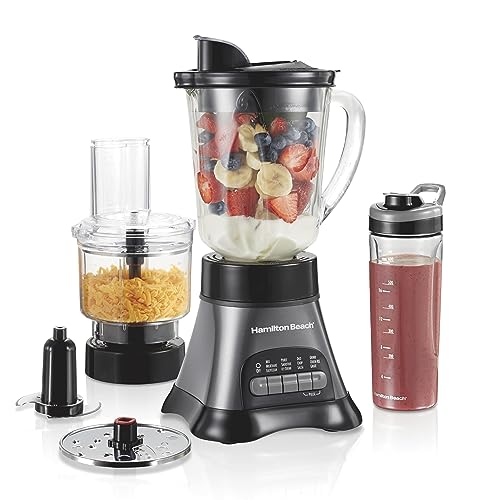
Starting a plant-based kitchen should not require a premium appliance budget, and the Hamilton Beach 58163 is the proof: a 40 oz glass blender jar, a 3-cup electric food chopper, and a travel cup on 700 watts of peak power. The glass jar matters for this cuisine in particular — turmeric, beetroot, and tomato are the plant kitchen’s staining aristocracy, and glass simply refuses their memory where budget plastic surrenders within a month. The chopper, honestly sized, handles the small-batch core: a cup of hummus, chopped nuts, breadcrumbs, a quick salsa.
Who it suits: new plant-based cooks, students, and small households building the habit before building the arsenal. There is a sound sequence in starting here: a season of daily smoothies, soups, and small chops teaches a household exactly which jobs it actually repeats, and whether its future lies with a system, a vortex blender, or — as many discover — right here, with the budget combo that turned out to be enough for two people’s real cooking.
The limits are the tier’s limits, unhidden. Hard frozen loads blend slower and less silkily than in the Ninja systems, nut butters are beyond its design, the jar makes family batches a two-round job, and the chopper cannot knead or shred at scale. None of that prevents it from starting — and sustaining — a small plant-based kitchen. As the budget pick for this cuisine, it spends its money on glass and completeness, which are the right things.
Strengths
- Glass jar resists the turmeric and beetroot staining this cuisine specialises in
- Complete starter pattern: jar, 3-cup chopper, and travel cup
- Budget tier from an identifiable brand with a long record
Trade-offs
- 700W peak power is the floor for frozen work — slower and coarser
- No nut-butter capability and no dough or shredding at scale
- 40 oz jar means family batches take two rounds
| Spec | Detail (verified) |
|---|---|
| Power | 700 watts peak power |
| Jar | 40 oz glass jar |
| Processor | 3-cup electric food chopper attachment |
| Extra | Blender travel cup |
| Finish | Gray and black (58163) |
Best for: new plant-based cooks and small households on a budget / Not suited for: nut-butter makers, large families, or volume preppers
Check on Amazon — check the current price on Amazon for the exact model named here.
Comparison Table
For a plant-based kitchen, compare on the cuisine’s jobs: puree texture, processor volume, and dough. This table compresses each pick’s verified configuration and the specific vegan workload it serves best, so you can match a machine to your written week of cooking rather than to a marketing category.
| Pick | Badge | Key spec | Best for |
|---|---|---|---|
| Ninja Kitchen System Pro BL770, 1500W, 72 oz + 8-Cup Processor | Best Overall for Vegans | 1500W, 72 oz pitcher, 8-cup processor bowl, (2) 16 oz cups | plant-based households wanting one station for the whole cuisine |
| Vitamix 5200 Professional-Grade Blender, 64 oz, Black | Best for Nut Butters and Hot Soups | 64 oz container, variable speed, self-cleaning, stainless blades | vegan cooks whose signature jobs are nut butters, creams, and hot soups |
| Cuisinart 14-Cup Food Processor DFP-14BCNY, 720W | Best Standalone Processor for Big-Batch Prep | 14-cup capacity, 720W motor, stainless steel | serious vegan meal-preppers and large households with a blender already |
| Ninja UltraCrush Pro Kitchen System BP401, 1500W | Best for Doughs and Frozen Desserts | 1500W, 72 oz pitcher, 8-cup processor, 18 oz to-go cup | plant-based families centred on frozen desserts, doughs, and entertaining |
| Cuisinart Velocity Ultra Blender Food Processor BFP-650P1 | Best Compact Combo for Vegans | 1 HP, blender + processor combo, (2) 16 oz travel cups | plant-based couples and small households blending daily |
| Hamilton Beach Blender and Food Processor Combo 58163 | Best Budget for Vegans | 700W peak, 40 oz glass jar, 3-cup chopper, travel cup | new plant-based cooks and small households on a budget |
How to Choose the Best Blenders and Food Processors for Vegans
Map your week before you map the market. Write down the plant-based jobs you actually repeat: if the list is smoothies, soups, and sauces, a blender-led purchase — the Vitamix, or a system — leads. If it is hummus, chopped salads, slaws, and dough, processor capacity is your headline and the 14-cup Cuisinart or an 8-cup system bowl decides. Most vegan kitchens discover both lists are long, which is why the system picks headline this guide: the cuisine is one of the few where the two-in-one argument is not about saving space but about covering a genuinely dual workload.
Texture standards deserve honesty, because they split the field. Good-enough hummus and smoothies are available at every tier here. Definitive textures — cashew cream with zero grit, nut butter from whole nuts without added oil wrestling, green smoothies with no fibre flecks — are vortex-blender work, and households that make those foods weekly should weight the Vitamix pick accordingly, pairing it with a processor rather than asking one system to be definitive at everything. Households that make them monthly can let a system’s very-good versions suffice and enjoy the single footprint.
- List your repeated jobs first: purees and greens point blender-ward, chopping and dough point processor-ward.
- Weight the Vitamix if nut butters and cashew creams are weekly, not monthly, foods.
- Size the processor to prep day: 14 cups for volume households, 8-cup system bowls for family scale, 3-cup choppers for couples.
- Prefer glass jars if turmeric, beetroot, and tomato feature heavily — they refuse the stains.
- Count travel cups for the daily smoothie ritual; two people need two cups.
Finally, think in pairs and stations, not in single heroes. The strongest vegan kitchens in this guide are configurations: a system alone, a Vitamix plus the big processor, or a compact combo that a couple actually uses daily. The weakest is a famous machine bought for one signature job while the cuisine’s other centre goes unserved. Buy the configuration that covers your whole week.
The Vegan Workload, Job by Job: What Each Appliance Must Prove
Hummus and bean dips are processor work with a blender’s ambition: the bowl gives the volume and the pulse control, and patience plus a little ice water gives the smoothness — a fact worth knowing before blaming any machine. Cashew cream is the opposite: pure blender work, where the vortex and sustained high speed decide whether the result is silk or sauce with ambitions. Green smoothies are the fibrous test — kale stems and ginger expose weak motors and shallow vortices within a week — while frozen desserts are the torque test, asking a pitcher to move a nearly solid load without stalling or jamming.
Chopping is where plant-based volume hides. A cuisine built on vegetables processes vegetables constantly — onions, cabbage, carrots, cauliflower for rice — and the difference between a 3-cup chopper and a 14-cup processor is the difference between a garnish and a prep day. Dough closes the map: pizzas, flatbreads, and wraps are the cuisine’s delivery vehicles, and a processor bowl that kneads credibly turns a blender budget into a bakery. Grade every candidate against the jobs you repeat, in the proportions you repeat them, and the right configuration usually names itself.
How to Use Your Blender and Processor for Plant-Based Cooking
Soaking is the plant kitchen’s first technique, and the machines reward it. Cashews soaked before blending need half the time and produce a smoother cream on any machine; chickpeas cooked until genuinely soft give hummus its texture before the processor is even switched on. In the blender, load liquids first, then soaked nuts or cooked beans, then frozen elements last, and give thick purees the tamper or stop-and-stir patience they demand rather than adding water until the flavour dilutes. In the processor, pulse chopped vegetables in short bursts and check — the line between chopped and pureed is three pulses wide.
Batch logic completes the method. Blend double soup and freeze half; process a week of onions, carrots, and cabbage in one session and refrigerate them as the week’s head start; keep a frozen banana and berry reserve so the pitcher can always answer dessert. Wash the jar immediately after nut and turmeric work — the self-cleaning cycle on the blender picks, a prompt rinse for bowls — because this cuisine’s residues are the most staining in home cooking, and a clean machine is the one that gets used tomorrow. The appliances in this guide can all sustain that rhythm; the rhythm is what turns them into a cuisine.
Two technique notes belong to this cuisine alone. For hummus, reserve a little of the chickpeas’ cooking liquid and add it gradually in the processor — the emulsion, not the motor, is what makes it light — and let the machine run longer than instinct suggests once the texture turns, because bean purees smooth out in the final thirty seconds. For nut butters in the vortex blender, commit to the full cycle: the load will climb, ball up, and look hopeless before it releases its oils and turns glossy, and stopping early to add oil is how gritty butter happens. Both lessons are the same lesson — in plant-based blending, patience is an ingredient — and both are free.
Setting Up a Plant-Based Prep Station That Stays Organised
Vegan kitchens accumulate vessels — bowls, blades, cups, jars of soaked nuts — and organisation decides whether the system feels like a station or a spill. Give the processor bowl and its blades one home, the blender and its cups another, and keep a dedicated soaking shelf or fridge zone so cashews and beans are always mid-preparation rather than mid-intention. Label frozen smoothie packs and soup portions with contents and date; a cuisine built on batches lives or dies by its labels, because frozen green purees are loyal to no recipe once frozen.
Keep the small tools with the big ones: the tamper with the blender, the spatula that fits the processor bowl in the same drawer, a bench scraper where the chopping happens. None of this is decoration. The households that sustain plant-based cooking for years are not the ones with the strongest opinions; they are the ones whose stations make Tuesday’s hummus easier than Tuesday’s takeaway — and that ease is built from configuration, storage, and habit far more than from any single specification in this guide.
A Week of Plant-Based Cooking on These Machines
Concrete weeks test configurations better than specifications do. Monday on the BL770: a green smoothie round in the pitcher at breakfast, hummus and chopped salad from the processor at lunch, a soup blended at dinner. Tuesday on the Vitamix-plus-processor pair: cashew cream in the morning, a mountain of slaw and diced onions from the 14-cup bowl at prep hour, tomato soup friction-heated at night. Wednesday on the compact combo: two travel-cup smoothies, a small salsa, a sauce. The machines differ; the cuisine’s rhythm — blend, chop, puree, knead — is constant, and every configuration in this guide was chosen because it can hold that rhythm at its household’s scale.
The weekend is where the configurations separate. Prep-day households will feel the difference between an 8-cup bowl and a 14-cup bowl in actual minutes saved, and between a system’s very good cashew cream and the Vitamix’s definitive one in actual texture on the tongue. Entertaining households will feel the BP401’s frozen pitcher and the BL770’s two cups. None of these differences is visible in a specification table, which is why this guide insists on the weekly audit before the purchase: your week, written down, is the only review that cannot be wrong about your kitchen.
Common Buying Mistakes
Mistake 1: Buying a blender-only setup for a cuisine that chops daily. Plant-based cooking is dual-workload cooking. A famous blender without processor provision leaves hummus, salads, slaws, and dough to hand work, and the hand work is where weeknight resolve goes to die. Cover both centres, by system or by pair.
Mistake 2: Expecting budget power to make nut butters. Whole-nut butters are the hardest job in home blending and belong to the vortex class. A budget combo will make excellent smoothies and small hummus batches; asking it to mill almonds is how motors are mourned. Match the job to the class.
Mistake 3: Running the processor continuously for chopped vegetables. Continuous running is a puree instruction. Pulse, check, pulse — especially for onions, cauliflower rice, and salad chops, where three extra pulses erase the texture the dish exists for.
Mistake 4: Skipping the soak to save time. Unsoaked cashews and undercooked chickpeas make gritty creams and hummus on any machine, including the best one in this guide. The soak is not a preference; it is half the recipe, and it costs nothing but a little foresight.
Mistake 5: Letting turmeric and beetroot sit in the jar. This cuisine’s pigments are permanent on neglected plastic. Rinse and self-clean immediately after colourful blends, or choose glass from the start — the budget pick here uses it for exactly this reason.
Mistake 6: Under-sizing the processor for prep day. A 3-cup chopper serving a five-person prep day turns one session into six tiring relays. Volume households should buy volume — the 14-cup standalone or an 8-cup system bowl — the first time around.
Final Recommendation
If you want one recommendation: take the Ninja BL770. One station that blends the smoothies and soups, processes the hummus and salads, kneads the dough, and cups the daily green smoothie is the closest thing this cuisine has to a complete answer, and most plant-based households that buy it stop shopping. Texture perfectionists should build the pair instead: the Vitamix 5200 for butters, creams, and soups, with the Cuisinart 14-cup processor carrying prep day beside it.
The BP401 serves frozen-dessert and dough-centred families, the Cuisinart Velocity Ultra serves couples at household scale, and the Hamilton Beach combo starts the whole pattern on a budget in a stain-resistant glass jar. Plant-based cooking asks more of these two appliances than any other cuisine — which is why it also rewards the right configuration more. Choose for your actual week, and the machines will carry it.
Related guides in this series: Best Blenders And Food Processors; Best Blenders And Food Processors Combo; Best Blenders; Best 8 Cup Food Processors.
Frequently Asked Questions
What is the single best appliance setup for a vegan kitchen?
For most households, one genuine system — the Ninja BL770 in this guide — because the cuisine needs blending and processing in equal measure and the system covers both at family scale. Households that make nut butters and cashew creams weekly should instead pair the Vitamix 5200 with a full-size processor such as the Cuisinart 14-cup, accepting two appliances for definitive texture plus prep volume.
Can these blenders make nut butter and cashew cream properly?
The Vitamix 5200 is the pick built for those jobs: its vortex and sustained high speed turn whole nuts into butter and soaked cashews into grit-free cream. The Ninja systems make very good versions of both and excel across the wider workload. Budget combos should not be asked to mill nuts — that job defines the high-performance class, and forcing it is how modest motors fail.
How big a food processor does a vegan household need?
It follows prep volume. Couples processing the daily small core are served by a 3-cup attachment. Families need an 8-cup system bowl for salsa, salads, and dough. Volume meal-preppers — the households cooking the week on Sunday — should go straight to the 14-cup standalone. In this cuisine, undersizing the processor is the most common and most tiring mistake.
Are glass jars better for plant-based cooking?
They have one real advantage here: glass refuses the turmeric, beetroot, and tomato stains that this cuisine produces constantly and that age plastic jars quickly. Large system pitchers remain plastic-family materials for weight reasons, and prompt self-cleaning keeps them presentable. If your cooking is colourful and your batches are moderate, the glass-jar picks — including the budget Hamilton Beach — deserve the preference. Glass also shrugs off the garlic and spice odours that linger in plastic after a week of savoury blending, which matters when the same jar makes a fruit smoothie the next morning.
Can a food processor replace a blender for smoothies?
No — the tools diverge exactly there. Processors chop, slice, shred, and knead, but their bowls cannot form the vortex that makes a smoothie smooth, especially with fibrous greens and frozen fruit. The reverse is also true: blenders puree rather than chop. A plant-based kitchen needs both actions, delivered by a system, a combo, or a deliberate pair.
What should a new vegan cook buy first?
Start where your week actually is. If budget leads, the Hamilton Beach combo covers smoothies, soups at household scale, and small chops in a glass jar, and teaches you your real patterns over a season of actual cooking. If you already know you blend and process daily, go straight to the BL770 system and skip the intermediate purchase entirely. If nut butters and creams are your known centre, the Vitamix plus a modest processor is the honest first configuration, and it will not need replacing when your cooking grows more ambitious.


