Disclosure: airfryerkitchensupply.com is reader-supported. When you buy through links on our site, we may earn an affiliate commission at no extra cost to you.
Where to buy
Every pick in this guide is sold through Amazon, and two-in-one systems are sold in several configurations under one name, so use the links below to confirm the exact model and the included pitcher and bowl sizes in the listing title before you order. With systems, the box contents are the product itself — verify them carefully, not just the badge on the base. The verified picks in this guide are: Ninja Kitchen System Pro BL770, 1500W, 72 oz + 8-Cup Processor; Ninja UltraCrush Pro Kitchen System BP401, 1500W; Cuisinart Smart Power Duet BFP-703BCP1, 48 oz Glass Jar + 3-Cup Processor; Hamilton Beach Blender and Food Processor Combo 58163, 40 oz Glass Jar; Ninja Compact Kitchen System AMZ493BRN, 1200W; Braun MultiQuick 7 3-in-1 Immersion Blender & Food Processor. When you are ready, check the current price on Amazon from any of these links rather than trusting a price quoted elsewhere, because listings in this category are repriced constantly.
The best blenders and food processors answer a storage problem as much as a cooking one. Most kitchens need both tools — the pitcher for smoothies, soups, and frozen drinks, the processor for chopping, salsa, slicing, and dough — and most kitchens resent giving both of them counter space, cupboard space, and budget. The products in this guide are the credible solutions: systems and combos that blend and process from one base, plus one immersion system that dissolves the problem entirely by living in a drawer.
Not all two-in-one products are equal, and the dishonest end of this category is well populated: blenders with a token chopper cup that processes a handful of nuts and calls itself a system. Every pick below was verified, with its pitcher and processor configuration confirmed in the listed title, and each one was chosen because both of its functions are genuinely usable — the processor bowls here chop family salsa and mix dough, the chopper attachments handle real weeknight prep, and the pitchers are full working sizes rather than display jars on a base.
Read the lineup as a scale map. At one end sit the full Ninja systems for households that prep at volume; in the middle, a compact Auto-iQ system and two glass-jar combos for smaller households; at the other end, an immersion system for soup-first kitchens with no counter to spare. Your kitchen’s size and your prep volume, honestly assessed, will point at one of them — and that honest assessment matters more than any single specification in the reviews.
A word about what this guide refuses to do: it will not call a chopper a processor, will not call a drinks pitcher a soup machine, and will not average two unequal functions into a single score. Two-in-one products invite exactly those blur, because a blended verdict hides a weak half behind a strong one. Each review below therefore grades its pick twice in prose — once as a blender, once as a processor — and the badges name the household, not a mythical overall champion of both crafts.
In this guide
Quick Picks
Short on time? These six verified picks cover the full map from a 1500W family system to a drawer-sized immersion set. The detailed reviews below separate genuine two-in-one machines from token-attachment products, and match each system carefully to the kitchen it actually fits.
- Ninja Kitchen System Pro BL770, 1500W, 72 oz + 8-Cup Processor — Best Overall: The defining two-in-one: a 1500W base with a 72 oz blender pitcher, an 8-cup processor bowl for salsa and dough, and two 16 oz cups for single servings. — Check on Amazon
- Ninja UltraCrush Pro Kitchen System BP401, 1500W — Best for Dough and To-Go Cups: The newer system alternative: 1500W of Total Crushing power with a 72 oz blender pitcher, an 8-cup processor, and an 18 oz to-go cup in a silver finish. — Check on Amazon
- Cuisinart Smart Power Duet BFP-703BCP1, 48 oz Glass Jar + 3-Cup Processor — Best Glass-Jar Combo: The traditionalist’s combo: a 500-watt base with a 48 oz glass blender jar and a 3-cup food processor, seven speeds with ice crush, and stainless blades. — Check on Amazon
- Hamilton Beach Blender and Food Processor Combo 58163, 40 oz Glass Jar — Best Budget Combo: The budget two-in-one: 700 watts peak, a 40 oz glass blender jar, a 3-cup electric food chopper attachment, and a travel cup for shakes and smoothies. — Check on Amazon
- Ninja Compact Kitchen System AMZ493BRN, 1200W — Best Compact System: The space-conscious system: 1200W with Auto-iQ, a 72 oz pitcher, a 40 oz processor bowl, and an 18 oz cup — three functions for smoothies, dough, and frozen drinks. — Check on Amazon
- Braun MultiQuick 7 3-in-1 Immersion Blender & Food Processor — Best Immersion System: The hand-held alternative: a 3-in-1 immersion blender and food processor set with adjustable speed, a beaker, a whisk, and a 2-cup chopper for kitchens that blend in the pot. — Check on Amazon
How These Picks Were Chosen
Picks were chosen by verifying each model: search by brand and model, match the listed title, and take the ASIN from the listing response. Only listing-confirmed models carry Amazon links. For this category, verification focused on configuration — pitcher size, processor or chopper size, included cups — because a system is its box contents, and the same model name can hide different bundles in different listings.
Selection required both functions to pass a usefulness test. A processor element had to handle a family salsa or a dough, or — for the deliberately small combos — the full small-prep core of onions, nuts, crumbs, and sauces without strain. A blender element had to be a working pitcher or, in the Braun’s case, a credible in-pot alternative with its own attachments. Products whose second function existed only for the packaging photo were excluded, as were standalone blenders and standalone processors, which have their own guides on this site.
The 6 Best Blenders and Food Processors: Full Reviews

Ninja Kitchen System Pro BL770, 1500W, 72 oz + 8-Cup Processor — Best Overall
The Ninja BL770 is the reference product for the best blenders and food processors category because it is the machine that proved one base could honestly do both jobs. Its verified configuration covers the whole prep map: a 72 oz pitcher for smoothies and frozen drinks, an 8-cup food processor bowl that chops, makes salsa, and mixes dough, and two 16 oz cups for single-serve blending, all driven by a 1500W base. Most two-in-one products are a good appliance with a token attachment; the BL770 is two credible appliances sharing a motor, which is a much rarer thing.
Who it suits: households equipping a kitchen in one purchase, meal-preppers who move between smoothies and salsa and pizza dough in a single session, and anyone whose storage says one system instead of three machines. The blender side delivers full Total Crushing drink performance for family batches, while the processor bowl handles the weeknight chopping that otherwise sends cooks to a knife and board. The cups close the loop for weekday singles, so the system covers the three most common prep patterns in a modern kitchen without a gap.
The compromises are the honest system ones. A dedicated premium blender will out-blend it on the silkiest green and nut-butter extremes, and a large standalone processor will out-process it on catering volume. Attachments need a home — a drawer or shelf zone — or the system’s convenience leaks away into clutter. But for the household this category exists for, the BL770 remains the benchmark because its weakest function is still genuinely useful, and that is the test most two-in-one products fail.
Strengths
- 1500W base drives a full-size pitcher, a real 8-cup processor, and single-serve cups
- Processor bowl credibly handles salsa, chopping, and dough — not a token attachment
- Covers family batches and weekday singles with no gap in the pattern
Trade-offs
- Dedicated premium blenders beat it on the silkiest extreme blends
- Multiple attachments need organised storage
- Processor bowl is mid-size for very large prep volumes
| Spec | Detail (verified) |
|---|---|
| Power | 1500W |
| Pitcher | 72 oz |
| Processor | 8-cup processor bowl |
| Cups | (2) 16 oz cups |
| Jobs | Smoothies, salsa, dough |
Best for: households that need blending and processing from one base / Not suited for: single-job purists chasing the absolute best blender or processor alone
Check on Amazon — check the current price on Amazon for the exact model named here.

Ninja UltraCrush Pro Kitchen System BP401, 1500W — Best for Dough and To-Go Cups
The Ninja BP401 UltraCrush Pro is the current-generation expression of the same system idea, and in a best blenders and food processors lineup it earns the second slot on configuration rather than novelty: 1500W, a 72 oz blender pitcher, an 8-cup processor for chopping, and an 18 oz to-go cup, in silver. Where the BL770 spreads its single-serve provision across two 16 oz cups, the BP401 answers with one larger to-go cup — a small difference that matters to commuters who blend one big morning smoothie and leave.
Who it suits: households choosing between the two Ninja systems on details rather than concept — buyers who prefer the newer model line, the silver finish, and the single larger cup — and dough-and-smoothie households in particular, since the listing names ice crush and chopping alongside smoothies as its home ground. The processor bowl covers the same salsa-and-dough brief as its sibling, and Total Crushing technology keeps frozen drinks in the family-pitcher class.
Choosing between the BP401 and the BL770 is a legitimate coin-flip decided by cup configuration, finish, and which listing presents better on the day — this guide lists both rather than pretending a gulf exists. Against the wider field, the same system caveats apply: extremes of silky blending belong to dedicated premium blenders, and attachment storage must be planned. As a two-in-one purchase, though, the BP401 is the BL770’s equal in concept and its superior in freshness of design, and households that start here will not feel they bought the old model.
Strengths
- Current-generation 1500W system with pitcher, processor, and to-go cup
- 18 oz to-go cup suits one big commuter smoothie better than smaller cups
- Silver finish and newer design language for style-conscious kitchens
Trade-offs
- Very close in concept to the BL770 — choose on cups and finish, not capability
- Same system ceiling on extreme silky blends as any two-in-one
- Attachment set still needs a storage plan
| Spec | Detail (verified) |
|---|---|
| Power | 1500W |
| Pitcher | 72 oz |
| Processor | 8-cup processor |
| Cup | 18 oz to-go cup |
| Technology | Total Crushing Tech |
Best for: households that want the newest Ninja system and a larger to-go cup / Not suited for: buyers who need two single-serve cups included rather than one
Check on Amazon — check the current price on Amazon for the exact model named here.

Cuisinart Smart Power Duet BFP-703BCP1, 48 oz Glass Jar + 3-Cup Processor — Best Glass-Jar Combo
The Cuisinart Smart Power Duet represents the older, quieter school of best blenders and food processors design: one 500-watt base, a proper 48 oz glass blender jar, and a 3-cup food processor attachment, with seven speeds and an ice-crush function. Where the Ninja systems compete on power and scale, the Duet competes on material and manners — glass in the hand, a brushed chrome finish on the counter, and a processor sized for the small, constant jobs (a cup of salsa, a batch of pesto, onions for tonight) rather than for dough production.
Who it suits: smaller households, glass-jar loyalists, and cooks whose processing is frequent but small — sauces, dressings, chopped nuts, breadcrumbs, baby-food-scale purees in the processor, smoothies and soups in the glass jar. The 3-cup processor is honestly sized for that work; it comes out for ten minutes of prep and washes in the sink, instead of dominating a dishwasher cycle the way a full-size bowl does. For couples and small kitchens, that proportionality is a feature the big systems cannot copy.
The limits are scale and force. Five hundred watts and a 48 oz jar will not run family frozen-drink production, and the 3-cup processor will not knead dough or shred a cabbage. Buyers must also accept the classic Duet ergonomics — attachments swap on one base in sequence, so blending and processing the same meal means washing between acts. Judged as what it is, a glass-jar combo for small households from a heritage kitchen brand, it fills a niche neither Ninja system addresses, which is exactly why it belongs in this guide.
Strengths
- 48 oz glass jar resists stains and odours, with a 3-cup processor for small daily jobs
- Heritage brand, brushed chrome finish, and seven speeds with ice crush
- Proportional size suits couples and small kitchens better than full systems
Trade-offs
- 500W and 48 oz cap it below family frozen-drink production
- 3-cup processor cannot knead dough or handle large volumes
- One base means sequential use — wash between blending and processing
| Spec | Detail (verified) |
|---|---|
| Power | 500-watt motor |
| Jar | 48 oz glass jar |
| Processor | 3-cup processor |
| Controls | 7-speed, ice crush |
| Blades | Stainless steel blades |
Best for: couples and small households that process small batches often / Not suited for: families needing big pitchers, dough capacity, or maximum power
Check on Amazon — check the current price on Amazon for the exact model named here.
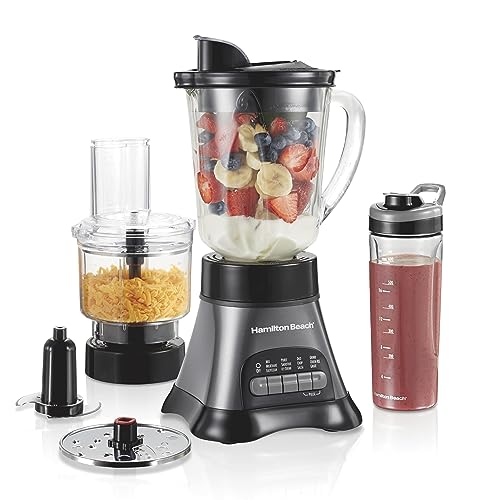
Hamilton Beach Blender and Food Processor Combo 58163, 40 oz Glass Jar — Best Budget Combo
The Hamilton Beach 58163 is the budget answer in the best blenders and food processors field, and it is more thoughtfully specified than its tier suggests: 700 watts of peak power, a 40 oz glass blender jar — glass, at a budget tier, where plastic is the norm — a 3-cup electric food chopper attachment, and a blender travel cup for the morning shake. That is the complete two-in-one pattern in miniature: blend in the jar, chop in the attachment, take the single serving in the cup.
Who it suits: first-apartment kitchens, budget-conscious couples, and buyers testing whether the two-in-one pattern fits their cooking before committing to a full system. The chopper attachment covers the small processing core — onions, nuts, salsa, crumbs — that makes a processor worth owning, and the glass jar keeps smoothies and shakes free of the staining that ages cheap plastic. Hamilton Beach’s long presence in this exact tier also means the model is a known quantity rather than a marketplace experiment.
Expectations must be set by the tier. Peak-power figures flatter; sustained blending of hard frozen loads will be slower and coarser than the Ninja systems, and the 40 oz jar makes family batches a two-round job. The chopper is a chopper, not a dough-capable processor. But as an entry to the category it is honestly built — glass where rivals use plastic, both functions present and usable — and for a small household it may simply be enough, full stop. Not every kitchen needs the benchmark; some need a competent combo at a budget tier, and this is the one to buy.
Strengths
- Glass blender jar at a budget tier where plastic is the norm
- Complete mini-pattern: jar blending, 3-cup chopping, and a travel cup
- Identifiable brand with a long record in this exact category
Trade-offs
- 700W peak power blends hard frozen loads more slowly than the Ninja systems
- 40 oz jar means family batches take two rounds
- Chopper attachment cannot knead dough or slice and shred like full processors
| Spec | Detail (verified) |
|---|---|
| Power | 700 watts peak power |
| Jar | 40 oz glass jar |
| Processor | 3-cup electric food chopper attachment |
| Extra | Blender travel cup |
| Finish | Gray and black (58163) |
Best for: small households and first kitchens entering the two-in-one category on a budget / Not suited for: families or dough makers who need full system capacity
Check on Amazon — check the current price on Amazon for the exact model named here.

Ninja Compact Kitchen System AMZ493BRN, 1200W — Best Compact System
The Ninja Compact Kitchen System trims the system idea for kitchens that cannot give a full-size platform their whole counter. Its verified layout keeps the essential trio — a full 72 oz pitcher, a 40 oz processor bowl, and an 18 oz cup — on a 1200W base with Auto-iQ programs for smoothies, dough, and frozen drinks. The processor bowl is the deliberate compromise: at 40 ounces it handles family salsa, chopped vegetables, and a pizza dough, while asking less storage and washing commitment than the 8-cup bowls on the bigger Ninjas.
Who it suits: apartment and small-household cooks who want genuine system coverage without system bulk, and Auto-iQ households that prefer programmed cycles to manual speeds. The Auto-iQ element is not decoration here — timed programs for the three named functions mean the smoothie, the frozen drink, and the dough each get a considered cycle rather than a guess, which is worth real money in a household where several people share the machine and none of them wants to learn it.
The compromises are written into the name. Compact means the processor bowl fills sooner on big prep days, and 1200 watts, while ample, sits a class below the 1500W systems on the hardest frozen loads in the full pitcher. Buyers who meal-prep at volume should step up to the BL770 or BP401. But for the large population of kitchens where the choice is between a compact system and no system at all, this model is the one that makes the category fit — literally.
Strengths
- Full system pattern — pitcher, processor bowl, cup — in a compact footprint
- Auto-iQ programs run smoothies, dough, and frozen drinks repeatably
- 72 oz pitcher keeps family drink batches at full size despite the compact brief
Trade-offs
- 40 oz processor bowl fills quickly on volume meal-prep days
- 1200W sits a class below the 1500W systems on the hardest frozen loads
- Still a multi-attachment system that needs a storage corner
| Spec | Detail (verified) |
|---|---|
| Power | 1200W |
| Pitcher | 72 oz |
| Processor | 40 oz processor bowl |
| Cup | 18 oz cup |
| Programs | Auto-iQ, 3 functions for smoothies, dough, frozen drinks |
Best for: apartments and small households wanting system coverage without the bulk / Not suited for: volume meal-preppers who need an 8-cup processor bowl
Check on Amazon — check the current price on Amazon for the exact model named here.

Braun MultiQuick 7 3-in-1 Immersion Blender & Food Processor — Best Immersion System
The Braun MultiQuick 7 challenges the premise of this whole category — that blending and processing must happen in a jug on a base. Its 3-in-1 format puts an adjustable-speed immersion blender at the centre, with a beaker for smoothies and sauces, a whisk for eggs and cream, and a 2-cup chopper that covers the small food-processing core. For soup-first kitchens it is arguably the most rational design here: the blender goes into the pot the soup is already in, which deletes the most dangerous and annoying step in soup making — transferring boiling liquid to a jar and back.
Who it suits: soup and sauce cooks, small kitchens with no counter to surrender, and households whose processing is small and frequent rather than large and occasional. Adjustable speed control on an immersion tool is a genuine craft feature — you feather the power for a vinaigrette, surge it for a puree — and Braun’s ergonomic handle and detachable attachments make the set wash and store like cutlery rather than like appliances. The whole system lives in a drawer, which no other pick in this guide can claim.
Its boundaries are the mirror of its virtues. There is no pitcher, so frozen drinks for a family and big smoothie batches belong to the countertop systems; the 2-cup chopper is a small-batch tool that will not knead dough or shred for a crowd; and immersion blending asks the cook to be present and steering for every second. Buy it as the soup-and-small-prep system it is, and it may be the most-used tool in the kitchen. Buy it expecting a BL770 in a drawer, and the mismatch is the buyer’s, not Braun’s.
One more constituency should hear its name called: cooks with limited grip strength or wrist trouble, and anyone who finds lifting a full 72 oz pitcher genuinely difficult. An immersion tool moves the work to the food instead of moving the food to the work — the pot stays on the stove, the beaker stays on the counter, and nothing heavy is carried, tilted, or poured at height. That ergonomic argument never appears on packaging, but in the kitchens it applies to, it outweighs every specification in this guide.
Strengths
- Blends soup directly in the pot — no hot transfers to a jar
- Whisk and 2-cup chopper cover the small-prep core in a drawer-sized system
- Adjustable speed gives immersion blending genuine craft control
Trade-offs
- No pitcher, so family frozen drinks and big batches are out of scope
- 2-cup chopper is small-batch only, with no dough capability
- Immersion work requires the cook present and steering throughout
| Spec | Detail (verified) |
|---|---|
| Format | 3-in-1 immersion blender and food processor |
| Controls | Adjustable speed control |
| Attachments | Beaker, whisk, 2-cup chopper |
| Handle | Ergonomic handle, detachable attachments |
Best for: soup-first kitchens and small spaces that blend in the pot / Not suited for: households needing pitcher batches and full processor capacity
Check on Amazon — check the current price on Amazon for the exact model named here.
Comparison Table
Systems are bought on configuration, so this table leads with what is in each box: base power, pitcher, and processor provision. Match the row to your prep volume first and your storage reality second; brand preference comes a distant third, because a system that does not fit your kitchen will not be saved by its badge.
| Pick | Badge | Key spec | Best for |
|---|---|---|---|
| Ninja Kitchen System Pro BL770, 1500W, 72 oz + 8-Cup Processor | Best Overall | 1500W, 72 oz pitcher, 8-cup processor bowl, (2) 16 oz cups | households that need blending and processing from one base |
| Ninja UltraCrush Pro Kitchen System BP401, 1500W | Best for Dough and To-Go Cups | 1500W, 72 oz pitcher, 8-cup processor, 18 oz to-go cup | households that want the newest Ninja system and a larger to-go cup |
| Cuisinart Smart Power Duet BFP-703BCP1, 48 oz Glass Jar + 3-Cup Processor | Best Glass-Jar Combo | 500W, 48 oz glass jar, 3-cup processor, 7 speeds | couples and small households that process small batches often |
| Hamilton Beach Blender and Food Processor Combo 58163, 40 oz Glass Jar | Best Budget Combo | 700W peak, 40 oz glass jar, 3-cup chopper, travel cup | small households and first kitchens entering the two-in-one category on a budget |
| Ninja Compact Kitchen System AMZ493BRN, 1200W | Best Compact System | 1200W, Auto-iQ, 72 oz pitcher, 40 oz processor bowl, 18 oz cup | apartments and small households wanting system coverage without the bulk |
| Braun MultiQuick 7 3-in-1 Immersion Blender & Food Processor | Best Immersion System | 3-in-1 immersion + processor, adjustable speed, beaker, whisk, 2-cup chopper | soup-first kitchens and small spaces that blend in the pot |
How to Choose the Best Blenders and Food Processors
Start with your processing volume, because it splits this category in two. Households that make dough, shred for salads and slaws, and prep salsa for a family need a true processor bowl — the 8-cup Ninja systems, or the 40 oz bowl on the compact Ninja if space argues back. Households whose processing is a daily onion, a pesto, a handful of nuts, and a dressing are honestly served by the 3-cup attachments on the Cuisinart and Hamilton Beach combos, which wash faster and store smaller. Overbuying processor capacity is as wasteful as underbuying it; the bowl you wash nightly should be the size of your nightly prep.
Next, judge the blender side by your drink and soup pattern. Family frozen drinks need pitcher size and crushing power — the Ninja systems again. Couples blending smoothies and soups are well served by the glass-jar combos. Soup-first cooks should seriously consider the immersion route, because blending in the pot removes the hot-transfer step entirely. And single-serve patterns argue for included cups, which three of the six picks provide, because blending a weekday smoothie in a 72 oz pitcher is how good systems end up unused on weekdays.
- Size the processor to your nightly prep: 8-cup bowls for dough and volume, 3-cup attachments for small daily jobs.
- Size the pitcher to your drink pattern: family batches need 72 oz, couples are served by 40-48 oz glass.
- Value included single-serve cups if weekday smoothies are your main blending.
- Choose immersion if soup is your centre and counter space is your constraint.
- Plan attachment storage before buying any system — a drawer or shelf zone, decided in advance.
Finally, be honest about sequence. One base means one job at a time: the smoothie waits while the salsa processes, or something gets washed mid-recipe. Households that routinely blend and process simultaneously for the same meal — a cook and a helper working in parallel — are the one profile genuinely better served by two separate appliances, and this guide will not talk them out of it. Everyone else gains more from the saved space and shared motor than they lose to sequencing.
Price the system against the pair it replaces, not against a single appliance. A genuine system like the BL770 should be compared with the combined cost, counter space, and cord count of a separate family blender and a separate mid-size processor — on that honest comparison the system case usually wins before features are even discussed. The budget combos invert the same logic at their tier: the Hamilton Beach costs less than most standalone glass-jar blenders while adding a chopper, which is why its modest power deserves the charitable reading the review gives it. Value in this category is always relative to the two-machine alternative.
Blender vs Food Processor: What Each Tool Actually Does Best
The two tools overlap in the middle and diverge at the edges, and knowing the edges prevents both disappointment and duplicate purchases. Blenders own liquids: they need a vortex, which needs fluid, and in exchange they produce perfectly smooth smoothies, pureed soups, and emulsified dressings that no processor can match. Processors own solids and structure: they chop without pureeing, slice and shred with discs, and knead dough — jobs where a blender’s vortex either fails or destroys the texture you wanted. The overlap zone — salsa, pesto, hummus, nut chopping — can be done by either, with the processor giving chunkier control and the blender giving smoother results.
That map explains the design of every system in this guide. The Ninja systems pair a drinks-strong pitcher with a solids-strong bowl, covering both edges. The glass combos pair a moderate pitcher with a small chopper, covering the middle thoroughly and the edges modestly. The Braun immersion set covers liquids in the pot and small solids in its chopper, trading pitcher scale for storage. None of them repeals the underlying physics; the best ones are simply honest about which edges they cover, and the reviews above grade them on exactly that honesty.
How to Use a Blender and Food Processor System Well
Systems reward batching. When the base is out and a meal needs both tools, sequence the work dry-to-wet and clean-to-dirty: chop the dry ingredients and aromatics in the processor first, set them aside, then blend the wet components, so one rinse between jobs replaces two full washes. Cook the processor bowl’s contents while the pitcher works, and the single-base limitation mostly disappears into the recipe’s own timing. Households that plan the sequence in the recipe, rather than discovering it mid-cook, are the ones who describe their system as effortless.
Technique inside each function carries over from the standalone tools. In the pitcher, load liquids first so the vortex forms, and never fill hot liquids past two-thirds. In the processor bowl, pulse for chopping control — continuous running is how onions become onion puree — and feed slicing and shredding jobs evenly for uniform cuts. In chopper attachments, work in the small batches they are sized for instead of forcing a full-size job into a 3-cup cup. And wash attachments promptly: processor blades and blender gaskets both punish dried-on residue, while a thirty-second rinse after use keeps a six-part system feeling like one appliance.
Storage and Care for Multi-Attachment Systems
The unglamorous truth about systems is that they are won or lost in the cupboard. Decide the storage architecture before the box arrives: bowls nested with their blades in a blade-safe zone, cups and lids together, the base resident on the counter if your blending is daily. Owners who give a system a defined home use all of it; owners who scatter attachments across three cupboards quietly revert to whichever single tool is easiest to reach, and the system’s value evaporates without anything breaking. A shallow tray or basket that holds the small parts together is the cheapest upgrade in this entire category.
Care follows the same logic. Most pitchers, bowls, and cups in this guide are dishwasher-friendly per their listings, but blades and seals last longer with prompt rinsing and occasional hand-washing, and glass jars — two picks here use them — reward the respect due to glass anywhere. Keep one habit above all: dry parts before storing them nested, because trapped moisture in a sealed bowl is how a clean system develops the stale smell that makes owners dread opening it. Five seconds with a tea towel protects a multi-year purchase.
A final ownership note concerns the base itself, the one part every function shares. Keep its vents clear, wipe spills before they migrate into the coupling, and never immerse it — a damp cloth is the whole cleaning regime. Because the base is shared, its care is leveraged: the ten seconds spent on it protects the blender, the processor, and the cups simultaneously. Systems concentrate value in one motor, and that concentration is their efficiency and their vulnerability in the same object. Treat the base like the appliance it is — the other parts are, in the end, its accessories — and a good system will out-serve the two separate mid-tier machines it replaced.
Common Buying Mistakes
Mistake 1: Buying a token-attachment blender and calling it a system. A chopper cup that handles a handful of nuts is not a food processor. Check the processor or chopper capacity in the listing title — every pick here states a real working size — and match it carefully to your actual weekly prep.
Mistake 2: Overbuying processor capacity for small daily prep. An 8-cup bowl washed nightly for one onion is a burden that teaches owners to reach for a knife instead. Small households are often better served by the 3-cup combos, honestly sized for the work.
Mistake 3: Running the processor continuously to chop. Continuous running purees. Chopping is a pulse discipline — short bursts, check, repeat — and it is the single technique that separates processor owners who love the tool from those who declare it useless for chopping.
Mistake 4: Expecting one base to serve two cooks simultaneously. A system sequences jobs; it does not parallelise them. Households that blend and process at the same moment, with two cooks working side by side, should buy separates — the one profile this category does not serve.
Mistake 5: Scattering attachments across the kitchen. A system without a storage plan becomes a single appliance plus expensive clutter. Give bowls, blades, and cups one defined, reachable home before the box even arrives.
Mistake 6: Transferring boiling soup to a pitcher when an immersion option exists. Hot transfers are the riskiest step in soup making. If soup is your centre, the Braun pattern — blending in the pot — removes the hazard entirely; if you do transfer, fill no more than two-thirds and vent the lid.
Final Recommendation
If you want one recommendation: take the Ninja BL770. It is the benchmark two-in-one because both of its jobs are real — a family pitcher and a dough-capable 8-cup processor on one 1500W base — and most households that buy it retire two appliances the same week. Newer-design households should take the BP401 on the same logic, choosing between them on cups and finish.
Smaller kitchens have their own right answers here: the compact Auto-iQ Ninja for system coverage in less space, the Cuisinart Duet for glass-jar manners and small daily processing, the Hamilton Beach combo for a budget entry with a glass jar, and the Braun immersion set for soup-first cooks with a drawer instead of a counter. The category rewards honesty about volume — buy the system your prep actually needs, and it will feel like two appliances; buy the one your aspirations describe, and it will feel like clutter.
Related guides in this series: Best Blenders; Best Blenders And Food Processors Combo; Best 8 Cup Food Processors; Best 10 Cup Blenders.
Frequently Asked Questions
Can one machine really replace both a blender and a food processor?
For most households, yes — provided the system is a genuine one like the picks here, with a full-size pitcher and a processor bowl or chopper sized for real work. The exceptions are extremes: the silkiest nut butters favour a dedicated premium blender, catering-volume processing favours a large standalone processor, and two cooks working simultaneously need two bases. Inside those edges, a good system covers the whole domestic map.
What size food processor bowl do I need in a combo system?
Match it to nightly prep. An 8-cup bowl handles dough, family salsa, and shredding for salads. A 40 oz bowl covers family salsa and a pizza dough in a smaller footprint. A 3-cup attachment suits the daily small core — onions, nuts, crumbs, dressings, pesto. Bigger is not better if the bowl is washed nightly for one onion; size honestly.
Is an immersion blender system a real alternative to a countertop system?
For soup-first and small-prep kitchens, yes. The Braun set blends in the pot, whisks, and chops small batches, and stores in a drawer. It cannot make family frozen drinks or big smoothie batches, and it cannot knead dough. If your pattern is soups, sauces, and small chopping, it is not a compromise — it is the more rational design. If your pattern includes pitcher drinks, you need a countertop system.
Can these systems knead dough?
The Ninja systems with full processor bowls — the BL770, the BP401, and the compact system on its Auto-iQ dough function — are the dough-capable picks here, suited to pizza and bread doughs at home scale. The 3-cup chopper attachments on the Cuisinart and Hamilton Beach combos cannot knead dough, and the Braun chopper cannot either. Dough is a bowl-size and blade-design question, so check the configuration in the listing title.
Glass jar or plastic pitcher in a combo — which is better?
Glass resists stains and odours and suits hot liquids, and the Cuisinart and Hamilton Beach combos offer it at moderate sizes. Large system pitchers are plastic-family materials because a 72 oz glass pitcher would be unmanageably heavy. Choose glass if your batches are moderate and hot work is common; choose the big system pitchers if family frozen drinks are the priority.
How do I keep a multi-part system from becoming clutter?
Give it one storage architecture before it arrives: bowls nested, blades in a safe zone within the bowl or a tray, cups and lids together, small parts in one basket or shallow tray. Systems fail socially, not mechanically — owners stop using attachments they cannot find or cannot be bothered to assemble. A defined home for every part, reachable in seconds, is the difference between a system that replaces two appliances and an expensive box that fills a cupboard.


