Disclosure: airfryerkitchensupply.com is reader-supported. When you buy through links on our site, we may earn an affiliate commission at no extra cost to you.
Where to buy
Every grill below was verified against Amazon’s catalogue before earning a link, so you can check the current price on Amazon from each listing — charcoal kettles, a folding propane traveller, a two-burner tabletop and one cast-aluminium connoisseur’s grill. Before you buy for the beach, check one thing no listing can tell you: your beach’s own rules. Some beaches welcome charcoal, some allow only gas, and some allow no grills at all, and the right fuel is the one your sand permits. If you are choosing between two sizes of the same kettle family, let the walk decide before the menu does: the grill that makes the trip happily is the grill that gets used, and a slightly small grill at the water’s edge beats a large one sulking in the garage every single time.
- Weber Smokey Joe 14-Inch Portable Charcoal Grill (Best Overall Beach Grill) — check price on Amazon
- Weber Jumbo Joe Charcoal Grill, 18-Inch (Best for Beach Groups) — check price on Amazon
- Weber Go-Anywhere Portable Charcoal Grill (Best Packing Design) — check price on Amazon
- Coleman Fold N Go Portable Propane Grill (Best Propane Beach Grill) — check price on Amazon
- Cuisinart Chef’s Style Portable Propane Tabletop Gas Grill CGG-306P (Best Two-Zone Tabletop) — check price on Amazon
- PK Grills PK360 Portable Charcoal Grill and Smoker (Best Premium Beach Grill) — check price on Amazon
The best beach grills are not simply small grills, because the beach is the harshest classroom in outdoor cooking: wind that steals heat and redistributes ash, sand that invades every mechanism, salt air that corrodes, rules that vary from one stretch of coast to the next, and a long carry between the car and the perfect spot. A great beach grill is light enough to carry happily, stable enough to sit safely, enclosed enough to keep its fire and its grease to itself, and simple enough to clean with a brush and a bin bag. This guide reviews six verified grills that meet the beach on its own terms — mostly charcoal kettles, because charcoal is the beach’s native fuel where it is allowed, plus propane options for the beaches where it is not — and covers the rules, the routine and the mistakes that matter on sand. One promise before the reviews: every grill here has been judged by the walk from the car park as severely as by the cooking, because at the beach the two are the same purchase.
In this guide
Quick Picks
Six verified beach-ready grills: three Weber kettles in ascending size, a folding propane option, a two-zone tabletop, and a cast-aluminium classic.
Weber Smokey Joe 14-Inch Portable Charcoal Grill — Best Overall Beach Grill. The definitive small beach kettle: 14 inches, featherweight, with a Tuck-N-Carry lid lock that keeps ash and grate contained between car and sand. — check price on Amazon
Weber Jumbo Joe Charcoal Grill, 18-Inch — Best for Beach Groups. The Smokey Joe’s bigger sibling: an 18-inch kettle with the same locking lid, sized for family beach days and groups of four to six. — check price on Amazon
Weber Go-Anywhere Portable Charcoal Grill — Best Packing Design. The rectangular traveller: folding legs that pivot to lock the lid, a two-piece grate, and a shape that packs into a car boot like it was designed by luggage people. — check price on Amazon
Coleman Fold N Go Portable Propane Grill — Best Propane Beach Grill. For beaches that ban charcoal: a lightweight folding propane grill with a 6,000 BTU burner, Instastart ignition and a dishwasher-safe grate. — check price on Amazon
Cuisinart Chef’s Style Portable Propane Tabletop Gas Grill CGG-306P — Best Two-Zone Tabletop. Twin 10,000 BTU burners across 275 square inches of stainless tabletop — two-zone control that no other portable here offers, for beaches that allow gas. — check price on Amazon
PK Grills PK360 Portable Charcoal Grill and Smoker — Best Premium Beach Grill. A cast-aluminium capsule that grills and smokes with genuine temperature control — the beach grill for people who take charcoal seriously, in graphite. — check price on Amazon
How These Picks Were Chosen
Beach fitness came first, before brand or price: every pick had to be genuinely portable by one person, stable on sand or a picnic table, enclosed enough to manage its fire, ash and grease in public spaces, and verified against Amazon’s catalogue data for this site before earning a link. Garden grills with detachable legs and indoor electrics were excluded, however good they are elsewhere.
Fuel honesty shaped the list. Charcoal is the classic beach fuel and dominates where it is permitted, so three Weber kettles and the PK360 carry that tradition at ascending levels of size and seriousness. But many beaches restrict charcoal or all open flame, so two propane picks — the folding Coleman and the twin-burner Cuisinart — are included for the venues where gas is the welcome fuel. The badges tell you which world each grill belongs to; your beach’s rules tell you which world you are shopping in.
Finally, we weighted corrosion and clean-up, the two beach taxes nobody mentions in the showroom. Porcelain enamel, stainless and cast aluminium dominate the picks because salt air eats painted steel; locking lids and contained designs dominate because a beach grill travels through cars and crowds, and its mess travels with it.
A last word on why this list contains no large grills at all: we considered and rejected several excellent mid-size portables because the beach carry exposed them. A grill that needs two hands, a rest stop and a clear path is a garden grill on holiday, and it will be left behind by its third summer. Every pick here can be carried by one person in one trip alongside other gear — that was a hard filter, applied without exceptions, and it is the main reason this shortlist looks the way it does.
The 6 Best Beach Grills, Reviewed
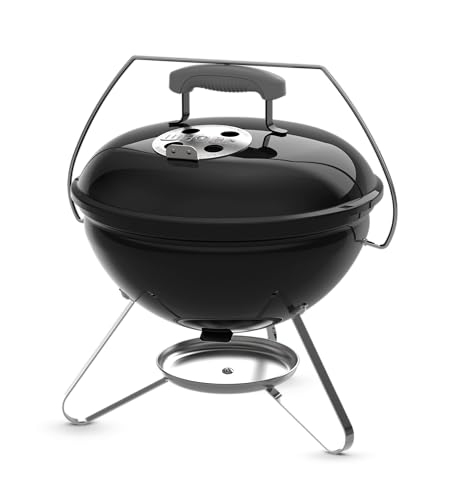
Pick 1: Weber Smokey Joe 14-Inch Portable Charcoal Grill — Best Overall Beach Grill
Check the current price on Amazon
The Smokey Joe is the beach grill in its purest form: a 14-inch porcelain-enameled kettle, light enough to carry in one hand, with a Tuck-N-Carry lid lock that clamps the lid down for transport and doubles as a lid holder at the site. It suits couples and small groups cooking burgers, sausages and skewers within sight of the water. It does not suit big parties or tall food — the kettle is shallow and the grate is 14 inches of honest limitation.
Strengths
- Genuinely one-hand portable — the lightest full grill in this roundup
- Lid lock contains ash and parts in transit, a beach-specific virtue
- Porcelain-enameled steel shrugs off salt air better than painted rivals
Trade-offs
- 14-inch grate means cooking in waves for more than three people
- No ash catcher beyond the pan — plan your ash disposal at the site
- Small charcoal loads burn fast in beach wind; bring reserve charcoal
| Size | 14-inch kettle |
| Fuel | Charcoal |
| Lid | Tuck-N-Carry locking lid |
| Finish | Porcelain-enameled |
| Format | Portable tabletop/ground kettle |
Everything about the Smokey Joe is proportioned for the beach carry: the walk from the car park, over the dunes, with a cool box in the other hand. At the site it sits low and stable, its dampers give enough control for direct grilling and short lid-down cooks, and the enamel finish is the correct answer to salt air — it wipes clean and does not rust at the first scratch the way painted steel does. Burgers for two, a round of skewers, corn wrapped and tucked at the edges: this is the grill’s repertoire, executed without fuss for decades by millions of beach evenings.
The beach disciplines it teaches are the right ones. Use a small chimney or a compact starter so you are not fighting a big fire in wind; cook in waves and hold finished food in a lidded container against the gulls; and let the coals die completely, then bag the cold ash to take home — the Joe’s small fire makes this easy, which is precisely why it belongs at a beach and a giant kettle does not. Simple, contained, honest: the benchmark of the category.
Best for: Couples and small groups wanting the classic beach cookout / Not suited for: Large parties or tall, lid-down roasts

Pick 2: Weber Jumbo Joe Charcoal Grill, 18-Inch — Best for Beach Groups
Check the current price on Amazon
The Jumbo Joe takes everything that makes the Smokey Joe a beach classic and stretches the grate to 18 inches — enough for a family’s burgers in one wave or a butterflied chicken with room to spare. It keeps the Tuck-N-Carry lid lock and the porcelain-enameled build. It suits families and groups of four to six. It does not suit the longest carries; the extra size is real, in the hand as much as on the grate.
Strengths
- 18-inch grate cooks for four to six without wave cooking
- Same locking lid and enamel durability as the Smokey Joe
- Deeper kettle behaviour suits lid-down cooking better than the 14-inch
Trade-offs
- Heavier and bulkier on the carry from car to sand
- Larger fire needs more charcoal and more cooling time before pack-up
- Still a basic kettle — no ash catcher system or thermometer
| Size | 18-inch kettle |
| Fuel | Charcoal |
| Lid | Tuck-N-Carry locking lid |
| Finish | Porcelain-enameled |
| Format | Portable kettle |
The jump from 14 to 18 inches sounds modest and cooks like a different category: the whole dynamic of the beach meal changes when the main course fits at once. The Jumbo Joe also gains useful lid-down ability — a spatchcocked chicken or a tray of peppers behaves properly under its dome — which widens the menu beyond direct-grilled staples. It remains a kettle of admirable simplicity: two dampers, one grate, nothing to break, and an enamel bowl that will outlast a decade of summers if the ash is emptied and the salt wiped off.
Pack it like a system and the size stops being a burden: charcoal in a sealed tub inside the kettle, tools in the cool box, the grill carried by its handle with the lid locked. At the site, give it a level patch of sand, a windbreak of cool boxes at its back, and a little more lighting time than the baby Joe — bigger fires are lazier to start in a breeze. Families who try the Jumbo rarely go back to cooking in waves.
Best for: Families and groups of four to six at the beach / Not suited for: Long carries or solo trips

Pick 3: Weber Go-Anywhere Portable Charcoal Grill — Best Packing Design
Check the current price on Amazon
The Go-Anywhere Charcoal is the engineer’s beach grill: a rectangular porcelain-enameled body whose legs fold up over the lid to lock everything shut, with a two-piece cooking grate inside. It suits tidy packers, small cars and anyone whose beach kit lives in a boot year-round. It does not suit cooks who want a round kettle’s airflow or the largest possible grate.
Strengths
- Legs fold to lock the lid — the most transport-secure design here
- Rectangular shape packs efficiently among cool boxes and chairs
- Two-piece grate suits mixed grilling and easy cleaning
Trade-offs
- Rectangular fire behaves differently from a kettle — a short learning curve
- Cooking area suits two to four, not a crowd
- Lid-down height limits tall foods, as with most portables
| Format | Rectangular portable |
| Fuel | Charcoal |
| Legs | Folding, lid-locking |
| Grate | 2-piece cooking grate |
| Use | Camping, tailgating, beach |
The Go-Anywhere’s party trick is containment. Beach travel punishes loose parts — a kettle lid in the boot, a grate sliding among the towels — and this design simply refuses the problem: legs up, lid locked, everything one rigid, grippable package. On the sand the rectangle proves practical too, lining up sausages and skewers in rows a round grate cannot match, and the two-piece grate lets you tend the fire on one side without evacuating lunch from the other.
It is also the beach grill most likely to live permanently in the car, which changes its value: spontaneous evening cookouts happen because the grill is already there. Keep a small sealed bag of charcoal and firelighters inside the body (lid locked, naturally), and the Go-Anywhere turns any coastal drive into a potential dinner. Few products in this entire guide series deliver more pleasure per cubic inch of boot.
Best for: Tidy packers, small cars and spontaneous beach stops / Not suited for: Crowds or kettle purists

Pick 4: Coleman Fold N Go Portable Propane Grill — Best Propane Beach Grill
Check the current price on Amazon
The Coleman Fold N Go is the answer where charcoal is not welcome: a lightweight portable propane grill with a 6,000 BTU burner, Instastart push-button ignition and adjustable temperature control, folding flat for transport. It suits couples at gas-only beaches, campsite picnic tables and anyone who values instant-off at pack-up time. It does not suit searing maximalists or groups — its output and area are modest by design.
Strengths
- Propane is permitted at many beaches that ban charcoal — check yours
- Folds flat and light; the easiest carry in this roundup
- Dishwasher-safe grate makes home clean-up genuinely simple
Trade-offs
- 6,000 BTU is gentle — wind steals heat, so shelter it and keep the lid down
- Small cooking area suits two, stretches to three
- Single burner means one heat zone and patient batching
| Output | 6,000 BTU |
| Ignition | Instastart |
| Grate | Dishwasher-safe |
| Format | Folding portable |
| Fuel | Propane |
| Colour | Red |
Judge the Fold N Go by beach logic rather than backyard logic. Its heat is modest, but its permissions are broad, its carry is nothing, and its pack-up is the cleanest in this guide — burner off, cool in minutes, folded flat, no ash conversation with anyone. For two people cooking fish, skewers, burgers and vegetables at a gas-only beach, that combination is not a compromise; it is the correct tool, chosen the way you choose a tide table — by the conditions of the place.
Work with its temperament and it rewards you: preheat with the lid down, cook in small batches so the grate stays hot, and park it out of the wind behind the cool box. The dishwasher-safe grate sounds like a footnote and becomes the feature owners mention most — beach grills live or die by whether cleaning them is easy, and Coleman removed every excuse. As a second grill for gas-only venues, it has no real rival in this list.
Best for: Couples at gas-only beaches and light packers / Not suited for: Groups or hard searing

Pick 5: Cuisinart Chef’s Style Portable Propane Tabletop Gas Grill CGG-306P — Best Two-Zone Tabletop
Check the current price on Amazon
The Cuisinart CGG-306P brings a backyard idea to the beach: two burners at 10,000 BTU each, giving genuine two-zone cooking across 275 square inches of stainless tabletop grill. It suits cooks at gas-friendly beaches and campsites who grill mixed menus — sear here, hold there. It does not suit the longest carries or charcoal-only venues.
Strengths
- Twin burners allow a hot zone and a gentle zone — unique control in this list
- 275 sq in is a working area for three to four people
- Stainless construction wipes down well after sandy sessions
Trade-offs
- Heavier than the single-burner portables; a car-based grill
- Propane only — no use where the beach bans gas canisters or all grills
- Two burners drink small cylinders faster; pack spares
| Burners | 2 x 10,000 BTU |
| Cooking area | 275 sq in |
| Body | Stainless steel |
| Format | Tabletop portable |
| Model | CGG-306P |
| Fuel | Propane |
Two zones transform beach cooking from batch management into actual cooking. Fish over the gentle burner, steaks over the fierce one, vegetables migrating between them as they finish — that choreography is impossible on every other portable in this roundup, and once you have cooked this way at a picnic table it is hard to go back. The Cuisinart’s stainless body and tabletop format suit the rhythm: set it on the site’s table, cook like a kitchen, pack it when the light goes.
Its constraints are logistics, not cooking. It wants the car nearby, a stable table, and a sensible cylinder supply — treat it as the basecamp cooker it is. In wind, the twin burners give you a useful trick: run the sheltered side harder and cook on the lee zone. For groups of three or four at a gas-welcome beach, this is the most capable cooker in the guide, full stop.
Best for: Mixed-menu cooking for three to four at gas-friendly sites / Not suited for: Long carries or charcoal-only beaches

Pick 6: PK Grills PK360 Portable Charcoal Grill and Smoker — Best Premium Beach Grill
Check the current price on Amazon
The PK360 is the connoisseur’s portable: a cast-aluminium charcoal grill and smoker whose capsule design and venting give the temperature control kettles cannot match, in a body that will not rust — a pointed virtue in salt air. It suits serious charcoal cooks who grill and smoke at the beach or campsite for two to four people. It does not suit casual buyers; it is a premium instrument with a learning curve worth climbing.
Strengths
- Cast aluminium cannot rust — the ideal beach and coastal material
- Capsule design and vents allow real low-and-slow smoking as well as grilling
- Exceptional heat retention and control for a portable charcoal grill
Trade-offs
- Premium price against every other pick here
- Heavier than the kettles; a deliberate carry, not a casual one
- Capacity suits two to four — it is a precision tool, not a crowd feeder
| Body | Cast aluminium |
| Fuel | Charcoal |
| Modes | Grill and smoker |
| Colour | Graphite |
| Format | Portable |
The PK360 exists because aluminium solves the beach’s two cruellest problems at once: it does not rust in salt air, and it holds and evens heat the way thin steel never will. The capsule shape with its controlled venting lets you run a beach brisket low and slow or open everything up and grill with authority — a range no kettle in this guide can honestly claim. Owners describe it in decades, not seasons, and at the coast that arithmetic is the whole argument.
Buy it as the last portable charcoal grill you intend to purchase, and learn its vents properly — small adjustments, patiently observed, are the PK dialect. It suits the cook who arrives at the beach with a plan and a probe thermometer, and it will make that cook look very good. Everyone else in this guide is cheaper and lighter; nobody else is playing the same sport.
Best for: Serious charcoal cooks wanting a rust-proof, decades-long portable / Not suited for: Casual buyers or big groups
Comparison Table
| Pick | Badge | Key spec | Best for |
|---|---|---|---|
| Weber Smokey Joe 14-Inch Portable Charcoal Grill | Best Overall Beach Grill | 14-inch charcoal kettle, locking lid, porcelain enamel | Couples and small groups wanting the classic beach cookout |
| Weber Jumbo Joe Charcoal Grill, 18-Inch | Best for Beach Groups | 18-inch charcoal kettle, locking lid | Families and groups of four to six at the beach |
| Weber Go-Anywhere Portable Charcoal Grill | Best Packing Design | Rectangular charcoal portable, locking folding legs | Tidy packers, small cars and spontaneous beach stops |
| Coleman Fold N Go Portable Propane Grill | Best Propane Beach Grill | Folding propane, 6,000 BTU, Instastart ignition | Couples at gas-only beaches and light packers |
| Cuisinart Chef’s Style Portable Propane Tabletop Gas Grill CGG-306P | Best Two-Zone Tabletop | Tabletop, twin 10,000 BTU burners, 275 sq in | Mixed-menu cooking for three to four at gas-friendly sites |
| PK Grills PK360 Portable Charcoal Grill and Smoker | Best Premium Beach Grill | Cast aluminium charcoal grill/smoker, portable | Serious charcoal cooks wanting a rust-proof, decades-long portable |
How to Choose a Grill for the Beach
Start with permission, not product. Check your beach’s rules on grills and fuels before anything else — they range from “charcoal welcome in the designated area” to “no grills of any kind,” and they change by season and fire conditions. The best beach grill is the best one you are allowed to use, which is why this guide spans both fuels deliberately.
Carry, stability and containment
Weigh the walk honestly: car park to sand, possibly over dunes, possibly with children and a cool box in the system. One-hand weight is a feature; two-hand bulk is a tax you pay twice a day. At the site, the grill must sit stable on sand or a table — low kettles and wide-based portables behave, tall narrow designs wobble — and it must contain itself: locking lids, captured grates and manageable ash are beach virtues, not conveniences.
Heat in the wind
Wind is the beach’s constant, and it taxes small fires cruelly. Prefer designs with lids you can cook under, dampers or burners with reserve, and a body you can shelter behind a windbreak of cool boxes. Charcoal cooks should bring more fuel than the menu suggests — a beach fire burns faster than a garden fire — and propane cooks should expect the same of their cylinders.
Charcoal or Propane at the Beach?
Charcoal brings flavour, simplicity and no canisters, and asks for lighting time, ash management and a longer cool-down before the drive home. Propane brings instant control, broad permissions and a clean pack-up, and asks for cylinder logistics and a certain humility about searing at the small end. Neither wins universally; the beach’s rules, your carry and your menu decide. What this guide can say firmly is that a small, well-chosen grill of either fuel beats a large, wrong one — the beach punishes excess baggage more than any other cooking venue on earth.
Beach Rules and Etiquette That Keep Grilling Welcome
Beach grilling survives on goodwill, and goodwill has a technique. Use designated areas where they exist. Keep the grill attended, keep it off walkways and away from other people’s towels, and manage smoke like a neighbour — position so the breeze takes it away from the crowd, not across it. Hot coals are buried by nobody: the old habit of burying coals in sand is dangerous to the next barefoot walker and banned in many places; coals are cooled, drowned where facilities allow, and taken home or binned cold.
Ash and grease go home or into site bins, never into the sand or the sea. Leave the pitch cleaner than you found it and the next family inherits a beach where grilling is still welcome. Every pick in this guide was chosen partly for how gracefully it supports that etiquette — contained fires, lockable lids, manageable ash — because the future of the whole pastime is decided by how its messiest practitioner behaves.
The Beach Cookout Routine, Start to Finish
Arrive and place the grill before anything else: a level patch, sheltered side to the wind, a mat or board under it if the sand is soft, and a clear working triangle of cool box, grill and seating. Light early — charcoal wants its twenty minutes while the swimmers are still in the water — and cook in the order the beach dictates: food that holds (sausages, corn, chicken pieces) first, the quick and precious (fish, burgers, steaks) in the golden window when everyone is hungry and gathered.
As the light goes, run the grill’s last heat under dessert fruit, then shut it down deliberately: dampers closed on charcoal, cylinder off on propane, and a full cool-down while the evening finishes around it. Cold ash bagged, grease contained, lid locked, one clean carry to the car. That rhythm — grill first, grill last — is the difference between a beach cookout and a beach ordeal, and every grill in this guide was picked because it can play its part in it.
Salt Air: Keeping a Beach Grill Alive for Years
Salt is patient and undefeated against neglect. The defence is a two-minute habit: after beach days, once the grill is home and cool, wipe the exterior with a damp cloth to lift salt film, dry it, and store it somewhere out of the weather with the lid closed. Porcelain enamel, stainless and cast aluminium — the materials this guide favours — all tolerate salt well when that film does not sit on them for months.
Once a season, go deeper: brush out the bowl or firebox, check dampers and hinges for stiffness, clear any sand from mechanisms, and touch up chips on enamel or paint before rust finds them. Charcoal grills should never store their own ash — ash plus coastal humidity is a corrosive paste that eats bowls from inside. Ten minutes a season is the entire maintenance budget of a beach grill that lasts a decade; the sea charges interest only to those who skip it.
Beach Menus: Food That Suits Sand, Wind and Small Grills
The beach menu is a genre of its own, built from foods that cook fast, hold gracefully and eat with fingers. Skewers are its purest expression — prawns, chicken, peppers, halloumi — because they portion themselves, cook in minutes and need no carving board in the sand. Burgers and sausages carry the middle of the meal. Corn, still in its husk, steams at the grate’s edge and asks nothing of the cook. Fish, the beach’s obvious poem, wants the gentlest handling: firm fillets, skin on, cooked once and turned once, or whole fish in a grill basket if you have one.
What does not belong at the beach is anything that needs precision, saucing at the pass, or a second appliance — the beach forgives bold, simple cooking and punishes fussiness with sand. Dessert, though, should never be skipped: bananas in their skins until black and custardy inside, pineapple until its edges caramelise, and whatever your tradition dictates around a thermos of coffee. The small grills in this guide cook this menu beautifully, which is the entire point — the beach is not a lesser kitchen, it is a different one, and its classics are classics because they suit it.
Feeding a crowd in waves, without apology
Wave cooking has a public-relations problem it does not deserve. Announced properly — “first wave is sausages and corn, steaks are coming” — it reads as courses, not shortage. Keep a lidded container as the holding station, send each wave out complete rather than dribbling items one by one, and let the cook eat with the last wave, standing at the grill with the light going down, which every beach cook knows is secretly the best seat at the meal.
Choosing Between the Kettles: A Size Honesty Check
The three Weber picks in this guide form a ladder, and climbing it should be a deliberate act. The 14-inch Smokey Joe is the right grill for two people and a short carry, full stop — its limits only appear when the group grows. The 18-inch Jumbo Joe is the family answer, and its cost is paid in the arms, not the wallet. The Go-Anywhere is not a size step at all but a shape philosophy: rectangle, lock, pack, forget. Buyers torn between them should answer two questions — how many mouths, honestly, and how far is the walk, honestly — and the ladder resolves itself.
The same honesty applies at the top of the guide. The PK360 is not a bigger kettle; it is a different commitment, to charcoal cooking as a craft, and its price buys decades and control rather than area. The propane picks, meanwhile, are not failed charcoal grills — they are the correct answer to a different rulebook. This guide’s deepest conviction is that beach grilling fails from mismatched expectations far more often than from equipment, and every badge and verdict above exists to match the two before money moves.
What to Pack Around the Grill: The Beach Kit List
A beach grill travels with a supporting cast, and the cast is short. Charcoal in a sealed, waterproof tub — or cylinders, secured upright — plus a reliable lighting method that works in wind. Long tongs and a wide spatula. A lidded container for cooked food and a second for raw, so the two never meet. A brush for the grate, a roll of foil, a bin bag for ash and rubbish, and a bottle of water for hands. That is the whole list, and it fits in and around the cool box.
Everything beyond that list must argue for its place against the carry. A thermometer argues successfully. A windscreen panel argues successfully on exposed coasts. The folding table, the utensil wardrobe and the Bluetooth speaker argue among themselves for the remaining space, and the wise cook lets them. Beach grilling is the minimalist end of the hobby, and its pleasures — salt air, simple food, a small fire doing honest work — are exactly proportional to how little stands between the cook and the evening.
How to Set Up a Grill Safely on the Beach
A safe beach setup is mostly decisions made before the fire exists. Work through them in order.
- Scout the spot: a level area away from dry grass, dunes vegetation, walkways and other groups, with the breeze blowing smoke away from people. Check the site’s rules for designated grilling areas and use them where they exist.
- Create a stable base. On sand, level a patch and set the grill on it firmly — or on a board or mat for soft sand — and confirm it cannot rock before any fuel appears. Tabletop models go on the site’s tables, never on towels or cool-box lids.
- Build a windbreak from cool boxes and bags on the windward side, leaving the cook open access. Shelter transforms small-grill performance more than any accessory.
- For charcoal: light in a chimney where possible, spread the coals only when fully ashed over, and keep water or a bucket of sand nearby for genuine emergencies. For propane: connect, check the joint by smell and sound, then light with the lid open.
- Cook with the lid as your wind shield, keep children briefed on the hot zone, and never leave the grill unattended — beaches are full of distractions and other people’s toddlers.
- At the end, close dampers or shut off the gas and let the grill cool completely in place while you pack everything else. Only when it is cold to a careful touch does it get carried, emptied or loaded.
Disposing of ash and coals, properly
Cold is the whole rule. Charcoal ash must be completely cold — hours, or drowned and stirred where the site provides facilities — then bagged and taken home or placed in designated bins. Never bury coals in sand, never tip ash into the sea or the dunes, and never put warm ash in a car or a plastic bin. The beach you leave safe is the beach that welcomes your grill back.
Common Buying Mistakes
Assuming grills are allowed
Rules vary by beach, season and fire conditions, and ignorance is not a defence against a fine or a confiscated dinner. Check before you pack, every season.
Carrying a grill that is too big
The beach taxes every kilo twice — out and back, the second time with tired children. Choose the grill your arms vote for, not the one your ambitions vote for.
Setting up on soft sand without a base
A rocking grill with a live fire is the beach’s most preventable accident. Level the patch, use a board or table, and test stability before lighting.
Burying hot coals in the sand
Buried coals stay hot for hours under an innocent surface and burn the next bare feet that find them. Cool them fully and take them home — always.
Letting salt and ash sit in the grill
The two corrosives of beach life, both free to remove and expensive to ignore. Wipe the salt, empty the ash, and your grill will outlast the car that carries it.
Final Recommendation
For most people, the Smokey Joe is the beach grill: light, contained, enamelled against the salt, and big enough for the cookouts most of us actually have. Families should step straight to the Jumbo Joe and its single-wave capacity, and tidy packers will fall for the Go-Anywhere’s locking, luggage-like manners.
Where the rules say gas, the Coleman Fold N Go is the featherweight answer and the Cuisinart CGG-306P the two-zone cook’s answer. And for the charcoal devotee who wants one portable for decades of coast, the PK360 stands alone. Every pick is verified, so check the current price on Amazon on the grill your beach permits.
Read the companion beach-and-camping propane guide alongside this one if your trips mix venues — between them they cover both fuels, both rulebooks and every carry in between.
And if this is your first beach grill rather than your fifth, a word of encouragement: start simple, with the kettle your group size suggests, and let the beach teach you its rhythm over a summer. By August you will know your wind, your sand and your menu — and the grill you chose from this page will feel less like equipment and more like the reason the car turns toward the coast on Friday evenings.
Best Beach And Camping Propane Grills Best Beginner Propane Grills Best Bbq Grills Under 650.00 Best Bbq Grills With Rotisserie Best Bbq Island Grills
Frequently Asked Questions
Are charcoal grills allowed on beaches?
It depends entirely on the beach — some allow charcoal in designated areas, some allow only gas, some prohibit grills completely, and rules tighten in dry or windy conditions. There is no universal answer, which is why this guide covers both fuels. Check your specific beach’s current rules before every season.
What size grill do I need for a beach cookout?
For two to three people, a 14-inch kettle is genuinely sufficient. For four to six, an 18-inch kettle or a larger tabletop avoids cooking in waves. Beyond six, either accept waves gracefully — they suit the rhythm of a beach day — or step up to a folding cart grill from our companion propane guide.
How do I stop the wind ruining beach grilling?
Shelter and lids. Position the grill behind a windbreak of cool boxes or a dune, cook with the lid down, bring extra fuel because beach fires burn faster, and choose designs with reserve heat. The wind cannot be beaten, but it can be managed — every pick in this guide was chosen with a sea breeze in mind.
How do I clean a grill at the beach?
Brush the grate while warm, let the fire die completely, and once cold, bag the ash for home or the site bin. Wipe grease into a container, never onto the sand. The full clean happens at home with water and a brush; the beach routine is about leaving nothing behind but footprints. At home, give the grill a proper wash and dry before storage, especially after beach trips, because the salt film you cannot see is the one that does the slow damage over the winter months, quietly and without announcement or mercy whatsoever, ever.
Can I leave a grill unattended while we swim?
No. A lit grill at a public beach is attended, always — for fire safety, for other people’s children, and because unattended grills attract both gulls and official attention. Cook, eat, cool it down, then swim. The sea will wait; it has practice.
Which beach grill lasts longest in salt air?
Cast aluminium, like the PK360, cannot rust at all and leads on longevity. Porcelain-enameled steel (the Weber kettles) is next, provided chips are touched up and salt is wiped off. Painted plain steel is the material to avoid at the coast, whatever its price advantage inland.


