Disclosure: airfryerkitchensupply.com is reader-supported. When you buy through links on our site, we may earn an affiliate commission at no extra cost to you.
Where to buy
If you are shopping for the best bbq grills for rvs, shop for the rig first and the dinner second. An RV grill has to fit a specific storage bay, ride thousands of miles without rattling apart, connect to the propane you already carry, and cook at a site where your kitchen is ten feet away and your neighbors are fifteen. Every pick below was confirmed against a live Amazon listing before it earned its place.
Open a listing to confirm folded dimensions, weight and fuel connection type against your rig, and check the current price on Amazon before you order. Two minutes with a tape measure at the storage bay will save you a return.
If your rig has a factory outdoor kitchen, note that two of these picks — the OTG griddle and the RoadTrip 225 tabletop — were chosen specifically to sit on a slide-out counter. If your rig has no outdoor kitchen, the Traveler Compact brings its own. Either way, the shortlist below covers the station you actually own.
- Weber Traveler Compact Portable Gas Grill (Best Overall for RVs) — Check the current price on Amazon
- Blackstone OTG Outdoor Tabletop Griddle 22 Inch with Hood (Best for Slide-Out Outdoor Kitchens) — Check the current price on Amazon
- Royal Gourmet GT1001 Stainless Steel Portable Propane Gas Grill (Best Budget Tabletop) — Check the current price on Amazon
- Charbroil Grill2Go X200 Portable Gas Grill (Best Rugged Pick) — Check the current price on Amazon
- Coleman RoadTrip 225 Portable Tabletop Grill (Best Easy-Clean Tabletop) — Check the current price on Amazon
- Weber Smokey Joe 14-Inch Portable Charcoal Grill (Best Charcoal (Where Permitted)) — Check the current price on Amazon
The RV Grill Problem: A Kitchen That Has to Travel
An RV is a small house that earthquakes itself down the highway every travel day. The best bbq grills for rvs are built for that reality: compact folded shapes that slide into bays, lids that latch, parts that do not rattle loose, and fuel systems that plug into what the rig already carries. A grill that ignores the travel half of the job — however beautifully it cooks in a driveway — will annoy you by the third trip and get left in the garage by the fifth.
This guide takes the rig’s point of view. Picks are organized around how RVs actually work: the storage bay, the slide-out outdoor kitchen, the low-pressure propane port many rigs provide, and the payload limit that makes every pound argue for its place. You will find a folding cart grill sized for bay doors, a griddle made for slide-out kitchens, a stainless tabletop at a budget tier, a rugged infrared portable, an easy-clean tabletop, and one small charcoal classic for the campgrounds and evenings that allow it.
A note on the difference from general camping advice: tent campers carry a grill in a car and cook steps from it. RVers live with their grill — storing it, smelling it, hearing it shift on rough roads. The standards here are set accordingly, and the buying guide after the reviews covers bay measurement, propane plumbing and payload in the detail RV owners actually need.
In this guide
Quick Picks: The Best bbq grills for rvs at a Glance
Shortlisting fast? These six cover the main RV use cases: bay-friendly folding, slide-out griddling, budget tabletop, rugged infrared, easy-clean tabletop and a charcoal classic for permitted nights. If you only read one line per pick, read the badge: each one names the RV scenario that pick was chosen for, and matching badge to rig is most of the decision. The reviews below then show the working — strengths, trade-offs, verified specifications and the honest limits of each grill on real roads.
- Weber Traveler Compact Portable Gas Grill — Best Overall for RVs. The bay-friendly Weber: a folding cart grill sized down for RV storage doors, with one-handed open-and-close setup. Check price on Amazon
- Blackstone OTG Outdoor Tabletop Griddle 22 Inch with Hood — Best for Slide-Out Outdoor Kitchens. Built for the RV outdoor kitchen: two heat zones, a protective hood and rear grease management on a 22-inch flat top. Check price on Amazon
- Royal Gourmet GT1001 Stainless Steel Portable Propane Gas Grill — Best Budget Tabletop. The budget done right: stainless body, 285 square inches, folding legs and a locking lid at an entry-level tier. Check price on Amazon
- Charbroil Grill2Go X200 Portable Gas Grill — Best Rugged Pick. The tough traveler: a latching, briefcase-style infrared grill built to be knocked around in a bay and still cook evenly. Check price on Amazon
- Coleman RoadTrip 225 Portable Tabletop Grill — Best Easy-Clean Tabletop. Two burners and a removable water pan that catches the mess: the tabletop that respects your gray tank and your evening. Check price on Amazon
- Weber Smokey Joe 14-Inch Portable Charcoal Grill — Best Charcoal (Where Permitted). The little kettle classic: featherweight charcoal grilling for the campgrounds and seasons that allow it — with honest warnings attached. Check price on Amazon
How These Picks Were Chosen
Each pick had to satisfy the rig before it could impress the cook. The tests were: does it fold, latch or break down into a shape a real storage bay accepts? Does it run on 1 lb canisters, a refillable tank, or an RV propane port with a standard hose? Can it be cleaned at a campsite with a scraper and a wipe, because an RV kitchen sink is small and the gray tank is finite? And does its construction — cast aluminum, stainless, heavy steel — promise survival on corrugated roads?
Cooking standards were applied after those gates. Every pick sears honestly, holds lid-down heat for chicken and thicker cuts, and manages grease into a tray rather than across a bay floor. Badges were assigned by RV scenario rather than by spec-sheet bragging: the best grill for a slide-out kitchen is not the best grill for a class B van, and this guide refuses to pretend otherwise.
Verification was mechanical and strict: each product was confirmed against Amazon listing data, and the specifications in the boxes below — burner counts, BTU figures, cooking areas, weights — come from those live listings. Nothing was copied from a manufacturer brochure or a memory of an older model year.
One deliberate inclusion deserves explanation up front: a small charcoal grill. Charcoal is restricted in many campgrounds and banned outright during fire conditions, and the guide says so wherever the pick appears. It is included because many RV evenings happen in places and seasons where charcoal is legal and welcome, and for those nights nothing else tastes the same. It is a specialist pick, badged and caveated as one.
The 6 Best Grills for RVs, Reviewed
Weber Traveler Compact Portable Gas Grill — Best Overall for RVs
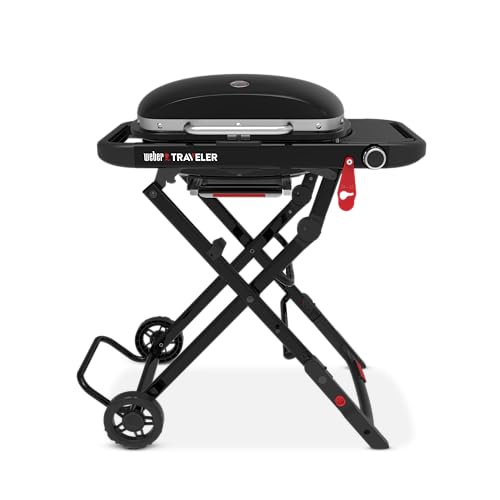
The Traveler Compact takes the idea of the full-size Traveler — a real grill on a folding, wheeled cart — and shrinks the package for rigs whose storage bays rejected the original. It rolls out of the bay, opens in one practiced motion, and cooks with the even, predictable heat Weber’s burner and grate design is known for. It suits class C and travel-trailer owners who want a stand-up grill without giving it a permanent corner of the garage at home.
Strengths
- Compact fold engineered for storage bays the full-size version misses
- Wheeled cart means one trip from bay to setup, tray in the other hand
- Easy open-and-close mechanism encourages use even on one-night stops
Trade-offs
- Smaller cooking area than the full-size Traveler — family-plus cooking takes batches
- Still a cart grill: heavier than any tabletop pick here
- Single cooking zone, managed by food placement rather than burners
| Fuel | Propane |
| Format | Folding portable grill with wheels |
| Design highlight (listing) | Easy open and close |
| Use (listing) | Camping, tailgating and travel |
The Compact exists because of a tape measure. Owners loved the original Traveler and then discovered their bay door was an inch too narrow or the bay an inch too shallow. This version trims the folded package while keeping the essential trick — a grill that is its own cart, its own stand and its own storage shape. If your rig is the reason you are shopping, this is the pick designed around your constraint.
Cooking is classic Weber portable: quick to light, steady with the lid down, hot enough to sear burgers and steaks properly for two to four people. The single zone asks for the usual camp technique — a hot center, a cooler edge, food moved rather than burners adjusted — and within a weekend it becomes second nature.
Long-term, the cart design pays an RV-specific dividend: nothing to assemble, nothing to lose. Tabletop grills need a surface; stand grills need their legs; the Traveler Compact needs a patch of ground. At the end of a long driving day, that simplicity is the difference between grilling dinner and ordering pizza in a town you cannot pronounce.
One ownership detail worth knowing: the Compact’s cart geometry keeps the grill stable on the surfaces campsites actually offer — gravel pads, grass, worn concrete — where lightweight folding stands wobble. Stability is a safety feature when a tray of raw chicken is in one hand and tongs in the other, and it is a quiet reason this design keeps winning RV owners over.
Best for: Most RV owners who want a stand-up grill that truly fits the rig / Not suited for: Feeding six-plus people in a single round
Check the current price on Amazon
Blackstone OTG Outdoor Tabletop Griddle 22 Inch with Hood — Best for Slide-Out Outdoor Kitchens
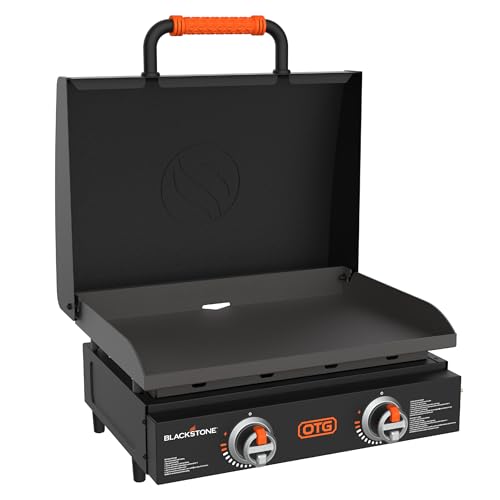
Many modern RVs roll out a slide-out outdoor kitchen — a counter, a sink, sometimes a fridge — and the OTG is the cooker that station deserves. It is a 22-inch flat-top griddle with two heat zones, a built-in protective hood and rear grease management, sized to sit on that slide-out counter or a camp table. It suits RV cooks whose menu runs from dawn pancakes to evening smash burgers and fried rice.
Strengths
- Two heat zones let you sear and hold on the same surface
- Rear grease management keeps the slide-out counter clean
- Protective hood shields the top in transit and speeds preheats
Trade-offs
- Flat-top cooking only — no grate marks or open-flame flavor
- Steel top needs seasoning and a light oil film in storage
- Takes a full counter section of the outdoor kitchen
| Fuel | Propane |
| Cooking surface | 22-inch flat top |
| Heat zones (listing) | 2 |
| Grease system (listing) | Rear grease management |
The rear grease cup is a small feature with outsized RV value. Front-drip griddles shed grease toward your shoes and the slide-out mechanism; routing it to a rear cup keeps the outdoor kitchen clean and the bay floor spotless when the griddle rides inside. Combined with a scrape-and-wipe cleanup, this is the lowest-mess cooker in the guide — a real virtue when your water comes from a tank.
Two-zone cooking is the performance story. Left side ripping hot for smash burgers, right side gentle for toasting buns and holding eggs — a full diner service from a countertop box. The hood matters too: it traps heat for melting cheese and finishing thick items, then closes over the top to protect the seasoned surface from bay dust and road grit between stops.
As with every flat top, the discipline is seasoning: build the layer before the first trip, scrape warm after each cook, oil lightly before storage. RVers who keep that five-minute routine get a cooking surface that improves for years; the griddle becomes the most-used appliance in the outdoor kitchen, which is exactly the job it was bought for.
A note on menu range for skeptics: the flat top handles more than breakfast. Philly-style sandwiches, quesadillas, seared scallops, fried rice, smashed potatoes and every vegetable that ever fell through a grate all cook beautifully on seasoned steel. Owners routinely report the griddle expanding their camp menu rather than narrowing it — the opposite of the compromise they feared.
Best for: RVs with slide-out kitchens and breakfast-loving crews / Not suited for: Grillers who want open-flame char
Check the current price on Amazon

Royal Gourmet GT1001 Stainless Steel Portable Propane Gas Grill — Best Budget Tabletop
The GT1001 is the value anchor of this guide: a stainless steel tabletop with a 10,000 BTU burner, a generous 285 square inches of cooking area, folding legs and a lockable lid for transport. It suits new RVers equipping a rig on a budget, owners of small trailers and vans where the grill is an occasional pleasure rather than a daily kitchen, and anyone who wants a real grate grill without a premium badge price.
Strengths
- Largest tabletop cooking area in this guide at a budget tier
- Lockable lid and folding legs make a tidy, rattle-free travel package
- Stainless body shrugs off bay life and coastal air better than painted steel
Trade-offs
- Single burner, single zone — heat management is by placement
- Lighter-gauge build than the Weber picks; treat it kindly on rough roads
- No stand included: it needs the picnic table or your own surface
| Fuel | Propane |
| Output (listing) | 10,000 BTU |
| Cooking area (listing) | 285 sq in |
| Transport | Folding legs, lockable lid |
The honest surprise here is the cooking area. Budget tabletop grills are usually tiny; 285 square inches is family-of-four territory, enough for burgers and corn in one round or a spatchcocked chicken under the lid. Paired with a burner that gets the grate properly hot, the GT1001 cooks well beyond what its price tier suggests — provided you preheat fully and keep the lid down.
Travel manners are equally considered. The locking lid is not a gimmick in an RV: it keeps the grate, burner and any loose parts from migrating and rattling across a thousand miles of expansion joints. Folding legs drop the profile so the grill slides into shallow bays and under-bed storage where taller units cannot go.
Set expectations at the tier. The steel is lighter than premium grills, the single zone is a real constraint for mixed menus, and this is a grill to be packed with a little care. For its intended owner — the RVer who grills a few times a trip and counts value honestly — it delivers the essential experience at the lowest cost in this guide.
For van and small-trailer owners, the GT1001’s folded flatness deserves one more mention: it slides into the shallow under-bed and rear-door compartments that define small-rig storage, spaces where cart grills and domed portables simply cannot live. In a small rig, the best grill is the one that has a home; this one finds homes others cannot.
Best for: Budget-conscious RVers and small rigs / Not suited for: Full-timers cooking on it every single day
Check the current price on Amazon

Charbroil Grill2Go X200 Portable Gas Grill — Best Rugged Pick
The Grill2Go X200 is the pick for rough roads and hard use. Its briefcase-style body latches shut for transport, and Char-Broil’s TRU-Infrared cooking puts an emitter plate between burner and food, which delivers even heat and tames the flare-ups that plague small gas grills under fatty burgers. It suits RVers who travel gravel roads, boondock often, and want a grill that treats bay life as normal rather than as abuse.
Strengths
- Infrared system cooks evenly and nearly eliminates flare-ups
- Latching briefcase body is made for transport abuse
- High, domed lid handles bulky items better than most portables
Trade-offs
- Infrared plate needs regular brushing to stay even
- Heavier than its footprint suggests — built solid on purpose
- Sear is strong but different in character from open-flame grilling
| Fuel | Propane |
| Cooking system | TRU-Infrared |
| Format | Portable, latching lid |
| Model reference | 25409200 |
Flare-ups are the small-grill disease: fat drips, flames leap, chicken skin burns while the inside stays raw. The infrared plate breaks that chain by catching drips and converting burner heat into even radiant heat. For the RV cook working on a wobbly picnic table at dusk, that forgiveness is worth more than a spec-sheet BTU race — dinner comes out evenly cooked instead of battle-scarred.
The transport design deserves the badge it earned. Everything latches, the handle is a real handle, and the whole unit feels like equipment rather than an appliance. Owners who store their grill loose in a bay with chairs, hoses and leveling blocks will appreciate a grill that does not need its own padded compartment to survive the season.
Maintenance is the standing note: keep the emitter plate’s perforations brushed clear, especially after marinades and fatty cooks, or the even heat slowly becomes uneven. Five minutes with a brush after the cook, while the grill is still warm, keeps the system honest. It is a small ritual for the most forgiving cooking in this guide.
The X200 also handles the RV-specific sin of neglect better than most. Miss a cleaning after a travel day and the infrared plate forgives you once; the domed lid sheds the condensation that bays collect in humid climates; the latching body keeps road dust out of the cooking chamber. It is the pick for owners whose maintenance style is “eventually, but thoroughly.”
Best for: Rough-road travelers and flare-up haters / Not suited for: Shoppers minimizing weight above all else
Check the current price on Amazon
Coleman RoadTrip 225 Portable Tabletop Grill — Best Easy-Clean Tabletop
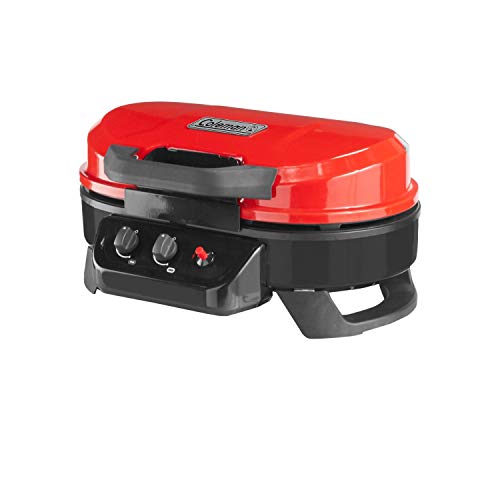
The RoadTrip 225 brings two features rare in tabletop grills: two burners with real zone control, and a removable water pan under the grate that catches drippings before they bake on. Add Instastart ignition and adjustable temperature control, and you have the tabletop for RVers who cook often and clean reluctantly. It suits couples and small families, and anyone whose RV kitchen sink is too small for a greasy grate scrub.
Strengths
- Removable water pan catches drips — cleanup is a rinse, not a scrub
- Two burners give a hot zone and a gentle zone on a tabletop footprint
- Instastart ignition is match-free and reliable in campsite wind
Trade-offs
- Water pan needs emptying and a rinse after greasy cooks
- Tabletop only: no stand or cart in the box
- Mid-size footprint — measure shallow bays before buying
| Fuel | Propane |
| Burners | 2 |
| Output (listing) | 11,000 BTU |
| Cleanup (listing) | Removable water pan |
Cleanup is where RV grills earn or lose their place, and the water pan is a genuinely clever answer. Drippings land in water instead of carbonizing on a heat plate, so the post-dinner job is: lift pan, empty, rinse. On a trip where every cleanup competes with sunset, that design choice gets this grill used more — and a grill that gets used is the only kind worth its bay space.
Two burners on a tabletop changes the cooking, too. Sear on one side, finish on the other; or run both for a full load of burgers. The control is not a luxury — it is how chicken thighs and delicate fish survive the same meal. Combined with even ignition and a lid that holds heat, the 225 cooks with a composure above its class.
The standing chore is the pan itself: it must be emptied before travel, or the bay learns about it. Make it part of the pack-away ritual — cool, empty, rinse, stow — and the system stays as clean as it promises. For RVers who have abandoned a previous grill over cleanup misery, this is the redemption pick.
The water pan has a second, quieter benefit: it moderates the grill’s internal environment, catching the drips that would otherwise flare on the heat tents below. Gentler flare behavior plus two-burner control makes this the tabletop we would hand to a nervous first-time griller — the one most likely to produce a good first trip and therefore a second.
Best for: Frequent cooks who hate cleanup / Not suited for: One-bag minimalists who want the tiniest package
Check the current price on Amazon
Weber Smokey Joe 14-Inch Portable Charcoal Grill — Best Charcoal (Where Permitted)
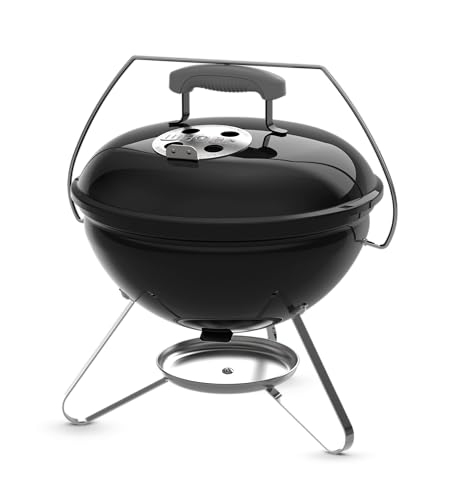
The Smokey Joe is the smallest, lightest way to cook over real charcoal: a 14-inch kettle with a lid that locks on with the Tuck-N-Carry handle for transport. It suits RVers with a charcoal habit and the storage discipline to carry a small bag of briquettes — for the nights, common in the right places and seasons, when charcoal is permitted and nothing else will do. Read the trade-offs before the strengths on this one; they matter.
Strengths
- Unmatched charcoal flavor in the smallest possible package
- Featherweight and tiny — fits bays no other pick can use
- Lid locks to the bowl for clean, one-hand carrying
Trade-offs
- Charcoal is banned in many campgrounds and during all fire restrictions — check every time
- Ash must be fully cold and packed out; never dumped at a site
- Slower to light, cook and cool than any gas pick here
| Fuel | Charcoal |
| Size (listing) | 14-inch kettle |
| Transport (listing) | Tuck-N-Carry lid lock |
| Body | Porcelain-enameled steel kettle |
The case for the Smokey Joe is flavor and simplicity. No canisters, no hoses, no ignition to fail — just briquettes, a match and the oldest cooking method there is. Steaks and burgers over charcoal have a depth the gas picks honestly cannot match, and the kettle’s small fire is economical with fuel: a modest pile of coals cooks dinner for two or three.
The case against is logistics and law. Charcoal needs storage space, produces ash that stays hot far longer than intuition says, and is the first fuel banned when conditions dry out — sometimes by the campground, sometimes by the county, always for good reason. The RVer who carries this grill carries the responsibility with it: verify permission at check-in, every time, and have a gas backup or a no-cook plan when the answer is no.
If your travels favor established campgrounds in green seasons and your taste runs to charcoal, the Smokey Joe is a delightful second grill — many owners pair it with a gas tabletop and choose nightly. As a sole grill for an RV, it asks more discipline than most travelers want to give. Badge accordingly: best charcoal, where permitted, full stop.
Storage discipline for the charcoal kit, for those who commit: briquettes in a sealed dry bin, the grill nested inside, ash container metal with a lid, all of it in one bay corner. Kept as a single tidy kit, the Smokey Joe setup takes less room than a case of drinks — the footprint argument, at least, is entirely on charcoal’s side.
Best for: Charcoal lovers with a gas backup and legal sites / Not suited for: Fire-season travel or anyone wanting a sole, always-legal grill
Check the current price on Amazon
Comparison Table
Notice the spread of philosophies: the Traveler Compact optimizes the travel day, the OTG optimizes the outdoor kitchen, the GT1001 optimizes the budget, and the Smokey Joe optimizes one perfect evening at the price of flexibility. Your rig and your routes decide which optimization is yours.
| Pick | Badge | Key spec | Best for |
|---|---|---|---|
| Weber Traveler Compact Portable Gas Grill | Best Overall for RVs | Folding cart grill with wheels, compact fold, easy open and close | Most RV owners who want a stand-up grill that truly fits the rig |
| Blackstone OTG Outdoor Tabletop Griddle 22 Inch with Hood | Best for Slide-Out Outdoor Kitchens | 22-inch flat top, 2 heat zones, protective hood, rear grease management | RVs with slide-out kitchens and breakfast-loving crews |
| Royal Gourmet GT1001 Stainless Steel Portable Propane Gas Grill | Best Budget Tabletop | 10,000 BTU, 285 sq in cooking area, folding legs, lockable lid, stainless | Budget-conscious RVers and small rigs |
| Charbroil Grill2Go X200 Portable Gas Grill | Best Rugged Pick | Portable gas grill, TRU-Infrared cooking system, latching lid design | Rough-road travelers and flare-up haters |
| Coleman RoadTrip 225 Portable Tabletop Grill | Best Easy-Clean Tabletop | 2 burners, 11,000 BTU, Instastart ignition, removable water pan | Frequent cooks who hate cleanup |
| Weber Smokey Joe 14-Inch Portable Charcoal Grill | Best Charcoal (Where Permitted) | 14-inch charcoal kettle, lightweight, Tuck-N-Carry lid lock | Charcoal lovers with a gas backup and legal sites |
How to Choose the Best BBQ Grills for RVs: Measure the Bay, Not the Brochure
Every RV grill purchase starts at the storage bay with a tape measure. Record three numbers: the door opening (the true gate — bays are always bigger inside than their doors suggest), the interior depth, and the interior height with anything else that must share the space. Then compare against the grill’s folded or packed dimensions from its listing, allowing an inch of grace for hoses, a brush and the grill’s own carrying case if you use one.
Height is the dimension shoppers forget. A grill that fits the footprint but stands too tall steals the bay’s stacking space and ends up riding in the shower — the classic RV compromise that everyone hates by week two. Folding legs, low-profile lids and cart grills that fold flat exist precisely to solve this, and they are worth prioritizing over an extra burner.
Weight closes the triangle. Payload is finite, and the grill competes with water, tools and everything else you carry. Weigh the decision honestly: a grill in the teens of pounds disappears into the budget; a heavy cart grill must justify itself with wheels and daily use. If you will curse the weight at every stop, you will eventually leave the grill — and the money — at home.
Propane Plumbing for RVs: Canisters, Tanks and Quick-Connect Ports
Three supply options cover nearly every RV. One-pound canisters are universal, simple and sold everywhere; they suit weekend use and grills that travel between rig and home. A refillable tank with an adapter hose cuts cost and waste for longer stays and full-timers. And many rigs offer a low-pressure quick-connect port plumbed to the RV’s own tanks — the cleanest solution of all when grill and port are compatible.
Compatibility is the catch that deserves your attention. A grill with its own regulator cannot simply be fed regulated low-pressure propane through that regulator; the standard solutions are hoses and fittings designed for exactly this pairing. Confirm the arrangement on the product listing and against your rig’s manual before the trip, not at the campsite. When the homework is done, the quick-connect life is genuinely luxurious: no canisters to store, no tank to wrestle, gas that is simply there.
Safety rules are short and absolute. Connect and disconnect outdoors, keep canisters and hoses away from heat and the exhaust path, store spare canisters upright in a ventilated compartment — never inside the living space — and leak-check any new connection with soapy water. Propane is the RVer’s friend precisely because its rules are simple enough to follow every single time.
Outdoor Kitchens and Slide-Outs: Building the Station Around the Grill
If your rig has a slide-out outdoor kitchen, choose the grill to serve the station. Counter depth decides between a tabletop griddle and a grate grill; the sink’s size decides how much cleanup you can tolerate; the fridge’s distance decides how many trips dinner takes. The OTG griddle earns its badge here because its rear grease management and scrape-clean surface respect a station with a small sink and a smaller gray tank.
Heat clearance is the safety dimension of the station. Keep the grill’s lid path clear of the slide-out’s underside and any awning, and never run a grill inside a closed compartment or under a deployed awning in still air. The station is outdoors by design — keep the cooking part of it that way.
For rigs without an outdoor kitchen, the folding cart grill is the station: it brings its own surface, parks where the site is best rather than where the rig dictates, and folds back into the bay when the meal ends. Many owners of big rigs still choose the cart for exactly that freedom.
Fire Rules, Seasons and the Charcoal Question
Grilling rules follow the fire map. In green conditions, most campgrounds allow propane freely and charcoal in designated or contained setups. As conditions dry, charcoal goes first, then sometimes all open flame; propane with a positive shutoff valve is usually the last category restricted. Pellet grills occupy a gray zone — some jurisdictions treat them as wood fires — so ask when it matters.
Build the habit of asking at check-in: “Any fire restrictions tonight, and do they cover my grill?” Thirty seconds, total clarity, no ranger visit at dusk. Keep a no-grill dinner plan in the pantry for the nights the answer closes the grill down — every experienced RVer has one and has used it.
This is also why the guide’s charcoal pick is framed as a companion rather than a foundation. The Smokey Joe will produce some of the best dinners of your traveling life, on the nights and in the places it is welcome. The gas picks carry the other nights. An RV grill setup that assumes one fuel and one rulebook is a setup waiting to be disappointed.
How to Set Up Your RV Grill at a New Site
A consistent arrival routine turns any campsite into your kitchen in ten minutes. This is the sequence, from leveling blocks to lit burner.
- Ask about fire rules at check-in. Confirm your fuel type is allowed tonight, and note generator hours if a pellet or powered accessory is part of your setup.
- Pick the cooking spot while you park. Flat ground or the picnic table, downwind of your doors and your neighbor’s windows, clear of the awning’s drip line and dry vegetation.
- Deploy and level. Unfold the cart or set the tabletop on a stable, heat-safe surface. A grill that rocks will spill grease and nerves; shim it level before fuel comes out.
- Connect fuel and leak-check. Canister, hose or quick-connect — snug by hand, then a soapy-water check on any new or disturbed connection. Bubbles mean reseat and retest.
- Preheat with the lid down. Ten minutes for gas and griddles. Use the time to stage food on a tray so the cook runs in one trip from the rig.
- Cook, then scrape warm. The minute food comes off, scrape the grate or top and wipe it down. Warm cleanup takes a minute; cold cleanup takes a chore.
- Cool fully before the bay. Empty the grease tray or water pan into the trash, let everything go cold, latch the lid, disconnect fuel, and stow. A tidy pack-away is tomorrow’s fast setup.
After a few trips the routine disappears into habit, and what remains is the good part: dinner outside, wherever the road stopped, with equipment that feels like part of the rig rather than cargo you tolerate.
Keep the kit together between trips — grill, hose or canisters, scraper, brush and a small spray bottle living in one bay zone. RV grilling gets easier every time the kit stays a kit, and harder every time a single missing piece sends you back into the rig mid-cook.
Common Buying Mistakes
RV-specific errors, collected from campground conversations everywhere — each one cheap to avoid and expensive to learn firsthand.
- Measuring the bay but not the bay door. The door is the gate. A grill that fits the interior but not the opening fits nowhere. Measure the opening diagonally too — folding carts often enter at an angle.
- Storing a grill with grease in it. A closed bay plus old grease equals smells that move into everything stored nearby, and a welcome mat for insects. Scrape, empty the tray, then stow.
- Feeding a regulated grill from a regulated port. Double regulation starves a burner to a candle. Match the hose and fitting arrangement to your grill’s regulator setup before the trip — the listing and your rig manual hold the answer.
- Grilling in the slide-out’s shadow. Heat rises into the slide underside and awning. Cook in the open at the station’s edge, with the lid path clear above.
- Carrying charcoal without an ash plan. Ash stays hot for many hours. It needs a metal container, a full cool-down and a proper disposal point — improvised ash handling is how campground fires start.
- Ignoring payload until the scales complain. Grills, hoses, canisters and pellet bags add up across a season of “just one more thing.” Weigh your setup once, honestly, and choose the grill that fits the number.
Final Recommendation
For the majority of rigs, the Weber Traveler Compact is the right first purchase: it fits the bays the original missed, sets up in a motion, and cooks like a Weber. Slide-out kitchen owners should build around the Blackstone OTG griddle, and budget outfitters get remarkable value from the Royal Gourmet GT1001.
The Grill2Go X200 is the rough-road insurance policy, the RoadTrip 225 is the cleanup-lover’s tabletop, and the Smokey Joe remains the little kettle for legal charcoal nights. Measure your bay door, confirm your propane plan, and check the current price on Amazon before ordering — then let the grill earn its place in the rig, one campsite dinner at a time.
Whichever pick you land on, treat the first trip as a shakedown: cook something simple, time your setup and pack-away, and note what the rig still needs — a hose, a mat, a better scraper. The second trip is when an RV grill stops being equipment and starts being part of how you travel.
Best Bbq Grills For Rv Camping Best Bbq Grills For Apartments Best Bbq Grills Propane Best 1lb Gas Grills Best Bbq Grills Guide
Frequently Asked Questions
What size grill fits a typical RV storage bay?
It varies by rig, which is why the tape measure comes first. As a class, folding cart grills like the Traveler Compact and low-profile tabletops with folding legs fit the widest range of bays. Measure your door opening, depth and height, then match the folded dimensions on the listing with an inch to spare.
Can I connect a grill to my RV’s propane quick-connect?
In many cases yes, with the correct hose arrangement for your grill’s regulator setup. Rigs supply low-pressure propane at the port; grills with built-in regulators need fittings designed for that pairing. Confirm on the listing and in your RV manual — never improvise propane connections.
Is a griddle or a grate grill better for an RV?
Griddles win breakfasts, smash burgers, stir-fries and cleanup; grates win steaks, chicken pieces and classic grill flavor. Slide-out kitchen owners lean griddle; traditionalists lean grate. Many long-term RVers eventually carry a compact version of each.
How do I stop my grill rattling in the bay?
Latch the lid, empty and secure the grease tray, pad the grill with its cover or a moving blanket, and stow it so it cannot slide. Grills designed for travel — locking lids, folding legs — rattle least because they were built expecting the road.
Are charcoal grills allowed at campgrounds?
Sometimes, in some places, in the right season — and never during fire restrictions. Rules vary by campground, county and current conditions, so the only safe answer is to ask at check-in each time. Propane grills are allowed far more widely, which is why they anchor this guide.
How much propane does an RV grill use?
For typical grilling — burgers, chicken, vegetables — a 1 lb canister covers several sessions in mild weather, fewer in cold and wind. Long-stay campers usually move to a refillable tank or the rig’s own supply through a proper hose, and keep one spare canister aboard as insurance.
Should the grill ride in the bay or the towed vehicle?
Whichever keeps it cool, latched, clean and legal. Bays keep it with the rig; a toad or truck bed suits grills used away from the site. Never transport a warm grill, and never store propane canisters inside the living space.


