Disclosure: airfryerkitchensupply.com is reader-supported. When you buy through links on our site, we may earn an affiliate commission at no extra cost to you.
Where to buy
If you are shopping for the best bbq grills for apartments, the honest starting point is your lease, not a product page. Most apartment balconies ban open-flame charcoal and many ban propane outright, which is why four of the six picks below are electric and the two propane models are clearly flagged for buildings that allow them. Every pick was confirmed against a live Amazon listing before it earned a place here.
Open a listing to confirm the plug type, cord length and footprint against your balcony, and check the current price on Amazon before you order. If your building bans gas completely, skip straight to the electric picks — they are the ones your property manager cannot argue with.
- Weber Lumin Compact Portable Electric Grill (Best Overall) — Check the current price on Amazon
- Char-Broil Patio Bistro TRU-Infrared Electric Grill (Best for Small Balconies) — Check the current price on Amazon
- Cuisinart CEG-115 2-in-1 Portable Outdoor Electric Grill (Best Budget Electric) — Check the current price on Amazon
- George Foreman Indoor/Outdoor Electric Grill with Stand (Best for Bigger Terraces and Groups) — Check the current price on Amazon
- Weber Q 1200N Portable Propane Gas Grill (Best Propane Pick (Where Allowed)) — Check the current price on Amazon
- Weber Q 2800N+ Portable Grill (Best Premium Propane (Where Allowed)) — Check the current price on Amazon
Grilling From a Balcony Without Breaking the Rules
Apartment grilling is a negotiation between three parties: you, your lease, and your downstairs neighbor. The best bbq grills for apartments are the ones that respect all three — compact enough to leave walking room on a small balcony, clean enough not to smoke out the unit above you, and legal under the fire rules your building actually enforces. That is a very different shopping problem from buying a backyard grill, and it is why this guide is organized by fuel permission first and cooking performance second.
The market reality is simple. Electric grills are the only category that is almost universally allowed, because there is no open flame and no fuel storage. The good news is that modern electric grills are far better than the sad hot-plate models of a decade ago: the best of them genuinely sear, hold steady heat for chicken and vegetables, and clean up in a sink instead of a yard. Propane still wins on raw heat and crust where it is permitted, so two compact Weber Q models are included for renters whose buildings allow small gas grills on open balconies — but they are labeled clearly, and you should confirm your rules before buying either.
Below you will find six picks with badges matched to real apartment situations: a tiny studio balcony, a shared courtyard, a renter who wants real sear marks, a household feeding six people on a larger terrace. After the reviews there is a full buying guide on balcony rules and sizing, a setup and storage walkthrough, the mistakes that get renters fined or disappointed, and direct answers to the questions apartment grillers ask most.
One more framing note before the picks: apartment grilling rewards the cook who grills often in small batches far more than the cook who grills rarely in huge ones. A compact grill that lives within arm’s reach, heats in minutes and cleans in the sink will produce more good dinners in a year than a big grill that needs a production to use. Every recommendation below is weighted toward that reality — frequency and ease first, maximum capacity only where a terrace and a guest list genuinely demand it.
In this guide
Quick Picks: The Best bbq grills for apartments at a Glance
Short on time? These are the six apartment-friendly grills we would shortlist first, split honestly between the electric models most leases allow and the compact propane models for buildings that permit them.
- Weber Lumin Compact Portable Electric Grill — Best Overall. Weber build quality in a small electric body that stores in a closet and runs from a standard outlet — the safest all-round answer for most renters. Check price on Amazon
- Char-Broil Patio Bistro TRU-Infrared Electric Grill — Best for Small Balconies. A slim freestanding electric grill with infrared-style even heat and a small round footprint that tucks into a balcony corner. Check price on Amazon
- Cuisinart CEG-115 2-in-1 Portable Outdoor Electric Grill — Best Budget Electric. The value pick: a 2-in-1 electric grill that works on its stand or a table, and gets properly hot for an entry-level model. Check price on Amazon
- George Foreman Indoor/Outdoor Electric Grill with Stand — Best for Bigger Terraces and Groups. The big electric option: a 15-serving domed grill on a removable stand for renters with a real terrace who cook for a crowd. Check price on Amazon
- Weber Q 1200N Portable Propane Gas Grill — Best Propane Pick (Where Allowed). For buildings that allow small gas grills: Weber’s compact Q brings real propane heat and cast-iron grates to a tabletop footprint. Check price on Amazon
- Weber Q 2800N+ Portable Grill — Best Premium Propane (Where Allowed). The step-up Q: a wider temperature range with a sear burner and low-and-slow roasting ability for serious balcony cooks with gas permission. Check price on Amazon
How These Picks Were Chosen
Every grill in this guide had to pass an apartment test before a cooking test. First, the footprint: each pick fits on a typical balcony with room left to stand in front of it, and each can be stored in a closet, a storage bin or a corner when the season ends. Second, the smoke and mess profile: electric models produce no combustion smoke at all, and the two propane picks burn clean with lids that contain most flare-up smoke. Third, the fuel question: no pick requires a fuel type that is broadly banned — there are no charcoal grills in this guide at all, because charcoal is the first thing most leases and local fire codes prohibit on multifamily balconies.
On top of those filters, each model was verified against Amazon listing data, so the product names, features and specifications quoted in the spec boxes come from the live listing rather than from memory or marketing copy. Picks that could not be verified were dropped rather than guessed at. Cooking judgments — searing ability, heat evenness, cleanup effort — are based on the design of each grill: grate material, burner or element layout, lid design and grease management, the things that actually decide whether a small grill cooks well.
Finally, the badges are deliberately practical. “Best Overall” went to the grill we would hand to the widest range of renters. Other badges name the specific job: the smallest balcony, the tightest budget, the biggest terrace crowd, and the two propane slots are badged by permission level so nobody buys a gas grill their building will confiscate.
A note on what is not here: big-box store brands with unverifiable listings, charcoal grills of any size, and full-size patio grills marketed as “apartment friendly” purely because the box says compact. If a grill cannot pass the permission test, the storage test and the verification test, it does not matter how well it cooks — it does not belong in an apartment guide.
The 6 Best Apartment Grills, Reviewed

Weber Lumin Compact Portable Electric Grill — Best Overall
The Lumin Compact is the grill to buy if you want one answer that works in almost any apartment. It is a real Weber — porcelain-enameled cast-iron cooking grates, a proper lid, a grease tray — shrunk to a portable electric format that sits on a balcony table or a sturdy stand and plugs into the outdoor outlet most balconies already have. It suits renters who cook for one to four people and want steaks, burgers, chicken and vegetables to taste grilled rather than steamed.
Strengths
- Cast-iron grates hold heat and lay down genuine sear marks, rare among electric grills
- Compact, lightweight body stores vertically in a closet or storage box between cooks
- No fuel storage and no open flame, so it clears nearly every balcony rule
Trade-offs
- Smaller cooking area means batch cooking for groups larger than four
- Electric heat recovery is slower than gas after the lid has been open a while
- Needs a nearby outdoor outlet or a heavy-duty extension arrangement
| Fuel | Electric |
| Format | Compact portable, tabletop |
| Design note from listing | Lightweight body, built for small spaces |
| Grates | Porcelain-enameled cast iron |
What separates the Lumin from generic electric grills is thermal mass. Most electrics use a thin wire or coated aluminum grate that dumps its heat the moment cold food lands on it, so burgers pale instead of searing. The Lumin keeps Weber’s cast-iron approach: the grate stores heat and gives it back, which is exactly how you get crust from a plug-in grill. Keep the lid down between flips and the cooking feels much closer to a small gas grill than to a countertop appliance.
Living with it is equally apartment-friendly. There is no tank to store, no ash, and the grease tray slides out for the sink. When the cook is over and the grill is cool, the whole unit is light enough to carry inside with one hand, which matters in buildings where management objects to anything left on the balcony permanently. For a renter who wants grilling to be a weeknight habit rather than a weekend project, this is the lowest-friction path that still tastes like grilling.
One more ownership note: the Lumin line was designed by Weber specifically for balconies and small patios, and it shows in the details renters care about — a lid that opens without needing clearance behind the grill, a grease tray you can reach without dismantling anything, and a body that wipes down instead of rusting through a season of balcony weather. It is the pick in this guide most likely to still be in weekly use three years from now.
Best for: Most renters who want real grilled flavor with zero lease drama / Not suited for: Cooking for large groups in a single batch
Check the current price on Amazon
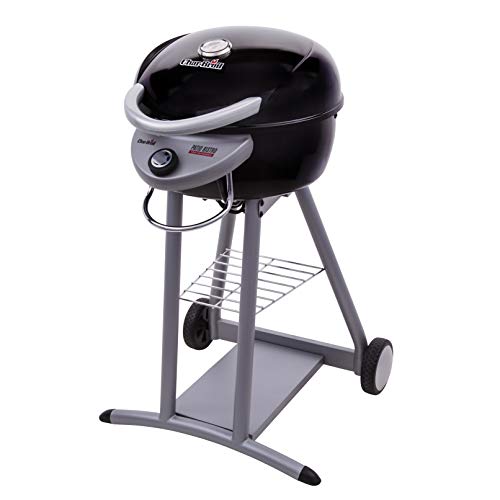
Char-Broil Patio Bistro TRU-Infrared Electric Grill — Best for Small Balconies
The Patio Bistro is built for the classic apartment problem: a narrow balcony where a tabletop grill would eat the only table. Its freestanding pedestal design parks in a corner, cooks at standing height, and the TRU-Infrared system puts an emitter plate between the electric element and the food, which evens out hot spots and cuts flare-ups. It suits singles and couples who grill a few times a week and value a tidy footprint over raw capacity.
Strengths
- Freestanding pedestal leaves your balcony table free and cooks at comfortable height
- Infrared emitter plate reduces flare-ups and the smoke that annoys neighbors
- Even heat across the grate makes it forgiving for beginners
Trade-offs
- Round grate limits how many burgers or skewers fit at once
- Infrared plate needs regular cleaning to keep performing evenly
- Assembly of the pedestal stand takes longer than a tabletop model
| Fuel | Electric |
| Heating system | TRU-Infrared |
| Format | Freestanding bistro grill |
| Model reference | 20602107 |
The infrared layout is the real story here. On a conventional electric grill the element glows in stripes and food cooks in stripes; the Patio Bistro’s emitter plate absorbs that energy and re-radiates it evenly, so chicken thighs and vegetable skewers cook at the same pace edge to edge. It also catches drips before they hit the element, which means fewer smoke plumes drifting into the apartment above — a genuine diplomatic advantage in a stacked building.
The trade is capacity and upkeep. This is a two-to-four-person grill, full stop, and the emitter plate wants a brush-down after greasy cooks to keep the perforations clear. Neither matters much for its intended user. If your balcony is five feet wide and your grill has to earn its corner every single day, the Bistro’s combination of small footprint, standing-height cooking and neighbor-friendly manners is hard to beat.
The Bistro also deserves credit for temperature honesty. Electric grills often promise high heat and deliver a warm plateau; the infrared plate design keeps the cooking surface genuinely hot across its whole area, so the third burger cooks like the first. For a couple cooking weeknight dinners — salmon, zucchini, a couple of chicken breasts — it hits a sweet spot of speed, tidiness and footprint that bigger grills cannot match on a small balcony.
Best for: Couples on narrow balconies who grill often / Not suited for: Feeding a crowd or cooking whole packer cuts
Check the current price on Amazon

Cuisinart CEG-115 2-in-1 Portable Outdoor Electric Grill — Best Budget Electric
The CEG-115 is the pick for renters who want to spend as little as possible while still grilling outdoors. Cuisinart rates it to reach 550°F from a standard wall outlet, which is a serious number for a budget electric, and the 2-in-1 design means the grill head lifts off its stand for tabletop use or storage. It suits first-time grillers, students in rental houses with patio space, and anyone testing whether apartment grilling fits their routine before spending more.
Strengths
- Reaches true searing temperature for an entry-level electric grill
- Grill head detaches from the stand for tabletop use and compact storage
- Simple single-dial control keeps it approachable for beginners
Trade-offs
- Lighter construction than the Weber and Char-Broil picks
- Smaller grate means cooking in batches for more than three people
- Stand is functional rather than sturdy-feeling under a full load
| Fuel | Electric |
| Max temperature (listing) | 550°F from a wall outlet |
| Format | 2-in-1: stand or tabletop |
| Model | CEG-115 |
Budget electric grills usually fail on heat, so the headline number matters: a grill that genuinely gets into searing territory will brown burgers and chicken skin instead of graying them. The CEG-115’s element and lidded design get it there, provided you preheat with the lid closed and cook in sensible batches so the element can recover between loads. Treat it like a small grill, not a weak big one, and the results are honestly good.
The detachable head is the second practical win. Apartment storage is measured in cubic inches, and a grill that breaks down into a head, a stand and a cord is far easier to closet than a one-piece unit. For the renter who grills twice a month and stores the grill the other twenty-eight days, that breakdown matters more than premium materials. This is the budget tier done sensibly: spend little, grill properly, store easily.
Set expectations correctly and the CEG-115 over-delivers. Preheat it fully, keep the lid closed, and cook in batches of two or three portions and it produces properly browned burgers, chicken and vegetables. Ask it to feed six people in one load and any small electric will struggle. As a first grill or a second home at a rental, its combination of real heat, breakdown storage and entry-level pricing is exactly the budget tier done right.
Best for: First-time grillers and tight budgets / Not suited for: Daily heavy use or large-batch cooking
Check the current price on Amazon
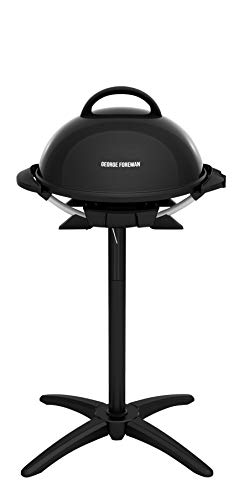
George Foreman Indoor/Outdoor Electric Grill with Stand — Best for Bigger Terraces and Groups
Most apartment grills are built for two. The George Foreman Indoor/Outdoor is the exception in this guide: a large domed electric grill sized for fifteen servings, mounted on a removable stand so it can also sit on a table or move indoors to a kitchen counter in bad weather. It suits renters with generous terraces, shared-house patios, and anyone who hosts — the apartment cook who grills for the whole friend group, not just the household.
Strengths
- Largest cooking capacity of any electric pick in this guide
- Removable stand lets it work outdoors on the terrace or indoors on a counter
- Sloped nonstick plate drains fat into a tray, keeping smoke and mess down
Trade-offs
- Big dome needs real storage space compared with the compact picks
- Nonstick plate sears more gently than cast iron
- Five heat settings give less fine control than a dial-and-lid gas grill
| Fuel | Electric |
| Capacity (listing) | 15-serving |
| Heat settings | 5 |
| Stand | Removable |
Capacity changes what you cook. On a 15-serving electric you can grill a whole spatchcocked chicken’s worth of pieces, a full tray of vegetables and a round of burgers without the relay-race batching that makes small-grill hosting miserable. The domed lid traps enough heat for bone-in pieces, and the sloped plate quietly handles the grease that would otherwise flare and smoke — a real consideration when your terrace sits under three more terraces.
Be honest about the compromises, though. The nonstick surface will never mark food like cast iron, and the unit is the hardest in this guide to store. Buy it because your space and your guest list justify it, not as a default. For the social renter with a big terrace, it solves the one problem the other five picks cannot: feeding everyone at once, legally, from a wall outlet.
The indoor option deserves emphasis, because no other pick here offers it. When weather kills a terrace plan, the same grill comes off its stand and finishes dinner on the kitchen counter — a genuine advantage for renters in rainy climates. The sloped plate and drip tray keep indoor cooking tidy, and the nonstick surface releases food and wipes clean fast. It is a different kind of grill from the cast-iron picks, but for group cooking under apartment rules it has no real rival in this lineup.
Best for: Hosts with large terraces who cook for groups / Not suited for: Tiny balconies or cooks who prize hard sear marks
Check the current price on Amazon

Weber Q 1200N Portable Propane Gas Grill — Best Propane Pick (Where Allowed)
Only read on if your lease and local code allow a small propane grill on your balcony — many do not. Where it is legal, the Q 1200N is the strongest compact gas grill in this guide: a single 10,000 BTU burner under porcelain-enameled cast-iron grates, electronic ignition, and a cast-aluminum body that shrugs off balcony weather. It suits couples and small households who want gas heat and real crust in a grill that still stores in a closet.
Strengths
- Propane heat gives the fastest recovery and hardest sear in this guide
- Cast-iron grates and cast-aluminum body are built to last for years
- Runs on 1 lb canisters, so there is no big tank to store on the balcony
Trade-offs
- Flatly prohibited in many apartment buildings — verify before buying
- Single burner means no true indirect zone for large cuts
- Costs more than the electric picks of similar size
| Fuel | Propane (1 lb canister) |
| Burner output (listing) | 10,000 BTU, 1 burner |
| Grates | Porcelain-enameled cast iron |
| Ignition | Electronic |
The Q 1200N cooks like a shrunken backyard grill because that is what it is: the burner, grate and lid geometry are Weber’s full-size ideas executed small. Steaks crust properly, burgers cook in one batch for three or four people, and the lid-down heat is steady enough for chicken pieces and corn. The 1 lb canister format is also the apartment-friendly way to do gas — no twenty-pound tank living on your balcony, which is the specific thing many fire codes object to.
The caveat cannot be repeated enough: permission first. Check your lease, ask your property manager in writing, and check your city or county rule on gas grills on multifamily balconies, because some jurisdictions ban them regardless of what a lease says. If the answer is no, the Lumin above gives you most of this experience legally. If the answer is yes, this is the compact gas grill to buy once and keep.
Ownership costs are worth a thought with any gas grill. One-pound canisters are convenient and storage-friendly, but heavy grillers will go through them steadily; a hose adapter to a larger tank is an option at houses and some patios, though balcony rules often forbid the big tank even when the grill itself is allowed. Factor the canister habit into your decision, and remember the grill itself is the durable part of the purchase — Q-series grills routinely serve owners for a decade.
Best for: Renters with written permission for small gas grills / Not suited for: Any building that bans propane on balconies — no exceptions
Check the current price on Amazon

Weber Q 2800N+ Portable Grill — Best Premium Propane (Where Allowed)
The Q 2800N+ is the premium propane option for the apartment cook who has permission for gas and actually cooks. Its listing highlights a 250–700°F working range with a dedicated burner for searing plus genuine low-temperature roasting — a spread no other compact in this guide attempts. It suits the renter with a larger balcony who reverse-sears thick steaks, roasts whole chickens and treats the balcony as a real outdoor kitchen.
Strengths
- Widest temperature range here: low roasting through true searing heat
- Dedicated sear burner gives steakhouse crust on thick cuts
- Larger cooking area than the Q 1200N for households of four to six
Trade-offs
- Premium price tier among compact grills
- Bigger and heavier, so closet storage needs planning
- Still propane — still banned in many buildings
| Fuel | Propane |
| Temperature range (listing) | 250–700°F |
| Burners | Main burner plus sear burner |
| Use highlight (listing) | Low-temp roasting and searing |
Range is what you are paying for. Most small grills do one thing — medium-high direct heat — and fake the rest. A compact that can hold roasting temperatures at the low end and push searing heat at the top lets you cook a thick ribeye properly: gentle heat until the center is right, then a hard finish over the sear burner. That two-stage cooking is the difference between balcony grilling as a compromise and balcony grilling as a craft.
It is also the pick that most rewards a slightly bigger balcony. You will want a stable table or cart, room to work beside it, and a storage plan for the off-season. Households that grill three or more times a week will feel the upgrade daily; occasional grillers should save the money and take the 1200N or the Lumin. Permission rules apply exactly as with the smaller Q — confirm gas is allowed before this grill anywhere near your cart.
The 2800N+ also changes the storage equation slightly: it is the one pick here you should measure twice. Confirm the table or cart it will sit on, the closet or bin it will live in, and the route between them. Renters who make that plan are rewarded with the most capable compact gas cooking in this guide — low roasting for a whole chicken on Sunday, hard searing for steaks on Friday, all from a grill that still qualifies as portable.
Best for: Serious cooks with gas permission and a mid-size balcony / Not suited for: Casual grillers or any no-gas building
Check the current price on Amazon
Comparison Table
Side by side, the pattern is clear: electric picks trade a little searing drama for total lease safety, while the two propane Webers cook hardest and demand permission. Match the row to your building rules first, then to your headcount.
| Pick | Badge | Key spec | Best for |
|---|---|---|---|
| Weber Lumin Compact Portable Electric Grill | Best Overall | Electric, compact portable design, built for small spaces | Most renters who want real grilled flavor with zero lease drama |
| Char-Broil Patio Bistro TRU-Infrared Electric Grill | Best for Small Balconies | Electric TRU-Infrared, freestanding bistro format | Couples on narrow balconies who grill often |
| Cuisinart CEG-115 2-in-1 Portable Outdoor Electric Grill | Best Budget Electric | Electric, reaches 550°F from a wall outlet, stand or tabletop use | First-time grillers and tight budgets |
| George Foreman Indoor/Outdoor Electric Grill with Stand | Best for Bigger Terraces and Groups | Electric, 15-serving capacity, removable stand, 5 heat settings | Hosts with large terraces who cook for groups |
| Weber Q 1200N Portable Propane Gas Grill | Best Propane Pick (Where Allowed) | 1-burner propane, 10,000 BTU, porcelain-enameled cast-iron grates, electronic ignition | Renters with written permission for small gas grills |
| Weber Q 2800N+ Portable Grill | Best Premium Propane (Where Allowed) | Propane, 250–700°F range, dedicated sear burner, low-temp roasting | Serious cooks with gas permission and a mid-size balcony |
How to Choose the Best BBQ Grills for Apartments: Start With the Rules
Before comparing a single grill, answer three permission questions. What does your lease say about grilling on the balcony? What has your property manager enforced in practice? And what does your local fire code say about grills on multifamily balconies? These are three separate gates and a grill has to pass all of them. Many leases ban charcoal outright, many ban all open flame, and a number of cities prohibit propane grills on balconies of buildings with more than a few units regardless of what the lease allows. Electric grills pass almost everywhere because there is no flame and no stored fuel, which is why they anchor this guide.
Ask in writing. An email from your property manager saying a small electric grill is fine is worth more than any product feature, and it protects you if a neighbor complains. If gas is allowed, ask specifically about tank size: rules that permit a grill often still limit you to small canisters, which is exactly the format the two Weber Q picks use. If the answer to gas is no, do not negotiate with yourself — the electric picks here genuinely cook well, and a confiscated grill cooks nothing.
Also consider the unwritten rule: your neighbors. Smoke drifts up, grease smells carry, and the fastest way to get a building-wide ban is to be the person who smokes out the fourth floor every Friday. Lidded grills, infrared plates and fat-draining designs are not just cooking features in an apartment — they are how you keep your grilling privileges.
Size, Storage and Power: The Apartment Buying Criteria That Matter
Measure your balcony before you shop, and measure the storage spot too. A grill that fits the balcony but not the closet will live outside all winter or live in your hallway, and both end badly. Tabletop electrics like the Lumin Compact and the Cuisinart store in a fraction of the space of a freestanding unit; the Patio Bistro and the George Foreman earn their floor space only if they can stay out or you have a storage bin. Depth matters more than width on narrow balconies — you need room to stand, open the lid and hold a tray.
Power is the second practical check. Outdoor outlets are not universal: some balconies have none, some share a circuit with the living room. Electric grills draw substantial power, so a grill plus indoor appliances on one circuit can trip breakers mid-cook. Test the outlet with the grill before your first real cook, use only a short, heavy-duty, outdoor-rated extension cord if you must use one at all, and never run a cord through a sliding door that will pinch it.
Finally, think about cleanup infrastructure. Apartment grills get cleaned in kitchen sinks and bathtubs, not with a garden hose. Removable grates, slide-out grease trays and nonstick plates that fit in a sink are worth more to a renter than an extra burner. Every pick in this guide was chosen partly on how realistically it cleans up in an apartment, because a grill that is miserable to clean becomes a grill you stop using.
Weight deserves a line of its own. A grill you cannot comfortably carry through your apartment will not get stored, and a grill that does not get stored gets weather-beaten, complained about, or both. Every electric pick here can be moved by one person without drama. The freestanding models earn their keep only when they can stay in place legally — confirm that before choosing them over a tabletop model.
Electric vs Propane on a Balcony: An Honest Comparison
Electric grills win on permission, storage and simplicity. They start instantly, hold a set temperature with a dial, produce no combustion smoke, and store without fuel concerns. Their honest weakness is peak performance: even the best electric recovers heat more slowly than gas, so overloading the grate or lifting the lid constantly will steam food instead of searing it. Cook in batches, preheat thoroughly with the lid down, and pat food dry — technique closes most of the gap.
Propane wins on heat and feel. A gas burner restores grate temperature almost immediately, crusts steaks harder, and gives you the responsive control experienced grillers expect. Its costs are regulatory and logistical: permission, canister storage, and the reality that a flare-up on a balcony is a bigger event than a flare-up in a yard. If your building allows it and you grill often, the Q models justify themselves. If there is any doubt about permission, electric is not a consolation prize — it is the correct tool for the building you actually live in.
How to Set Up and Store a Balcony Grill Safely
Apartment grilling goes wrong at the setup stage more than at the cooking stage. This routine keeps you legal, safe and on good terms with the building from the first cook onward.
- Confirm permission in writing. Email your property manager naming the grill type and fuel. Keep the reply. No reply, no gas grill — electric only until you have an answer.
- Choose the spot. Place the grill on a stable, level, non-flammable surface, away from railings draped with towels, outdoor curtains, and the wall of the building. Keep a clear path so you are never reaching across the grill.
- Check your power or fuel. For electric, plug directly into the outdoor outlet where possible and test the circuit before food is involved. For propane, connect the canister outdoors, and check the connection with soapy water — bubbles mean a leak; tighten and retest.
- Preheat with the lid down. Ten to fifteen minutes for electric, ten for gas. A properly preheated grate is the whole secret to food releasing cleanly instead of sticking.
- Cook in batches sized to the grate. Leave space between pieces so heat circulates. Crowding is the number one cause of pale, steamed results on small grills.
- Manage grease every cook. Empty the drip tray once cool, wipe the lid interior, and brush the grate while it is still warm. Grease left sitting is what smokes and smells on the next cook.
- Cool fully before storing. Let the grill go completely cold, coil the cord or remove the canister, and store the grill in its closet, bin or corner. Canisters store upright, outdoors, never in a hot enclosed space.
Do this routine twice and it becomes automatic — a five-minute discipline that keeps the grill clean, the balcony legal and the neighbors friendly. The cooks who lose balcony grilling privileges almost never lose them over one dramatic incident; they lose them over accumulated grease, smoke and noise complaints. Steady, tidy habits are the real apartment grilling skill.
Common Buying Mistakes
These are the errors that cost renters money, deposits and grilling privileges — every one of them avoidable.
- Buying propane before checking the lease. The single most common apartment grill mistake. If your building bans gas, a beautiful grill becomes a storage problem and possibly a lease violation. Permission first, purchase second, always.
- Assuming charcoal is fine because the balcony is open-air. Charcoal is the most-banned fuel in multifamily housing, and ash disposal in an apartment is a genuine fire risk. There is a reason this guide contains zero charcoal picks.
- Overloading a small electric grate. Electric elements recover slowly. A grate packed edge to edge steams everything. Cook in two relaxed batches and the second batch will still finish faster than one crowded, soggy one.
- Skipping the grease tray. On a balcony, yesterday’s grease is today’s smoke complaint. Empty the tray after every cook, not when it overflows onto the balcony floor and your deposit.
- Storing a propane canister indoors. Canisters belong outdoors, upright, away from heat. A canister in a hall closet or next to a water heater is a hazard no convenience justifies.
- Grilling under an overhang or awning. Heat and smoke need somewhere to go. A grill under a low balcony ceiling or fabric awning discolors surfaces, sets off alarms and can damage the structure above you.
Final Recommendation
For most renters, the decision ends quickly: the Weber Lumin Compact is the apartment grill we recommend first — real Weber cooking, cast-iron grates, closet-friendly storage and no fuel rules to break. On a narrow balcony, the Char-Broil Patio Bistro’s corner-friendly pedestal and low-smoke infrared cooking make it the smarter fit, and the Cuisinart CEG-115 proves you do not need to spend much to grill properly from an outlet.
If — and only if — your building allows small gas grills, the Weber Q 1200N brings genuine propane performance to a tabletop footprint, and the Q 2800N+ is the upgrade for cooks who will use its wide temperature range. Hosting a crowd on a big terrace? The George Foreman Indoor/Outdoor is the one electric here built for that job. Whichever you choose, confirm the rules, measure the balcony, and check the current price on Amazon before ordering.
Grilling from an apartment is not a lesser version of grilling. It is a tighter, tidier discipline — and with the right grill, the food is every bit as good.
Best Bbq Grills For Rv Camping Best Bbq Grills Propane Best Bbq Grills Guide Best 1lb Gas Grills Best Bbq Grills Traeger
Frequently Asked Questions
Are electric grills actually allowed on apartment balconies?
In most buildings, yes — electric grills have no open flame and no stored fuel, so most leases and fire codes treat them like any other appliance. That said, a minority of buildings ban all balcony cooking devices, so a quick written check with your property manager is still the smart first step.
Can an electric grill really sear a steak?
A good one can. The keys are cast-iron grates that store heat, a full preheat with the lid down, dry meat surfaces and not overcrowding the grate. The crust will be slightly gentler than a screaming-hot gas grill, but a properly preheated electric like the Lumin produces genuine browning and grill marks.
Why is there no charcoal grill in this guide?
Because charcoal is prohibited on the balconies of most multifamily buildings by lease, local fire code or both, and hot ash disposal in an apartment is a real hazard. Recommending charcoal to apartment readers would be recommending a grill most of them cannot legally use.
What size grill do I need for two people?
For two people, a compact tabletop electric or the Q 1200N class is plenty — you can cook two steaks plus vegetables in one batch. Households of four should look at the larger electrics or the Q 2800N+, and regular hosts should consider the 15-serving George Foreman.
How do I keep smoke from bothering my neighbors?
Keep the lid down, keep the grease tray empty, trim excess fat, and avoid sugary marinades burning on the grate. Infrared and fat-draining designs smoke less by construction. Grilling earlier in the evening and keeping cooks reasonably short also helps diplomacy.
Can I leave my grill on the balcony year-round?
Only if your building allows balcony storage and the grill is covered and cold. Many leases require balconies to stay clear, and winter weather ages any grill. The compact electrics in this guide are designed to come inside — that portability is a feature, not an inconvenience.
Do I need a stand, or is a tabletop grill enough?
A tabletop grill is enough for most renters and stores far more easily. Choose a freestanding model like the Patio Bistro only when you have no suitable table or counter-height surface on the balcony, or when the grill will live outside permanently. If you do use a table, it must be stable, level and heat-resistant — a wobbling plastic side table is not a grill stand.


