Disclosure: airfryerkitchensupply.com is reader-supported. When you buy through links on our site, we may earn an affiliate commission at no extra cost to you.
Where to buy
Every product in this guide to the best apron kitchen sinks was verified as a current Amazon listing before inclusion, or is clearly marked as a recommendation without a link where no listing could be confirmed with confidence. Models in this category are sold in several sizes, finishes and model years, so use the links below to check the current price on Amazon and confirm the exact configuration before ordering.
Quick links to the picks in this guide: TUKTUK White Farmhouse Sink, 30 Inch, Fireclay; Miuara Farmhouse Sink, 33 x 18 Inch, White Fireclay; Lordear Farmhouse Sink, 33 Inch, White Fireclay; Elkay Fireclay Farmhouse Sink, SWUF3320WH, Double Bowl 60/40; Kraus Gloss White Fireclay Workstation, KFDW1-33GWH, 33 Inch; Lordear Kitchen Sink, 33 Inch, Fireclay Workstation with Slide Ledge.
The best apron kitchen sinks are farmhouse sinks by another name — the terms describe the same exposed-front design — so this guide takes the wider view the keyword invites: not only which apron sink to buy, but which kind. Across the six verified picks you will find white fireclay in three sizes and two configurations, a fireclay workstation with an integrated ledge, and the size and shape decisions laid out so a household can match the sink to its cabinets and its washing habits rather than to a photograph.
Where the companion farmhouse guide leads with a stainless workstation, this one leads with the classics, because ‘apron sink’ searches are usually style-led: the buyer has seen the white front, the deep bowl, the kitchen it anchors. The practicalities still rule — cabinet size, support framing, bowl depth, single versus double — and each review covers them, because an apron sink chosen on looks alone and fitted hopefully is the most expensive mistake in kitchen plumbing.
One clarification before the picks: apron and farmhouse are the same construction, so everything here — measuring, support, faucet reach — applies equally whichever word your cabinet maker uses. What differs between the six sinks below is material behaviour, bowl layout and size, and those are the decisions that will still matter in year fifteen.
One more piece of orientation before the picks: apron sinks photograph identically and live differently, because the differences that matter — bowl depth, divider geometry, ledge design, fitting method — are all below the rim in the photographs. This guide therefore writes about the sinks from the user’s position, hands in the bowl, rather than from the camera’s. If a review dwells on reach, span and support, that is the apron sink’s real specification sheet talking.
In this guide
Quick Picks
TUKTUK White Farmhouse Sink, 30 Inch, Fireclay — Best Overall: The 30-inch classic: white fireclay, a deep single bowl, a reversible front and an accessory kit — the apron sink that fits the cabinets most kitchens actually have. — Check the current price on Amazon
Miuara Farmhouse Sink, 33 x 18 Inch, White Fireclay — Best 33-Inch Classic: The full-size classic with flexible installation: 33 inches of reversible white fireclay that can fit as an apron front or a drop-in, with a bowl rated resistant to stain, crack, heat and scratch. — Check the current price on Amazon
Lordear Farmhouse Sink, 33 Inch, White Fireclay — Best Deep Bowl: Size stated plainly: 33 by 20 by 10 inches of solid fireclay — the deepest bowl in this guide, in a sink whose listing leads with resistance to stains, chipping, cracking and scratching. — Check the current price on Amazon
Elkay Fireclay Farmhouse Sink, SWUF3320WH, Double Bowl 60/40 — Best Double Bowl: Two bowls, intelligently divided: Elkay’s 60/40 fireclay farmhouse with an Aqua Divide — a lowered divider that lets long items span both bowls when the day demands it. — Check the current price on Amazon
Kraus Gloss White Fireclay Workstation, KFDW1-33GWH, 33 Inch — Best Workstation Apron: Fireclay meets the workstation: Italian-made gloss white fireclay with an integrated ledge, a cutting board and colander included — the apron sink as a prep system, in the classic material. — Check the current price on Amazon
Lordear Kitchen Sink, 33 Inch, Fireclay Workstation with Slide Ledge — Best Fireclay Workstation Alternative: A second route to the fireclay workstation: Lordear’s 33x19x10 dual-mount sink with a slide ledge — deep like its sibling, ledged like the Kraus, and flexible in how it fits. — Check the current price on Amazon
How These Picks Were Chosen
All six sinks were verified against the current Amazon catalogue connection, with only listings whose returned title matched the exact model linked. Sizes, materials and configurations quoted are from those verified listings; installation requirements are stated where the listing states them and flagged for confirmation where it does not.
The selection was built to span the real decision space rather than to list near-duplicates: a 30-inch and a 33-inch classic single bowl, a double-bowl fireclay, a reversible-front model, a fireclay workstation with a ledge, and a second 33-inch with a workstation ledge in fireclay — so the trade-offs between size, division and workflow can be compared directly.
Designs that are apron in styling only, or whose listings could not be verified, were excluded. Every pick is a true exposed-front sink in fireclay — the material the apron style was invented in — because at the time of verification the strongest, best-documented apron range on the catalogue is fireclay; stainless apron options are covered in depth in the companion farmhouse guide in this series.
A note on the all-fireclay shape of this list, for the record: it reflects verification, not doctrine. The stainless apron models that qualified under this guide’s rules are reviewed in depth in the companion farmhouse article in this series, and a buyer whose household is rough on sinks should read that article alongside this one before deciding. Within the fireclay field itself, these six were separated by size, division, ledge and fitting — the axes that actually divide them.
The 6 Best Apron Kitchen Sinks

TUKTUK White Farmhouse Sink, 30 Inch, Fireclay — Best Overall
Check the current price on Amazon
Start the apron conversation at 30 inches, because that is the size the greatest number of real kitchens can accept — a 33-inch sink base, the commonest in smaller and older homes. The TUKTUK’s fireclay bowl is deep and single, its front reversible between profiles, and it arrives with an accessory kit that acknowledges how these sinks are actually used. Its listing’s own words — heavy duty, easy to clean — are the two promises fireclay genuinely keeps.
Strengths
- 30-inch format fits the 33-inch cabinets other apron sinks cannot
- Deep single fireclay bowl with reversible front and accessory kit included
- Fireclay glaze: stain-resistant, heat-resistant, quiet and permanently white
Trade-offs
- Fireclay weight demands a proper support frame even at this size
- A bottom grid is strongly advised against chips from dropped pans
- Single bowl only — two-bowl households should look at the Elkay double below
| Specification | Detail |
|---|---|
| Size | 30-inch |
| Material | Fireclay |
| Bowl | Single, deep |
| Front | Reversible |
| Install | Drop-in / undermount |
The 30-inch apron is the format’s sweet spot for authenticity per inch of cabinet. You lose surprisingly little bowl versus the 33 — the depth is retained, and depth is what swallows the stockpot — while gaining access to kitchens the larger sinks are simply locked out of. For a galley or a modest family kitchen, this is not the compromise pick; it is the correct one.
TUKTUK’s accessory kit rounds out the ownership start: the grid and extras that fireclay owners end up buying anyway. Combined with the reversible front — choose the profile at fitting, not at ordering — it is the most forgiving route into a genuine apron sink in this guide.
A small ownership note for the TUKTUK: its accessory kit makes it the pick most likely to be fully equipped on day one — grid in place, extras to hand — which is exactly how a fireclay sink should begin its life.
The TUKTUK’s reversible front is best decided with the kitchen’s handles and hinges in view: the profile that echoes your cabinetry’s lines will look custom rather than catalogue.
Best for: smaller kitchens wanting the genuine apron sink experience / Not suited for: households needing two bowls or maximum tray capacity

Miuara Farmhouse Sink, 33 x 18 Inch, White Fireclay — Best 33-Inch Classic
Check the current price on Amazon
At 33 inches the apron sink reaches its canonical size, and the Miuara’s distinguishing feature is installation flexibility: the same reversible fireclay sink can be fitted in the classic apron-front manner or as a drop-in/undermount variant, which widens the range of remodels it can join. The fireclay itself makes the material’s usual promises — resistance to staining, cracking, heat and scratching — in a single, deep bowl.
Strengths
- 33-inch canonical farmhouse size with a deep single bowl
- Reversible front and flexible apron or drop-in fitting suits more remodels
- Fireclay surface resists stains, heat and scratches and stays white
Trade-offs
- Needs the 36-inch-class cabinet commitment of any 33-inch apron sink
- Fireclay care rules apply: support frame, bottom grid, no dropped cast iron
- Flexibility is no substitute for measuring — confirm your chosen fitting style’s requirements
| Specification | Detail |
|---|---|
| Size | 33 x 18 in |
| Material | Fireclay |
| Bowl | Single, reversible |
| Install | Apron front or drop-in (undermount) |
The installation flexibility is more valuable than it sounds. Remodels discover things — a cabinet that will not take the planned cut, a countertop worth keeping — and a sink that can change its fitting method without changing its look rescues projects. Planned conventionally, it is simply a well-sized fireclay apron sink from a range specialising in them.
Choose the Miuara if 33 inches is your size and your remodel has any uncertainty in it. The bowl, the material and the front are the classic article; the fitting options are insurance you hope not to use and will be glad of if you do.
The Miuara’s drop-in option deserves respect as remodel insurance: projects change when walls open, and a sink that can change its fitting method without changing the kitchen’s design has saved more than one renovation from a month of delay.
Miuara’s flexible fitting also suits phased remodels: install as a drop-in now, convert the same sink to its apron presentation when the cabinets are rebuilt — one sink, two kitchens.
Best for: 33-inch apron buyers whose remodel plans may need to adapt / Not suited for: 30-inch cabinets that cannot accept a 33-inch sink
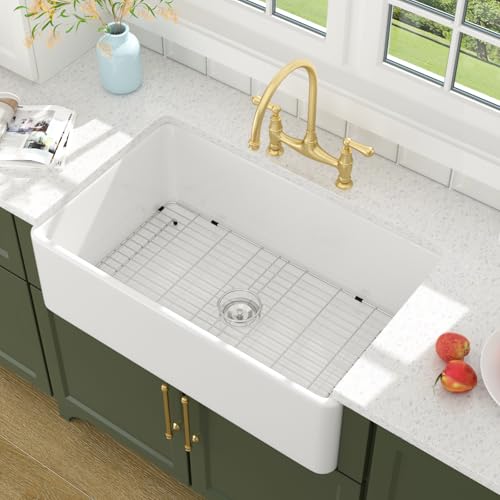
Lordear Farmhouse Sink, 33 Inch, White Fireclay — Best Deep Bowl
Check the current price on Amazon
Depth is the farmhouse sink’s working dimension, and the Lordear states its case numerically: a 10-inch-deep bowl in a 33×20 footprint. Ten inches swallows a stockpot upright, hides a day’s dishes below the sightline, and keeps splash inside the bowl where it belongs. The solid fireclay construction carries the material’s standard virtues, with the maker specifically claiming resistance to the chipping and cracking that are fireclay’s known vulnerabilities.
Strengths
- 10-inch bowl depth is the deepest here — stockpots and soaking trays disappear into it
- Solid fireclay with stated resistance to stains, chipping, cracking and scratching
- 33×20 footprint gives generous width alongside the depth
Trade-offs
- The deepest bowl is also among the heaviest — support framing is non-negotiable
- Deep bowls plus a disposal underneath need under-sink clearance checked
- Tall users and short users alike should test the reach into a 10-inch bowl mentally before committing
| Specification | Detail |
|---|---|
| Size | 33 x 20 x 10 in |
| Material | Solid fireclay |
| Bowl | Single, 10-inch deep |
A deep bowl changes washing ergonomics both ways: less splash and less visual clutter, but a longer reach to the bottom, which shorter cooks should weigh honestly. For households whose cooking generates big, soak-worthy loads — roasters, oven trays, preserving pans — the depth earns its keep weekly.
Lordear’s fireclay range is built around farmhouse formats, and this model’s specification-first presentation suits buyers who comparison-shop on dimensions. If your pans are big and your cabinet is ready, the deepest bowl in the guide is a rational first choice.
Deep-bowl owners develop one habit worth copying early: wash the tallest items first, while the bowl is empty, rather than discovering at the end that the stockpot must balance on a pile of plates.
A 10-inch bowl changes the soaking equation for oven racks: laid at a diagonal with the tap over them, they finally fit under water in a way standard bowls never allowed.
Best for: big-pan households that soak and wash in volume / Not suited for: shorter cooks for whom a 10-inch reach is a strain

Elkay Fireclay Farmhouse Sink, SWUF3320WH, Double Bowl 60/40 — Best Double Bowl
Check the current price on Amazon
The double-bowl objection to itself is that the divider always stands where the big pan wants to be. Elkay’s Aqua Divide answers with a lowered divider: in daily use you get a 60/40 split — a generous main bowl and a smaller second bowl for rinsing, prep or soaking — and when a long tray or pan arrives, it can rest across the lowered divide instead of being excluded. It is the most thoughtful bowl geometry in this guide, from a maker with a century of sinks behind it.
Strengths
- 60/40 split matches real washing patterns better than a 50/50 division
- Aqua Divide lowers the divider so long items can span the bowls
- Elkay fireclay quality and range support in a permanent fixture
Trade-offs
- Even the main bowl is smaller than a 33-inch single — measure your largest pan
- Double-bowl fireclay is heavy; the cabinet work must be planned
- Costs the flexibility that makes single bowls the farmhouse default
| Specification | Detail |
|---|---|
| Material | Fireclay |
| Bowl | Double, 60/40 |
| Feature | Aqua Divide lowered divider |
| Colour | White |
The 60/40 layout deserves emphasis because it reflects how sinks are actually used: one bowl does eighty percent of the work. Giving that bowl sixty percent of the width — rather than half — is the difference between a double bowl that feels generous and one that feels like two compromises. The Aqua Divide then removes the layout’s last structural objection.
Choose the Elkay double if your household hand-washes in a wash-and-rinse rhythm and your largest cookware fits the main bowl. It is the double-bowl pick for people who have thought about doubles carefully — which, for a fixture this permanent, is exactly the right way to choose one.
Elkay’s Aqua Divide also helps with a subtler task — soaking a long utensil or a baguette tray diagonally — where a full-height divider would force an awkward tilt and a sloshed floor.
The Elkay double’s main bowl, at sixty percent of a full-size sink, still exceeds many kitchens’ entire current sink — a useful perspective when the divider anxiety strikes.
Best for: wash-and-rinse households wanting a smarter double bowl / Not suited for: single-bowl devotees whose pans span any divider

Kraus Gloss White Fireclay Workstation, KFDW1-33GWH, 33 Inch — Best Workstation Apron
Check the current price on Amazon
Workstation ledges are usually stainless territory; the KFDW1-33GWH brings the concept to fireclay, and made-in-Italy fireclay at that — Italy being where the material’s best tradition lives. The integrated ledge carries the included cutting board and colander over the bowl, so prep happens above the sink: peelings fall in, washed produce drains in place, and the counter stays clear. The listing states heat resistance to 300F for the fireclay, and the fitting is drop-in, the friendlier installation.
Strengths
- Integrated ledge with board and colander turns the sink into a prep station
- Italian fireclay in gloss white — the classic material at its most traditional source
- Drop-in fitting is the most forgiving apron installation
Trade-offs
- Workstation accessories are sized to the ledge — replacements come from the same range
- Fireclay weight and chip care apply, workstation or not
- The ledge narrows the open bowl slightly, as all workstation designs do
| Specification | Detail |
|---|---|
| Size | 33 in |
| Material | Fireclay, made in Italy |
| Feature | Integrated ledge; cutting board and colander included |
| Heat-safe (listing) | To 300F |
The workstation workflow suits small and medium kitchens disproportionately: when counter space is scarce, a sink that hosts its own chopping board returns a stretch of counter to the kitchen permanently. In fireclay, you give up nothing of the classic look to get it — the front is the same gloss white apron, the bowl the same quiet, hard glaze.
Kraus supports the model within a broad sink range, which matters for grids and extra ledge accessories over the years. For the cook who preps constantly and loves the farmhouse material, this is the most complete single purchase in the guide.
The Kraus workstation’s colander earns a specific mention: washed berries and herbs draining over the bowl, at counter height, is the small daily pleasure that converts workstation sceptics most reliably.
Kraus’s Italian fireclay has a surface quality owners notice with cutlery: the bowl sounds muted, almost soft, under daily use — a small luxury that compounds across thousands of washes.
Best for: prep-heavy cooks in kitchens short on counter space / Not suited for: buyers who want the plainest possible classic bowl

Lordear Kitchen Sink, 33 Inch, Fireclay Workstation with Slide Ledge — Best Fireclay Workstation Alternative
Check the current price on Amazon
The second workstation here differs in its details: a slide ledge rather than a fixed integrated one, dual-mount fitting (undermount or drop-in), and the same generous 33x19x10 dimensions as Lordear’s deep classic. The fireclay porcelain-ceramic bowl is a single rectangular basin, keeping the workstation’s workflow benefits while preserving an undivided bowl for big pans when the ledge accessories are off.
Strengths
- Slide ledge adds workstation workflow to a full single bowl
- Dual-mount fitting adapts to undermount or drop-in installations
- 10-inch depth matches the deepest bowls in this guide
Trade-offs
- Two workstation fireclays in one guide is a real choice — compare accessory ecosystems before deciding
- Fireclay support and grid rules apply in full
- Confirm ledge accessory availability for the long term when ordering
| Specification | Detail |
|---|---|
| Size | 33 x 19 x 10 in |
| Material | Fireclay porcelain ceramic |
| Feature | Slide ledge workstation |
| Install | Dual mount |
Between the two fireclay workstations, the decision is ecosystem and ledge style: Kraus’s integrated ledge with included board and colander is the more complete start; Lordear’s slide ledge and dual mount are the more adaptable. Both deliver the same underlying gain — prep over the bowl — in the same classic material.
For a remodel whose fitting method is not yet settled, the dual mount is a practical mercy, and the 10-inch depth keeps this sink in the big-pan class its sibling leads. It closes the guide as the flexible alternative to two different specialists at once.
For the Lordear workstation, confirm which ledge accessories you will actually use before adding spares — the slide ledge’s virtue is flexibility, and a drawer of unused inserts is nobody’s goal.
Dual-mount flexibility has a resale angle: the next owner’s remodel can refit the same sink the other way, which is one more reason a quality fireclay is a fixture rather than a fitting.
Best for: remodels wanting workstation workflow with fitting flexibility / Not suited for: buyers who prefer an integrated ledge with accessories included
Comparison Table
| Pick | Badge | Key spec | Best for |
|---|---|---|---|
| TUKTUK White Farmhouse Sink, 30 Inch, Fireclay | Best Overall | 30-inch white fireclay, reversible, accessory kit | smaller kitchens wanting the genuine apron sink experience |
| Miuara Farmhouse Sink, 33 x 18 Inch, White Fireclay | Best 33-Inch Classic | 33×18 fireclay, reversible, flexible fitting | 33-inch apron buyers whose remodel plans may need to adapt |
| Lordear Farmhouse Sink, 33 Inch, White Fireclay | Best Deep Bowl | 33x20x10 solid fireclay, deepest bowl | big-pan households that soak and wash in volume |
| Elkay Fireclay Farmhouse Sink, SWUF3320WH, Double Bowl 60/40 | Best Double Bowl | 60/40 fireclay double, Aqua Divide | wash-and-rinse households wanting a smarter double bowl |
| Kraus Gloss White Fireclay Workstation, KFDW1-33GWH, 33 Inch | Best Workstation Apron | 33-inch Italian fireclay workstation, ledge kit | prep-heavy cooks in kitchens short on counter space |
| Lordear Kitchen Sink, 33 Inch, Fireclay Workstation with Slide Ledge | Best Fireclay Workstation Alternative | 33x19x10 fireclay, slide ledge, dual mount | remodels wanting workstation workflow with fitting flexibility |
Apron, Farmhouse, Workstation: Choosing Your Kind of Apron Sink
The vocabulary first: apron front and farmhouse describe the same exposed-front construction, and workstation describes an added ledge system that either style can carry. So the real choices are three independent axes — size, bowl division, and ledge or no ledge — and the six picks map them: 30-inch (TUKTUK) versus 33-inch (the rest) for size; single bowls everywhere except the Elkay 60/40 double; and ledges on the Kraus and the Lordear workstation.
Size is dictated by cabinet, full stop: a 33-inch sink base takes the 30-inch sink; a 36-inch base opens the 33-inch field. Bowl division is dictated by habit: hand-washers with a two-bowl rhythm should honour it (Elkay double), while dishwasher households and big-pan cooks should protect the single bowl’s span. The ledge is dictated by counter space: the less you have, the more a workstation returns to you, because prep migrates over the sink.
Material, in this guide, is fireclay throughout — a deliberate reflection of where the verified apron catalogue is strongest. Fireclay’s case is permanence of appearance: a glaze that does not scratch-patina, spot or yellow, on a bowl quiet enough to change the kitchen’s soundscape. Its demands — support framing, a bottom grid, respect for dropped cast iron — are covered in every review above, because they are the price of that permanence and they are not optional extras.
The Apron Sink Decision Nobody Makes in the Showroom: Depth
Bowl depth — 9 inches, 10 inches — sounds like a specification and behaves like a lifestyle. A 10-inch bowl, as in both Lordear models, hides a full day’s washing below the rim, takes a stockpot upright, and contains splash from a high faucet. It also asks shorter cooks to reach further down, dozens of times a day, and asks the under-sink space to fit a disposal beneath a deeper bowl. Neither effect appears in photographs; both appear in your shoulders and your plumbing.
Apron height interacts with depth: the exposed front’s height is fixed by the sink, and the cabinet cut must match it, which is why measuring your specific model’s apron against your specific cabinet is repeated throughout this guide. A mismatch of even half an inch is visible every day, in the one fixture designed to be looked at.
The practical method: mock it up. Mark the bowl’s depth on your current sink with tape, live with the reach for a day, and check your largest pan, your disposal plan and your dishwasher door swing against the candidate’s published dimensions. Twenty minutes of mock-up is the cheapest research in the entire remodel.
Fireclay, With Eyes Open: What Ownership Is Actually Like
Fireclay owners describe a sink that looks, at year ten, essentially as it did at installation — the glaze does not take the fine scratches that give stainless its patina, does not spot with water minerals, and does not discolour with heat or age. Daily care is a rinse and a non-abrasive clean. That is the upside, and it is substantial: no other common sink material preserves its showroom state as completely.
The cautions are equally specific. Fireclay is heavy — a 33-inch sink is a two-person lift and a framed support, not a countertop hang. It is hard but brittle at the surface: a cast-iron pan dropped corner-first can chip the glaze, which is why the bottom grid appears in every fireclay review in this guide. And it is unforgiving of installation error, because a sink carried unevenly can crack under its own point loads.
None of this deters the households fireclay suits — which is most households willing to do the installation properly once. It should deter only the improvised installation, and that deterrence is this guide doing its job.
The Apron Sink and the Rest of the Kitchen: Counters, Faucets, Disposals
An apron sink does not arrive alone; it rearranges its neighbours. The countertop must end at the bowl — usually stone, quartz or solid surface cut to the sink’s template — and because the sink is set before the top, the two purchases are one decision wearing two invoices. Laminate countertops are the difficult partner: their edges dislike the water exposure an apron installation creates at the joint, which is why apron sinks are overwhelmingly paired with solid surfaces, and why a laminate kitchen should plan the countertop upgrade into the same project.
The faucet, as this guide repeats deliberately, mounts behind the bowl with no deck to help it, so its reach must be chosen against the bowl’s depth. Wall-mounted faucets are the period-correct alternative and move the plumbing into the wall — beautiful, and a decision to make before tiling, not after. Either way, a pull-down spray is the working household’s friend in a deep single bowl.
Below the sink, the disposal question is geometry: a deep bowl lowers the drain, and the disposal must fit between that drain and the cabinet floor while meeting the waste pipe’s height. In standard cabinets it almost always fits; in cabinets with drawers or low waste stubs it occasionally does not. Two measurements before ordering — drain height and waste height — settle it, and the how-to section’s planning sequence exists to make sure they get taken.
What Apron Sinks Cost Beyond the Sink: An Honest Budget Frame
State it qualitatively, as this guide states all money: the sink itself is often the smaller half of an apron installation’s cost. Cabinet modification — cutting the front, building the support frame — is carpentry time. The countertop, if it is being cut or replaced at the sink run, is fabricator time. The faucet, if its reach or mounting changes, is a purchase. None of this is hidden cost; it is simply the project’s real shape, and it is knowable in advance from the measurements this guide keeps asking for.
Against that frame, the value logic of the picks clarifies. A fireclay sink at a mid tier, installed once and kept for decades, is cheap per year in a way a fashionable drop-in replaced twice is not. The workstation models fold their accessories into the purchase. The 30-inch models can save an entire cabinet replacement by fitting the base you have. Each is a different way of being economical, and each is more honest than the false economy of an apron sink bought cheap and installed hopefully.
The one false economy to refuse is skimping the support and fitting to save the carpentry. A fireclay sink is a multi-decade object balanced on its installation; the frame and the setting are the foundation of every year it will serve. Pay for them properly, once.
Second Sinks and Small Spaces: Where a Compact Apron Earns Its Place
The apron idea scales down gracefully, and the 30-inch format in this guide deserves a wider brief than ‘small kitchen’. Butler’s pantries, sculleries, laundry rooms and serious home bars all run water constantly and benefit from a deep, honest bowl with the farmhouse front’s ergonomics. A fireclay 30-inch in a pantry takes the roasting pans the main kitchen is queuing, and its classic face suits the rooms modern kitchens are rediscovering.
In the main kitchen, compactness is often about the cabinet run rather than the room: a 33-inch base flanked by a range and a dishwasher leaves no honest room for a 33-inch sink, and forcing the larger format means stealing from the appliances that share the run. The 30-inch sink, fitted properly, keeps the whole run working — which is the actual definition of the right size.
Small apron sinks also change the faucet maths pleasantly: the bowl is nearer in every dimension, so standard-reach faucets that would strand a deep 33-inch bowl work perfectly. If your remodel budget is tight, the compact apron can save the faucet replacement as well as the cabinet — savings that belong in the support framing and the grid, where this guide keeps insisting the money matters most.
Apron Sinks in Open-Plan Kitchens: Sound and Sightlines
Open-plan living changed what a sink must be: it is on display from the sofa, and it is audible from the dining table. Fireclay answers both pressures better than any other common material — its mass and glaze deaden the clatter of washing up, and its front gives the kitchen island or run a composed, furniture-like face. Several owners choose the apron format for the second reason and stay for the first.
The display cuts both ways: a deep bowl that hides the day’s dishes below the sightline is a genuine open-plan virtue, and one more argument for the 10-inch bowls in this guide. In a room where the kitchen never closes, the sink that conceals its own workload is not a luxury; it is the design working as intended.
How to Plan an Apron Sink Installation From Measurement to First Wash
Measure in this order: cabinet width (which fixes sink width), cabinet interior height available under the counter (which must accept apron height plus bowl), the distance from the cabinet front to your existing drain (apron bowls sit forward of standard sinks), and the swing of any dishwasher or oven door beside the sink base. Write the numbers down and shop against them — every model in this guide publishes its dimensions, and the match must be exact, not approximate.
Prepare the cabinet before the sink arrives: remove the false front, build the internal support frame level at the height that will set the sink rim flush with the countertop, and confirm the frame carries weight across the sink’s full footprint. For fireclay, this frame is the installation; everything else is finishing. Arrange a second pair of hands for fitting day — these sinks are placed once, carefully, not adjusted repeatedly.
Plan the faucet with the sink, not after it: apron sinks have no deck, so the faucet mounts behind the bowl in the countertop or on the wall, and its spout must reach comfortably into a deep bowl. After fitting, seal the joints, connect the drain (checking disposal clearance under deep bowls), and run the first wash with the bottom grid in place — the habit that will keep the glaze perfect starts on day one.
Common Buying Mistakes
Treating ‘apron’ and ‘farmhouse’ as different products. They are the same construction under two names. Compare sinks on size, material and bowl — not on which word the listing uses.
Choosing the 33-inch sink for a 33-inch cabinet. Sink width and cabinet width are different numbers. The cabinet is one size up from the sink, verified against the model.
Underestimating fireclay’s weight. Support framing inside the cabinet carries the sink. Plan it, build it, level it — before the sink arrives.
Ignoring bowl depth’s ergonomics. Ten inches is glorious for soaking and a reach for shorter cooks. Mock the depth up before you commit to it.
Forgetting the drain moves. Apron bowls sit further forward. Check your waste position and disposal clearance against the new bowl’s geometry.
Skipping the grid to save a little money. The grid protects the most permanent surface in your kitchen from its one real enemy. Buy it with the sink.
Final Recommendation
If your cabinets take it and your taste is classic, start at the TUKTUK 30-inch for smaller kitchens and the Miuara 33-inch for full-size ones — the canonical apron sinks, in the canonical material. Step to the Lordear for the deepest bowl, to the Elkay 60/40 if two bowls are your honest habit, and to the Kraus or Lordear workstations if your counters need the help only a ledge can give.
Every pick here is fireclay, verified and honestly caveated: install it on a frame, protect it with a grid, and it will repay you with the longest-lived good looks in the kitchen. That is the apron sink bargain, and it is a good one.
The apron decision, reduced to its essentials, is three questions in order. What does your cabinet accept? How do your hands actually wash — one bowl or two, ledge or plain? And will you install it on a frame, with a grid, as the material asks? Answer those and the six picks sort themselves; the reviews exist to make each answer an informed one.
Buy the sink your measurements and habits choose, install it as a fixture rather than a fitting, and it will repay you in the currency apron sinks trade in: a kitchen that feels built around the work, every single day, for longer than anything else in the room.
Related guides in this series: Best Apron Front Kitchen Sinks Best Black Kitchen Sinks Best Blanco Kitchen Sinks Best Farmhouse Kitchen Sinks Best Kitchen Sinks
Frequently Asked Questions
Are apron sinks and farmhouse sinks the same thing?
Yes — both names describe a sink with an exposed front panel that replaces the cabinet’s false drawer front. Listings use the words interchangeably, so compare models on size, material, bowl layout and installation requirements rather than on the name.
What size apron sink should I buy?
The size your cabinet dictates: a 30-inch sink for a 33-inch sink base, a 33-inch sink for a 36-inch base, verified against the specific model’s stated requirement. Within the size that fits, deeper single bowls suit big-pan households and doubles suit two-bowl washing routines.
How long does a fireclay apron sink last?
Decades is the honest answer — fireclay farmhouse sinks routinely outlast the kitchens around them and are sometimes reinstalled in remodels. The glaze does not wear, fade or scratch-patina; the risks are installation damage and impact chips, both preventable with a support frame and a bottom grid.
Can I install an apron sink myself?
A confident DIYer with carpentry skills can: the work is cabinet modification, building a level support frame, setting the sink and connecting standard plumbing. Drop-in and dual-mount models are the most forgiving. What it is not is a like-for-like swap — allow a full day and a helper for the lifting.
Do apron sinks work with a garbage disposal?
Yes, with a clearance check: deep bowls hang lower, so measure the space between the bowl’s drain and the cabinet floor against your disposal’s height. It fits in the great majority of standard cabinets, but the check takes two minutes and prevents the one surprise that matters.
Why do apron sinks cost more than standard sinks?
Material and mass: a fireclay apron sink is a large, heavy, high-fired ceramic fixture, and even steel apron models carry more formed material than a standard drop-in. Against that, they are among the longest-lived fixtures in the home — the cost is spread over decades, not years.
How much does it cost to install an apron sink?
Costs vary with the kitchen, but the shape is consistent: cabinet modification and support framing, countertop work at the sink run, and plumbing connection — on top of the sink and usually a faucet chosen for reach. It is a remodel line item, not a swap fee, and it is best quoted by your installer from the specific model’s dimensions before you order.
Can an apron sink be fitted with a standard countertop?
It needs a countertop that can be cut precisely to the bowl and that tolerates the joint’s water exposure — stone, quartz and solid surface are the standard partners. The sink is set before the top so the rim relationship is exact. Laminate tops are the difficult case and usually mean the countertop joins the project scope.
Is an apron sink a good choice for an open-plan kitchen?
Yes — often the best choice. The deep bowl hides washing-up from the living area’s sightline, the fireclay body keeps noise down, and the exposed front gives an island or run a finished, furniture-like face. Choose the front profile with the room’s view in mind, since that is the angle it will be seen from.


