Disclosure: airfryerkitchensupply.com is reader-supported. When you buy through links on our site, we may earn an affiliate commission at no extra cost to you.
The best apartment toasters solve a problem that has very little to do with toast quality and almost everything to do with the counter they sit on. Apartment kitchens are short on counter depth, short on outlets, and often short on storage, so a toaster that earns its place has to be compact when it sits out, easy to stash when it does not, quiet enough not to announce breakfast to a sleeping roommate, and simple to clean because crumbs in a small kitchen end up everywhere. Every pick in this guide was chosen against those apartment-specific tests first, and only then on browning performance.
One more apartment truth shapes this whole guide: the toaster is the appliance most likely to be bought twice — once for the kitchen you imagine, and once for the kitchen you actually have. The first purchase is usually too big, too heavy or too hungry for the circuit; the second is the one in this guide. Read the picks with your real counter, your real cabinet and your real breakfast in mind, and you can skip straight to the second purchase.
Be realistic about the market before you shop. Apartment toasting is served by two honest formats: compact two-slice pop-up toasters and slim or four-slice models that trade a narrow footprint for capacity. What does not exist is a genuinely tiny toaster that also handles artisan loaves, bagels and family batches equally well — slot size and footprint fight each other, and any listing that promises both is glossing over one of them. The six picks below split the difference in different ways, so the right answer depends on whether your constraint is counter width, cabinet height, household size, or simply how much toast you make in a week.
Where to buy
All six confirmed picks are sold through Amazon, where you can check the current price on Amazon for each model, confirm the finish and slot configuration on the listing itself, and have a small appliance delivered without a trip across town. Start with these confirmed options:
- Cuisinart CPT-142P1 4-Slice Compact Plastic Toaster — Best Overall: Check the current price on Amazon
- Amazon Basics 2 Slice Toaster — Best Budget: Check the current price on Amazon
- Cuisinart CPT-160P1 2-Slice Metal Classic Toaster — Best Classic Metal Build: Check the current price on Amazon
- bella Fits-Anywhere Slim Toaster, 4 Slice — Best Slim Profile: Check the current price on Amazon
- GE 2 Slice Stainless Steel Toaster — Best for Bagels and Waffles: Check the current price on Amazon
- Chefman 2 Slice Toaster — Best for Thick Bread: Check the current price on Amazon
Always re-check the listing for the exact variant you intend to order. Toaster families share names across two-slice and four-slice bodies, different finishes and different slot widths, and in an apartment the wrong variant is usually the one that does not fit the counter you measured.
In this guide
Quick Picks
- Best Overall: Cuisinart CPT-142P1 4-Slice Compact Plastic Toaster — Four slots in a compact plastic body — the rare apartment toaster that serves two people at once without a full-size footprint. Check price on Amazon
- Best Budget: Amazon Basics 2 Slice Toaster — Extra-wide slots, six browning settings, a removable crumb tray and a cord wrap at a budget tier — the apartment checklist, covered. Check price on Amazon
- Best Classic Metal Build: Cuisinart CPT-160P1 2-Slice Metal Classic Toaster — Brushed stainless, 1.5-inch slots and a simple six-setting dial — the durable, good-looking two-slice for a counter it can stay on. Check price on Amazon
- Best Slim Profile: bella Fits-Anywhere Slim Toaster, 4 Slice — A slim four-slice body with an extra long and wide slot — capacity that runs front-to-back instead of eating counter width. Check price on Amazon
- Best for Bagels and Waffles: GE 2 Slice Stainless Steel Toaster — Slots measuring 1.38 by 5.50 inches, seven shades and 1,500 watts — sized and powered for bagels and frozen waffles, not just bread. Check price on Amazon
- Best for Thick Bread: Chefman 2 Slice Toaster — Built and badged by its maker for thick bread and bagels, with seven shade settings and defrost and cancel buttons. Check price on Amazon
How These Picks Were Chosen
Each candidate was checked through the airfry site Amazon listing data so that every linked model in this guide is a real, currently listed product with the name and configuration stated here — no ASIN in this article was guessed or carried over from a different model. From that verified shortlist, picks were ranked on the criteria that actually decide apartment satisfaction: footprint and stowability, slot width for real bread rather than only sandwich slices, browning controls that a half-awake person can use, crumb management, cord storage, and how the toaster behaves in a shared kitchen at unsocial hours.
A note on what did not decide the ranking: novelty browning features, app connectivity and couture finishes were ignored unless they changed daily apartment life. In a small kitchen, reliability of the basics — even browning, a tray that slides out without a fight, a lever that lifts small items clear — compounds over thousands of breakfasts, while a touchscreen’s novelty expires in a fortnight. The picks below are ranked by that compounding, which is why several famous premium names lost to plainer machines with better apartment manners. Every model that survived those filters also had to be available in a configuration a renter can actually order today, in a finish that suits a real kitchen, without relying on a variant that exists only in a catalogue photograph.
Two filters removed a lot of otherwise fine toasters. First, oversized four-slice bodies with deep footprints were cut unless their shape was genuinely slim, because depth is the dimension apartment counters run out of first. Second, models whose only distinguishing feature was a novelty finish were cut in favour of machines with a practical apartment trait — a cord wrap, a high-lift lever for small items, a removable crumb tray, or a long-slot layout that replaces width with depth you can push against the backsplash.
The 6 Best Apartment Toasters
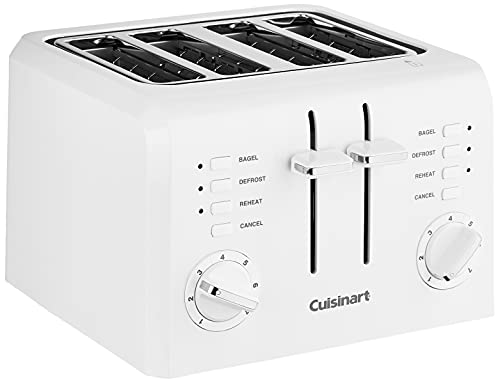
Cuisinart CPT-142P1 4-Slice Compact Plastic Toaster — Best Overall
This is the pick for apartment households of two to four people who actually eat breakfast together. Most compact toasters force a queue: one person’s toast finishes before the other’s starts. The CPT-142P1 puts four slots in a body that stays apartment-scaled, so a couple can toast in parallel and a small family can get through a weekend round without batch cooking. The plastic housing also keeps the unit light, which matters more than it sounds — in a small kitchen the toaster often lives in a cabinet and comes out daily, and a light toaster gets used while a heavy one gets resented.
Strengths
- Four slots in a compact body, so two people toast at the same time
- Light plastic housing is easy to lift in and out of a cabinet
- A proven, long-running Cuisinart compact design with straightforward controls
Trade-offs
- Plastic housing feels less premium than metal models
- Four slots still need more counter width than a two-slice unit
- White finish shows toast crumbs and kitchen splashes quickly
| Format | 4-slice compact toaster |
| Housing | Plastic, white (per Amazon title) |
| Model | CPT-142P1 |
What makes this the overall pick is balance rather than any single headline feature. Four slots change the morning maths in a shared apartment: two slices each for two people, done in one cycle, with nobody eating in shifts. Compact four-slice bodies achieve that by keeping slot spacing tight, so thick artisan slices are not its natural territory — it is a sandwich-bread, bagel-half and frozen-waffle machine, and judged on that everyday work it is exactly right for apartment life.
The daily details suit rentals too. A compact plastic body wipes down easily, does not show every fingerprint the way brushed metal does, and will not dent a landlord’s worktop if it gets knocked during a move. If your apartment seats a household rather than a single person, start here; the two-slice picks below only win when counter space is tighter than your appetite.
Ownership in a small kitchen is where this model quietly wins its badge. Four slots mean the machine earns its counter space every single day rather than only on weekends, and because the body is light, the daily lift — counter to cabinet and back — never becomes the reason breakfast defaults to cereal. Expect to empty crumbs more often than with a two-slice, simply because throughput is higher; build the twenty-second tray empty into the Sunday routine and it never becomes a smoke problem.
Best for: couples and small families in apartments who toast for more than one person at a time / Not suited for: solo renters with very narrow counters, or anyone who mainly toasts thick artisan loaves

Amazon Basics 2 Slice Toaster — Best Budget
Renters furnishing a first kitchen should look hard at this one. The Amazon Basics two-slice covers the apartment essentials without paying for branding: extra-wide slots that genuinely take bagels, six browning settings, dedicated defrost, cancel and bagel buttons, a removable crumb tray, and — the detail apartment dwellers will appreciate most — a cord wrap, so the cable is not permanently draped across a small counter or dangling into the sink zone. At 900 watts per the Amazon title, it is also a sensible load for older apartment wiring shared with a kettle or microwave.
Strengths
- Cord wrap keeps a small counter tidy between uses
- Extra-wide slots handle bagels, not just sandwich bread
- Removable crumb tray makes the weekly empty painless
Trade-offs
- Budget build and finish; it looks like what it costs
- Two slots only, so couples toast in turns
- Basic controls with no countdown or premium extras
| Format | 2-slice toaster |
| Power | 900W (per Amazon title) |
| Browning settings | 6 (per Amazon title) |
| Extras | Defrost / cancel / bagel buttons, cord wrap, removable crumb tray (per Amazon title) |
The honest way to judge a budget toaster is by what it refuses to skimp on, and this one protects the right things. Slot width and crumb handling are the two specs that decide whether a cheap toaster is a bargain or a false economy, and both are present here. The defrost button earns its keep in apartments too, where freezer space is used hard and bread is often toasted straight from frozen on weekday mornings.
Where the budget shows is in refinement: the browning dial will not be as repeatable as a premium model’s, and the housing is functional rather than handsome. For a rental kitchen, a dorm-adjacent studio, or a first flat being furnished all at once, those are the right compromises. Spend the savings on a kettle you like looking at — you will use this toaster daily and think about it almost never, which is the point.
Long-term, the value case is about replacement avoidance: renters move often, and a light, inexpensive toaster that survives moves in a kitchen box is worth more than a fragile premium unit. Keep the cord wrap used, store it upright, and this is the kind of appliance that follows you through three leases. When it eventually wears out, its replacement cost sits in the same budget tier, which is exactly the economics a first apartment needs.
Best for: first apartments, renters on a budget, and anyone who wants cord-wrap tidiness / Not suited for: households toasting for three or more people every morning

Cuisinart CPT-160P1 2-Slice Metal Classic Toaster — Best Classic Metal Build
Some apartment kitchens do have one permanent appliance spot, and if your toaster is going to live on display, it may as well be the metal classic. The CPT-160P1 pairs a brushed stainless body with a deliberately simple six-setting dial and 1.5-inch slots per the Amazon title — wide enough for bagels and thicker bakery slices without the bulk of a long-slot machine. It suits the solo renter or couple who toast once or twice a day, value a counter that looks deliberate, and would rather buy one solid toaster than replace a flimsy one twice.
Strengths
- Brushed stainless steel body suits a permanent counter spot
- 1.5-inch slots take bagels and thicker slices
- Simple six-setting dial anyone can use half-asleep
Trade-offs
- Metal body is heavier to move for cabinet storage
- Two slices per cycle, like every classic two-slice
- Stainless shows fingerprints and needs a wipe to stay smart
| Format | 2-slice toaster |
| Slot width | 1.5 in. (per Amazon title) |
| Browning settings | 6 (per Amazon title) |
| Housing | Brushed stainless steel (per Amazon title) |
The retro brief here is functional, not decorative. A single dial and a lever are the whole interface, which means guests, roommates and visiting parents can all operate it without a tutorial — an underrated apartment virtue. The metal body also shrugs off the knocks of small-kitchen life better than thin plastic shells, and it will not pick up the lingering odours that older plastic housings can hold in a compact, steamy kitchen.
Choose it when the toaster is a fixture rather than a gadget you hide. Pair it with the measurement advice later in this guide: check the counter spot against the unit’s depth, leave breathing room behind it for heat, and it will quietly do its one job for years. If your kitchen has no permanent spot at all, the lighter compact picks above and below will serve you better.
Durability is the quiet argument here. A metal body tolerates the knocks of a shared kitchen — the kettle shoved past it, the chopping board leant against it — and the simple dial mechanism has very little to go wrong. Owners of classic metal toasters tend to keep them through several homes, and in an apartment context that longevity also means one less bulky item to dispose of responsibly at move-out, which anyone who has carried a broken appliance down four flights will appreciate.
Best for: renters with one permanent appliance spot who want a durable, handsome two-slice / Not suited for: cabinet-storage kitchens where the toaster is lifted in and out daily

bella Fits-Anywhere Slim Toaster, 4 Slice — Best Slim Profile
The bella Fits-Anywhere attacks the apartment problem from the other direction: instead of shrinking capacity, it reshapes it. The slim body runs narrow across the counter while its extra long and wide slot layout handles four slices’ worth of bread in a stretched format, which also makes it the natural pick here for longer bakery slices that square two-slice slots reject. It suits kitchens where the available space is a narrow strip along the backsplash — galley kitchens, studio kitchenettes, and counters crowded by a coffee setup at one end.
Strengths
- Slim profile fits narrow backsplash strips of counter
- Extra long and wide slot suits longer bakery slices
- Four-slice capacity without a wide four-slice body
Trade-offs
- Long body needs depth along the counter run instead
- Long-slot layout is less ideal for two small slices side by side
- Style-led design; controls are simpler than premium rivals
| Format | 4-slice slim toaster |
| Slot | Extra long and wide (per Amazon title) |
| Finish | Oatmilk (per Amazon title) |
Measure before you fall for the shape: a slim toaster trades width for length, so it wins on counters that are narrow front-to-back but long along the wall, and loses in corner spots or short counter runs. In the right kitchen it is genuinely liberating — four slices at once, tucked against the backsplash, leaving the front of the counter free for a chopping board, which is where apartment cooking actually happens.
The long slot also changes what you can toast. Oblong sourdough slices, panini halves and other bakery shapes that need folding or trimming in a standard toaster lie flat here. If your bread buying leans bakery rather than sandwich loaf, this is arguably the most practical pick in the guide despite its style-first looks. Just confirm the full length against your counter run, including room for the cord, before ordering.
Living with a long-slot body teaches one habit: keep the counter run it occupies genuinely clear, because the moment clutter colonises the strip, the toaster gets pushed, angled and eventually exiled. Treat its length as reserved territory — a bread board at one end, nothing at the other — and the slim format delivers its promise daily. Wipe the light finish with a damp cloth rather than abrasives; light matte finishes reward gentle cleaning and punish scouring pads.
Best for: galley kitchens and narrow counters, and bakery-bread buyers who need a long slot / Not suited for: short counter runs or corner spots where a long body cannot sit
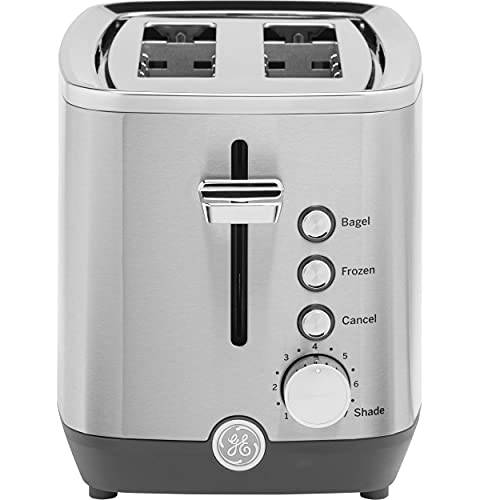
GE 2 Slice Stainless Steel Toaster — Best for Bagels and Waffles
If your apartment breakfast is more likely to be a bagel or a freezer waffle than a slice of sandwich bread, this GE is the honest specialist. The Amazon title gives the slot dimensions outright — 1.38 by 5.50 inches — and names bagels and waffles as the intended load, backed by 1,500 watts for even toasting and a defrost function for straight-from-freezer mornings. Seven shade settings give finer control than the usual six, which matters with bagels, where the line between chewy-golden and scorched is one notch wide.
Strengths
- Slot dimensions published and sized for bagels and waffles
- 1,500 watts for fast, even toasting
- Seven shade settings for finer browning control
Trade-offs
- Higher wattage is a heavier load on shared apartment circuits
- Two-slice capacity only
- Stainless body needs wiping to stay presentable
| Format | 2-slice toaster |
| Power | 1,500 watts (per Amazon title) |
| Slot size | 1.38 x 5.50 in. (per Amazon title) |
| Shade settings | 7 (per Amazon title) |
| Extras | Removable crumb tray, defrost function (per Amazon title) |
Power is this pick’s argument and its caveat in one. At 1,500 watts it browns quickly and evenly, which is exactly what dense bagels and frozen waffles need — weaker toasters leave waffles pale at the edges and bagels dried out before they colour. The removable crumb tray matters here too, because bagel seeds and waffle crumbs are the debris that ends up smoked onto the elements if a tray is awkward to empty.
The caveat is electrical, and apartment-specific: on an older circuit shared with a microwave or kettle, a 1,500-watt toaster is the appliance most likely to be involved when a breaker trips mid-breakfast. The fix is simple — do not run it simultaneously with another high-draw appliance — and the buying guide below covers circuit etiquette in small kitchens. If your mornings are bagel-shaped and your wiring is modern, this is the strongest two-slice here.
The ownership habit this GE demands is electrical, and it is simple: sequence your appliances. Toast first or microwave first, not both together, and the higher draw stops being a breaker risk and becomes pure speed — breakfast genuinely arrives faster. Bagel households will also empty the crumb tray more often than bread households, because seeds shed constantly; the slide-out tray makes that a ten-second job rather than a shake-over-the-sink ritual.
Best for: bagel and frozen-waffle households that want fast, even, well-controlled browning / Not suited for: old wiring where a 1,500-watt draw alongside other appliances trips breakers

Chefman 2 Slice Toaster — Best for Thick Bread
The Chefman is the value pick for people whose bread does not come in a uniform sandwich loaf. Its Amazon title says the quiet part out loud — this is a thick bread and bagel toaster — and it backs that with seven shade settings, defrost and cancel buttons and a removable crumb tray in a black two-slice body that disappears visually on a dark counter. It suits the apartment baker, the farmers-market sourdough buyer, and anyone who has ever had to squash a slice down into a slot that was designed for thinner bread.
Strengths
- Designed for thick bread and bagels, not just sandwich slices
- Seven shade settings for finer control on dense loaves
- Defrost and cancel buttons cover frozen and change-of-mind mornings
Trade-offs
- Two-slice throughput for a household is limited
- Black finish shows flour dust and crumbs clearly
- Value-tier build compared with the metal picks
| Format | 2-slice toaster |
| Shade settings | 7 (per Amazon title) |
| Extras | Defrost and cancel buttons, removable crumb tray (per Amazon title) |
| Finish | Black (per Amazon title) |
Thick bread fails in toasters in two ways: it jams on the way down, or it toasts unevenly because the elements sit too close to a fat slice. A model designed around thick slices addresses the geometry first, and the seven-step shade range addresses the second problem — dense, moist crumb needs longer, gentler exposure rather than a short blast, and finer steps let you find that setting instead of hopping between too pale and too dark.
In an apartment rotation this Chefman pairs well with a freezer habit: bake or buy a good loaf, slice it thick, freeze it, and defrost-toast a slice at a time. That is how small kitchens eat bakery bread without it going stale on a counter that has no room for a bread bin anyway. As a second toaster for a bread enthusiast, or a main toaster for a solo thick-slice devotee, it earns its badge honestly.
For the thick-bread routine, one ownership tip matters: slice loaves evenly before freezing, because uniform slices toast uniformly and the seven-step dial can then hold a single setting for the whole loaf. Uneven hand-cut slices are why people conclude a toaster browns inconsistently. Paired with a freezer bag of your bakery’s best loaf, this modest machine delivers a breakfast that feels anything but budget — which, in a small apartment, is the highest praise a toaster can earn.
Best for: thick-slice and sourdough lovers, and freezer-to-toast weekday routines / Not suited for: families needing four slices at once every morning
Comparison Table
| Pick | Badge | Key spec | Best for |
|---|---|---|---|
| Cuisinart CPT-142P1 4-Slice Compact Plastic Toaster | Best Overall | 4-slice compact plastic body | couples and small families in apartments who toast for more than one person at a time |
| Amazon Basics 2 Slice Toaster | Best Budget | 900W, 6 settings, cord wrap | first apartments, renters on a budget, and anyone who wants cord-wrap tidiness |
| Cuisinart CPT-160P1 2-Slice Metal Classic Toaster | Best Classic Metal Build | 1.5 in. slots, stainless body | renters with one permanent appliance spot who want a durable, handsome two-slice |
| bella Fits-Anywhere Slim Toaster, 4 Slice | Best Slim Profile | Slim long-slot 4-slice body | galley kitchens and narrow counters, and bakery-bread buyers who need a long slot |
| GE 2 Slice Stainless Steel Toaster | Best for Bagels and Waffles | 1,500W, slots 1.38 x 5.50 in. | bagel and frozen-waffle households that want fast, even, well-controlled browning |
| Chefman 2 Slice Toaster | Best for Thick Bread | 7 shades, thick-bread design | thick-slice and sourdough lovers, and freezer-to-toast weekday routines |
How to Choose the Best Apartment Toasters for Your Space
Start with the tape measure, not the product listings. Apartment toaster regret is almost always dimensional: measure the depth of your counter from backsplash to edge, the height under your wall cabinets if the toaster will sit beneath them, and the length of the run where it can live. Then decide the toaster’s lifestyle — permanent resident or cabinet guest. Permanent residents can be metal and handsome; cabinet guests should be light, with a cord solution, because a toaster that is annoying to retrieve becomes a toaster you stop using.
Next, match slots to your real bread. Sandwich-loaf households are served by any pick here. Bagel households need published slot width — look for around 1.4 inches or more and a bagel setting or at least a defrost function. Bakery-loaf households should think in terms of slot length, which points to the slim long-slot design. Frozen-breakfast households should prioritise a genuine defrost cycle, which toasts longer at lower initial heat rather than simply adding a minute of full power.
Finally, budget in tiers rather than prices. The budget tier buys correct basics — wide-enough slots, a crumb tray, simple controls — and is the rational choice for first rentals. The mid tier buys build quality, finer shade control and finishes that survive daily display. The premium end of apartment toasting buys motorised or digital refinements that are nice but rarely necessary; in a small kitchen, spending the difference on the right shape beats spending it on features. Choose the shape first, the tier second, and the brand last.
Counter Space, Cabinets and Circuits: Apartment Realities
Heat management is the apartment topic nobody mentions. A toaster vents serious heat upward and outward, so a unit parked under low wall cabinets will steam and discolour the cabinet underside over time, and one pushed flush against a wall runs hotter than it should. Leave a hand’s width behind and above where you can, and never toast under a cabinet overhang with the unit pulled forward over the counter edge — crumbs and heat both end up in the wrong places. If your only spot is under cabinets, a compact model you pull forward for use and push back after is the practical routine.
Circuits deserve equal respect. Many apartment kitchens run the counter outlets on one or two circuits shared with the fridge circuit’s neighbours, the microwave and the kettle. A 1,500-watt toaster plus a microwave will trip a marginal breaker; a 900-watt toaster is far more forgiving. Learn which of your outlets share a circuit — plug a lamp in and flip breakers once, on a quiet afternoon — and then simply stagger the big draws. It is a five-minute education that ends breakfast-time breaker trips permanently.
Storage maths completes the picture. If the toaster lives in a cabinet, measure the cabinet’s clear height and depth too, and be honest about the lift: you will do it hundreds of times a year. Light bodies, cord wraps and handles you can grip one-handed are not minor conveniences at that repetition count; they are the difference between a toaster that gets used and one that gets replaced by a frying pan.
Two-Slice, Four-Slice or Long-Slot: Choosing the Format
Format is the decision everything else hangs on, so settle it deliberately. Two-slice toasters are the default for a reason: smallest footprint, lightest body, lowest draw on the circuit, and enough capacity for one person’s breakfast or a couple eating in shifts. Their hidden cost is time — four slices for two people means two cycles, and the first slices cool while the second batch toasts. If your household eats together, that cost is paid every single morning.
Four-slice compact models remove the queue at the price of counter width, and they suit households of two to four who breakfast together. Slim long-slot models remove the queue differently, stretching along the backsplash, and add the ability to toast long bakery slices flat — but they claim a long run of counter that corner kitchens may not have. There is no universally correct format; there is only the format whose compromise your kitchen absorbs most easily. Decide by walking your actual morning: who eats, when, and what else needs the counter at the same moment.
A final format note for the smallest kitchens: if even a compact two-slice has no home, the honest alternatives are a slim model stored vertically in a deep cabinet, or skipping the pop-up format for a small toaster oven that also reheats pizza and melts cheese — a different appliance class with its own guide in this cluster, linked at the end of this article. Do not solve a space problem by buying a toaster you will hate moving; solve it by choosing the format your storage can genuinely serve.
Keeping a Toaster Clean and Odour-Free in a Small Kitchen
Small kitchens amplify everything a toaster sheds: crumbs travel, smells linger, and a neglected machine perfumes the whole flat every time it runs. The countermeasure is a light but non-negotiable routine. The crumb tray gets emptied weekly — daily users in tiny kitchens may find twice a week keeps the burnt-crumb smell away entirely. Once a month, unplug the toaster, let it cool completely, turn it gently over a bin and shake out the loose debris the tray never catches, then wipe the exterior with a damp cloth. Never use water inside the slots, never poke at elements with cutlery, and never spray cleaner into the body.
Placement hygiene matters as much as cleaning. A toaster parked beside the hob absorbs grease mist that bakes onto its finish and into its vents; a toaster parked by the sink absorbs splashes. Give it a dry, grease-free home and it stays fresher for years. If your apartment kitchen is also your living room — the studio reality — run the toaster near an open window or the extractor for the first minute of a heavy session, because toast aroma is charming at breakfast and stale by evening. These are small disciplines, but in a small space they are the difference between a kitchen that smells like breakfast and one that smells like a café bin.
How to Set Up and Use a Toaster in a Small Apartment Kitchen
Apartment toasting goes better with a small setup ritual and a few habits that keep crumbs, heat and breaker trips under control. Work through these steps when a new toaster arrives, and keep the habits that follow.
- Position first: place the toaster on a clear, level stretch of counter with space behind it for heat to escape, away from the sink splash zone and not directly under low cabinets if you can avoid it.
- Run the first cycle empty or with sacrificial bread, following the maker’s first-use guidance, to burn off manufacturing residues — open a window, because in a small apartment that first-cycle smell fills the whole living space.
- Dial in your number: toast the same bread at three settings across the dial and note which one is yours. Every model’s scale differs, and finding your setting once ends daily guesswork.
- Learn the defrost and bagel functions on a quiet weekend morning rather than a rushed weekday — frozen bread and bagel modes change timing in ways worth seeing once at leisure.
- Empty the crumb tray weekly. In a small kitchen, a full tray is a smoke source, an odour source and an ant invitation; it takes twenty seconds over the bin.
- Keep the cord disciplined: use the cord wrap if fitted, or route the cable along the backsplash, never across the hob or dangling where a sleeve can catch it.
- Stagger the big appliances: while the toaster runs, let the kettle or microwave wait. Small kitchens reward sequencing, and your breaker will thank you.
Common Buying Mistakes
Buying by slice count instead of by shape. A four-slice toaster that does not fit the counter is worse than a two-slice that does. Shape — footprint, depth, and whether it is slim or square — decides apartment success before capacity does.
Ignoring slot dimensions. If you eat bagels or thick bakery slices, an unmeasured standard slot will frustrate you daily. Look for published slot width or length, or a model explicitly designed for thick bread.
Parking the toaster under low cabinets permanently. Rising heat and steam damage cabinet undersides over time and make the toaster run hotter. Pull it forward for use, or choose a spot with clear air above.
Running every appliance at once. Toaster plus microwave plus kettle is how apartment breakers trip. Stagger high-draw appliances by a minute or two and breakfast stays peaceful.
Forgetting the crumb tray exists. In a compact kitchen, accumulated crumbs smoke, smell and attract pests fast. Weekly emptying is the whole maintenance schedule — do not skip it.
Paying for features a small kitchen cannot use. Motorised lifts and touchscreen countdowns do not toast better; the right footprint, the right slot and a tray you will actually empty do. Spend on fit first.
Final Recommendation
Match the pick to the constraint and apartment toasting becomes a solved problem. For most households, the Cuisinart CPT-142P1 is the balanced answer: four slots, compact body, light enough to move daily. Solo renters and first flats should take the Amazon Basics for its cord wrap and honest basics, while anyone with a permanent counter spot and an eye for build should take the Cuisinart CPT-160P1 in stainless. Galley kitchens belong to the bella slim, bagel households to the GE, and thick-bread devotees to the Chefman.
Whichever you choose, do the three apartment things on day one: measure the spot before the box arrives, find your shade number with a test round, and learn your kitchen’s circuit limits before the first rushed Monday. A toaster chosen on fit and used with those habits will serve a small kitchen quietly for years.
One last piece of apartment-specific advice: buy for the household you have this year, not the one you might have in three years. Kitchens change with every move, bread habits change with every new bakery nearby, and a toaster is inexpensive enough that matching it to your current counter is always the right economics. The picks above cover the realistic spread — solo, couple, small family, galley, bagel-led and bread-led — so there is a correct answer here for the apartment you actually live in. Choose it, measure twice, and let breakfast become the easiest decision of your day.
- Cuisinart CPT-142P1 4-Slice Compact Plastic Toaster — Best Overall: Check the current price on Amazon
- Amazon Basics 2 Slice Toaster — Best Budget: Check the current price on Amazon
- Cuisinart CPT-160P1 2-Slice Metal Classic Toaster — Best Classic Metal Build: Check the current price on Amazon
Keep researching the cluster: Best Toasters Best 2 Slice Toasters Best 4 Slice Toasters Best Slim Toasters Best Compact Toasters Best Toaster Ovens For Apartments
Frequently Asked Questions
What size toaster is best for a small apartment?
A compact two-slice toaster suits most solo renters, while couples do better with a compact four-slice or a slim long-slot model. The deciding measurement is counter depth and the space the toaster can occupy permanently or in storage — measure both before choosing a format.
Is a 2-slice or 4-slice toaster better for an apartment?
It depends on household size and shape, not just appetite. Four-slice models toast for two people at once but need more counter; slim four-slice designs reduce the width penalty. Solo dwellers rarely miss the extra slots and gain counter space with a two-slice.
Can I keep a toaster in a cabinet and take it out daily?
Yes, and many apartment dwellers do. Choose a light model, ideally with a cord wrap, and measure the cabinet’s clear height and depth. Let the toaster cool fully before putting it away, and empty the crumb tray first so crumbs do not migrate into the cabinet.
Why does my toaster trip the breaker in my apartment?
Usually because it shares a circuit with another high-draw appliance running at the same time, such as a microwave or kettle. Higher-wattage toasters draw more, so stagger appliances, and consider a lower-wattage model if your wiring is old and trips persist.
Do I need a bagel setting in a small kitchen?
Only if bagels are a regular breakfast. A bagel function toasts the cut side more than the crust side; without it, a wide slot plus a mid shade setting still produces good bagels, just less precisely. Slot width matters more than the button — check the published dimensions.
How do I keep crumbs under control in a tiny kitchen?
Choose a model with a removable crumb tray and empty it weekly over the bin. Toast over the counter rather than carrying slices across the room, and give the toaster’s surroundings a quick brush-down after weekend sessions when crumbs peak. In the smallest kitchens it also helps to keep a small handheld brush or the vacuum’s crevice tool nearby for the weekly counter sweep, because crumbs that reach the floor in a studio flat end up tracked through the entire living space within a day.


