Disclosure: airfryerkitchensupply.com is reader-supported. When you buy through links on our site, we may earn an affiliate commission at no extra cost to you.
Where to buy
Comparing the best american made toasters? Start here. This guide starts with the truth, because you deserve it before the picks: there is currently no mass-market pop-up toaster manufactured in the United States. Decades ago there were; today every high-street toaster — including those from American brands — is made overseas. So the picks below are the honest closest options: a hand-built, fully repairable toaster (built in the UK, and labelled as such), the strongest toasters from American companies, and two genuinely US-linked alternatives covered in prose. Nothing here is dressed up as something it is not.
- Dualit Classic 4 Slice NewGen Toaster — Check price on Amazon; choose the listing sold or shipped by Amazon or the brand’s own storefront, and confirm the exact model variant before ordering.
- GE 2 Slice Stainless Steel Toaster — Check price on Amazon; choose the listing sold or shipped by Amazon or the brand’s own storefront, and confirm the exact model variant before ordering.
- Hamilton Beach 2 Slice Toaster 22794 — Check price on Amazon; choose the listing sold or shipped by Amazon or the brand’s own storefront, and confirm the exact model variant before ordering.
- Cuisinart 4-Slice Toaster CPT-180P1 — Check price on Amazon; choose the listing sold or shipped by Amazon or the brand’s own storefront, and confirm the exact model variant before ordering.
- Wolf Gourmet High-Performance Toaster — sold mainly through the maker’s own store and specialty dealers rather than Amazon, so it is covered in prose below without a purchase link.
- Star Manufacturing Commercial Toasters — sold mainly through the maker’s own store and specialty dealers rather than Amazon, so it is covered in prose below without a purchase link.
If you are searching for the best american made toasters, you are asking a question with a disappointing literal answer and a useful practical one. The literal answer: American factories no longer produce pop-up toasters for the home market — the category moved overseas over the past half-century, brand by brand, until none remained. Any guide that hands you a cheerful list of ‘American-made toasters’ without saying this is selling you a story, not a toaster.
The practical answer is more interesting. Buyers who search this term usually want one of three things: a toaster built to be repaired rather than replaced, a purchase that supports an American company and its workers, or commercial-grade domestic manufacturing. All three are achievable — just not in the same machine. This guide ranks the six closest honest options: the repairable icon (hand-built in Britain, and proud of it), three excellent toasters from American companies, and two unlinked entries covering the premium American brand and the commercial American factory route. Read the origin note in every review before you buy; in this guide, the origin note is the review’s most important paragraph.
In this guide
Quick Picks
Six picks, six different relationships to the word ‘American’. The badges name the honest claim each machine can make — read them as carefully as the names.
- Dualit Classic 4 Slice NewGen Toaster — Best Repairable — Hand-Built in the UK. Not American — hand-built in the UK, and included because it is the only toaster that delivers what most ‘American-made’ seekers actually want: repairable, replaceable parts, built for decades. Check price on Amazon
- GE 2 Slice Stainless Steel Toaster — Best from an American Appliance Company. From GE Appliances — the Louisville, Kentucky appliance company — with 1,500W, seven shades and extra-wide slots. American company; like all modern home toasters, manufactured overseas. Check price on Amazon
- Hamilton Beach 2 Slice Toaster 22794 — Best American-Brand Value. From Hamilton Beach, the Virginia-founded American small-appliance company: extra-wide slots, bagel setting, toast boost and defrost at a value tier. Manufactured overseas, like the whole category. Check price on Amazon
- Cuisinart 4-Slice Toaster CPT-180P1 — Best American-Brand 4-Slice. From Cuisinart — founded in Connecticut and still an American kitchen institution — with dual independent controls and extra-wide slots in brushed stainless. Manufactured overseas. Check price on Amazon
- Wolf Gourmet High-Performance Toaster — Best Premium American Brand. The premium American name — Wolf Gourmet, sister to the Sub-Zero/Wolf appliance family of Wisconsin — covered in prose because no verified listing was available to link.
- Star Manufacturing Commercial Toasters — Best Truly Made-in-USA Route. The one place ‘American-made toaster’ is literally true: commercial conveyor and pop-up toasters from US foodservice manufacturers like Star — industrial machines sold through restaurant dealers.
How These Picks Were Chosen
The research method for this guide was origin verification before product verification. Each candidate’s manufacturing story was checked first: where is it actually built, and what exactly is the American connection, if any? Only then was the product itself confirmed in live catalogue data for its link. That order matters, because this search attracts more mythology than any other in the toaster category — vintage production runs remembered as current, headquarters addresses presented as factory addresses, and ‘designed in’ quietly upgraded to ‘made in’.
The ranking that emerged rewards honesty and durability over flag-waving. The top pick is not American at all, and the guide says so in its badge and its first paragraph: it earns first place because the thing most ‘American-made’ seekers actually want — a toaster built by hand, from replaceable parts, that will outlive its owner — exists today in exactly one famous machine, and it is built in England. The American-company picks follow, graded as toasters and labelled precisely: American brand, American design and support, overseas manufacture.
Two entries are not linked by principle. A premium American brand whose toasters we could not verify in the catalogue data appears without a link rather than with a borrowed one, and the commercial route — the one place American toaster manufacturing genuinely survives — is described as the industrial purchase it is. No prices are printed anywhere; check price on Amazon through the links, and treat any third-party listing claiming US manufacture for a home pop-up toaster as a claim to interrogate, not to trust.
The 6 Best American Made Toasters
Every review leads with what the machine is and where it comes from. In this guide, that is not fine print — it is the headline.
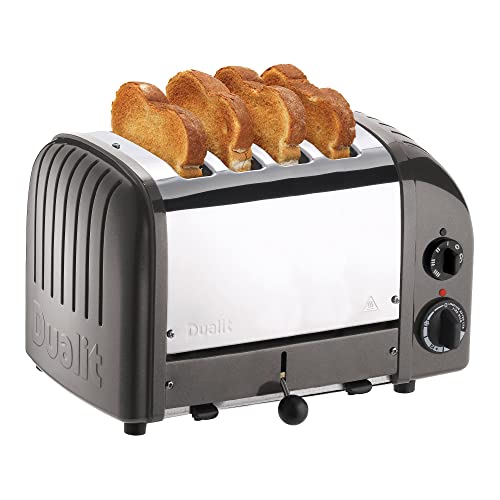
Dualit Classic 4 Slice NewGen Toaster — Best Repairable — Hand-Built in the UK
Let us be direct: the Dualit is English. It is in this guide at number one because it is the sole surviving example of how toasters were built when American factories made them — assembled by hand, from parts designed to be replaced, by a company that still sells the elements, timers and switches to keep a decades-old machine toasting. If your search for ‘American made’ really means ‘not disposable’, this is the machine your search was pointing at, one country over.
Strengths
- Replaceable ProHeat elements and a mechanical timer: the parts that wear out are the parts you can change
- Hand-built stainless construction with a service life measured in decades, not seasons
- Mechanical controls with no software to obsolete — it will never need an update or an app
Trade-offs
- It is made in the UK, not the USA — buyers for whom the flag is the point should read on to the American-brand picks
- Premium tier pricing that only makes sense amortised over its very long life
- Manual, mechanical operation: no bagel button choreography, just a timer and your judgement
| Specification | Detail |
|---|---|
| Origin | Hand built in the UK |
| Elements | Replaceable ProHeat elements |
| Controls | Mechanical timer; defrost function |
| Build | Stainless steel |
The Dualit’s argument is arithmetic. A household that replaces a budget toaster every few years spends, across two decades, a sum in the neighbourhood of one Dualit — and sends a small fleet of appliances to landfill in the process. The Dualit owner instead replaces an element occasionally, with a screwdriver, from parts the maker still stocks. That was the normal economics of appliances in the era of American toaster factories; Dualit is simply the company that never stopped.
As a toaster it is defiantly analogue: a mechanical timer, a satisfying manual lever, toast judged by eye and habit. Owners tend to become evangelists, and unusually for appliances, the evangelism is rational. If the spirit of your search is durability and repairability, your search ends here — with a Union Jack on the factory, honestly declared.
Best for: buyers whose real brief is a repairable toaster for life / Not suited for: buyers for whom US manufacture itself is non-negotiable
Check on Amazon to see the current listing, the exact variant and delivery options before you decide.
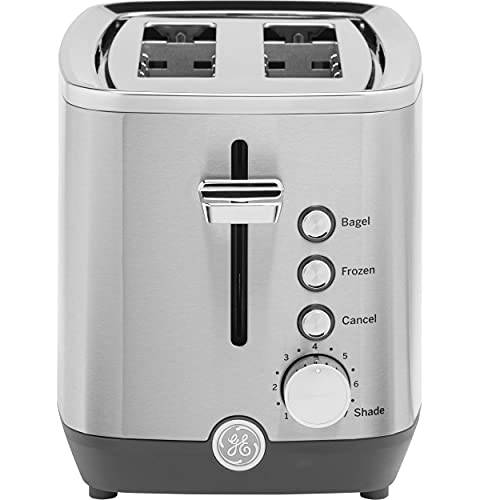
GE 2 Slice Stainless Steel Toaster — Best from an American Appliance Company
GE is one of the oldest names in American appliances, and its modern appliance business is headquartered and engineered in Louisville, Kentucky, where it employs thousands of Americans — while, in common with every brand in this guide, its toasters are manufactured overseas. What you get for choosing it is a genuinely strong toaster: an unusually full 1,500 watts, seven shade settings, extra-wide slots measured at 1.38 by 5.50 inches, and a removable crumb tray, from a company with a real American service network behind it.
Strengths
- 1,500W is serious power for a 2-slice — fast cycles and confident browning
- Extra-wide slots with published dimensions fit bagels and waffles honestly
- Backed by GE Appliances’ American service and parts infrastructure
Trade-offs
- Manufactured overseas, as every modern home toaster is — the American element is the company, not the factory
- Two-slice format only in this model
- Seven shades still reward a morning of calibration to find your number
| Specification | Detail |
|---|---|
| Power | 1,500W |
| Slots | Extra-wide, 1.38 x 5.50 in |
| Controls | 7 shade settings; defrost function |
| Cleaning | Removable crumb tray |
Judged purely as a toaster, this GE is one of the strongest 2-slice machines in any of our guides: the wattage shows in its pace, the slots take the bread Americans actually eat, and the shade range is graduated rather than decorative. Judged on origin, it is the honest modern compromise — an American company, American design and support, overseas manufacture — stated plainly so you can decide how much of your brief it satisfies.
For many searchers, that compromise is the right landing spot: support American appliance employment and engineering where it still exists, and own a toaster that is excellent at being a toaster. The guide simply refuses to let you buy it believing something that is not true.
Best for: buyers who want an American appliance company and a strong everyday toaster / Not suited for: buyers requiring US factory manufacture
Check on Amazon to see the current listing, the exact variant and delivery options before you decide.

Hamilton Beach 2 Slice Toaster 22794 — Best American-Brand Value
Hamilton Beach has been an American kitchen name for over a century, headquartered in Virginia, and its toasters are the value end of the American-brand story: extra-wide slots, a bagel setting, toast boost for small slices, defrost, auto-shutoff and a slide-out crumb tray, at a tier most households can reach without thinking twice. The manufacture is overseas — as it is for every home toaster sold today — but the design, brand and support are as American as the modern category offers.
Strengths
- Full feature set at a value tier: bagel setting, toast boost, defrost, auto-shutoff
- Extra-wide slots handle the breads that defeat narrow budget machines
- A century-old American small-appliance brand with real support behind it
Trade-offs
- Overseas manufacture — the American connection is brand and design, stated openly
- Budget-tier build rewards gentle treatment of lever and tray
- Two-slice capacity suits small households best
| Specification | Detail |
|---|---|
| Slots | 2 extra-wide slots |
| Controls | Bagel setting, defrost, cancel; Toast Boost |
| Safety | Auto-shutoff |
| Cleaning | Slide-out crumb tray |
There is a reason this model also appears in our affordable-toasters guide: it is simply a very complete budget toaster. In this guide it wears a different badge — the value face of buying American-brand — and it earns it the same way, by covering the whole brief without a hidden omission and by standing behind a name that has answered American customers’ calls for generations.
Buy it if your brief reads ‘support an American company, spend sensibly, eat good toast’. That is a coherent brief, honestly satisfiable — and this machine satisfies it more completely than anything else at its tier.
Best for: value buyers who want an established American brand / Not suited for: US-manufacture purists or four-slice households
Check on Amazon to see the current listing, the exact variant and delivery options before you decide.
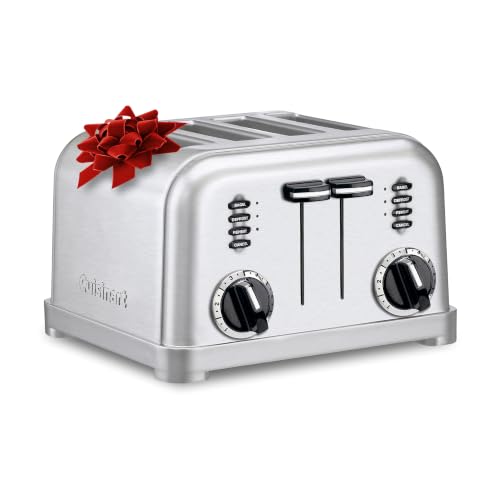
Cuisinart 4-Slice Toaster CPT-180P1 — Best American-Brand 4-Slice
Cuisinart began in Connecticut in the 1970s by bringing the food processor to American kitchens, and its toasters carry that American culinary-brand heritage into the category’s best 4-slice format: dual independent controls so two people toast differently at once, six-setting browning dials, extra-wide slots and a brushed stainless body. The manufacture is overseas, as with every pick here; the brand, design language and support are the American contribution.
Strengths
- Dual independent controls: two users, two shades, one machine, no arguments
- Extra-wide slots and a genuine six-setting range per side
- Brushed stainless build with the presence of a countertop fixture, not an appliance of the week
Trade-offs
- Overseas manufacture, openly noted — the American element is the brand
- Four slots cost counter space two-slice households may begrudge
- Stainless finish asks for a wipe to stay at its best
| Specification | Detail |
|---|---|
| Capacity | 4 slices, dual independent controls |
| Slots | Extra-wide slots |
| Controls | 6-setting browning dials |
| Finish | Brushed stainless steel |
| Model | CPT-180P1 |
The dual-control layout is the feature families actually use: one side set dark for the sourdough devotee, the other light for the white-bread traditionalist, both cycles running at once. It sounds minor until a household has lived with a single-dial four-slice and its daily compromise. Cuisinart’s execution — solid dials, even browning, slots that take real bread — has made this model a fixture of American counters for years.
In this guide’s terms it is the family-sized American-brand answer: not US-made, and never claimed here to be, but a product of an American kitchen company with a half-century of standing. For the household that wants four slices and that heritage, it is the natural landing spot.
Best for: families wanting an American culinary brand in a 4-slice format / Not suited for: small households or US-manufacture purists
Check on Amazon to see the current listing, the exact variant and delivery options before you decide.
Wolf Gourmet High-Performance Toaster — Best Premium American Brand
Wolf is the American luxury-appliance name: ranges from Wisconsin’s Wolf Appliance, refrigeration from Sub-Zero, and a countertop line under the Wolf Gourmet badge that includes a high-performance toaster with extra-wide slots, self-centring guides and the fit and finish of the parent brand. Its toasters are manufactured overseas — even at this tier, the factory reality holds — but the design brief, brand and premium support structure are American luxury through and through. It appears here without a purchase link, because our verification searches did not return a listing we could stand behind.
Strengths
- Premium American luxury-appliance brand with design and support to match
- Extra-wide, self-centring slots and high-performance browning brief
- Build quality aimed at the top of the home market
Trade-offs
- No verified Amazon listing at research time — buy through Wolf Gourmet dealers or the brand’s own channels
- Manufactured overseas despite the premium American branding
- Premium tier commitment for a two-slice job
The Wolf Gourmet toaster exists for the buyer whose kitchen already speaks its language — the range, the fridge, the whole Wisconsin-litany — and who wants the countertop to match in weight, finish and browning ambition. By all credible accounts it toasts superbly. What it does not do, and what no listing should imply, is roll off an American production line; the premium buys design, materials and support, not a domestic factory.
Our advice is procedural: if this is your toaster, buy it from the brand or an authorised dealer where the product and warranty are unambiguous, and enjoy it as the finest American-brand toaster — with the origin understood, which is the only way this guide wants you buying anything.
Best for: Wolf/Sub-Zero households wanting the matching premium American-brand toaster / Not suited for: anyone who needs a verified Amazon listing or US manufacture
This pick is covered without a link: no verified Amazon listing for the cooker itself was confirmed when this guide was researched, so check the maker’s own store for current availability rather than trusting a marketplace listing under a similar name.
Star Manufacturing Commercial Toasters — Best Truly Made-in-USA Route
If US manufacture is truly non-negotiable, here is where it survives: the commercial foodservice industry. Manufacturers such as Star — part of the Middleby family of foodservice equipment companies — build conveyor and heavy-duty pop-up toasters in American factories for diners, hotels and institutions, and sell them through restaurant supply dealers. These are the genuine article: domestic manufacture, commercial duty cycles, and price tags, footprints and power requirements to match. They are covered in prose because they are not consumer products and are not sold as such.
Strengths
- Actual US factory manufacture — the literal answer to the search
- Commercial duty cycles that make home toasters look fragile
- Dealer network sells parts and service for working kitchens
Trade-offs
- Commercial machines: commercial prices, footprints, warm-up times and often commercial power needs
- Sold through foodservice dealers, not consumer channels — no link is offered here
- Wildly over-specified for toast for two
It is worth understanding why the surviving American toaster is a commercial one. Institutions buy on lifetime cost and serviceability, so domestic factories with dealer support still pencil out; home buyers buy on shelf price, and the home category’s manufacturing followed that arithmetic overseas decades ago. The Star route is therefore real but narrow: a diner-grade conveyor toaster in a home kitchen is a statement, a hobby and a significant installation, all at once.
We include it because a guide that says ‘nothing is made in America’ while a factory in the Midwest ships toasters daily would be committing the same sin as the guides that pretend your high-street toaster is domestic. The truth has a shape: home pop-ups, no; commercial machines, yes. Choose with the whole map in front of you.
Best for: purists for whom US manufacture outranks every other consideration / Not suited for: ordinary home buyers, for whom every other pick here is more suitable
This pick is covered without a link: no verified Amazon listing for the cooker itself was confirmed when this guide was researched, so check the maker’s own store for current availability rather than trusting a marketplace listing under a similar name.
Comparison Table
Read the origin column first — it is the point of this guide. The machines split into three honest groups: hand-built and repairable (UK), American-brand and overseas-made (three picks), and the unlinked premium and commercial routes.
| Pick | Badge | Key spec | Best for |
|---|---|---|---|
| Dualit Classic 4 Slice NewGen Toaster | Best Repairable — Hand-Built in the UK | Hand-built UK, replaceable elements | buyers whose real brief is a repairable toaster for life |
| GE 2 Slice Stainless Steel Toaster | Best from an American Appliance Company | 1,500W, extra-wide slots, GE Appliances (US company) | buyers who want an American appliance company and a strong everyday toaster |
| Hamilton Beach 2 Slice Toaster 22794 | Best American-Brand Value | Extra-wide slots, bagel setting, US brand | value buyers who want an established American brand |
| Cuisinart 4-Slice Toaster CPT-180P1 | Best American-Brand 4-Slice | 4-slice, dual controls, US brand | families wanting an American culinary brand in a 4-slice format |
| Wolf Gourmet High-Performance Toaster | Best Premium American Brand | Premium US luxury brand (direct/dealer sale) | Wolf/Sub-Zero households wanting the matching premium American-brand toaster |
| Star Manufacturing Commercial Toasters | Best Truly Made-in-USA Route | US-made commercial toasters (dealer sale) | purists for whom US manufacture outranks every other consideration |
The Honest History of the American Toaster
America invented the pop-up toaster market and, for most of the twentieth century, made the world’s toasters — Sunbeam, Toastmaster, Dualit’s American contemporaries and a dozen others poured from factories across the Midwest and Northeast. The T-20-era machines were built like the Dualit still is: heavy, repairable, and expected to serve for decades. If you own a mid-century American toaster, you own a piece of industrial history, and it may well still work.
The economics turned in stages: labour costs, globalised supply chains and shelf-price competition moved production first to Mexico and then to Asia, brand by brand, through the eighties, nineties and two-thousands. The brands survived — GE, Hamilton Beach, Cuisinart are American companies still — but the factories did not. By the time online shopping made ‘where is it made’ a searchable question, the honest answer for home pop-up toasters had become: nowhere in America.
Two survivals complicate the story usefully. Britain’s Dualit kept the old manufacturing philosophy alive — hand assembly, replaceable everything — proving the model still works at a premium. And America’s own commercial foodservice industry kept domestic toaster production running for buyers who purchase on lifetime cost. The home buyer in 2026 stands between those two survivals, and this guide is organised around exactly that map.
What ‘American Made’ Shoppers Usually Want — and How to Get It
Unpack the search and it usually contains three different wishes. The first is durability: a toaster that does not die in year two. That wish is served by build philosophy, not geography — the Dualit’s replaceable elements answer it directly, and the better American-brand machines answer it partially with stronger mechanisms and support. The second wish is economic: spend with American companies and workers. That wish is genuinely served by the GE, Hamilton Beach and Cuisinart picks — headquarters, design, engineering and service jobs are real employment, even when the factory is overseas.
The third wish is the literal one: a product of an American factory. For a home pop-up toaster, that wish cannot currently be granted, and any seller claiming otherwise deserves hard questions — ask for the factory’s name and town, and watch the claim dissolve into ‘designed in’ or ‘assembled from global parts’. For a commercial machine, the wish is grantable through the dealer route described in this guide, at commercial cost and scale.
Knowing which wish is yours turns a frustrating search into a short one. Durability: pick one. Economic support: picks two to four. Premium brand coherence: pick five. Literal manufacture: pick six, with eyes open. All four answers are respectable; the only failure is buying one wish while believing you bought another.
How to Spot Fake ‘American Made’ Claims
The tells are linguistic. ‘Made in USA’ is a regulated claim with a strict meaning; sellers who cannot meet it reach for the fog around it — ‘American brand’, ‘USA company’, ‘designed in California’, ‘assembled in the USA’ from imported components, flag imagery with no origin statement at all. Each phrase may be individually true while the impression it creates is false, and toaster listings are thick with all of them.
Your defences are simple. Find the country-of-origin line — legitimate listings and manuals state it — and treat its absence as an answer. Check the maker’s own website rather than a marketplace page, and be most suspicious of no-name brands waving the largest flags: the genuinely American-connected makers in this guide are famous companies with reputations to lose, and they state their overseas manufacture plainly when asked.
Finally, keep the perspective this guide began with: overseas manufacture is not a moral failing in a toaster, and several picks here are excellent machines. The failing is only in the disguise. Buy the machine whose story is told straight — that habit will serve you in every category, not just this one.
The Vintage Route: Restoring a Classic American Toaster
There is one more way to own an American-made toaster, and for the mechanically inclined it is the most satisfying: buy the past. Mid-century American toasters — Sunbeam’s automatics, Toastmaster and a dozen regional makers — were built from heavy steel and elements designed to be serviced, and they survive in large numbers at estate sales and online auctions. A sound example, cleaned and fitted with a modern cord by someone competent, toasts with a gravity and evenness that explains the era’s reputation.
Enter the route with open eyes. Vintage appliances predate modern safety standards: no auto-shutoff culture, cords that perish, and insulation that assumes a different century’s wiring. Have any vintage toaster inspected by an electrician or a competent restorer before it meets your kitchen, never leave it running unattended, and treat it as the cherished vintage object it is rather than a fit-and-forget appliance. The community of restorers around these machines is knowledgeable and generous — use it.
Judged as a purchase, a restored classic is not cheaper, safer or more convenient than the modern picks in this guide. Judged as an object — American-made in the fullest sense, repairable by design, and beautiful in a way modern appliances rarely attempt — it may be the most satisfying answer to the search that brought you here. This guide’s honesty cuts both ways: the past was real, and it is buyable, at the price of treating it as the past.
What Happened to American Appliance Factories — and What Remains
The toaster’s story is the small-appliance story in miniature. American factories once made nearly everything on the kitchen counter; then, category by category, production followed labour costs and retailer price pressure overseas. What remained onshore is instructive: the categories where buyers pay for lifetime value, service networks and customisation — commercial foodservice equipment, high-end refrigeration and cooking — kept their American factories, because their customers do the five-year arithmetic that home shelf prices discourage.
That is why the map in this guide looks the way it does. The American appliance industry is not gone; it is concentrated where the economics reward it, employing Americans in engineering, design and manufacturing at the premium and commercial tiers. A buyer who wants to support that industry has real options — the American-brand picks here, the Wolf Gourmet route, the commercial machines — provided they buy with the map in front of them rather than a slogan.
The hopeful reading is that the map is not fixed. Repairability is returning to product design, lifetime cost is returning to buyer thinking, and the Dualit’s decades of quiet success prove a market exists for the built-to-keep appliance. If that market grows, the factory geography can follow it. The most American-made thing a buyer can do today may be to purchase like the customers who kept the surviving factories alive: on lifetime value, and out loud.
Care, Repair and the Long Life of a Good Toaster
Whichever honest route you took through this guide, the ownership ethic is the same, and it is the ethic the old American factories assumed: keep the machine, maintain it, repair it when it asks. The daily layer is crumbs and cleanliness — tray emptied weekly, slots kept clear, exterior wiped — because debris is the slow enemy of elements and mechanisms alike. The seasonal layer is inspection: the cord’s condition, the lever’s action, the crumb tray’s slide, and on machines that offer them, the state of replaceable parts before they fail rather than after.
Repair deserves a word of rehabilitation. A toaster is among the simplest appliances in the home — elements, a timer or thermostat, a latch — and the makers in this guide who sell parts, Dualit above all, demonstrate that a dead element is a component swap, not a funeral. Even where you will not repair a machine yourself, choosing brands with parts pipelines and service networks keeps the option alive for the repair cafés and independent fixers who increasingly do this work.
There is a quiet satisfaction in this ethic that no unboxing provides: the toaster that has served a household for fifteen years becomes part of the kitchen’s furniture of memory. The American-made era understood that satisfaction as the product itself. Buying for it — repairable where possible, supported where not, and honestly labelled always — is how a modern buyer honours the tradition without being sold a myth about it.
How to Verify a Toaster’s Origin Before You Buy
Five minutes of checking beats a purchase built on a flag emoji. Here is the routine this guide used, in the order to use it.
- Find the country-of-origin statement. Look for the explicit ‘Country of Origin’ field on the listing or the maker’s product page. If it names a country, you have your answer; if the field is missing, treat that as information too.
- Read the maker’s own site, not just the marketplace. Brands state their manufacturing honestly on their own pages and in manuals. A claim that appears only in marketplace bullet points and nowhere on the maker’s site is marketing, not fact.
- Translate the weasel words. ‘Designed in’, ‘engineered in’, ‘American brand’ and ‘USA company’ describe headquarters and design teams. None of them describe a factory. Only ‘Made in’ does — and it is a regulated phrase.
- Check for repairability as a durability proxy. Makers who sell elements, timers and switches for their toasters are telling you the machine is built to be kept. That parts list is worth more than any origin slogan.
- For commercial claims, call the dealer. Foodservice dealers will name the factory and town for genuinely domestic machines like Star’s, because their customers ask. A seller who cannot name the factory is not selling a domestic product.
Run this routine once and you will never read an appliance listing the same way again — which is rather the point. Origin honesty is a habit of mind, and the toaster category, with its century of American history and its present reality, is the perfect place to learn it.
Common Buying Mistakes
Believing flag imagery equals manufacture
A flag on the box is a design choice, not an origin statement. In this category it appears on machines made on three continents. Find the country-of-origin line or assume nothing.
Paying a premium for a ‘USA’ claim that dissolves
Some sellers price the implication of American manufacture into machines that are merely American-branded. The genuine American-brand picks in this guide cost no such mythology premium — compare before you pay for a story.
Dismissing the Dualit for being British without hearing its case
If your underlying wish is a repairable, decades-long toaster, the Dualit is the only machine that fully grants it. Rejecting it on geography while buying a disposable machine instead serves neither the wish nor, in the long run, anyone’s economy.
Assuming vintage American toasters prove current production
A working 1960s Toastmaster proves American factories once made superb toasters — a fact this guide celebrates. It says nothing about today’s shelves, and sellers who blur that line are blurring it on purpose.
Overlooking the commercial route when the brief is literal
Buyers who truly require US manufacture sometimes give up entirely, never learning that commercial foodservice production survives. It is expensive and oversized for most homes — but it exists, and a complete guide must say so.
Final Recommendation
Decide which wish brought you here, and the guide resolves itself. For a toaster built the way American factories once built them — by hand, from replaceable parts, for decades — buy the Dualit, knowing it is British and not caring, because it is the philosophy you were actually shopping for. For an excellent toaster from an American company, take the GE for power, the Hamilton Beach for value, or the Cuisinart for family-sized dual control. For the premium American brand experience, shop Wolf Gourmet through its dealers. And for literal US manufacture, go commercial through a foodservice dealer — the one honest door still open. What this guide will not do is sell you a flag sticker on an ordinary import; you came for the truth, and the truth, it turns out, still toasts very well.
The linked shortlist, for convenience: Dualit Classic 4 Slice NewGen Toaster (check price on Amazon); GE 2 Slice Stainless Steel Toaster (check price on Amazon); Hamilton Beach 2 Slice Toaster 22794 (check price on Amazon); Cuisinart 4-Slice Toaster CPT-180P1 (check price on Amazon).
Related guides in this series: Best Affordable Toasters; Best And Most Popular Toasters; Best Air Fryer Toasters; Best 6 Slice Toasters; Best 2 Slice Toasters.
Frequently Asked Questions
Are any pop-up toasters made in the USA today?
No mass-market home pop-up toaster is currently manufactured in the United States — every major home brand produces overseas. American toaster manufacturing survives in the commercial foodservice sector, where companies such as Star build conveyor and heavy-duty toasters domestically for restaurants and institutions.
Is the Dualit toaster American made?
No — Dualit toasters are hand-built in the United Kingdom, with replaceable elements and mechanical timers. They appear at the top of this guide because they embody the repairable, built-for-decades philosophy that most ‘American made’ searchers are actually looking for, and the guide labels their origin openly.
Which American companies still make toasters?
American companies such as GE Appliances, Hamilton Beach and Cuisinart design, market and support toasters in the United States, employing American workers in engineering, design and service — while the toasters themselves are manufactured overseas, as is universal in the modern home category.
Why did toaster manufacturing leave the United States?
Shelf-price competition and globalised manufacturing moved production overseas in stages from the 1980s onward. Home buyers chose on price, so factories followed the economics; commercial buyers, who purchase on lifetime cost and service, kept a domestic industry alive in the foodservice sector.
What does ‘designed in the USA’ mean on a toaster listing?
It means the design and engineering work happened in the United States, while manufacture happened elsewhere. It is a legitimate point of pride and supports American jobs — but it is not ‘made in the USA’, and listings that blur the two are relying on you not to notice the difference.
Is a vintage American toaster worth buying instead?
A mid-century American toaster can be a joy — heavy, repairable and often still working — but buy it as a vintage appliance: check the cord and elements, expect to maintain it, and never leave it unattended. It is a hobbyist’s route to American manufacture, not a like-for-like alternative to a modern machine with modern safety features.
Did Toastmaster and Sunbeam really make toasters in the USA?
Yes — for most of the twentieth century, the great American toaster brands manufactured domestically, and their mid-century machines remain common, collectible and often restorable today. Current models under those historic names are produced overseas, which is why vintage and modern examples of the same brand have entirely different origin stories.
Is assembled in the USA the same as made in the USA?
No. Assembled in the USA generally means domestic assembly of substantially imported components, and it is a weaker, different claim from the regulated Made in USA standard. Both can be legitimate — but they are not interchangeable, and listings that blur them are relying on the blur.
Are there American-made toaster ovens?
The same market logic applies: home toaster ovens from American brands are manufactured overseas, while commercial conveyor and contact toasters for foodservice remain the domestic stronghold. Buyers seeking US manufacture should again look to the commercial dealer channel, with commercial expectations.
What is the closest thing to a classic American toaster made today?
In spirit, the Dualit Classic: hand-assembled, mechanically timed, built from replaceable parts in the maker’s own factory — in England. In letter, the commercial American machines from the foodservice industry. Nothing in the modern home market combines both the philosophy and the flag, which is the finding this entire guide exists to report honestly.
Does buying an American brand really support American jobs?
Yes, in the parts of the business that remain domestic: headquarters, product design, engineering, marketing, customer service and parts distribution are real American employment, and the companies in this guide maintain substantial US operations. It is not factory employment, and this guide does not pretend otherwise — but it is not nothing, either.


