Disclosure: airfryerkitchensupply.com is reader-supported. When you buy through links on our site, we may earn an affiliate commission at no extra cost to you.
Where to buy
This guide ranks the best american made bread machines as honestly as the category allows. Read the first paragraph of this guide before using this box: the honest headline is that no major bread machine is manufactured in the USA today. The machines below are the best bread makers from American companies — US-designed, US-supported, and verified against Amazon’s catalog data — which is what this search can realistically deliver.
- West Bend Hi-Rise Bread Maker — Best American Heritage Pick: Check the current price on Amazon
- Hamilton Beach Digital Bread Maker 29987 — Best Value American Brand: Check the current price on Amazon
- Cuisinart Convection Bread Maker CBK-210 — Best Premium American Brand: Check the current price on Amazon
- Hamilton Beach Bread Maker with PFAS-Free Pan — Best for Coating-Conscious Buyers: Check the current price on Amazon
- Cuisinart Compact Automatic Bread Maker CBK-110 — Best Compact American Brand: Check the current price on Amazon
- Elite Gourmet Programmable Bread Maker EBM8103SS — Best Feature Value: Check the current price on Amazon
If buying American brands matters to you, the practical wins are real even without a US factory: US-based support, US-written manuals and recipes measured in cups, and parts stocked domestically. Check the current price on Amazon for the models below.
Here is the straight answer this page owes you before any picks: the best american made bread machines, in the literal manufactured-in-the-USA sense, do not exist as a current product category. Every major bread machine sold in America today — including the excellent Japanese and European brands — is manufactured in Asia. What does exist, and what this guide ranks, is the best bread machines from American companies: brands headquartered in the US, designing for American kitchens, supporting customers from US offices, and in West Bend’s case, carrying a bread-machine heritage that goes back to the category’s beginning.
We think that honesty matters more than a misleading list. Some guides quietly relabel foreign-made machines as American; we will not. Instead, this guide tells you exactly what “American” buys you in this category — US-based customer support that answers in your time zone, recipes and manuals written for American ingredients and cup measures, replacement pans and paddles stocked in US warehouses, and companies accountable to US consumer law — and then ranks the six best machines from American brands, each verified against Amazon’s catalog data.
If your heart is set on US manufacturing above all, the realistic routes are vintage machines (West Bend and Breadman models from the 1990s were the last of the US-assembled era, and they appear on resale markets) or a stand mixer plus your oven, which is how most American bakeries’ worth of home bread actually gets made. For everyone else — buyers who want an American brand on the counter and fresh bread on the table — the six machines below are the strongest choices, led by the two heritage names in American bread machines.
In this guide
Quick Picks
Best American Heritage Pick — West Bend Hi-Rise Bread Maker
From the Wisconsin company that helped invent the home bread machine: a traditionally shaped horizontal pan with dual knead blades and loaves up to 3 lb — the biggest here. Check on Amazon
Best Value American Brand — Hamilton Beach Digital Bread Maker 29987
The Virginia brand’s full-featured machine: 14 settings with artisan and gluten-free programs, a 2 lb capacity and delay start, at a price that undercuts most of the category. Check on Amazon
Best Premium American Brand — Cuisinart Convection Bread Maker CBK-210
Cuisinart’s flagship: a convection fan for even, artisan-style crust, 16 programs including a sourdough starter cycle, and an automatic dispenser that adds nuts and fruit at the right moment. Check on Amazon
Best for Coating-Conscious Buyers — Hamilton Beach Bread Maker with PFAS-Free Pan
The model for buyers who read pan coatings carefully: a PFAS-free nonstick pan and paddle, 12 settings with gluten-free, and a 2 lb capacity in black. Check on Amazon
Best Compact American Brand — Cuisinart Compact Automatic Bread Maker CBK-110
Cuisinart’s smaller machine for smaller kitchens: up to 2 lb loaves from a compact footprint, 12 programs, and a paddle-removal alert so the paddle need not bake into the loaf. Check on Amazon
Best Feature Value — Elite Gourmet Programmable Bread Maker EBM8103SS
The California brand’s feature maximizer: 19 presets — the most in this guide — three loaf sizes, gluten-free, dough and jam programs, in stainless. Check on Amazon
How These Picks Were Chosen
Selection for this guide applied two filters. First, the brand filter: the maker had to be an American company — headquartered and designing in the United States — with US-based support. That admits West Bend, Hamilton Beach, Cuisinart and Elite Gourmet, and excludes the Japanese and Chinese brands that dominate the wider market, however good their machines are. Second, the quality filter: the machine had to be a genuinely good bread maker on the usual criteria — loaf quality, pan shape, programs, delay timer and parts availability.
Every model was verified against Amazon’s catalog data on 2026-11-21, and only confirmed models carry purchase links. We state each brand’s manufacturing reality plainly in its review rather than implying US production. We also weighed the things American buyers specifically ask about: whether recipes are given in US cup measures, whether the company stocks replacement pans and kneading paddles domestically, and how reachable support is when a machine misbehaves in month thirteen.
The result spans the category: the heritage West Bend with its traditional horizontal loaf, two Hamilton Beach values at different feature levels, two Cuisinarts including a convection model, and a feature-rich Elite Gourmet. All six bake good bread; they differ in loaf shape, features and how much hand-holding their recipe books provide.
We also want to be transparent about the brands we excluded and why: the Japanese makers build superb machines — several would top a brand-blind version of this list — but they are not American companies, and including them would have betrayed the one thing this search asks for. This guide serves the buyer who has already decided the brand’s home matters, and serves them honestly about what that does and does not include.
The 6 Best American-Brand Bread Machines

West Bend Hi-Rise Bread Maker — Best American Heritage Pick
West Bend is the name American bread-machine history starts with, and the Hi-Rise is its modern flagship. Where most machines bake a tall, square loaf, the Hi-Rise uses a horizontal pan with dual knead blades to produce a traditionally shaped loaf that slices like bakery bread — and at up to 3 lb, the largest capacity in this guide. For American buyers who care about heritage brands, this is the flagship of the home team.
Strengths
- Traditional horizontal loaf shape that slices evenly for sandwiches
- Dual knead blades handle large and heavy doughs properly
- Up to 3 lb capacity, the largest in this guide, with 12 programs including gluten-free
Trade-offs
- Large footprint; the horizontal pan needs counter room
- Manufactured overseas like every modern rival, despite the heritage brand
- Fewer premium touches than the Cuisinart convection model
| Loaf sizes | Up to 3 lb, 3 sizes |
| Pan | Horizontal pan with dual knead blades |
| Programs | 12 programs including gluten-free |
| Crust | 3 crust colors |
Loaf shape sounds cosmetic until you make sandwiches. The tall loaves from vertical pans give you a few perfect slices from the middle and awkward heels at the ends; the Hi-Rise’s horizontal loaf gives uniform slices from end to end, which is why sandwich households consistently prefer it. The dual blades matter at the 3 lb size too — a single paddle cannot knead that much dough evenly, and under-kneaded big loaves are the classic failure of cheap large machines.
West Bend’s American story is genuine but should be stated accurately: the company is a Wisconsin original with more than a century of history, and like the entire industry it manufactures this machine overseas. What remains American is the design brief — big loaves, US measures, hearty whole-grain recipes — and the support structure. If those are the things you mean by buying American, this is the most authentic pick in the category.
Best for: sandwich households and heritage-brand buyers who want big, traditionally shaped loaves / Not suited for: small kitchens, or buyers who want convection and premium features

Hamilton Beach Digital Bread Maker 29987 — Best Value American Brand
Hamilton Beach — headquartered in Virginia and one of the oldest names in American small appliances — makes the value case for the home team. The 29987 packs 14 programs including artisan and gluten-free cycles into a 2 lb machine with delay start, at a tier that embarrasses many imported rivals. For most households, this is the American-brand machine that does everything needed and nothing that inflates the price.
Strengths
- 14 programs including artisan and gluten-free at a budget-friendly tier
- Delay start for waking up or coming home to fresh bread
- US brand support and widely stocked replacement pans and paddles
Trade-offs
- Vertical loaf shape, like most machines at this tier
- Basic exterior finish compared with the Cuisinarts
- Manufactured overseas, as with all modern bread machines
| Capacity | 2 lb loaf |
| Programs | 14 programmable settings including artisan and gluten-free |
| Timer | Delay start |
| Finish | White and stainless steel |
The artisan program is the feature that lifts this model above basic budget machines: it manages the longer, slower rises that give lean doughs real flavor and crust, rather than forcing every recipe through the same fast cycle. Combined with a proper delay timer — load it at night, wake to the smell of bread — the 29987 covers both the convenience case and the enthusiast case for a home machine, which is a rare combination at its tier.
Where it concedes ground is presentation and loaf geometry: the vertical pan produces the familiar tall loaf, and the housing is functional rather than handsome. Neither matters to the bread. For buyers whose priority is an American brand, honest features and a fair price, this is the machine we would hand over first — and the one whose replacement parts will still be orderable years from now.
Best for: most households wanting an American-brand machine with full features at a fair tier / Not suited for: buyers who want a horizontal loaf or a premium countertop presence

Cuisinart Convection Bread Maker CBK-210 — Best Premium American Brand
Cuisinart — the American brand that taught home cooks to want professional tools — builds the premium entry in this guide. The CBK-210’s convection fan circulates hot air for the most even crust of any machine here, its 16 programs include a genuine sourdough starter cycle, and the automatic mix-in dispenser adds fruit, nuts and seeds at the correct point in kneading instead of leaving you listening for a beep.
Strengths
- Convection baking gives the most even, bakery-style crust in this guide
- 16 programs including sourdough starter, the widest range here
- Automatic mix-in dispenser removes the babysitting from fruit and nut loaves
Trade-offs
- Premium tier pricing within the American-brand field
- Vertical loaf, despite the premium features
- More technology to learn than the basic machines
| Capacity | 2 lb |
| Programs | 16 programs including sourdough starter |
| Baking | Convection fan |
| Extras | Automatic mix-in dispenser |
Crust is where bread machines usually betray themselves — pale tops, uneven sides — and convection is the direct fix, which is why this model’s loaves come closest to oven-baked among the six. The sourdough starter program deserves its mention too: maintaining a starter cycle in the machine lowers the barrier to real sourdough for home bakers, and combined with the artisan-style programs it makes the CBK-210 the enthusiast’s choice among American brands.
The dispenser is the convenience you will use weekly. Anyone who has hovered by a bread machine waiting for the add-in beep — or forgotten it and found raisins shredded into the dough — understands the value of automating it. Add the brand’s US support and recipe development, and the premium is accounted for: this is the machine for the buyer who wants the best American-brand bread maker, full stop.
Best for: enthusiasts who want the best crust and widest program range from an American brand / Not suited for: budget buyers, or anyone who wants a horizontal loaf shape
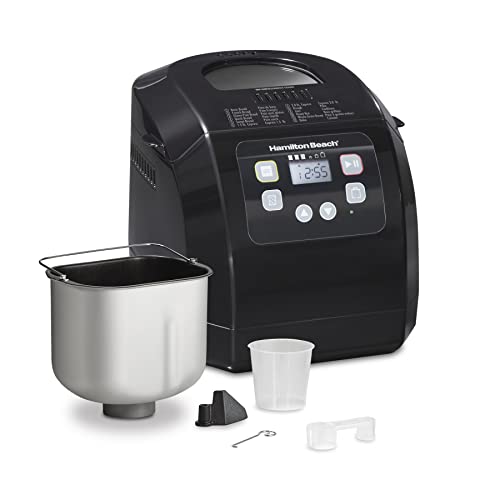
Hamilton Beach Bread Maker with PFAS-Free Pan — Best for Coating-Conscious Buyers
This Hamilton Beach variant exists for a specific and growing concern: what the nonstick pan is made from. Its pan and kneading paddle use a PFAS-free nonstick coating, answering buyers who want a bread machine without fluoropolymer coatings. Around that pan sits a capable 12-setting machine with a gluten-free program and a 2 lb capacity — a mainstream feature set with a cleaner materials story.
Strengths
- PFAS-free nonstick pan and paddle for coating-conscious households
- 12 settings including gluten-free cover the mainstream menu
- Same US brand support and parts availability as its sibling model
Trade-offs
- Fewer programs than the 14-setting Hamilton Beach above
- Nonstick of any kind still needs gentle handling to last
- Vertical loaf shape
| Capacity | 2 lb |
| Programs | 12 settings plus gluten-free |
| Pan | PFAS-free nonstick pan and kneading paddle |
| Finish | Black |
Bread machine pans live a hard life — a metal paddle kneading against the coating for years — so the coating question is legitimate, and most makers do not answer it clearly. Hamilton Beach does with this model, and that clarity is the product. In baking terms the machine performs like its siblings: reliable sandwich loaves, decent whole wheat, a delay timer for morning bread, and dough cycles for pizza and rolls finished in the oven.
Choose between the two Hamilton Beach picks on your priorities: this one if the pan material matters to you, the 29987 if you want the artisan program and the extra settings. Either way you get the practical American-brand benefits — support that answers, parts that exist — at the friendliest tiers in this guide.
Best for: buyers who prioritize a PFAS-free pan in an affordable American-brand machine / Not suited for: program collectors who want the widest settings list

Cuisinart Compact Automatic Bread Maker CBK-110 — Best Compact American Brand
Counter space is the scarcest resource in American kitchens, and the CBK-110 is Cuisinart’s answer: a compact machine that still bakes up to a 2 lb loaf. Its 12 programs cover the everyday menu, and it includes a thoughtful detail — an alert that lets you remove the kneading paddle before baking, so the loaf comes out without the paddle hole that mars most machine bread.
Strengths
- Compact footprint that suits apartments and small counters
- Paddle-removal alert gives cleaner loaves than most machines
- 12 programs, 3 loaf sizes and 3 crust shades cover the essentials
Trade-offs
- No convection or dispenser; those live on the premium sibling
- Compact shape still produces a vertical loaf
- Serious bakers will want the CBK-210’s program range
| Loaf sizes | Up to 2 lb, 3 sizes |
| Programs | 12 programs |
| Timer | 13-hour delay start |
| Extras | Paddle-removal alert |
The paddle alert sounds minor and is not. The hole a baked-in paddle leaves tears slices and annoys anyone who photographs or gifts a loaf; being told exactly when to lift the paddle out — a ten-second job — removes the category’s most visible flaw. Combined with the compact footprint, it makes the CBK-110 the easiest machine here to live with in a small kitchen, which is where bread machines most often die of cupboard exile.
Performance is mainstream-good: dependable white and wheat loaves, a respectable gluten-free cycle, and dough programs for oven-finished baking. It concedes the enthusiast features to its bigger sibling deliberately. If your kitchen is small and your bread ambitions are everyday rather than artisanal, this is the American-brand machine sized for your life.
Best for: small kitchens wanting a full-featured American-brand machine in a compact body / Not suited for: enthusiasts who want convection, a dispenser and sourdough programs

Elite Gourmet Programmable Bread Maker EBM8103SS — Best Feature Value
Elite Gourmet, a California-based brand, competes on sheer program count: 19 presets covering breads, gluten-free, dough and jam, with three loaf sizes up to 2 lb and a delay timer, wrapped in stainless. If your buying style is to compare spec sheets, this machine wins the American-brand table — and its bread backs up the paper promise with perfectly respectable loaves.
Strengths
- 19 presets, the widest selection in this guide
- Three loaf sizes and three crust shades for flexibility
- Stainless finish looks at home next to other appliances
Trade-offs
- Smaller brand than the heritage names; support network is thinner
- Program quantity exceeds what most bakers actually use
- Vertical loaf and overseas manufacture, like the rest of the field
| Capacity | 2 lb, 3 loaf sizes |
| Programs | 19 presets including gluten-free, dough and jam |
| Timer | Delay timer |
| Finish | Stainless steel |
Nineteen presets is partly marketing — nobody needs nineteen — but the useful core is real: separate cycles for gluten-free, dough-only and jam make this a small production unit for a household that uses a bread machine as an all-purpose dough and preserves tool, not just a loaf baker. The three loaf sizes also matter more than they appear to: a 1 lb loaf for a couple stays fresh in a way a cut 2 lb loaf does not.
The trade is brand depth. Elite Gourmet is a legitimate US company, but it does not have West Bend’s century or Hamilton Beach’s parts ubiquity, and long-term paddle and pan availability is a fair question to weigh. For buyers who prioritize features per dollar today, it is a strong pick; for buyers optimizing for a decade of support, the heritage names above rank higher.
Best for: feature-focused buyers who will use dough and jam programs as well as loaves / Not suited for: buyers who prioritize the deepest long-term parts and support network
Comparison Table
| Pick | Badge | Key spec | Best for |
|---|---|---|---|
| West Bend Hi-Rise Bread Maker | Best American Heritage Pick | 3 lb horizontal pan, dual knead blades, 12 programs | sandwich households and heritage-brand buyers who want big, traditionally shaped loaves |
| Hamilton Beach Digital Bread Maker 29987 | Best Value American Brand | 2 lb, 14 settings including artisan and gluten-free, delay start | most households wanting an American-brand machine with full features at a fair tier |
| Cuisinart Convection Bread Maker CBK-210 | Best Premium American Brand | Convection fan, 16 programs, automatic mix-in dispenser, sourdough starter program | enthusiasts who want the best crust and widest program range from an American brand |
| Hamilton Beach Bread Maker with PFAS-Free Pan | Best for Coating-Conscious Buyers | 2 lb, 12 settings plus gluten-free, PFAS-free nonstick pan and paddle | buyers who prioritize a PFAS-free pan in an affordable American-brand machine |
| Cuisinart Compact Automatic Bread Maker CBK-110 | Best Compact American Brand | Compact footprint, 2 lb, 12 programs, paddle-removal alert | small kitchens wanting a full-featured American-brand machine in a compact body |
| Elite Gourmet Programmable Bread Maker EBM8103SS | Best Feature Value | 2 lb, 19 presets, 3 loaf sizes, stainless finish, delay timer | feature-focused buyers who will use dough and jam programs as well as loaves |
How to Choose the Best American Made Bread Machines — Honestly
Start with the truth in the intro: “American made” in this category means American brand, not American factory. Once that is settled, the real criteria emerge. US-based support matters when a machine fails in month thirteen. US-written recipe books matter more than people expect — bread machines are unforgiving of wrong flour ratios, and books written for American all-purpose and bread flours, in cups, produce better first loaves than translated manuals with gram-only recipes. Domestic parts stocking matters in year three when the paddle coating wears.
Then choose on baking criteria, which are the same for any brand. Loaf shape first: horizontal pans slice better for sandwiches; vertical pans take less counter. Capacity second: 2 lb suits most families; 3 lb suits big sandwich households; compact 1–1.5 lb loaves suit couples who bake often and eat fresh. Programs third: a gluten-free cycle if you need it, a dough cycle if you will finish rolls and pizza in the oven, and a delay timer if morning bread is the dream.
What about genuinely US-manufactured options?
If domestic manufacturing is a hard requirement rather than a preference, know your real options. Vintage bread machines from the 1990s — the era when West Bend and Breadman assembled machines domestically — appear regularly on resale markets and many still work, though pans and paddles for them are luck-dependent. The other route is a US-made stand mixer for kneading plus your oven for baking, which is more work per loaf and produces the best bread of any method in this guide. Everything between those poles is an American brand with overseas manufacture, which is the honest framing for all six picks here.
Getting Bakery Results From a Bread Machine
Machine bread fails for predictable reasons, and the fixes are free. Weigh or carefully spoon-and-level flour: a packed cup can add twenty percent extra flour and guarantee a dense loaf. Use fresh yeast and keep it away from direct contact with salt and hot liquid in the pan. Check the dough once, about ten minutes into kneading — it should form a smooth, slightly tacky ball; add water a teaspoon at a time if it looks ragged, or flour a tablespoon at a time if it slaps wetly against the pan. That single check transforms results more than any program.
Respect the delay timer’s limits: it is for plain loaves, not recipes with eggs, milk or cheese that should not sit at room temperature for hours. And let the loaf rest before slicing — cutting into steam-soft crumb compresses it into gumminess. Ten minutes on a rack is the difference between a loaf that slices and a loaf that smears, whatever machine baked it.
Budget Tiers Among American Brands
The value tier — the Hamilton Beach models and the Elite Gourmet — covers the full everyday menu: sandwich loaves, whole wheat, dough cycles and delay timers. Nothing essential is missing. The mid tier buys Cuisinart’s compact design and details like the paddle-removal alert. The premium tier, represented by the convection CBK-210, buys crust quality and program depth that enthusiasts genuinely taste.
What no tier buys in this guide is US manufacture, because it is not sold at any price in today’s market. Spend your money instead on the things that differ: loaf shape, pan coating, program range and the depth of the brand behind the machine. On those criteria, American brands compete fairly with any in the world.
A Short History of the American Bread Machine
The bread machine is a Japanese invention that America made its own. When the first home machines reached the US at the end of the 1980s, American companies — West Bend prominent among them — redesigned the concept for American kitchens: bigger loaves, horizontal pans shaped like bakery bread, and recipe books written for the bread flour and instant yeast sold in American supermarkets. Through the 1990s the category boomed, machines were assembled in meaningful numbers domestically, and the bread machine became as American a countertop sight as the slow cooker.
The economics of small appliances then did what they did across the industry: manufacturing consolidated overseas, and by the 2000s every brand in this guide — like every brand in the wider market, including the Japanese originators — produced its machines in Asia. The brands, the design work, the recipe development and the support stayed home; the factories did not. That is the honest summary of where “American made” went in this category, and it is why this guide ranks American brands on their real merits instead of dressing them in a manufacturing claim none of them can make.
The interesting modern chapter is that the machines got better as the category matured: convection baking, gluten-free cycles designed for the single rise those doughs need, automatic dispensers, and in one pick here, a pan coating reformulated for buyers who read materials labels. The American brands in this guide were part of that progress, and the best of them remain the equal of any imported rival on the bread itself.
Flour, Yeast and the American Pantry
One underappreciated advantage of American-brand machines is that their recipe books assume your pantry. American bread flour runs higher in protein than most all-purpose flours; American instant yeast is sold in jars and strips measured in teaspoons; American kitchens measure in cups. A machine whose recipes were developed against those ingredients behaves predictably on the first loaf, while translated recipe books are a quiet source of the dense-loaf stories that give bread machines an undeserved reputation. Every brand in this guide develops its recipes in US test kitchens, and it shows in first-loaf success rates.
Two pantry habits multiply that advantage. Keep yeast in the fridge or freezer and replace it on schedule — yeast age is the single most common cause of a loaf that stops rising, and it gets blamed on machines constantly. And treat flour as a variable, not a constant: the same brand of flour absorbs water differently across seasons, which is why the ten-minute dough check in our how-to section matters more than any program the machine offers. American-brand machine plus American pantry plus that one check is a system that produces bakery-acceptable bread on demand.
For gluten-free bakers the same logic applies with extra force: use blends formulated for the US market, use the machine’s gluten-free cycle rather than adapting a wheat program, and expect the dough to look wetter than wheat dough — that is correct, and resisting the urge to add flour is the skill the first three loaves teach.
Stand Mixer and Oven vs Bread Machine: The Honest Comparison
Since this guide has raised the stand-mixer route as the genuinely American-manufactured path, it owes that route a fair hearing. A quality stand mixer — including models still assembled in the USA — kneads dough with more power and flexibility than any bread machine, handles every flour and hydration a baker will ever meet, and hands the shaping and baking to you and your oven. The bread that results can exceed machine bread: proper shaping, a Dutch oven or stone, and your judgment about doneness beat a fixed cycle. For bakers who enjoy the process, this is not a compromise at all; it is the hobby itself.
The bread machine’s counter-argument is time and certainty. Its total human involvement is five minutes of loading and one optional dough check; the mixer route asks twenty minutes of attention spread across kneading, rising, shaping and baking, plus the judgment to run them. On a Tuesday night in a working household, that difference is the difference between fresh bread and no bread. Machines also win on consistency for beginners: the first loaf from a decent machine is usually good, while the first mixer loaves are an education.
Many serious home bakers end with both, using each for its strength: the machine for the weekly sandwich loaf and the delay-timer morning bread, the mixer and oven for weekend projects and everything the machine’s pan shape cannot do. That is a legitimate end-state, and it reframes this guide’s picks correctly — not as substitutes for real baking, but as the appliance that guarantees the baseline, bought from the American brands that support it best.
Choose by your calendar and your curiosity. If bread is a staple, buy the machine. If bread is a craft, buy the mixer. If bread is both, you already know the answer, and it is both.
Replacement Pans, Paddles and the Long Game
A bread machine’s working life is decided by two small parts: the pan and the kneading paddle. Their coatings face metal-on-dough abrasion for an hour or more per loaf, and after some hundreds of loaves the coating thins, dough begins to stick, and loaves tear on removal. This is normal wear, not failure — provided the brand sells the parts. Every brand in this guide stocks replacement pans and paddles through US channels, which converts a worn machine back to full performance for a fraction of a new machine’s cost. It is also, quietly, one of the strongest practical arguments for the American brands over no-name imports whose parts simply do not exist.
Extend the parts’ life with three habits. Never use metal utensils in the pan; a silicone spatula frees a stuck loaf without scoring the coating. Wash the pan by hand even if it is nominally dishwasher tolerant — the paddle shaft seal, the part that actually fails expensively, hates dishwasher heat cycles. And dry the pan before storing it in the machine, since a damp pan in a closed appliance is where odors and corrosion start.
The machine body, by contrast, asks almost nothing: wipe the crumb tray area, keep the lid seal clean, and let the machine cool between back-to-back loaves on heavy baking days. Motors in this category routinely outlast two pans. Buyers who understand that rhythm — machine for a decade, pan as a consumable — get the category’s real value, and it is available from every pick in this guide.
When you order the machine, consider ordering the spare paddle at the same time. Paddles are the part most often lost — they bake into loaves and ride to the bin in the excitement — and having the spare turns a small disaster into a shrug.
How to Bake Your First Loaf in an American-Brand Bread Machine
This walkthrough assumes a basic white or wheat sandwich loaf on any of the six machines. Master this once and every program on the machine becomes a variation you understand.
- Fit the paddle and pan. Push the kneading paddle firmly onto its shaft and set the pan in the machine with a twist to lock it. A paddle seated loosely is the top cause of a first-loaf failure.
- Add liquids first. Water or milk at room temperature, then oil or melted butter. Liquids first protect the yeast and let the paddle form the dough properly.
- Add flour to cover the liquid. Spoon flour into the cup and level it — never scoop from the bag, which packs it. Make a shallow well in the center of the flour.
- Salt and sugar in opposite corners, yeast in the well. Keeping yeast dry and away from salt until the machine starts is what makes the delay timer possible and the rise reliable.
- Choose the program, size and crust. Basic or white cycle, your loaf size, medium crust for a first loaf. Close the lid and start.
- Check the dough at ten minutes. Open the lid during kneading and look for a smooth, tacky ball. Adjust with a teaspoon of water or a tablespoon of flour if needed — this one check fixes most dense-loaf problems forever.
- Rest, then slice. Turn the loaf out onto a rack, wait at least ten minutes, and slice with a serrated knife in a sawing motion. Store cut-side down on the board for a day, then bagged.
Write down what you did — flour brand, water amount, program — on a card kept with the machine. Bread machines reward small, recorded adjustments, and your second loaf will be better than your first for exactly that reason.
Common Buying Mistakes
Believing any current bread machine is made in the USA. None of the major brands manufacture bread machines domestically today. Guides implying otherwise are misleading you; buy the American-brand benefits that are real — support, recipes, parts — with open eyes.
Scooping flour from the bag. Scooping packs flour and can add a fifth more than the recipe intends, producing dense, dry loaves that get blamed on the machine. Spoon and level, or weigh.
Skipping the ten-minute dough check. Flour absorbs water differently by brand and season. One glance and a tiny adjustment during kneading is the difference between a dense brick and a proper loaf.
Using the delay timer with perishable ingredients. Eggs, milk and cheese should not sit in a warm machine for hours. Delay-timer loaves should be plain flour, water, yeast recipes only.
Slicing the loaf immediately. Steam inside the crumb needs time to settle. Cutting hot bread compresses it into a gummy texture no machine can be blamed for.
Final Recommendation
Our recommendations: the West Bend Hi-Rise for the most authentically American choice — heritage brand, traditional loaf, biggest capacity. The Hamilton Beach 29987 for most households on value, or its PFAS-free sibling if pan coating is your priority. The Cuisinart CBK-210 for the enthusiast who wants convection crust and sourdough programs, the CBK-110 for small kitchens, and the Elite Gourmet for maximum presets per dollar. All six are American brands with US support, verified for this guide.
And the honest closing note: if US manufacture itself is the non-negotiable, buy the vintage machine or the stand mixer — do not let any guide sell you a modern machine under a flag it was not made under. Check the current price on Amazon for the American-brand model that fits your kitchen.
If you take one idea from this guide, let it be the distinction between made and backed. These six machines are backed — designed, recipe-tested, supported and parts-stocked — by American companies with long histories, and for most buyers that backing is the part of “American made” that ever touches their daily life. Buy the backing with open eyes and you will be happy with any machine on this list.
Keep exploring the cluster: Best Bread Machines Best 2 Lb Bread Machines Best Can Openers Best Can Openers Dishwasher Safe Best Blenders Below 200
Frequently Asked Questions
Are any bread machines actually made in the USA today?
No major brand currently manufactures bread machines in the United States. The machines in this guide come from American companies that design for the US market and support customers domestically, but manufacture overseas — as do the Japanese and European brands. The last era of US-assembled bread machines was the 1990s, and those survive on the resale market.
Which American bread machine brand has the longest history?
West Bend, founded in Wisconsin in 1911, is one of the pioneers of the home bread machine category itself, and Hamilton Beach traces its appliance history to the early 1900s as well. Both offer the deepest US support and parts networks in this guide.
Does buying an American brand get me better support?
Generally, yes. US-headquartered brands run US-based support operations, stock replacement pans and paddles domestically, and write their manuals and recipe books for American ingredients and measures. Those are practical, everyday advantages even though the machines are manufactured overseas.
What size bread machine does a family need?
A 2 lb machine suits most families of three to five. Choose the 3 lb West Bend if you bake large sandwich loaves for a big household, and a compact model with 1–1.5 lb settings if you are a couple who prefers small, fresh loaves baked often.
Can these machines make gluten-free bread?
Yes — every pick in this guide includes a gluten-free program, which uses the single rise that gluten-free doughs need. Results depend heavily on the flour blend; use a blend designed for bread machines and check the dough consistency at the ten-minute mark, as gluten-free doughs run wetter.
Is a horizontal or vertical loaf better?
Horizontal loaves, like the West Bend’s, slice uniformly from end to end and suit sandwich households. Vertical loaves take less counter space and dominate the market. Neither tastes different; it is a slicing and footprint choice.
Were bread machines ever made in the USA?
Yes. During the category’s 1990s boom, American brands including West Bend produced and assembled machines domestically in meaningful numbers. Those vintage machines still circulate on resale markets and many still bake, though replacement pans and paddles for them depend on luck and donor machines.
Which of these is best for sandwich bread?
The West Bend Hi-Rise, because its horizontal pan produces uniform slices from end to end at up to 3 lb. Among the vertical-pan machines, the Hamilton Beach and Cuisinart models all make good sandwich loaves; choose between them on programs and pan coating.


