Disclosure: airfryerkitchensupply.com is reader-supported. When you buy through links on our site, we may earn an affiliate commission at no extra cost to you.
Where to buy
Every pick in this guide to the best 12 volt car battery was verified against Amazon’s own catalog data before it earned a link, and the shortlist below is the fastest route to each one. Use the retailer links here and in each review to check price on Amazon, confirm the exact group size, port count, or capacity for your vehicle, and read the fitment notes before ordering — with vehicle gear, the right model in the wrong variant is still the wrong purchase.
- OPTIMA RedTop 34/78 Starting Battery — Best Overall
- OPTIMA YellowTop D34/78 Dual Purpose Battery — Best Dual Purpose
- OPTIMA YellowTop DH6 Dual Purpose Battery — Best for Start-Stop Vehicles
- Weize Platinum AGM Battery Group 49 (H8) — Best Large-Case Value
- Renogy 12V 70Ah AGM Car Battery H6 (Group 48) — Best Budget Start-Stop Pick
- Mighty Max Battery MM-H6 Group 48 AGM — Best Budget Alternative
Availability in this category moves with the seasons — demand spikes before winter, before summer road-trip season, and during holiday travel — so a pick that shows limited stock is worth ordering ahead of the trip or the cold snap rather than during it.
If you are shopping for the best 12 volt car battery, the honest starting point is that the battery itself is the easy part — the hard part is buying the right one for your vehicle. Almost every modern car, truck, and SUV runs a 12-volt starting battery, but group size, terminal position, cold cranking amps, and chemistry all vary, and a battery that is excellent in the wrong group size is simply a battery that does not fit. This guide narrows the field to six verified picks and then spends as much time on fitment and buying judgment as on the products themselves, because that is where battery purchases actually succeed or fail.
The market splits into three broad families. Traditional flooded lead-acid batteries are the budget tier and still fine for older vehicles driven daily. AGM (absorbed glass mat) batteries cost more but tolerate vibration, deep discharges, and start-stop systems far better, and they are what most vehicles built in the last decade were designed around. Lithium starting batteries exist at the premium edge, mostly for performance and powersports use. The six picks below concentrate on AGM, because for most drivers replacing a battery today, AGM is where reliability per dollar is strongest — with honest notes on where a cheaper flooded battery or a dual-purpose design makes more sense.
One more reality before the picks: a car battery is a wear item with a typical service life of three to five years, shorter in hot climates. If your current battery is in that window and showing slow cranks, dim lights at idle, or a swollen case, replacement on your schedule — in your driveway, with the right group size confirmed — is far cheaper and calmer than replacement on the battery’s schedule, in a parking lot, in February.
In this guide
Quick Picks
OPTIMA RedTop 34/78 Starting Battery — Best Overall. The long-running benchmark for a dedicated starting battery: a sealed AGM spiral-cell design with strong cranking power and dual terminals that fit both SAE-post and GM side-terminal vehicles. Check the current price on Amazon.
OPTIMA YellowTop D34/78 Dual Purpose Battery — Best Dual Purpose. A dual-purpose AGM that both starts the engine and tolerates the deeper discharges of winches, audio systems, and accessory-heavy trucks — the pick when one battery has to do two jobs. Check the current price on Amazon.
OPTIMA YellowTop DH6 Dual Purpose Battery — Best for Start-Stop Vehicles. The H6/Group 48 fitment that most modern start-stop cars actually need, with dual-purpose AGM endurance and 800 CCA — the direct-fit answer for a large share of newer vehicles. Check the current price on Amazon.
Weize Platinum AGM Battery Group 49 (H8) — Best Large-Case Value. A big-case H8 AGM with 900 CCA and 160 minutes of reserve capacity at a value-tier position — the pick for large SUVs and trucks whose factory batteries are genuinely expensive. Check the current price on Amazon.
Renogy 12V 70Ah AGM Car Battery H6 (Group 48) — Best Budget Start-Stop Pick. A start-stop-ready H6 AGM from a brand better known for solar, with 720 CCA and 120 RC at a budget-friendly tier — sensible for the common Group 48 replacement. Check the current price on Amazon.
Mighty Max Battery MM-H6 Group 48 AGM — Best Budget Alternative. Another value-tier H6 with slightly higher verified CCA than the Renogy — 760 CCA and 120 RC — for shoppers comparing the two most affordable routes into a correct start-stop AGM. Check the current price on Amazon.
How These Picks Were Chosen
Each pick below was verified through Amazon’s Creators API on this site’s own install: we searched by brand and model, matched the returned listing title to the product, and took the ASIN from the API response. Only API-confirmed listings carry a purchase link. Specifications quoted in the mini spec boxes come only from those verified API titles — cold cranking amps, reserve capacity, group size — never from memory or from third-party roundups.
Selection weighed four things. First, starting power with headroom: a battery should meet or exceed the vehicle maker’s CCA specification, because cranking demand rises as engines and batteries age. Second, reserve capacity, which is your insurance when an alternator fails or lights are left on. Third, construction: sealed AGM designs dominate the list because they are maintenance-free, spill-proof, and vibration-resistant. Fourth, fitment breadth — picks cover the most common group sizes (48/H6, 49/H8, 34/78, 24F, 35, 65) so most readers can match one directly.
What we excluded matters too. No-name batteries with unverifiable CCA claims were left out, as were batteries whose listings could not be confirmed through the API. Where a well-known premium line and a value AGM offer near-identical verified specifications, both appear, and the reviews say plainly what the extra money does and does not buy.
The 6 Best 12 Volt Car Batteries

OPTIMA RedTop 34/78 Starting Battery — Best Overall
The RedTop is the pick for the driver who wants to install a battery and not think about it again for years. It is a dedicated starting battery — engineered to deliver a large burst of cranking power, recharge quickly from the alternator, and shrug off the vibration that kills conventional batteries early in trucks and SUVs.
Strengths
- 800 CCA gives generous cranking headroom for most gasoline cars, trucks, and SUVs
- Dual SAE and GM terminals solve the top-post versus side-post fitment problem in one SKU
- Sealed AGM spiral-cell construction is spill-proof, maintenance-free, and highly vibration-resistant
Trade-offs
- Premium-tier pricing compared with value AGM batteries of similar CCA
- Purpose-built for starting, so it is not the right choice for deep-cycle accessory loads
- Group 34/78 footprint does not match vehicles that require H6, H7, or H8 case sizes
| Chemistry | Sealed AGM (spiral cell) |
| Cold cranking amps | 800 CCA |
| Terminals | Dual SAE and GM |
| Group size | 34/78 |
What separates the RedTop in daily use is consistency. Spiral-cell AGM plates present a large surface area to the electrolyte, which is why the design cranks strongly even after sitting, and why it tolerates the short-trip driving pattern — school run, grocery run, repeat — that chronically undercharges ordinary flooded batteries. Owners of older trucks and project cars value the dual terminals in particular: the same battery can move between a top-post daily driver and a side-post GM vehicle without adapters.
Be clear about its lane, though. A starting battery is a sprinter, not a marathoner. If your vehicle runs a winch, a big audio system, camping accessories, or a start-stop system that cycles the battery constantly, the YellowTop below is the better OPTIMA. For a conventional vehicle that simply needs to start every morning in every season, the RedTop remains the reference pick in this guide.
Best for: drivers who want a fit-and-forget starting battery for a conventional car, truck, or SUV / Not suited for: start-stop vehicles or rigs with heavy accessory loads — choose a dual-purpose AGM instead
Check on Amazon — check price on Amazon and confirm the variant matches your vehicle before ordering.

OPTIMA YellowTop D34/78 Dual Purpose Battery — Best Dual Purpose
The YellowTop D34/78 exists for vehicles that ask more of a battery than starting. If your truck runs a winch, your SUV powers a fridge on camping trips, or your car carries a serious audio system, a pure starting battery will be cycled deeper than it was designed for — and will die young for it. This dual-purpose design accepts that duty.
Strengths
- Dual-purpose plates tolerate repeated deeper discharges that shorten a starting battery’s life
- 750 CCA still provides strong, confident starting for most gasoline engines
- Dual terminals and sealed AGM case suit trucks, SUVs, and custom installations
Trade-offs
- Costs more than the RedTop while offering slightly lower peak CCA
- Heavier than a comparable flooded battery, like most AGM designs
- Still not a true deep-cycle battery for daily full discharges in an off-grid system
| Chemistry | Sealed AGM (spiral cell), dual purpose |
| Cold cranking amps | 750 CCA |
| Terminals | Dual terminal |
| Group size | 34/78 |
The engineering compromise is visible in the numbers: a little less peak cranking power than the RedTop, in exchange for plates built to survive cycling. In practice that trade is invisible at the key — 750 CCA starts big V8s without drama — and very visible two years later, when the dual-purpose battery is still healthy in a vehicle whose accessories would have consumed a starting battery. It is also a sensible pick for vehicles with modest start-stop demand where the maker allows an AGM upgrade.
Fitment follows the same 34/78 footprint as the RedTop, with the same dual-terminal convenience. Check hold-down clearance, because spiral-cell cases sometimes sit differently under factory clamps, and confirm your charging system is healthy before blaming any new battery for a repeat failure — a dual-purpose battery cannot outrun a dying alternator.
Best for: trucks and SUVs with winches, audio, or camping loads, and drivers who cycle the battery beyond starting / Not suited for: pure commuter cars with no accessory loads, where the RedTop or a value AGM costs less for the same job
Check on Amazon — check price on Amazon and confirm the variant matches your vehicle before ordering.

OPTIMA YellowTop DH6 Dual Purpose Battery — Best for Start-Stop Vehicles
Start-stop systems changed what a car battery has to survive: dozens of extra starts a day, constant partial discharge, and heavy electrical loads with the engine off. The DH6 is OPTIMA’s answer in the H6 (Group 48) case size that a huge share of modern sedans, crossovers, and trucks specify from the factory.
Strengths
- 800 CCA with dual-purpose cycling endurance matched to start-stop duty
- Direct-fit H6/Group 48 case for the many modern vehicles built around that size
- Sealed AGM design is maintenance-free and mounts securely under factory hold-downs
Trade-offs
- Premium tier — value AGM H6 batteries below undercut it substantially
- Start-stop vehicles may require battery registration with a scan tool after replacement
- Only helps if your vehicle actually takes an H6; it will not adapt to other group sizes
| Chemistry | Sealed AGM, dual purpose |
| Cold cranking amps | 800 CCA |
| Group size | H6 / Group 48 |
| Fitment | Direct fit |
The practical question with start-stop cars is never just ‘will it start’ — it is whether the battery management system stays happy. Vehicles that shipped with AGM expect AGM charge profiles and cycling behavior; fitting a cheaper flooded battery to save money is the classic false economy in this class, often repaid with early failure and start-stop faults. The DH6 keeps the chemistry the car was designed around, with more cycling margin than the typical factory unit.
Before ordering, confirm two things in your owner’s manual or under-hood label: that the specified size is H6/Group 48, and whether the vehicle requires a battery registration procedure after replacement. Many European and newer domestic models do. Registration is a quick job with the right scan tool, and skipping it can shorten any new battery’s life, premium or not.
Best for: start-stop cars, crossovers, and trucks that specify an H6/Group 48 AGM battery / Not suited for: vehicles sized for other groups, or older cars where a value AGM delivers the same service for less
Check on Amazon — check price on Amazon and confirm the variant matches your vehicle before ordering.

Weize Platinum AGM Battery Group 49 (H8) — Best Large-Case Value
Some vehicles simply need a lot of battery. Full-size SUVs, diesel-adjacent gasoline trucks, and European models built around the H8/Group 49 case carry large electrical loads and long accessory run times, and their replacement batteries are priced accordingly. The Weize Platinum AGM matches the format with strong verified numbers.
Strengths
- 900 CCA and 160 RC are strong figures for the large-case class
- AGM construction supports start-stop systems, per the verified listing
- Value-tier positioning against premium brands in the expensive H8 size
Trade-offs
- H8 is a big, heavy battery — confirm case dimensions and be ready for an awkward lift
- Value brands depend more on the seller’s warranty handling than on a local store network
- Reserve and CCA figures should be matched to your manual, not treated as bigger-is-always-better
| Chemistry | AGM |
| Capacity | 95Ah |
| Cold cranking amps | 900 CCA |
| Reserve capacity | 160 RC |
| Group size | 49 / H8 |
The numbers deserve a moment, because they are the reason this pick exists. Reserve capacity of 160 minutes means the battery can sustain a modest electrical load for a long stretch — the difference between a dead truck and a running one when an alternator quits an hour from home, or when accessories run at a campsite. Combined with 900 CCA, it covers both halves of a big vehicle’s battery job in one case.
Handle the practicalities honestly: an H8 battery is heavy and often buried low in an engine bay or under a cargo floor. Two-person lifting, a battery carrier strap, and a memory saver for the vehicle’s electronics are worth arranging before the swap. And as with every pick here, verify the listing’s terminal orientation against your old battery before the box is opened.
Best for: large SUVs, trucks, and European models that specify Group 49/H8 / Not suited for: compact and mid-size cars — the case is too large and the capacity unnecessary
Check on Amazon — check price on Amazon and confirm the variant matches your vehicle before ordering.
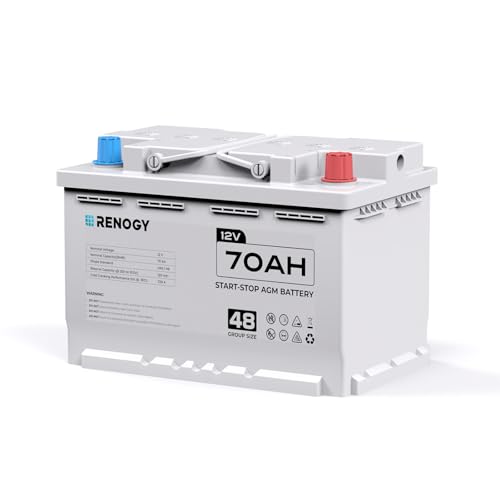
Renogy 12V 70Ah AGM Car Battery H6 (Group 48) — Best Budget Start-Stop Pick
Group 48/H6 is the workhorse size of the modern fleet, and most owners replacing one need exactly three things: correct fit, start-stop-compatible AGM chemistry, and a price that does not sting. The Renogy entry covers those bases with verified specifications that meet typical factory requirements for the size.
Strengths
- 720 CCA and 120 RC meet the standard H6 replacement envelope
- AGM start-stop design matches what Group 48 vehicles were built with
- Budget-tier positioning makes the correct chemistry affordable
Trade-offs
- Less cranking headroom than premium H6 options for very cold climates
- A newer name in automotive starting batteries than in solar storage
- Confirm terminal layout — Group 48 applications vary by model year
| Chemistry | AGM |
| Capacity | 70Ah |
| Cold cranking amps | 720 CCA |
| Reserve capacity | 120 RC |
| Group size | H6 / Group 48 |
Context matters for judging this battery. A factory H6 in a typical crossover asks for roughly this output envelope, so 720 CCA is not a compromise for most drivers — it is the specification, met. The drivers who should step up to a premium H6 are those in genuinely cold regions, those whose engines are large or hard-cranking, and those who keep vehicles for a decade and value maximum margin.
Renogy’s background in off-grid storage is relevant in one way: the company understands AGM cycling, and a start-stop battery is fundamentally a cycling product. Treat this as the rational default for a Group 48 car that is driven normally and maintained normally, and spend the savings on the thing that actually extends battery life — a smart maintainer for vehicles that sit between drives.
Best for: Group 48/H6 cars and crossovers needing a start-stop AGM at a fair tier / Not suited for: extreme-cold regions or large hard-cranking engines that reward maximum CCA headroom
Check on Amazon — check price on Amazon and confirm the variant matches your vehicle before ordering.

Mighty Max Battery MM-H6 Group 48 AGM — Best Budget Alternative
Mighty Max has sold value lead-acid batteries across powersports and automotive categories for years, and its MM-H6 applies the same formula to the Group 48 start-stop replacement: the right chemistry, verified output figures that clear the factory bar, and a price position well under the premium badges.
Strengths
- 760 CCA edges out the other budget H6 in this guide
- 120 RC matches the standard reserve expectation for the size
- Start-stop AGM design keeps the chemistry correct for modern vehicles
Trade-offs
- Budget-tier warranty and support experience varies by seller
- Like all value AGMs, long-term consistency matters more than headline specs — buy from a listing you can return to
- No advantage if your vehicle needs a different group size
| Chemistry | AGM |
| Capacity | 70 AH |
| Cold cranking amps | 760 CCA |
| Reserve capacity | 120 RC |
| Group size | 48 / H6 |
Placed beside the Renogy, the choice is a coin flip decided by small things: a little more CCA here, brand familiarity there. That is genuinely useful information — it means the budget H6 tier is competitive, and a shopper can choose on delivery speed and seller terms rather than fearing a bad battery. Both clear the bar that matters: AGM chemistry, correct case, adequate verified output.
Whichever budget AGM you choose, protect the purchase with two habits. Photograph the old battery’s label and terminal layout before removal, so any mismatch is caught while a return is still easy. And load-test or at least voltage-check the new battery on arrival; a battery that sat discharged in a warehouse starts life handicapped, and catching that in week one is the difference between a warranty claim and a stranded morning.
Best for: budget-conscious Group 48 owners who still want correct start-stop AGM chemistry / Not suited for: drivers who prioritize a local store warranty network over online value
Check on Amazon — check price on Amazon and confirm the variant matches your vehicle before ordering.
Comparison Table
| Pick | Badge | Key spec | Best for |
|---|---|---|---|
| OPTIMA RedTop 34/78 Starting Battery | Best Overall | 800 CCA, dual terminals | drivers who want a fit-and-forget starting battery for a conventional car, truck, or SUV |
| OPTIMA YellowTop D34/78 Dual Purpose Battery | Best Dual Purpose | 750 CCA, dual purpose AGM | trucks and SUVs with winches, audio, or camping loads, and drivers who cycle the battery beyond starting |
| OPTIMA YellowTop DH6 Dual Purpose Battery | Best for Start-Stop Vehicles | 800 CCA, H6 direct fit | start-stop cars, crossovers, and trucks that specify an H6/Group 48 AGM battery |
| Weize Platinum AGM Battery Group 49 (H8) | Best Large-Case Value | 900 CCA, 160 RC, H8 | large SUVs, trucks, and European models that specify Group 49/H8 |
| Renogy 12V 70Ah AGM Car Battery H6 (Group 48) | Best Budget Start-Stop Pick | 720 CCA, 120 RC, H6 | Group 48/H6 cars and crossovers needing a start-stop AGM at a fair tier |
| Mighty Max Battery MM-H6 Group 48 AGM | Best Budget Alternative | 760 CCA, 120 RC, H6 | budget-conscious Group 48 owners who still want correct start-stop AGM chemistry |
How to Choose the Best 12 Volt Car Battery for Your Vehicle
Start with the owner’s manual, not with a brand. The manual or the label on your current battery states the group size — the standardized case dimensions and terminal layout — and the minimum CCA your vehicle requires. Group size is non-negotiable: a battery that is a half-inch too tall can short against a hood or fail the hold-down, and reversed terminals can put cables under dangerous strain. Everything else in this guide is secondary to matching that size.
Next, chemistry. If your vehicle has start-stop, was built with an AGM battery, or carries heavy electrical loads, buy AGM. If it is an older vehicle driven daily with modest electrics, a quality flooded battery remains a legitimate budget choice — daily driving keeps it charged, which is what flooded designs need. Never downgrade a vehicle that shipped with AGM to a flooded battery to save money; the charging system and duty cycle are calibrated for AGM behavior.
Then compare CCA and reserve capacity within your group size. CCA should meet or exceed the factory specification; more headroom helps in cold climates and as the battery ages. Reserve capacity is your failure insurance and your accessory runtime. Within a size, differences of 10–15% between reputable batteries matter less than freshness — a battery manufactured recently will out-serve an older shelf unit with slightly better numbers.
What Do CCA, Reserve Capacity, and Group Size Actually Mean?
Cold cranking amps (CCA) measures the current a battery can deliver for 30 seconds at 0°F while holding voltage above a minimum threshold. It is the single best predictor of winter starting. Bigger engines, diesels, and cold climates need more of it; a small sedan in a mild climate needs comparatively little, and excess CCA in the correct group size does no harm.
Reserve capacity (RC) is measured in minutes: how long the battery can deliver 25 amps before dropping to 10.5 volts. That is roughly the load of headlights, ignition, and fuel pump together — so RC approximates how long you can drive on the battery alone if the alternator fails, and how long accessories can run with the engine off. Amp-hour (Ah) ratings, common on dual-purpose and European-spec batteries, describe the same energy idea over a longer, slower discharge.
Group size, set by the Battery Council International (BCI), encodes case dimensions, terminal type, and terminal position. Common sizes in this guide include 34/78, 48/H6, and 49/H8. The ‘H’ sizes are the European DIN equivalents now standard on many domestic vehicles too. When a listing shows both, they describe the same case.
Budget Tiers for a 12 Volt Car Battery, Explained Honestly
Battery pricing follows chemistry and case size more than brand magic. The budget tier is flooded batteries and value AGMs: correct specifications, thinner warranty support, and quality that depends on buying fresh stock from a reputable listing. The mid tier — where most of this guide’s value AGMs sit — buys verified AGM performance with reasonable support. The premium tier buys margin: higher CCA in the same case, stronger cycling endurance, longer design life, and established warranty networks.
The honest way to frame the tiers is cost per year of service, not cost at checkout. A battery that serves five years at a premium price can be cheaper annually than a budget battery replaced at two and a half — and it spares you the failure event itself, which usually arrives with towing, missed work, or a jump-start in bad weather attached. Drivers who maintain their batteries — full charges, clean terminals, a maintainer during storage — flatten the tiers considerably, because care extends the life of every chemistry.
How to Replace a 12 Volt Car Battery Safely, Step by Step
Replacing a car battery is one of the most satisfying DIY jobs in motoring — thirty minutes, basic tools, no lift — provided the safety order is respected. Batteries are heavy, contain acid, and can deliver enormous current; the steps below keep all three boring.
- Park on level ground, engine off, key out. Put on eye protection and gloves, and keep a memory saver plugged in if your vehicle loses radio, seat, or ECU settings without power — many modern cars do.
- Confirm the new battery matches the old one’s group size and terminal orientation before removing anything. Photograph the cable layout.
- Loosen and remove the NEGATIVE (black, marked −) cable first, and tuck it where it cannot spring back onto the terminal. Then remove the positive (red, +) cable. This order prevents a wrench short if your tool touches body metal while working on the positive side.
- Remove the hold-down clamp or strap, then lift the old battery straight up with two hands or a carrier strap — expect real weight, especially in H7 and H8 sizes.
- Clean the tray and cable terminals. Corrosion is removed with a terminal brush and a baking-soda solution; dry everything before the new battery goes in.
- Set the new battery in, secure the hold-down snugly (over-tightening cracks cases), then connect POSITIVE first and negative last — the reverse of removal.
- Start the engine, check that warning lights clear, and reset clock and window auto-up functions as needed. If your vehicle requires battery registration (common on start-stop and European models), complete it with a scan tool or have a shop do it.
- Recycle the old battery. Every auto parts retailer accepts cores, and lead-acid recycling is one of the most complete recycling loops in any industry — never landfill a battery.
After the swap, take a real drive — twenty minutes at road speed — rather than a short idle, so the alternator can top the new battery off properly. Then forget about it, except for a glance at the terminals whenever the hood is open for other reasons.
Battery Lifespan: What Actually Kills a 12 Volt Battery, and How to Slow It Down
Heat is the first killer, and it works invisibly. Under-hood temperatures in summer traffic accelerate the chemical wear inside every lead-acid battery, which is why batteries in hot regions routinely die a year or two earlier than identical batteries in mild ones — and why the failure so often announces itself on the first cold morning afterward, when a heat-weakened battery meets its hardest cranking test. You cannot change your climate, but you can respect it: park in shade when the choice is free, keep the battery’s heat shield in place if your vehicle fitted one, and treat a battery in a hot region as a three-year item rather than a five-year hope.
The second killer is chronic undercharge. Modern vehicles draw power while parked — alarms, keyless receivers, telematics — and short-trip driving rarely replaces what starting and sitting consume. A battery that lives at partial charge sulfates: lead-sulfate crystals harden on its plates and permanently remove capacity. This is the death most garage-kept and second cars die, and it is almost entirely preventable with a maintainer during long parking, which is why the charger guide in this series pairs so naturally with this one. A battery kept full is a battery aging at half speed.
Vibration and neglect finish the list. A loose hold-down lets the battery shake its internal connections apart over thousands of miles — the failure mode AGM spiral-cell designs resist best, and one more reason to secure any new battery properly. Corroded terminals raise resistance, strain the charging system, and masquerade as battery failure. The lifespan program, in full, is unglamorous: correct size and chemistry at purchase, a tight hold-down, clean terminals, full charge maintained, and a load test each autumn once the battery passes its third birthday. Follow it and the picks in this guide will serve at the long end of their design lives.
Testing Your Old Battery Before You Replace It
Replacement should follow evidence, because the symptoms of a dying battery overlap with those of a dying alternator, a corroded cable, and a starter motor on its way out. The simplest evidence is voltage: a fully charged, rested 12-volt battery reads about 12.6 volts or slightly above at its terminals. Readings meaningfully below that after a full charge suggest a battery that can no longer hold what it is given. Voltage alone, though, is a witness, not a verdict — a battery can show fair voltage and still collapse under the starter’s load.
The verdict comes from a load test, which parts stores perform free: the battery is loaded to a fraction of its CCA rating and must hold voltage above a threshold. Conductance testers — the handheld units every shop now owns — estimate the same health in seconds without a full load. Either test, done on a fully charged battery, separates ‘replace it’ from ‘charge it and look elsewhere’ more reliably than any amount of symptom-reading.
Test the charging system in the same visit. With the engine running, system voltage should sit in the normal charging range; a system that undercharges will murder the new battery you are about to buy, slowly and deniably, while an overcharging one will cook it. And if the battery passes its tests while the car still cranks slowly, believe the evidence: clean the terminals, check the cables and grounds, and suspect the starter. Batteries are replaced on suspicion more often than any other part in the car — a ten-minute test is the cheapest accuracy you will ever buy.
Warranty, Freshness, and Where You Buy: The Unglamorous Deciders
Two batteries with identical specifications can be very different purchases, and the difference lives in paperwork and dates. The manufacturing date is printed or stickered on every battery; a unit that has sat in a warehouse for a year has already spent a year of its service life self-discharging on a shelf. Buy the freshest stock available, and be politely suspicious of a deal whose only explanation is age. When a new battery arrives, check its resting voltage before installation — a healthy new battery arrives nearly full, and one that arrives low has a story you want to hear before it is bolted into your car, not after.
Warranty structure matters in proportion to how stranded a failure would leave you. The meaningful distinction is between free-replacement periods and pro-rated schedules, and between a warranty honored at any store in a national network and one honored by returning a 40-pound battery through the mail. Online value picks in this guide compete on specification per dollar; the premium picks compete partly on the network standing behind them. Neither answer is wrong — but choose consciously, pricing the warranty you are actually buying rather than assuming one exists.
Finally, keep the receipt and photograph the battery’s top label after installation. Warranty claims run on proof of purchase and date codes, and the owner who can produce both in thirty seconds gets the replacement while the owner who cannot gets a negotiation. It is a small, dull discipline that converts a battery from a gamble into a managed wear item — which is the entire philosophy of this guide.
Jump-Starting, Safety, and the Order That Matters
Every battery owner eventually jump-starts or is jump-started, and the procedure’s safety lives in its sequence. Connect the dead battery’s positive terminal first, then the donor’s positive, then the donor’s negative, and finally the ground connection on the dead vehicle — to bare metal on the engine, away from the battery, because the last connection makes the spark and the spark belongs nowhere near battery gases. Start the donor, let it run a few minutes, then start the dead vehicle. Remove cables in exact reverse. The ritual is old because it works, and because the alternatives have been demonstrated, historically, at some cost.
Modern vehicles add two cautions. Electronics dislike voltage spikes, so quality jumper cables or a lithium jump pack with surge protection are worth their modest premium over the cheapest leads in the bin. And a vehicle with a battery management system may specify jump points under the hood distinct from the battery itself — use them; the manual’s diagram outranks habit. After any successful jump, the drive that follows should be a real one, at road speed, long enough to matter — and the battery should be charged properly and tested soon, because a jump-start is a diagnosis as much as a cure: something discharged that battery, and it will try again.
Common Buying Mistakes
Buying by CCA alone. A huge CCA number in the wrong group size is useless, and in the right size it matters less than freshness and chemistry. Match size first, chemistry second, numbers third.
Downgrading a start-stop car to a flooded battery. The charging profile and cycling duty will kill it early and can trigger start-stop faults. If the car shipped with AGM, replace with AGM.
Skipping battery registration. Many modern vehicles must be told a new battery was installed, or they charge it with the old battery’s profile and shorten its life. Check the manual.
Reversing the cable order. Negative off first, on last. Getting this backwards is how wrenches weld themselves to fenders.
Ignoring a repeat failure. If a new battery dies within a year, the battery is usually the victim, not the culprit. Test the alternator and check for parasitic drains before buying a third battery.
Final Recommendation
For most drivers, the OPTIMA RedTop is the confident default: strong cranking, dual terminals, and a long record in exactly this job. Vehicles with start-stop or heavy accessory loads should step to a YellowTop — the DH6 for modern H6 fitments, the D34/78 for dual-terminal trucks and SUVs. Large H8 vehicles are best served by the Weize Platinum’s combination of capacity and value, while Group 48 owners on a budget can choose either the Renogy or the Mighty Max with a clear conscience, because both keep the chemistry correct, which is the decision that actually matters.
Whichever pick you choose, buy it fresh, fit it carefully, register it if your vehicle asks, and recycle the old one. A battery chosen that way stops being a gamble and becomes what it should be: the least interesting, most reliable part of your car.
Related guides in this series: Best 12 Volt Car Battery Charger, Best 12 Volt Auto Battery, Best 12 Volt Batteries, Best 12 Volt Agm Battery, Best 12 Volt Car Charger.
If you only click one link in this guide, make it the first pick: OPTIMA RedTop 34/78 Starting Battery — check price on Amazon and confirm the variant for your vehicle.
Two more verified routes to the same shortlist: OPTIMA YellowTop D34/78 Dual Purpose Battery and OPTIMA YellowTop DH6 Dual Purpose Battery — check price on Amazon for either.
Frequently Asked Questions
How long should a 12 volt car battery last?
Typically three to five years. Heat is the biggest life-shortener — batteries in hot climates often sit at the short end — while cold climates reveal weakness rather than cause it. Short-trip driving and long storage without a maintainer also shorten life at any latitude.
Can I install a battery with higher CCA than my car specifies?
Yes. CCA is a capability, not a dose — the starter draws what it needs. As long as the group size and terminal layout match, extra CCA is harmless headroom that helps in winter and as the battery ages.
What is the difference between AGM and flooded batteries?
In a flooded battery the electrolyte is free liquid; in an AGM battery it is absorbed in fiberglass mats. AGM designs are sealed, spill-proof, more vibration-resistant, and tolerate deeper discharge and start-stop cycling far better, at a higher price.
Does my car need battery registration after replacement?
Many newer vehicles — especially European models and start-stop cars — do. Registration tells the charging system the battery is new so it applies the correct charge profile. Your owner’s manual or a dealer can confirm; many independent shops and some DIY scan tools can perform it.
How do I know my battery is failing rather than the alternator?
Slow cranking that worsens over days, a battery that will not hold charge overnight, and a case that is swollen or older than four years point to the battery. A battery warning light while driving, or a good battery repeatedly going flat, points to charging or a parasitic drain. A free load test at a parts store separates the two quickly.
Can a 12 volt car battery be recharged after going completely flat?
Often, yes — with a smart charger using a recovery or force mode, charged slowly. But a battery that has gone fully flat has usually lost some capacity permanently, and one that has done so repeatedly should be replaced rather than trusted.


