Disclosure: airfryerkitchensupply.com is reader-supported. When you buy through links on our site, we may earn an affiliate commission at no extra cost to you.
Where to buy
The best 12 volt bilge pump is the cheapest insurance on any boat: a submersible 12V pump that removes the water that rain, spray, shaft seals, washdowns and small leaks inevitably put inside the hull, season after season, whether anyone is aboard or not. The six pumps below were verified against Amazon catalog data on 2026-11-21 by brand and model, and every flow rating, outlet size and feature quoted comes from those verified listings.
- Rule 25DA Standard Bilge Pump (500 GPH) — Best Overall (Non-Automatic). Check the current price on Amazon.
- Rule-Mate RM500B Automatic (500 GPH) — Best Automatic (Solid-State Sensing). Check the current price on Amazon.
- Attwood Sahara Mk2 Automatic (500 GPH) — Best Automatic (Integral Float). Check the current price on Amazon.
- SEAFLO 06 Series Automatic (750 GPH) — Best Higher-Capacity Automatic. Check the current price on Amazon.
- SEAFLO 01 Series (500 GPH) — Best Budget Pump. Check the current price on Amazon.
- Rule 25SA Automatic (500 GPH) — Best Compact Automatic. Check the current price on Amazon.
Choosing the best 12 volt bilge pump is really two decisions wearing one label. The first is capacity: how much water, in gallons per hour, the pump can move against the real-world lift height of your installation. The second is switching: whether the pump runs only when you throw a switch, turns itself on with a float switch, or senses water electronically with no moving parts. Get those two decisions right for your boat and almost any reputable pump serves you; get them wrong and the best-made pump in the world is the wrong pump.
The six picks below are built around the 500 GPH class — the standard fit for small and mid-size boats — with one 750 GPH step-up. They split deliberately across the switching philosophies: a classic non-automatic pump for manual and float-switch installations, traditional float-equipped automatics, and a solid-state sensing model for owners tired of stuck floats. Rule and Attwood represent the established marine names; SEAFLO represents the value challenger with a notably long warranty.
One rating honesty note that shapes the whole guide: GPH figures are measured at open discharge with no lift. Against a real three-to-four-foot lift through a real hose, every pump delivers a fraction of its headline number — which is why the buying guide insists on buying capacity a class above your calculation, and why a second, independent pump is the correct answer for boats kept in the water unattended.
In this guide
Quick Picks
The classic Rule non-auto, two automatic Rules (float and solid-state sensing), Attwood’s Sahara automatic, and two SEAFLO options — the budget 500 and the higher-capacity 750 GPH automatic step-up for bigger bilges.
- Rule 25DA Standard Bilge Pump (500 GPH) — Best Overall (Non-Automatic). The industry-standard small bilge pump: 500 GPH, non-automatic, with check valve and thermal protection — the pump half of a switch-it-yourself installation. Check on Amazon
- Rule-Mate RM500B Automatic (500 GPH) — Best Automatic (Solid-State Sensing). An automatic 500 GPH pump with solid-state water sensing instead of a float — no moving switch to foul, stick or jam. Check on Amazon
- Attwood Sahara Mk2 Automatic (500 GPH) — Best Automatic (Integral Float). Attwood’s automatic: integral float operation with both elbow and straight fittings in the box for awkward discharge runs. Check on Amazon
- SEAFLO 06 Series Automatic (750 GPH) — Best Higher-Capacity Automatic. The step-up: 750 GPH with a built-in float switch and a snap-off strainer, under a 4-year warranty. Check on Amazon
- SEAFLO 01 Series (500 GPH) — Best Budget Pump. A 500 GPH non-automatic with anti-airlock protection and a 4-year warranty at the budget end of the branded market. Check on Amazon
- Rule 25SA Automatic (500 GPH) — Best Compact Automatic. Rule’s compact automatic: 500 GPH in a small footprint with an easy-clean strainer, for tight bilges that still need automatic protection. Check on Amazon
How These Picks Were Chosen
Every pump below was verified through Amazon catalog data on 2026-11-21: searched by brand and model, the returned listing title — which for bilge pumps states flow rate, voltage, outlet size and switching type — matched to the intended product before a link was attached. Only specifications in those verified titles are quoted in this guide.
Screening criteria were marine-specific. Switching type first, because it defines the installation: non-automatic (external switch or panel), automatic with integral float, or automatic with electronic sensing. Capacity second, in honest classes — 500 GPH is the small-boat standard; bigger boats and longer lifts step up. Third, the unglamorous hardware that decides service life: strainer design and cleanability, check-valve or backflow behaviour, thermal protection, outlet size and thread or barb style, and warranty length as a proxy for the maker’s confidence.
We favoured pumps a boat owner can actually maintain: strainers that snap off for cleaning without tools, standard 3/4-inch outlets that match common hose, and designs with decades of installed base behind them. A bilge pump is not a gadget; it is a safety system that must work at 3 a.m. in a storm with nobody watching.
Scope, stated plainly: this guide covers the submersible electric pumps that constitute the overwhelming majority of small and mid-size boat installations. It does not cover manual diaphragm pumps (a required backup on many offshore boats, and a different purchase), engine-driven pumps, or the large bronze centrifugal units of big yachts. Within its scope — the 12V electric pump that most boats actually rely on — the six picks are the field that matters, and the system advice around them applies to every boat they fit, large or small.
The 6 Best 12 Volt Bilge Pumps

Rule 25DA Standard Bilge Pump (500 GPH) — Best Overall (Non-Automatic)
The Rule 25DA is the pump against which small bilge pumps are measured: a 500 GPH non-automatic submersible with a check valve, thermal cut-off and low current draw, on 3/4-inch threaded ports. Non-automatic means it pumps when powered — by your panel switch, or by a separate float switch you choose and wire — which is exactly the architecture experienced boat owners prefer for a primary pump.
It suits trailer boats, fishing boats and any installation where the owner wants to control the switching separately, replace a failed float without replacing the pump, and standardise on the most proven pump body in the business.
Strengths
- The benchmark design: proven across decades of installations
- Separate switching lets you choose and service the float independently
- Check valve limits backflow cycling; thermal cut-off protects a dry-run pump
Trade-offs
- Pumps nothing until switched — needs a float switch for unattended duty
- 500 GPH is a small-boat class rating
- Threaded ports need the right hose adapter for some installs
| Flow rating | 500 GPH |
| Switching | Non-automatic (external switch/float) |
| Outlet | 3/4″ threaded ports |
| Protection | Thermal cut-off, check valve, low amperage draw |
The case for non-automatic-plus-float over all-in-one automatics is serviceability. Float switches live in the bilge’s filth and fail more often than pumps do; in a separated architecture you replace a cheap switch and keep a good pump, and you can wire a manual override and a high-water alarm into the same circuit with full understanding of what you built. The 25DA is the pump that architecture has standardised on, and its low amperage draw suits the small batteries of small boats.
Buy it as a system component, not a complete system: pump, quality float switch, fused circuit, corrugated-resistant smooth hose and a manual override at the helm. Assembled that way, this unassuming pump is the most trustworthy 500 GPH you can install.
Best for: Owners who want a serviceable primary pump with separate float switching / Not suited for: Anyone wanting fit-and-forget automatic operation from one unit
Check on Amazon — check the current price on Amazon before you buy, because listings and bundles change.
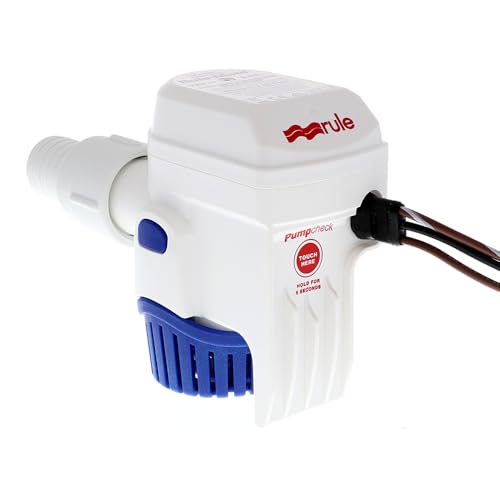
Rule-Mate RM500B Automatic (500 GPH) — Best Automatic (Solid-State Sensing)
The Rule-Mate RM500B answers the float switch’s known failure modes by deleting the float: its Auto Sense intelligence detects water electronically and cycles the pump accordingly, with thermal cut-off and backflow prevention in a compact 500 GPH body. Nothing mechanical sits in the bilge slime waiting to stick.
It suits boats kept in the water — marina boats, moored boats — where the pump must cycle unattended for weeks, and owners who have already replaced one jammed float switch and sworn it was the last.
Strengths
- Solid-state sensing removes the float, the classic failure point
- Automatic cycling with backflow prevention reduces short-cycling
- Compact body fits tight bilges
Trade-offs
- Electronic sensing draws a small standby current to stay alert
- Oil or heavy contamination in the bilge can confuse water sensing
- A sensing fault is a pump replacement, not a cheap switch swap
| Flow rating | 500 GPH |
| Switching | Automatic — Auto Sense electronic sensing |
| Protection | Thermal cut-off, backflow prevention |
| Design | Compact, threaded discharge, easy install |
Every switching philosophy trades one failure mode for another, and the Rule-Mate’s trade is the modern one: exchange a mechanical part that fouls for electronics that sip standby power and dislike oily bilge water. For a clean-kept boat on a marina berth with shore power or a healthy battery bank, that trade is clearly favourable — the pump simply works, cycle after cycle, with nothing to stick.
The standby draw deserves respect in the other direction: on a small boat with a single battery and no charging source, any automatic pump’s vigilance is funded by the battery it protects. Size the battery and charging to the pump’s appetite (the guide below covers this), and the RM500B is the most set-and-forget 500 GPH in this guide.
Best for: Boats kept in the water with reliable battery charging; float-switch sceptics / Not suited for: Boats stored long-term on a single small battery with no charger
Check on Amazon — check the current price on Amazon before you buy, because listings and bundles change.

Attwood Sahara Mk2 Automatic (500 GPH) — Best Automatic (Integral Float)
The Sahara Mk2 is the traditional automatic done properly: an integral float switches the 500 GPH pump as water rises, and Attwood includes both elbow and straight discharge fittings with 3/4-inch and 1-inch barbs, acknowledging that bilges rarely offer the straight vertical run pump diagrams assume.
It is also the designated replacement for the earlier Sahara generation, which makes it the path of least resistance for the large fleet of boats already fitted with its predecessor — same job, updated unit, minimal replumbing.
Strengths
- True fit-and-forget automatic operation
- Both discharge fittings included for real-world hose runs
- Direct replacement path for older Sahara installations
Trade-offs
- Integral float shares the float family’s fouling risks
- If the switch fails, the whole unit is serviced or replaced
- 500 GPH class capacity
| Flow rating | 500 GPH |
| Switching | Automatic (integral float) |
| Fittings | Elbow and straight included; 3/4″ and 1″ barbs |
| Note | Direct replacement for earlier Sahara 4505-7 |
The Sahara’s argument is completeness. Many automatic pumps arrive as a bare unit that assumes your installation is standard; the Mk2 arrives with the fittings to finish the job in the bilges boats actually have, where the discharge must turn a corner immediately to reach the through-hull. That reduces both installation time and the kinked-hose bodges that silently strangle flow on lesser installs.
Choose it when you want one-box automatic protection and your bilge is reasonably clean; choose the Rule-Mate when float fouling is your specific fear, and the Rule 25DA architecture when you want every part independently serviceable. These are philosophies, not rankings — the Sahara is the middle path, and for most small boats it is the right one.
Best for: Small boats wanting simple automatic protection; Sahara replacement upgrades / Not suited for: Owners who want switching and pumping independently serviceable
Check on Amazon — check the current price on Amazon before you buy, because listings and bundles change.

SEAFLO 06 Series Automatic (750 GPH) — Best Higher-Capacity Automatic
When 500 GPH is not enough — a bigger bilge, a longer lift to the discharge, a boat that takes on spray and rain in quantity — the SEAFLO 06 Series automatic steps to 750 GPH while keeping the all-in-one automatic format, with a built-in float switch and a snap-off strainer base for cleaning.
It suits mid-size boats, boats with high lift heights where real-world flow falls fastest, and owners fitting a second, higher pump as a backup tier (mounted slightly higher, it sleeps until the primary is overwhelmed).
Strengths
- 750 GPH gives real headroom over the 500 class
- Snap-off strainer makes the essential cleaning job tool-free
- 4-year warranty is a strong confidence signal at this price tier
Trade-offs
- Draws more current than the 500 class — check the battery budget
- Integral float architecture, with its standard caveats
- Value brand: verify on arrival and register the warranty
| Flow rating | 750 GPH |
| Switching | Automatic — built-in float switch |
| Outlet | 3/4″ |
| Features | Snap-off strainer base, compact body |
| Warranty | 4-year (per listing) |
Headroom is the theme of this entire guide, and the 06 Series is where headroom gets affordable. Because real installations deliver a fraction of rated flow, a 750 rating can mean the difference between a pump that keeps pace with a stuffing-box drip plus rain, and one that slowly loses. As a backup-tier pump its case is stronger still: capacity you hope never runs, at a price that does not sting, under a warranty that suggests the maker expects it to last.
The snap-off strainer deserves its mention: bilge pumps die by ingestion and clogging more than by motor failure, and a strainer an owner can clear in ten seconds, dockside, without tools or contortion, is a strainer that actually gets cleared. Design that respects maintenance is safety design.
Best for: Mid-size boats, high-lift installs, and backup-tier second pumps / Not suited for: The smallest boats where 500 GPH and minimal draw are correct
Check on Amazon — check the current price on Amazon before you buy, because listings and bundles change.

SEAFLO 01 Series (500 GPH) — Best Budget Pump
The SEAFLO 01 Series 500 GPH is the value entry in the classic architecture: a non-automatic pump for panel or float-switch control, with anti-airlock protection — a small feature that matters, since an airlocked pump spins uselessly while water rises — and a 4-year warranty that out-punches its price tier.
It suits budget-conscious refits, trailer boats, and the second-pump role: as a high-mounted backup, a budget pump with a long warranty is an entirely rational purchase.
Strengths
- Anti-airlock design prevents a classic silent failure
- 4-year warranty at a budget price
- Standard 3/4″ outlet matches common hose and fittings
Trade-offs
- Non-automatic: needs a switch or float for unattended duty
- Value-brand finish compared with Rule and Attwood
- 500 GPH class ceiling
| Flow rating | 500 GPH |
| Switching | Non-automatic |
| Outlet | 3/4″ |
| Features | Anti-airlock protection, CE and RoHS certified |
| Warranty | 4-year (per listing) |
Budget bilge pumps invite a fair scepticism — this is safety equipment — and the 01 Series answers it in the two ways available: certification marks (CE and RoHS per the listing) and a warranty four years long, which is a financial bet by the maker on the pump’s survival. Combined with anti-airlock protection, the specification reads like a pump designed by people who know how bilge pumps actually fail.
Deployed as a primary on a small, attended boat or as the backup tier on a larger one, it earns its place. Deployed as the sole protection on an unattended boat in the water, we would still step up to the Rule or Attwood automatics — not from specification, but from the depth of their installed base and service networks.
Best for: Budget refits, trailer boats, and high-mounted backup pumps / Not suited for: Sole protection for an unattended boat kept in the water
Check on Amazon — check the current price on Amazon before you buy, because listings and bundles change.

Rule 25SA Automatic (500 GPH) — Best Compact Automatic
Small boats have small bilges, and the 25SA is Rule’s automatic shaped for them: a fully submersible 500 GPH automatic pump in a compact body (107 x 64 x 74mm per the listing), with an easy-clean strainer, check valve and thermal cut-off, and low power draw sized for small batteries.
It suits RIBs, small fishing boats, sailboat bilges with limited sumps, and any installation where the Sahara-class automatics physically will not fit but unattended protection is still required.
Strengths
- Compact footprint fits restricted bilges and sumps
- Automatic operation with Rule’s check-valve and thermal protection
- Easy-clean strainer encourages the maintenance that keeps pumps alive
Trade-offs
- Compact automatics have compact switches — keep the bilge clean
- 500 GPH class capacity
- Small body means small strainer area; check it more often
| Flow rating | 500 GPH |
| Switching | Automatic |
| Features | Easy-clean strainer, check valve, thermal cut-off, low power use |
| Dimensions | 107 x 64 x 74 mm (per listing) |
Fit is a safety feature: a pump that cannot be installed low in the bilge, where the water actually collects, protects nothing. The 25SA’s dimensions let it sit in sumps and lockers that reject larger automatics, and its low power draw respects the single small battery most of its host boats carry.
Its discipline is cleanliness. A compact strainer in a dirty bilge clogs faster than a large one, so the easy-clean design must actually be used — a monthly snap-off rinse during the season. Owners who keep tidy bilges get a genuinely fit-and-forget small automatic; owners who do not should choose the separated architecture of the 25DA and a float they can reach.
Best for: Small boats and tight bilges needing automatic protection / Not suited for: Dirty bilges and owners who will not clean a strainer
Check on Amazon — check the current price on Amazon before you buy, because listings and bundles change.
Comparison Table
| Pick | Badge | Key spec | Best for |
|---|---|---|---|
| Rule 25DA Standard Bilge Pump (500 GPH) | Best Overall (Non-Automatic) | 500 GPH; non-auto; check valve; thermal cut-off; 3/4″ threaded ports | Owners who want a serviceable primary pump with separate float switching |
| Rule-Mate RM500B Automatic (500 GPH) | Best Automatic (Solid-State Sensing) | 500 GPH; Auto Sense electronic switching; backflow prevention | Boats kept in the water with reliable battery charging; float-switch sceptics |
| Attwood Sahara Mk2 Automatic (500 GPH) | Best Automatic (Integral Float) | 500 GPH; automatic; elbow and straight fittings; 3/4″ and 1″ barbs | Small boats wanting simple automatic protection; Sahara replacement upgrades |
| SEAFLO 06 Series Automatic (750 GPH) | Best Higher-Capacity Automatic | 750 GPH; automatic with built-in float switch; snap-off strainer | Mid-size boats, high-lift installs, and backup-tier second pumps |
| SEAFLO 01 Series (500 GPH) | Best Budget Pump | 500 GPH; non-auto; anti-airlock; 4-year warranty | Budget refits, trailer boats, and high-mounted backup pumps |
| Rule 25SA Automatic (500 GPH) | Best Compact Automatic | 500 GPH; automatic; easy-clean strainer; 107 x 64 x 74mm | Small boats and tight bilges needing automatic protection |
Capacity classes here are close — five picks at 500 GPH, one at 750 — so the real decisions are switching philosophy (manual-plus-float, integral float, solid-state sensing) and form factor. Buy the switching you will maintain, in the body that fits lowest in your bilge, and treat 750 GPH as cheap insurance wherever lift height is significant. Warranty length is the quiet column worth a glance: in a category where the product must simply not fail, a maker willing to stand behind a pump for four years is telling you something the flow rate cannot.
How to Choose the Best 12 Volt Bilge Pump for Your Boat
Start with the water you must move, then double it. Estimate the realistic ingress your pump must beat — rain accumulation, spray, a stuffing-box drip, a minor leak — remembering that the pump’s job in a genuine emergency (a failed through-hull, a split hose) is not to save the boat single-handed but to buy time, loudly, while alarms and humans respond. Then account for your installation: every foot of lift height and every foot of hose costs flow, so a pump rated 500 GPH at open discharge may deliver half that at your through-hull. Buy the class above your arithmetic.
Choose switching by how the boat lives. Trailer boats and day boats used attended can run a non-automatic pump on a panel switch, ideally with a float added. Boats kept in the water need automatic switching, full stop — and then the choice is temperament: integral floats are simple and proven but foul; solid-state sensing cannot jam but sips standby power and dislikes oily water; separated float switches are the most serviceable and the most wiring.
Finally, plan the system, not the pump. Correct hose (smooth-bore, not corrugated, wherever possible), a vented loop where the discharge demands it, a fuse at the battery, tinned marine wire, and a high-water alarm independent of the pump circuit. The pump is one component; boats are kept dry by systems.
- Rate for your lift height, not the headline: buy one class up
- Boats in the water need automatic switching — no exceptions
- Integral float = simple; solid-state = nothing to jam; separate float = most serviceable
- Smooth-bore hose preserves flow; corrugated hose strangles it
- Fuse the circuit at the source; use tinned marine-grade wire
- A second, higher-mounted pump is the correct backup, not a spare in a locker
Understanding GPH Ratings and Real-World Flow
The GPH on the box is measured the kind way: pump at the bottom of a tank, discharge straight out at the same level, no hose, no lift, full voltage. Your boat offers none of those kindnesses. Flow falls as lift rises — the pump’s curve, if published, shows output at several head heights — and falls further with hose friction, tight bends, a partially fouled strainer and a battery at 12.2 volts instead of 13.6. A realistic planning figure for a small pump at a typical three-to-four-foot lift is roughly half the headline, sometimes less.
This is not a scandal; it is physics shared by every brand, which is why comparisons within a class are fair and why the class step-up is the experienced owner’s reflex. It also explains the backup-pump doctrine: two pumps do not merely double capacity, they cover each other’s failure modes — the primary handles the routine water, the higher, larger secondary sleeps through the routine and wakes for the emergency, on its own circuit and its own discharge where the installation allows.
Voltage deserves a sentence of its own: a pump fed by a tired battery through thin, corroded wire is a smaller pump than the one you bought. Correct wire gauge, clean connections and a charged battery are flow-rate features as surely as the impeller is.
Budget Tiers for Bilge Pumps
Bilge pumps are inexpensive safety equipment, and the tiers reflect refinement more than survival. The budget tier (SEAFLO) now offers certified, long-warranty pumps whose specifications match the establishment; what you give up is depth of dealer network and decades of installed-base data. The establishment tier (Rule, Attwood) sells exactly that depth, plus the widest parts and replacement availability in any marina chandlery — worth real money when a pump fails on a Friday of a holiday weekend.
The genuinely poor purchase in this category is not a brand choice but a system choice: one small pump, no alarm, no backup, on a boat kept in the water. Two budget pumps in a primary-plus-backup arrangement will out-protect one premium pump alone, every tide of the year. Spend on architecture first, brand second.
Float Switches, Sensors and Alarms: The Switching Layer in Depth
The mechanical float switch is a hinged or mercury-free float that rises with bilge water and closes the circuit. Its virtues are simplicity, zero standby draw and easy testing — lift it by hand and the pump runs. Its vices are the bilge itself: debris, oil-soaked crud and stray wire ends can pin a float down (no pumping) or up (endless running, a flat battery and a burnt pump). Mounting position matters enormously: the float needs clear water around it and a guard from sliding gear.
Electronic sensing — the Rule-Mate pattern — watches for water by resistance or field sensing and cycles intelligently, often running a brief check cycle periodically. It cannot jam, but it can be fooled by oil films and it spends a small continuous current on vigilance. On a boat with shore-power charging that current is nothing; on a moored boat with one battery and no solar, it is a budget line to plan around, not a surprise to discover.
Whichever switching you choose, add the independent layer: a high-water alarm on its own float, mounted above the pump’s operating level, wired to make noise where humans are. Pumps fail silently; alarms fail loudly. The alarm is what converts a pump failure from a sinking discovered at the weekend into a phone call from the marina on Tuesday.
Wiring and Plumbing That Protect the Pump’s Rating
Wire the pump directly to the battery side of the system through its fuse, not through the main panel switch — an automatic bilge pump must remain live when the boat’s master switch is off, which is the entire point of automatic protection. This single rule is the most-violated in small-boat wiring and the cause of the saddest stories: boat stored “safely” with everything off, pump disabled by the same switch, rain doing the rest.
Plumb with the shortest, smoothest run to a through-hull placed safely above the waterline at heel, with a vented loop where back-siphoning is possible. Keep the discharge hose dedicated — never tee the bilge discharge into another system’s line — and support the hose so its weight and the boat’s motion cannot work the pump’s outlet loose. A check valve near the pump (built into several picks here) reduces backflow cycling, but it is a supplement to correct plumbing, not a substitute for it.
Finish with a test that takes one bucket: pour water into the bilge and watch the system work — pump starts at the right level, discharge flows freely outside, pump stops without endless short-cycling, no leaks at any joint. Systems tested with a bucket in the marina do not surprise their owners at sea.
The Bilge Itself: Keeping the Pump’s Workplace Clean
Every component in this guide works in the bilge, and the bilge is the worst workplace on the boat: oil drips, belt dust, dropped screws, leaves, fishing line and the occasional lost sandwich all migrate to the lowest point, which is where the pump sits. A clean bilge is therefore not cosmetics — it is pump maintenance performed in advance. Debris that never reaches the bilge cannot jam a float, clog a strainer or wrap an impeller.
The routine is unglamorous and short: absorbent pads under the engine to catch drips before they spread, a quick bilge wipe at every engine check, and a rule that anything dropped in the bilge is retrieved the same day. Boats kept this way find their pumps lasting longer, their switches behaving, and their bilge smelling like a boat rather than a sump — and when a real leak starts, clean bilge water tells you so immediately, while a filthy bilge hides the evidence in the general murk.
Environmental duty rides along: bilge water with oil in it must not be pumped overboard in harbour, which is another practical reason the solid-state sensing picks prefer clean bilges and why an oil-shedding stuffing box or engine drip is a maintenance item, not a fact of life. Keep the bilge clean and every system in this guide works better, longer and legally.
Sizing for Sailboats, Fishing Boats and Trailer Boats
Sailboats concentrate water in deep, narrow sumps where a standard pump body may not fit and where heel changes which corner is “lowest” underway. The compact automatic pattern (the Rule 25SA) exists for these bilges, and sailboat owners should measure the sump before falling for any pump. A remote possibility worth planning: on a heeled boat the discharge through-hull must stay above the waterline at angle, which is a plumbing decision made once and lived with every sail.
Fishing boats live wet: washdowns, livewell overflow, rain on open decks and fish boxes all route water to the bilge as a matter of routine, so capacity and strainer area matter more than on a dry-kept cruiser, and the strainer-cleaning rhythm shortens. The 750 GPH class earns its place here, and a second pump is common sense on an open boat that fishes offshore.
Trailer boats have the easiest duty and the simplest correct answer: an attended boat can run a non-automatic pump (the Rule 25DA or SEAFLO 01 pattern) on a helm switch, because the owner is present whenever the boat is wet. The trailer-boat failure is different — rain accumulation in a stored boat with a dead battery or a blocked drain — and it is solved by storage habits (drain plug discipline, a cover that sheds water) more than by pump technology.
How to Install a 12 Volt Bilge Pump
A first-pump installation is a half-day job; a replacement in an existing system is under an hour. The outline below covers the standard small-boat case — always follow the pump maker’s instructions and your boat’s wiring standards where they differ.
- Choose the lowest accessible point of the bilge where water collects, with room for the strainer to sit flat and clear of debris. The pump must sit lower than the water it is meant to remove.
- Mount the strainer base securely to a flat surface or a bonded mounting pad — never leave a pump loose to wander the bilge. Keep the intake clear of limber holes and loose gear.
- Run smooth-bore discharge hose from the pump outlet to the through-hull, as short and straight as the boat allows, rising continuously without sags where water can pool. Secure every joint with proper hose clamps.
- Wire with tinned marine cable of the gauge the maker specifies for your run length: battery positive through a fuse (mounted close to the battery) to the pump circuit, with the float or sensor wired per its diagram, and a manual override switch at the helm for non-automatic and automatic pumps alike.
- Wire automatic pumps so they remain powered with the boat’s main switch off. Make all connections with heat-shrink marine terminals, supported and routed above the bilge waterline wherever possible.
- Test with a bucket of water poured into the bilge: confirm start level, stop level, discharge flow outside the hull, and that the manual override works. Check for leaks at every joint under pressure.
- Label the fuse and the switch, and record the install date. Future-you, troubleshooting in the rain, is the audience for every label you write today.
Maintenance is a rhythm, not an event: lift-test the float or check the sensor monthly in season, snap the strainer off and rinse it, and pour the bucket again at every haul-out or lay-up. A bilge pump system that is tested is a system; one that is merely installed is a hope.
Common Buying Mistakes
Wiring the pump through the main battery switch. An automatic pump disabled by the master switch protects nothing. Bilge pumps wire to the battery side, fused, so they stand guard when everything else is off.
Trusting the headline GPH. Lift, hose and voltage halve real flow. Buy a class above your calculation and plumb with smooth hose, or your 500 GPH pump is a 250 GPH pump with good marketing.
One pump, no alarm, boat in the water. The classic loss pattern. A second high-mounted pump and an independent high-water alarm cost little and cover the primary’s every failure mode.
Corrugated hose and sagging runs. Corrugations strangle flow and sags trap water that runs back into the bilge. Smooth-bore hose, rising continuously, is part of the pump’s real rating.
Never cleaning the strainer. Pumps die by clogging more than by burning out. Snap-off strainers exist to be used — monthly in season, and after any work done in the bilge.
Undersized wire and corroded connections. Voltage drop turns a good pump into a weak one and heats connections in the process. Correct gauge, tinned cable, sealed terminals — once, properly.
Final Recommendation
For most small boats the choice is philosophical before it is technical. The Rule 25DA with a separate float is the serviceable classic; the Rule-Mate RM500B is the modern solid-state answer; the Attwood Sahara Mk2 is the complete one-box automatic; the Rule 25SA fits the bilges the others cannot; and SEAFLO covers the budget primary and — especially in the 750 GPH 06 Series — the backup-tier role with a warranty that argues its case.
Whichever pump you install, install the system around it: fused battery-side wiring, smooth hose, a bucket test, a monthly float check, and ideally a second pump and an alarm. Boats are not kept dry by pumps; they are kept dry by owners whose pumps are part of a system that gets tested.
Keep the receipt and the install date with the boat’s papers, and note the pump model in the same place. When a pump eventually needs replacement — at a marina, mid-season, with the chandlery closing in an hour — the owner who can name the exact model and outlet size is back on the water the same evening, and the owner who cannot is measuring a wet bilge by torchlight. Small records are seamanship too.
- Rule 25DA Standard Bilge Pump (500 GPH) — Best Overall (Non-Automatic)
- Rule-Mate RM500B Automatic (500 GPH) — Best Automatic (Solid-State Sensing)
- Attwood Sahara Mk2 Automatic (500 GPH) — Best Automatic (Integral Float)
Keep researching within this category: Best 12 Volt Battery Starter Best 12 Volt Battery Tender Best 12 Volt Battery Tester Best 12 Volt Battery With 300cca Best 12 Volt Blanket
Frequently Asked Questions
What size bilge pump does my boat need?
For small boats, 500 GPH is the standard class; step to 750 GPH or more for bigger bilges, high lift heights, or as a backup pump. Remember headline ratings are open-discharge figures — real flow at your lift height may be half — so when in doubt, buy the class above your calculation.
Automatic or non-automatic: which is better?
Boats kept in the water need automatic switching. Non-automatic pumps suit attended trailer and day boats, or serve as the pump half of a separate float-switch system — the most serviceable architecture. Automatics divide into integral floats (simple, can foul) and solid-state sensing (cannot jam, small standby draw).
Why does my automatic pump keep cycling briefly?
Usually backflow: water in the discharge hose runs back into the bilge when the pump stops, re-triggering it. A check valve (built into several picks here), a shorter or better-rising hose run, or correct sensor placement usually cures it. Persistent cycling wastes battery and wears the pump, so treat it as a fault, not a quirk.
Can a bilge pump run my battery flat?
A correctly sized automatic pump protecting against normal ingress uses modest power, but a pump cycling against a real leak will run until the battery dies — which is the correct priority order (pump first, battery second) and why boats in the water need charging: shore power, solar, or regular checks. Solid-state sensing pumps also draw a small standby current to stay alert.
How often should I replace a bilge pump?
Test monthly and replace on evidence: weak flow, noisy bearings, unreliable switching, or a strainer/body cracked by age and bilge chemicals. Many owners replace primary pumps preventatively every several seasons and demote the old unit — the cost is small against the risk it covers.
Do I need a second bilge pump?
If the boat is kept in the water unattended, yes — mounted higher than the primary, on its own circuit, ideally with a high-water alarm. The second pump covers the primary’s failure and doubles capacity in a genuine flooding event, buying the time that actually saves boats.


