Disclosure: airfryerkitchensupply.com is reader-supported. When you buy through links on our site, we may earn an affiliate commission at no extra cost to you.
Where to buy
Every pick in this guide to the best 12 volt battery charger was verified against Amazon’s own catalog data before this article was written, so each linked product is a real, currently listed item with the specifications quoted from its listing. Use the links in this box, in the Quick Picks, in each review, and in the comparison table to check live availability and the current price on Amazon before you buy.
- NOCO GENIUS5 Smart Charger (5A) — Check the current price on Amazon
- NOCO GENIUSPRO50 Professional Charger (50A) — Check the current price on Amazon
- Schumacher SC1281 Charger with Engine Start (6A / 100A Start) — Check the current price on Amazon
- CTEK MXS 5.0 Automatic Charger (4.3A) — Check the current price on Amazon
- NOCO GENIUS2X4 Four-Bank Charger (8A Total) — Check the current price on Amazon
- NOCO GENIUS2D Onboard Charger (2A) — Check the current price on Amazon
The best 12 volt battery charger is the one that brings a flat battery back to a full, healthy charge without cooking it, and then knows when to stop. Modern smart chargers do this automatically: they analyze the battery, charge in stages, compensate for temperature, switch to maintenance when full, and handle the chemistries in your life, flooded, AGM, gel, and increasingly LiFePO4, from one compact unit.
The cheap dumb charger of the past, a transformer in a steel box that pushed current until you remembered to unplug it, ruined as many batteries as it saved. Every charger in this guide is a microprocessor-controlled smart charger, verified against its manufacturer’s Amazon listing, and the reviews quote only stated capabilities: amperage, voltage range, chemistry support, and features like desulfation, force mode, and engine-start assist.
Choosing is mostly about amperage and banks. Amperage sets charging speed: small maintainers sip at 1 to 2 amps, all-rounders work at 4 to 6 amps, and shop units push far more. Banks are independent outputs; a boat or a collector garage needs one per battery. Match those two numbers to your vehicles and the rest of the decision, brand, warranty, clamp quality, takes care of itself.
In this guide
Quick Picks
If you are short on time, these are the six picks that matter. Each one earned its badge for a specific reason, and the full reviews further down explain the trade-offs in detail.
- NOCO GENIUS5 Smart Charger (5A) — Best Overall: A 5A 6V/12V smart charger and maintainer for lead-acid and LiFePO4, with desulfation, temperature compensation, and force mode. Check price on Amazon
- NOCO GENIUSPRO50 Professional Charger (50A) — Best Professional / Fast Charging: A 50A 6V/12V/24V workshop charger and maintainer with a power supply mode for professionals and serious fleets. Check price on Amazon
- Schumacher SC1281 Charger with Engine Start (6A / 100A Start) — Best with Engine Start: A 6V/12V charger and maintainer whose 100A engine-start mode and battery/alternator tester cover the whole driveway emergency. Check price on Amazon
- CTEK MXS 5.0 Automatic Charger (4.3A) — Best Premium Alternative: CTEK’s fully automatic 4.3A 12V charger and maintainer, the Swedish-engineered benchmark of the set-and-forget school. Check price on Amazon
- NOCO GENIUS2X4 Four-Bank Charger (8A Total) — Best for Multiple Batteries: Four independent 2A banks in one unit, charging and maintaining four 6V/12V lead-acid or lithium batteries at once. Check price on Amazon
- NOCO GENIUS2D Onboard Charger (2A) — Best Onboard Marine Charger: A direct-mount 2A 12V charger that installs permanently in the boat and maintains the battery whenever shore power is plugged in. Check price on Amazon
How These Picks Were Chosen
Picks were verified through Amazon’s catalog data and screened for genuine multi-stage smart charging with automatic shutoff or float maintenance. Manual chargers that require babysitting were excluded, as were chargers whose listings did not state chemistry support, because a charger that cannot be set for AGM or lithium will undercharge one and can damage the other.
We weighted versatility: chargers that handle 6V as well as 12V, or multiple chemistries including LiFePO4, serve a household longer than single-purpose units. Temperature compensation earned real credit, because a charger that adjusts for a freezing garage or a hot engine bay charges correctly in both, and desulfation or repair modes earned credit for recovering neglected batteries.
We also deliberately spanned the range: a flagship all-rounder, a professional 50A unit, a charger with engine-start power, a premium European alternative, a four-bank unit for multi-battery owners, and an onboard marine charger that mounts permanently in the boat.
The 6 Best 12 Volt Battery Chargers

NOCO GENIUS5 Smart Charger (5A) — Best Overall
The GENIUS5 is the charger most households should own: 5 amps is fast enough to recover a car battery overnight and gentle enough to maintain one all winter, and it speaks every common chemistry, flooded, gel, AGM, and lithium LiFePO4, across both 6V and 12V systems, with thermal compensation and a force mode for batteries drained nearly to zero.
Strengths
- Charges and maintains lead-acid and LiFePO4 from one unit
- Force mode can start charging batteries too discharged for normal detection
- Temperature compensation charges correctly in cold garages and hot engine bays
Trade-offs
- 5A is slow for very large or deeply discharged truck and marine banks
- Single bank; multi-vehicle households need the multi-bank picks below
- Premium price against basic maintainers that only trickle
| Output | 5A |
| Voltage | 6V and 12V |
| Chemistries | Lead-acid (wet, gel, AGM) and lithium LiFePO4 (per listing) |
| Features | Desulfator, temperature compensation, force mode, overcharge protection |
The GENIUS5’s intelligence shows in the batteries it saves. Its desulfation stage attacks the sulfate buildup that makes neglected batteries seem dead, its temperature sensor prevents the undercharging that plagues winter storage, and when the job is done it simply becomes a maintainer, holding the battery at full without overcharging. The force mode deserves special mention: many smart chargers refuse a battery below a voltage threshold, writing it off as faulty, while the GENIUS5 lets you command a charge attempt on exactly the batteries that need one most. For one car, one truck, or one boat battery, this is the complete answer.
The GENIUS5’s size is part of its usefulness: small enough to live on a garage shelf edge or in a boat’s electrical locker permanently, it is the charger that is actually there when needed, connected with its clamps or an optional permanent harness. Chargers that live in their boxes in a cabinet get used a fraction as often. Between its chemistry range, its rescue features, and its shelf-friendly footprint, it is the easiest recommendation in this entire series of guides.
Best for: Most car, truck, and single-battery boat owners wanting one charger for everything / Not suited for: Large diesel banks needing faster recovery or owners of several stored vehicles
Check the current price on Amazon

NOCO GENIUSPRO50 Professional Charger (50A) — Best Professional / Fast Charging
The GENIUSPRO50 is a different class of tool: 50 amps across 6, 12, and 24 volt systems, for lead-acid and lithium, with a power supply mode that holds vehicle voltage steady during diagnostics and module programming. It is built for workshops, fleets, and owners whose time is worth more than the price difference.
Strengths
- 50A output recovers large batteries in hours instead of a day
- 6V, 12V, and 24V coverage spans cars, trucks, and equipment
- Power supply mode supports diagnostics and ECU work without voltage sag
Trade-offs
- Professional price for capability most households never need
- Larger and heavier than glovebox-class chargers
- Single output despite the power; banks still require multi-bank units
| Output | 50A |
| Voltage | 6V, 12V, 24V |
| Chemistries | Lead-acid and lithium (per listing) |
| Features | Power supply mode, desulfator, temperature compensation, force mode |
Speed changes behavior: when a full charge takes two hours instead of twenty, you charge batteries properly instead of jump-starting them and hoping. That is the professional case for the GENIUSPRO50, along with its power supply mode, which turns it into the stable voltage source that modern vehicle electronics demand during service. For a home garage it is glorious overkill; for a small fleet, a farm, a marina, or a serious enthusiast with big diesel banks, it is the charger that pays for itself in recovered batteries and saved mornings.
Workshops should note the operational detail that makes the PRO50 a system rather than a toy: its power supply mode and high output let one unit service a vehicle through a long diagnostic session without a second battery or a running engine, which is how modern electronics service is actually performed. For the home user with a diesel truck and a boat, the same headroom simply means charging stops being an overnight plan and becomes an afternoon errand.
Best for: Workshops, fleets, farms, and owners of large or multiple heavy-duty batteries / Not suited for: Single-car households, where the GENIUS5 does the same job for far less
Check the current price on Amazon

Schumacher SC1281 Charger with Engine Start (6A / 100A Start) — Best with Engine Start
Schumacher’s SC1281 is the traditional garage charger, modernized: 6A charging and maintenance for 6V and 12V batteries, a boost range for faster recovery, a 100A engine-start mode for the morning the battery is flat and you are already late, and a built-in battery and alternator tester to tell you why it happened.
Strengths
- 100A engine start gets a dead vehicle moving without a second car
- Battery and alternator tester turns guesswork into a diagnosis
- Boost charging speeds recovery beyond its 6A maintenance rate
Trade-offs
- Benchtop size; it lives in the garage, not the glovebox
- No lithium LiFePO4 mode stated in the listing; lead-acid households only
- Engine-start modes demand a nearby outlet, unlike a portable booster
| Charge rate | 6A, with boost range (per listing) |
| Engine start | 100A |
| Voltage | 6V and 12V |
| Features | Battery and alternator tester, restores batteries (per listing) |
This charger answers the realistic home scenario better than any other pick: the battery is dead in YOUR driveway, where there IS an outlet, and you need the vehicle now and a diagnosis next. The engine-start mode handles the ‘now’, and the alternator tester handles the ‘why’, catching the failing alternator that otherwise strands you again next week with a ruined new battery. Schumacher has built garage chargers for generations, and the SC1281’s blend of charging, starting, and testing in one box is why the type endures.
The SC1281’s tester function changes owner behavior in a valuable way: when testing the alternator takes two minutes on the same box that charged the battery, owners actually do it, and failing alternators get caught in the driveway season instead of the highway hour. That diagnostic habit, more than the engine-start headline, is the long-term argument for this style of charger in a home garage.
Best for: Home garages wanting charging, engine starting, and testing in one unit / Not suited for: Lithium battery owners or anyone needing a charger that travels in the vehicle
Check the current price on Amazon

CTEK MXS 5.0 Automatic Charger (4.3A) — Best Premium Alternative
CTEK supplies chargers to half the premium car brands on earth, and the MXS 5.0 is why: a fully automatic 4.3A charger and maintainer that you connect and genuinely forget, with the calm, methodical charging behavior that keeps stored sports cars and seasonal vehicles alive for years.
Strengths
- Fully automatic operation suits long-term storage better than any rival ritual
- Premium build and accessory ecosystem, including comfort connectors for permanent install
- Gentle, patient charging that is kind to expensive batteries
Trade-offs
- 4.3A only; no 6V mode and no engine-start theatrics
- Premium pricing for a single-bank charger
- Slower recovery of a deeply discharged large battery than the 5A and 50A picks
| Output | 4.3A |
| Voltage | 12V |
| Type | Fully automatic charger and maintainer (per listing) |
The MXS 5.0 is the connoisseur’s charger: less about headline amps, more about the quality of the charge and the discipline of its maintenance float. Owners of stored vehicles, classics, motorcycles in winter, boats on the hard, swear by CTEK because the batteries simply stop dying in storage. If your pattern is ‘connect in November, disconnect in April, drive away’, this is your charger. If your pattern is rescuing neglected batteries and testing alternators, the NOCO and Schumacher picks above are the better tools.
CTEK’s accessory ecosystem is the ownership detail behind the MXS 5.0’s reputation: permanent comfort connectors on each stored vehicle turn the seasonal hookup into a single click, extension leads reach awkward battery locations, and the whole ritual shrinks until it reliably happens. Premium chargers are often bought for their electronics and kept for their ergonomics; the MXS 5.0 is the clearest example in this guide.
Best for: Stored vehicles, classics, and seasonal equipment kept on maintenance / Not suited for: Fast recovery work or multi-voltage, multi-chemistry fleets
Check the current price on Amazon

NOCO GENIUS2X4 Four-Bank Charger (8A Total) — Best for Multiple Batteries
Some garages do not have a battery problem; they have a batteries problem: two cars, a motorcycle, a boat, a mower. The GENIUS2X4 solves it with four completely independent charging banks in one housing, each with the GENIUS line’s chemistry support, desulfation, temperature compensation, and force mode, so four vehicles winter on one outlet.
Strengths
- Four independent banks end the rotation of one charger among vehicles
- Each bank handles lead-acid and LiFePO4, 6V and 12V
- One unit, one outlet, four maintained batteries
Trade-offs
- 2A per bank is maintenance pace, not fast recovery pace
- Cable management for four vehicles takes a little planning
- Costs more than a single charger, though less than four good ones
| Banks | 4 independent |
| Output per bank | 2A class (4-bank unit, per listing) |
| Voltage | 6V and 12V |
| Chemistries | Lead-acid and lithium LiFePO4 (per listing) |
| Features | Desulfator, temperature compensation, force mode |
The math of stored vehicles is brutal: one charger rotated among four batteries means each battery sits discharged three weeks out of four, sulfating quietly. The GENIUS2X4 replaces that rotation with simultaneity, and because each bank is a full GENIUS charger, a lithium boat battery and a flooded mower battery can share the unit without compromise. For collectors, multi-boat owners, and families with seasonal everything, this is the charger that changes storage from a chore into a non-event.
Plan the GENIUS2X4’s installation as a small project: a shelf or wall position near the stored vehicles, leads routed so doors and hoods close without pinching, and each bank’s connector labeled with its vehicle. Done once, the payoff is a storage row where every battery sits at a maintained full charge from a single outlet, and where spring commissioning is reduced to checking tire pressures.
Best for: Households with three or more stored vehicles, boats, or seasonal machines / Not suited for: Owners of a single daily-driven vehicle
Check the current price on Amazon
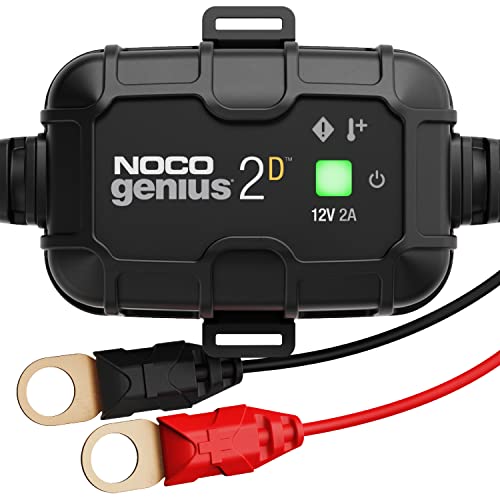
NOCO GENIUS2D Onboard Charger (2A) — Best Onboard Marine Charger
The GENIUS2D takes a different approach: instead of carrying a charger to the battery, you mount the charger beside it, permanently. This 2A direct-mount unit lives in the boat, wired to the battery, so plugging in the shore or garage extension cord charges and maintains automatically, with the GENIUS line’s desulfation, temperature compensation, and force mode aboard.
Strengths
- Permanent mount ends the ritual of fetching and clamping a charger
- Plug in one cord at the dock or garage and charging just happens
- Full GENIUS feature set in a compact onboard form
Trade-offs
- 2A is maintenance pace; a drained trolling battery needs a bigger charger or more time
- Lead-acid chemistries per the listing; no lithium mode stated
- Installation takes an hour of mounting and wiring the first time
| Output | 2A |
| Voltage | 12V |
| Mounting | Direct-mount onboard |
| Chemistries | Lead-acid: wet, gel, AGM, SLA (per listing) |
| Features | Desulfator, temperature compensation, force mode |
Boats die in storage more than they die on the water, usually because charging them required effort at exactly the moments nobody felt like making it. An onboard charger removes the effort permanently: the same cord that powers the garage or dock outlet wakes the GENIUS2D, and the battery sits at a maintained full charge, desulfated and temperature-compensated, until the next trip. For a single-battery boat kept on a trailer or at a slip with power, it is the highest-convenience charging solution in this guide.
The GENIUS2D’s 2A pace deserves framing rather than apology: an onboard maintainer-charger’s job is to greet a battery that is usually already near full, from the trip home or the last outing, and hold it perfectly until the next one. For that duty 2A is correctly sized, silent, and cool-running in a confined locker. Boats that return with deeply drained batteries should step up to a higher-output onboard unit; boats that return tired but not flat will find this one exactly fitted.
Best for: Single-battery boats and equipment where the charger can live onboard / Not suited for: Lithium trolling batteries or multi-bank boats needing faster charging
Check the current price on Amazon
Comparison Table
| Pick | Badge | Key spec | Best for |
|---|---|---|---|
| NOCO GENIUS5 Smart Charger (5A) | Best Overall | 5A, 6/12V, lead-acid + LiFePO4, force mode | Most car, truck, and single-battery boat owners wanting one charger for everything |
| NOCO GENIUSPRO50 Professional Charger (50A) | Best Professional / Fast Charging | 50A, 6/12/24V, power supply mode | Workshops, fleets, farms, and owners of large or multiple heavy-duty batteries |
| Schumacher SC1281 Charger with Engine Start (6A / 100A Start) | Best with Engine Start | 6A charge, 100A engine start, alternator tester | Home garages wanting charging, engine starting, and testing in one unit |
| CTEK MXS 5.0 Automatic Charger (4.3A) | Best Premium Alternative | 4.3A, 12V, fully automatic maintainer | Stored vehicles, classics, and seasonal equipment kept on maintenance |
| NOCO GENIUS2X4 Four-Bank Charger (8A Total) | Best for Multiple Batteries | 4 banks, 6/12V, lead-acid + LiFePO4 | Households with three or more stored vehicles, boats, or seasonal machines |
| NOCO GENIUS2D Onboard Charger (2A) | Best Onboard Marine Charger | 2A, 12V, direct-mount onboard | Single-battery boats and equipment where the charger can live onboard |
How to Choose a 12 Volt Battery Charger: Amps, Banks, and Chemistries
Amperage is charging speed. As a rule of thumb, a charger’s amps should be roughly 10 percent of the battery’s amp-hour capacity for a healthy overnight charge: a 50Ah car battery pairs with a 5A charger, a 100Ah marine battery with a 10A charger or a patient wait on a 5A unit. Much smaller is fine for maintenance but frustrating for recovery; much larger buys speed you may not need at a price you will notice.
Banks are independence. Each bank charges its own battery on its own program, which matters the moment a household has more than one stored vehicle. A single charger shared by rotation leaves most batteries sitting discharged most of the time, which is precisely the condition that kills them.
Chemistry support is the future-proofing question. Your next battery may be AGM or LiFePO4 even if today’s is flooded. A charger with selectable modes for flooded, gel, AGM, and lithium, like the NOCO GENIUS line, survives that transition; a lead-acid-only charger becomes a paperweight the day you switch. Check the listing for the exact chemistries, as we did for every pick here.
What the Smart Charging Stages Actually Do
A modern charger earns the word ‘smart’ in stages. It begins by analyzing the battery, and in better units, attempting desulfation: controlled pulses that break down the sulfate crystals that coat neglected plates and steal capacity. Then bulk charging pushes current at the charger’s full rate until the battery reaches roughly 80 percent, followed by absorption, where voltage is held and current tapers as the last capacity fills in slowly and completely.
After that comes the stage that separates chargers from maintainers: float or maintenance mode, holding the battery at full charge with tiny, monitored top-ups instead of a continuous push that would boil a flooded battery or overcharge a sealed one. Temperature compensation threads through all of it, raising voltage slightly in a cold garage and lowering it in summer heat, because a battery’s correct charging voltage genuinely changes with temperature.
Force mode is the override worth knowing: it commands the charger to attempt a battery discharged below the normal detection threshold. Use it knowingly, on a battery you have inspected, because the threshold exists to protect against shorted cells; but for the common case of a good battery left with the lights on, it is the difference between recovery and replacement.
Charger vs Maintainer vs Booster: Which Do You Actually Need?
The three tools answer three different emergencies. A charger answers ‘this battery is flat and I have hours’, restoring it fully from wall power. A maintainer answers ‘this vehicle will sit for months’, holding the battery at full indefinitely; most smart chargers, including every NOCO and CTEK pick here, do both jobs. A booster answers ‘I must leave NOW’, starting the engine from its own stored energy, and our booster guide covers those picks.
Most households need the charger-maintainer combination first, because it prevents emergencies rather than rescuing them, and a booster second, for the emergencies that happen away from an outlet. If you find yourself boosting weekly, neither tool is the fix; the battery or alternator is failing, and the Schumacher SC1281’s built-in tester exists to prove it.
Reviving a Neglected Battery: A Realistic Protocol
Every charger owner eventually faces the battery that sat too long: the mower in March, the boat in May, the project car in whatever month it finally gets attention. The realistic protocol starts with inspection and measurement. Check for swelling, cracks, leaks, and terminal damage, and measure the resting voltage. A battery showing a plausible low voltage is a charging candidate; one showing near zero may have a shorted cell, and no charger’s repair mode fixes that.
Charge slowly and completely, with desulfation enabled if your charger offers it, and use force mode only when the charger refuses a battery you have inspected and believe is sound. Then let the battery rest off the charger for several hours and measure again: a healthy recovered battery holds its charge; a dying one slides back down and confesses. A load test, at a parts store or with the tester built into units like the Schumacher SC1281, settles the question definitively.
Set expectations honestly. Desulfation recovers batteries whose problem is neglect, not age or damage, and even a successful recovery rarely restores a battery to new; it restores it to service. Mark the date, watch it over the following weeks, and put it on a maintainer so the neglect does not repeat. The cheapest battery is the one you do not have to replace, and the second cheapest is the one you replace once, on schedule, instead of twice in emergencies.
Charging Batteries in Vehicles with Sensitive Electronics
Modern vehicles are computers with engines attached, and owners reasonably worry about connecting chargers to them. The reassuring truth is that a quality smart charger is gentler than the vehicle’s own alternator: it charges at controlled voltage, without the spikes of old transformer chargers, and every pick in this guide is of that modern type. Follow the vehicle maker’s guidance where it exists, since several manufacturers specify charge points under the hood, a positive post and a designated ground, for batteries buried in trunks or under seats.
Two practices cover most situations. Connect the charger with the vehicle off and the charger unplugged, then plug in and let the smart charger analyze before it delivers current. And for vehicles that will sit on maintenance, use the maker’s charge points or a permanent harness rather than repeatedly disturbing the battery terminals, which on modern vehicles can disturb learned settings and corrode connections.
The professional corollary is the power supply mode on units like the GENIUSPRO50: during diagnostics, programming, or any service where the ignition sits on with the engine off, a charger in power supply mode holds system voltage steady so modules do not brown-out mid-procedure. It is a niche feature at home and an essential one in a shop, and it illustrates where the category has arrived: the modern charger is part of the vehicle’s electrical infrastructure, not an appliance that merely visits it.
Extending Battery Life: The Habits a Charger Enables
A charger used well changes a battery’s life expectancy more than any other single factor, because the two great battery killers, chronic undercharge and deep discharge followed by sitting, are both habits a charger breaks. The vehicle that takes only short trips lives undercharged; a monthly full charge on a smart charger, or a maintainer connection on weekends, restores what the commute pattern steals and can add years to the battery’s service.
Seasonal equipment benefits even more dramatically. The mower, boat, motorcycle, and snow blower batteries that traditionally die every second spring almost always died of the same cause: a winter spent discharged and sulfating. Any charger in this guide, left in maintenance mode or applied monthly, converts that pattern into batteries that last their full design life, which is why experienced owners describe the charger as the cheapest part they ever bought.
The final habit is record-keeping: a note of when each battery was bought, charged, and tested, kept with the charger. Batteries announce their decline gradually, in slower cranks and quicker discharges, and the owner with records notices the announcement a season early, when replacement is a planned errand rather than a roadside event.
Permanent Harness Installations for Chargers
Most smart chargers offer a ring-terminal harness that bolts to the battery permanently and ends in a quick-disconnect plug. Installing one converts charging from a hood-open, clamp-balancing ritual into a ten-second connection, and that conversion is what makes monthly charges and winter maintenance actually happen on schedule. Motorcycles, boats, mowers, and any vehicle whose battery hides under bodywork benefit most.
Route the plug to somewhere reachable without tools, protect it from heat and chafing, and keep its cap on when disconnected. Label it if the vehicle has more than one electrical accessory lead, because the next person to work on the vehicle, possibly you in three years, will thank the labeler. A charger plus a harness on every stored vehicle is the closest thing this category has to a permanent solution.
Safety Around Charging: The Short, Complete Briefing
Charging a lead-acid battery produces hydrogen gas, in small amounts with modern smart chargers and sealed batteries, in larger amounts with old chargers and flooded batteries pushed hard. The safety rules follow from that one fact and from the stored energy involved: charge in a ventilated space, keep flames, sparks, and smoking away, connect and disconnect with the charger unplugged, and wear eye protection when working over a battery, because the acid inside does not care how careful you usually are.
Respect the hardware as well. Never charge a battery that is frozen, cracked, leaking, or swollen; never set a charger on top of the battery where its vents and terminals live; never let clamps dangle against each other or bodywork while the unit is live. Lithium batteries change the gas question but not the respect: charge them only on a lithium-profile charger, in the temperature range their makers allow, with the same tidy cable discipline.
Finally, teach the household. A charger is one of the few garage tools that gets used by whoever discovers the dead battery first, often a teenager or a spouse in a hurry. A laminated card with the connection order and the chemistry setting for each vehicle, kept with the charger, converts a moment of improvisation into a procedure, and procedures are what safety actually consists of.
Charging Two Batteries on One Charger: Parallel Pitfalls
Owners with two batteries and one charger eventually ask whether they can charge both at once in parallel, and the honest answer is: sometimes, carefully, and usually worse than the alternatives. Two batteries in parallel charge as one bank, so they must be the same chemistry, similar age, and at a similar state of charge to begin with; a full battery paired with a flat one spends the session trading charge between themselves while the charger watches a confusing average. The charger also cannot desulfate or diagnose either battery individually, so problems hide inside the pair.
If the two batteries live in a vehicle as a matched pair, a diesel truck, for instance, parallel charging is how they are used anyway, and charging them together in place is normal practice. If they are two unrelated batteries from different machines, the correct answers are a multi-bank charger like the GENIUS2X4, which gives each battery its own program, or simple rotation with each battery reaching a full, finished charge in turn rather than both sitting at a shared almost.
The deeper principle is that a charge is also a measurement: a smart charger learns about the battery it is connected to and reports problems through its behavior. Anything that merges two batteries into one electrical blur throws that information away, and information about battery health, delivered early and free, is half of what a modern charger is for.
Reading Charger Indicators and Knowing When to Worry
A smart charger’s indicator panel is a conversation, and learning its language prevents both complacency and panic. A charger that moves steadily through its stages and settles into maintenance is reporting health. A charger that sits in bulk for an unusually long time on a battery that should be nearly full is reporting a battery that cannot accept or hold charge normally, or a load still connected somewhere in the vehicle quietly eating the charger’s output. A charger that drops into an error or refuses the battery outright is delivering a diagnosis, not malfunctioning; consult its manual’s code before assuming the tool is at fault.
The worry list is short and physical: a battery that becomes hot to the touch, swells, hisses, or smells strongly during charging should be disconnected, charger unplugged first, and replaced rather than coaxed. Everything else, slow charges, overnight completions, a desulfation stage that takes hours on a neglected battery, is the normal patience of electrochemistry, and the owner’s job is simply to give the process the time and ventilation it asks for.
A Final Word on the Garage Shelf
Give the charger a permanent home: a shelf or wall spot near an outlet, its cables coiled loosely, its manual and any vehicle-specific notes in a sleeve beside it, and its harness connectors on the vehicles it serves already installed. Equipment that lives ready gets used at the first sign of trouble, when a charge is cheap and quick; equipment that must be found, untangled, and remembered gets used after the failure, when everything is slower and more expensive. The shelf is part of the tool.
How to Charge a 12 Volt Battery Correctly
Smart chargers have made this nearly foolproof, but the connection order and a few checks still matter for safety and for the charger’s own diagnostics.
- Inspect before you charge: look for a cracked case, leaking electrolyte, swollen sides, or corroded terminals. A battery with physical damage should be replaced, not charged.
- If the battery is in a vehicle, switch everything off. Connect the charger’s red clamp to the positive terminal and the black clamp to the negative terminal or a solid engine ground, with the charger still unplugged.
- Plug in the charger and select the correct mode for your battery’s chemistry and size if your charger asks; automatic units will analyze and begin on their own.
- Let the charger finish. A full charge on a healthy, half-discharged car battery takes hours, not minutes; the charger will tell you when it has moved to maintenance mode.
- For a battery that reads nearly zero volts, use force mode if your charger offers it, and watch the first hour: a battery that gets hot, hisses, or smells of rotten eggs should be disconnected and replaced.
- When done, unplug the charger first, then remove the black clamp, then the red. If the battery will sit, leave a maintainer connected instead of repeating this ritual monthly.
Charge in a ventilated space, keep sparks and flames away from a charging battery, and never charge a frozen battery; let it thaw first. Those three habits cover nearly every charging accident ever recorded.
Common Buying Mistakes
Using a manual charger unattended. Old transformer chargers never stop, and overcharging destroys batteries and can boil them dry. A smart charger with automatic float is the minimum standard now
Charging lithium on a lead-acid-only charger. The voltage profile is wrong and the battery may never fill or may be stressed. Confirm a LiFePO4 mode in the listing before you buy, as with the GENIUS picks
Buying amps you do not need, or too few. A 1A maintainer will take days on a truck battery; a 50A pro unit is wasted on a motorcycle. Match amps to your largest battery’s capacity
Clamping in the wrong order. Connect clamps with the charger unplugged, positive first in practice per most manuals, and unplug before removing them. Sparks at a battery are never a good idea
Charging a damaged battery. Swollen, cracked, or leaking batteries are replacements, not charging projects. No charger’s repair mode fixes physical damage
Assuming a charger fixes a bad alternator. If the battery dies again days after a full charge, test the charging system. The charger was never the problem
Final Recommendation
Buy the NOCO GENIUS5 unless you have a specific reason not to: it charges everything common, maintains indefinitely, and rescues deeply discharged batteries with force mode. Go GENIUSPRO50 if you run a shop or fleet, Schumacher SC1281 if you want engine-start and alternator testing in the garage, CTEK MXS 5.0 if a stored vehicle deserves the premium treatment, GENIUS2X4 if your batteries outnumber your outlets, and GENIUS2D if the boat should simply charge itself.
Whichever lands in your garage, connect it correctly, choose the right chemistry mode, and let it finish. Batteries rarely die suddenly; they die by a hundred small neglects a good charger quietly prevents.
Ready to buy? Start with the top three: NOCO GENIUS5 Smart Charger (5A) — Check the current price on Amazon; NOCO GENIUSPRO50 Professional Charger (50A) — Check the current price on Amazon; Schumacher SC1281 Charger with Engine Start (6A / 100A Start) — Check the current price on Amazon.
Related guides in this series: Best 12 Volt Battery Charger And Maintainer Best 12 Volt Battery Booster Best 12 Volt Batteries For Trucks Best 12 Volt Batteries For Trolling Motors Best 12 Volt Batteries Used For Solar Recharging
Frequently Asked Questions
How many amps should a 12V battery charger have?
About 10 percent of the battery’s amp-hour rating is the classic guideline: 5A for a typical car battery, 10A for a 100Ah marine battery. Smaller chargers still work, just more slowly, and are ideal for maintenance.
Can one charger handle both lead-acid and lithium batteries?
Yes, if it has selectable chemistry modes, as the NOCO GENIUS chargers in this guide do. Never charge a LiFePO4 battery on a charger with only a lead-acid profile.
How long does it take to charge a dead car battery?
A half-discharged car battery on a 5A charger typically needs several hours; a fully flat, large battery can need overnight or longer. Engine-start chargers and boosters exist for when you cannot wait.
What is force mode on a battery charger?
It overrides the charger’s low-voltage refusal and attempts to charge a battery discharged below the normal detection threshold. Use it on an inspected, undamaged battery, and monitor the first hour of charging.
Can I leave a smart charger connected all winter?
Yes; that is exactly what the maintenance or float stage is for. Every charger in this guide is designed to be left connected to stored vehicles, holding the battery at full without overcharging.
Why does my battery keep dying after charging?
Either the battery has lost capacity and needs replacement, or the vehicle’s alternator is not recharging it, or a parasitic drain is emptying it overnight. A charger with a built-in tester, like the Schumacher SC1281, helps separate those causes.


