Disclosure: airfryerkitchensupply.com is reader-supported. When you buy through links on our site, we may earn an affiliate commission at no extra cost to you.
Where to buy
Every pick in this guide to the best 12 volt batteries for trolling motors was verified against Amazon’s own catalog data before this article was written, so each linked product is a real, currently listed item with the specifications quoted from its listing. Use the links in this box, in the Quick Picks, in each review, and in the comparison table to check live availability and the current price on Amazon before you buy.
- LiTime 12V 100Ah Trolling Motor LiFePO4 Battery — Check the current price on Amazon
- SUPER EMPOWER 12V 100Ah LiFePO4 Battery (Group 24) — Check the current price on Amazon
- GuaiGLong 12V 100Ah LiFePO4 Bluetooth Battery — Check the current price on Amazon
- Newport 12V 50Ah Deep Cycle AGM Marine Battery — Check the current price on Amazon
- Mighty Max MM-G27M 12V 100Ah Marine AGM Battery — Check the current price on Amazon
- LiTime 12V 100Ah Dual Purpose Cranking LiFePO4 Battery — Check the current price on Amazon
The best 12 volt batteries for trolling motors are the ones that still have charge left when the wind picks up at the far end of the lake. A trolling motor is a steady, hours-long draw rather than a quick burst, so the battery behind it has to be a true deep-cycle design that tolerates being drained and recharged hundreds of times. That single fact rules out ordinary car starting batteries, which are built for short cranking bursts and fail early when they are cycled deeply every weekend.
The market splits cleanly into two camps. Lithium iron phosphate (LiFePO4) batteries cost more up front but weigh roughly half as much as lead-acid, hold their voltage almost flat until they are nearly empty, and can be discharged far deeper without damage. AGM lead-acid batteries cost less, work with the chargers most anglers already own, and remain the sensible choice for occasional use or tight budgets. This guide includes verified picks from both camps, including one dual-purpose lithium battery that can also crank an outboard.
Sizing matters more than brand. A 30 to 55 lb thrust motor on a small boat can fish happily on a 50Ah battery, while a 55 to 80 lb thrust motor on a bigger bass boat will drain a 100Ah battery in a long day. Every pick below states its real capacity, group size, and battery management limits from its verified listing, so you can match the battery to your motor and your hull instead of guessing.
In this guide
Quick Picks
If you are short on time, these are the six picks that matter. Each one earned its badge for a specific reason, and the full reviews further down explain the trade-offs in detail.
- LiTime 12V 100Ah Trolling Motor LiFePO4 Battery — Best Overall: A purpose-built Group 31 trolling motor battery with a 100A BMS, low-temperature protection, and an IP65 sealed case. Check price on Amazon
- SUPER EMPOWER 12V 100Ah LiFePO4 Battery (Group 24) — Best Compact Fit: The same 100Ah capacity and 1280Wh energy in a smaller Group 24 case for tight compartments. Check price on Amazon
- GuaiGLong 12V 100Ah LiFePO4 Bluetooth Battery — Best with Bluetooth Monitoring: A 100Ah trolling motor battery whose Bluetooth BMS lets you check real state of charge from your phone. Check price on Amazon
- Newport 12V 50Ah Deep Cycle AGM Marine Battery — Best for Kayaks and Small Boats: A sealed 50Ah AGM from a trolling motor specialist, sized and priced for kayaks and small boats. Check price on Amazon
- Mighty Max MM-G27M 12V 100Ah Marine AGM Battery — Best AGM for Big Boats: A Group 27M dual-purpose AGM with 100Ah capacity, 800 CCA cranking power, and a 170-minute reserve capacity. Check price on Amazon
- LiTime 12V 100Ah Dual Purpose Cranking LiFePO4 Battery — Best Dual-Purpose Lithium: A Group 24 lithium battery with 900 CCA cranking power, self-heating, and an IP67 case that also deep-cycles. Check price on Amazon
How These Picks Were Chosen
Each battery in this guide was verified through Amazon’s catalog data before writing: the brand, model, capacity, group size, and protection features in each review come from the manufacturer’s own listing, not from roundup sites. Picks were then filtered for genuine deep-cycle construction, a battery management system (BMS) on lithium models, low-temperature charge protection for cold mornings, and case sizes that actually fit standard marine battery trays and boxes.
We deliberately mixed chemistries and capacities rather than listing six near-identical lithium batteries. Anglers fish very differently: a kayak angler needs light weight above all, a tournament angler needs maximum runtime and fast turnaround, and a weekend angler in a jon boat needs the lowest cost per season. The badges reflect those real differences, and the trade-off lists state plainly what each battery gives up.
Finally, we excluded starting-only batteries and any lithium battery whose listing did not state a BMS rating, because an unprotected lithium pack behind a trolling motor is a safety and longevity risk. Where a pick is dual-purpose, the review says so and explains the compromise involved.
The 6 Best 12 Volt Batteries for Trolling Motors
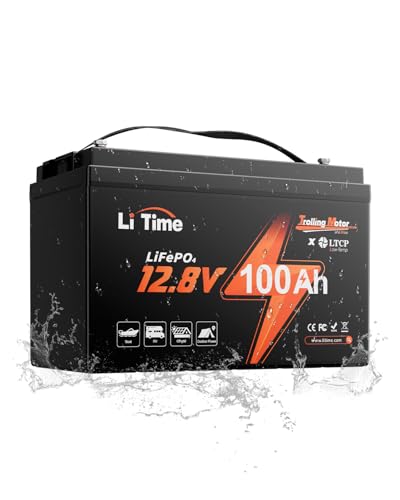
LiTime 12V 100Ah Trolling Motor LiFePO4 Battery — Best Overall
If you want one battery that answers the trolling motor question for most freshwater boats, this is it. LiTime built this 100Ah LiFePO4 specifically for marine trolling use rather than relabeling a solar battery, and it shows in the details: a Group 31 case that drops into standard trays, a 100A BMS sized for real motor loads, and low-temperature protection for cold dawn launches.
Strengths
- Purpose-built for trolling motors, with a 100A BMS that handles sustained motor draw without nuisance cutoffs
- Low-temperature protection guards the cells when you charge after a cold morning on the water
- IP65 waterproof case shrugs off spray, rain, and damp battery compartments
Trade-offs
- Group 31 size is too large for most kayak battery boxes
- Costs more up front than an AGM of the same capacity
- Needs a lithium-compatible charger to reach a full, proper charge
| Capacity | 12V 100Ah, 1280Wh |
| Case size | Group 31 |
| BMS | 100A built-in |
| Expansion | Up to 4P4S series/parallel |
| Protection | Low-temperature protection, IP65 waterproof |
The flat discharge curve is the real-world advantage here. A lead-acid battery’s voltage sags steadily as it drains, so your motor feels weaker hour by hour; this lithium battery holds near full voltage until it is almost empty, which means the thrust you set at 7 a.m. is the thrust you still have at noon. At roughly half the weight of a comparable AGM, it also makes a genuine difference when you are carrying the battery down a dock or lifting it out of a compartment to charge. The 4P4S expansion support matters for anglers running 24V or 36V motors later: you can build a matched bank from identical batteries instead of starting over. For a single 12V motor on a bass boat, aluminum fishing boat, or larger kayak with a proper battery box, this is the battery we would buy first.
Ownership details round out the case: the Group 31 footprint matches the trays and boxes most bass boats already have, the terminals are positioned for standard marine cables, and the battery pairs naturally with a 10A-class lithium charger for overnight turnaround between fishing days. Anglers stepping up from lead-acid should also budget five minutes to rethink their battery gauge expectations, because this battery’s flat voltage makes an old voltmeter nearly useless; the Bluetooth picks below or a shunt monitor from our bank meter guide restore the visibility you are used to.
Best for: Most 12V trolling motor setups on fishing boats that fish full days / Not suited for: Kayak anglers with small battery boxes or buyers who only fish a few short trips a year
Check the current price on Amazon

SUPER EMPOWER 12V 100Ah LiFePO4 Battery (Group 24) — Best Compact Fit
Plenty of boats have a battery compartment sized for a Group 24 case and no room for anything bigger. This SUPER EMPOWER battery puts a full 100Ah of lithium capacity into that smaller footprint, with a 100A BMS, low-temperature cutoff, and support for series and parallel expansion up to 4P4S.
Strengths
- Group 24 case fits compartments and boxes that cannot take a Group 31
- Full 100Ah / 1280Wh capacity despite the smaller case
- Low-temperature cutoff protects cells during cold-weather charging
Trade-offs
- Lesser-known brand than the established marine names
- No Bluetooth monitoring, so state of charge needs a separate meter or charger readout
- Compact case means terminals sit closer together; take care with wrench clearance
| Capacity | 12V 100Ah, 1280Wh |
| Case size | Group 24 |
| BMS | 100A built-in |
| Expansion | Supports 4P4S, up to 20.48kWh in a bank |
Group size is the unglamorous specification that decides whether a battery actually works in your boat, and it is where this pick earns its place. Jon boats, smaller center consoles, and many kayaks with aftermarket boxes are built around Group 24 or Group 27 trays. Getting 100Ah of lithium into the Group 24 footprint means those boats get full-day runtime without cutting fiberglass or relocating the battery to a worse position. The expansion rating is equally practical: two of these in series make a 24V bank for a bigger motor, and the matched low-temperature cutoff keeps a cold garage from quietly damaging the cells during a winter charge. If your compartment measures small but your fishing days run long, this is the efficient answer.
In practice, the Group 24 case is this battery’s whole argument, and it is a strong one: it drops into the compartment of an older boat without modification, sits in kayak boxes designed before lithium existed, and leaves room beside it for the charger or tackle storage that a Group 31 would evict. The 4P4S expansion rating means the small case does not trap you at 12V either; two of these in series run a 24V motor with the same tidy footprint logic, just doubled.
Best for: Boats with Group 24 battery compartments that need full 100Ah runtime / Not suited for: Anglers who want app-based charge monitoring built in
Check the current price on Amazon

GuaiGLong 12V 100Ah LiFePO4 Bluetooth Battery — Best with Bluetooth Monitoring
The biggest daily frustration with lithium batteries is that a simple voltmeter cannot tell you how much charge is left, because the voltage stays flat for most of the discharge. This GuaiGLong 100Ah battery solves that with a Bluetooth-connected BMS, so your phone shows actual remaining capacity, current draw, and cell status while you fish.
Strengths
- Bluetooth monitoring shows true state of charge, which flat lithium voltage curves otherwise hide
- 100A BMS with low-temperature cutoff for protected cold charging
- Supports 4P4S expansion for building 24V or 36V banks
Trade-offs
- App quality and long-term app support are less certain than with premium brands
- Bluetooth adds a small parasitic draw in long storage
- Brand has a shorter track record than LiTime or the big AGM names
| Capacity | 12V 100Ah, 1280Wh |
| BMS | 100A built-in with Bluetooth |
| Protection | Low-temperature cutoff |
| Expansion | Supports 4P4S, up to 20.48kWh in a bank |
Knowing your real remaining runtime changes how you fish. Instead of guessing whether you can run up the lake and still get back against the wind, you can watch actual amp-hours consumed and make the call with data. The Bluetooth BMS also warns you about problems a dumb battery would hide: a cell drifting out of balance, an over-current event, or a charge attempted below freezing. The honest caveat is that app-dependent products live and die by software support, so treat the Bluetooth as a strong convenience rather than the sole reason to buy; the underlying battery, a 100Ah LiFePO4 with a properly rated 100A BMS and low-temperature cutoff, is sound on its own merits. For anglers who run their battery hard and hate surprises, this is the informative pick.
The Bluetooth data deserves one more practical note: it changes how you maintain the battery off the water as well. A quick app check in the garage tells you whether the battery went onto the charger after the last trip or got forgotten, what its resting state is before a tournament morning, and whether a cell is drifting out of balance long before that drift becomes a failure. For anglers who keep meticulous tackle logs, this battery simply extends the same habit to the power system.
Best for: Anglers who want phone-based state-of-charge and BMS data while fishing / Not suited for: Buyers who prefer the longest-established brands and no app dependency
Check the current price on Amazon

Newport 12V 50Ah Deep Cycle AGM Marine Battery — Best for Kayaks and Small Boats
Newport makes trolling motors, so its 50Ah AGM battery is aimed squarely at the small-boat end of the market: kayaks, canoes, inflatables, and jon boats running compact motors. The sealed AGM design can be mounted in any orientation inside a kayak hull or battery box without leaking, and it works with the inexpensive chargers most anglers already own.
Strengths
- Sealed AGM design mounts in any position and never needs water top-ups
- 50Ah size keeps weight manageable for kayak and portable setups
- Works with standard lead-acid chargers, no lithium charger purchase needed
Trade-offs
- Only about half the capacity is safely usable, so effective runtime is roughly 25Ah
- Much heavier per usable amp-hour than any lithium pick here
- Shorter service life than LiFePO4 if it is regularly drained deeply
| Capacity | 12V 50Ah |
| Chemistry | Sealed AGM lead-acid |
| Intended use | Trolling motors, kayaks, small boats (per listing) |
This battery is the honest budget answer, and its limits are easy to understand. AGM batteries should not be drained below about half charge if you want them to last, so plan your day around roughly 25 usable amp-hours: fine for a 30 to 45 lb thrust motor on a kayak for a morning, not enough for an all-day session with a big motor on a heavy hull. Within that envelope it is excellent value, completely maintenance-free, and far more forgiving of cheap chargers and rough handling than lithium. It is also the pick we would choose for a spare or loaner setup, where the battery may sit for weeks between trips. Buy it with realistic expectations about runtime and it will not disappoint you; buy it expecting lithium performance and it will.
Newport’s specialization shows in the small things: this is a battery sold by a company whose customers will bolt it next to that company’s motors, in kayaks and small boats where a sealed, orientation-proof case is not a luxury but a requirement, since a kayak battery may ride on its side in a hull. Paired with an inexpensive automatic AGM charger and kept above half charge between trips, it delivers the cheapest honest seasons in this guide, which is precisely the job it was picked to do.
Best for: Kayak, canoe, and small-boat anglers running compact motors on shorter trips / Not suited for: Full-day fishing with 55 lb thrust or larger motors
Check the current price on Amazon
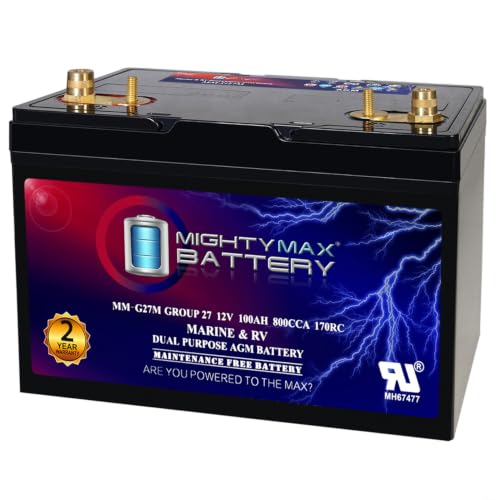
Mighty Max MM-G27M 12V 100Ah Marine AGM Battery — Best AGM for Big Boats
Some boats need one battery to do two jobs: crank the outboard and then run the trolling motor. The Mighty Max MM-G27M is a dual-purpose Group 27M AGM built for exactly that, with 100Ah of capacity, 800 cold cranking amps for starting, and a spill-proof maintenance-free case.
Strengths
- Dual-purpose design starts the engine and cycles for the trolling motor
- 800 CCA and 170 RC give strong starting reserve on bigger outboards
- Spill-proof AGM case is maintenance-free and vibration tolerant
Trade-offs
- Heavy, like every 100Ah lead-acid battery; plan on two hands and a short carry
- Usable deep-cycle capacity is about half the label rating in daily practice
- Dual-purpose designs are a compromise versus a dedicated deep-cycle battery
| Capacity | 12V 100Ah |
| Case size | Group 27M |
| Cranking | 800 CCA, 850 MCA |
| Reserve capacity | 170 RC |
| Design | Spill-proof, maintenance-free AGM |
On a boat with a single battery position, dual-purpose is not a compromise to apologize for; it is the correct engineering answer. This Mighty Max starts a mid-size outboard with authority, then settles into the steady draw of a trolling motor, and its 170-minute reserve capacity is a meaningful safety margin if the day runs long. The AGM construction handles pounding and vibration better than a flooded battery and never needs watering in a cramped compartment. The weight is the unavoidable cost, and disciplined charging matters: get it back on a charger the same day you fish, keep it above half charge in storage, and it will deliver several seasons. For a one-battery boat, this is the practical pick.
The dual-purpose compromise deserves a clear-eyed summary: compared with a dedicated deep-cycle battery, this Mighty Max gives up some deep-cycle lifespan; compared with a pure starting battery, it gives up a little cranking specialization. What it buys with those concessions is simplicity: one battery, one charger setting, one set of terminals to maintain, on boats where the alternative is a second battery that has nowhere to live. For the large fleet of 16 to 20 foot fishing boats in exactly that situation, the compromise is the correct engineering answer.
Best for: Single-battery boats that must start an outboard and run a trolling motor / Not suited for: Anglers who can carry two batteries and want a dedicated deep-cycle lithium
Check the current price on Amazon

LiTime 12V 100Ah Dual Purpose Cranking LiFePO4 Battery — Best Dual-Purpose Lithium
This LiTime battery collapses two batteries into one: it is a LiFePO4 deep-cycle battery that can also crank an outboard, rated at 900 CCA, in a Group 24 case with IP67 sealing and built-in self-heating for cold starts. For smaller boats where every kilogram and every compartment matters, that combination is genuinely useful.
Strengths
- 900 CCA cranking ability plus true deep-cycle capacity in one lithium case
- Self-heating supports charging and starting in cold weather
- IP67 waterproofing is the strongest sealing rating among these picks
Trade-offs
- Verify your outboard’s charging system compatibility before relying on alternator charging
- Premium pricing for the dual-purpose engineering
- Group 24 case still will not fit the smallest kayak boxes
| Capacity | 12V 100Ah |
| Cranking | 900 CCA |
| Case size | Group 24 |
| Protection | IP67 waterproof, self-heating |
| Cycle rating | 4000+ deep cycles (per listing) |
Dual-purpose lithium used to be a contradiction, because cranking demands current spikes that ordinary lithium BMS units refuse to deliver. This battery is engineered around that problem, with cranking output rated in its listing and deep-cycle capacity behind it. The self-heating function is more than a brochure feature for northern anglers: it lets the battery accept charge and deliver starting current on mornings when a standard lithium pack would be locked out by its own low-temperature protection. The one homework item is your outboard’s charging output; some older alternators and stators do not play well with lithium, so check LiTime’s compatibility guidance for your motor before you count on underway charging. As a one-battery solution for a compact fishing boat, nothing else in this guide does as much.
Cold-weather anglers should note how the features combine: self-heating lets the battery accept charge and deliver its 900 CCA on mornings when an unheated lithium pack would be locked out by its own protection, and the IP67 case means the battery that starts your outboard in November rain is not troubled by it. It is the most specialized pick in this guide, priced accordingly, and for the one-battery boat in a cold climate it solves problems no other single pick here addresses.
Best for: Compact boats wanting one lithium battery for both starting and trolling / Not suited for: Owners of older outboards whose charging systems are not lithium-compatible
Check the current price on Amazon
Comparison Table
| Pick | Badge | Key spec | Best for |
|---|---|---|---|
| LiTime 12V 100Ah Trolling Motor LiFePO4 Battery | Best Overall | 100Ah LiFePO4, Group 31, 100A BMS | Most 12V trolling motor setups on fishing boats that fish full days |
| SUPER EMPOWER 12V 100Ah LiFePO4 Battery (Group 24) | Best Compact Fit | 100Ah LiFePO4, Group 24, 100A BMS | Boats with Group 24 battery compartments that need full 100Ah runtime |
| GuaiGLong 12V 100Ah LiFePO4 Bluetooth Battery | Best with Bluetooth Monitoring | 100Ah LiFePO4, Bluetooth 100A BMS | Anglers who want phone-based state-of-charge and BMS data while fishing |
| Newport 12V 50Ah Deep Cycle AGM Marine Battery | Best for Kayaks and Small Boats | 50Ah AGM, sealed marine deep cycle | Kayak, canoe, and small-boat anglers running compact motors on shorter trips |
| Mighty Max MM-G27M 12V 100Ah Marine AGM Battery | Best AGM for Big Boats | 100Ah AGM Group 27M, 800 CCA, 170 RC | Single-battery boats that must start an outboard and run a trolling motor |
| LiTime 12V 100Ah Dual Purpose Cranking LiFePO4 Battery | Best Dual-Purpose Lithium | 100Ah LiFePO4, 900 CCA, Group 24, IP67 | Compact boats wanting one lithium battery for both starting and trolling |
How to Choose the Right Trolling Motor Battery
Start with your motor, not with the battery. Find its maximum amp draw, which rises with thrust: small 30 lb motors sip current, while 55 to 80 lb motors can draw 50 amps or more at full speed. Multiply the draw you actually use, most anglers cruise at half throttle or less, by the hours you fish, and you have the amp-hours you need. Then apply the chemistry rule: a lithium battery can use 80 to 100 percent of its label capacity, while an AGM should only use about half if you want it to last.
Next, measure your battery compartment before falling in love with a specification sheet. Group 24, Group 27, and Group 31 cases differ by inches that matter, and a battery that does not fit your tray or box is worthless no matter how good its cells are. Check terminal position too, because short factory cables may not reach a battery whose posts sit on the opposite side.
Finally, think about the whole system. Lithium batteries need a lithium-profile charger to charge fully and stay balanced. Motors wired for 24V or 36V need matched batteries of the same age, capacity, and model in series. And every battery deserves a proper marine breaker or fuse between it and the motor, sized to the motor’s draw.
Lithium vs AGM for Trolling Motors: An Honest Comparison
Lithium wins on weight, usable capacity, and consistency. A 100Ah LiFePO4 weighs about half what a 100Ah AGM weighs, delivers nearly all of its capacity instead of half, and holds its voltage flat so the motor pulls hard until the battery is nearly empty. Over a long service life of thousands of cycles, the cost per trip often ends up lower than lead-acid, despite the higher purchase price.
AGM wins on purchase price, charger compatibility, and simplicity. It tolerates inexpensive chargers, cold weather charging without electronic lockouts, and casual neglect better than lithium. For an angler who fishes ten short trips a year, an AGM like the Newport or Mighty Max picks above is the rational spend. For an angler who fishes every weekend, carries the battery any distance, or runs a big motor all day, lithium pays for itself in convenience long before it pays for itself in cycle math.
One safety note applies to both: never use an automotive starting battery as a trolling battery. Its thin plates are designed for seconds of cranking, and deep cycling destroys it quickly, sometimes within a single season.
How to Wire and Mount a Trolling Motor Battery Safely
Mount the battery in a battery box or on a tray with a strap, low and as close to the boat’s centerline as practical. A loose 100Ah battery in a chop is a genuine hazard. Use marine-grade cable of the gauge your motor manual specifies for the run length, and crimp and heat-shrink every connection rather than twisting wire and taping it.
Install a circuit breaker or fuse on the positive lead near the battery, sized to your motor’s maximum draw; most trolling motor makers sell matched breakers for exactly this purpose. Route cables so they cannot chafe on the hull or sit in bilge water, and coat the terminals with corrosion protection after torquing them down.
For series banks on 24V or 36V motors, use batteries of the same model, capacity, and age, connect them with cable of equal length, and charge each 12V battery fully before assembling the bank. Mixing an old battery with a new one guarantees the bank performs like the old one.
Matching Battery Capacity to Motor Thrust and Boat Size
Thrust ratings mislead shoppers because two motors with the same thrust can live very different lives: one pushing a light kayak, the other holding a heavy bass boat against river current. The kayak motor cruises at low settings and sips current; the bass boat motor works near its ceiling for hours. That is why capacity advice must start with the boat, not the motor label. A useful field rule is to budget roughly one amp-hour of lithium capacity, or two amp-hours of AGM capacity, for every pound of thrust at your typical cruising pace for each hour you fish, then add a reserve for the windy day you did not plan.
Kayaks and canoes sit at the efficient end: a 30 to 45 lb motor on a light hull, fished for four or five hours at modest settings, fits honestly inside a 50Ah battery, which is why the Newport AGM and compact lithium batteries serve this crowd so well. Jon boats and small aluminums with 45 to 55 lb motors are the 100Ah class: a full day, some wind, some current, and an angler who does not want to watch the gauge. Big glass bass boats, walleye boats, and anything running spot-lock anchoring in current for hours should treat 100Ah as the floor and consider a second battery or a 24V system.
Spot-lock and autopilot features deserve a special note, because they change the consumption pattern completely. A motor that holds position against wind and current works continuously, surging as conditions change, and a day of spot-lock fishing can consume half again what the same day of slow trolling would. If your fishing style is built around anchoring on structure, size the battery for the motor’s working draw, not its cruising draw, and let the Bluetooth or shunt monitoring picks in this guide tell you the truth about your first few trips.
Cold Weather, Storage, and Off-Season Care
Trolling batteries live hard lives in summer and neglected lives in winter, and the winter half is where most of the damage happens. A lead-acid battery stored discharged in a cold garage sulfates steadily and can freeze once its charge, and therefore its acid strength, falls low enough. A lithium battery stores more gracefully but has its own rule: it must not be charged below freezing unless it has low-temperature protection or self-heating, which is why those features appear in the listings of the lithium picks above and why we treated them as requirements rather than luxuries.
The off-season routine that works for both chemistries is short. Charge the battery fully at the end of the season if it is lead-acid, or to the maker’s recommended storage level if it is lithium. Disconnect it from the boat so no parasitic load can nibble at it. Store it somewhere dry and out of standing water, and check it every month or two: top up the AGM, glance at the lithium’s indicator or app, and put everything back on the charger a week before the first spring trip rather than the night before.
Spring commissioning deserves the same discipline. Inspect cables and terminals for the green corrosion that grew over winter, torque every connection, and run the motor in the driveway or at the ramp before the first real trip. A battery that sat well will perform like it did in October; a battery that sat discharged will tell you immediately, while you are still somewhere you can do something about it.
When to Run Two Batteries or Step Up to 24 Volts
Every trolling setup eventually meets the day that one 12V battery cannot cover: the tournament that runs from dawn to weigh-in, the river with real current, the bigger motor the boat actually needed. The first upgrade is a second 12V battery in parallel, which doubles capacity at the same voltage and keeps your existing motor and charger relevant. Parallel banks demand matched batteries, same model, same age, ideally bought together, wired with equal-length cables, and charged as a bank or individually to full before reconnecting.
The second upgrade is a 24V or 36V motor, which needs its batteries in series instead. Higher voltage is genuinely better for big boats: the motor draws fewer amps for the same power, cables run cooler, and efficiency improves. The lithium picks in this guide whose listings support 4P4S expansion are built for exactly this path, so an angler can start with one battery on a 12V motor and build a matched series bank later without replacing the original battery.
Whichever direction you grow, add the monitoring habit at the same time. A bank you cannot measure is a bank you will mismanage, and the jump from one battery to a bank is precisely when a shunt-based meter or Bluetooth BMS stops being a gadget and becomes the instrument panel the system always needed.
Frequently Overlooked: Terminals, Cables, and Breakers
The battery gets the attention, but the circuit around it decides how much of its power reaches the motor. Undersized or corroded cables waste voltage as heat, and a motor fed through tired wiring feels weak with any battery installed. Inspect the full run when you replace a battery: cable gauge matched to the motor’s draw and the run’s length, crimps tight and sealed, terminals clean and torqued. It is common to ‘fix’ a supposedly tired battery by replacing the cables it was blamed for.
Breaker sizing follows the motor, not the battery: the breaker protects the wiring and provides a disconnect, and it should be rated just above the motor’s maximum draw per the motor maker’s guidance. A breaker that trips at full throttle is undersized or failing; a breaker rated far above the motor’s draw is decoration. Treat the breaker as part of the battery purchase, because installing a premium battery behind a bargain circuit wastes the premium.
How to Get the Most Runtime from Your Trolling Motor Battery
Runtime is partly the battery you buy and partly how you run the motor. These habits consistently add fishing time without spending anything.
- Cruise at the lowest speed setting that holds your position or covers water at the pace you want; amp draw rises steeply at the top settings, and the last two clicks of the dial can cost more current than the first five combined.
- Use the wind and current instead of fighting them. Drift with the wind and use the motor to steer and slow the drift rather than motoring directly into a headwind all day.
- Keep the propeller clean and undamaged. Weed, fishing line, and a nicked blade all waste energy as vibration and turbulence instead of thrust.
- Charge the battery the same day you fish, every time. Both lithium and AGM batteries last longer when they are returned to full charge promptly instead of sitting discharged in the garage.
- Store the battery cool and dry, off concrete if it is lead-acid, and check its charge monthly in the off-season; top up AGM batteries and store lithium batteries partially charged if the maker recommends it.
- Watch your consumption for the first few trips, with a battery monitor or Bluetooth BMS if your battery has one, and learn your boat’s real amp draw at your usual speeds. That number makes every future battery decision easy.
Follow those steps and the honest difference between a well-run 50Ah setup and a carelessly run 100Ah setup mostly disappears. Buy capacity for your worst day, then fish efficiently on all the others.
Common Buying Mistakes
Buying a starting battery for trolling. Cranking batteries are built for short bursts and die quickly under deep cycling. Always choose a battery whose listing states deep-cycle or dual-purpose construction
Judging lithium by voltage alone. A lithium battery reads nearly the same voltage at 80 percent and at 30 percent charge. Use a shunt-based monitor or a Bluetooth BMS to know your true state of charge
Ignoring the charger. A lithium battery charged forever on an old lead-acid-only charger may never reach full charge or balance properly. Budget for a lithium-profile charger when you switch chemistries
Undersizing for the motor. A small battery run at maximum draw every trip works harder and ages faster. Match capacity to your motor’s real draw and your longest day, not your average one
Skipping the breaker. Running a motor straight off the battery with no fuse or breaker leaves a short circuit with nothing to stop it. The breaker is cheap insurance that also doubles as a service disconnect
Mixing old and new batteries in a bank. In a series bank, the weakest battery limits everything and gets damaged first. Build banks from matched batteries bought together
Final Recommendation
If you only read one recommendation: the LiTime 12V 100Ah Trolling Motor battery is the default choice for most boats, with the SUPER EMPOWER Group 24 as the answer when your compartment is smaller and the GuaiGLong as the pick when you want Bluetooth state-of-charge data. Kayak and small-boat anglers should look at the Newport 50Ah AGM, single-battery boats at the Mighty Max MM-G27M, and anyone wanting one lithium battery to both start and troll should choose the LiTime Dual Purpose.
Whichever you pick, pair it with the right charger and a properly sized breaker, charge it the day you fish, and it will repay you with seasons of quiet, reliable thrust.
Ready to buy? Start with the top three: LiTime 12V 100Ah Trolling Motor LiFePO4 Battery — Check the current price on Amazon; SUPER EMPOWER 12V 100Ah LiFePO4 Battery (Group 24) — Check the current price on Amazon; GuaiGLong 12V 100Ah LiFePO4 Bluetooth Battery — Check the current price on Amazon.
Related guides in this series: Best 12 Volt Batteries Used For Solar Recharging Best 12 Volt Battery Charger Best 12 Volt Battery Bank Meter Best 12 Volt Batteries For Trucks Best 12 Volt Battery Charger And Maintainer
Frequently Asked Questions
How many amp-hours do I need for a trolling motor?
Estimate your motor’s draw at the speeds you actually use and multiply by hours fished. Many anglers cruise at 10 to 25 amps, so a four-hour trip might use 40 to 100Ah. Lithium batteries can use nearly all their rated capacity; plan on only half of an AGM’s rating.
Can I use a car battery for a trolling motor?
It will work briefly and fail early. Starting batteries are not built for deep discharge. Choose a deep-cycle or dual-purpose marine battery instead, as every pick in this guide is.
How long will a 100Ah battery run a 55 lb thrust trolling motor?
At full speed, a motor that size can draw around 50 amps, giving roughly two hours from a lithium 100Ah battery and about one hour of safe use from an AGM. At half throttle the draw falls dramatically and runtime stretches to most of a day.
Do lithium trolling motor batteries need a special charger?
They need a charger with a lithium profile to charge fully and safely. Many modern smart chargers include one; check for a LiFePO4 mode before you buy, and never rely on an old manual charger.
Can I connect two 12V batteries for a 24V trolling motor?
Yes, in series, positive to negative, using two matched batteries of the same model, capacity, and age. Batteries whose listings support series connection, like the 4P4S-rated picks above, are designed for exactly this.
Why does my trolling motor feel weaker late in the day on an AGM battery?
Lead-acid voltage falls steadily as the battery discharges, and motor thrust falls with it. Lithium batteries hold voltage almost flat until nearly empty, which is one of their biggest on-the-water advantages.


