Disclosure: airfryerkitchensupply.com is reader-supported. When you buy through links on our site, we may earn an affiliate commission at no extra cost to you.
Where to buy
The fastest way to compare the best and most durable kitchen sinks in this guide is on Amazon, where each verified pick below links directly to its product page so you can check the current price on Amazon, confirm the exact size and finish in the listing photos, and read the manufacturer specification sheet before you order. Durability claims are cheap in sink listings, so this guide only credits evidence: steel gauge, construction type and included protection such as bottom grids. Every pick was verified as an exact model, and the reviews say plainly what each sink’s durability does and does not cover.
- Kraus Standart PRO KHU100-30 30-Inch 16 Gauge Undermount Sink (Best Overall) — Check the current price on Amazon
- SANYCASA 30-Inch 11 Gauge Workstation Sink (Thickest Steel) — Check the current price on Amazon
- Kraus Standart PRO KHU100-32 32-Inch 16 Gauge Undermount Sink (Best Large Bowl) — Check the current price on Amazon
- Elkay Crosstown 18 Gauge Workstation Sink Kit 31-1/2 Inch (Best Workstation Durability) — Check the current price on Amazon
- Kraus KA1US33B 33-Inch 16 Gauge Undermount Sink (Best Scratch Camouflage) — Check the current price on Amazon
- Ruvati RVM4132 24-Inch 16-Gauge Undermount Sink (Best Compact Durable) — Check the current price on Amazon
Finding the best and most durable kitchen sinks is harder than the marketing suggests, because the label on the box rarely tells you how a product behaves after a year of daily use. Durability in a kitchen sink is not one quality but four, and confusing them is how buyers end up disappointed by a genuinely well-made sink. There is impact resistance — the dropped cast-iron skillet test. There is surface durability — whether a decade of pans and scouring leaves the bowl scarred. There is structural durability — seams, welds and mounting points that must never flex or leak. And there is acoustic durability, the truth that a thin sink sounds cheap every single day. This search deserves a guide that scores all four, which is what the six verified picks below were chosen to do.
The list is led by thick stainless steel, because 16-gauge construction is the most complete durability answer available at residential scale: it resists dents, cannot chip, tolerates heat and, with sound dampening and a bottom grid, shrugs off daily impacts. Kraus dominates the verified options for good reason — its Standart PRO and related lines publish gauge and construction openly — joined by an Elkay Crosstown workstation kit and a Ruvati undermount, plus an unusually heavy-gauge SANYCASA model whose 11-gauge claim, as stated in its verified title, puts it in a class of its own. Sizes run from compact 23-inch-class bowls to full 33-inch family sinks so durability does not require a big kitchen.
In this guide
Quick Picks
If you are short on time, start here. These six best and most durable kitchen sinks earned their places for different reasons, and the badge on each one tells you exactly who should buy it and who should keep looking.
- Kraus Standart PRO KHU100-30 30-Inch 16 Gauge Undermount Sink — Best Overall: The complete durability package: verified 16-gauge Kraus construction with rounded corners, sound dampening and the grid and drain in the box. — Check price on Amazon
- SANYCASA 30-Inch 11 Gauge Workstation Sink — Thickest Steel: The maximum-metal pick: an 11-gauge workstation sink, as stated in its verified title, for buyers who want thickness above every other criterion. — Check price on Amazon
- Kraus Standart PRO KHU100-32 32-Inch 16 Gauge Undermount Sink — Best Large Bowl: The large-bowl Standart PRO: the same verified 16-gauge construction stretched to 32 inches for serious cookware and family-scale washing. — Check price on Amazon
- Elkay Crosstown 18 Gauge Workstation Sink Kit 31-1/2 Inch — Best Workstation Durability: The heritage workstation: Elkay’s Crosstown kit, bringing a ledge-based prep format and a century-old brand’s parts ecosystem to the durability brief. — Check price on Amazon
- Kraus KA1US33B 33-Inch 16 Gauge Undermount Sink — Best Scratch Camouflage: The cosmetic-durability pick: a 33-inch, 16-gauge Kraus whose radiant pearl finish is stated to mask the scratches other steel records. — Check price on Amazon
- Ruvati RVM4132 24-Inch 16-Gauge Undermount Sink — Best Compact Durable: The compact heavyweight: genuine 16-gauge Ruvati construction in a 24-inch bowl, for small kitchens that refuse to buy flimsy. — Check price on Amazon
How These Picks Were Chosen
Picks were ranked on verifiable durability evidence in a fixed order: stated steel gauge first, then construction and corner design, then included protection such as grids and sound pads, then the accountability of the brand behind the warranty. Marketing adjectives were ignored entirely. Where a model’s verified title states its gauge — 16 gauge across the Kraus and Elkay-class picks, 11 gauge on the SANYCASA — that figure is quoted in the spec box; no durability figure appears in this guide that did not come from the listing itself.
Every product name and code in this guide was cross-checked against Amazon listing data before a link was added. A pick only carries a purchase link when that check confirmed the exact model, so you will never find an invented code or a link that lands on a different product. Where a well-known option could not be confirmed that way, it is discussed in prose without a link rather than linked on a guess. Prices are never printed in this guide because they change too often to stay honest; each link instead invites you to check the current price on Amazon at the moment you are actually shopping.
One honest limitation belongs up front: no residential sink is indestructible, and this guide will not pretend otherwise. Stainless records fine scratches even at its thickest, fireclay and enamel can chip under point impacts, and any sink can be ruined by a leaking installation. What durability buys you is margin — a bowl that treats your worst accident as a non-event and your daily routine as beneath its notice. Judged that way, the six below earn their places, and the buying-guide sections explain how to keep them earning it for decades.
The 6 Best Durable Kitchen Sinks

Kraus Standart PRO KHU100-30 30-Inch 16 Gauge Undermount Sink — Best Overall
Check the current price on Amazon
The complete durability package: verified 16-gauge Kraus construction with rounded corners, sound dampening and the grid and drain in the box. Picture the worst five minutes your sink will face this year: a full stockpot slipped from wet hands, a baking sheet dropped corner-first, a frozen turkey thawing for two days, a teenager scouring with whatever pad is nearest. The right durable sink is the one whose review still reads calmly against that list.
Strengths
- True 16-gauge T-304 construction is the dent-resistant top tier of residential stainless
- Rounded corners and channel grooves combine durability with bowls that actually drain and clean easily
- Complete kit — grid, drain assembly, hardware and template — protects the bowl from day one
Trade-offs
- Undermount installation demands a solid countertop and correct mounting; not a laminate-friendly pick
- 30-inch bowl needs a 33-inch minimum cabinet, so measure before falling for it
- Brushed stainless still records fine scratches over years, grid or no grid
| Specification | Detail |
|---|---|
| Material | T-304 16-gauge stainless steel (TRU16) |
| Size | External 30 x 18 x 10.5 in; bowl 28 x 16 x 10 in |
| Cabinet | Minimum 33 in |
| Includes | Bottom grid, drain assembly with strainer, mounting hardware, cutout template, towel |
Durability is also installed, not just bought. An undermount sink is only as strong as its mounting and sealing; a thick bowl hung badly will fail at the joint long before the steel does. Use the manufacturer’s mounting method, support the bowl as specified rather than relying on adhesive alone, and fit the bottom grid from day one — retrofitting protection after the first dent is a story this guide would rather you never tell.
Best for: the main family kitchen in a 33-inch cabinet that must survive decades / Not suited for: small cabinets or laminate countertops that cannot take an undermount
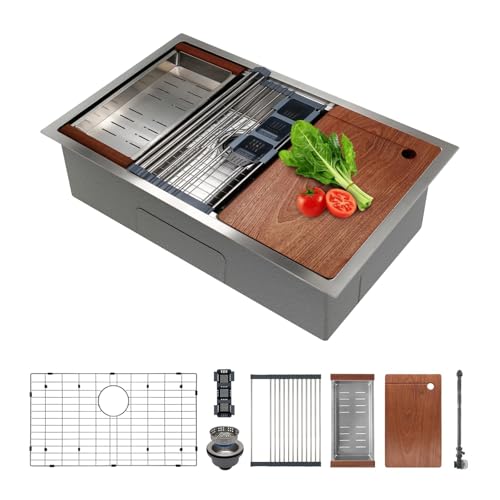
SANYCASA 30-Inch 11 Gauge Workstation Sink — Thickest Steel
Check the current price on Amazon
The maximum-metal pick: an 11-gauge workstation sink, as stated in its verified title, for buyers who want thickness above every other criterion. Picture the worst five minutes your sink will face this year: a full stockpot slipped from wet hands, a baking sheet dropped corner-first, a frozen turkey thawing for two days, a teenager scouring with whatever pad is nearest. The right durable sink is the one whose review still reads calmly against that list.
Strengths
- 11-gauge steel as stated in the verified title is far thicker than residential norms and shrugs off impacts
- Integrated ledge adds workstation function without a second product to wear out
- Workstation set format arrives as a complete, matched system
Trade-offs
- Heavier than standard stainless; cabinet and mounting must be planned for it
- A less established brand than Kraus or Elkay, so warranty support is less proven
- Workstation accessories are system-specific replacements
| Specification | Detail |
|---|---|
| Material | 11-gauge (3mm) stainless steel (per Amazon title) |
| Configuration | Single bowl workstation with integrated ledge |
| Size | 30 in undermount |
Durability is also installed, not just bought. An undermount sink is only as strong as its mounting and sealing; a thick bowl hung badly will fail at the joint long before the steel does. Use the manufacturer’s mounting method, support the bowl as specified rather than relying on adhesive alone, and fit the bottom grid from day one — retrofitting protection after the first dent is a story this guide would rather you never tell.
Best for: maximum-metal buyers and heavy canning, baking or entertaining kitchens / Not suited for: anyone who values a long-established brand network above raw thickness

Kraus Standart PRO KHU100-32 32-Inch 16 Gauge Undermount Sink — Best Large Bowl
Check the current price on Amazon
The large-bowl Standart PRO: the same verified 16-gauge construction stretched to 32 inches for serious cookware and family-scale washing. Picture the worst five minutes your sink will face this year: a full stockpot slipped from wet hands, a baking sheet dropped corner-first, a frozen turkey thawing for two days, a teenager scouring with whatever pad is nearest. The right durable sink is the one whose review still reads calmly against that list.
Strengths
- Same proven 16-gauge Standart PRO construction in a larger 32-inch bowl for serious cookware
- NoiseDefend padding keeps a big steel bowl sounding solid rather than drum-like
- Rounded corners clean faster and resist the grime build-up sharp corners invite
Trade-offs
- Needs an even wider cabinet than the 30-inch model; verify before ordering
- Large steel bowls show water spots across a bigger canvas
- Undermount-only format limits countertop choices
| Specification | Detail |
|---|---|
| Material | T-304 16-gauge stainless steel (TRU16) |
| Size | 32 in undermount |
| Features | Rounded corners, channel grooves, NoiseDefend pads (per Amazon title) |
Durability is also installed, not just bought. An undermount sink is only as strong as its mounting and sealing; a thick bowl hung badly will fail at the joint long before the steel does. Use the manufacturer’s mounting method, support the bowl as specified rather than relying on adhesive alone, and fit the bottom grid from day one — retrofitting protection after the first dent is a story this guide would rather you never tell.
Best for: large families and keen cooks with the cabinet width to use it / Not suited for: compact kitchens or top-mount-only countertops

Elkay Crosstown 18 Gauge Workstation Sink Kit 31-1/2 Inch — Best Workstation Durability
Check the current price on Amazon
The heritage workstation: Elkay’s Crosstown kit, bringing a ledge-based prep format and a century-old brand’s parts ecosystem to the durability brief. Picture the worst five minutes your sink will face this year: a full stockpot slipped from wet hands, a baking sheet dropped corner-first, a frozen turkey thawing for two days, a teenager scouring with whatever pad is nearest. The right durable sink is the one whose review still reads calmly against that list.
Strengths
- Elkay’s manufacturing accountability and parts ecosystem behind a workstation format
- Workstation ledge spreads work across the bowl, reducing countertop wear and dropped-pan impacts on edges
- Kit format bundles the sink with matched components for a coherent install
Trade-offs
- 18-gauge steel is a step below the 16-gauge picks for pure dent resistance
- Workstation accessories add replacement considerations over a plain bowl
- Premium brand positioning within its tier
| Specification | Detail |
|---|---|
| Material | 18-gauge stainless steel |
| Size | 31-1/2 x 18-1/2 x 9 in |
| Configuration | Workstation single bowl undermount kit |
Durability is also installed, not just bought. An undermount sink is only as strong as its mounting and sealing; a thick bowl hung badly will fail at the joint long before the steel does. Use the manufacturer’s mounting method, support the bowl as specified rather than relying on adhesive alone, and fit the bottom grid from day one — retrofitting protection after the first dent is a story this guide would rather you never tell.
Best for: prep-heavy cooks who want a workstation from a heritage American brand / Not suited for: buyers whose sole criterion is the thickest possible steel

Kraus KA1US33B 33-Inch 16 Gauge Undermount Sink — Best Scratch Camouflage
Check the current price on Amazon
The cosmetic-durability pick: a 33-inch, 16-gauge Kraus whose radiant pearl finish is stated to mask the scratches other steel records. Picture the worst five minutes your sink will face this year: a full stockpot slipped from wet hands, a baking sheet dropped corner-first, a frozen turkey thawing for two days, a teenager scouring with whatever pad is nearest. The right durable sink is the one whose review still reads calmly against that list.
Strengths
- Radiant pearl finish is stated to mask scratches, attacking stainless steel’s one cosmetic weakness directly
- Full 33-inch bowl with 16-gauge construction for the largest residential washing loads
- Foil-layer NoiseDefend soundproofing for a solid, quiet bowl
Trade-offs
- Largest footprint here; cabinet and countertop planning is non-negotiable
- Finish-matched accessories should be chosen with the same care as the sink
- Undermount format only
| Specification | Detail |
|---|---|
| Material | T-304 16-gauge stainless steel (TRU16) |
| Size | 33 in undermount |
| Finish | Radiant pearl — masks scratches (per Amazon title) |
Durability is also installed, not just bought. An undermount sink is only as strong as its mounting and sealing; a thick bowl hung badly will fail at the joint long before the steel does. Use the manufacturer’s mounting method, support the bowl as specified rather than relying on adhesive alone, and fit the bottom grid from day one — retrofitting protection after the first dent is a story this guide would rather you never tell.
Best for: perfectionists who want thick steel without watching every scratch appear / Not suited for: small kitchens or anyone replacing a top-mount sink in laminate

Ruvati RVM4132 24-Inch 16-Gauge Undermount Sink — Best Compact Durable
Check the current price on Amazon
The compact heavyweight: genuine 16-gauge Ruvati construction in a 24-inch bowl, for small kitchens that refuse to buy flimsy. Picture the worst five minutes your sink will face this year: a full stockpot slipped from wet hands, a baking sheet dropped corner-first, a frozen turkey thawing for two days, a teenager scouring with whatever pad is nearest. The right durable sink is the one whose review still reads calmly against that list.
Strengths
- Genuine 16-gauge construction in a compact 24-inch bowl — durability without the big footprint
- Brushed finish is stated to hide scratches, suiting hard-working small kitchens
- Single bowl proportions suit apartments, bars and prep zones as well as small main kitchens
Trade-offs
- 24-inch bowl will not flat-fit the largest roasting pans and sheet pans
- Compact undermount still needs a proper countertop and mounting
- Fewer bundled accessories than the larger Kraus kits in this guide
| Specification | Detail |
|---|---|
| Material | 16-gauge stainless steel |
| Size | 24 in undermount |
| Finish | Brushed — hides scratches (per Amazon title) |
Durability is also installed, not just bought. An undermount sink is only as strong as its mounting and sealing; a thick bowl hung badly will fail at the joint long before the steel does. Use the manufacturer’s mounting method, support the bowl as specified rather than relying on adhesive alone, and fit the bottom grid from day one — retrofitting protection after the first dent is a story this guide would rather you never tell.
Best for: apartments, small kitchens and secondary prep sinks that still take daily abuse / Not suited for: families whose cookware is uniformly oversized
Comparison Table
| Pick | Badge | Key spec | Best for |
|---|---|---|---|
| Kraus Standart PRO KHU100-30 30-Inch 16 Gauge Undermount Sink | Best Overall | T-304 16-gauge stainless steel (TRU16) | the main family kitchen in a 33-inch cabinet that must survive decades |
| SANYCASA 30-Inch 11 Gauge Workstation Sink | Thickest Steel | 11-gauge (3mm) stainless steel (per Amazon title) | maximum-metal buyers and heavy canning, baking or entertaining kitchens |
| Kraus Standart PRO KHU100-32 32-Inch 16 Gauge Undermount Sink | Best Large Bowl | T-304 16-gauge stainless steel (TRU16) | large families and keen cooks with the cabinet width to use it |
| Elkay Crosstown 18 Gauge Workstation Sink Kit 31-1/2 Inch | Best Workstation Durability | 18-gauge stainless steel | prep-heavy cooks who want a workstation from a heritage American brand |
| Kraus KA1US33B 33-Inch 16 Gauge Undermount Sink | Best Scratch Camouflage | T-304 16-gauge stainless steel (TRU16) | perfectionists who want thick steel without watching every scratch appear |
| Ruvati RVM4132 24-Inch 16-Gauge Undermount Sink | Best Compact Durable | 16-gauge stainless steel | apartments, small kitchens and secondary prep sinks that still take daily abuse |
Read the table as a shortlist, not a ranking. The right choice among these best and most durable kitchen sinks depends on the constraint you cannot change — the space you have, the tools you already own, and the way you actually work day to day — far more than on any single headline feature.
How to Choose a Durable Kitchen Sink
Start with gauge, and learn the one counterintuitive fact of this category: in steel gauge, the smaller number is the thicker, stronger sheet. Sixteen gauge is the residential heavyweight standard and the floor for any sink calling itself durable; eighteen gauge, as on the Elkay workstation here, is respectable and lighter; twenty gauge and below is where bowls begin to flex, drum and dent in ways no finish can hide. The SANYCASA in this guide states 11 gauge in its verified title — commercial territory — which illustrates the scale: each step is a real difference in metal, and metal is what durability is made of. Any listing that will not state a gauge is telling you something by omission.
Then examine construction. A durable bowl has corners you can clean — tight-radius or rounded corners resist both grime and the stress concentration of true zero-radius designs — a bottom that slopes honestly to the drain so water and debris leave instead of pooling, and sound dampening that covers the bowl rather than decorating it with a token pad. Included protection matters as much: a fitted bottom grid is not an accessory but a component of the durability system, intercepting the pan impacts that cause most visible damage. Price the grid into any sink that does not include one before comparing totals.
Finally, match the material to your failure mode. Households that drop things need impact margin, which thick stainless provides without a chip risk. Households that scour aggressively need a surface that tolerates it, which brushed stainless forgives and enamel punishes. Households in hard-water areas should weigh how each finish shows mineral spotting. Durability is personal because accidents are personal — the most durable sink is the one engineered against your kitchen’s actual worst habits, installed correctly, and protected by its grid from the first day.
Steel Gauge, Explained Without the Marketing
Gauge numbers descend from wire and sheet manufacturing, which is why they run backwards to intuition: 16-gauge stainless is roughly half as thick again as 20-gauge, and the difference is obvious the moment a pan lands. Thicker sheet resists denting, flexes less under a full bowl of water, and carries sound padding better, which is why thick sinks sound solid and thin sinks sound like instruments. The trade-offs are weight and cost as tiers, not performance. For a main kitchen sink bought for a decade or more, 16 gauge is the evidence-based recommendation of this guide; for a lightly used bar or laundry sink, 18 gauge is a rational saving; below that, call the sink inexpensive rather than durable and set expectations accordingly.
Thickness also interacts with everything hung on the bowl. A disposal’s vibration, a tall faucet’s leverage on a top-mount deck, and a full bowl’s static load all test the sheet and its mounting together. That is why this guide pairs every thickness claim with an installation instruction: gauge is the material’s promise, and mounting is how the promise is kept.
Keeping a Durable Sink Durable
Most sink damage is a habit problem wearing a hardware costume. Keep the grid in place, lift rather than slide cast iron across the bowl, and rinse gritty debris — the sand from root vegetables is a genuine abrasive — before wiping. Clean with the grain on brushed stainless, keep scouring pads to the non-scratch kind, and dry the bowl in hard-water areas often enough that mineral scale never gets a foothold. Under the sink, check the mounting and seals once a year: the commonest way a ‘failed’ durable sink actually fails is a neglected seal letting water into the cabinet, which is an installation maintenance issue, not a bowl issue. Ten minutes a year protects a twenty-year purchase.
The Durability Tests That Matter — and the Ones That Do Not
Sinks attract theatrical durability claims, so it helps to know which tests predict your life and which predict nothing. The tests that matter are boring and physical: a heavy pan set down hard a thousand times, which gauge and a grid answer; a knife slipped from a washing-up hand, which hardness and finish answer; a decade of scouring in one habitual direction, which brushed finishes forgive and polished ones record; and the slow test of a sealed joint through ten winters of expansion and contraction, which installation quality alone answers. A sink that is engineered and installed for those four will look and behave durably in every way you will ever notice, regardless of what any advertisement dropped on it from a height.
The tests that do not matter are the spectacular ones. No household drops a bowling ball into the sink, drives over it, or sets it on fire, and a bowl optimised for stunts can quietly be worse at the boring tests — a mirror polish that records every scour, a zero-radius corner that traps grime at the exact point of maximum stress. Judge durability the way insurers judge risk: by frequency, not by drama. The frequent events in a sink’s life are water, weight, grit and time, and the picks in this guide were ranked, in that order, on gauge, construction, protection and brand accountability — the four defences against exactly those four enemies.
Durability Beyond the Bowl: Drains, Grids and Mountings
A durable sink is a system, and its supporting parts decide whether the bowl’s promise is kept. The drain assembly is the hardest-worked joint in the kitchen, thermal-cycled daily and loaded with disposal vibration; a quality assembly, correctly sealed, is the difference between a dry cabinet decade and the slow, silent rot that owners discover by smell. This is one reason the complete-kit Kraus picks score so highly here: the drain in the box was designed for the bowl it seals. The grid, already praised in these pages, deserves its second mention as a system part too — it protects not only the bowl floor but the drain’s finish, by keeping pan traffic off both.
Mountings complete the system. An undermount’s clips, rails or frame carry a filled bowl’s considerable weight through every disposal shudder and every leaning teenager, and they deserve the same branded, specified seriousness as the steel. When you plan a durable installation, write the whole system on one list — bowl, drain, grid, mounting, sealant — and refuse to economise silently on the four items that are not the bowl, because they are where durable sinks actually fail. The bowl will be fine. It is everything attached to it that you are really choosing.
When Durability Is the Wrong Priority
Honesty requires one section against this guide’s own premise. Durability is the right master for a main kitchen sink in a home you will keep, but it is not the only value in the category, and there are kitchens where it should yield. A sink bought for a short tenancy, a property being prepared for sale, or a rarely used utility room does not need 16-gauge steel and a specified mounting system; it needs to be clean, sound and honestly priced as a tier, and overspending there starves rooms that matter more. A design-led kitchen may also rationally trade a measure of impact margin for fireclay’s beauty, accepting the grid discipline that trade demands — that is not a durability failure, it is a durability decision, made knowingly.
What this guide opposes is not those choices but the accidental version of them: the household that wanted a twenty-year sink and bought a three-year one because the listing photographs were identical and the gauge was nowhere on the page. If you have read this far, that accident is now very unlikely to happen to you. You know the number to demand, the kit to prefer, the grid to fit and the mounting to specify — and you know when to relax all of it on purpose. That is the complete durability skill, and it transfers to every sink you will ever buy after this one.
Reading a Sink Specification Like an Inspector
Most buyers skim a sink specification for dimensions and stop, which is like reading a contract for its page count. Read it instead the way an inspector would, in a fixed order, and the durable sinks identify themselves. First the material line, which must name a grade — T-304 stainless is the meaningful phrase — and a gauge, and any specification vague on either is finished being read. Second, the construction notes: corner radius, bottom slope and whether the bowl is pressed or fabricated, each of which predicts cleaning and drainage behaviour for a decade. Third, the sound treatment, where coverage matters more than branding — pads described across the bowl and underside, not a token square. Fourth, the included kit, line by line, because a grid and drain in the box are durability components you would otherwise buy blind. Fifth, the warranty’s own words — what it covers, for how long, and what it excludes — read in the document, not summarised by the listing.
Finish with the installation requirements, the most skipped and most prophetic paragraph in the document: minimum cabinet, mounting system, support instructions. A manufacturer who specifies support carefully is a manufacturer who expects the sink to be loaded for decades, and that expectation is itself durability evidence. Run this five-minute inspection on any sink, in this guide or beyond it, and you will never again need a stranger’s adjective to tell you whether a bowl was built to last — the document will have told you, in the maker’s own hand, exactly what you are buying.
Your Sink’s First Weekend: The Shakedown That Sets Its Decade
Treat a new durable sink’s first weekend as a shakedown, deliberately, and its decade will follow the pattern you set. Wash the largest pan you own and learn where it sits, where water pools, and how the bowl drains under a real load rather than a demonstration trickle. Run the disposal with the bowl full and listen — a solid, padded bowl has a voice, and learning its normal voice now means you will hear the abnormal one instantly in year four. Test the grid’s removal and replacement until the motion is thoughtless, because a grid that is annoying to lift is a grid that will be left out, and a grid left out is the durability system switched off. Photograph everything — bowl, drain, under-sink arrangement, model details — and file the photographs with the specification. Then cook the messiest meal your household makes, wash it up without ceremony, and let the sink stop being new. A durable sink does not want admiration; it wants employment under the habits this guide has described, and a shakedown weekend is how those habits are installed in the household rather than merely recommended to it. Start them now, and the bowl will do the rest for longer than most of the kitchen around it.
What to Do in the First Month If Anything Seems Wrong
A durable sink should be uneventful, so treat any event in its first month as information and act on it while warranties and installers are close at hand. A joint that weeps once will weep again — have it resealed properly rather than wiped hopefully. A bowl that rocks, flexes or sounds hollow where it should sound padded is a mounting conversation to have immediately, not a character trait to accept. A grid whose feet mark the bowl should be exchanged for a coated-foot design before the marks set the pattern for the decade. And a drain that gurgles, slows or smells in week two is telling you about venting, slope or sealing while the telling is free. None of these is a reason to regret the purchase — every installed product has a shakedown list — but all of them are reasons the first month is the wrong time for patience. Report, reseat, reseal and re-check within the month, and the sink will almost certainly reward you by becoming, for the following twenty years, the least interesting appliance you own. In this category, boring is the sound of money well spent.
Durability, Summarised in One Sentence
If everything else in this guide were lost, keep this: buy the thickest honestly specified bowl your cabinet accepts, fit its grid on the first day, mount it exactly as its maker instructs, and glance at its seals once a year — because durability is not a material you purchase but a small system you assemble once and then, for decades, simply enjoy.
How to Fit a Bottom Grid and Set Up an Undermount Sink for Long Life
The grid and the mounting decide whether a durable bowl stays durable. This setup sequence is short, unglamorous and worth more than any upgrade tier.
- Unpack and inspect the bowl before anything is cut: check corners, drain opening and finish under good light, and confirm the template matches the physical sink.
- Fit the sink using the manufacturer’s specified mounting system for your countertop material, supporting the bowl as directed rather than trusting adhesive or the countertop edge alone.
- Seal joints exactly as specified, connect the drain, fill the bowl completely and leave it full while you inspect every joint and the cabinet floor for the smallest weep.
- Place the bottom grid before the first pan is washed, checking that its feet are the soft, coated kind that will not themselves mark the bowl, and that it lifts out easily for cleaning beneath.
- Position the faucet and any dispenser so water lands inside the bowl’s working area, then run the disposal if fitted and confirm nothing vibrates against the bowl or its padding.
- Photograph the finished installation and keep the model and mounting details with your kitchen documents; future accessory and grid replacements become trivial with them.
A durable sink set up this way asks almost nothing of you afterwards: a yearly glance at seals and a grid that stays in the bowl. That is the entire maintenance philosophy of this category in one sentence.
Common Buying Mistakes
Believing ‘stainless’ without a gauge. Stainless describes a family, not a thickness. A sink that hides its gauge is hiding its durability too.
Skipping the bottom grid to save a little. The grid intercepts the impacts that cause most visible sink damage. It is part of the sink, not an upsell.
Hanging an undermount on adhesive alone. Use the specified mounting system and support. Joints fail before steel does, and they fail wet.
Scouring across the grain. On brushed stainless, aggressive cross-grain scouring writes permanent bright lines. Clean with the grain, with non-scratch pads.
Judging durability by weight alone in the showroom. Weight hints at gauge but padding, grids and construction decide real-world survival. Read the specification, not your wrist.
Final Recommendation
If you buy one sink from this guide, buy the Kraus KHU100-30: verified 16-gauge construction, rounded cleanable corners, sound dampening and the grid and drain in the box make it the most complete durability package for a standard cabinet. Step up in size to the KHU100-32 or the KA1US33B if your cabinet allows, choose the SANYCASA if maximum stated thickness is your religion, the Elkay Crosstown if a workstation from a heritage brand suits your cooking, and the Ruvati if your kitchen is small but your standards are not. Fit the grid on day one and any of them should outlast the kitchen around it.
- Kraus Standart PRO KHU100-30 30-Inch 16 Gauge Undermount Sink — Check price on Amazon
- SANYCASA 30-Inch 11 Gauge Workstation Sink — Check price on Amazon
- Kraus Standart PRO KHU100-32 32-Inch 16 Gauge Undermount Sink — Check price on Amazon
- Elkay Crosstown 18 Gauge Workstation Sink Kit 31-1/2 Inch — Check price on Amazon
- Kraus KA1US33B 33-Inch 16 Gauge Undermount Sink — Check price on Amazon
- Ruvati RVM4132 24-Inch 16-Gauge Undermount Sink — Check price on Amazon
Best American Standard Kitchen Sinks Best American Made Farmhouse Kitchen Sinks Best Stainless Steel Kitchen Sinks Best Undermount Kitchen Sinks Best Kitchen Sinks
Keep that sentence somewhere you will see it on installation day — taped inside the cabinet door is traditional — because every later decision, from the cleanser you buy to the pad you reach for, is simply that sentence applied again.
Frequently Asked Questions
What is the most durable kitchen sink material?
For all-round residential durability, thick 16-gauge stainless steel is the strongest answer: it cannot chip, resists dents, tolerates heat and, with a grid and sound padding, handles daily impacts for decades. Fireclay and enamel are harder surfaces but can chip under point impact; very thick steel such as the 11-gauge model in this guide maximises impact margin further.
Is 16-gauge really better than 18-gauge?
Yes, measurably. Sixteen gauge is a thicker sheet that dents less, flexes less under load and sounds more solid. Eighteen gauge, as on the Elkay workstation pick here, is still a sound choice for lighter use, but for a main family sink the step to 16 gauge is the single most worthwhile durability upgrade.
Do durable sinks still scratch?
Stainless ones record fine scratches — that is surface character, not structural damage, and brushed or pearl finishes mask it well, especially with a grid in place. What durable construction prevents is the damage that matters: dents, chips, flexing and joint failure.
Does a bottom grid really matter?
It is the highest-value durability accessory that exists. Most visible bowl damage comes from pan impacts and sliding cast iron, and a fitted grid intercepts both. Several picks in this guide include one; budget for one on any pick that does not.
How long should a durable kitchen sink last?
A correctly installed 16-gauge stainless sink should last as long as the kitchen itself — decades rather than years. The parts that age first are seals, mounting hardware and accessories, all of which are maintainable or replaceable without touching the bowl.
Are workstation sinks as durable as plain bowls?
The bowl construction can be identical; the ledge adds a working surface that actually reduces damage elsewhere by keeping boards and racks off the countertop edge. The accessories are system-specific, so choose a brand whose replacements you can still buy in five years.


