Disclosure: airfryerkitchensupply.com is reader-supported. When you buy through links on our site, we may earn an affiliate commission at no extra cost to you.
Where to buy
Every sink in this roundup of the best 32 undermount stainless steel kitchen sinks is sold through Amazon, which suits a purchase you will measure three times and install once: you want the cutout template, mounting clips and return window from the same box. Start with the Kraus KHU100-32 for the classic single-bowl default, the Ruvati RVH8300 if you want a full workstation, or the Ruvati RVM4350 if your household still believes in two bowls. Confirm the model number in the listing title matches the review below, and confirm your base cabinet width before ordering — most 32 inch sinks want a 36 inch cabinet, a detail explained in the introduction because it ends more purchases than any finish choice.
Introduction: how to shop for the best 32 undermount stainless steel kitchen sinks
If you are shopping for the best 32 undermount stainless steel kitchen sinks, start with the measurement that decides everything: a 32 inch sink is the outside width of the bowl rim, and it almost always needs a 36 inch base cabinet underneath it. The cabinet has to swallow the bowl, the mounting clips and the faucet connections, and a 33 inch cabinet — the size a 30 inch sink fits — leaves no honest room for a 32. Measure the inside of your cabinet box, not the door front, before you fall for any listing in this guide. Get that one number right and the 32 inch class is the most rewarding size in the sink market.
Why do so many remodels land on 32 inches? Because it is the largest single bowl that still fits a standard cabinet run, and a single 32 inch bowl swallows the objects that defeat smaller sinks: half-sheet pans flat, stockpots without tilting, roasting pans, and a full day of family dishes with room to work around them. The class splits into plain single bowls for minimalists, workstation single bowls with an integrated ledge for cutting boards and racks, and double bowls in 50/50, low-divide and offset splits for households that wash and rinse in separate water. All three families are represented below, because the best 32 is the one that matches how your kitchen actually washes up.
Undermount fitting shapes the rest of the decision. The rim disappears under stone or solid-surface counters, so you sweep crumbs straight in and the counter line stays clean — but the sink is glued and clipped from below, which means the countertop material, the cutout accuracy and the installer matter as much as the sink. Laminate counters with raw particleboard cores are the one common pairing to avoid unless the edge is properly sealed and the sink is a model the counter maker approves. Everything in this guide is stainless steel, mostly 16 gauge, and the differences that matter are corner radius, ledge design, bowl split and sound treatment — not the badge on the box.
In this guide
Quick Picks
Six verified 32 inch undermount sinks: three single bowls, three double bowls, one clear default for most kitchens. Specs quoted are only those stated in the verified listings, and every model here is 16-gauge steel — the gauge this width demands — so the real choices are bowl split, corner style and whether you want a workstation ledge.
- Best Overall — Kraus KHU100-32 Standart Pro 32 Inch Undermount Sink: the default 32 for most kitchens: 16-gauge TRU16 steel, rounded corners that wipe clean with a sponge, channel grooves that actually drain the bowl dry, and NoiseDefend pads for quiet disposal running.
- Best Workstation (Value) — Kraus KWU110-32 Kore Workstation 32 Inch Undermount Sink: the Kore ledge system at 32 inches — cutting board and roll-up rack in the box, 16-gauge steel, NoiseDefend soundproofing, and the same easy-cleaning bowl shape as the range default.
- Best Premium Workstation — Ruvati RVH8300 32 Inch Undermount Workstation Sink: Ruvati’s chef-grade workstation: 16-gauge, soundproofed, brushed finish that hides scratches, with cutting board and accessories.
- Best Double Bowl — Ruvati RVM4350 32 Inch 50/50 Double Bowl Undermount Sink: the classic equal split in T-304 16-gauge steel — wash on one side, rinse and stack on the other, with a brushed finish.
- Best Low-Divide — Ruvati RVH7411 32 Inch Low-Divide Double Bowl Sink: a 50/50 footprint with a lowered centre divider — long pans bridge across the top while the two bowls still separate wash and rinse below the divider line.
- Best Easy-Clean Single Bowl — Ruvati RVH7400 32 Inch Rounded-Corner Undermount Sink: Ruvati’s rounded-corner single bowl: 16-gauge steel, brushed finish, accessories included in the box, and corners a sponge can actually clean in one pass.
How These Picks Were Chosen
We built this list by verifying every model through the airfry site Amazon listing data — searching by brand and model, matching the returned title to the sink we intended to review, and taking the ASIN from the listing response. Only listing-confirmed sinks carry Amazon links here, and the mini spec boxes print only facts the verified listing titles state: gauge, bowl configuration, corner style, ledge and included accessories. Where a listing did not state a dimension or a cabinet minimum, we did not invent one; the one dimensional rule we do state — a 32 inch sink generally needs a 36 inch cabinet — is the category standard and is flagged as a check-your-cabinet instruction, not a per-model spec.
Selection weighted the things owners live with daily. Corner radius: tight-radius corners look sharp and maximise flat floor space but need a brush to clean; rounded corners wipe clean with a sponge and give up a little floor. Drainage: a bowl floor that slopes to the drain and channel grooves that move water matter more than any finish claim. Sound: pads and undercoating decide whether a running disposal sounds like a drum. And accessories: a bottom grid protects the floor from pan scratches and is worth real money if you would otherwise buy one separately, so included-kit models scored accordingly.
We also kept the roundup honest about bowl philosophy. Double bowls have fallen from fashion, but for households without a dishwasher, or that hand-wash delicate items while soaking a pan, a split bowl is still the right tool — so three of the six picks are doubles, in three different splits, rather than six variations of the same single bowl. Prices and fixed ratings are never printed in our guides because both change constantly; check the current price on Amazon through the links and judge each sink against its tier.
The 6 Best 32 Inch Undermount Stainless Steel Kitchen Sinks

1. Kraus KHU100-32 Standart Pro 32 Inch Undermount Sink — Best Overall
The KHU100-32 is the sink we would install in a normal family kitchen without a second thought. It is a single 32 inch bowl in proper 16-gauge steel with rounded corners, a grooved draining floor and sound pads — the specification that fancier models decorate rather than improve. It suits anyone who wants one big, quiet, easy-cleaning bowl and no ledge accessories to store.
Strengths
- 16-gauge TRU16 stainless construction — the heavier gauge that resists denting from dropped pans
- Rounded corners wipe clean with a sponge; no brush work in the corners like tight-radius designs
- Channel grooves in the bowl floor move water to the drain instead of leaving puddles, and NoiseDefend pads keep disposal noise down
Trade-offs
- No workstation ledge, so no sliding cutting boards or roll-up racks — this is a bowl, purely
- Plain single bowl means soaking and rinsing share the same water
- Accessories in the box vary by listing variant; confirm whether a bottom grid is included before assuming
Key specs (from the verified listing)
- Size class: 32 in undermount, single bowl
- Steel: 16-gauge TRU16 stainless
- Corners: rounded, easy-clean
- Drainage: channel grooves
- Sound: NoiseDefend pads
What makes the KHU100-32 the default is the absence of failure modes. The rounded corners trade a sliver of flat floor for a bowl you can keep genuinely clean with a sponge in ten seconds, and in a sink that sees three meals a day, that trade wins every week of the year. The grooved floor sounds like marketing until you watch a plain flat floor hold a film of water around the drain for an hour; grooves break the surface tension and the bowl dries. Sixteen-gauge steel at this size also matters structurally: a 32 inch span of 18-gauge can oil-can and flex under a full load of water and cast iron, while the 16-gauge bowl feels dead solid when you drop a Dutch oven into it. If your remodel brief is “the sensible sink, done properly,” this is the one the brief describes.
Best for: most family kitchens wanting one big simple bowl / Not suited for: workstation fans who want a ledge and sliding accessories
Check the current price on Amazon for the Kraus KHU100-32 Standart Pro 32 Inch Undermount Sink.

2. Kraus KWU110-32 Kore Workstation 32 Inch Undermount Sink — Best Workstation (Value)
The KWU110-32 takes the KHU100 formula and adds the feature that has reshaped the sink market: an integrated ledge machined into the bowl walls, on which a cutting board and roll-up drying rack slide. Prep over the sink, sweep scraps straight in, dry glasses on the rack — the counter stays clear. It suits keen cooks in kitchens where counter space is the scarcest resource.
Strengths
- Integrated ledge turns the sink into a prep station; board and roll-up rack are included per the listing
- Same 16-gauge TRU16 steel and NoiseDefend soundproofing as the Best Overall pick
- Roll-up rack doubles as a trivet and a drying mat, earning its storage space
Trade-offs
- The ledge narrows the effective top opening slightly compared with a plain bowl
- Accessories are model-specific; replacement boards must match the Kore ledge dimensions
- More parts to clean around the ledge track after messy prep
Key specs (from the verified listing)
- Size class: 32 in undermount workstation
- Steel: 16-gauge TRU16 stainless
- Ledge: integrated, for sliding accessories
- Included per listing: cutting board, roll-up rack
- Sound: NoiseDefend soundproofing
A workstation sink succeeds or fails on whether the accessories get used after the first month, and the Kore kit passes that test because the roll-up rack is useful every single day — glasses, herbs, a hot pan, a colander of pasta — while the board covers the big-prep sessions. The ledge is part of the bowl pressing rather than a clip-on rail, so accessories sit dead level with the counter and slide without rocking. Underneath the theatre, the fundamentals match the KHU100: heavy gauge, real sound treatment, a floor that drains. Choose it over the plain bowl if you prep at the sink; skip it if your chopping happens at a butcher-block island and the ledge would only collect crumbs.
Best for: keen cooks short on counter space / Not suited for: minimalists who prep away from the sink
Check the current price on Amazon for the Kraus KWU110-32 Kore Workstation 32 Inch Undermount Sink.

3. Ruvati RVH8300 32 Inch Undermount Workstation Sink — Best Premium Workstation
The RVH8300 is the workstation for buyers who want the category’s full expression: a 16-gauge single bowl with a proper accessory set, a soundproofed body and a brushed finish chosen to disguise the scratches a working sink collects. Ruvati built its name on exactly this format, and the 8300 is its reference design. It suits serious home chefs equipping a remodel meant to last a decade.
Strengths
- Complete workstation system — cutting board and accessories included per the listing
- Brushed finish hides the scratch pattern a busy sink develops, keeping it looking newer longer
- Soundproofing treatment for a quieter bowl under disposal use
Trade-offs
- Premium tier of this roundup; the premium buys finish and accessories, not a bigger bowl
- Workstation accessories commit you to Ruvati dimensions for replacements
- Tight, chef-style corners need a brush to clean properly, unlike rounded-corner bowls
Key specs (from the verified listing)
- Size class: 32 in undermount workstation
- Steel: 16-gauge stainless
- Bowl: single, multifunction chef layout
- Finish: brushed, scratch-hiding
- Included per listing: cutting board, accessories
The difference between this and the value workstation is in the details you notice at month six. The brushed finish is the big one: a mirror or satin bowl shows every pan drag as a bright line, while the Ruvati brushing breaks light so the wear pattern blends in — the sink ages gracefully instead of looking tired. The accessory fit is the other: boards and racks machined for the ledge sit flush and silent, where universal accessories rock and rattle. If the sink is the centre of a keen cook’s kitchen and the remodel budget has room, this is the 32 inch workstation that feels like equipment rather than an appliance. If the budget is tight, the Kore above delivers the same workflow for less ceremony.
Best for: serious home chefs and long-horizon remodels / Not suited for: budget remodels where the premium is better spent elsewhere
Check the current price on Amazon for the Ruvati RVH8300 32 Inch Undermount Workstation Sink.
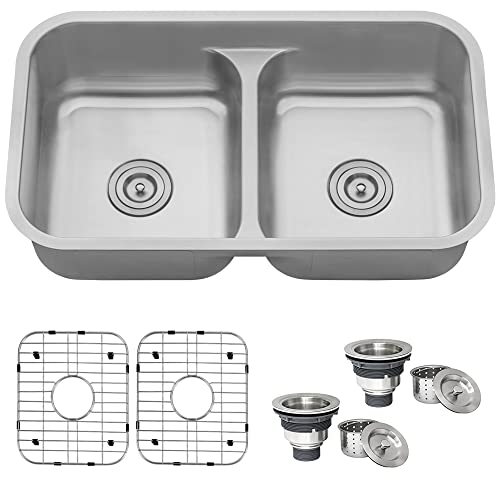
4. Ruvati RVM4350 32 Inch 50/50 Double Bowl Undermount Sink — Best Double Bowl
The RVM4350 keeps faith with the double-bowl tradition in its purest form: two equal bowls, each big enough for real work, in T-304 16-gauge steel. For households that hand-wash — soaking in one side, rinsing in the other — nothing else in this guide replicates the workflow. It suits no-dishwasher households and anyone who batch-washes delicate items separately from pans.
Strengths
- True 50/50 split: two full working bowls rather than a main bowl and a token side
- T-304 stainless in 16 gauge — the heavier, food-grade-standard specification
- Brushed finish hides scratches in both bowls
Trade-offs
- Neither bowl fits a half-sheet pan flat — the single-bowl party trick is gone
- The centre divider is one more surface to clean and a hard edge for tall items
- Equal bowls mean the disposal side is no bigger than the wash side; plan plumbing accordingly
Key specs (from the verified listing)
- Size class: 32 in undermount, double bowl
- Split: 50/50 equal bowls
- Steel: T-304, 16-gauge stainless
- Finish: brushed, scratch-hiding
Judge a 50/50 by its real workflow: fill the left with hot soapy water, wash, transfer to the right to rinse and air-dry on a rack, and a full family wash-up moves through without the counter becoming a drying field. That rhythm is why double bowls survive every fashion cycle, and the RVM4350 executes it in the right material — T-304 is the alloy spec you want stated, and 16 gauge keeps two filled bowls rigid. The honest cost is pan capacity: a roasting pan will bridge the divider rather than sit flat, and sheet pans wash at an angle. Households with a dishwasher that handles pans anyway will never miss the flat floor; households that hand-wash everything should read the low-divide pick next before deciding.
Best for: hand-wash households that soak and rinse separately / Not suited for: sheet-pan bakers who need a flat single floor
Check the current price on Amazon for the Ruvati RVM4350 32 Inch 50/50 Double Bowl Undermount Sink.

5. Ruvati RVH7411 32 Inch Low-Divide Double Bowl Sink — Best Low-Divide
The low-divide is the double bowl’s answer to the sheet-pan problem: the divider stops partway up, so a long pan or a roasting tray rests across both bowls while water stays separated below the divider line. The RVH7411 pairs that layout with tight-radius corners and 16-gauge steel. It suits households torn between the single-bowl and double-bowl camps — which is to say, most households.
Strengths
- Low divider lets long pans and trays bridge across both bowls — the single-bowl trick, kept
- Below the divider, the bowls still separate soaking from rinsing for everyday wash-up
- Tight-radius corners maximise flat floor area in each bowl
Trade-offs
- Fill one side past the divider and both sides share the water — deep soaking is limited
- Tight-radius corners need brush cleaning; they are the least sponge-friendly here
- Bridged pans sit high; check your faucet height clears a tray resting on the divider
Key specs (from the verified listing)
- Size class: 32 in undermount, double bowl
- Split: 50/50 with low centre divider
- Corners: tight radius
- Steel: 16-gauge stainless
The low-divide is a compromise that genuinely works because it compromises at different depths. For the ninety percent of washing that is plates, glasses and cutlery, the bowls behave like a normal double. For the weekly roast or the bake-day sheet pans, the pan bridges the divider and washes like a single bowl — awkwardly angled, but washed. The design’s limit is water depth: you cannot fill one side to the brim for a long soak without the other side joining in, so stockpot-soakers should note it. Tight-radius corners give back floor space and look tailored against stone counters, at the price of a brush in the cleaning kit. For the undecided household, this is usually the sink that ends the argument.
Best for: households split between single and double bowl habits / Not suited for: deep-soak cooks who fill one bowl to the brim
Check the current price on Amazon for the Ruvati RVH7411 32 Inch Low-Divide Double Bowl Sink.
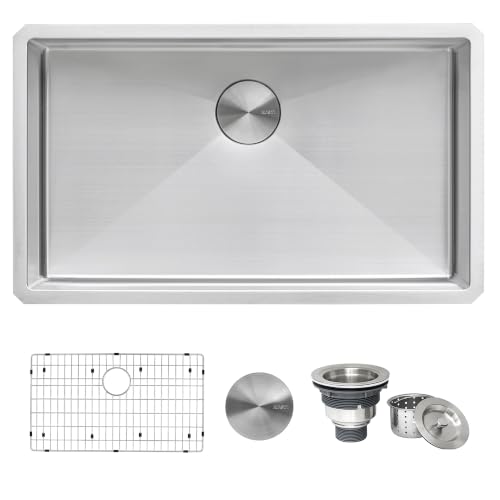
6. Ruvati RVH7400 32 Inch Rounded-Corner Undermount Sink — Best Easy-Clean Single Bowl
The RVH7400 is the Ruvati answer to the KHU100: a single 32 inch bowl that prioritises cleaning ease with properly rounded corners, in 16-gauge steel with a brushed finish and accessories in the box. It suits busy households that want premium material without workstation hardware or tight-corner upkeep.
Strengths
- Rounded corners clean with a sponge pass — the lowest-upkeep bowl shape here
- 16-gauge steel with a brushed, scratch-hiding finish
- Accessories included per the listing, so the box arrives complete
Trade-offs
- No workstation ledge; the accessories are bowl accessories, not a sliding prep system
- Rounded corners give up a little flat floor versus tight-radius designs
- Shares the single-bowl soaking compromise: one water, every job
Key specs (from the verified listing)
- Size class: 32 in undermount, single bowl
- Corners: rounded, easy-clean
- Steel: 16-gauge stainless
- Finish: brushed, scratch-hiding
- Included per listing: accessories
There are two kinds of sink owners: those who enjoy maintaining a tailored tight-radius bowl, and those who want to wipe the sink and be done. The RVH7400 is built for the second kind, with the first kind’s materials. Rounded corners are not a small thing across a decade of daily cleaning — the corner is where grime compounds, and a corner a sponge can sweep in one motion simply never builds the grey line that brush-corners develop between deep cleans. Add the scratch-hiding brushed finish and this is the lowest-visual-maintenance sink in the roundup: it will look presentable with the least effort, for the longest time. If your remodel values calm over theatre, shortlist it against the Kraus KHU100-32 and choose on price on the day — check the current price on Amazon for both.
Best for: busy households wanting premium steel, minimal upkeep / Not suited for: workstation cooks who want a ledge system
Check the current price on Amazon for the Ruvati RVH7400 32 Inch Rounded-Corner Undermount Sink.
Comparison Table
| Pick | Badge | Key spec | Best for |
|---|---|---|---|
| Kraus KHU100-32 Standart Pro 32 Inch Undermount Sink | Best Overall | 32 in, 16-gauge, rounded corners | most family kitchens wanting one big simple bowl |
| Kraus KWU110-32 Kore Workstation 32 Inch Undermount Sink | Best Workstation (Value) | 32 in workstation, ledge + board + rack | keen cooks short on counter space |
| Ruvati RVH8300 32 Inch Undermount Workstation Sink | Best Premium Workstation | 32 in chef workstation, brushed finish | serious home chefs and long-horizon remodels |
| Ruvati RVM4350 32 Inch 50/50 Double Bowl Undermount Sink | Best Double Bowl | 32 in, 50/50 double, T-304 16-gauge | hand-wash households that soak and rinse separately |
| Ruvati RVH7411 32 Inch Low-Divide Double Bowl Sink | Best Low-Divide | 32 in, low-divide 50/50 | households split between single and double bowl habits |
| Ruvati RVH7400 32 Inch Rounded-Corner Undermount Sink | Best Easy-Clean Single Bowl | 32 in single, rounded corners | busy households wanting premium steel, minimal upkeep |
How to Choose a 32 Inch Undermount Stainless Steel Sink
Decide the bowl first, because it is the one choice you cannot accessorise your way out of later. Single bowls (KHU100-32, KWU110-32, RVH8300, RVH7400) take sheet pans flat and simplify every big wash; double bowls (RVM4350, RVH7411) serve hand-wash workflows and households that separate soaking from rinsing. The low-divide RVH7411 is the designed compromise. Then decide the corner: rounded for sponge cleaning, tight-radius for maximum floor and a tailored look, accepting the brush. Then the ledge question: a workstation earns its premium only if prep genuinely happens at your sink.
Gauge is simpler than the marketing suggests. At 32 inches, buy 16 gauge — every pick here is — because a wide bowl in thinner steel flexes and drums. Alloy: T-304 stainless is the specification to look for, stated outright on the Ruvati doubles. Sound treatment matters if a disposal will live under the bowl; pads plus undercoating turn a gong into a thud. Accessories: a bottom grid is the one add-on nearly every owner values, protecting the floor from pan scratches and lifting dishes off the wet surface; if it is not in the box, budget for the model-specific grid when you compare totals.
Budget framing for the class, without printing prices that will date: plain 16-gauge single bowls anchor the sensible tier; workstations add a ledge and an accessory kit for a step up; premium-branded workstations and doubles sit at the top of the mainstream range. Installation money is separate and real — an undermount into stone needs the cutout and fitting done by the counter shop or a plumber, and that labour belongs in the project budget from the start. Check the current price on Amazon for your shortlist, add grid and fitting costs honestly, and the true ranking of the six often shuffles — which is exactly why our verdicts are written by use case rather than by price.
Cabinet Maths: Why a 32 Inch Sink Needs a 36 Inch Cabinet
The sink’s 32 inches describe the bowl assembly’s outside width, but the cabinet has to contain more than the bowl. Undermount clips and the adhesive ledge need working room on both sides, the faucet supply lines and the drain assembly drop into the same box, and the bowl walls themselves taper inward from the rim. The industry rule that falls out of those clearances is a cabinet roughly four inches wider than the sink — hence 36 inch cabinets under 32 inch sinks, and hence the steady stream of remodel grief from kitchens planned around a 33 inch base. Measure the cabinet’s inside width between its side panels, and also check the depth front-to-back: a 32 inch sink is typically paired with a bowl depth that assumes a standard-depth cabinet with room behind for the faucet holes in the counter.
If your cabinet is 33 inches, you have three honest options, none of which is forcing the 32. Choose a 30 inch sink — a mature class with excellent models. Choose a drop-in 32, whose rim sits on the counter and whose bowl can be slightly narrower underneath, if your counter material allows it. Or, in a full remodel, re-plan the cabinet run around a 36 inch sink base, which is the clean solution when the kitchen is being rebuilt anyway. What never works is trimming the sink or the cabinet in place; undermount fitting has no tolerance budget for improvisation. The picks in this guide assume the standard pairing — verify your cabinet first, then order with confidence.
16 Gauge vs 18 Gauge at This Size: What the Numbers Buy
Gauge runs backwards: the lower the number, the thicker the steel. Sixteen gauge is roughly a quarter thicker than eighteen, and at 32 inches wide that quarter is the difference between a bowl that feels cast and a bowl that can flex when a full stockpot lands in it. The audible difference is just as real — thinner steel drums under a disposal and rings when cutlery drops; thicker steel, especially with pads, answers with a thud. Dents follow the same pattern: a cast-iron pan corner that bruises an 18-gauge floor leaves no mark on a 16.
Does 18 gauge ever make sense? In smaller sinks, yes — a 24 inch bowl in 18 gauge is perfectly serviceable and the savings are real. At 32 inches the span is simply too wide to economise on the material that spans it, which is why every pick in this guide is 16 gauge and why we treat gauge as a threshold rather than a preference at this size. When you compare listings, also confirm the gauge claim refers to the whole bowl and not a reinforced rim; the verified listings here state their gauge plainly, and any listing that hides it is telling you something.
Sound, Slope and the Bottom of the Bowl
Three quiet engineering details separate a pleasant sink from an annoying one, and none of them photograph well. Sound treatment first: rubber pads bonded to the bowl’s underside, ideally with a sprayed undercoating over them, absorb the vibration that turns a thin bowl into a drum. Every pick here carries stated sound treatment — NoiseDefend on the Kraus models, soundproofing on the Ruvati workstation — and it is worth more daily than any finish upgrade.
Slope second: the bowl floor must fall toward the drain from every point, or water stands in films and rings the bowl with mineral marks. Channel grooves, as on the KHU100-32, actively shepherd water to the drain; a well-pressed slope does it silently. Third, the drain position: centred drains maximise under-sink storage symmetry, while offset drains (common on workstations) free a larger clear space on one side for bins and pull-out organisers. None of these details appear in a headline, and all three are felt every day — which is why our reviews call them out model by model instead of repeating the headline specs.
Living With a 32: What Changes in the Daily Wash
The first week with a 32 inch bowl rearranges habits you did not know you had. The roasting pan that used to soak across the counter corner now sits flat in the bowl under the faucet. The sheet pan goes in whole instead of corner-first. A day of family dishes accumulates inside the sink instead of colonising the counter beside it, which quietly makes the whole kitchen look tidier even before anything is washed. Batch cooks feel it most: a stockpot, a colander and a pile of prep bowls coexist in the bowl at once, where a 27 or 30 inch sink forces a rotation.
The adjustments are real, too. A big bowl tempts you to let washing accumulate — out of sight in a deep bowl is still a full bowl at 9pm. Reaching the back corners of a 32 inch bowl is a longer stretch, one more reason rounded corners and a pull-down faucet pair so well with this size. And a single big bowl changes the soaking equation: one fill of water serves every job, so households that separated soaking from rinsing should think honestly about the double and low-divide picks before defaulting to the single. None of this argues against the size — it remains the sweet spot of the market — but the owners who love their 32 longest are the ones who chose the bowl configuration for their rhythm, not their aspirations.
Grids, Strainers and Disposals: Completing the Installation
A sink is a system, and three companions decide how the system feels. The bottom grid comes first: sized to the exact bowl, resting on protective feet, it takes the scratches, cushions glassware and lifts dishes out of the drain water. Buy the grid made for your model — the drain hole position alone defeats most universal grids. The strainer and drain assembly come second: many listings include them, some do not, and a mismatched strainer thread discovered on installation day is a wholly avoidable delay, so confirm what is in the box on the listing before the counter is cut.
The disposal comes third, and it interacts with the sink more than buyers expect. Its weight hangs from the bowl floor, which is one more argument for 16-gauge steel at this span, and its vibration is exactly what sound pads are for. Check the disposal flange matches the sink’s drain opening — the standard is widely shared, but “widely” is not “always” — and plan the under-sink layout while the cabinet is empty: disposal position, pull-out bin, water filter and cleaning supplies all compete for the same box, and the 36 inch cabinet under a 32 inch sink is roomy only if the plumbing is kept tight to the back wall.
How to Measure and Prepare for a 32 Inch Undermount Installation
Step one: measure the cabinet. Record the inside width between side panels, the inside depth, and the height from the cabinet floor to the underside of the counter. A 32 inch undermount wants a 36 inch cabinet class; if your inside width says otherwise, stop and re-plan with a 30 inch sink rather than hoping. Step two: confirm the counter. Undermounts belong on stone, quartz, solid surface or properly sealed butcher block; if your counter is laminate over particleboard, talk to the counter shop about edge sealing and approved models before ordering.
Step three: dry-fit on paper. Every verified listing here ships with or specifies a cutout template — use it, or have the counter shop cut from the manufacturer’s DXF, and decide your reveal: a negative reveal hides the rim entirely, a flush reveal shows a hairline of steel, and a positive reveal shows a rim ledge that catches crumbs. Most owners are happiest with a small negative reveal. Step four: plan the plumbing day — faucet holes in the counter behind the bowl, disposal position under the drain, and the dishwasher air gap or high loop per your local code. Step five: after fitting, water-test the seal with a full bowl before the disposal goes on, and keep the template and model number in the house file; the grid, strainer and accessories you may want in five years are all model-specific, exactly like the picks reviewed above.
Common Buying Mistakes
Ordering the sink before measuring the cabinet. The 32-into-33 mistake is the most common and the most expensive in this category, because the discovery usually happens with the counter already cut. Measure inside the cabinet, confirm the 36 inch class, and only then fall in love with a model. The companion error is forgetting the faucet: a 32 inch bowl plus a tall faucet plus a bridged roasting pan needs vertical clearance — check the geometry before the holes are drilled.
Choosing corners by photograph. Tight-radius corners look superb in listing photos and demand a brush forever; rounded corners look ordinary and clean in one sponge pass. Neither is wrong, but choosing the look without pricing the upkeep is. The same applies to finishes: brushed finishes hide the scratch story of a working sink, while polished bowls show every chapter.
Skipping the bottom grid to save money. The grid is not a garnish; it is the sacrificial surface that takes pan scratches instead of the bowl floor, and it lifts washing-up out of the draining water. If your pick does not include one, buy the model-specific grid with the sink — universal grids rock, rattle and never quite fit the drain position. Finally, never let an installer bed an undermount on adhesive alone without its clips: the clips are the structure, the sealant is the seal, and confusing the two ends with a sink in the cabinet one February morning.
Forgetting the water that lives under the sink. A 32 inch bowl over a disposal, a filter and a pull-out bin is a small plumbing city, and the time to plan its streets is before installation, not after the first leak hunt. Leave access to the disposal reset and the filter housing, keep the trap removable without tools you do not own, and put a shallow tray under the whole assembly: it turns the first slow drip from a cabinet-ruining event into a five-minute observation. The tray costs almost nothing and is the cheapest insurance in the entire remodel.
Final Recommendation
For most kitchens the Kraus KHU100-32 is the right 32 inch sink: heavy gauge, easy corners, honest drainage. Cooks who prep at the sink should step to the Kraus KWU110-32 for value or the Ruvati RVH8300 for the premium workstation. Hand-wash households get the Ruvati RVM4350, the undecided get the RVH7411 low-divide, and low-upkeep households get the Ruvati RVH7400. Measure the cabinet first, confirm the counter pairing, and order the model-specific grid with whichever sink you choose — then any of these six will serve for a decade, and the only sink decision left will be the pleasant one of what to cook first in a kitchen that finally fits its pans.
Keep comparing within the range: Best 30 Inch Kitchen Sinks Best 36 Inch Kitchen Sinks Best Affordable Kitchen Sinks Best 33 Inch White Kitchen Sinks Undermount Best 16 Gauge Stainless Steel Undermount Kitchen Sinks
Frequently Asked Questions
Will a 32 inch sink fit a 33 inch cabinet?
Generally, no. A 32 inch undermount sink is designed around a 36 inch minimum cabinet class, because the bowl, clips and plumbing need clearance the 33 inch box does not have. If your cabinet is 33 inches, a 30 inch sink is the honest fit. Always measure the inside of the cabinet and check the specific model’s stated minimum before ordering.
Is 16 gauge worth it over 18 gauge in a 32 inch sink?
At this width, yes. The wider span flexes and drums more in thinner steel, and 16 gauge resists dents from heavy pans that a 32 inch bowl is specifically bought to hold. In smaller sinks the difference narrows; at 32 inches we treat 16 gauge as the baseline, and every pick in this guide meets it.
Single bowl or double bowl at 32 inches?
Single bowls fit sheet pans flat and simplify big washes; double bowls separate soaking from rinsing for hand-wash households. The low-divide design bridges the two — pans rest across the divider while everyday washing stays separated below it. Choose by your washing rhythm, not by fashion.
What countertops can take an undermount sink?
Stone, quartz, solid surface and properly sealed butcher block are the standard pairings. Laminate over a particleboard core is the risky one, because water at the cut edge swells the core; only fit an undermount there with the counter maker’s approved method and sealing. When in doubt, ask the counter shop before ordering the sink.
Do workstation accessories fit any 32 inch sink?
No. Ledge accessories are machined to a specific model’s ledge width and bowl dimensions, so boards and racks are brand- and model-specific. Buy the kit that belongs to your sink, and keep the model number — replacements in later years are ordered by it. Universal accessories exist but rarely sit as flush or slide as well.
How do I keep stainless steel looking good?
Rinse and wipe the bowl dry after heavy use, clean with a soft sponge and mild detergent along the grain of the finish, and use a bottom grid to keep pan scratches off the floor. Brushed finishes disguise the fine scratch pattern that develops naturally. Avoid leaving steel wool or cast iron sitting wet in the bowl, which can leave rust marks on the surface that are cosmetic but stubborn. In hard-water areas, a weekly wipe with a diluted vinegar solution keeps mineral film from dulling the finish; rinse it away promptly and never mix it with bleach-based cleaners.


