Disclosure: airfryerkitchensupply.com is reader-supported. When you buy through links on our site, we may earn an affiliate commission at no extra cost to you.
Where to buy
Every grill in this guide to the best barbecue grills under 200 charcoal buyers can choose was confirmed against a live Amazon listing before being shortlisted, so each link opens the exact model reviewed — right size, right configuration. Prices in this tier move with promotions, so check the current price on Amazon for each pick and confirm it still sits in the under-$200 tier before ordering.
- Weber Original Kettle Charcoal Grill, 22-Inch — Check the current price on Amazon
- Weber Jumbo Joe Charcoal Grill, 18-Inch — Check the current price on Amazon
- Weber Smokey Joe 14-Inch Portable Charcoal Grill — Check the current price on Amazon
- Char-Griller Patio Pro Charcoal Grill and Smoker — Check the current price on Amazon
- Cuisinart 14-Inch Portable Charcoal Grill CCG-190RB — Check the current price on Amazon
- Weber Original Kettle Charcoal Grill, 18-Inch — Check the current price on Amazon
Introduction: Why Charcoal Under $200 Is the Sweetest Spot in Grilling
Here is the happy secret of the best barbecue grills under 200 charcoal category: charcoal is the one fuel where a small budget does not mean a compromised grill. A kettle is a steel bowl, a grate, vents, and legs — there is no burner to cheapen, no igniter to fail, no electronics to die — so a modest price buys the genuine article, built the same way it has been built for decades. The 22-inch Weber kettle that anchors this list is not a “budget version” of anything; it is the classic itself, and it will outcook grills costing three times more on the foods charcoal does best.
That is the honest framing for this tier: under $200 in charcoal buys real grills with real longevity, sized from a 14-inch travel kettle to the full 22-inch family standard, plus a cast-iron-grate patio smoker for cooks who lean toward low-and-slow. What the tier does not include is offset smokers of any substance or ceramic kamados — those live at higher prices, and the picks here were chosen because none of them pretends otherwise. Every model was verified against a current Amazon listing, and every review states capacity and trade-offs in plain terms.
Who is this list for? Flavor-first cooks on a budget, beginners who want to learn fire on forgiving equipment, campers and tailgaters who grill where there is no outlet and no tank, and anyone who suspects — correctly — that the simplest grill in the store might also be the best one. If that is you, read on: your grill is below, and it costs less than the groceries for a month of cookouts. It is also worth naming the deeper reason this tier satisfies so many owners: a charcoal kettle asks a little of you — twenty minutes, some attention, a learned hand with the vents — and returns flavor and ritual out of all proportion to its price. Grilling becomes something you do, not something a machine does while you watch, and for a great many cooks that participation is not the cost of charcoal. It is the entire point.
In this guide
Quick Picks
- Best Overall — Weber Original Kettle Charcoal Grill, 22-Inch: the classic kettle with the One-Touch cleaning system — family-sized, nearly indestructible, and the benchmark every charcoal grill is judged against. Check the current price on Amazon
- Best Portable Full-Size Grate — Weber Jumbo Joe Charcoal Grill, 18-Inch: an 18-inch grate in a portable body with the Tuck-N-Carry lid lock — campsite cooking without the tiny-grate compromise. Check the current price on Amazon
- Best for Two People and Travel — Weber Smokey Joe 14-Inch Portable Charcoal Grill: the little kettle that lives in car trunks and on small balconies — two-person grilling with genuine Weber build. Check the current price on Amazon
- Best for Small-Batch Smoking — Char-Griller Patio Pro Charcoal Grill and Smoker: 250 square inches with cast-iron grates and damper control in a compact barrel — the under-$200 door into real smoking. Check the current price on Amazon
- Best Budget Portable — Cuisinart 14-Inch Portable Charcoal Grill CCG-190RB: 196 square inches, dual air vents, and three lid locks for one-handed carrying — the most space per dollar in the portable class. Check the current price on Amazon
- Best Compact Kettle — Weber Original Kettle Charcoal Grill, 18-Inch: the full kettle experience — One-Touch cleaning included — in the size that suits couples and small patios best. Check the current price on Amazon
How These Picks Were Chosen
We verified the under-$200 charcoal field, confirming every candidate as a real, current listing in this tier, then scored the field on the things that decide a charcoal grill’s worth. Construction came first: porcelain-enameled steel bowls that resist rust and heat, sturdy leg assemblies that do not wobble, and grates that are either plated steel in good gauge or cast iron. Vent design followed — a charcoal grill’s vents are its thermostat, so we favored dampers that adjust in fine, repeatable increments and stay where you set them.
Ash management was scored as heavily as cooking, because ash is charcoal’s daily tax. Weber’s One-Touch sweeping system, which moves ash into a catcher with a lever, is the gold standard at this price; simple ash pans scored next; designs that require scooping the bowl by hand lost points. Portability was judged honestly — lid locks, handle placement, total size — for the three travel picks. And we required each pick to be a genuine grill first: capable of a hard sear over a concentrated coal bed and a gentle indirect cook with coals banked, because a charcoal grill that only does one of those is half a tool.
We also considered the secondhand and hand-me-down reality of this category: kettles are the grills most often inherited, gifted, and resold, precisely because they last. A pick whose parts — grates in the standard 14, 18, and 22-inch sizes, dampers, leg kits, handles — are stocked everywhere protects not just the first owner but every owner after. That ecosystem thinking is part of why the list looks the way it does, and it is a fair tiebreaker for any buyer cross-shopping a kettle against a no-name rival with a prettier render.
The final list is Weber-heavy, and we make no apology for it: in under-$200 charcoal, Weber’s kettle line is the market’s center of gravity for build quality and parts support. The Char-Griller and Cuisinart picks earned their slots by doing specific jobs — small-batch smoking and maximum portable value — better than the kettles do.
The 6 Best Barbecue Grills Under 200 Charcoal Picks

Weber Original Kettle Charcoal Grill, 22-Inch — Best Overall
The 22-inch Original Kettle is the most proven grill design in the world, and at this price it is also the best value in charcoal, full stop. The porcelain-enameled bowl and lid shrug off heat and weather, the One-Touch cleaning system sweeps ash into a removable catcher, and the 22-inch grate cooks for a family plus guests — a whole spatchcocked chicken with room to spare, two dozen burgers in a batch, or a two-zone setup with steaks searing over banked coals while vegetables finish on the cool side.
Strengths
- The complete charcoal toolkit: fierce direct heat, easy two-zone indirect cooking, and respectable smoking with a water pan and patience.
- One-Touch ash sweeping turns charcoal’s worst chore into a lever pull.
- Almost nothing to break — no burners, igniters, or electronics — and every part is replaceable and stocked everywhere.
Trade-offs
- The base model has no lid thermometer; a probe or instant-read thermometer is essential kit (and better anyway).
- Charcoal’s routine applies: twenty minutes to a cooking fire, vent management instead of knobs, ash disposal after cooks.
- The plated-steel grate is good, not great — it is the component owners eventually upgrade, and Weber sells the upgrade.
Mini spec box: 22-inch kettle · One-Touch cleaning system · porcelain-enameled bowl and lid · charcoal fuel.
What owners discover is that the kettle’s simplicity is its genius. There is no learning curve imposed by gadgets — only the fundamental skill of fire, which the kettle teaches generously because its vents respond predictably and its shape distributes heat kindly. It grills, roasts, and smokes; it travels to the park on its wheels and handle; it will still be cooking when grills bought the same year at three times the price have been replaced. If you buy one charcoal grill under $200, buy this one.
Best for: families, beginners, and flavor-first cooks who want the benchmark kettle. / Not suited for: cooks who need push-button weeknight speed or a built-in thermometer. Check the current price on Amazon

Weber Jumbo Joe Charcoal Grill, 18-Inch — Best Portable Full-Size Grate
The Jumbo Joe solves the portable charcoal dilemma: travel grills usually shrink the grate until cooking for four becomes a relay race. The Jumbo Joe keeps an 18-inch grate — genuinely family-capable — in a portable body whose lid locks down with the Tuck-N-Carry system, so the whole grill lifts by its handle and rides in a trunk without shedding ash or parts. It is the campsite and tailgate kettle for cooks who refuse to cook small just because they traveled.
Strengths
- 18-inch cooking surface in a portable — burgers for six, a two-zone setup, real meals at the site.
- Tuck-N-Carry lid lock secures the lid for one-handed transport and doubles as a lid holder while cooking.
- Weber kettle build and vents: predictable heat control, porcelain-enameled durability, available parts.
Trade-offs
- Short legs mean it cooks on a table, tailgate, or the ground — plan your surface.
- No One-Touch ash system; ash is managed by careful dumping once fully cold.
- Bigger than the mini portables — it is car-portable, not tote-bag portable.
Mini spec box: 18-inch portable kettle · Tuck-N-Carry lid lock · porcelain-enameled steel · charcoal fuel.
At the site, the Jumbo Joe behaves like the home kettle it descends from: bank the coals, sear over them, finish indirect under the lid. It has fed more campsite crews than grills costing far more, precisely because its grate never forces the menu to shrink. Paired with a chimney starter, it is a complete traveling kitchen for the charcoal cook — and back home it serves small patios as happily as it serves the woods. One practical note for new owners: because the Jumbo Joe rides in trunks and truck beds, get in the habit of confirming the ash is fully cold and the lid lock is engaged before every lift. That two-second check is the entire difference between a portable that arrives clean and one that redecorates a car interior, and it becomes as automatic as buckling a seatbelt.
Best for: campers, tailgaters, and small-patio cooks who want a real grate that travels. / Not suited for: ultralight travelers or cooks who want standing height without a table. Check the current price on Amazon
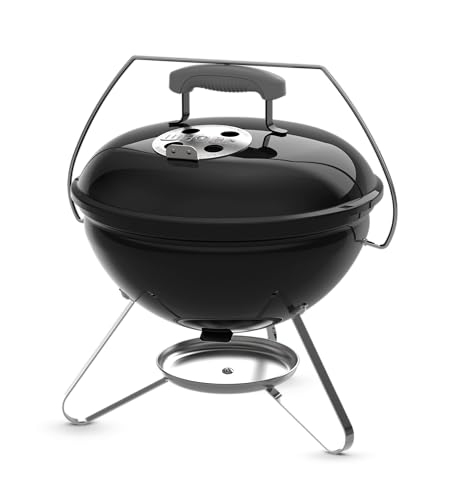
Weber Smokey Joe 14-Inch Portable Charcoal Grill — Best for Two People and Travel
The Smokey Joe is the kettle distilled to its essence: a 14-inch porcelain-enameled bowl and lid, a plated grate, and the Tuck-N-Carry lid lock, in a package light enough to live permanently in a car trunk, a boat, or an apartment closet. It is the two-person grill — steaks for a couple, burgers for three or four in a batch, a small whole chicken with care — and it has introduced more people to charcoal grilling than any grill in history.
Strengths
- Genuinely tiny and light: stores anywhere, travels everywhere, sets up on any stable surface.
- Real Weber kettle quality — the enamel, vents, and grate are the same lineage as the big kettles.
- Sips charcoal; a small chimney of coals cooks a full meal for two.
Trade-offs
- 14 inches is a hard ceiling — groups cook in batches, and big indirect cooks are beyond it.
- Tabletop height only; you cook seated or at a picnic table.
- Ash management is manual — let it cool fully and dump carefully.
Mini spec box: 14-inch portable kettle · Tuck-N-Carry lid lock · porcelain-enameled steel · charcoal fuel.
The Smokey Joe’s virtue is presence: because it is always with you — in the trunk, on the balcony, at the lake — it gets used in all the moments a bigger grill misses. Its cooks are small and perfect: two ribeyes over a fierce little coal bed, corn and sausages at a sunset picnic. For couples and solo cooks, it is not the budget option; it is the right-sized one.
Best for: couples, solo cooks, apartment dwellers, and anyone who grills away from home often. / Not suited for: families or group cooking in a single batch. Check the current price on Amazon

Char-Griller Patio Pro Charcoal Grill and Smoker — Best for Small-Batch Smoking
The Patio Pro is the different shape in this guide: a compact barrel-style charcoal grill and smoker with 250 square inches of cooking space, cast-iron grates, a premium metal shelf, and damper control, sized for small patios. Where the kettles are all-rounders, the Patio Pro leans toward the smoker’s arts — its barrel shape and dampers suit low, slow, indirect cooking for a rack of ribs, a small pork shoulder, or a chicken, in a footprint a kettle owner would recognize.
Strengths
- Cast-iron grates — the best searing surface in this guide and a rarity at the price.
- Barrel shape and damper control make small-batch smoking and indirect roasting natural.
- Compact patio footprint with a proper shelf for tools and trays.
Trade-offs
- 250 square inches is a small-batch tool; party loads are not its brief.
- Painted steel construction wants a cover and rust vigilance the porcelain kettles forgive more easily.
- Temperature management via dampers is a learned skill with a longer apprenticeship than kettle vents.
Mini spec box: 250 sq. in. cooking area · cast-iron grates · damper control · metal side shelf.
Cooking on the Patio Pro rewards the patient: set a small fire, mind the dampers, and it will hold a gentle smoking temperature while ribs take on color and tenderness — the under-$200 route into barbecue’s slow arts. When dinner is steaks instead, the cast-iron grates over a hot bed deliver the best crust in this guide. It asks for a cover and a little rust discipline, and returns a specialty the kettles only approximate.
Best for: small households curious about smoking, and sear lovers who value cast iron. / Not suited for: crowd cooking or owners who will skip the cover. Check the current price on Amazon

Cuisinart 14-Inch Portable Charcoal Grill CCG-190RB — Best Budget Portable
Cuisinart’s little red portable is the value spoiler of the travel class: a 14-inch grill with 196 square inches of cooking area — noticeably more than most 14-inch rivals — a dual air-vent system for temperature control, a chrome-plated grate, and three lid locks that let you carry the whole closed grill one-handed by its handle. For picnics, beach days, and small balconies on the tightest budget, it is the most grill per dollar that travels.
Strengths
- 196 square inches from a 14-inch portable — the roomiest small travel grate in the tier.
- Dual vents give real temperature control, rare on budget portables with a single fixed vent.
- Three lid locks and a carry handle make transport genuinely one-handed and spill-free.
Trade-offs
- Chrome-plated grate is the lightest-duty in this guide — treat it gently and expect it to be the first wear item.
- Enamel and hardware are budget-grade next to the Weber portables; it is a seasons grill, not a decade grill.
- Like all small portables, ash is dumped manually once fully cold.
Mini spec box: 14-inch portable · 196 sq. in. cooking area · dual air vents · 3 lid locks · chrome-plated grate.
The CCG-190RB cooks above its station: the dual vents let you actually manage a two-stage cook — sear with vents open, settle with them cracked — and the extra grate room fits a family’s picnic burgers without a second batch. It is the pick for buyers whose budget is firmest and whose standards for dinner are not. Keep it dry, treat the grate kindly, and it returns far more than its price suggests. It is also a genuinely good first charcoal grill for a teenager’s first apartment or a family’s beach house — inexpensive enough to live where it is used, capable enough that nobody misses the big grill back home.
Best for: picnics, beach days, and the tightest budgets that still want real temperature control. / Not suited for: buyers wanting decade-long build quality. Check the current price on Amazon
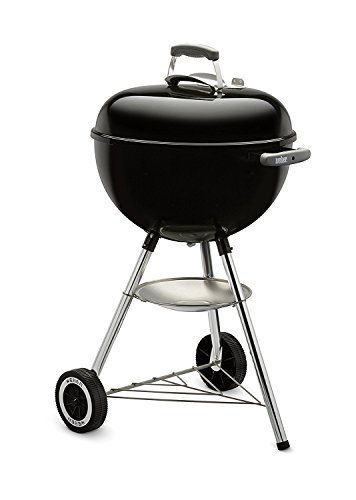
Weber Original Kettle Charcoal Grill, 18-Inch — Best Compact Kettle
The 18-inch Original Kettle is the 22-inch benchmark’s smaller sibling: same porcelain-enameled bowl, same One-Touch ash-sweeping system, same predictable vents, in a size that suits couples, small families, and patios where the 22 would crowd the furniture. It heats faster on less charcoal than its big brother and stores in a noticeably smaller corner, while cooking — for two to four people — identically in character.
Strengths
- Full kettle system, including One-Touch cleaning, in the most manageable size.
- Frugal with charcoal and fast to reach cooking temperature — weeknight-friendly for a charcoal grill.
- Light enough to reposition around the yard or load for an outing without a second pair of hands.
Trade-offs
- The grate serves two to four; family-plus-guests loads overflow to the 22-inch.
- No lid thermometer on the base model — cook by probe and experience.
- Charcoal’s standard routine of lighting time and ash care applies in full.
Mini spec box: 18-inch kettle · One-Touch cleaning system · porcelain-enameled bowl and lid · charcoal fuel.
For the household it fits, the 18-inch kettle is arguably the sweetest grill in this entire guide: every kettle virtue — flavor, searing, two-zone control, ash that sweeps away — with none of the size you do not need. It is the grill couples keep for twenty years and the one small households reach for three nights a week. Choose it when the headcount is honest, and it will never feel like the smaller choice.
Best for: couples and small families who want the complete kettle experience in a compact size. / Not suited for: regular cooking for six or more. Check the current price on Amazon
Comparison Table
| Pick | Badge | Key spec | Best for |
|---|---|---|---|
| Weber Original Kettle 22″ | Best Overall | 22-inch kettle, One-Touch cleaning | Families, all-round charcoal |
| Weber Jumbo Joe 18″ | Best Portable Full-Size Grate | 18-inch grate, lid lock | Camping for groups |
| Weber Smokey Joe 14″ | Best for Two and Travel | 14-inch portable kettle | Couples, car trunks |
| Char-Griller Patio Pro | Best for Small-Batch Smoking | 250 sq. in., cast-iron grates | Low-and-slow on a patio |
| Cuisinart CCG-190RB | Best Budget Portable | 196 sq. in., dual vents | Picnics, tight budgets |
| Weber Original Kettle 18″ | Best Compact Kettle | 18-inch kettle, One-Touch cleaning | Couples, small patios |
How to Choose a Charcoal Grill Under $200
Size by headcount, honestly. Fourteen inches cooks for one to two (Smokey Joe, Cuisinart), eighteen inches for two to four (Jumbo Joe, 18-inch kettle), and twenty-two inches for four to eight (the Original Kettle 22). Charcoal grills batch gracefully, but a grill matched to your normal load lights faster, uses less fuel, and controls better than an oversized one run half-empty.
Decide between home and travel. The standing kettles (22 and 18) are home grills with wheels; the portables (Jumbo Joe, Smokey Joe, Cuisinart) are built around lid locks, handles, and surfaces you provide. The Jumbo Joe straddles the line — home-capable grate, travel-ready body — which is why it anchors so many campers’ kits.
Read the vents like a thermostat. Because they are one: bottom vents feed the fire, top vents draw and exhaust. Fine, repeatable adjustment — Weber’s damper systems and the Patio Pro’s dampers — is what separates a grill you can hold at temperature from one you chase all afternoon. Single fixed vents on the cheapest portables are the tier’s false economy; every pick here adjusts properly.
Check the ash plan. You will deal with ash after every cook for the life of the grill. One-Touch sweeping into a catcher (both standing kettles) is the easiest system under $200; careful cold dumping (the portables) is acceptable; anything requiring you to reach into a hot or dirty bowl is a design to avoid.
Budget the consumables and the one essential tool. Charcoal itself is the ongoing cost — briquettes for steady, predictable heat; lump for higher heat and cleaner flavor. The one essential tool is a chimney starter, which lights coals evenly with a sheet of newspaper and no lighter fluid, ever. Add an instant-read thermometer and heat-resistant gloves and the under-$200 kit is complete.
How to Light and Run a Charcoal Grill: The Complete Routine
- Start with a chimney. Fill the chimney starter with charcoal, light the newspaper beneath, and wait until the top coals are edged with gray ash — roughly fifteen to twenty minutes. This is the reliable, fluid-free start every pick in this guide is designed around.
- Arrange the coals for the cook. For searing, spread them in an even single layer. For the two-zone setup that handles most meals, bank them to one side: sear over the coals, finish on the empty side with the lid on. For the Patio Pro’s smoking, keep a small pile to one end with a water pan beside it.
- Set the vents before the food. Start with vents open to build heat, then close them partway to settle at your target. Bottom vent is the coarse control, top vent the fine one. Small adjustments, then wait five minutes — charcoal responds slowly, and chasing it is the beginner’s classic error.
- Preheat the grate and oil it lightly. Five minutes over the coals with the lid on, a brush to clear the last cook, and a wipe with an oiled paper towel in tongs. Food releases from a hot, clean, lightly oiled grate; it welds to a cold dirty one.
- Cook with the lid as your oven. Lid on for anything thick, with the top vent over the food side to draw heat and smoke across it. Lid off for quick sears and constant-turning items like skewers and asparagus.
- Finish, rest, and close down safely. Rest grilled meat before slicing. Then close all vents to starve the fire, and leave the ash in the closed grill until it is completely cold — a full day is not too long — before sweeping or dumping it into a metal container. Ash that feels cool can hide a live coal; treat it with respect every time.
Charcoal Techniques: Direct, Indirect, and Low-and-Slow on a Budget Grill
The reason a simple kettle outcooks expensive equipment is that charcoal technique scales with the cook, not the price tag. These are the core methods, and every pick in this guide can perform all three.
Direct grilling is the method everyone pictures: coals spread in an even layer, food directly above them, lid on for thick items and off for thin ones. It is for burgers, steaks, chops, sausages, and vegetables — anything that cooks in under twenty minutes. The craft is in the coal bed: a full chimney for a fierce sear, two-thirds for everyday grilling, and a grate preheated until it is properly hot before food touches it.
Two-zone indirect is the method that makes charcoal cooks look like magicians. Bank all the coals to one side; the empty side becomes a gentle oven. Sear over the coals, then move the food to the cool side, lid on with the vent over the food, and let it finish without burning — bone-in chicken, thick pork chops, whole fish, and roasts all depend on this arrangement. On the 22-inch kettle there is room for a drip pan under the food side, which keeps the bowl cleaner and catches juices for sauces.
Low-and-slow extends the two-zone idea over hours. Use fewer coals, add a water pan to buffer temperature, and feed the fire a few unlit briquettes at a time — or arrange unlit coals in a ring or line (the snake arrangement) with wood chunks on top, light one end, and let the fire creep slowly around for hours of steady, smoky heat. Ribs and small pork shoulders are the classic kettle projects. The Patio Pro’s dampers make this style its home ground, but the kettles have done it for generations, and the technique — not the budget — is the limiting factor.
Wood is an ingredient, not just fuel smoke. A chunk or two of hardwood on the coals — oak or hickory for beef and pork, apple or cherry for poultry and fish — adds the smoke character people mean by barbecue flavor. Chips scattered on coals burn off in minutes; chunks smolder for the length of a cook. Start with less than you think; smoke should season the food, not dominate it.
Kettle Care: Keeping a Budget Charcoal Grill Alive for a Decade
Charcoal grills ask for the simplest care contract in outdoor cooking, and honoring it is why kettles outlive appliances costing five times more. The enemies are only two: damp ash and weather.
After each cook: close the vents to extinguish the fire, and once the ash is completely cold — give it a full day — sweep it into the catcher (One-Touch models) or dump it carefully into a metal container. Ash left in the bowl absorbs moisture from the air and becomes a corrosive paste that attacks the enamel and steel from inside; more kettles die of stored ash than of any cooking they ever did.
The grate: brush it hot at the start of each cook, when the last cook’s residue is brittle and releases easily. Plated grates eventually wear at the high-heat center; that is a wear item doing its job, and replacements are inexpensive and universal for the Weber sizes. Cast-iron grates on the Patio Pro want the opposite kindness — a light oil coat after cooking to keep rust off the seasoning.
The exterior: porcelain enamel cleans with warm soapy water and resists rust for years; chips from knocks can be left alone or touched up. Painted steel, like the Patio Pro’s body, benefits from the cover habit and a quick check each season for rust spots to clean and touch up before they spread. Legs and wheels appreciate being kept out of standing water — a grill mat or a dry corner of the patio is enough.
Storage: covered, dry, and empty of ash. In humid climates, store the cooking grate indoors during long idle stretches if rust has been a problem. That is the entire manual of care — five minutes a cook, fifteen minutes a season — and it is why the under-$200 charcoal tier is full of grills that will still be cooking when their owners’ cars have been replaced.
Common Buying Mistakes
- Buying the smallest kettle for a family. A 14-inch grill for six people means an hour of batches. Match the grate to the headcount; the price differences in this tier are small.
- Skipping the chimney starter. Lighter fluid flavors food and frustrates beginners. The chimney is the cheapest skill upgrade in all of grilling.
- Judging by grate size alone. Vent quality and ash handling decide daily satisfaction more than an extra inch of diameter.
- Ignoring ash disposal. Hot ash in a plastic bin or a paper bag is a fire story waiting to be told. Metal container, fully cold ash, every time.
- Storing the grill with ash inside. Damp ash is corrosive paste that eats bowls from the inside. Empty, dry, covered — that is the whole storage rule.
- Expecting gas convenience from charcoal. Charcoal’s twenty-minute start and hands-on control are the price of its flavor. Buy it for the right reason and it never disappoints.
- Overloading a small kettle. Crowded food steams instead of searing and smothers the fire’s airflow. Cook in two confident batches rather than one suffocated layer — charcoal rewards patience at every step.
- Using wet or stale charcoal. Charcoal absorbs humidity and lights reluctantly, burns dirty, and runs cool. Store it sealed and dry, and replace a bag that has spent a winter in a damp garage.
Charcoal Safety: Fire, Ash, and Air
Charcoal’s virtues come with fire’s responsibilities, and three rules cover nearly all of them. First, location: charcoal grills belong outdoors, on a level non-combustible surface, clear of siding, fences, deck rails, and overhangs — and never in a garage, tent, or enclosed porch, because charcoal produces carbon monoxide generously and without odor. Balconies deserve a special note: many buildings prohibit charcoal outright, so check your lease or HOA rules before a kettle takes up residence there.
Second, the fire itself: light with a chimney, never with gasoline, and treat lighter fluid as the flavor-ruining shortcut it is. Keep water or a fire extinguisher within reach but never splash water into a grease flare — close the lid and vents and starve the flames instead. Keep children and pets out of the cooking zone, and remember that a kettle’s bowl stays burn-hot long after the coals look gray and innocent.
Third, the ash: coals can hide live heat for a day or more after a cook. Let ash cool completely in the closed grill, transfer it to a metal container with a lid, and keep that container outdoors on a non-combustible surface for several days before the ash joins household trash. The majority of charcoal-related fires happen after the cooking, in the disposal — this routine is the whole prevention.
Accessories Worth Adding to a Budget Charcoal Grill
The essentials are short — chimney starter, instant-read thermometer, long tongs, heat-resistant gloves, metal ash container — and everything after them should be bought in response to your own cooking. Three upgrades earn their keep for most kettle owners. A hinged replacement grate makes adding coals mid-cook effortless and is the first upgrade 22-inch owners make. A quality cover fitted to your model protects the enamel and the legs through winters. And a set of charcoal baskets — simple rails or baskets that hold coals to the sides — turns two-zone setup into a ten-second arrangement instead of a rake-and-hope exercise.
Buy later, if your cooking grows that way: a slow-cooking insert or a raised second rack for bigger smoking sessions on the 22-inch, a cast-iron grate for maximum sear marks, a side table that clips to the kettle’s handle. Skip, at any stage: gadget bundles of tools you will never hold, novelty-shaped branding irons, and cheap no-name grates that rust in a season — when a grate wears out, the manufacturer’s replacement is the value buy. The pattern is the same as the grills themselves: in charcoal, simple and well-made beats elaborate every time.
Final Recommendation
For most buyers, the answer is the Weber Original Kettle 22-Inch — the classic, at a classic price, with decades of cooking ahead of it. Couples and small patios should take the same idea smaller in the 18-inch kettle. Travelers split by crew size: the Jumbo Joe for groups, the Smokey Joe for two, and the Cuisinart CCG-190RB when the budget is tightest. And the cook drawn to slow smoke should choose the Char-Griller Patio Pro and its cast-iron grates. Under $200, charcoal is not the compromise fuel — matched to the right household, it is the best value in all of grilling. Buy the chimney starter with it, learn the two-zone fire in your first week, keep the ash empty and the cover on, and the grill you bought for the price of a few restaurant dinners will still be cooking when grills bought the same spring at five times the price have been replaced — that is what this tier, at its best, actually delivers.
Compare the rest of the cluster before you decide: Best Barbecue Grills Under $200 covers the propane side of this budget, Best Barbecue Grills Under $500 shows the mid-range step up, Best Bar Bq Grills rounds up every fuel, Best Barbecue Grills To Buy is the general shortlist, and Best Barbecue Grills For Women To Use ranks grills by ease of handling and cleanup.
Frequently Asked Questions
Is a charcoal grill under $200 actually good, or just cheap?
Genuinely good — charcoal is the one category where the budget buys the classic article. A kettle has no burners, igniters, or electronics to cheapen, so an under-$200 Weber kettle is built like the premium versions: porcelain-enameled steel, proper vents, replaceable parts. The savings versus expensive grills are in size and features, not in cooking ability.
Briquettes or lump charcoal — which should I buy?
Briquettes burn longer, steadier, and more predictably, which makes them the beginner’s friend and the right choice for long indirect cooks. Lump charcoal lights faster, burns hotter and cleaner, and suits hard searing. Many kettle owners keep both: briquettes for the routine, lump for steak night. Either way, skip self-lighting charcoal — the fluid taste defeats the purpose of cooking over fire.
How long does a kettle grill last?
With ash emptied regularly and a cover in use, a porcelain-enameled kettle commonly serves for a decade or more; the bowl and lid are the long-lived parts, and grates, dampers, and leg kits are replaceable wear items sold everywhere. The fastest way to shorten a kettle’s life is storing it with damp ash inside.
Can I smoke meat on a kettle under $200?
Yes — happily, within portion limits that suit most households. Bank coals to one side, add a water pan, put the meat on the cool side, and manage the vents to hold a low temperature — ribs, chicken, and small pork shoulders all work well. For frequent, large-scale smoking, the Patio Pro’s barrel shape helps, and true offset or pellet smokers live at higher budgets; but the kettle has smoked more ribs than any appliance in history.
How do I control temperature without knobs?
With the vents and the coal arrangement. More air means more heat; the bottom vent is the main control and the top vent the fine adjustment. Approach your target from below, adjust in small steps, and give the grill five minutes to respond before adjusting again. An inexpensive probe thermometer through the top vent turns the guesswork into a reading.
How much charcoal does a cook use, and what does it cost to run?
A typical kettle cook uses about one chimney of charcoal — a few pounds — and a bag of briquettes covers many cooks, making charcoal one of the cheapest fuels per session in grilling. Portables use less; the Patio Pro’s small firebox is frugal by design. Partially burned coals can be extinguished by closing the vents and reused in the next fire once fully cold, which stretches a bag further. Keep charcoal dry in a sealed bin; damp charcoal is the main cause of hard-lighting frustration.
Can I use a kettle grill on a wooden deck?
Yes, with precautions: a grill mat or metal tray under the kettle to catch stray embers and ash, clear space around it, and never leaving the grill unattended while coals are live. Portable kettles on tables need the same respect — a heat-proof surface and stability. Check local fire codes and building rules as well; some jurisdictions and leases restrict charcoal on decks and balconies regardless of precautions.
What else do I need to buy with a charcoal grill?
Surprisingly little, which is part of the format’s charm. A chimney starter, an instant-read thermometer, long tongs, heat-resistant gloves, and a metal ash container — plus charcoal itself. That short list completes the kit; everything else (grate upgrades, side tables, covers beyond the basic) can wait until your cooking tells you what you actually want.


