Disclosure: airfryerkitchensupply.com is reader-supported. When you buy through links on our site, we may earn an affiliate commission at no extra cost to you.
Where to buy
Every grill in this guide to the best barbecue grills propane buyers can choose today was confirmed against a live Amazon listing before being shortlisted, so each link opens the exact model reviewed — correct burner count, correct configuration, correct fuel type. Propane grill pricing moves with the season, so check the current price on Amazon for each pick and confirm what ships in the box before ordering.
- Weber Genesis E-415 Gas Grill — Check the current price on Amazon
- Weber Spirit E-435 Gas Grill — Check the current price on Amazon
- Charbroil Pro Series Amplifire Infrared 4-Burner Propane Gas Grill — Check the current price on Amazon
- Royal Gourmet GA6402S 6-Burner Propane Gas Grill — Check the current price on Amazon
- Nexgrill Deluxe 5-Burner Gas Grill with Ceramic Side Burner — Check the current price on Amazon
- Kendane 4-Burner Propane Gas BBQ Grill with Side Burner — Check the current price on Amazon
Introduction: Propane Is the Default for a Reason
Ask a hundred households what fuels their barbecue grill and the large majority will say propane — and the best barbecue grills propane category is where that majority should shop carefully, because the spread between a great propane grill and a disappointing one is wide. Propane’s advantages are structural: it lights instantly, preheats in about ten minutes, holds a set temperature with knob adjustments, shuts off the moment you are done, and asks for no ash disposal, no chimney, and no twenty-minute wait while coals ash over. For weeknight cooking — the cooking that decides whether a grill earns its patio space — nothing else comes close.
But propane grills are not interchangeable. Burner materials decide whether the grill cooks evenly in year five or rusts into hot spots by year two. Grate material decides whether steaks sear or steam. Lid construction decides whether the grill holds roasting heat on a breezy evening or leaks it away. Ignition design decides whether lighting the grill is a one-handed afterthought or a recurring annoyance. This guide ranks the verified propane field on exactly those fundamentals, from the premium benchmark down to the honest budget pick, so that whatever your budget tier, you land on the propane grill that tier does best.
Propane also wins on a point buyers underestimate before their first winter: cleanliness of operation. There is no ash to dispose of, no charcoal dust on the patio, no pellet hopper to keep dry — just a grease tray to empty and a tank to swap a few times a year. For households on decks, balconies where local rules permit gas, and patios that double as living space, that tidiness is a genuine quality-of-life advantage, and it is part of why propane dominates the market this guide surveys.
The list deliberately spans the range: a premium four-burner flagship, a sear-focused mid-size Weber, an infrared specialist for steak lovers who hate flare-ups, a six-burner crowd machine, a big five-burner value play with a ceramic side burner, and a budget four-burner that keeps expectations honest. Every model was verified against a current Amazon listing, and every review names the trade-offs plainly — because with propane grills, the differences that matter only show up across seasons, and that is exactly when returns are no longer possible.
In this guide
Quick Picks
- Best Overall — Weber Genesis E-415 Gas Grill: four PureBlu burners, porcelain-enameled cast-iron grates, and Weber’s flagship build quality in a size that suits most patios. Check the current price on Amazon
- Best for Searing — Weber Spirit E-435 Gas Grill: four burners with a Sear Zone with Boost and a side burner — the steak lover’s pick in the mid-size class. Check the current price on Amazon
- Best Infrared — Charbroil Pro Series Amplifire 4-Burner: infrared emitter plates that end flare-ups, distribute heat evenly edge to edge, and keep food juicier — with a side burner and cabinet. Check the current price on Amazon
- Best for Big Crowds — Royal Gourmet GA6402S 6-Burner: six burners, a side burner, and 74,000 BTU of total cooking power for the households that grill like they are running a small restaurant. Check the current price on Amazon
- Best Big Grill on a Budget — Nexgrill Deluxe 5-Burner with Ceramic Side Burner: five burners, 65,000 BTU, and a ceramic side burner for high-heat searing, at a value-tier price. Check the current price on Amazon
- Best Budget 4-Burner — Kendane 4-Burner Propane Gas BBQ Grill: four burners, a side burner, and enameled cast-iron grates at an entry price — with honest notes on what the price leaves out. Check the current price on Amazon
How These Picks Were Chosen
We started with the verified field of propane barbecue grills on Amazon, confirming each candidate so that burner counts, model names, and headline specifications match real, current listings. Unverifiable models were excluded rather than guessed at. We then scored the field on the fundamentals that determine how a propane grill performs across years, not weeks.
Burner quality led the scoring: stainless-steel burners with even port spacing, protected by heat tents or flavorizer-style bars, over plain steel that rusts from the inside. Grates came next — porcelain-enameled cast iron is the standard the premium picks meet, because it holds heat through a full load of cold food and resists rust for years. Heat management followed: lid weight and seal, burner-to-grate distance, and how evenly the cooking surface heats from front to back. We also scored ignition systems (per-burner electronic ignition beats a single shared sparker), grease management, tank access, and the manufacturer’s replacement-parts ecosystem, because a propane grill is a five-to-fifteen-year appliance and its mid-life parts define its real value.
Two scoring details deserve emphasis because shoppers rarely see them in listings. The first is heat mapping: a propane grill’s grate is only as good as its coolest useful corner, so we favored burner layouts and heat-spreading systems — Weber’s burner design, Charbroil’s full-width infrared emitters — that make the whole grate cookable rather than a hot center with cold edges. The second is control range: a good propane burner throttles down to a gentle hold without snuffing out in a breeze, which is what makes low roasting and resting zones possible. Grills that only do “hot” and “off” lost points regardless of their peak output.
Finally, we spread the picks across price tiers deliberately and labeled them honestly. A propane-only guide that listed six premium grills would fail most readers; one that listed six budget grills would fail the rest. The six below cover flagship, mid-range, specialty infrared, maximum capacity, big-on-a-budget, and true budget — each the strongest verified option in its lane.
The 6 Best Barbecue Grills Propane Shoppers Should Compare

Weber Genesis E-415 Gas Grill — Best Overall
The Genesis E-415 is what a propane grill looks like when a manufacturer spends the budget on the firebox instead of the brochure. Four PureBlu burners — designed to deliver a consistent flame pattern along the full burner length — sit under porcelain-enameled cast-iron grates in a generously sized four-burner cabinet grill. It is the benchmark pick of this guide: the grill against which the value picks are measured, and the one we recommend to buyers who intend to keep a propane grill for a decade or more.
Strengths
- PureBlu burners produce an even flame front, which translates to the most uniform grate temperatures in this guide — no shuffling food away from scorched corners.
- Porcelain-enameled cast-iron grates sear with authority and recover heat quickly between batches.
- Weber’s build quality and parts network: burners, grates, igniters, and Flavorizer bars remain orderable for years, protecting the investment.
Trade-offs
- Premium pricing — it costs meaningfully more than the value picks while cooking for the same headcount.
- Four burners is generous for most families but the footprint is substantial; measure a small patio first.
- No dedicated infrared sear burner; searing relies on the main burners and grate mass, which they handle well but not identically.
Mini spec box: 4 PureBlu burners · porcelain-enameled cast-iron grates · liquid propane · cabinet cart.
Cooking on the E-415 is an exercise in calm. Preheat is fast, temperatures are where the knobs suggest they should be, and the two-zone setups a four-burner layout allows — sear left, roast right, hold in the middle — work exactly as intended. The lid holds roasting heat for whole chickens and pork shoulders with minimal fussing, and the grease system keeps the firebox tidy. Nothing about it shouts; everything about it works, season after season. That quiet competence is what flagship money is supposed to buy, and in a market full of grills that spend their budgets on styling and screens, the E-415’s discipline about the fundamentals is exactly why it leads this guide. If your budget reaches the flagship tier, this is the propane grill that justifies reaching.
Best for: buyers who want the best all-round propane grill and plan to own it for a decade. / Not suited for: strict budgets or very small patios. Check the current price on Amazon

Weber Spirit E-435 Gas Grill — Best for Searing
The Spirit E-435 takes Weber’s mid-size platform and aims it at the steak cook: four burners, a Sear Zone with Boost burners that pour extra heat into one section of the grate, a side burner, and porcelain-enameled cast-iron grates. Where the Genesis is the flagship all-rounder, the E-435 is the pick for households whose grilling centers on steaks, chops, and burgers cooked hard and fast, with enough standard burners left over for everything else.
Strengths
- Sear Zone with Boost delivers a genuinely hotter patch of grate — the difference between gray steaks and crusted ones.
- Side burner included, so the steakhouse routine (sear, rest, sauce) can happen entirely outdoors.
- Same Weber grate quality, ignition reliability, and parts support as the flagship, in a slightly smaller footprint.
Trade-offs
- The sear zone concentrates heat in one area; very large searing batches still cook in rounds.
- Sits at the top of the mid-range price band — close enough to the Genesis that some buyers should compare both.
- Four-burner cabinet footprint, like the E-415, needs a real patio.
Mini spec box: 4 burners · Sear Zone with Boost · side burner · porcelain-enameled cast-iron grates · Weber Works rails.
The E-435’s party trick is sequencing. Sear steaks over the boosted zone, slide them to a gentle burner to finish to temperature, and keep a pan sauce warm on the side burner meanwhile — a full steakhouse plate without a trip indoors. Everyday cooking is equally composed: four burners give true zoning for mixed grills, and the grates hold heat through back-to-back batches of burgers for a crowd. For propane buyers whose first question is “how does it sear?”, this is the answer in the mid-size class.
Best for: steak and chop lovers who want a dedicated high-heat zone plus everyday four-burner flexibility. / Not suited for: buyers who rarely sear, or who would rather put the sear-zone money toward the Genesis badge. Check the current price on Amazon

Charbroil Pro Series Amplifire Infrared 4-Burner Propane Gas Grill — Best Infrared
Charbroil’s Pro Series with Amplifire takes a different route to heat: instead of an open flame under the grate, burners heat emitter plates that radiate infrared energy evenly across the cooking surface. The practical results are the two things infrared owners evangelize about — flare-ups essentially disappear, because drippings vaporize on the emitter instead of igniting, and heat reaches the far corners of the grate with unusual evenness. Four burners, a side burner, and a cabinet base round out a grill aimed at cooks who are tired of chicken flaring and hot-spot roulette.
Strengths
- Infrared emitters all but eliminate flare-ups — fatty chicken, burgers, and sausages cook calmly instead of catching fire.
- Edge-to-edge heat evenness is excellent; the corners of the grate are as useful as the center.
- Infrared cooking is known for keeping food moist, since intense radiant heat sears the surface quickly and seals in juices.
Trade-offs
- Emitter plates need periodic cleaning — drippings bake onto them, and neglected emitters lose their evenness advantage.
- The cooking feel differs from open-flame grilling; there is a short adjustment period for timing and technique.
- Replacement emitters are a model-specific part; keep the model number handy for mid-life maintenance.
Mini spec box: 4 burners · Amplifire infrared emitter system · side burner · cabinet base (model 463281024).
Living with the Amplifire Pro is a revelation for anyone whose grilling has been a war against flare-ups. Chicken thighs with skin — the classic flare-up food — cook through with crisping skin and no fire-show. Burgers stay juicy, and the even heat means the back row finishes with the front row instead of ahead of it. The honest cost is maintenance: brush and occasionally deep-clean the emitters as the manual directs, and the system rewards you with the most even cooking surface in this guide.
Best for: flare-up-weary cooks, chicken and burger specialists, and anyone who values even heat over open-flame drama. / Not suited for: cooks who love tending an open flame, or who will skip emitter cleaning. Check the current price on Amazon

Royal Gourmet GA6402S 6-Burner Propane Gas Grill — Best for Big Crowds
Six burners changes the conversation from “family grill” to “event equipment.” The GA6402S pairs six main burners and a side burner with a total output of 74,000 BTU in a silver cabinet grill built for volume: graduation parties, team dinners, holiday cookouts where the guest list starts at twenty. When the cooking problem is sheer throughput, burner count and grate width are the specs that matter, and this is the largest verified propane grill in the guide.
Strengths
- Six independently controlled burners allow multiple temperature zones at once — searing, roasting, and holding simultaneously.
- Total output of 74,000 BTU keeps a fully loaded grate hot instead of sagging under a party-sized batch.
- Side burner keeps big-pot sides — corn, beans, boiled potatoes — outside where the crowd is.
Trade-offs
- It is a very large grill: assembly is a major project, and the footprint demands a generous patio and a wide gate.
- Heating six burners for a two-person dinner is wasteful; small households will rarely use its capacity.
- Fit and finish trail the Weber picks — the value here is capacity per dollar, not refinement.
Mini spec box: 6 burners + side burner · 74,000 BTU total · silver cabinet.
At a real event, the GA6402S earns its floor space. Two zones of burgers, a zone of chicken, a zone of vegetables, and a holding zone mean the cook serves continuously instead of in waves, and the side burner keeps the pot that never fits from exiling itself to the kitchen. The discipline it asks in return is basic: cover it, clean the grease system after big cooks, and do not buy it for a household of two. Matched to the right crowd, it is the hardest-working dollar in this guide.
Best for: large families, frequent hosts, and event-scale cookouts. / Not suited for: small households, small patios, or buyers who value fit and finish over capacity. Check the current price on Amazon
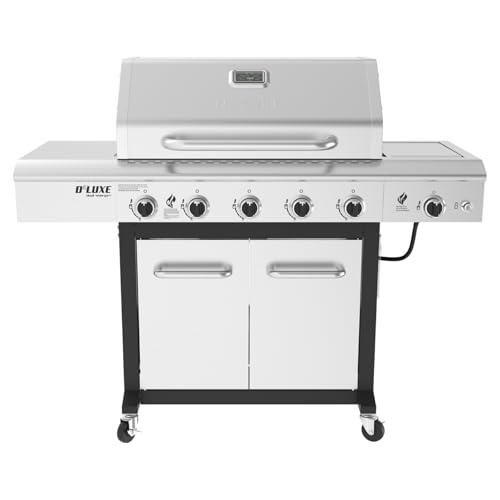
Nexgrill Deluxe 5-Burner Gas Grill with Ceramic Side Burner — Best Big Grill on a Budget
Nexgrill’s Deluxe 5-Burner is the value play among big grills: five main burners, a total output of 65,000 BTU, and — the detail that lifts it above other budget big grills — a ceramic side burner, which produces the intense, focused heat that ordinary side burners cannot, making it a legitimate searing station for a steak or two while the main grate handles the crowd.
Strengths
- Ceramic side burner delivers true high-heat searing — a feature usually found a price tier up.
- Five burners and 65,000 BTU give crowd capacity and zoning flexibility at a value price.
- Side table workspace supports the big-grill workflow of trays, tools, and resting meat.
Trade-offs
- Panel and component quality is value-tier: thinner steel, lighter shelves, and a finish that wants a cover and gentle treatment.
- Heat distribution on the main grate is good, not elite — expect to learn its warmer zones.
- Assembly of a five-burner grill is a substantial job; plan time and a helper.
Mini spec box: 5 burners · 65,000 BTU · ceramic side burner · side table.
The Deluxe 5-Burner’s best trick is the two-stage steak dinner for a group: burgers and chicken work across the main burners while the ceramic side burner — fiercely hot and fast — puts a steakhouse crust on the cuts that deserve it. That division of labor is how restaurants cook, and having it at this price is the grill’s whole argument. Kept covered and cleaned, it returns seasons of big-grill service for mid-grill money.
Best for: budget-conscious hosts who want five burners plus a real searing side burner. / Not suited for: buyers prioritizing premium build and finish over capacity and features. Check the current price on Amazon

Kendane 4-Burner Propane Gas BBQ Grill with Side Burner — Best Budget 4-Burner
The Kendane 4-Burner is the entry door to full-size propane grilling: four burners, a side burner, and enameled cast-iron grates — a spec line that, on paper, matches grills well above its tier. It earns its place here as the honest budget pick, with the caveats stated plainly: at this price, manufacturing tolerances are wider, panel steel is thinner, and long-term parts support is less certain than the established brands above it. Judged as an inexpensive way to get four burners and cast-iron grates under a family’s food, it does its job.
Strengths
- Enameled cast-iron grates at a budget price — the single most important cooking component, done right.
- Four burners plus a side burner give genuine zoning and full-menu flexibility from day one.
- Full-size cooking capacity for family meals and small gatherings without a value-brand premium.
Trade-offs
- Thinner panels and hardware; expect more flex and faster cosmetic wear than the Charbroil or Weber picks.
- Brand support and spare-parts availability are thinner — an igniter or burner replacement may take more hunting.
- Assembly quality varies; check every burner alignment and connection carefully during the build and leak-test thoroughly.
Mini spec box: 4 burners + side burner · enameled cast-iron grates.
Cooking on the Kendane is better than its price suggests, because cast-iron grates do the heavy lifting: food sears, marks, and releases properly, and four burners give the zoning that makes mixed grills manageable. The ownership contract is equally clear — keep it covered, keep the grease tray emptied, tighten what loosens, and it will serve a household well for its seasons. Buyers who understand they are purchasing capability now rather than a decade of support will be satisfied; buyers who want the decade should step up to the Spirit or Genesis.
Best for: budget-first buyers who want four burners and cast-iron grates now. / Not suited for: buyers who prioritize long-term parts support and premium construction. Check the current price on Amazon
Comparison Table
| Pick | Badge | Key spec | Best for |
|---|---|---|---|
| Weber Genesis E-415 | Best Overall | 4 PureBlu burners, cast-iron grates | Decade-long ownership |
| Weber Spirit E-435 | Best for Searing | Sear Zone with Boost, side burner | Steak-focused cooks |
| Charbroil Pro Series Amplifire | Best Infrared | Infrared emitters, 4 burners, cabinet | No-flare-up, even cooking |
| Royal Gourmet GA6402S | Best for Big Crowds | 6 burners + side burner, 74,000 BTU | Event-scale cookouts |
| Nexgrill Deluxe 5-Burner | Best Big Grill on a Budget | 5 burners, ceramic side burner, 65,000 BTU | Capacity plus searing, value price |
| Kendane 4-Burner | Best Budget 4-Burner | 4 burners + side burner, cast-iron grates | Full-size grilling, entry price |
How to Choose the Right Propane Grill
Count burners by zones, not by ego. Each burner is an independently controlled heat zone. Two burners serve couples and small families; three is the flexible standard; four adds a true sear or holding zone; five and six are crowd equipment. More burners than your headcount buys you nothing but preheat time and propane use.
Interrogate the burners and grates, ignore the BTU headline. Total BTU measures gas consumption across all burners, not cooking quality. What matters: stainless burner construction, protective heat tents or bars above the burners, and porcelain-enameled cast-iron grates. Those three items predict both tonight’s sear and year five’s performance. Every pick in this guide was screened on them; any grill you consider elsewhere should be too.
Decide whether you want a specialty heat system. Infrared (the Amplifire) trades open flame for evenness and calm, flare-free cooking. A boosted sear zone (the Spirit E-435) concentrates conventional heat for crust. A ceramic side burner (the Nexgrill Deluxe) moves the searing off the main grate entirely. None is universally better — match the system to the food you cook most.
Check the ownership details. Is the grease tray reachable? Does the tank swap without gymnastics? Are replacement burners, grates, and igniters listed for this exact model? Does the lid feel planted or tinny? These unglamorous questions decide satisfaction in year three, and they are all answerable from listings, manuals, and reviews before you buy.
Count cooking space honestly. Compare primary grate area, and treat warming racks as bonus holding space rather than cooking space — they sit high, run cooler, and are meant for buns, resting meat, and delicate items. A grill advertising a huge total area may cook less at once than a smaller-area grill whose space is all primary grate. The six picks here were compared on their real cooking surfaces, which is why the capacity claims in the reviews are framed by headcount and batch size rather than by the biggest number on the box.
Budget by tier, honestly. The budget tier (the Kendane) buys real capability with thinner construction and support. The mid tier (Spirit, Amplifire) buys better materials and parts ecosystems. The flagship tier (Genesis) buys refinement, evenness, and longevity. The worst propane purchase is the grill priced like the mid tier but built like the budget tier — compare burner and grate specs, not styling, to catch it.
How to Set Up a Propane Grill and Run Your First Cook
- Assemble on a flat surface, in manual order. Propane grills reward patience: burner tubes must seat fully over the valves, and heat tents must sit level. A mis-seated burner is the hidden cause of most “uneven grill” complaints.
- Leak-test before the first light — and at every tank change. Brush soapy water over the regulator, hose, and valve connections; open the tank valve with burners off; bubbles mean a leak to fix by reseating, never by ignoring.
- Burn off the factory finish. Run all burners on high, lid closed, for 15–20 minutes. Then let the grill cool and wipe the grates.
- Season cast-iron grates lightly. A thin coat of high-smoke-point oil on warm grates, heated until it polymerizes, repeated twice, gives you a rust-resistant, food-friendly surface from day one.
- Map your heat zones with the bread test. A grate covered in white bread slices on medium heat toasts into a perfect map of hot and cool areas. Five minutes now saves a season of surprises.
- First cook: something forgiving. Chicken thighs, sausages, or burgers teach you the grill’s temperament. Save the expensive ribeyes for the second cook, when you know where the hot corner lives.
- End the cook like a professional. Burn off residue for ten minutes, brush the grates, check the grease tray, close the tank valve, and cover the grill once cool. This five-minute habit is the difference between a five-year grill and a two-year grill.
Propane Cooking Techniques: Zoning, Lid Discipline, and Resting
A propane grill’s knobs make technique precise in a way charcoal cooks have to earn through vent craft. These are the techniques that separate a good propane cook from a great one, and they work on every pick in this guide.
Build zones deliberately. Before food goes on, decide the map: a searing zone at full heat, a working zone at medium, and a safe zone at low or off. On the three- and four-burner Webers this is three knob settings; on the six-burner Royal Gourmet you can run two full working zones plus a holding zone. Food moves across the map as it cooks — sear, finish, hold — and nothing burns while you plate the first batch.
Respect the lid. Lid down converts your grill into an oven: food cooks from all sides, flare-ups starve for oxygen, and roasting temperatures hold. Lid up is for active searing and for foods you are turning constantly. The most common propane mistake is cooking everything lid-up and then blaming the grill for dry chicken; thick cuts belong under the lid on the gentle zone, checked by thermometer rather than by clock.
Preheat the grates, not just the air. A lid thermometer reading 500°F does not mean the grates are ready. Cast-iron grates — fitted to most picks here — need a full ten minutes to saturate with heat, and that stored heat is what produces sear marks instead of steamed gray surfaces. Food added too early sticks; food added to saturated cast iron releases cleanly.
Rest everything. Propane’s speed tempts cooks to serve straight off the grate. Ten minutes of resting under loose foil lets juices redistribute in steaks, chops, and chicken, and carryover heat finishes the centers gently. Build the rest into your zone map — the holding zone at its lowest setting is a perfect resting shelf for the first items off while the last ones finish.
Propane Grill Care: The Routine That Doubles a Grill’s Life
Propane grills fail in predictable ways — clogged burner ports, rusted heat tents, grease-clogged fireboxes, dead igniters — and every one of those failures is slowed or prevented by a short routine. This is the maintenance contract for every grill in this guide.
Every cook: ten minutes on high after the food comes off burns residue from grates and heat tents; brush the hot grates with a bristle-free brush; once cool, check that the grease tray is not approaching full. Grease management is fire prevention — most grill fires are grease fires, and they are almost always the product of a neglected tray.
Monthly in season: inspect the burner flames through the grate with the lid open at dusk. Healthy flames are mostly blue with yellow tips and even along the burner. A section burning lazy yellow, or not burning at all, means a blocked port — clear it with a thin wire or port brush after the grill cools, and check the venturi tubes for spider nests, the classic cause of sudden ignition trouble.
Once a season: grates and heat tents out, firebox scraped into the drip tray, interior washed down. Clean the igniter electrode and confirm the spark. Inspect the hose for cracks and sun damage, and repeat the soapy-water leak test. On the infrared Amplifire, add the emitter cleaning its manual prescribes — baked-on drippings are the one thing that can dull its evenness.
Storage: cover on, tank valve closed. For winter, clean thoroughly first, oil cast-iron grates lightly, and disconnect the tank if the grill will sit for months; store the tank upright outdoors, never in a sealed indoor space. Fifteen minutes of care twice a year is the entire price of doubling a propane grill’s working life — the cheapest upgrade in this entire guide.
Common Buying Mistakes
- Shopping by total BTU. A sealed, well-built 40,000 BTU grill out-cooks a leaky 70,000 BTU grill. Judge burners, grates, and lid — not the gas bill.
- Buying six burners for a household of three. Oversized grills preheat slowly and waste fuel nightly. Size for your routine; the GA6402S is for genuine crowds.
- Ignoring the parts ecosystem. The cheapest grill is the one you cannot buy a burner for in year four. Verify spare parts exist for the exact model.
- Treating infrared like a gimmick — or like magic. Infrared is a real, different heat system with real maintenance (emitter cleaning). Buy it for its benefits with eyes open.
- Forgetting the tank. Many grills ship without a propane tank, and exchanges cost money and a trip. Budget for a filled tank and consider a spare or a gauge.
- Skipping the cover. Propane grills live outdoors; rain in the firebox is the leading cause of early burner death. The cover is part of the grill’s price.
- Judging a grill by its showroom shine. Thin stainless that gleams under store lights can still mean light-gauge shelves and a flexing lid. Press the lid, wiggle the shelves, and weigh the grates in your hands — heft in the cooking components is a feature; chrome-colored plastic is not.
Propane Practicalities: Tanks, Refills, and Natural Gas Conversions
A few fuel logistics are worth settling before you buy, because they shape daily life with a propane grill more than any feature list. First, the tank: the standard 20-pound cylinder is the ecosystem’s currency — exchanges are available at hardware stores, supermarkets, and gas stations everywhere, and refills are cheaper per pound than exchanges if you own your tank and have a filler nearby. Many grills in this guide ship without a tank, so confirm what is in the box and budget accordingly. A tank gauge, or simply a spare filled tank in the corner, eliminates the one propane emergency every owner eventually meets: the flame dying mid-cook with guests at the table.
Second, placement: a propane grill needs its tank accessible — you will swap it a few times a year — and the hose run should be short, unkinked, and away from the firebox’s heat. Cabinet models like the Genesis, Spirit, and Amplifire hide the tank neatly, which also shields the regulator from weather. Third, cold weather: propane pressure drops in deep cold, and a grill that roars in July works noticeably harder in January. Keeping the tank fuller in winter and sheltering the grill from wind restores most of the difference; the well-sealed lids on the Weber picks help here too.
Finally, natural gas: some buyers with a house gas line dream of never swapping a tank again. Be aware that propane and natural gas grills are jetted differently, and conversion is only legitimate with a manufacturer-approved kit for that exact model — never by drilling or swapping orifices informally. If a plumbed line is in your future, confirm the conversion kit exists for the model you are buying before you buy it, and have the work done by a qualified installer. For everyone else, the humble 20-pound tank remains the most flexible fuel system in outdoor cooking.
Final Recommendation
For the best propane barbecue grill overall, the answer is the Weber Genesis E-415 — even, durable, and supported for the long term. Steak-first cooks should take the Spirit E-435 and its boosted sear zone; flare-up-weary cooks should take the infrared Amplifire Pro and enjoy the calmest cooking in the category. Genuine crowds justify the six-burner Royal Gourmet GA6402S, while budget-minded hosts get remarkable capacity from the Nexgrill Deluxe 5-Burner and its ceramic side burner. And if the budget is firm, the Kendane 4-Burner delivers real four-burner, cast-iron-grate cooking at an entry price, with its trade-offs stated plainly above. Choose by your headcount and your horizon, and any of these six will serve you well. One last piece of advice applies to whichever you pick: buy the cover and the spare-tank plan in the same week as the grill, assemble it carefully, leak-test it, and cook something forgiving first. Propane grilling rewards that small front-loaded care with years of push-button dinners.
Keep comparing within the cluster: Best Bang For Buck Propane Grills ranks propane purely by value, Best Barbecue Grills To Buy is the cross-fuel shortlist, Best Bar Bq Grills covers every fuel type, Best Barbecue Grills Under $500 applies a mid-range ceiling, and Best Barbecue Grills Under $200 shows the true budget tier.
Frequently Asked Questions
Is propane better than charcoal for barbecue?
Propane is better for speed, control, and weeknight convenience — light, cook, shut off. Charcoal is better for live-fire flavor and maximum searing heat. Most households that grill several times a week are happier with propane as the primary grill, which is why this guide exists; flavor purists can add a small charcoal kettle later for weekend cooks.
How many BTU do I need in a propane grill?
Judge by burner quality and construction, not the total. As a rough orientation, a well-sealed three- or four-burner grill in the 30,000–50,000 BTU range cooks superbly for a family, while big five- and six-burner grills legitimately need their higher totals to heat a much larger grate. A high BTU number on a thin, leaky grill just means faster propane consumption.
What is the advantage of an infrared propane grill?
Infrared emitter plates sit between the burners and the food, radiating heat evenly and vaporizing drippings before they can flare. The results are calmer cooking, fewer burned exteriors, and excellent edge-to-edge evenness — at the cost of periodically cleaning the emitters, as the Amplifire Pro’s review explains.
How long does a 20-pound propane tank last?
Longer than most new owners expect. A 20-pound tank holds roughly 430,000 BTU of fuel. A family grill cooking on medium settings for a few sessions a week typically gets a full season or more from a tank, though big grills run hot for crowds will empty one faster. A tank gauge or a spare tank removes the guesswork.
Is a bigger propane grill always better for parties?
Only if the parties are real and regular. A five- or six-burner grill like the Nexgrill Deluxe or the Royal Gourmet GA6402S transforms a twenty-person cookout, but the same grill preheats slower and burns more propane for a Tuesday dinner for three. Households that host big a few times a year often do better with a strong four-burner — the Genesis or Spirit class — plus a portable or a kettle for overflow, rather than heating a six-burner firebox fifty weeks a year for the sake of two weekends.
Can a propane grill smoke food?
Lightly, yes: a smoker box or foil pouch of wood chips over a burner adds genuine smoke flavor to longer cooks, especially with the lid down and one burner low. For deep, all-day smoking, a pellet grill or kamado is the better tool — propane’s strength is controlled grilling and roasting, not low-and-slow smoke.
Do I need a side burner?
It depends on how you cook sides. If sauces, corn, beans, or a sauté pan regularly compete for grate space, a side burner — fitted to five of the six picks here — keeps the whole meal outdoors and is genuinely useful. The Nexgrill Deluxe’s ceramic side burner goes further and works as a dedicated searing station. If your sides always come from the kitchen, a side burner is unused weight, and models without one put the money into the main firebox instead.
Why does my propane grill have hot spots?
Some unevenness is normal — burners radiate most heat directly above themselves — but severe hot spots usually have a fixable cause: a mis-seated burner after assembly, blocked burner ports, warped or missing heat tents, or a regulator in reduced-flow mode after a too-fast tank-valve opening. The bread test in this guide’s setup section maps the pattern; the care section explains the port cleaning that cures most cases. Even, premium models like the Genesis minimize the issue by design.
How long should a good propane grill last?
With a cover and basic care, expect a few seasons from the budget tier, five to eight years from the mid tier, and a decade or more from a flagship like the Genesis E-415 with occasional burner or grate replacements along the way. Parts availability is what makes the long timelines possible, so it is worth weighing at purchase time.


